KDLL - Kenai

KDLL is our partner station in Kenai. KTOO collaborates with partners across the state to cover important news and to share stories with our audiences.
As Hilcorp drills for more gas, some Ninilchik neighbors refuse to sign on

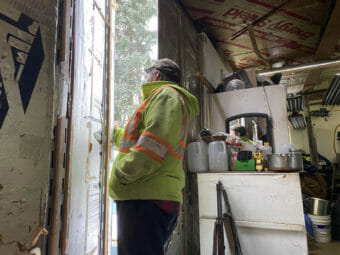
Don Shaw in his home in Clam Gulch. (Riley Board/KDLL)

Don Shaw bought his 10-acre property in Clam Gulch on the Kenai Peninsula for $9,000 in 2003, with an inheritance from his mother’s death. A self-described techno-hermit, he can stay on his property for upwards of two months, leaving only for cigarettes.

He’s also a member of the Exxon Valdez oil spill class-action lawsuit from 1994. He said he has deep resentments about the way oil companies have impacted Alaska.

“It murdered my life, I’ve never recovered from it. I’m out here in the woods minding my own business,” he said. “I despise the way the state handles the oil industry.”

Shaw uses a Wi-Fi hotspot from his phone and an old laptop to keep up with his battle against the oil and gas company Hilcorp, which he’s been waging for more than five years.

He lives close to some of Hilcorp’s wells. To show just how close, Shaw sent me to Frances 1, a high-producing well on a property overlooking Cook Inlet, and fired two shotgun shots into the air from his property. I heard them about four seconds later.

Shaw is now among the Kenai Peninsula residents getting offers from Hilcorp as the company expands. Shaw said Hilcorp wants to lease the area underneath his property to explore for gas. He said they’ve made him offers in exchange for that lease, like this one:

“Maybe my boss will let me come down, and we can go on a deer hunting charter and you can sign a lease,” he said, recounting what a Hilcorp landman told him. “Or maybe we can go on a fishing charter and you can sign a lease.”

Hilcorp wouldn’t confirm or deny that interaction. But the company is expanding its presence in the Ninilchik area as it looks for more gas.

Hilcorp is the main producer of natural gas on the peninsula. As it looks for more gas, the company is seeking to extract the resource from beneath private parcels like Shaw’s. The company asks private property owners to lease the land underneath them, and then pays them royalties on the gas produced there.

The vast majority of people have taken those deals. But Shaw is one of the holdouts.

Hilcorp declined to answer a list of questions for this story, including whether the proposed deal with Shaw took place, the steps it takes when it wants to expand drilling, and how many people have signed leases or refused to sign them, like Shaw. Instead Hilcorp released a brief written statement saying it prides itself on being a good neighbor and is proud of the work it’s done, “to revitalize the Cook Inlet basin and produce natural gas for Alaskan homes and businesses.”

Shaw said he’s worried that signing a lease would devalue his property and that any payment would be inadequate.

He isn’t the only one standing his ground against the company.

At a Nov. 3 hearing with the state commission that oversees oil and gas regulation in Alaska — requested by Shaw — two Hilcorp officials explained how they’re trying to get an exception from the state in order to drill a new well. An existing rule limits oil and gas producers to staying 1,500 feet away from private properties.

McKibben Jackinsky lives on a homestead property so close to a Hilcorp pad that they share a driveway. She protested when Hilcorp first moved in, and said she has refused to sign three leases presented to her by the company. She said she doesn’t think the state should grant Hilcorp that exception, given their history of noncompliance, including a local meter reporting violation in 2020.

For Jackinsky, it isn’t about the money.

“I’m not refusing to sign on based on the dollar value,” she said. “I just don’t want this intrusion on land that has been in my family for… my grandchildren are now the fifth generation.”

Jackinsky has concerns about the way drilling impacts local wildlife, the beach near her house and her own safety. Over the summer, while Southcentral Alaska went under a burn notice to avoid potential wildfires, she said Hilcorp conducted flaring, a process of burning off natural gas while a production site is set up.

At the hearing, Jackinsky testified about her fears over her proximity to the well.

“The disturbance that their activity has caused already — and they’ve not even started to produce — has been immense,” she said. “The noise of the flaring that went on this last summer, the noise of their activity, the disturbance that causes to the neighborhood and wildlife is immeasurable.”

One other resident testified at the hearing. Patricia Wagner lives within a mile of three Hilcorp pads, and spoke against all future drilling and reduced spacing, because of how the noise of drilling has affected her life.

“I’m impacted by all three sides, multiple years of lost sleep,” she said. “The adjacent residents and I commiserate at three in the morning.”

She also mentioned her frustration with the few opportunities for members of the public to make comments about drilling.

Even if property owners don’t sign leases, they can’t control what their neighbors do.

Jackinsky said she was told by a Hilcorp representative that the company plans to begin gas production on the new Pearl Pad in Ninilchik by the end of the year. A Hilcorp spokesperson declined to clarify whether this is true.

Hilcorp also did not respond to questions about how far they’ll go to get leases. But Sean Clifton with the Department of Natural Resources Oil and Gas Division said those who refuse to grant a lease can’t stop development of their neighbors’ resources.

Subsurface resources like natural gas don’t follow the property lines on the surface. Instead, the company is obligated to put the royalties owed for the share of production generated from their properties into what’s called an escrow account. And unlike the lease-signers, who get a monthly royalty check, the holdouts have to wait until production is over to get their money.

Jackinsky said she’s steadfast in her decision not to sign a lease, but is concerned about how her proximity to the well will impact the livability of her home.

“I don’t know if there’ll come a point when it’s too aggressive,” she said. “My daughters and I have talked about this: How much change before this piece of land has lost its value to us? But we can’t even think of an answer, because it’s very sad to think of.”

And Shaw said he’ll never be on board.

“I don’t care if it’s a Stay Puft Marshmallow oil company, I would still fight them just as diligently,” he said.

He says he learned from his grandfather to never sign a contract.

This article has been updated to include a statement from Hilcorp.

After years of high wages in Alaska, other states are catching up

SLAM Tour
Workers in the Father Andrew P. Kashevaroff State Library, Archives and Museum building in Juneau in 2016. (Rashah McChesney/KTOO)

The hourly wage rate in Alaska has historically stayed higher than those of other states, drawing in workers from Outside to work in the state’s lucrative industries like oil and fishing.

And while Alaska’s rate is still comparatively high, other states are catching up. Today, Alaska’s 2021 average wage of $30.52 an hour is less than 10% higher than the national average of $28.01. Alaska’s wage rate ranks eighth overall nationwide, wedged between Maryland and Colorado.

State economist Neal Fried wrote about that phenomenon in the latest issue of Trends for the Alaska Department of Labor and Workforce Development. He says there are a few reasons why Alaska’s kept up a high hourly wage rate for so long.

Listen:

This transcript has been lightly edited for clarity.

Neal Fried: For a period of time, part of it was just to attract workers to this strange place that was in the old days, in the 50s and 60s and 70s, pretty remote and difficult to get to. One way you could lure workers here is by paying higher wages. So that was probably one of the reasons why more generous wages were being offered.

The cost of living, of course, all along has been significantly above the national average and higher than most places, and back in those days probably was the highest in the country. That’s not quite the same.

Some of it was the kind of jobs, too. Working for the federal government in the construction trades was usually a pretty good gig. Working in the fishing industry, the same thing. And of course then working in the oil industry, where premium wages were often paid was another reason.

So there’s been a lot of different reasons. It’s sort of been part of our economic legacy and for some years and periods of time was a very major attractant to Alaska.

Sabine Poux: We don’t have the leg up that we once had in terms of that comparatively high hourly wage rate. How are you synthesizing this change and the shortening of the gap between Alaska and other states, and the national average?

Neal Fried: It’s been a longer-term trend and it didn’t just happen recently. It’s really since the mid 1990s and later that, first of all, our economy’s just grown more slowly than it did. And typically, when an economy is growing faster, wages often follow that trend.

And more recently, in the last decade, we have very much underperformed the rest of the country. Not only did we have a period of time of four or five years of a recession, but during much of that period, the rest of the country’s economy was literally red hot. There was wage growth there. So we’re a very different economic place.

And our mixture of jobs changed during part of this time — for example, the oil industry and construction and some of those higher wage sectors, they’re still here, but they as a percent of our total economy are smaller. And so that also sort of had a downward pressure on wages so that now, we aren’t that different.

And some people also believe it’s sort of the normalization of our economy. We have a more normal sort of mix of jobs. We have a very large service sector now that did not exist in those earlier decades and generally wages in that service sector tend to be lower.

Sabine Poux: Do you see that relative shift in hourly wage rates as a reason, maybe, that we aren’t seeing as much in-migration?

Neal Fried: I don’t think there’s any doubt that that is part of it, that we’re just not quite as attractive as we were. I mean, wages are often a very very strong attraction.

I think also, when things are good in a particular place, people don’t tend to move as much. Americans are moving less than they ever have. And the American economies in most of the country have done relatively well for quite a while, so people are staying closer put. So some of it’s also, just the fact that, you know, why move somewhere else when opportunities are pretty decent closer to home.

But yes, there’s no doubt that that is a factor.

Good news, Alaskans: Your emus are legal now

An emu in profile
An emu in 2016. (Creative Commons photo by Mathias Appel)

Emus are pretty exceptional birds.

Averaging almost six feet tall, they’re the second tallest bird in the world, only after ostriches. They weigh more than 100 pounds, and they can’t fly.

But, like more conventional chickens and turkeys, they’re also considered poultry. They’re harvested for meat, leather and oil. And as of this summer, they’re considered legal livestock in the state of Alaska, thanks to an Anchor Point man named Pike Ainsworth.

Ainsworth was inspired to raise emus in Alaska after learning about emu farmers in Maine and British Columbia. He ordered some eggs and managed to hatch one.

“It was really neat,” he said. “ It grows so fast. It’s a really cool little creature.”

Then, he discovered emus weren’t on the Clean List — a register of livestock allowed in the state without a permit. He started working to get emus on that list in 2019.

But it wasn’t so easy. Ainsworth said he encountered resistance from the Board of Game, the authority that greenlights what animals go on the Clean List. Board of Game Executive Director Kristy Tibbles said the board only addresses the Clean List every three years, and they weren’t set to do so until 2021. That meeting was ultimately delayed until the spring of 2022 because of the COVID-19 pandemic.

Ainsworth submitted an agenda change request to bring his proposal before the board earlier, but it was denied. Tibbles said it did not meet the board’s criteria for an out-of-cycle request.

Finally, in March of this year, Ainsworth was able to make his case before the board. At the meeting, he testified about the condition of food security in Alaska.

“Food security is an extremely serious issue, especially now during wartime and COVID-19, stores have been consistently out of food, the price of meat has skyrocketed, making red meat unattainable to most Alaskans,” he said. “I have a proposal. I’d like to add emu to the Clean List.”

He told the board emu meat is more nutritious than beef, that it is eaten by extreme athletes as fuel and that the birds put less of a strain on the land than other livestock. He also said emus require little feed and water and grow quickly.

“Emu can be hatched from an egg and be ready to market in six months,” he said.

Ryan Scott, an assistant director at the Alaska Department of Fish and Game, said the board needed time to review Ainsworth’s proposal because birds often carry a slew of diseases. However, they looked into it, and he said there didn’t appear to be any issues.

“We would anticipate very little impact on Alaska’s indigenous species,” he told the board at its deliberation on Ainsworth’s proposal, three days after his testimony. The state veterinarian didn’t have any concerns, either. Scott noted that emus are not under any threat of becoming endangered.

The proposal passed unanimously, and went into effect July 1.

Since then, Ainsworth said he’s had several farmers thank him for getting emus on the Clean List, allowing them to raise their birds without fear of retribution. He said on top of the health and food security benefits, emus just make great pets.“They’re really a bonding animal, almost like a dog,” Ainsworth said. “They’re so loving, they’re not dangerous creatures.”

Ainsworth currently has two emus and plans on getting more. He also designed a geodesic dome to house his birds without heat in the winter, made of concrete with air bubbles that provides insulation. He shares that design, and his knowledge about raising emu, with others who are interested.

Victims’ families settle suits in Gary Knopp midair collision over Soldotna

Rep. Gary Knopp, R-Soldotna, speaks during a House Minority press availability, April 6, 2017. (Photo by Skip Gray/360 North)
Rep. Gary Knopp, R-Soldotna, speaks during a House Minority press availability in April 2017. (Photo by Skip Gray/360 North)

The families of the victims of a 2020 midair crash over Soldotna have reached a settlement, according to one of the family’s lawyers — putting to rest a set of several lawsuits over the collision that killed then-state Rep. Gary Knopp and six other people.
The settlement comes more than two years after the Republican lawmaker’s private plane collided with a charter plane in July 2020, killing the four passengers, guide and pilot aboard.

Michael Schneider, a lawyer for one of the families, said the terms of the settlement reached weeks ago are confidential.

“The parties were able to come to an agreement. And it wasn’t easy, it took a long time,” he said. “But it allows everyone involved to end the matter, get some closure and get on downstream with their lives.”

Last year, representatives for four of the victims, Kristen Wright, Caleb Hulsey, MacKay Hulsey and Heather Hulsey, all of South Carolina, filed two separate federal lawsuits against Knopp’s estate and his widow, Helen Knopp. Both suits also targeted the estate of Gregory Bell, the charter pilot who also died in the crash, and the two companies that owned and operated the charter plane.

The complaints alleged Knopp was negligent because he was flying without a medical certification. Knopp was denied a certification in 2012 due to vision problems.

Schneider, the attorney, said the settlement consolidates those suits and that there’s no outstanding litigation. Blaine Gilman, an attorney for Knopp, declined to comment.

The estate of the guide who died in the crash, David Rogers, also sued the Knopp estate. And Knopp’s widow filed a counter-complaint against the charter company, High Adventure Air Charters of Soldotna. The owners of High Adventure Air Charters, Marc and Sandy Bell, are now trying to sell their business, according to their website.

A separate lawsuit, between the guide and the charter plane operators, was already settled out of court.

The National Transportation Safety Board still hasn’t published its final analysis of the crash.

An 11-page report from the board, released in August, outlines some of the factors that could have contributed, though it stops short of pointing to a probable cause.

NTSB regional chief Clint Johnson said a determination of cause will be included in the final report on the crash, which he expects will be out “soon.”

Pierce confirms he’s staying in Alaska governor’s race after running mate drops out

Charlie Pierce speaks into a microphone
Charlie Pierce is one of two Republicans running for Alaska governor. (Elyssa Loughlin/Alaska Public Media)

The running mate of Republican governor candidate and former Kenai Peninsula Borough Mayor Charlie Pierce has dropped out of the race — four days after Pierce was sued by a former assistant for sexual harassment.

Edie Grunwald’s name will still appear as a candidate for lieutenant governor, on the ballot next to Pierce’s, since the deadline to drop out of the race has passed. Pierce said in a text message Tuesday that he’s staying in the race.

But Grunwald said she decided that she’s no longer running alongside him.

“My withdrawing is not a reflection of guilt or innocence,” she said. “I really just have to just stand up for the general idea of respectful treatment of women in the workplace.”

Grunwald said she’s encouraging people to vote for incumbent Republican Gov. Dunleavy.

Her decision comes after Pierce’s former executive assistant sued him for sexual harassment, and more than a month after the Kenai Peninsula Borough publicly confirmed for the first time there were “credible” workplace harassment claims made against Pierce. In the lawsuit, the assistant, Pamela Wastell, alleges the harassment from Pierce was “constant” over the year and a half she worked in his office.

Wastell also sued the Kenai Peninsula Borough, since she said there were not sufficient reporting procedures in place for Wastell and other employees to make harassment claims. Attorneys for Pierce and the borough both have declined to comment on the case.

Pierce picked Grunwald, a retired Air Force colonel, to be his running mate in March.

Grunwald lives in the Matanuska-Susitna Borough and ran as Republican candidate for lieutenant governor in 2018. She was picked to be chair of the Alaska Parole Board by Dunleavy in 2019 and has been a victims’ rights advocate since her 16-year-old son was kidnapped and killed in Palmer in 2016.

Grunwald said she’s not calling for Pierce to drop out and still believes he’s done a lot to protect Alaskans’ freedoms.

“That’s a decision he’ll have to make,” she said. “But for me, given the content of the report, let the courts work that out. And it’s just a general statement from me that I support the respectful treatment of women.”

Dunleavy, for his part, has previously encouraged his own supporters to rank Pierce and Grunwald second on their ballots. In an email Monday , a spokesperson said the governor would not make any “snap judgments or draw any conclusions from a complaint filed just days ago.” Other current and former candidates for governor have called for Pierce to drop out.

Grunwald said she has no direct knowledge of the instances alleged in the suit. She says she hasn’t been a target of inappropriate behavior from Pierce on the campaign trail.

“98% of his time he’s been with his wife. And the times he hasn’t been, there’s always been other people. And his behavior has always been respectful,” she said.

Pierce has previously declined to answer reporters’ questions about the allegations. In response to request for comment on Tuesday, he said by text: “I am not dropping out of the race and continue to look forward to the November 8th election.”

Absentee ballots have already been mailed out and early voting started Monday, statewide.

In Kenai Peninsula wood-stacking contest, you’re supposed to bribe the judge

A woodpile arranged and decorated to look like a giant, bearded face
Gary Galbraith’s first-place winning wood pile. (Photo courtesy Of Sandra Holsten)

People who live in Cooper Landing and Moose Pass take a little extra care when they stockpile their firewood for the winter — because they know they’re going to be judged.

At this year’s fifth annual Cooper Landing Woodpile Contest, competitors in both Kenai Peninsula communities had a chance to show off their wood-stacking creativity in front of three judges, who traveled from home to home judging the piles in a number of categories.

Sandra Holsten was one of this year’s judges, along with Mary Story and Katie Feichtinger.

“The intention of the contest is to highlight people’s creativity with their cut firewood — which of course we have gobs of this year,” Holsten said.

That surplus of firewood is a result of the spruce bark beetle outbreak, which has been severe in the Cooper Landing area and has required residents to take down many of their damaged spruce trees.

“No matter how big or how little, anyone who has a woodpile is proud of it because they always take a lot of work,” Yvette Galbraith, the organizer of the competition, said. Galbraith said the winner receives a “Best Woodpile” plaque to display for the year, which was made by a woodworker known as Rabbit who passed away two years ago.

This year, there were 11 contestants who showed off their firewood finesse in categories including wood quantity, storage, accessibility and stacking creativity. The judges award points in each category to rank competitors.

Then there are the bribes. In this competition, bribing is not only allowed — it’s encouraged.

“Bribes can include anything from a beautiful jar of raspberry jelly, blueberry tarts, or alcohol,” Holsten said.

The judges can exercise a good deal of discretion when choosing a winner, and the bribes count for a lot. Holsten said she received a number of delicious treats and beverages from competitors.

Her favorite?

“Well, there was a wonderful blueberry Bailey’s coffee drink over in Moose Pass and that gentleman, incidentally, got second place,” she said.

When it came to first place, judges say it was woodpile supremacy that put one competitor over the top. Gary Galbraith of Cooper Landing — the husband of contest organizer Yvette Galbraith — arranged his woodpile into the shape of a giant face with ears and eyes, even using brush to create a wooden beard.

Jim Janssen of Moose Pass came in second with the tallest woodpile — and of course, his delicious bribe. The third place winners were a young Cooper Landing couple who are new to the area, Patrick McCartney and Sophie Koveleski, who Holsten said created a woodpile full of subtle touches.

“They came out and they were dressed like woodcutters, and of course they had a good bribe as well,” she said.

Galbraith, the first prize winner, won a brand new Stihl chainsaw for his pile prowess, donated by Craig Taylor Equipment of Soldotna. Taylor has been providing a chainsaw to the winner for three years now.

Holsten said one of the most touching moments of the contest was when Galbraith donated the chainsaw to the second place winner.

She said another standout of this year’s competition was the participation from a handful of residents of Moose Pass.

“In Cooper Landing, we think of Moose Pass as kin, if you would. Family,” she said. “There’s so much that goes back and forth that we were really, really happy to see them participating this year at that level, and hope we’ll get more.”

Of course, the judges are the real winners of the contest, since they’re on the receiving end of the bribes. Holsten said she and the other judges were supposed to take only two hours visiting the woodpiles, but ended up taking five because of how much fun they were having.

Editor’s note: Sandra Holsten is a board member of KDLL. 

Site notifications
Update notification options
Subscribe to notifications