KDLL - Kenai

KDLL is our partner station in Kenai. KTOO collaborates with partners across the state to cover important news and to share stories with our audiences.
Get ready for Fat Bear Week

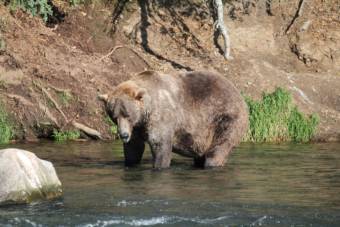
Otis, last year’s Fat Bear Week champion, photographed on Sept. 16, 2021. (Photo by C. Spencer/National Park Service)

The highly anticipated annual celebration of Katmai National Park’s most rotund bears kicks off this week. Fat Bear Week returns Wednesday with a tournament to decide the Katmai brown bear that best exemplifies “fatness.” The competition began in 2014 and has grown into a national phenomenon.

As some of the world’s largest brown bears bulk up for the winter, the tournament gives voters a chance to celebrate the success of Katmai’s bears as they prepare for hibernation. The competition is also meant to highlight the large sockeye salmon runs of Bristol Bay.

Last year, an older bear named Otis took the crown for the fourth time. Around 800,000 people voted in Fat Bear Week 2021.

The competition is arranged as a single-elimination tournament, where the public can vote in one-on-one fat bear matchups each day until one is crowned champion.

The brown bears up for this year’s title will be revealed in a live stream on Monday at 3 p.m.

The warm-up competition, called Fat Bear Junior, is going on right now. A two-year-old cub called 909’s yearling is up against a litter of three cubs that were born last winter. The winning cub will compete against the adult fat bears next week.
You can visit www.fatbearweek.org to vote.

Forest Service to build new cabins in the Tongass and Chugach

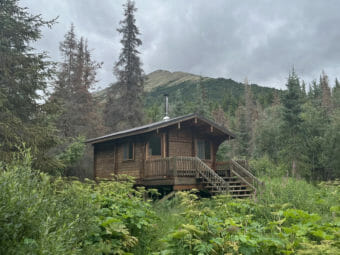
A cabin with a mountain behind it
Fox Creek Cabin, on Resurrection Pass Trail, is one of 40 existing Chugach National Forest cabins available for reservation. (Photo by Sabine Poux/KDLL)

The Forest Service is planning to build a slate of new recreation cabins in high-demand areas of the Chugach and Tongass national forests, the service announced last week.

Money for the project comes from the federal infrastructure bill, passed by Congress last year. The U.S. Department of Agriculture said it’s sending over $37 million to national forests so they can build up their infrastructure, like campgrounds and cabins.
Alaska will get about $14.4 million to repair existing cabins and build new ones throughout the state, said James King, the Forest Service’s director of recreation, land and minerals for the Alaska region.

“We know that cabins are very popular,” he said. “And we’re looking forward to putting cabins where demand exists.”

As it stands, the Forest Service has about 200 public use cabins in Alaska, spread between the Chugach and the Tongass.

The most popular of the 40 in the Chugach are accessible by trail and are often booked out months in advance. Many can only be accessed by plane or boat.

King said it’s not often the Forest Service gets to build new cabins.

“Simply because most of our cabins are put in remote locations,” he said. “So by the time shipping and helicoptering and all the transportation logistics are worked out, cabins are pretty expensive to put in location.”’

He said the Forest Service has a wishlist of 50 or so potential cabin locations.

“Over the years, we’ve conducted various public outreach opportunities where people have suggested ideas for new locations,” he said. “And we’ve kept track of those.”

King said he’s not sure exactly how many they’ll be building, since he said there are so many moving parts. But he’d love to tackle half of the 50 on the list.

Next month the Forest Service will hold listening sessions to narrow its list down. King said more information will be available on the Forest Service Region 10 website shortly about those sessions. King said he’d also like to involve local contractors in the building process, to boost local economies.

Barry Arm landslide’s acceleration is ‘the opposite of reassuring,’ scientist says

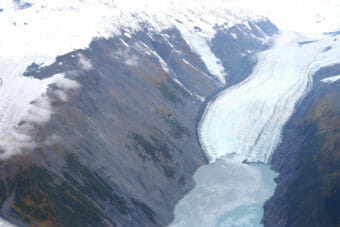
The terminus of a glacier in a fjord, seen from the air
Bretwood Higman did a flyover of several area glaciers Sunday — part of his work keeping tabs on unstable slopes in Alaska. Here, an aerial view of Barry A, where most of the attention from researchers is focused. (Courtesy of Bretwood Higman)

Researchers monitoring the landslide at Barry Arm in Prince William Sound say the slope’s movement has sped up recently, but they’re no closer to knowing when a catastrophic slide might occur that could trigger a potentially life-threatening tsunami near Whittier.

Even without that information, Seldovia Geologist Bretwood Higman said the update should be taken seriously.

“We don’t know exactly what it means, but it is the opposite of reassuring,” he said.

Barry Arm has been under the proverbial microscope since 2020, when scientists first took note of movement at the unstable fjord northeast of Whittier and started monitoring the area with satellites. Higman’s sister, Seldovia artist Valisa Higman, flagged the landslide threat back in 2019.

The slope at Barry Arm could slide into the water below, creating a wave that could pose a serious risk to nearby boaters and recreators and — in a worst-case scenario — a wave up to seven feet high in Whittier.

According to a status update Friday from the state Department of Geological and Geophysical Surveys, the slope is moving faster than it has since 2020, at a rate of 1.6 to 2.7 inches per day — and the area that’s moving is directly above the water.

Higman said that kind of acceleration is something that can happen to slopes before they fail.

“In the last month and a half here, there have been these accelerations of particularly one portion of that mass,” he said. “So that could be a sign of impending failure.”

In response to the acceleration, the state said scientists have stopped accessing the site by water.

Unfortunately, the new data doesn’t tell researchers when a failure might occur.

“That makes it really difficult to message,” Higman said. “Because we don’t want to be in the position where we see something scary but we don’t say anything, because we don’t know how scary it is. But we also don’t want to say, ‘Well, we saw something, we’re all terrified and nobody should go there.’ Because we don’t really know if it’s that bad.”

Still, he said it’s important for the public to know about the change.

“For individuals who are making choices about whether to spend time and what sort of activities to do in that area, I would say this should be received as a note of caution,” he said.

A fresh landslide, with dust still in the air, piled up on a glacier below a steep fjord wall
A separate landslide at the Ellsworth Glacier last week released an estimated mass of 10 million tons — making it 100 times larger than the landslide at Lowell Point Road this spring, Higman said. (Courtesy of Bretwood Higman)

While scientists are watching the slide at Barry Arm closely, it’s not the only unstable slope in the area. In much of coastal Alaska, glacial retreat has left slopes exposed, unstable and more prone to failure.

Higman said he’s monitoring hundreds of others. Just last Wednesday, there was a landslide at the Ellsworth Glacier near Seward, which Higman said sent an estimated 10 million tons of material sliding. The material did not hit the water. He said even if it had, it’s remote enough that it wouldn’t have had any human impacts.

White House announces $49M for Alaska mariculture development

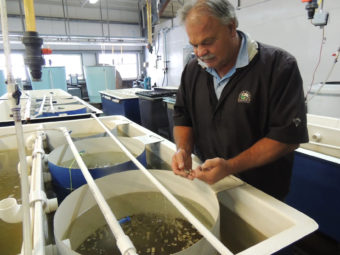
A man standing amid rows of sinks filled with buckets
Jeff Hetrick is mariculture director at the Alutiiq Pride Marine Institute — one of Alaska’s existing mariculture facilities, in Seward. (Photo by Sabine Poux/KDLL)

A coalition of Alaska organizations and agencies have won $49 million to grow the state’s mariculture industry over the next five years, the White House announced on Sept. 2.

Mariculture is the farming and enhancement of seaweed and shellfish, and it’s picking up steam in Alaska. While the industry is still somewhat in its infancy, proponents say the state — with its thousands of miles of coastline — has the potential to become a leader in the industry.
The U.S. Department of Commerce believes in that vision, too. The Alaska Mariculture Cluster — a coalition of economic development districts and organizations — was one of 21 recipients of the Build Back Better Regional Challenge grant, funded through the American Rescue Plan Act of 2021. The cluster has five years to spend that money.

“We won’t have much time to bask in the glory of the moment,” said Robert Venables, executive director of Southeast Conference, which led the project. “But we got a lot of work ahead of us, so we’re excited.”

As it stands today, most mariculture in Alaska is concentrated in Southeast Alaska, Kodiak and Prince William Sound.

The scene on the Kenai Peninsula is more varied.

The Alutiiq Pride Marine Institute has been involved in mariculture for three decades, growing saltwater clams and other shellfish stock from its facility on Resurrection Bay.

There are clusters of shellfish and kelp farms on the other side of Kachemak Bay, as well, including 14 active aquatic farm permits between Jakalof Bay, Peterson Bay, Halibut Cove and Bear Cove, according to a map from the Alaska Department of Fish and Game.

Tim Dillon with the Kenai Peninsula Economic Development District, the local lead on the project, said the mariculture cluster has been gathering information from Alaskans in the business to decide where the money is needed most.

The cluster identified eight different projects — including a revolving loan fund, funded at $9.3 million, and a plan to build up mariculture equipment and technology, funded at $15.9 million.

Dillon said he’s excited about the $9.3 million appropriated for workforce development.

“One of the things that we’ve heard is the graying of the fleet from our commercial fishermen,” he said. “Well, this is an opportunity that maybe we can get some newer folks, some younger folks or some people that are dabbling in — OK, if commercial fishing continues with the hardships that they’ve had, is this a way to offset some of that and keep some of these folks involved?”

He said members of the Alaska Mariculture Cluster will be meeting in Ketchikan next week to talk about next steps.

In a Sept. 2 press conference, President Joe Biden said building up a workforce is a key component of the project.

He said the point of the Build Back Better Regional Challenge grants at large is to create local jobs so that workers can find opportunity where they live.

“It’s centered around a vision that as our economy recovers and modernizes, as science and technology accelerate and change the nature of how we manufacture — we want workers and small businesses leading this transition, making sure they’re a part of it,” Biden said.

Commerce Secretary Gina Raimondo said the grants make up the biggest investment the Department of Commerce has made in individual communities, at $1 billion in total funding across 21 projects. She said the mariculture project was one of 529 applications the department received.

Congress directs Interior Department to hold Cook Inlet lease sale this year

Previous Cook Inlet lease sales have been canceled due to lack of industry interest. (Photo by Sabine Poux/KDLL)

The U.S. Department of the Interior will be required to hold an oil and gas lease sale in Cook Inlet before the end of the year.

That’s according to a section of the new Inflation Reduction Act, passed by the U.S. House on Friday.

The 730-page act, awaiting President Joe Biden’s signature, tackles tax and health reform. Environmental groups are celebrating its big investments in renewable energy.

But the act also requires the Interior Department to hold several oil and gas lease sales this year — including a long-contested sale in Cook Inlet.

Previous plans for Cook Inlet lease sales have always come with the qualifier that they could be canceled due to lack of industry interest. And they have been, repeatedly — most recently this year, as well as in 2006, 2008 and 2010.

But the new act said the lease sale must go forward before Dec. 31, 2022. That means the Bureau of Ocean and Energy Management, which oversees the offshore program, can’t change or cancel the sale regardless of whether they think they’ll get bids, said Liz Mering, advocacy director for Cook Inletkeeper.

“However, just because BOEM holds a sale, doesn’t actually mean anyone will show up to bid,” she added.

The lease sale requirement was added into the act by Sen. Lisa Murkowski and West Virginia Democrat Sen. Joe Manchin, said Murkowski spokesperson Hannah Ray. The latest iteration of the Inflation Reduction Act was a compromise between Manchin and Sen. Majority Leader Chuck Schumer, of New York.

Ray said the goal of the provision is to remedy the decision earlier this year to cancel the sale and to make sure that won’t happen again.

Before it can put out a request for bids, the bureau has to release a final environmental impact statement, as well as a final plan and a record of decision.

“It means that BOEM will kind of have to act expeditiously in order to start complying with the steps that are directed,” Mering said.

The sale falls outside the agency’s typical five-year window for lease sale plans.

There was no sale during the previous five-years period, which ended this summer. A new draft plan, released in July, does float the idea of a lease sale in Cook Inlet in 2026.

The Inflation Reduction Act also raises the minimum royalty rate for offshore oil and gas leasing for the first time in over a century, from 12.5% to 16.5%. That rate is the percentage of revenue that oil and gas producers have to pay the government based on the amount of fuel they get out of the ground on any slice of federal land or the ocean floor.

But the act does place a new cap on those royalties, at 18.75%.

Sterling man writes guide to Kenai refuge’s ‘underutilized’ canoe trails

A man sits by a canoe pulled up on the bank
Dave Atcheson says he’s been canoeing the trails since he first moved to Alaska. (Photo courtesy of Dave Atcheson)

The 100 miles of canoe trails on the Kenai National Wildlife Refuge are something of a well-kept secret — a hidden-from-view network of interconnected rivers and lakes that together make up the expansive Swanson River and Swan Lake canoe systems.

Dave Atcheson has been exploring and paddling those trails for the last 30 years.

“It’s one of my favorite places,” he said. “And it’s really underutilized, too.”

The Sterling author and fly-fishing instructor just published a guidebook that chronicles that system so others can also enjoy it. The book is called “Canoeing Yaghanen: A Guide to Kenai National Wildlife Refuge’s Swan Lake and Swanson River Canoe Systems.” It’s published by Alaska Geographic.

The two canoe routes were established back when the refuge was the Moose Range, in the 1960s and 1970s. Today, the system includes two rivers and 70 lakes, stretching deep into protected refuge lands on the central peninsula.

Atcheson said he finds the quietude of those trails comforting. He grew up canoeing in the Adirondacks in New York and has been exploring and paddling the Kenai refuge’s trails since he arrived in Alaska.

But he said the breadth of the trails can be intimidating to newcomers. At the moment, there’s no other comprehensive guidebook for the trails.

Leah Eskelin, lead park ranger and visitor center manager with the Kenai National Wildlife Refuge, said the only other book on the system is now out of print.

“To not have an in-print guide — that especially a new visitor or member of the public here in the refuge can put in their hands and take out and use as kind of a whisper in their ear about best places to check out while they’re out in the canoe system — that’s hard for someone like myself, who really wants to make sure that everyone has the best experience while they’re here at the refuge,” she said.

For Atcheson’s research, he went back out onto the trails last summer, working out ways to explain the routes he’s been paddling for so long.

“I spent a lot of time out there revisiting places I hadn’t been in a while, which was really fun,” he said.

The Dena’ina word in the book’s title, “Yaghanen,” means “the good land,” referring to the Dena’ina homelands of the Cook Inlet region. Atcheson said he wanted to pay homage to the people who have used those rivers and lakes for generations.

The book is filled with maps and visuals from Kathy Lepley of Galaxy Graphics. It’s waterproof, for in-the-field use, and includes pages on packrafting, a guide on what to bring on a trip and information about traveling the trails in the winter.

“I love crust skiing out there in April when the snow compacts and it’s crusty, because you can go anywhere,” Atcheson said. “You can just go places you can’t go in the summer.”

When it comes to writing about the natural world, he said there’s always a give and take.

On one hand, he said it’s tempting to not draw too much attention to places like these trail systems that don’t get a whole lot of traffic.

“But I think the more people who get out and utilize these things and get out in the natural world, the more apt they are to protect it and take care of it. Which we need big time,” he said.

Site notifications
Update notification options
Subscribe to notifications