KDLL - Kenai

KDLL is our partner station in Kenai. KTOO collaborates with partners across the state to cover important news and to share stories with our audiences.
Is now the time for Alaska’s massive liquified natural gas line project?

This illustration shows a rendition of what the liquefaction plant in Nikiski could look like if the Alaska LNG project is completed as planned. (Image courtesyAlaska LNG project.)
A 2015 rendering of what the plant in Nikiski might look like. (Alaska LNG)

For decades, Alaska was Japan’s sole supplier of liquefied natural gas, or LNG — a version of the substance used to heat homes and electrify power plants. Those exports stopped when competition from other producers edged Alaska out of the picture.

But this month, Brad Chastain told an audience in Kenai that Japan is once again interested in importing natural gas from Alaska — and that his project is the best way to get it there.

“The best way I can describe it is: Every planet possible that we can think of is aligned right now,” he said.

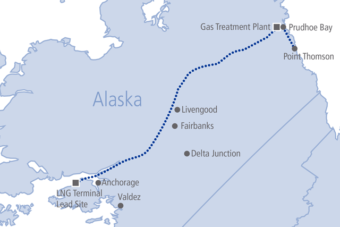
Chastain manages the $39-billion Alaska Liquefied Natural Gas project, which would construct an 800-mile pipeline to send North Slope natural gas to Nikiski, where it would be liquified, shipped out and sold.

It’s been on the table for as long as Alaska has been an energy state, though the costs of constructing the pipeline have long been considered prohibitive.

That was before global demand for LNG shot up. Today, overseas buyers are desperate for gas as they look to move away from their dependence on Russia — which has historically supplied some European countries with as much as half of their supply. Russia, in turn, is responding to the opposition by cutting off its natural gas flow to Europe.

“And so what’s happening is Europe is sucking up all available LNG, and everyone is paying the price,” said Ben Cahill, a senior fellow at the Center for Strategic and International Studies in Washington, D.C.

He said natural gas prices in Europe rose last summer, even before Russia invaded Ukraine. But the war has supercharged that crisis.

Cahill said LNG project developers are noticing and, like Alaska LNG, trying to push their projects to the finish line while the timing is right.

“There are a lot of proposed LNG projects,” Cahill said. “And there’s no way they can all move forward.”

He said to get projects financed, producers first have to convince buyers they have long-term supply and that their project rises above the others, which he said mostly comes down to cost.

That high project cost has stymied the Alaska plan in the past. And Cahill said he still sees that as a big hurdle.

Larry Persily said that hurdle is simply too large to overlook. Persily was previously tasked with getting an Alaska gas line built, under former President Barack Obama.

Persily said with all the competition, there’s no way Alaska LNG will come out on top, due to “the cost and the risk, and the fact that there are a lot more projects out there that are less risky and a lot cheaper than ours.”

Many of the new proposed gas projects are on the country’s Gulf Coast, which is the top exporter of LNG worldwide. Gas, and the costs of shipping it out, are generally cheaper there.

Plus, Persily said, he’s skeptical that buyers overseas will want to sign long-term contracts with gas companies as renewable energy picks up steam.

“And that move has been accelerated by the high cost of oil and gas,” Persily said.

Industry analyst Jason Feer from intelligence firm Poten & Partners said it’s true that the Gulf Coast is better positioned to deliver gas to Europe.

But he said Alaska has at least one potential advantage over its competitors: its proximity to Asia.

“I think that sort of dynamic, where you might see Gulf Coast LNG being pulled to Europe, may create opportunities for projects on the west coast,” Feer said. “So I think that’s a very interesting dynamic.”

He said demand in Asia is high, too — and he doesn’t see it dropping any time soon.

This spring, Gov. Mike Dunleavy visited Japan to talk up the plan. Feer said Japan has for years been the world’s biggest importer of LNG.

“So those are hugely significant markets that are accounting for the bulk, or very significant shares, of global LNG,” Feer said.

That demand, in Asia and elsewhere, is already driving a slate of natural gas projects toward development. Cahill said there has been an uptick in signed contracts in recent months, as buyers look to secure their energy futures.

But even if the planets are aligning, like Chastain said, analysts say there’s still just no guarantee one of those contracts will be inked in Alaska.

Gas prices remain high in Alaska while falling nationally

Gas pumps at an S Express gas station
Regular gas at the Nikiski Speedway is sitting at $5.59 a gallon today. (Photo by Riley Board/KDLL)

Last week, the White House announced U.S. gas prices had been falling for over a month, marking some of the fastest price declines in a decade. According to AAA, the national average Tuesday was $4.33 a gallon, down from the mid-June peak of just over $5.

But while gas prices across the nation have been steadily decreasing since they peaked mid-June, Alaska drivers haven’t been so lucky.

Alaska’s statewide average is still $5.21 today. In Kenai, most gas stations are advertising around $5.55.

Brent Hibbert owns and operates Alaska Cab on Kalifornsky Beach Road. He said the high prices have been affecting the company’s cab drivers, who pay for their own fuel.

“It’s probably costing them $25 to $30 extra a day. We had to raise our rates, which we didn’t want to, but we did,” he said.

Alaska has been dealing with those higher gas prices for longer than most. Forbes reported earlier this month that the state was among a handful where gas prices were falling the least.

Larry Persily, a longtime Alaska oil industry observer, said gas inventory turnover at both pumps and refineries in Alaska is slower than it is elsewhere in the country, which could account for the lag.

But in general, Alaska gasoline prices tend to be higher than those in the Lower 48. Persily said that’s related to the relatively small oil refinery that supplies Alaska gas stations, and the proportionally higher energy costs that come with it.

“The single substantial refinery in Alaska in Nikiski does tens of thousands of barrels of oil a day, whereas the highly efficient refiners in the Lower 48 do hundreds of thousands of barrels a day,” he said.

Persily also said city and borough sales taxes in Kenai and Soldotna add 6% to any fuel costs inside the city limits. This keeps them pricier than, say, in Anchorage, where city taxes only add 10 cents a gallon.

High gas prices are driving people out of the cities and into the small town of Cooper Landing, where surprisingly low prices are keeping fuel pump owner Arden Rankins busy.

“We’re selling so much of it, it’s unbelievable,” she said.

At just $5.01 today, the prices at the Sunrise Inn gas pump are drawing motorists from around the peninsula with their low prices, including those with motorhomes and campers, which Rankins said has never happened before.

“We’re selling so much gas that we’re getting gas delivered daily or every second day,” she said.

Rankins said that she’s just using the formula that the business usually relies on to calculate their fuel costs. She said her low prices are especially surprising, because getting fuel all the way out to Cooper Landing is just more expensive than bringing it to cities like Anchorage and Soldotna.

“Instead of making a profit on a really high price, we’re doing very well with the lower price and the formula that we’ve always used, and the numbers are making us a lot of money,” Rankins said.

Analysts predict that costs nationwide will continue to drop. And while Alaska’s prices aren’t dropping quite so fast, they are falling, slowly.

At a Speedway Express in Nikiski, for example, a store clerk said prices are declining by just a few cents a week. Today, the station’s marquis clocked in at $5.59 a gallon.

Cook Inlet fishermen sue over set-net closures

Tw men pulling a net over the bow of a boat
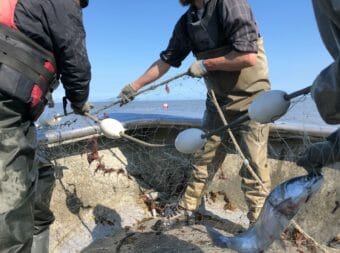
Set-netters pick a sockeye out of the net this June. (Photo by Sabine Poux/KDLL)

Days after they were ordered to take their nets out of the water, Cook Inlet set-netters are suing the state over the fishery’s closure.

In a case filed in state court last week, the Cook Inlet Fishermen’s Fund, representing Cook Inlet fishermen, said the state is mismanaging the east-side set-net fishery to the benefit of other user groups. It’s asking the state to immediately reopen the fishery this season to its 440 or so permit-holders, to pay fishermen back for what they lost and to revise the plan that closed it in the first place.

Due to restrictions linked to the sport fishery, the east-side set-net fishery in Cook Inlet closes when king salmon abundance on the Kenai River is low. The set-netters were shut down early this year for the fourth year in a row.

In their complaint, the fishermen said those closures are part of a larger trend of the state allocating salmon to the other fisheries at their expense. And they said anglers from those sport and personal use fisheries are guiding the Dunleavy administration’s fishery policy for their own interests.

The injunction demands the Alaska Board of Fisheries get rid of the paired restrictions that close their fishery when king counts are low and that it adjust the goalposts that determine when the run shuts down.

Cook Inlet Fishermen’s Fund has been a plaintiff in a variety of fishing lawsuits over the years, including an ongoing suit filed on behalf of set-netters in 2019. The group was also a plaintiff in a federal lawsuit over the closure of a large swath of Cook Inlet to the drift fleet last year.

Fishermen won that case this June, and the fishery was reopened for the 2022 season.

Fish and Game Commissioner Doug Vincent-Lang said his department is disappointed in the filing but is confident they will prevail in court.

He said the department is following Board of Fisheries-approved plans and guidance. “The most appropriate venue for this is with the Board of Fisheries, not the courts,” he wrote in an email Thursday.

The lawyer for Cook Inlet Fishermen’s Fund, Carl Bauman, deferred questions about the case to the group, but a representative could not be reached before deadline.

From frozen pizzas to toilet paper, Alaska stores deal with erratic shortages

Grocery store shelves with numerous spices missing and no salt at all
The spice aisle at a Kenai grocery store, where salt — meant to line the bottom shelf — is fully out of stock. (Photo by Riley Board/KDLL)

It’s hard to walk into a grocery store these days without thinking about the buzz-phrase “supply-chain problems.” The common sight of scattered empty shelves is the product of global supply systems that were shattered by the pandemic, and even more recently by the war in Ukraine.

Reported national shortages include meat, canned goodscoffee and wine. On the Kenai Peninsula, many grocers agree that it’s hard to predict which items will be unavailable during any given week.

“One week it’s like Jimmy Dean sausage, the next week it’s paper products. It’s just been so random lately,” said Jim Kolb, the marketing director at Alaska-based chain Three Bears.

He said the shortages come in strange waves — one week it will be tampons and pads, and the next, frozen pizzas.

“Honestly, that’s what it’s like. We don’t know. Ammo used to be a big problem, it’s not anymore,” he said.

Lately, it hasn’t been too bad. The only products Kolb said he’s missing at the moment are frozen items.

The erratic shortages hit small grocery stores even harder. At Cooper Landing Grocery and Hardware, owner Wayne Mitchell said 25% of everything he orders just never shows up.

That’s particularly true for items that come from overseas, like souvenirs.

“It runs the whole gamut, from cigarettes to candy to souvenirs to anything. Almost anything. I’m taking a chance on what I order,” Mitchell said.

Souvenirs are especially important at the Cooper Landing store, which serves a lot of tourists in the summer.

Mitchell said the store has basic items available most of the time, but placing orders has become difficult and inconsistent.

Last year, he said, he only had to go through one vendor to get items. But with a lack of supplies, he’s had to diversify. Now, he has to go through three or four different vendors to get what he needs. That’s made purchasing for the store a major time commitment.

“I’m working on orders almost constantly trying to get stuff in here. So it’s been a challenge,” he said.

Those challenges resonate with Jenny Bushnell, the Kenai manager of the small chain Save U More. She said the seasoning liquid smoke and toilet paper are recent culprits.

She also said product shortages are accompanied by sky-high shipping rates.

“Say a pallet costs me a thousand dollars. To get it up here I would pay 20% of that, so it would cost me $1,200 to get that stuff up here. Now if the palette costs $1,000 it’s 40% added on so it’s $1,400 to get the pallet here,” Bushnell said.

She said that doesn’t even account for the cost of putting the product on a barge — which has to first make its way to Anchorage, then down to the store on Kalifornsky Beach Road.

For Bushnell, that means she’s paying higher costs for those products and changing up Save U More’s traditional offerings.

Save U More, like the store in Cooper Landing, is serving a primarily tourist customer base this summer. Bushnell said she struggles to meet the needs of customers who are only in town for a short while. By the time she’s able to bring in the missing products tourists are asking for, they’ve already gone back home.

But shortages aren’t hitting every grocery store the same way.

Jim Kolb of Three Bears said that besides a week without frozen items here or paper products there, Three Bears has, in general, been able to keep its nine Alaska stores well supplied. He attributes this to a strong buying staff and a willingness to seek out a variety of alternative vendors, something that larger chains might be likely to do.

Funds from infrastructure bill could mean larger expansion of Alaska’s EV charging network

A Freewire EV charging station
The first phase of funding — from a Volkswagen settlement — covered installation costs for several chargers, like this one at Custom Seafood Processors in Soldotna. (Photo by Sabine Poux/KDLL)

Money from the federal Infrastructure Investment and Jobs Act is helping Alaska with myriad different projects — from bluff stabilization in Kenai to port improvements in Nome.

The funds are also going to help the Alaska Energy Authority build out a corridor of electric vehicle fast-chargers along the road system, which it hopes will make it easier for current and future EV users to get around the state.

Curtis Thayer, executive director of AEA, said Alaska is getting about $50 million of the $2.5 billion that’s reserved in the bill for states through the National Electric Vehicle Infrastructure Formula Program.

“What we thought was going to be a multi-year process to secure funding, the federal infrastructure bill literally gave us the money overnight,” he said.

AEA has already been working on a nine-charger corridor between Homer and Fairbanks. To date, funding for that project has come from a 2017 settlement with Volkswagen over a diesel emission scandal.

Thayer said this money, from the federal infrastructure bill, will help expand the corridor beyond that group of nine to Delta Junction, Glenallen and Tok.

“Then, when we look at the Marine Highway System, now we can do this in Kodiak and Ketchikan and Juneau and Sitka and Valdez,” Thayer said.

He said the money does not extend to chargers in rural Alaska — yet. He said future phases of the plan could focus on building out an EV system in those parts of the state.

AEA has to submit an implementation plan by Aug. 1 to access the federal funds. It’s asking for input from Alaskans until July 29.

You can submit input here and read the plan on AEA’s website here.

Meanwhile, Thayer said the host businesses from the first phase of the project are working on installing their stations now.

Four businesses on the Kenai Peninsula were awarded grants to install and maintain fast chargers on their properties: Custom Seafoods in Soldotna, AJ’s in Homer, Grizzly Ridge Lodge in Cooper Landing and the Seward Chamber of Commerce.

Homer’s charger, at AJ’s, is already hooked up and active. Custom Seafoods in Soldotna, on the Kenai Spur, recently installed its station as well.

Thayer said others — like the station in Seward — have taken longer to fall into place.

“There’s been some logistical issues, just because of a little bit of inflation, but more the logistics of getting them physically here in Alaska,” Thayer said.

He said he hopes to have those stations up and running by the end of the summer.

Alaska-bound bees find new homes after shipping disaster

A man holds a honeycomb full of bees in front of his head
Bill Crumpler holds up a honeycomb to examine the bees’ state from a hive rescued from the tarmac of Atlanta-Hartsfield Airport a month before, when a shipment of millions of bees meant for Alaska was diverted from California. ( Photo by Matthew Pearson/WABE)

Bill Crumpler stood in front of a handful of honeybee hives tucked away on conservation land in the industrial outskirts of Atlanta.

These were not his normal bees.

They were rescued from among millions of honeybees that died in a Delta cargo bay in the April sun. The more than 600 pounds of bees were supposed to go from Sacramento to Anchorage, but due to flight cancellations the bees ended up at Atlanta’s Hartsfield-Jackson airport.

“They’re thriving compared to what they came from,” Crumpler said, gesturing toward the hives with a smoke pot in his hand. “They’re still alive. They’re building frames out. The queen is laying eggs.”

While the Alaska-bound bees never made it to their final destinations, the quick work of a well established colony of bee keepers united communities across the continent, and the honeybees found new homes across Georgia. And 4,400 miles away, in Alaska, one local beekeeper went to great lengths to make her beekeepers whole again.

While the rescue attempt happened in Atlanta, Sarah McElrea was waiting at the Anchorage airport when she heard most of the bees had died.

“Very devastating,” she said from her backyard in June. “Still just nauseating to think about what happened.”

A woman inspects a beehive inside a shipping container
In April, beekeepers flocked to Atlanta’s Hartsfield-Jackson airport to check on the bees and take the survivors home. (Matthew Pearson/WABE)

McElrea sells bees and teaches classes from her home in Soldotna. She was gutted by the tragedy. And it also took a huge financial toll.

McElrea had to buy an entirely new shipment of 5 million bees from her supplier in Sacramento. But this time, she and her husband stayed with the bees. They booked flights to Seattle and drove down to Sacramento, where they picked up the bees in person.

“It was high 80s at 9:00 at night when we left Sacramento with the bees,” McElrea said. “And it’s really dangerous, obviously. I mean, that’s what killed them in Atlanta.”

They had to get creative to keep them cool. McElrea’s husband made a makeshift pipe to get cold air to the bees in the back of two rental vans. They drove to Seattle and made sure the bees were carefully loaded on the flight back to Alaska.

A standing by an airport hangar, holding a bee hive
McElrea said she was immensely relieved when the new shipment of bees finally touched down in Anchorage. (Photo courtesy of Sarah McElrea)

It was a lot of stress and not a lot of sleep. But she said it was worth it.

“Boy, what a sigh of relief,” McElrea said. “It was an incredible feeling to be back on the ground in Alaska. The sense of relief is pretty indescribable.”

From there, they drove north as far as Fairbanks and south to Homer to get the bees to their new homes.

One of those homes was Jim Allemann’s, in Nikiski. At a beekeepers potluck in McElrea’s backyard this June, he sat in a camp chair amongst a small circle of local beekeepers, exchanging stories and advice.

“You just look forward to kind of catching up with Sarah and what’s going on in the bee world, ‘cause she knows what’s going on,” Allemann said. “[She’s] so dedicated. I mean, when you see what she went through this year to get bees up here for us — that’s way beyond the call of duty.”

First-time beekeeper Brandy Nelson of Soldotna took McElrea’s class this winter and said she was excited to see how her hive does this summer.

“I think we’re really lucky to have someone who loves bees so much,” she said at the potluck.

There’s not a long-term solution to the bee transportation problem yet. And McElrea won’t be getting another shipment until next year. But for now, the weather seems to be rewarding her efforts.

It’s been a particularly warm spring and summer for Southcentral Alaska. And McElrea said her bees are loving it.

“I always say this time of year, you know, this is our year — this is going to be an amazing year. This is the year to be a beekeeper,” she said. “We’re about due for a really buttkicking year, I think.”

This story was produced in collaboration with WABE in Atlanta, Ga.

Site notifications
Update notification options
Subscribe to notifications