KDLL - Kenai

KDLL is our partner station in Kenai. KTOO collaborates with partners across the state to cover important news and to share stories with our audiences.
Chugach peaks get Dena’ina names: ‘A huge statement to all that we value life’

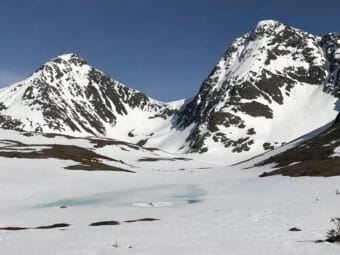
A pair of steep, treeless Chugach peaks, smeared with snow.
North (left) and South Yuyanq’ Ch’ex. (Dave Bass)

A pair of peaks in Chugach State Park are getting a name change, with help from a local Dena’ina elder.

North and South Yuyanq’ Ch’ex peaks, as they’ll be known from here on out, tower 5,000 feet above Turnagain Arm and are popular spots for Southcentral hikers.

For decades, those mountains have been called North and South Suicide — names that are said to have come from railroad workers who were remarking on the steepness of the slopes. The names were codified by the U.S. Geological Survey in 1951.

Soldotna Sen. Peter Micciche, who served on the Statewide Suicide Prevention Council, said he’s happy to see those names go away. He said it’s important to be respectful to the many Alaskans who have been impacted by suicide.

“It’s painful, particularly in our state,” he said Friday. “We’re number two in the U.S. We had 204 suicide fatalities in 2020 — that’s 27.5 per 100,000.

The Alaska Legislature sent a letter to the U.S. Geological Survey’s Board on Geographic Names in support of the name change earlier this week.

But the two-year push has largely come from William Pagaran, a Palmer man who runs faith-based non–profit called Carry the Cure, aimed at curtailing teen suicide in Alaska.

Pagaran could not be reached in time for this story. But in an online petition from 2020, he said the name change “makes a huge statement to all that we value life.” That same year, Pagaran led a hike up the south peak in the name of suicide awareness.

Pagaran’s initial renaming proposal was denied by the Alaska Historical Commission. That was as the commission was considering naming and renaming several other Alaska landmarks by their Indigenous names.

It wasn’t until this week that the U.S. Board on Geographic Names gave the change a green light.

Yuyanq’ Ch’ex — pronounced “you-yonk check” — means “Heaven’s Breath” in Dena’ina. Pagaran tapped Kenaitze elder Helen Dick, of Kenai, one of the few Dena’ina speakers who learned the language as a child, for help finding a new name.

Micciche credits Pagaran and Homer Republican Rep. Sarah Vance for leading the charge to find a better fit.

“And it’s a little step,” Micciche said. “We’ve taken many other steps in our state. But ‘Heaven’s Breath’ is a better name.”

Separately, the U.S. Board on Geographic Names will also consider a recommendation from the Alaska Legislature to name another mountain on Turnagain Arm after Gail Phillips, an legislator who represented the southern Kenai Peninsula for many years. Phillips died in 2021.

Advocates still hopeful about legislation to give youth sentenced as adults an earlier chance at parole

""
Angela and Brian Hall. (Courtesy Angela Hall)

Brian Hall is part of a group of several men that grew up in Alaska’s correctional system together and refer to each other as family.

Brian, now 46, is serving a portion of his 159-year sentence at Wildwood Correctional Complex in Kenai. He’s been incarcerated since he was 17, on charges of killing two people. And his earliest chance at parole is still decades away.

His wife, Angela Hall, is hoping the Alaska Legislature will pass legislation that would make sure Alaskans like him have an earlier chance at parole.

“You hear about people getting sentenced all the time,” she said. “But you don’t really hear about what has happened to those people after 20-plus years.”

Statewide, there are 30 people incarcerated today who were convicted of their crimes as juveniles, according to a spokesperson with the Alaska Department of Corrections.

Senate Bill 114, introduced last year, would give those who committed crimes as minors a chance at discretionary parole review after the first 15 years of their sentence.

The bill wouldn’t guarantee parole for those people. But it would give them a chance in front of the Alaska Parole Board. And if rejected, they could come back to the board after two years.

“This way, they could develop a relationship with the parole board,” Angela said. “The parole board would give recommendations of what they would like to see. And they could do these things in the meantime, and then hopefully be parole-ready the next time they come before the board.”

Alaska is one of 25 states that doesn’t allow life sentences without parole for juveniles.

But Angela said long periods of jail time, like the one her husband is serving, are virtual life sentences. She said the first chance Brian has to see the parole board will be when he’s in his 70s.

“The life expectancy for individuals who are incarcerated is much lower than that,” Angela said.

That’s just when he would be eligible — in 2020, the Alaska Parole Board accepted just 16% of the applications it received for parole.

Megan Edge, communications director with the American Civil Liberties Union of Alaska, said the prison population in Alaska — and at Wildwood, specifically — is an aging one, in part because fewer people are being granted discretionary parole today.

She’s concerned about the higher-than-usual number of deaths in Corrections custody this year. Edge said some of those 15 people were serving lengthy sentences.

“So it’s incredibly sad,” Edge said. “Especially in a state that doesn’t have the death penalty — we’re still committing people to death by incarceration.”

Angela Hall runs Supporting Our Loved Ones, a support group for families of incarcerated Alaskans. She said her husband has turned his life around since he was first sentenced three decades ago.

The two got married and celebrated their 10th anniversary this year. Brian got his GED and became a dog obedience instructor. He’s Cherokee and keeps his spiritual and cultural practice alive as much as possible from Wildwood. In 2019, he won a lawsuit affirming the right to wear cultural regalia in prison.

Wildwood Correctional Center in Kenai. (Courtesy of the Department of Corrections)
Wildwood Correctional Center in Kenai.
(Courtesy of the Department of Corrections)

Angela said she doesn’t know what’s next for the legislation.

Democrat Minority Leader Sen. Tom Begich was the bill’s sponsor last session. But despite support from a state criminal justice commission, the legislation didn’t get a hearing. And Begich isn’t running for another term.

“We’re not sure if there’s going to be support for it at this point,” Angela said. “So it just really depends on what happens with the elections.”

Edge, with the ACLU, said the bill fits squarely into the broader prison reform work she’s spearheading as part of the organization’s new Alaska Prison Project.

That initiative formed last month with the goal of reducing the number of incarcerated Alaskans and improving conditions for those already in the system.

Tribe to hold virtual Dena’ina workshop for early language learners

Jolene Sutherland, left, and Dena’ina elder Helen Dick at a Kenai Peninsula College Dena’ina language class in 2014. Dick is one of the few Dena’ina language speakers around who learned the language as a child. (Photo by Jenny Neyman/Redoubt Reporter)

Learning any language can be intimidating, at the outset.

Will Norton, a Dena’ina community language teacher with the Kenaitze Indian Tribe, said sometimes getting started is the hardest part. That’s what he’s hoping to tackle at a virtual Dena’ina language workshop later this month.

“Although this course really is just the basics, what we’re trying to do is give people a platform to really start learning and to go as far as they want to,” he said.

The Kenaitze Indian Tribe received a two-year Emergency Native Language grant from the American Rescue Plan Act to hold free Dena’ina language workshops for beginners.

The series is part of a mosaic of language revitalization work from the Kenaitze Indian Tribe. The tribe recently launched a virtual Dena’ina Audio Dictionary and is continuing to offer language courses for adults, through Kenai Peninsula College, and language lessons for kids, at its new educational campus in Kenai.

“There’s kind of a gap, in terms of classes for adults who aren’t necessarily interested or able to take a college course for a full semester,” Norton said. “And that’s a pretty big group of people. So we’re trying to meet the gap with these classes.”

This is the second of three community language workshops through the federal grant. The first was in-person — but Norton said the community wanted a virtual workshop, too.

Norton and co-instructor Yvonne Flynn will brief attendees on Zoom on basic Dena’ina greetings, introductions and vocabulary.

“It’s not the sort of thing where you have to become fluent,” Norton said. “That takes a lot of work and a lot of time, and of course we encourage anyone who wants to to do it.”

But he said even learning a phrase here and there can be valuable — for Dena’ina people and others who live on Dena’ina land.

“It’s still important to know at least a little bit of the language of the place where you live,” he said.

The Dena’ina language workshop is Oct. 25 and 27, from 5 to 6:30 p.m. The workshop is free and will be fully remote, over Zoom.

To register, email Norton at wnorton@kenaitze.org.

Norton said if the workshops are successful, they’ll consider some longer-term offerings, as well. He said they’re already planning workshops that will cover advanced grammar, as well as vocabulary related to the Native Youth Olympics, next spring.

After fat bear fraud, 747 again crowned chunky champion

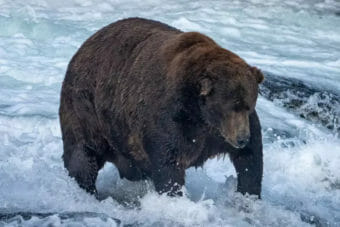
A barrel-shaped brown bear stands in the middle of a foamy fast-moving stream
747, the 2022 Fat Bear Week champion. (Photo by L. Law/National Park Service)

For the second time in three years, the jumbo jet-sized 747 has been crowned champion of Fat Bear Week.

Weighing in at nearly one ton, the voracious brown bear toppled his competition Tuesday during the finals for this year’s tournament — which pits the brown bears of Katmai National Park against each other in battle brackets as they bulk up for winter.

Voters don’t rely on size alone when casting their ballots. But this year, they went with the chunkiest choice. Lian Law with Katmai National Park said 747 is the largest bear at Brooks Falls and maybe one of the largest in the world.
“His dominance, combined with his fishing skills — that really allows him to build up substantial fat reserves for the winter,” Law said. “And even in early summer, when I first see this bear, you know, he is large, and he still carries the weight of his previous successes.”

That weight tipped the scales in his favor to beat feisty finalist 901, with just over 54% of the votes — 68,105 votes to 901’s 56,876.

But the competition wasn’t without drama.

On Sunday, the park announced on its official Twitter that someone had spammed that night’s face-off with fraudulent votes.

Mike Fitz is a former ranger at Katmai and the resident naturalist at explore.org. Fitz oversees the competition and said several thousand fraudulent votes were cast during the matchup between 747 and Holly, a blond adult female who was the 2019 champion.

“Throughout the day, 747 had been leading, by a sizable margin,” Fitz said. “And then Holly quickly caught up and surpassed him in votes. Once the suspicious votes were filtered out, then 747 was the clear winner.”

Fitz said he had hoped that perhaps a celebrity or influencer had rallied online support for Holly that resulted in an influx of votes. But he said explore.org staff were able to identify the votes as fraudulent because of their suspicious email addresses.

Fitz said the site has since installed CAPTCHA software to prevent further scandal. And he said staff checked all the previous matchups for suspicious votes — but found them all to be clean races.

“It’s disappointing. I mean, Fat Bear Week is based on honesty, right? And it’s supposed to be a fun and good-natured virtual competition,” he said earlier this week. “It’s also interesting to me that someone cared so much to try to flip the vote for Holly.”

Fitz said the competition should really be about the stories behind the bears and the ecosystems that support them, not just who wins.

This year, those stories are reaching more people than ever. Fitz said he’s been interviewed by reporters as far away as France and Australia.

“It’s an event that spans international boundaries,” Fitz said. “And the more people that are aware of Katmai and the Bristol Bay region — and Alaska and its wild landscapes in general, I think, the better.”

It may not be just about who wins. But fans of 747 can hibernate soundly tonight knowing their pick is — certifiably and undeniably — the fattest bear.

Alaska Public Media’s Chris Klint contributed reporting.

Oil and gas jobs slow to bounce back to pre-pandemic levels

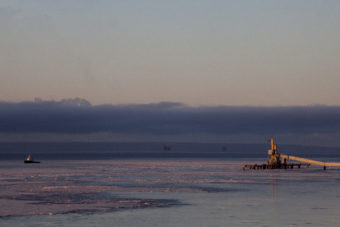
Cook Inlet oil platforms are visible from shore on Dec. 13, 2016 near Kenai, Alaska.
Cook Inlet oil platforms are visible from shore on Dec. 13, 2016 near Kenai, Alaska. (Photo by Rashah McChesney/Alaska’s Energy Desk)

Employment in Alaska’s oil and gas sector is still lagging in 2022, according to an October report from the Alaska Department of Labor.

Jobs have been slow to recover across many industries since the COVID-19 pandemic began. The report said Alaska lost about 26,270 jobs in 2020.

But oil and gas — which is tied to roughly 1 in 5 jobs in the Kenai Peninsula Borough, according a 2021 report from the Kenai Peninsula Economic Development District — is having an especially hard time bouncing back. The industry lost over 2,046 jobs in 2020 and then another 1,489 in 2021.

“I would’ve expected that employment would’ve recovered more than it has so far,” said Neal Fried, an economist with the State of Alaska.

Fried said last month that even though oil prices have been relatively high and companies have more money to spend, it hasn’t been followed by a big surge in activity.

He said that’s partly because the state’s industry is very project oriented. There’s often a longer lag time between changes in oil prices and new investment than there may be elsewhere.

“And some of it’s just been reluctance of investment,” Fried said. “And that’s nationally, and internationally. That’s not just in Alaska. It’s just been more accentuated in Alaska than it’s been elsewhere”

Even when there are new oil and gas projects, like those offshore in Cook Inlet and a potential project in Willow, those projects often create temporary jobs, not permanent ones, according to the department’s report.

Still, Alaska is gaining some jobs in the industry — just slowly. The report estimates the state will see an additional 2,000 oil and gas jobs by 2030, which would bring the industry to just above its pre-pandemic levels.

Meanwhile, the Gulf Coast Region of Alaska, which includes the Kenai Peninsula, saw an overall rate of job growth of just over 3 percent from Aug. 2021 to Aug. 2022, according to the state’s report.

Rewrite of federal fisheries law navigates rough partisan waters

Fishing boats wait for an opener in Chignik’s city harbor in 2019. (Photo by Alex Hager/KDLG)

There are two names that come up a lot in the Alaska fisheries world.

The Magnuson-Stevens Fishery Conservation and Management Act, named for U.S. Senators Warren G. Magnuson (D-Wash.) and Ted Stevens (R-AK), has been around since 1976 and sets the rules for federal fisheries in the U.S.

Management plans set in those waters have to stand up to the act and its national standards — for example, a plan that would’ve closed a large swath of Cook Inlet to commercial fishing was overturned earlier this year because the court said it did not comply with Magnuson.

The act has been renewed and revised twice, in 1996 and 2006. On Sept. 29, the House Natural Resources Committee passed a long-sought rewrite of the act that tightens restrictions on bycatch — which is the incidental catch of non-target species, like salmon — and calls out the threat of climate change in federal fisheries.

The resulting Sustaining America’s Fisheries for the Future Act would still need to pass Congress before taking effect. But if passed, it could have big implications for the way Alaska’s federal fisheries are managed.

“Anybody who is dependent on halibut is impacted by the language in this bill. Anybody who is dependent on salmon and interactions between salmon and pollock fishery, for example, is impacted by this bill,” said Marissa Wilson, of Homer, who directs the Alaska Marine Conservation Council.

She said it’s important to keep the Magnuson-Stevens Act updated as the threats facing fisheries change in Alaska and beyond.

For example, the revisions included in the new bill would explicitly call out the effects of climate change on federal fisheries for the first time and would require regional councils to make plans to address those threats. Changes related to climate have played a large role in fisheries declines across the state, like the crash in cod stocks in the Gulf of Alaska.

Linda Behnken with the Alaska Longline Fishermen’s Association in Sitka said the acknowledgement of those effects is significant.

“I think it’s an important step in just highlighting how essential it is for fishery managers to build climate considerations into management of fisheries, since we are seeing such rapid change,” she said.

The act also adds two Alaska Native representatives to the North Pacific Fishery Management Council — one of eight regional councils created by the original act to manage fishing in federal waters. Today, the council has 11 appointed voting members and four non-voting members from Oregon, Washington and Alaska.

Alaska Democrat Rep. Mary Peltola advocated for those seats last year, when she testified in favor of the reauthorization in front of Congress as the executive director Kuskokwim River Inter Tribal Fish Commission. Her predecessor in the U.S. House, Republican Rep. Don Young, was a staunch advocate of renewing Magnuson-Stevens.

Peltola is now on the House committee that passed the revised act.

“The bill before us today makes great progress toward limiting the wasteful problem of bycatch — the destructive practice that hurts Alaskans who need the fish for sustenance,” she said in a hearing last week.

Bycatch is one of the most significant focuses of the rewrite.

Previous versions of Magnuson-Stevens said bycatch should be minimized in management plans “to the extent practicable.” That phrase is scratched from the updated version, essentially calling for the total elimination of bycatch.

That’s a sticking point for a large coalition of industry groups and fishermen — including the At-Sea Processors Association and the Bristol Bay Economic Development Corporation— who sent a letter to the House committee alleging the new version of the act is overly partisan and could throw the industry “into chaos.”

“For example, with very limited exceptions, bycatch is a reality in every commercial and recreational fishery,” the groups wrote. wrote. “A mandate to absolutely minimize bycatch in all circumstances … could very well lead to managers or the courts shutting down fisheries where bycatch cannot be eliminated.”

Wilson, with the conservation council, said she doesn’t think the act would create as much chaos as opponents suggest.

“What it does is it really signals, I think, to councils that reductions are really important — particularly here in the North Pacific,” Wilson said.

Even though the rewrite cleared the House committee, its path forward is anything but guaranteed.

Amendments proposed by Republicans in committee were shut down during the markups and the bill will have to make it through a split Congress before passing.

Site notifications
Update notification options
Subscribe to notifications