KDLL - Kenai

KDLL is our partner station in Kenai. KTOO collaborates with partners across the state to cover important news and to share stories with our audiences.
Environmental groups sue over Cook Inlet oil and gas sale

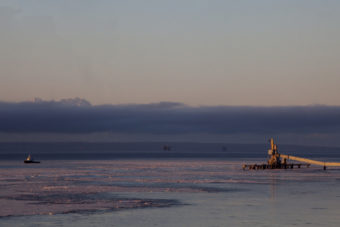
Cook Inlet oil platforms are visible from shore near Kenai, Alaska. (Photo by Rashah McChesney/Alaska’s Energy Desk)

Environmental groups are suing the federal government over next week’s federal lease sale in Cook Inlet, alleging the environmental analysis on the sale was incomplete and did not consider less harmful alternatives.

The long-anticipated federal sale will put up for bid nearly one million acres and was previously canceled, due to lack of industry interest. This time, it’s required in federal law, part of the 2022 Inflation Reduction Act.

Sue Mauger is executive director of Cook Inletkeeper, one of the plaintiffs in the suit. She said the environmental review process was hurried to comply with the end-of-the-year deadline.

“Just because they were rushed to get this done, that does not allow them to skip steps,” Mauger said. “And they clearly have.”

She said the Interior Department failed to consider alternatives that could lessen the impacts of oil and gas development on wildlife — like auctioning off a smaller area of the inlet, for example. And she said the process does not take into account the requirements of the National Environmental Policy Act, or NEPA, which sets the ground rules for environmental regulations

“We ultimately want no oil spills,” Mauger said. “We want minimal, if any, impacts to our whales and sea otters and fisheries.”

It’s unclear what would happen to leaseholders if a judge were to make a ruling on the case after the sale takes place.

Mauger said the plaintiffs hope oil and gas companies take the suit into account before they bid. And she said it’s important to let the federal Bureau of Ocean Energy Management know that it has to follow a more rigorous environmental review before it holds a sale like this one and another one in the Gulf of Mexico.

“Our hope is, first of all, that no one bids on Dec. 30,” she said. “And the second option is for BOEM to realize that they rushed through a lot of things and haven’t addressed a great many concerns, and that they go back and actually come up with a more reasonable environmental impact statement.”

The Department of the Interior declined to comment on the suit.

There’s no guarantee oil and gas companies will place bids in next week’s sale. Oil and gas company Hilcorp has been the only company to bid on federal leases in recent years. The company recently announced it was rethinking its natural gas contracts amid uncertain supply.

Currently, another lease sale is taking place in the state waters of Cook Inlet. That sale includes 2.8 million acres both on- and offshore from Wasilla to Anchor Point.

Indigenous languages will get the spotlight at Kenai schools’ film fest

Victoria Johnson teaches Lingit language classes to children at Sayeik Gastineau School in Juneau. (Photo by Paige Sparks/KTOO)

The Kenai Peninsula Borough School District is holding an Indigenous language film festival for the first time. It’s part of a greater push to highlight Indigenous languages in the district.

The February festival will showcase short, locally made films that feature Alaska Native languages like Dena’ina. Those films will later be stored for future use by tribal organizations and schools.
“What better way to highlight Indigenous languages than to have people make films that could then be housed and possibly used in tribal or school district classrooms,” said Rachel Pioch, district coordinator for Title VI — the federal program that supports programming for Alaska Native and Native American students. “Especially knowing the history of how Indigenous languages have been viewed and silenced by school systems.”

Pioch said her department wanted to incorporate more language programs into the district to celebrate the United Nations’ Decade of Indigenous Languages, which began this year.

A handful of district schools already incorporate Indigenous language learning into their curricula, including schools in Port Graham, Nanwalek and Tyonek. Separately, the Kenaitze Indian Tribe is spearheading language revitalization efforts of its own, including public language workshops, an online Dena’ina audio dictionary and other programs from its new educational campus in Kenai.

Pioch wants more of that learning to be available at all Kenai Peninsula schools. She said since the pandemic, the Title VI department has taken a big step toward ramping up the district’s cultural programs, including food- and drum-making workshops at schools.

The film festival is another branch of that effort. Pioch said she worked with an advisory committee to make sure the project would be respectful and authentic.

Video submissions can range between one and five minutes. Just a portion of each film has to feature an Indigenous language.

“Even if it’s simple as an elder teaching a preschool class a couple of words — what a great video that would be,” Pioch said.

Pioch is already working with peninsula educators to encourage their students to submit videos. They’ll all show at a film festival in February and, after that, will be archived on the Title VI website.

Already, Pioch said the project has kind of exploded.

“It’s actually gone a little farther than I thought,” she said. “We do have a group in Anchorage who, even though it’s just supposed to be for the Kenai Peninsula, asked, ‘Can our kids please submit?’ And I said, ‘Sure, we’ll create a friends and family division.’”

Federal funding covers costs for Title VI students specifically, but Pioch said the district can supplement with additional funding to cover the costs of working with non-Native students.

“All of our students, regardless of ethnicity, will benefit from connecting to the land on which they live, as well as learning the history of the land and its people — and thereby the culture,” she said.

She hopes the project strikes a chord with families, too. Pioch has been moved by her own experience recording her mother, who’s Finnish.

“Getting her on video, telling how to make the traditional bread — that’s such a gift for my family,” she said. “This can also be a gift for the participant families.”

State opens bidding on additional Cook Inlet lease sale

Cook Inlet oil platforms are visible from shore near Kenai, Alaska. (Photo by Rashah McChesney/Alaska’s Energy Desk)

The State of Alaska is auctioning off oil and gas leases for 2.8 million acres in the Cook Inlet area this month — just ahead of another lease sale from the federal government.

The Alaska Division of Oil and Gas said 721 tracts will be out for bid during the sale. The tracts cover Wasilla down to Anchor Point, both onshore and off.

The sale is the division’s second sale this year and will happen against the backdrop of warnings from producer Hilcorp to buyers that the company might not have a dependable natural gas supply beyond its current contracts. At the same time, interest in oil and gas tracts in the inlet has waned overtime, with a small number of companies picking up leases in recent state and federal sales.

The division usually holds Cook Inlet sales in the spring, and during the last state-run lease sale, in June, just one company — Furie Operating Alaska — bid on two offshore leases. For several years, Hilcorp was the only company to buy leases in state sales.

A map of the Cook Inlet region showing the area covered by the lease sale, which extends all the way north to Wasilla.
A December 2022 lease sale will take place over 2.8 million acres in and around Cook Inlet. (From Alaska Division of Oil and Gas)

This month’s state sale will close just days before another, in the inlet’s federal waters further offshore. That federal sale is mandated by Congress, after previous cancellations from the federal Bureau of Ocean Energy Management.

Sean Clifton, with the Division of Oil and Gas, said it has a history of holding the sales concurrently to spur interest from potential buyers. He said the division is holding the extra sale in December so the timing lines up again.

“We’re hoping that we can take advantage of that this time, after BOEM previously canceled this lease sale and then was ordered to hold it anyway,” he said.

The state sale is happening online, on EnergyNet. Dec 12 was the first day to submit bids, and the deadline is Dec. 28. The division said it will publish results early Dec. 30.

Proceeds from new holiday album will help rural Alaska domestic violence shelters

""
(Stefanie Miller/Courtesy Of James Glaves)

When it comes to classic holiday songs, there are some that are impossible to top.

That’s why producer James Glaves said the Alaska artists on this year’s Bright Lights album aren’t trying to reinvent the classics. Each song on the compilation is a fresh take on holiday music.

“That’s what I think is really great about it,” he said. “It’s not about ‘Jingle bell, jingle bell rock.’ It’s about what people feel and what they think about the holidays and the fact that there’s dark songs, I think, is really cool.”

“Bright Lights Vol. 3” is a holiday music album featuring original music from Alaska artists— and a fundraiser for domestic violence shelters in the state’s rural communities.

The project is in its third year. Glaves, who lives in Anchorage, mastered this year’s album.

Glaves has roots in Soldotna and Kasilof, where he said he grew up in a house that loved music. He started jamming when he was a student at K-Beach Elementary School.

“Got my first drum set. Got my first guitar, even though I wanted a four-wheeler,” he said, laughing. “I was a peninsula kid. My life would’ve probably been much different if I had gotten that expensive four-wheeler instead of the little red guitar under the Christmas tree.”

Glaves said from there, he became more and more obsessed with making music. Today, he’s worked with artists in Alaska and beyond and put out solo and group projects of his own.

He was brought onto the Bright Lights project in its first year in 2020 by its founders, Chad Reynvaan and Ninilchik-raised musician Andy Tholberg. The group donated the proceeds from that first album to Hope Community Resources, an Anchorage-based nonprofit that works with Alaskans with disabilities.

The next year, they donated to a few smaller organizations — all of them women’s domestic violence shelters in remote communities like Bethel, Hooper Bay and Kotzebue.

Glaves said it was important to the group to bring attention to organizations in rural parts of the state, specifically, where the problem is magnified and where organizations fighting the problem might see less funding come in.

“Most Alaskans understand that there is an unbelievable [domestic violence] problem in our state,” he said. “But a lot of people don’t know that. At the very very least, there are a few people who are going to see this and think about it for a minute.”

He said the response so far has been somewhat small. He estimated they’ve raised between $1,000 to $2,000 a year. People donate what they can to buy each album on the site Bandcamp.

Glaves said they’re hoping for a bigger response this year.

“We beat the sophomore slump,” he said. “It’s the third year. It’s real now.”

Vol. 3 features songs from Strawberry Friend in Anchorage and the Casey Smith Project in Fairbanks. Glaves and Tholberg also put it together a track, called “End of Year Feeling.”

“It’s weird and dark, but we had a super fun time making it,” Glaves said.

Glaves said there was room for artists featured on the album to be creative with their sound, since they were making music for a different kind of project than they might usually work on.

“I think that gives people a hall pass to just have fun, let their hair down, do whatever they want,” Glaves said. “And I think that’s why the albums are turning out so awesome.”

You can find “Bright Lights Vol. 3” on Bandcamp.

Cook Inlet beluga birth rates lower than expected, study finds

A woman on a snowy shore looks out on the water with binoculars
Trained beluga monitor Kelly Hild, of Kasilof, watches for belugas on the bluff in Kenai in March 2022. (Sabine Poux/KDLL)

Low birth rates are likely contributing to the decline in the population of beluga whales in Cook Inlet, according to a study published this week.

Gina Himes Boor is a research professor in the ecology department at Montana State University and the lead author on the study. She said this is the first time researchers have been able to estimate birth rates for the species, and she said those lower-than-expected rates are likely a big factor in the population’s overall downfall.

“Getting that demographic piece in place and understanding that helps us to get closer to identifying what might be the external factors that are limiting their recovery,” she said.

The study is the latest piece in a puzzle scientists are trying to solve about why the endangered population of Cook Inlet belugas is not rebounding.

A beluga whale and calf, seen from above
A Cook Inlet beluga whale mother and calf (Photo by Hollis Europe and Jacob Barbaro/NOAA Fisheries)

Himes Boor and her team used photos of individual belugas to chart trends in the population as a whole. They found that whales weren’t giving birth at rates they would expect from healthier populations. She said while belugas in healthy populations gave birth every two to three years, Cook Inlet belugas were reproducing every four.

Rebecca Taylor, from the Alaska Science Center, was another author on the study. She said researchers also used the photo data to measure survival rates in the population, which they also found were lower than expected.

“It is really important to understand birth and death rates for endangered populations like the Cook Inlet belugas,” Taylor said.

Himes Boor said the next step in research will be pinning down the specific factors contributing to low beluga birth rates and higher death rates. “Because this population is declining and its prospects aren’t looking great,” she said.

In the next year, she said researchers will look at data that extends through 2022.

Himes Boor and her team used photos from the Cook Inlet Beluga Whale Photo-ID Project, led by Tamara McGuire, to study the population. That project also takes photos from citizen scientists. You can submit photos to the project at cookinletbelugas.com.

Kenai man has the nation’s 19th-best mullet

A man wearing mirror shades, and bushy mustache, and an extremely long mullet
Malatesta earned 486 votes in the last round of the 2022 USA Mullet Championship. (Courtesy Of Joe Malatesta III)

Mullets are making a big comeback. The business-in-the-front, party-in-the-back hairstyle, famously worn by hockey players and rock stars in the 1980s and 90s, has made its way back into the canon in the 2020s.

That trendiness doesn’t matter to 31-year-old Joe Malatesta III, of Kenai. He’s been growing out his own curly mullet for four years, for kicks. And he said when he sees another person rocking one, it signals to him that they also don’t take themselves too seriously.

“Like, they don’t care what people think, they’re just here to have a good time,” he said. “In high school, I couldn’t earn the mullet because I cared too much about what people thought. But I don’t care about what anyone thinks, now.”

Malatesta may not care what anyone else thinks about his hair. But his mullet did get approval from the online masses when he ranked in the top 25 of the 2022 USA Mullet Championship.

The competition is just two years old, tracking with the resurgence of mullets in popular culture. And in it, mullet-wearers go head-to-head through several rounds, culminating in a public vote and crowning of the top three finalists.

Malatesta heard about the national competition from friends this fall and sent in some headshots. He raked in just under 500 votes overall, coming in in 19th place out of almost 500 entries. (The first place winner, from New York State, got 3,740 votes.)

But Malatesta hasn’t always had the carefree attitude to rock the hair.

“It was one of those things that, growing up, I kind of grew up in that shag era,” said Malatesta, who grew up in Soldotna. “Everyone was rocking shags. I hated it. I hated my hair in my face. It was one of those things that I was like, ‘Man, I feel like a mullet would be awesome because I could rock long hair, which I wanted, without the hair in my face.’

But mullets weren’t really in yet and he said he cared too much about what people thought at the time.

Then, in 2018, he was going through some personal battles and needed a bit of a pick-me-up.

“And I thought it would be hilarious to start growing a mullet. So one day, I just walked into my boss’s office and was like, ‘Hey, I’m going to grow a mullet, you cool with that?’ and she kind of laughed at me and was like, ‘I don’t care,’” he said.

A man with a mullet hugs two young boys with mullets.
Both of Malatesta’s sons also keep it business-in-the-front, party-in-the-back. (Courtesy Of Joe Malatesta III)

Malatesta works with the Alaska Department of Family and Community Services. He’s also getting his masters in social work.

Today, his hair is a good talking point for clients, and for strangers. He’s had people approach him in the street and ask to take photos.

“I’ve been shocked to see how many people will comment about the mullet, just in random passing,” he said. “And then at work it is a solid place to start talking. So I’ve talked to clients about that too. It puts them a little at ease, a little more comfortable.

Today, the mullet is a part of him. It changes with the seasons — he shears the sides shorter in the summer and grows them out a bit longer in the winter. Both of his sons, ages 3 and 4, have mullets, too.

Mullets are also a helpful social signifier. He said he knows others who have the mullet have good vibes, too.

“My general assumption with people who are rocking a mullet is A) they don’t care about much, and B) they’re just around to have a good time. Whatever that good time means,” he said. “I’m not a drinker. So that party life isn’t my style. But it doesn’t mean I can’t have a good time.”

You can see more pictures of Malatesta and the other 2022 finalists at mulletchamp.com

Site notifications
Update notification options
Subscribe to notifications