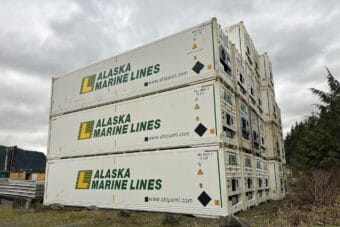
Alaska Marine Lines freight sits at a facility in Thorne Bay. (Hunter Morrison/KRBD)
An Alaska Marine Lines barge that was taking on water off the coast of British Columbia has continued its journey south to Seattle.
The barge was spotted floating lower than normal last week near Bella Bella, about 260 miles south of Ketchikan, on its way from Alaska.
According to an email from Alaska Marine Lines Director of Marketing Ryan Dixon, the barge was damaged during transit but was “secure” and “not sinking.”
Dixon said the barge was not carrying groceries or supplies for Southeast Alaska that could cause supply chain disruptions for the region. The barge also did not contain bulk cargo or petroleum products, according to the email.
On Tuesday, the company announced that a second barge was sent to offload some of its cargo. As of Sunday, both were en route to Seattle.
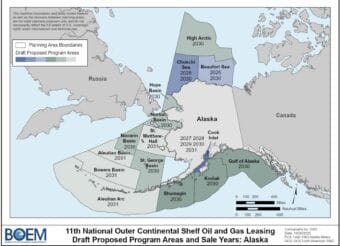
This map shows offshore areas the Trump administration wants to open for potential oil and gas leases. (Bureau of Ocean Energy Management)
WASHINGTON — The Trump administration proposes to open nearly all of the oceans off Alaska to potential oil and gas drilling.
The draft offshore leasing plan includes the Bering Sea, the Gulf of Alaska and other areas important to the fishing industry. It’s part of a national proposal that includes the entire coast of California, where drilling is fiercely unpopular.
“By moving forward with the development of a robust, forward-thinking leasing plan, we are ensuring that America’s offshore industry stays strong, our workers stay employed, and our nation remains energy dominant for decades to come,” Interior Secretary Doug Burgum said in an emailed announcement.
The top Democrat on the U.S. House Natural Resources Committee, Rep. Jared Huffman of California, pledged to fight, in court and in Congress. Huffman said it doesn’t make sense for Alaska either.
“I just think it’s incredibly reckless,” he said. “I mean, we know what the seafood economy means to the state of Alaska.”
The plan goes beyond what Alaska advocates of offshore development have favored in the past. In 2018, Alaska’s all-Republican delegation to Congress praised an offshore plan that included lease sales in Cook Inlet and the Chukchi and Beaufort seas. But they asked the first Trump administration to remove the Bering Sea and the Gulf from consideration.
The plan released Thursday is a “first analysis,” with two more planned before final approval. If it survives, the first lease sale would be in the Beaufort.
It’s not clear oil companies would be interested. Shell spent 10 years and $7 billion trying to drill there before giving up on offshore Arctic exploration.
Holland America’s Noordam cruise ship in Juneau on Wednesday, July 9, 2025. It operates an open-loop exhaust scrubber and was found to violate federal water quality standards on 30 days in 2024, according to an EPA data analysis by SEACC. (Photo by Clarise Larson/KTOO)
Listen to this story:
Some Alaskans are fired up about water pollution from heavy fuel oil burned on large cruise ships. At a panel discussion in Juneau on Wednesday, members of tribes and conservation organizations said there’s a solution: using cleaner fuel.
Heavy fuel oil is the stuff from the bottom of the barrel — the waste product at the end of the oil refining process. It’s cheaper than distillate fuels and is used widely by most of the large cruise ships that travel along Alaska’s coastline every year.
When it’s burned, heavy fuel oil exhaust releases sulfur oxide into the air, which can cause heart and lung disease and lead to acid rain. In 2020, the International Maritime Organization, or IMO, required ships that burn heavy fuel oil to use scrubbers, which filter the exhaust through seawater.
Aaron Brakel is a clean water campaigner at the Southeast Alaska Conservation Council, which organized the panel. He said scrubbers didn’t solve the pollution problem — they just moved it into the ocean.
“They spray the water, transferring pollutants from the air into the water from the exhaust,” he said. “Most of the scrubbers worldwide, most of the ones here in Alaska, are open-loop systems.”
That means they pump seawater infused with toxic exhaust back into the ocean instead of storing it and disposing of it at an onshore facility.
Nearly 80% of the cruise trips made in Alaska last year burned heavy fuel oil through open-loop or hybrid systems. Hybrid scrubbers can switch between dumping the effluent or storing it, depending on discharge regulations in the waters the ship is passing through.
Brakel probed into U.S. Environmental Protection Agency records and found that between 2023 and 2024, 17 ships using open-loop scrubber systems reported more than 700 water quality violations off the coast of Alaska, as Alaska Public Media reported last month.But the data doesn’t show exactly where the violations happened.
Kay Brown is the Arctic policy director at Pacific Environment, an advocacy nonprofit. Last year, she and her colleagues published a literature review of studies around the world on the negative effects of scrubbers.
“The big takeaway here is that scrubber pollution is toxic to marine life at very low concentrations,” Brown said.
One study found scrubber wastewater at a concentration of 5% killed tiny crustaceans called copepods within one day, and called the wastewater a “witch’s cauldron” of toxic compounds. Another study found that exposure to scrubber discharge affected the reproduction success of some mussel and sea urchin species at even lower concentrations.
Several Southeast tribes have passed resolutions calling for cleaner fuel, including the Yakutat Tlingit Tribe, the Organized Village of Kake, the Organized Village of Kasaan and the Ketchikan Indian Community.
Ilsxilee Stáng Gloria Burns is president of the Ketchikan Indian Community. She said she wants cruise lines to take initiative.
“This practice of fuel dumping makes the cruise ships an extractive industry,” she said.
Burns said the onus is on the cruise industry to build a relationship of reciprocity instead.
Linda Behnken is the executive director of the Alaska Longline Fishermen’s Association and board president of Alaska’s Sustainable Fisheries Trust. She’s fished commercially for 40 years and says the statewide seafood marketing strategy is built on telling the story of Alaska’s healthy, pristine waters.
“To have this information, to me, where we know sort of that dirty secret, I feel like we’re being disingenuous by continuing to build our reputation on this,” she said.
Behnken said Alaskans have a responsibility to protect the water from pollution.
Cruise ships that burn heavy fuel oil are equipped to switch between fuel types.
Some regulations have already taken effect in U.S. waters. Last year, the IMO banned heavy fuel oil in Arctic waters, with some fuel tank exceptions. Scrubber discharge is restricted in Hawaii’s waters and banned within the Port of Seattle. California has long required ships to burn cleaner fuels upon entering its waters.
Sen. Jesse Kiehl, D-Juneau, attended the panel. He said he’s concerned about water pollution from scrubbers, but hasn’t decided on a policy path yet.
He said he’s been meeting with a lot of people about it, including cruise companies.
“We had some serious conversations and they presented some research, some of which I bought and some which I didn’t,” Kiehl said.
Cruise Lines International Association Alaska represents the cruise industry.
“There is no scientific basis to support a ban on [scrubbers],” CLIAA spokesperson Lanie Downs wrote in an email, adding that they “remain an important compliance option as the maritime sector continues to reduce air emissions.”
Alix Pierce, Juneau’s visitor industry director, said in an interview that there’s a long-standing voluntary commitment from the cruise lines to switch to marine gas oil when they’re in Gastineau Channel, while in Juneau’s cruise port and upon departure.
“All we can do is make agreements and ask that they be followed, and even if we did have legislation, I don’t know what our compliance program would look like,” Pierce said.
She said the city has no reason to believe ships aren’t honoring the commitment. But in 2019, Gov. Mike Dunleavy axed state funding for the Ocean Rangers program that had observers aboard cruise ships, so there is no longer oversight on oil slicks. The state’s wastewater permits and ship inspectors only address sewage and grey water, not scrubber wastewater dumping.
Pierce said the city is working to help find alternative shipping fuels through a partnership between ports and cruise lines called the Pacific Northwest to Alaska green corridor project.
“We’re excited to see how we can kind of continue to try to drive change in the alternative fuel space, because that’s really the future,” she said.
She said the group will publish a report in the next few months looking at the feasibility of transitioning cruise ships to another fuel type called green methanol, which can be produced from municipal or agricultural waste. The IMO suggests it could cut carbon and sulfur oxide emissions. Pierce said the effort could move the needle beyond the scrubber problem and meet IMO’s goal to make shipping a net-zero emissions industry by 2050.
Juneau’s last cruise ship of the 2025 season will depart next Tuesday.
Correction: The panel discussion was on Wednesday.
Sandsend Beach in Shapinsay, Scotland. (Photo by Paul Hollinrake)
In April, Julie and Dug Watkins were walking their dogs on Sandsend Beach, near their home in northern Scotland. As Julie was taking a short swim in the cold water, her husband found something unusual lying on the pebbles: an amber-colored wine bottle.
The bottle was sandy and partly covered with seaweed. Inside, they found a note saying it had been released on sea ice near Utqiagvik, on Alaska’s North Slope, six years earlier. The author had drawn a picture of a whale on the back and signed it: Craig George.
“When we read the message in the bottle and realized how significant a thing it was, we were really very excited,” Julie Watkins said.
Craig George (right) and Kate Stafford work during whale census outside of Utqiagvik in spring, 2019. (Photo provided by Cyd Hanns)
John Craighead George was a prominent whale expert who lived in Utqiagvik for decades. He died in 2023 — three years after setting the bottle adrift — leaving behind an extensive body of research. He published studies on things like how long bowheads can live and how they can survive in cold waters.
“I suppose Craig lives on in that message,” Watkins said. “He probably lives on in so many ways, but that was just one more thing.”
Release
Originally from New York, George was instrumental in starting a bowhead whale census back in the 1970s that incorporated knowledge of Iñupiaq hunters and supported their subsistence.
Kate Stafford, a researcher at the Marine Mammal Institute at Oregon State University, counted whales with George in the spring of 2019. For several months, they took hour-long snowmachine rides to an observation perch built on the ice north of Utqiagvik. At the end of the census, she said they followed George’s tradition and released several bottles with messages.
John Craighead George had drawn a whale on the back of the note that he released in a bottle in 2019. (Photo by Julie Watkins)
“Most of the time, we put them in the lead, and they probably got crushed when the ice moved around,” she said. “We thought this time, we would put them on the sea ice.”
Over the years, George collected sturdy wine bottles and emptied them with friends during music nights – which, to Stafford, is a lovely memory in itself. She said he would write his messages on waterproof paper, seal the bottles with wax and tape, and release them after the whale census.
The only known retrieval happened when one of those bottles washed up in Point Lay, about 180 miles to the southwest. That is, until now.
“Craig was the most curious person you’d ever meet,” Stafford said. “I think it just tickled him to think about putting a message – often with a little drawing that he’d done, and the weather, and the date – putting it in a bottle and seeing where it ended up, or if it ever got recovered. He would have been so thrilled that that bottle was recovered in such an interesting spot, like the Atlantic.”
Bottles with messages float in an open water lead outside of Utqiagvik after John Craighead George and Kate Stafford released them in spring 2016. (Photo by Kate Stafford)
The journey
When George released the bottle near Point Barrow, the northernmost tip of the United States, he was facing a strong northeastward stream. Seth Danielson, a physical oceanographer at the University of Alaska Fairbanks who was also George’s colleague and friend, said the bottle most likely got caught in the Beaufort Gyre, a clockwise ocean circulation that sent it toward the East Siberian Sea.
“There’s sort of this large ocean superhighway of ice that moves from the East Siberian Sea towards Fram Strait on the east side of Greenland,” Danielson said.
Danielson said that somewhere south of Iceland, the bottle probably drifted east and was caught by the North Atlantic Current, which carried it to its final destination: Shapinsay, one of the Orkney Islands, off the north coast of Scotland.
Discovery
There are no bowheads in Orkney, but the area is a popular whale watching spot for orcas. Julie and Dug Watkins – the couple who found George’s bottle – shared their discovery in a local Facebook group for whale enthusiasts. They learned that another Orkney resident knew George from helping with the whale census in Alaska, back in the 1980s.
“It’s just absolutely incredible that it should travel that far and not get broken or nothing else happened to it, but also end up on this beach, on this island, where people knew about him and respected his work and things,” Julie Watkins said. “It’s unbelievable almost, but it happened.”
Julie and Dug Watkins. (Photo by Julie Watkins)
The note in the bottle included George’s email address. The couple reached out, to no avail. Then they contacted the City of Utqagvik, which connected them with George’s widow, Cyd Hanns.
Hanns said she was glad the couple kept trying to reach out. She wrote to them about George’s life and research, as well as Alaska whaling traditions.
“I was happy-sad because he wasn’t here,” Hanns said. “He has so many friends around the world, and still making them.”
Julie Watkins’s husband Dug died unexpectedly a month after finding the bottle. The family sent his ashes out in a small burning boat from the same beach where the bottle washed up. Losing a loved one was a point of connection between Hanns and Watkins, who have stayed in touch over email.
And Hanns said the discovery brought her family closer together, three years after her husband’s death.
“It’s a story on the ocean currents and the way loved ones can surprise us even after they’re gone,” she said.
Researcher Nike McCampbell (right) stands with her diving partner Alexis Schultz at Smitty’s Cove in Whittier, AK. (Photo by Rachel Cassandra/Alaska Public Media)
Nike McCampbell pulled on her dry suit and air canister and walked down a concrete ramp to the edge of the water at Smitty’s Cove in Whittier.
She dove below the surface and swam about 80 yards from shore to collect water samples at different depths.
On shore, she said APU is studying how microplastics are transported through ocean currents.
“We’re going to see where microplastics are moving,” McCampbell said. “We’re going to see if there’s any sort of correlation in certain areas through certain time periods, if the wind and the waves are showing similar patterns and traits.”
McCampbell is part of a new team at Alaska Pacific University, or APU, in Anchorage studying microplastics — the tiny particles of plastic found in nearly every environment that can likely work their way into human tissues.
Last year the APU team got a $5 million grant from NASA to study microplastics in Alaska. In addition to their space program, NASA funds ocean research to better understand Earth’s environment.
Microplastics have already been found in the most remote corners of the state, so the university’s research aims to expand that understanding by looking at how microplastics enter all water sources, including oceans and rain. The researchers will also study the chemical properties of the microplastics they find, which can help scientists understand how the tiny particles might impact human health.
Kian Muldoon, a graduate student on the research team, said the ultimate goal of their work is to help reduce the harmful health effects of microplastics.
“We’re not so concerned as necessarily showing that they’re there, but knowing where they came from, and how they move, and hopefully using that research to either inform cleanup efforts or anything to try to mitigate harm,” Muldoon said.
Back at the APU lab, Muldoon and his colleagues will use new specialized equipment to help identify various microplastics in the samples.
The team has already collected samples from the summit of Denali, the Eklutna Lake watershed and Prince William Sound, where Smitty’s Cove is. That’s according to Dr. Dee Barker, a chemist and head of the research team.
Researcher Nike McCampbell (right) and her diving partner Alexis Schultz prepare to dive and collect water samples. (Photo by Kian Muldoon/Alaska Pacific University)
Barker said with new instruments funded by the grant, the team can identify particles small enough to likely pass through human tissues and study the chemistry behind the microplastics they find.
“To find out what type of plastic is most likely to be found of a size that would enter into the human body, and then what size would transport through human tissues, and then the chemistry of that particle,” she said. “How does that interact with the chemistry of a human being?”
She said that analysis of chemistry is missing from much of the existing microplastics research.
Ultimately, Barker said, they aim to get their lab accredited for microplastics testing through the California Water Board. Dee said that would put APU’s lab among only three other labs worldwide that are accredited by the board to test for microplastics.
Once the lab is accredited, Barker said, Alaska communities can send in water samples to test for microplastics. Barker said some communities could pay for the testing but the grant funding will allow them to test water for free for communities who can’t.
“Why they’ve helped us get this instrumentation, is not only (to) do research, but also serve the community,” Barker said. “That’s the key piece in this.”
Graduate student Muldoon said the importance of this testing was shown when they processed the water of one remote community.
“Their drinking source was a natural drinking source, was extremely clean in terms of bacteria and coliforms, extremely clean in terms of heavy metals, extremely clean in terms of PFAs, but did have microplastics,” Muldoon said.
He said that could be surprising to communities who have seemingly pristine water sources, but microplastics can travel through the atmosphere.
Pam Miller, who directs Alaska Community Action on Toxics, said many communities they work with are concerned about microplastics in water.
“This effort is really critical, because our Alaska Department of Environmental Conservation has not developed a systematic way to look at microplastics in our drinking water,” Miller said.
She said it’s important to work toward prevention, too, by reducing plastics contamination on a policy level.
But for water that is already contaminated, Barker said it’s relatively easy to filter out larger microplastic particles. She said individuals can do that, even with a simple pitcher water filter at home. And she said testing water sources for microplastics is the first step in understanding how communities could protect themselves from the tiny plastic particles.
Ice and debris float in Tracy Arm on Monday, Aug. 11, 2025 following Sunday’s landslide. (Photo courtesy of Christine Smith)
Early Sunday morning, Sasha Calvey awoke to a roar.
“I look out of the tent, and then I see a massive wave coming, like, inches away,” Calvey said.
Calvey was camped with two friends, Billy White and Nick Heilgeist, on Harbor Island, an uninhabited islet in Holkham Bay. It’s at the convergence of two of Southeast Alaska’s most-visited fjords, Tracy Arm and Endicott Arm.
Calvey, White and Heilgeist had spent the past 78 days kayaking the Inside Passage from Washington. The three hoped to spend the final two weeks of their trip making their way to Glacier Bay.
It was 5:45 a.m. Sunday when their plans abruptly changed.
Calvey scrambled to wake up White and Heilgeist. The three are professional guides who have been taking a summer off from leading trips through the San Juan Islands. They’d pitched their tent in the woods, far from the high tide line.
They emerged to find much of their gear had vanished, swept away by the rush of water. Calvey’s kayak was floating a quarter mile off shore. White’s rested on a cliff. Heilgeist’s was in a tree.
“It was just pure chaos out of nowhere,” Heilgeist said. “All of it was just gone.”
The kayakers were camped in the woods on Harbor Island, well above the high tide line. (Photo courtesy of Sasha Calvey)
‘Something was really different, and wrong’
Miles away, anchored near the entrance of a fjord known as Fords Terror, Christine White saw water moving backwards. She knew the area well — she’d been taking clients there aboard her small cruise ship, the David B., for nearly two decades. On Sunday, she saw the tide quickly rise and fall by roughly 10 feet.
“When we started seeing the water rising again on what should have been a falling tide, we knew something was really different, and wrong,” she said.
Smith reached out to a seismologist she knew, who consulted with colleagues at the Alaska Earthquake Center and the U.S. Geological Survey.
Smith was onto something. Seismometers across North America had rattled just a few minutes before.
“Honestly, I think of it as the side of a mountain collapsing,” said Michael West, the Alaska state seismologist.
Details of the remote landslide were uncertain in the immediate aftermath, but West said early indications are that a truly impressive amount of rock and debris tumbled down — tens or hundreds of millions of cubic meters.
“We’re talking about a cube of rock, that is, you know, a couple football fields on each side,” West said.
A truly colossal tsunami
Southeast Alaska has seen a growing number of fatal landslides near populated areas in recent years. But Sunday’s landslide was something quite a bit different. Rather than a top layer of soil giving way, in this case, large masses of bedrock came down, West said.
When all that rock fell near the end of Tracy Arm, where South Sawyer Glacier reaches tidewater, West said it set off a truly colossal tsunami. One photo, taken by Heilgeist after the trio was rescued by a charter yacht, shows an island deep in the fjord scoured of almost all vegetation.
A lone tree remains atop Sawyer Island, right, in Tracy Arm following a landslide-induced tsunami on Sunday, Aug. 10, 2025. (Photo courtesy of Nick Heilgeist)
“We’ll get better height estimates in the days to come, but even posts floating around on social media make pretty clear it was at least 100 feet tall in some areas near the source,” West said.
The wave continued to resonate for hours, he said, not unlike water sloshing in a bathtub. It even showed up on a tide gauge in Juneau, 75 miles north and around a few corners, with fluctuations of a foot or so evident several times in the hours after the landslide.
Smith, the captain, said she saw downed trees and scoured shorelines as the David B. made its way up Tracy Arm on Monday. Allen Marine tour boats had to turn around on trips up the fjord on Monday, according to Juneau-based operations manager Stuart MacDonald, though nearby Endicott Arm was free of debris.
A shoreline in Tracy Arm shows the destruction left after a tsunami in this photo taken Monday, Aug. 11, 2025. (Photo courtesy of Christine Smith)
West spotlighted one early, intriguing piece of evidence — a series of small tremors before the bigger slide.
“Modest earthquakes, but hundreds or thousands of very small ones,” West said. “This landslide had a very clear precursory sequence, and that is not something we have often observed.”
Alaskans were lucky the slide happened when it did, West said. It was early in the morning — around 5:30 a.m. local time — so there weren’t tour boats or cruise ships in the fjord when the mass of rock fell.
“It is hard to imagine that, in front of the landslide itself, anything would survive,” West said.
Tsunamis like this ‘won’t always be in remote places’
West said the incident gives scientists a chance to learn more about how massive landslides like Sunday’s happen and what havoc they can wreak.
“We are in the rare position of being able to have these events that don’t have truly catastrophic impacts, sometimes just because we can tuck them away in remote places. But they won’t always be in remote places,” he said. “What they do present is a phenomenal opportunity to learn and better understand how these things work, so that when it’s in Whittier or Seward or Hoonah or Elfin Cove or wherever else, we’re better prepared for that.”
A tree and iceberg float in Tracy Arm following a landslide and tsunami on Monday, Aug. 11, 2025. (Photo courtesy of Christine Smith)
For the kayakers, the episode is a reminder that “sometimes, stuff just happens,” Heilgeist said.
The trio was rescued by a charter yacht, the Blackwood, which heard their distress call on a marine radio. A tender fought strong currents as the kayakers loaded what remained of their belongings onto the vessel. The crew welcomed them with blankets and showers, even taking them up Tracy Arm to see the damage the tsunami had left behind.
“Sawyer Island only had one tree left on it,” Heilgeist said.
For White, the entire experience feels “surreal,” she said, but she said the group is holding up well. More than a dozen Juneauites reached out to offer housing or logistical support. And while the group is raising money to replace the lost kayak and gear, White said she’s grateful they escaped any physical harm.
“I’m just glad that we’re all healthy and safe,” White said.
Close
Update notification options
Subscribe to notifications
Subscribe
Get notifications about news related to the topics you care about. You can unsubscribe anytime.