Oceans

Aleutian communities on edge after massive earthquake sends waves to U.S. coasts

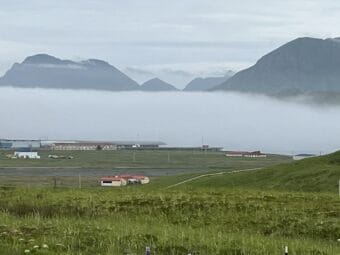
looking down on buildings in the distance from a green hillside. mountains and fog in the background
The City of Adak seen from the island’s tsunami shelter on Bering Hill Tuesday, July 30, 2025. (Courtesy of Breck Craig)

A tsunami advisory was lifted for the Aleutians and the Pribilof Islands Wednesday morning, after one of the most powerful earthquakes ever recorded struck off the coast of Russia’s Kamchatka Peninsula at about 3:25 p.m. Alaska time.
The magnitude 8.8 earthquake sparked tsunami warnings across the Pacific and sent a series of waves to the coastlines of several states and countries, including Japan and Russia, where damage was reported.

The largest wave in Alaska, at 2.7 feet, hit Adak Island at 11:21 Tuesday night, according to the U.S. Tsunami Warning System, which is part of the National Weather Service.

Adak City Manager Breck Craig and most of the community of about 50 people gathered to wait for the wave at the Bering Hill Chapel on Tuesday evening. A wave was forecasted to arrive at 5:40 p.m., but Craig said he saw no sign of one. He said people cleared out around 7 p.m.

“Everybody still went home and loaded up their trucks and gassed up their vehicles and got their generators gassed up, and we were all ready, in case, you know something happened,” Craig said Wednesday morning.

He said he didn’t get much sleep Tuesday night.

“I slept in my clothes like everybody else in town, I think, did,” Craig said.

Craig said people in Adak didn’t feel the initial magnitude 8.8 earthquake or any of its aftershocks. And thankfully, he said, they haven’t found any damage.

“We checked the pier. We checked the small boat harbor. We’re still in the process of just checking things, just to be double sure,” Craig said. “Even small waves, you know, can do damage. So far, we’re not finding anything.”

Craig said the town’s emergency systems were ready for the alert — they’d just held a tsunami siren test Friday.

“The downside of that was we had to make sure we said ‘Hey, this is not another test. This is real, please evacuate to the tsunami center,'” Craig said.

Other communities in the western Aleutians also saw tsunami waves — including Atka and Nikolski, which both had observed wave heights of over a foot, according to the National Weather Service. Waves of just under a foot were also observed in Unalaska.

Dave Snider, a tsunami warning coordinator with the National Tsunami Warning Center, said there may still be some unusual currents and water levels in coastal communities over the next several days.

“Don’t be surprised if that happens, and be extra cautious in places that you’re familiar with. Every community knows their coastline better than anybody else,” he said.

A tsunami warning had initially been in effect for communities along the western Aleutian Chain, including Atka and Adak, as well as the Pribilofs. An advisory remains in effect for parts of the California coastline as of Wednesday afternoon.

People in those places are advised to stay out of the water and away from beaches and waterways.

A magnitude of 8.8 would make this one of the ten largest earthquakes ever recorded worldwide, and the largest in more than a decade.

KUCB’s Sofia Stuart-Rasi and Theo Greenly contributed reporting.

Tsunami warning lifted for Aleutians, advisory still in effect following M8.8 earthquake in Russia

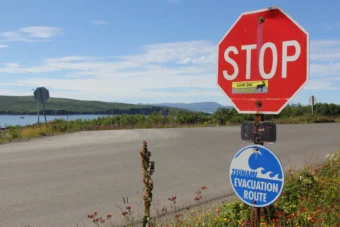
A sign marking a tsunami evacuation route in Sand Point, Alaska on July 29, 2025. (Theo Greenly/KDSP)

A tsunami warning was lifted for Alaska communities in the western Aleutians on Tuesday evening, after a magnitude 8.8 earthquake struck off the coast of
Russia’s Kamchatka Peninsula at about 3:25 p.m. Alaska time. A tsunami advisory is still in effect for the western Aleutians, including Adak, Atka and Amchitka.

A tsunami warning had initially been in effect for communities along the western Aleutian Chain, including Unalaska, Atka, Adak and the Pribilofs.

An update at 5:27 p.m. Alaska time canceled the tsunami watch for the Alaska Peninsula east of Chignik Bay as well as southern and Southeast Alaska, after an alert had been issued earlier that day for much of the state’s coast.

A map showing the tsunami warning area along the southern Alaska coastline
(Courtesy of U.S. Tsunami Warning System)

Much of the U.S. West Coast also remains under a tsunami advisory, with parts of California and Hawaii still under a warning.

A tsunami warning means people should evacuate inland or to higher ground. Under an advisory, people are advised to stay out of the water and away from beaches and waterways.

The Tsunami Warning Center said that waves of a foot or under had been observed in communities across the Aleutians, including Unalaska, St. Paul and Nikolski. Adak and Atka saw wave heights of over one foot, according to the center, with waves in Atka measuring 1.4-feet.

“A tsunami did occur,” said Dave Snider, a tsunami warning coordinator with the center. “A tsunami is not just one wave, it’s a series of powerful waves. And so it’s entirely possible that the first wave is not the largest and may not be the last.”

Snider said there may still be some unusual currents and water levels in coastal communities over the next several days.

“Don’t be surprised if that happens, and be extra cautious in places that you’re familiar with. Every community knows their coastline better than anybody else,” he said.

In Adak, City Manager Breck Craig and most of the community gathered to wait for the wave at the Bering Hill Chapel on Tuesday evening. The town’s village public safety officer, Mike Lejarzar, peered out to Kuluk Bay with his binoculars, looking for any signs of a tsunami.

“Are you seeing anything, Mike?” Craig asked. “You don’t see anything?”

A wave was forecasted to arrive at 5:40 p.m., but Craig saw no sign of one.

Craig said that by then, most of the town had evacuated to the chapel, which acts as the city’s tsunami shelter.

“We sounded the tsunami siren and collected everybody up and got everybody up here,” Craig said. “We’re all just kind of hanging out, waiting for what they’re thinking is a one foot or three foot wave maybe to come in.”

Craig said everyone had gone home by about 7 p.m., but the city would stay vigilant and watch any updates over the next 15 hours. According to the National Weather Service, tsunamis are a series of waves, and a large tsunami can continue for hours or days in some locations.

In Atka, one of the westernmost communities in the Aleutian Chain, Mayor Luke Snigaroff said that no wave had materialized as of 6:12 p.m., but roughly two dozen residents in the Unangax̂ village had evacuated to high ground.

“We’re still under warning,” Snigaroff said in a telephone interview. “Everybody’s up at the water treatment plant or the quarantine shelter.”

A magnitude of 8.8 would make this one of the ten largest earthquakes ever recorded worldwide, and the largest in more than a decade.

KUCB’s Maggie Nelson and Theo Greenly contributed reporting.

Toxin that causes paralytic shellfish poisoning blamed for Alaska seal deaths

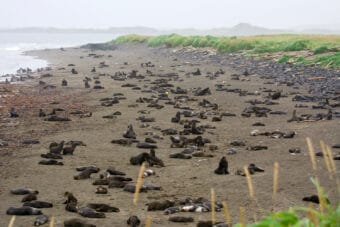
Northern fur seals rest on a beach south of St. Paul Island’s Polovina Rookery in August of 2021. Dead fur seals found on the island in August of 2024 are determined to have been victims of saxitoxin, an algal toxin that causes paralytic shellfish poisoning. (Photo provided by the National Oceanic and Atmospheric Administration Fisheries Service)

For the first time, scientists have made a definite link between the toxin produced by algae that causes paralytic shellfish poisoning and marine mammal deaths.

Fur seals found dead last August on Alaska’s St. Paul Island had significant levels of saxitoxin in their bodies, as did several of the dead fish around them.

It was the clearest evidence ever found for this type of toxin-caused death, scientists say.

“I would say this is the absolute strongest case for saxitoxin poisoning in marine mammals anywhere,” said Kathi Lefebvre, a National Oceanic and Atmospheric Administration research biologist and the lead author of a study detailing the findings, published in the journal Marine Mammals Science in May.

The discovery, a warning for local communities that rely on subsistence hunting, comes as long-term warming in the Bering and Chukchi seas is increasing the prevalence of a type of algae that produces saxitoxin is becoming more prevalent in these bodies of water.

Dangerous blooms of the Alexandrium have long been observed in more southern waters of Alaska, where paralytic shellfish poisoning is a well-recognized and sometimes deadly hazard. Clams are notorious for accumulating saxitoxin, and there are frequent safety advisories that warn people of specific sites’ shellfish poisoning dangers, and two labs in the state — one in Anchorage operated by the Department of Environmental Conservation and one in Sitka operated by the Sitka Tribe of Alaska — test harvested shellfish to determine whether it is safe for human consumption.

A subadult fur seal is hauled out on St. Paul Island in 2007. About two-thirds of the world’s northern fur seal population uses the Pribilofs for breeding. (Photo by Carla Stanley/U.S. Fish and Wildlife Service)

Farther north, the emergence of large Alexandrium blooms and potentially dangerous saxitoxin levels is new. But, as Lefebvre explains it, the conditions to create those toxin hazards have been set up over decades and possibly even centuries.

Over time, ocean currents have carried bits of Alexandrium algae north, and over time, that algae has dropped to the bottom of the ocean. That created massive beds of dormant cysts, the equivalent of algal seeds.

The Bering, Chukchi and even Beaufort seas hold some of the highest concentrations of Alexandrium cysts ever found in the world, according to Don Anderson, a harmful algal specialist with the Woods Hole Oceanographic Institution. Anderson led research teams that mapped out Alaska cyst beds over several years, including a bed in the Chukchi that he said is the biggest ever discovered.

Those cyst beds were dormant until recently, said Lefebvre, who works closely with Anderson.

“They’ve just been building and building and building. And then in the last couple decades – actually, the last 10 years, maybe — the bottom temperature finally was warm enough for cyst germination,” Lefebvre said. That appears to be the cause of the large blooms now being found routinely in the Bering, Chukchi and Beaufort seas, she said.

Dead fur seals and fish

In the case of the St. Paul fur seals, local beachcombers found 10 dead animals at a site on the northeastern side of the island called Benson Beach. It is a catchment site where marine debris, kelp and other items are known to accumulate, said Lauren Divine, director of the island’s Tribal ecosystem conservation office.

Tribal representatives managed to retrieve some of the dead seals, as well as some of the dead fish with them, said Divine, who works for the Aleut Community of St. Paul Island. They photographed the scene and gathered whatever information they could, and they contacted the NOAA-coordinated Alaska Marine Mammal Stranding Network and Anchorage-based veterinarian pathologist Kathy Burek-Huntington to continue the investigation, she said.

It was clearly a startling discovery, Divine said.

“This was something that everyone was quite alarmed (at) and noticed as something that was wrong in the ecosystem and something that really hadn’t ever been noticed or detected before,” she said. “So we were pretty adamant about really trying to do the best job that we could to collect as much information as we could about the event, and also with quite little capacity that we have out in the remote community.”

In all five of the adult seals tested, saxitoxin was found in feces or urine, significant because they indicate higher exposure when tainted food was eaten. Two fish were sampled as well, and both turned up saxitoxin in their intestines.

At about the same time, samples being taken by researchers in the southeastern Bering Sea — the same area where the dead fur seals would have been foraging — revealed dense Alexandrium blooms, large cyst beds and extremely high prevalence of saxitoxin in fish, zooplankton, clams and worms.

Anderson, who noted that his team has already found a huge Alexandrium cyst bed near St. Paul, the seal discovery is significant for two reasons.

“The seal mortality demonstrates that dangerous levels of toxin can accumulate there and that local communities need to be careful about what they consume during certain times of the year,” he said by email.

Seed-like cysts of the harmful alga Alexandrium, which produces saxitoxin, are seen in this microscopic image. (Image provided by the National Oceanic and Atmospheric Administration)

Additionally, because scientists know that ocean currents run north from that region, “this might be yet another source of cells that can affect the Alaskan Arctic,” he said.

Lefebvre said all the evidence about the seals’ bodies, the fish samples and the environmental conditions were needed to show that the algal toxins killed the seals.

Up to now, it has not been possible to prove such a strong link between saxitoxin and marine mammal deaths, she said.

Mammals poisoned by saxitoxin are likely to disappear while at sea, she said. “They become paralyzed. They’re going to basically suffocate, not even drown, not even taking a breath of air, of water,” she said. “They’re going to just stop breathing.”

That contrasts with effects of a different type of algal toxin that, since the 1990s, has caused mass strandings and deaths since 1990 of marine mammals in California. That toxin, domoic acid, is produced by the Pseudo-nitzschia algae. Rather than causing paralysis, it overstimulates the nervous system, causing seizures that can result in death.

Lefebvre and others have documented thousands of cases of domoic acid poisoning among marine mammals in California, including sea lions, dolphinsseals, and whales, with animals easily seen by people on the beach. Mass die-offs of seabirds have also been documented.

So far, there have been no domoic acid poisoning cases documented in Alaska, though Lefebvre and her colleagues have consistently found low levels of it in various marine mammal species.

But a new study suggests that continued warming may make domoic acid a future problem in Alaska. The study, also led by Lefebvre, found that bowhead whales hunted over a two-decade period carried higher levels of both saxitoxin and domoic acid in years when waters were warm and sea ice was low.

Saxitoxin risks in various wild foods?

For now, saxitoxin and the paralytic shellfish poisoning it causes remain the main algal toxin concern in Alaska.

Among people, there were 132 reports of paralytic shellfish poisoning between 1993 to 2021, with the highest prevalence in Southeast Alaska and the Kodiak Archipelago, according to a bulletin published in 2022 by the Department of Health’s epidemiology section. The last fatal case concerned a person who ate shellfish at Unalaska Island.

Information about saxitoxin poisoning in wildlife has been more difficult to pinpoint.

In past years, it was suspected in some marine mammal deaths in Alaska, but it was not proven.

In the fall of 2017, four dead walruses found in the Bering Strait region had saxitoxin in their stomachs or intestines. They were among 39 walruses that, though otherwise in good body condition, were found dead in the region that August and September.

Two years later, another piece of the puzzle came when scientists retrieved clams from the Bering Strait area and the Chukchi Sea that had levels of saxitoxin above the thresholds for safe consumption by humans. That added another piece to the puzzle. Clams are an important part of the Pacific walrus diet, though the saxitoxin threshold for walruses has yet to be determined.

There are other suspected cases. For example, saxitoxin poisoning was a suggested cause of a 1987 sea otter die-off in the Kodiak Archipelago, though test results were inconclusive.

Beyond mammals, Alaska seabirds are known to have been killed by saxitoxin. That toxin caused a 2019 die-off of Arctic terns in the Juneau area; the birds had been feeding on sand lance, a type of fish known to accumulate saxitoxin.

A female northern fur seal is seen in this undated photo. (Photo provided by the National Oceanic and Atmospheric Administration)

For people in St. Paul and elsewhere in Western Alaska, who live far away from the two Alaska labs that currently test shellfish for toxins, the new information is concerning, Divine said.

St. Paul residents and others in the Pribilof Islands harvest various types of animals beyond the clams and mussels that are routinely screened for consumption safety, she said. But there is not much known yet about saxitoxin levels in the full breadth of subsistence foods, she said. “We just don’t have robust information on how much is accumulating and how things are impacted across the food web,” she said.

A grant from a NOAA program called ECOHAB funded much of the work that supported the new study. The grant for that work, which is led by Lefebvre and Anderson, runs through this year.

Anderson said the team just learned that it has been awarded ECOHAB grant funding for another year of work, part of what had been planned as a five-year follow-up program to better understand the saxitoxin risk in wild foods gathered in Indigenous subsistence harvests.

News of the one-year award is encouraging, but the scientists are worried about future years, Anderson said

The Trump administration has targeted NOAA for deep cuts, he noted. The administration is proposing to entirely terminate NOAA’s National Centers for Coastal Ocean Sciences, the agency arm that supports research into algal toxins.

Termination of the National Centers for Coastal Ocean Sciences would end funding for NOAA’s entire Integrated Ocean Observing System. Within the IOOS is the Alaska Ocean Observing System, which monitors algal blooms, among other work.

Divine said the same people who have been drawn together by their concerns about toxins in the food web are also worried about the potential loss of scientific research.

“We have just an incredible amount of interest in this, and the funding that has been secured to really tackle this in a coordinated way is all on hold in this administration. And I do think that that’s worth noting,” she said.

Paralytic shellfish poisoning moves beyond Alaska’s shoreline

The beach in Sand Point July 2023.
The Knik Tribe tested for marine toxins along the coast in Sand Point. Typically found during the summer months, paralytic shellfish poisoning is becoming more prevalent throughout the year, due to Alaska’s warming climate. (Theo Greenly/KSDP)

Just back from the beach in Sand Point, Jackie McConnell carried a bucket of clams and cockles into her motel room at the Anchor Inn.

McConnell is the project coordinator for the Knik Tribe’s program for monitoring paralytic shellfish poisoning, or PSP — a dangerous and often fatal neurotoxin that can show up in local shellfish.

PSP is typically found during the warm summer months, but McConnell says the toxin has been showing up in butter clams and cockles for much longer.

“They are basically hot all year round,” she said.

McConnell was sorting through the bucket of shellfish with Bruce Wright, the tribe’s chief scientist. He’s studied PSP levels in Alaska for about 20 years. On this trip, he said he is particularly interested in Arctic surf clams — also called pink-neck clams — a favored food of walruses.

“There’s people that, when they catch a walrus, they like to take the stomach and eat the undigested clams,” Wright said.

That’s one example of how saxitoxin moves through the food web — starting in shellfish, then traveling into larger animals. But the researchers say they’re also finding high levels of saxitoxin in animal droppings far from the coast.

“We’re finding that wolves, bears, their scat in areas where they’re not even feeding from the ocean, that they can have moderate levels of PSP in their scat,” Wright said.

They’ve concluded the inland contamination comes from cyanobacteria, a type of blue-green algae found in ponds and lakes. That suggests a second, freshwater source of saxitoxin is entering the food web.

Saxitoxin — one of about 50 neurotoxins found in shellfish — commonly accumulates in freshwater systems in the Lower 48, where warm weather creates favorable conditions for the bacteria. Its presence in Alaska’s cooler climates is relatively new.

Despite the elevated readings, the researchers said local shellfish can still be safe to eat if it’s been tested first.

“We’ll pay for the shipping, we’ll pay for the analysis, and we’ll and we’ll take care of that consultation after the data comes back,” Wright said.

He said residents can leave their harvest in a bucket and send a sample to the tribe. Results are typically returned within one or two days.

Plastic fish food bags litter the water between Sitka and Juneau

Juneau resident Wayne Carnes holds one of the 54 fish food bags he found around Funter Bay. (Photo by Alix Soliman/KTOO).
Juneau resident Wayne Carnes holds one of the 54 fish food bags he found around Funter Bay. (Photo by Alix Soliman/KTOO)

A shipping container full of empty industrial-sized fish food bags fell off a barge heading from Baranof Island to the landfill in Petersburg. Dozens of the plastic bags have washed up near Juneau over the past week.

They came from the Hidden Falls Hatchery, owned by the Northern Southeast Regional Aquaculture Association. 

Adam Olson, the operations manager at the aquaculture association, says high winds likely caused a container to go overboard near the southern tip of Admiralty Island in May. In a press release, the aquaculture association said that the barge company it contracted to transport the trash, Lituya Freight Runners, did not contact them or make any efforts to recover the bags.

Instead, another vessel traveling through Chatham Strait notified hatchery staff about the incident on May 20. Olson says he did not report it to any authorities. A representative at the Alaska Department of Environmental Conservation couldn’t specify an official process for reporting such an incident in Alaska. 

Hatchery staff attempted to clean up the spill.

“We flew the area to see what was there, and we sent staff from the facility out in skiffs to collect refuse out of the water,” Olson said. 

Olson says hatchery staff retrieved more than a thousand bags over six days, but there could be thousands left in the water. 

The bags are white and the size of large dog food bags. Most of them are from an aquaculture brand called Bio-Oregon and others are from a brand called EWOS. 

A shipping container full of the fish food bags fell off of a barge destined for the Petersburg landfill. (Photo by Alix Soliman/KTOO).
A shipping container full of fish food bags fell off of a barge destined for the Petersburg landfill. (Photo by Alix Soliman/KTOO)

Juneau resident Wayne Carnes discovered the litter about 90 miles north of the spill site while he was on a boat trip from Gustavus to Juneau last week. He retrieved 54 bags that had washed up at Funter Bay and were floating in the water nearby. 

“We don’t want our fish eating these things, because that’s what happens to it eventually it ends up as microplastics, and we’ve got enough of that in the water already,” Carnes said.

The aquaculture association encourages those who have seen the litter to tell the Southeast Alaska Commercial Fishermen Marine Debris Clean Up program at seakmarinedebris@gmail.com.

Scientists and Inupiaq hunters count bowhead whales. So far, the numbers seem to be on the rise.

Observers count bowhead whales passing by Utqiagvik, part of a census that takes place every 10 years. (Photo by John Citta/North Slope Borough Department of Wildlife Management)

When bowhead whales pass Utqiagvik on their way north, it’s a good time to count them. So ever since April 1, observers have been climbing a perch built on sea ice, right at the edge of an open lead, to count the whales as they swim past.

Every 10 years, scientists and local hunters team up to carry out this census of bowhead whales that migrate between Bering, Chukchi and Beaufort seas. It is an effort to evaluate the health of the whale population up north, and it helps set subsistence harvest limits for the years to come.

“We do it for the whaling captains, and we do it in collaboration with them,” said John Citta, a senior wildlife biologist with the North Slope Borough Department of Wildlife Management who is leading the effort. “They’ve taught us how to be on the ice safely.”

Bowheads might be thriving as ice declines 

Whaling captains trained the observers on how to work safely on the ice. They will continue counting whales from the perch throughout the spring bowhead migration.

That visual count is only the first step of the census. Scientists will need to statistically adjust the data to account for the whales the observers don’t see. But so far, Citta said the raw numbers have been high. He said the final abundance estimate might turn out at around 20,000 whales or more. The highest counts in recent years found around 17,000 whales.

“We think there are a lot more whales out there now than what there used to be,” he said. “We suspect the populations continue to grow, but we just don’t know that for certain yet.”

An observer looks for whales from a perch built on sea ice.
An observer looks for whales from a perch built on sea ice. (John Citta/North Slope Borough Department of Wildlife Management)

Citta said the bowheads might be thriving as the sea ice in the Arctic declines. Past bowhead research suggests that the whales were in better physical condition in years with less sea ice, he said.

But the shrinking sea ice and increasing open water habitat can also lead to more competition with humpbacks, predation from killer whales or collisions with ships. Citta said the only way to know is to continue monitoring the bowhead population.

Hunters’ contribution to whale count

Whalers have been involved in the bowhead census since the early 70s. That’s when the International Whaling Commission, an organization that regulates whaling, estimated that there were fewer than a thousand whales in the Bering-Chukchi-Beaufort stock. That estimate was so low that the commission first tried to place a moratorium on whaling and then reduced the harvest.

Hunters protested the limit, saying it was based on an undercount.

While that early count only included whales passing through the open lead, hunters knew that some animals traveled far from shore or under thick ice. Over the years, the late Craig George collaborated with local whalers to improve the census methods and account for those whales.

“We were able to improve our techniques over the years,” said Geoff Carroll, a retired wildlife biologist who worked with George. “We were able to show that there’s plenty of bowheads to support the subsistence hunt.”

A bowhead whale swims through an open lead near Utqiagvik.
A bowhead whale swims through an open lead near Utqiagvik. (Photo by Kate Stafford/Oregon State University)

An acoustic component of the count, pioneered around 1984, helped determine how many whales could be heard migrating when the lead is closed or the weather is too poor to see whales. Kate Stafford, a researcher at the Marine Mammal Institute at Oregon State University who studies bowheads using acoustic monitoring, has worked on the past five bowhead censuses.

“This combination of methods makes for a more robust population estimate and confirms what Native whalers have always known – that whales migrate in heavy ice, sometimes far offshore and at all times of the day,” Stafford said.

Declining sea ice could change the census

Last August, scientists deployed hydrophones – underwater devices that record ocean sounds – on the sea floor. They plan to retrieve them this fall.

“It turns out that bowhead whales really talk a lot when they’re migrating,” said Carroll, who is also an advisor for this year’s census.

An aerial survey will happen later this summer.

The North Slope Borough is collaborating with the National Oceanic and Atmospheric Administration on flights over the Alaskan and Canadian Beaufort seas to photograph migrating whales, Citta said.

While counting whales from the observation perch has been a success this season, Citta said that with sea ice becoming less reliable each year, the method is getting more dangerous.

“We’re worried that those ice-based counts will not be a viable way to count bowheads in the future,” he said. “If that’s the case, we need alternatives, and one of the leading alternatives is an aerial survey.”

After the count is done, scientists will need to process the data, which can take up to two years. The International Whaling Commission expects the final estimate, which will be used to decide whether to renew the region’s subsistence whaling quota, in 2029.

Site notifications
Update notification options
Subscribe to notifications