Oceans

Toxic algal blooms in Southeast will likely become less predictable with warming seas

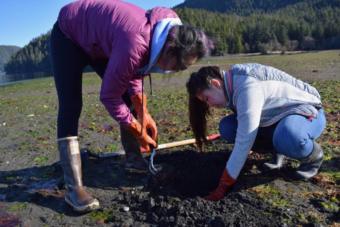
Mt. Edgecumbe High School students dig for butter clams and blue mussels in Starrigavan Estuary.
Mt. Edgecumbe High School students dig for butter clams and blue mussels in Starrigavan Estuary. (Photo courtesy of Helen Dangel)

Listen to this story:

The Southeast Alaska Tribal Ocean Research network posted a paralytic shellfish toxin advisory for recreational and subsistence harvesting in communities across Southeast this week.  

The advisory warns of high toxin levels in all shellfish species in Sitka, Skagway and Ketchikan and in butter clams in Juneau, Kake, Craig, Hydaburg and Kasaan. 

John Harley, a shellfish expert at the University of Alaska Southeast, said that Sitka had a harmful algal bloom that led to high shellfish toxins in early April — the earliest since scientists started keeping a record in 2016. 

“I think that the window in which we have to think about harmful algal blooms occurring is increasing,” he said. 

An old adage was that months ending with the letter ‘r’ were safe for harvesting. Harley said researchers in this region don’t know whether that was ever a useful rule of thumb, since data only goes back about a decade in this region. But he said that as the ocean warms, blooms will likely become less predictable.  

Jeff Feldpausch, the resource protection director for the Sitka Tribe of Alaska, said to never assume is safe. 

“I wouldn’t recommend people eat shellfish unless it’s tested,” he said. “Other than that, you’re just going to be taking that risk.”

Feldpausch recommends tribal members and the general public send samples of their shellfish harvest to the Sitka Tribe of Alaska’s environmental research lab to test for toxins and wait to get results back before eating them. 

Alaska has one of the highest rates of paralytic shellfish poisoning in the world. The state reported 132 cases between 1993 and 2021, including five deaths. That’s in part because Alaska is the only coastal state in the U.S. without a state-run toxin testing system for recreational and subsistence shellfish harvesting. Feldpausch said testing would be a heavy lift for the state.

“The state of Alaska has countless miles of shoreline and potential areas that they would need to sample,” he said. 

In fact, Alaska has more miles of shoreline than all Lower 48 states combined. The state’s high rate of shellfish poisoning could also be due in part to a tradition of shellfish harvesting across remote communities where testing is less common.

Carol Brady, Alaska’s shellfish program coordinator, said the state does routinely test commercial operations, so store-bought shellfish is considered safe. The state ramps up testing in the spring and summer.

“Between May 1 to October 31 it requires testing of the first lot harvested each week, of each species,” she said. 

An alga called Alexandrium catenella is responsible for paralytic shellfish poisoning. The alga produces a neurotoxin that builds up in clams, mussels and other shellfish that feed on it. There is more toxic algae for them to feast on when conditions are ripe for a bloom, meaning there’s plenty of sunlight, nutrients, calm seas and the water is warm enough. Once the toxin concentration in shellfish is above the federal regulatory limit, it’s dangerous for people to eat. Just one milligram can kill a person. 

Symptoms of poisoning include tingling or numbing in the arms, legs and lips as well as nausea and difficulty breathing. People with these symptoms should seek medical care immediately. 

To prevent foodborne illness, state officials recommend checking advisories before going out to forage, avoiding shellfish that are sitting in the sun, harvesting as soon as the tide goes out, putting the harvest on ice immediately and cooking everything thoroughly. While freezing and cooking won’t kill Alexandrium catenella, it can kill harmful bacteria like vibrio and norovirus. 

To report paralytic shellfish poisoning cases, contact the Alaska Department of Health and Social Services at (907) 269-8000, or (800) 478-0084 after hours.

Arctic sea ice has been hitting record lows. Scientists just lost a critical tool for studying it.

Wintertime shore ice near the village of Shaktoolik.
Wintertime shore ice near the village of Shaktoolik. (Laura Kraegel/KNOM)

The National Oceanic and Atmospheric Administration announced on Tuesday that it will defund a program that catalogs decades sea ice data in Alaska. Scientists say the program’s termination could create a gap in climate research at a time when polar ice is dwindling to historic lows.

Rick Thoman, a climate specialist at the Alaska Center for Climate Assessment and Policy in Fairbanks, is among them. On Tuesday, just a couple hours after he got the news about the program cuts, he was taking a tour group past an art installation about sea ice at the International Arctic Research Center.

The installation is in a long hallway at the University of Alaska Fairbanks, covered with vertical stripes in shades of blue and red. Thoman explained that bluer stripes mean the temperature was cooler than the 100-plus year average, while red stripes were warmer than average.

At the end of the hallway, the stripes stop. The years from about 2000 until the present day blend together, forming a solid block of scarlet.

Climate specialist Rick Thoman stands in front of the International Arctic Research Center’s Climate Stripes art installation on May 6, 2025. (Shelby Herbert/KUAC)

A guest asked Thoman what changed, and his answer was simple: less ice means higher temperatures.

“A lot of what’s driving this is the collapse of sea ice,” he said. “Both decreased extent and the thinning of sea ice — and, of course, increasing greenhouse gasses.

That long-term Arctic temperature data is safe, but the United States’ premier catalog of sea ice data — NOAA’s sea ice index — isn’t. The organization announced earlier this week that it will decommission the program, and the index stopped updating on May 6.

That development came as a shock to climate specialist Rick Thoman, but it comes after many other NOAA cuts this year. According to an internal budget document, the Trump administration is seeking to end nearly all of the agency’s climate research.

The termination of the index is one chapter in a long series of cuts the White House has made — or proposed — in recent months. February saw hundreds of probationary jobs slashed. And April saw a request for sweeping cuts to research funding.

It also follows an Alaska Climate Research Center report that said Arctic sea ice has been at or near record low levels since December, with 58,000 square miles fewer than the previous record low, which was set in 2017.

Scientists and barges left without a map

Hajo Eicken, director of the International Arctic Research Center at UAF, said the loss of the ice index could greatly impact the lives and livelihoods of coastal Alaskans. For example, it could make it harder for people to know the best time to schedule the barges that resupply communities off the road system.

“All of that type of activity relies on the sea ice information that gives you a sense of what’s normal,” Eicken said. “Like, what can we expect for a particular year?”

And Thoman said the scientific community will mourn the loss of the sea ice index, which he uses for his own research all the time. He said he used fresh ice data from the Bering, Chukchi, and Beaufort seas every day, which allowed him to track how things are changing relative to previous years.

Thoman said other global sea ice monitoring programs, like those in Europe and Japan, could pick up the slack. But the loss of the NOAA-funded sea ice index, which he calls “the gold standard,” will sting.

“When people ask me, ‘What does the sea ice concentration look like in the Bering Sea? What’s the ice extent now compared to last year in the short term?’ The answer is going to be: ‘We don’t know,'” he said.

NOAA officials did not respond to a request for comment by press time Wednesday.

New guide for kelp farmers chronicles more than 100 kinds of seaweed found in Alaska

Audubon intern Mali Tamone discovers ribbon kelp at the beach near the Rainforest Trail on July 15, 2022 in Juneau. (Photo by Paige Sparks/KTOO)

The waters of Southeast Alaska are an ideal environment to grow species ranging from Pacific oysters to ribbon kelp. But growing them successfully requires in-depth knowledge of dozens of species — where they grow, when they grow, and under what conditions.

A new tool aims to make that easier.

The National Oceanic and Atmospheric Administration released a new guide earlier this month that chronicles more than 100 species of seaweed commonly found in Alaska.

“To grow it for the kelp industry, you need to know where you can find those spores, what time of year,” said Jordan Hollarsmith, a mariculture-focused research biologist with NOAA. “Or if you want to harvest it, to eat it, you need to know what you’re looking for, where you can find that species.”

The guide aims to advance the state’s budding mariculture industry at a time when global demand for kelp products is on the rise. Alaska mariculture is still tiny compared to other coastal states, like California, Oregon and Washington. But it is steadily gaining ground. All told, the state boasts more than 1,300 acres permitted for mariculture, according to a NOAA report from last year.

And more mariculture farms are coming. On average, Alaska received more than a dozen applications for new sites each year between 2019 and 2023. That’s more than double the average for the five years prior.

“A decade ago, I don’t know if there was a single farm,” Hollarsmith said. “And now we see multiple around Kodiak, some pretty small-scale ones in Kachemak Bay and in Prince William Sound, and then a few smaller, medium-sized ones and a large one as well in Southeast Alaska.”

Hollarsmith didn’t author the updated guide. But she says it will be a crucial tool as the industry develops across the state. Right now, the highest concentration of mariculture is in Southeast, with forty permitted farms, according to the 2024 report.

NOAA is also exploring where other farms might thrive. At one point that included the waters around Haines. But the agency later dropped Haines from the list because the area is near several state marine parks, which cannot overlap with farm lease applications, Alicia Bishop, a regional coordinator for NOAA Fisheries, said in an email.

Siting new farms is one of the key obstacles to growth. That’s because new sites have to meet several key criteria, including the right environmental conditions and limited overlap with other marine activities.

“You can’t set your farm where there’s already a fishery, where there’s military installations, a ferry route, those sorts of things,” Hollarsmith said.

Still, the industry is growing – and fast.

That’s largely due to a $49 million federal grant awarded in 2022 to a coalition of companies, agencies, tribes and researchers working to boost the industry. NOAA said at the time that the grant could help grow the industry to be worth nearly $2 billion within the next decade. A state task force, meanwhile, set a goal in 2016 to develop mariculture into a $100 million industry by 2040.

Driving the state’s interest in part is the industry’s potential to boost Alaska’s coastal economies. Hollarsmith thinks mariculture could offer more opportunities for people already working on Alaska’s waterfronts.

“We see a lot of people that participate in commercial fisheries also participating in the mariculture industry,” she said.

Hollarsmith says untapped opportunities for Alaskan oyster farms could also fuel growth. Kelp, meanwhile, is becoming an increasingly popular health food, and can also be used for other purposes. The industry is exploring how different species can be used as a strengthening ingredient in concrete, or in fertilizer to boost crop production.

While the new field guide doesn’t focus on the quickly growing industry, it does provide detailed information about dozens of seaweed species commonly found in Alaska. That was made possible in part by new genetic techniques, like DNA sequencing, that have allowed researchers to better classify seaweed and identify new species over the last decade.

“It’s really important that we’re all using the same name to describe a given species,” Hollarsmith said. “Especially in this time of kelp industry growth, when farmers are experimenting with new species and trying to understand what species are out there and what kind of benefits they might have.”

Inland caribou herds aren’t recovering, report says

A group of Western Arctic Herd caribou pause in front of mountains in Kobuk Valley National Park during fall migration in 2016. The Western Arctic herd, one of the largest in the world, has been in decline for the past two decades. The 2023 census shows that the decline is continuing. The population is now only about a third of what it was in 2003. (Photo by Kyle Joly/National Park Service)

The Arctic tundra shifted this past year from capturing carbon to releasing it, which means it’s now contributing to rising global temperatures, according to the 2024 Arctic Report Card from the National Oceanic and Atmospheric Administration.

Rick Thoman, a climate researcher at University of Alaska Fairbanks, edited the report and said the NOAA report card also documents rapid declines in caribou herds.

“Particularly the large migratory herds, including the Western Arctic herd, have shown significant drops in population numbers, and they’re not recovering,” Thoman said. “Now it’s not all bad news. Some of the smaller coastal herds that don’t migrate as far have numbers [that] have rebounded in recent years from lows a decade or two ago.”

He said declining numbers are due to several factors connected to climate change. More precipitation in the winter can interfere with caribou feeding, and warmer summer temperatures mean bigger plants grow that crowd out the lichen that caribou eat.

Thoman said surface air temperatures are increasing across the Arctic, and precipitation is increasing, especially in winter, because even modest rising temperatures increase the amount of water the air can hold.

He also said the average extent of sea ice in the fall was the lowest on record, and that has led to increased ocean traffic.

“We had many, many transits of the Northwest Passage. And so the port of Nome [has been] very busy, as we’ve seen the last few years,” Thoman said. “A lot of traffic along the northern sea route.”

He said the uptick in vessel traffic means an elevated risk for a significant accident in Alaska coastal waters.

One big piece of good news from the report is that ice seals are still doing well, according to Thoman.

“Yes, we’ve had a decrease in sea ice, and we’ve had a couple of really low years there, 2018 and ‘19 in the Bering Sea.” Thoman said. “But overall, the health of ice seals is still pretty good. So I think that’s good news for Alaskans.”

The Arctic report card from NOAA incorporated research from October 2023 to September 2024. Next year will be the 20th year they’ve produced the report card consecutively.

Environmentalist group sues to gain information about Alaska trawler toll on marine mammals

Two killer whales are seen breaching in Alaska waters on June 9, 2005. (David Ellifrit/NOAA Alaska Fisheries Science Center)

The federal government has failed to give adequate information on deaths of killer whales and other marine mammals that become entangled in commercial trawling gear in Alaska waters, claims a lawsuit filed on Thursday in U.S. District Court in Anchorage.

The lawsuit, filed by the environmental group Oceana, targets the National Marine Fisheries Service, an agency of the National Oceanic and atmospheric Administration.

The whales and other marine mammals killed in fishing gear are subjects of what is known as bycatch, the unintended, incidental catch of species that are not the harvest target.

The lawsuit focuses on three Freedom of Information Act requests filed by Oceana from 2021 to 2023. Oceana asked for records, photographs and videos of animals that have been killed as bycatch in Alaska fisheries. The agency denied some requests and provided information in response to others, but that information was heavily redacted, with photographs blurred and made unrecognizable through a pixelation technique and text blacked out, the lawsuit said.

Distorted photos sent to Oceana included images of whales, Steller sea lions, a walrus, and bearded, fur and ribbon seals, according to the complaint, which seeks to compel the agency to provide more complete information.

NMFS justified the redactions and image distortions as necessary to protect confidentiality, according to the lawsuit. But Oceana, in its lawsuit, said those redactions “are not based on any valid legal requirement to protect confidential information and are not consistent” with applicable laws: the Freedom of Information Act, the Magnuson-Stevens Fishery Conservation and Management Act and the Marine Mammal Protection Act.

“Public access to information is essential to hold the government accountable and ensure U.S. fisheries are managed sustainably,” Tara Brock, Oceana’s Pacific legal director and senior counsel, said in a statement issued by the organization. “The unlawful withholding of information by the Fisheries Service related to the deaths of whales, fish, and other ocean life is unacceptable. People have the right to know how commercial fisheries impact marine wildlife.”

Oceana filed a related lawsuit on Thursday in the U.S. District Court of Central California over bycatch of various species of mammals and fish by the halibut trawl fishery that operates off that state’s coast.

An altered photo of a killer whale that died as bycatch in Alaska trawl gear is part of the evidence presented by Oceana in a lawsuit against the National Marine Fisheries Service. The lawsuit, filed onThursday, cites this an other photos provided by NMFS as evidence that the agency is withholding important information about marine mammal deaths in the Alaska trawl fisheries. (Photo courtesy of Oceana)

That halibut harvest “catches enormous quantities of marine species as bycatch,” which “results in the injury and death of thousands of fish and other animals,” including Dungeness crab, giant sea bass, elephant seals, harbor porpoises and cormorants, among other species. That halibut fishery “has the highest bycatch rate in the nation,” and it discards about 77% of the fish it catches, the lawsuit said.

The National Marine Fisheries Service declined to comment on the lawsuits filed Thursday.

The legal actions follow a period with an unusually high number of killer whales ensnared in trawl gear used to harvest Bering Sea fish. Nearly a dozen killer whales were found dead in 2023, compared to 37 cases of killer whale deaths in fishing gear that were recorded in Alaska from 1991 to 2022.

A different environmental organization, the Center for Biological Diversity, last year filed a notice of intent to sue NMFS over the trawl bycatch of whales and other marine mammals.

So far, no such lawsuit has been filed, said Cooper Freeman, the center’s Alaska director. Instead, his organization has been meeting with NMFS to try to find ways to reduce the dangers to marine mammals from trawling, he said.

“At this point we have not decided to bring a lawsuit although we continue to have very, very serious concerns about the fisheries and are tracking the harms,” Freeman said.

The agency has pledged some corrective action, Freeman said. It has committed to reassess harms to endangered species and it has promised to analyze Alaska’s killer whales as separate populations, one in the Bering Sea and the other in the Gulf of Alaska, he said. Lumping the two populations as one can understate the impacts of bycatch deaths, he said.

Environmental group seeks limits on Alaska trawling

The American Triumph — a 285-foot factory trawler with an onboard processing plant — sits in the Port of Dutch Harbor. (Hope McKenney/KUCB)

The international advocacy organization Oceana is pushing for the North Pacific Fishery Management Council to take action on trawling. The nonprofit released a statement Oct. 7 calling on the council to limit trawling in the Bering Sea and Alaska fisheries, saying it is a threat to sensitive seafloor habitats.

Trawling involves dragging a large fishing net behind a boat to collect fish. It’s big business: the trawl fishery targeting Alaska pollock in the Bering Sea is the largest fishery in the nation. Critics say trawl gear used in the Gulf of Alaska and Bering Sea makes contact with the seafloor, damaging marine ecosystems.

Ben Enticknap, a scientist and campaign director for Oceana, expressed concerns about the practice, saying trawling “risks damaging sensitive habitats.” He called on the council to impose measures to ensure the gear stays off the bottom.

Another hot-button issue in the trawl fishery is bycatch, which is when non-target species like salmon are unintentionally caught and often discarded. Pollock trawlers operating in the Gulf of Alaska recently caught more than their annual bycatch limit of Chinook salmon — over 2,000 fish.

Oceana has also taken legal action, filing a lawsuit against federal fishery managers for “failing to protect Alaska’s seafloor habitats.” The lawsuit argues that fishery management plans in the region have not fully considered the best available science or implemented adequate conservation measures.

Fishing groups and coastal communities have pushed back against many criticisms of the trawl fishery. Industry representatives argue that calls for tighter restrictions are unnecessary and could place undue burdens on the fishing sector. The Groundfish Forum, a trade group representing 17 catcher-processor vessels, says the criticisms are often based on misperceptions.

Stephanie Madsen, executive director of the At-Sea Processors Association, warns that recent legislative proposals aimed at curbing trawling would introduce “unworkable and burdensome new federal mandates.”

The North Pacific Fishery Management Council will take up the bycatch issue at its February 2025 meeting in Anchorage.

Site notifications
Update notification options
Subscribe to notifications