Oceans

Decades ago, sperm whales learned how to raid fishermen’s lines of black cod. Now, an Alaska man is charged with killing one.

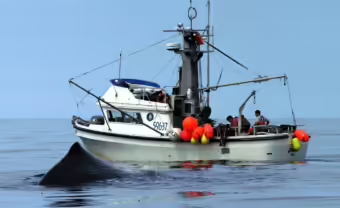
In this May 25, 2005, photo provided by the Southeast Alaska Sperm Whale Avoidance Project, a sperm whale swims near a fishing boat in Alaska. Sperm whales may be using the sounds of fishing boat engines as underwater “dinner bells” to hone in on valuable sablefish hooked by longlines in the Gulf of Alaska.

A Ketchikan fisherman has pleaded guilty in federal court to killing an endangered sperm whale in a first-of-its-kind case that highlights a long, little known conflict between the giant toothed whales and the fishermen whose sablefish catch they have learned to raid.

In a proposed plea agreement filed May 15, Dugan Daniels agreed to plead guilty to one charge of an illegal taking under the Endangered Species Act, a class A federal misdemeanor.

The charge stems from a March 2020 incident in which Daniels, 54, “knowingly took an endangered species of wildlife” by “having a crewman shoot the whale and trying to ram the whale with the F/V Pacific Bounty” in the Gulf of Alaska about 30 miles west of Yakobi Island, near the community of Pelican in Southeast Alaska, according to court filings in the case.

The case appears to be the first time someone has been criminally charged for taking a sperm whale in Alaska, according to the U.S. Attorney’s Office of Alaska.

Sperm whales can be more than 50 feet long and weigh up to 90,000 pounds. They’ve been listed as an endangered species since 1970.

Decades ago, sperm whales learned to pluck commercial fishermen’s catch from their gear, gaining an easy meal but costing fishermen a day’s work and ruining gear and putting whales at risk of entanglement or injury. Scientists call the phenomenon depredation, and an innovative collaboration between the fishermen and scientists in Alaska has long looked for ways to avoid conflicts.

For the most part, that collaboration has been successful, and fishermen have changed gear types to deter the whales from raiding their catch.

“I am deeply dismayed,” wrote Linda Behnken of the Alaska Longline Fishermen’s Association. “Longliners were proactive about seeking solutions to whale depredation and our organization worked hard to develop deterrents and avoid conflicts. Most eventually switched to pots as the most effective solution.”

“Whale depredation can be frustrating — I understand that— but I cannot comprehend what Mr. Daniels did,” she wrote.

Daniels also will plead guilty to a false labeling charge associated with black cod harvests he said took place legally in federal waters, but actually happened illegally in prohibited state waters. The plea agreement doesn’t discuss Daniels’ motive for illegally taking the whale.

Daniels’ federal public defender said she had no comment on the case.

It’s not clear how the National Oceanic Atmospheric Administration’s law enforcement arm caught wind of the incident, which happened in the open ocean, or why the case was charged more than four years later.

But the plea agreement suggests Daniels wasn’t quiet about it.

In text messages, Daniels “recounted these events — specifically, his crew shooting the sperm whale, his efforts to ram the whale with the vessel and coming within five feet of doing so, and his desire to kill the sperm whale,” according to the plea agreement.

It doesn’t say anything about what Daniels was fishing for on that day in March, or what kind of gear he was using or how he knew — and prosecutors knew — the shot whale died.

Sperm whales are found in every ocean on the planet. They were hunted heavily in the 19th century for a waxy substance produced by their digestive systems.

The 19th century classic “Moby Dick” was about a fisherman driven to madness in pursuit of a sperm whale.

Like humans, sperm whales love sablefish, also known as black cod, a fish prized for its rich, buttery taste.

Alaska fishermen used to harvest black cod in frenzied derby-style openings using longline gear. Then, in the 1990s the derby style opening was changed to a quota system, where fishermen with permits could harvest sablefish over a longer, monthslong commercial fishing season.

That’s when sperm whales started to regard the distinctive sound of longline gear dropping lines as something like a dinner bell.

“They use acoustic cues, sounds like a boat hauling gear. And they’re really deep-diving, capable of going to the bottom of a set,” said Suzie Teerlink, a marine mammal specialist with NOAA.

The whales would pluck an entire set worth of sablefish off longlines. For black cod fishermen, sperm whale depredation became not just an annoyance but a major financial and gear loss.

In 2003, a collaborative research project called SEASWAP was born, looking to understand the relationship between the whales and longline fishermen and to come up with ways to deter conflicts, said Jan Straley, a retired Sitka whale biologist who was a co-founder of the effort.

“The fishermen really drove the study,” said Straley.

In recent years, fishermen started to use a different kind of gear, called a slinky pot, that’s harder for marine mammals to break into than traditional longlines, said Teerlink.

An albatross flies over a surfacing sperm whale next to the US Fish and Wildlife Service research boat R/V Tiglax as it travels from Adak Island to Attu Island in 2015. (Bob Hallinen/ADN)

But not impossible: In the Bering Sea and Gulf of Alaska, there have been documented occurrences of sperm whales taking catch even from slinky pots, she said.

Sperm whales are so intelligent, it’s hard to stay one step ahead, Teerlink said.

“They’re really smart and are capable of learning human patterns and taking advantage of ways to get food.”

Daniels is set to appear in federal court on June 6 in Juneau.

This story originally appeared in the Anchorage Daily News and is republished here with permission.

Biologists describe freeing Unalaska whale from ‘life-threatening entanglement’

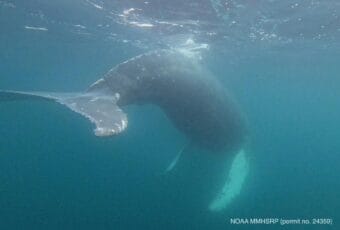
Experts say the whale looked good and that it was swimming normally. Once it got further out, it picked up some speed and took a nice deep dive. (From NOAA)

On April 1, a young humpback whale was found tied up in what was likely fishing line and anchored down in a busy area in Iliuliuk Bay. Four days later, a group of whale entanglement experts carefully cut the line wrapped around the humpback’s mouth and tail.

Ed Lyman, an entanglement response coordinator for the Hawaiian Islands Humpback Whale National Marine Sanctuary, thinks the whale was a two-year-old male who got hogtied while feeding in the area.

“(He) gets the line wrapped up in the mouth, panics, and twirls up,” Lyman said. “Suddenly, he’s got it on his tail as well — between the mouth and tail.”

It is unclear what type of fishing gear weighed down the 30-foot whale, but it gave enough slack for him to come up for air.

Lyman said the rescue process takes time. He has participated in 120 whale entanglements and said even though entanglements can be life-threatening for whales, they are not an immediate threat. He said whales are large animals, and disentangling can be deadly if not done carefully.

“So they have time on their side; we have time on our side,” Lyman said. “I’ve never been involved in entanglement where the animals died in a day or two.”

It’s unclear what type of fishing gear was weighing down the 30-foot whale, but it did give enough slack for the humpback to come up for air. (From NOAA)

The Alaska Department of Fish and Game in Dutch Harbor received a call about the entangled whale from locals who noticed that the humpback was breathing and unable to move freely.

It was then reported to marine traffic in the area. The U.S. Coast Guard in Alaska and the nonprofit organization Marine Exchange of Alaska posted a digital map displaying the entangled humpback, warning vessels entering the harbor to avoid the hazard.

Asia Beder, the state’s assistant area management biologist for Dutch Harbor, appreciated the patience shown by the community of Unalaska. She says it played a vital role in the successful rescue of the humpback whale.

“I know this was a very emotional story and event for the community,” she said. “By giving us reports, keeping the distance, and allowing us time, I think that created this into a success story.”

Local ADFG staff received expert advice on capturing footage of the whale entanglement using a camera attached to a pole. They said it helped whale experts determine specialized tools required for the rescue operation.

Sadie Wright, a large-whale entanglement response coordinator for the National Oceanic and Atmospheric Administration, is based in Juneau and has participated in 15 whale entanglements. She said whales can sometimes free themselves from entanglements. However, based on the photos and reports collected from the Unalaska community, it was clear that this whale needed help.

“It was a life-threatening entanglement, and we determined it needed an advanced response,” she said. “So reporting is essential.”

The Alaska Department of Fish and Game’s Ethan Nichols captained the primary vessel involved in freeing an entangled humpback whale in Unalaska’s Iliuliuk Bay on April 5, 2024. (Sofia Stuart-Rasi/KUCB)

The actual rescue took two days. On a boat, local Fish and Game biologists and visiting whale experts gathered data from specialized tools. They floated around the whale and sometimes over it. The team used a large pole with a hook knife at the end of it, and a camera attached, so they could see in real time where the knife was cutting the rope underwater.

“We knew which line we wanted to cut first, and then second, to try to encourage the rope to then come off by itself to slide off the animal,” Wright said, “which eventually happened.”

Lyman said the whale cooperated during the rescue and even seemed curious at times.

“It would almost rise up a little bit more and lean over a little bit,” he said. “Like, ‘What are you guys doing? Why are you here?’ You know, that kind of thing.”

After the whale was cut loose, the team followed it out of the bay and into the Bering Sea. They said the whale looked good and was swimming normally. Once it got further out, it picked up some speed and took a nice deep dive. Lyman said there’s a good chance the humpback will be fine.

“You know, I would almost bet on it, and I’m not a betting man,” he said.

The whale rescue team recommends not putting unnecessary objects in the water and reducing the use of floating lines to prevent whale entanglements.

The young humpback whale is currently identifiable with a string-like mark on its dorsal fin, which the team thinks is from when the whale was trying to break free from the gear.

Most animals don’t go through menopause. So why do these whales?

A post-reproductive toothed whale mother and her son. (David Ellifrit/Center for Whale Research)

Across the animal kingdom, menopause is something of an evolutionary blip. We humans are one of the few animals to experience it.

Sam Ellis, an animal behavior researcher at the University of Exeter, says that this fact isn’t so surprising.

“The best way to propagate your genes is to get as many offspring as possible into the next generation,” says Ellis. “The best way to do that is almost always to reproduce your whole life.”

So perhaps it’s more surprising that a handful of animals ever evolved this trait.

Ellis and his team at the University of Exeter have recently published a study in the journal Nature that sheds light on how this trait may have evolved in toothed whales. There are five species of toothed whales that undergo menopause — short-finned pilot whales, false killer whales, killer whales, narwhals and belugas — making it the type of animal that is known to have evolved menopause most frequently.

A winning intergenerational survival strategy

The rare nature of menopause across animals doesn’t mean, however, that it’s a bad strategy.

Ellis and his team, in partnership with the Center for Whale Research, looked at the welfare and longevity of menopausal toothed whales versus non-menopausal toothed whales. They found that not only do the menopausal female whales live, on average, 40 years longer than females of other species — these females also live longer than the males of their own species.

Researchers think that reason for this could be tied to reproductive competition.

Generally, if a mother and her daughter are both reproducing and living in the same group at the same time, they’re competing for the same resources. “There’s a limited amount of food around and you’ve got to choose who you give it to,” says Ellis. “And so there’s competition.”

According to the grandmother hypothesis, menopause could help avoid that competition. Older females can better protect their offspring — and better ensure their genes are passed on — by instead helping to protect and provide for their children and grandchildren.

Why toothed-whales?

For menopause to evolve, very specific circumstances are needed.

First, females must spend their lives in close contact with both their immediate offspring and their grand-offspring in order to create this reproductive competition. In menopausal toothed whales, not only do the lifespans of females overlap with their direct kin and grand-kin, they can continue to interact with these generations throughout their lives — as observed in killer whales, for example.

Second, the females must have an opportunity to help their families after they can no longer reproduce. There are various ways that older female toothed whales can provide intergenerational help. They might share food with relatives, share their knowledge of the ecosystem and lurking dangers, or even help babysit their grand-calves.

All of this behavior has been documented in toothed whales. While much of whales’ social structures are still unknown, beluga whales and narwhals are usually called “matrifocal,” meaning the oldest female takes charge.

Essentially, menopause helps create a social role of the whale grandmother. She sticks close to her descendants, helps them in times of need and shares her wisdom.

Ellis says that while scientists can’t say for sure, humans likely evolved menopause for similar reasons. “It looks like there’s only one pathway for the evolution of menopause.”

He and his team plan to dive deeper into intergenerational help – instances they see in these whales and other menopausal species.

But for now, this research reveals some of the similarities we humans share with creatures that at first glance seem quite different from us. Not only are both animals menopausal, we’re also long-lived — with grandmothers that play a large role in our social structures.

Curious about other animal behavior mysteries? Email us at shortwave@npr.org.

Listen to Short Wave on Spotify, Apple Podcasts and Google Podcasts.

Listen to every episode of Short Wave sponsor-free and support our work at NPR by signing up for Short Wave+ at plus.npr.org/shortwave.

Today’s episode was produced by Rebecca Ramirez and Gus Contreras. It was edited by Rebecca, Viet Le and Christopher Intagliata. Rebecca also fact-checked it, alongside Rachel Carlson. Kwesi Lee and Ko Takasugi-Czernowin were the audio engineers.

Copyright 2024 NPR. To see more, visit https://www.npr.org.

Federal agency says Alaska’s coastline has potential for more renewable energy, carbon storage projects

Kodiak generates about 20 percent of its electricity from wind. The Kodiak Electric Association has installed six turbines on Pillar Mountain since 2009. (Photo by Eric Keto/Alaska's Energy Desk)
Wind turbines in Kodiak. (Photo by Eric Keto/Alaska’s Energy Desk)

A little-known federal agency called Bureau of Ocean Energy Management has a big role in regulating nearly 7,000 miles of coastline in Alaska.

Last week, the bureau’s Regional Director Givey Kochanowski and Public Affairs Officer John Callahan met with dozens of lawmakers in Juneau. They also met with KTOO reporter Anna Canny, who asked them about the emergence of new technologies like offshore renewable energy and carbon storage projects in the state.

This interview has been edited for length and clarity.

Givey Kochanowski: Good morning. I’m Givey Kochanowski. I’m the Regional Director for the Alaska region of the Bureau of Ocean Energy Management.

John Callahan: Yeah, John Callahan, and I’m the Public Affairs Officer for the Alaska Region.

Anna Canny: Thanks for joining me this morning. So I want to start off just for some of our listeners who haven’t heard of the Bureau of Ocean Energy Management. Could you give us a little rundown of some of the work your agency does?

Givey Kochanowski: We were created by Congress, originally to economically and environmentally friendly developed the Outer Continental Shelf, and those means the federal waters of the United States. And here in Alaska and elsewhere, that begins three miles offshore. So we’re not a funding or development agency. We’re a regulatory and permitting agency. So we work with other federal and state agencies to accomplish our mission in partnership.

John Callahan: Um, if you wanted to explore for oil and gas, or minerals, or develop any energy sources in that zone — more than three miles offshore — we’re the bureau that you would come to.

Anna Canny: Sounds like that would apply to a wide variety of resource development projects. And I know in the past, the agency has focused on oil and gas projects, but I’m wondering if you could speak a little bit to the agency’s recent shift towards renewable energy projects?

Givey Kochanowski: It’s kind of a shift, but it’s kind of not a shift at the same time. We have never stopped doing our legacy mission of conventional energy, we have active leases and Cook Inlet and on the North Slope for conventional energy. We have petroleum engineers on staff that helped maintain our work and the conventional side. But in addition to that, we’re expanding into some exciting new areas, which include renewable power, critical minerals and marine minerals, and also carbon storage. But on a renewable front, what’s really exciting right now is a study that just came out from the National Renewable Energy Lab that we funded, looking at the renewable energy potential for Cook Inlet. And that has grid-wide impacts for Alaska where the majority of our population lives.

John Callahan: Tidal energy is promising, wind energy is probably more promising in terms of a development prospect in the near-term. There’s an area off Southern Cook Inlet, north of the Barren Islands, that has literally literally some of the best winds in the world — it blows hard, it goes constantly — and those are the sort of resources that we’re looking to bring to bear.

Anna Canny: Okay, so developing renewables, that’s huge for cutting the amount of carbon emissions we’re putting into the atmosphere. On the flip side of that, I noticed you mentioned carbon storage or carbon sequestration — basically taking carbon out of the atmosphere and storing it, in this case, underground. And I thought that was really interesting. That’s been a hot topic here in Alaska, since Governor Dunleavy introduced his carbon management bill last session. So what will BOEM’s role be in, in safely rolling out those types of projects in the state?

Givey Kochanowski: If you look at a map of the state, many of the areas in coastal Alaska that fall in the federal jurisdiction, are very well suited for carbon storage — so the Cook Inlet and Northwestern Alaska — I think this is an exciting time to be in this space to be in the ground level of it. And that it’s also wonderful to come down here and learn that the state government is working in parallel to a lot of what we’re trying to accomplish, that there could be a lot of synergies there and collaboration.

John Callahan: Yeah, and, and very relevant to that, so carbon sequestration, as you know, is a very promising technology, right? But it’s in its relative infancy. Our bureau, we again, are the ones who are going to be tasked with regulating that, in the offshore space. And in fact, we have been developing draft regulations in concert with other cooperating agencies, and expect to have draft regulations out to that effect later this year.

Anna Canny: And finally, you’re in town this week talking with legislators about some of these things — the carbon sequestration, the new renewable energy projects – how are those conversations going? And could you give us an idea of, of what that might mean for the agency’s future work in the region?

John Callahan: All the legislators down here, both left and right, are very focused on energy issues — well-informed, we’ve gotten good questions. And we really appreciate the opportunity to educate them on how BOEM is part of that energy mix, especially as we get this renewable energy initiative kicked off.

Givey Kochanowski: Yeah, and you know, as Alaskans, many of us have concerns about the overreach of the federal government pushing stuff onto the state without state coordination or collaboration, and there’s no better way to get collaboration than working with the state, coming down here talking to legislators working with state agencies, like the Alaska Energy Authority, and the Department of Natural Resources, Department of Revenue. And we have several state agencies as part of our Cook Inlet workgroup, looking at ways to harmonize the development pathway for industry, so that you don’t get nine or ten different answers from nine agencies, that you get a solid approach to what will it take to actually make a project happen in Alaska.

Study tracks calls used by endangered Alaska belugas — and human-made noise in their habitat

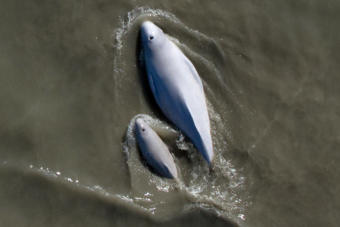
A beluga whale and calf, seen from above
A Cook Inlet beluga whale mother and calf. A research project has identified and catalogued a variety of calls that Cook Inlet belugas use to communicate with each other. The study also found that commercial shipping is the dominant source of human-made noise in the inlet and may be interfering with the endangered whales’ calls. (Photo by Hollis Europe and Jacob Barbaro/NOAA Fisheries)

For the first time, the underwater calls made by the endangered beluga whales in Southcentral Alaska’s Cook Inlet have been recorded, identified and cataloged.

To accomplish that, University of Washington Ph.D. student Arial Brewer spent thousands of hours listening to the noises captured from audio devices planted on the seafloor. The result was a catalog of 18 distinct calls used by the belugas, which were a mixture of whistles and pulsed calls.

And, importantly for the belugas’ conservation, there is now evidence that those calls might be getting drowned out by noises from the commercial ships that ply the marine waters of Alaska’s most populous region, according to a study led by Brewer that details the findings.

Commercial ships are the dominant noise source in the inlet, “the most prevalent and just lasted the longest,” Brewer said. “Commercial ship noise can last for hours and hours.”

Brewer, in addition to her Ph.D. studies, works at the National Oceanic and Atmospheric Administration’s Alaska Fisheries Science Center. That agency and the Alaska Department of Fish and Game were partners in the study.

Cook Inlet belugas, which number about 330 animals according to the most recent estimates, are among the world’s 21 beluga populations. Only a few have had their calls recorded and cataloged, so that raises questions about the specificity of the 18 Cook Inlet calls that Brewer found.

“Whether those are completely unique to Cook Inlet or they just haven’t been described in other populations, we don’t know for sure,” she said. But it would be logical to think that the Cook Inlet calls are geographically distinct because the beluga population there has been isolated for 10,000 years, she said. “So, you know, ecologically, I think it makes sense.”

Also yet to be determined, she said, is whether Cook Inlet belugas are increasing the sound levels of their calls so they can be heard over the din of ship engines and other manmade noises. That behavior, known as the Lombard effect, does happen elsewhere, such as among belugas in eastern Canada’s St. Lawrence River, she said.

During the project, which used acoustic devices planted on the seafloor at two key sites in 2018 and 2019, Brewer and her partners heard plenty of other underwater noise. What is believed to be oil and gas activity sounded like “jingling or flushing” she said. There were occasional bursts from small boats’ outboard motors. Even airplane noise could be distinctly heard from the bottom of the inlet.

“I was really surprised when I started on this project,” Brewer said. “You can hear if it’s like a commercial plane coming into the airport or if it’s like a little prop plane and it really sounds like it does in air.”

There are also natural sounds, like calls from humpback or killer whales that may swim through, and the scratching and popping of ice, which is likely seasonal background noise to Cook Inlet belugas.

For some environmentalists, the findings about ship noise are evidence that regulators need to do more to reduce effects on industrialization on Cook Inlet belugas, which federal scientists say numbered about 1,300 in 1979 but declined steeply after then.

The Center for Biological Diversity has been calling for a pause to issuances of incidental harassment authorization that allow operators in the inlet to accidentally disturb belugas and other Cook Inlet marine mammals. Those authorizations are granted under the federal Marine Mammal Protection Act, either by NOAA’s National Marine Fisheries Service or by the U.S. Fish and Wildlife Service, depending on the marine mammal species.

Under the act, the actions, known as “takes,” that are permitted through authorization can range anywhere from minor encounters that might cause a protected animal to have a slight physical reaction like a change in swimming direction to those that cause accidental animal deaths. The allowable takes depend on the type of authorization.

Some of the most recent authorizations issued for incidental harassment of Cook Inlet belugas and other inlet marine mammals were given in 2022 to Hilcorp for activities around a drill rig. The first authorization covered work until Sept. 14, 2023; and the second is valid until mid-September of this year. More recently, the National Marine Fisheries Service in January issued an incidental take authorization to the Port of Alaska for construction work.

The Hilcorp authorizations were issued over the objections of the Center for Biological Diversity and other organizations. In a petition submitted in 2022, the center asked NOAA’s National Marine Fisheries Service to stop issuing incidental harassment authorizations until it completes a study of the cumulative effect on the endangered beluga population.

“They’re allowing tens of thousands of these takes a year, and that’s just incredibly harmful,” said Cooper Freeman, Alaska representative for the Center for Biological Diversity. “And they have no idea what the cumulative effect of all that is.” Since most of the activities in the inlet do not require incidental harassment authorizations, a pause should not cause serious problems, Freeman said.

“The residents love Cook Inlet beluga whales and really care about these whales and want to see their recovery,” he said. “We think that the agency, by completing this cumulative analysis, can help meet their goal of recovering the belugas and get a better handle on all the impacts that are hindering their recovery.”

While authorizations issued over the past nine years allowed a cumulative 100,000 beluga takes, the actual number that occurred was far lower, according to a NOAA spokesperson. Virtually all the permitted takes in Cook Inlet have been for what is classified as minor disturbances not expected to cause harm, said agency spokesperson Julie Fair. Examples of allowable takes include research activities that support the agency’s Cook Inlet beluga recovery plan, she said.

Beyond the question of permitted takes, there is another way to reduce noise impacts to belugas and other whales: slower speed limits.

Brewer pointed to Washington’s Puget Sound as an example. There, in habitat for an endangered killer whale population, shippers are experimenting with slower vessel speeds. It is, for now, a voluntary program.

Additionally, a new state law that goes into effect next year creates a mandatory 1,000-yard vessel buffer there to protect the whales.

Noise disturbances have been at the center of concerns elsewhere in Alaska, including their potential effect on whales swimming in Arctic waters. There, climate change has reduced sea ice and expanded shipping opportunities.

2021 study by Canadian and U.S. scientists, including some from the University of Alaska Fairbanks and Alaska Department of Fish and Game, found that belugas and bowhead whales in the Chukchi and Beaufort seas are swimming in the same places where ship traffic is expected to increase. “Without proactive vessel management and effective mitigation measures, acoustic disturbance of whales is expected to increase, and eventually expand to more months of the year, as ship traffic continues to increase in step with increases in the length of the open water season,” the study said.

This story originally appeared in the Alaska Beacon and is republished here with permission.

Scientists investigate paralytic shellfish poisoning as possible factor in large marine die offs

Blue mussels at Nahku Bay. (Claire Stremple/KHNS)

Paralytic shellfish poisoning, or PSP, is a growing concern for Alaska’s entire marine food web, according to a scientist who presented testing data at Alaska Forum on the Environment on Monday.

Bruce Wright is senior scientist at the Knik Tribe and leads PSP monitoring efforts across the state. He said while PSP has been a concern for subsistence shellfish harvesters for centuries, he and other scientists have begun noticing deadly marine toxins targeting animals at every level of the food chain, from plankton to whales.

“We’re finding PSP in just about everything we test, all the animals we test, at different levels, different times of the year, different locations,” Wright said.

Paralytic shellfish poisoning can occur when a type of algae called Alexandrium blooms in the ocean, releasing lethal neurotoxins that end up lodged in many species of clams, mussels, scallops and other shellfish. In high concentrations, a single clam could kill a person.

“One of the pathways is shellfish,” Wright said. “But the other pathway is Alexandrium to zooplankton, to macrozooplankton and forage fish, to predatory fish like salmon and cod, and then the top predators like whales.”

Wright said this research could potentially help explain recent population declines and die-offs in Alaska’s marine ecosystem — like the Pacific cod crash in the Gulf of Alaska or the ongoing Yukon River king salmon collapse.

“I know there’s other issues out there with the Yukon River king salmon, but this might be one of them,” he said.

Wright presented recent data showing detectable levels of paralytic shellfish toxin in many species of predatory fish, including cod and salmon. A Yukon king salmon liver harvested in 2023 nearly broke the Food & Drug Administration’s maximum limit of toxin for safe consumption.

Graphic depicting trophic transfer of PSP toxins produced by Alexandrium cells to shellfish, zooplankton, shellfish consumers, forage fish, predatory fish, and eventually to top predators such as seabirds and marine mammals. (Credit: Steve Kibler, NOAA)

Wright said the data his team has collected is anecdotal so far, but he’s continuing to test samples from animals all over the state. He said he suspects toxins will show up in more places as climate change warms ocean waters and pushes harmful algal blooms further north.

Steve Kibler, a NOAA research biologist who studies harmful algal blooms all over the country says there are still a lot of unanswered questions, like how paralytic shellfish toxins move through the food web.

He said without more data it’s hard to know how much toxin is lethal for different animals, or what the biological effects are.

“It does make me worry that the toxins could be having an impact,” Kibler said. “It definitely hurts their fitness. Maybe they can’t feed as well, can’t reproduce as well, can’t migrate. Those are all major issues.”

Kibler and Wright both have more data collection planned this summer to begin piecing together how paralytic shellfish toxins may be impacting the health of Alaska’s ocean food web.

Site notifications
Update notification options
Subscribe to notifications