Anchorage Daily News

Anchorage Daily News is our partner in Anchorage. KTOO collaborates with partners across the state to cover important news and to share stories with our audiences.
Juneau man accused of killing Anchorage cellmate found competent to stand trial on murder charges

Lawrence Fenumiai appears in court in Anchorage on February 19, 2025. Fenumiai is charged with murder after a fellow inmate died following an assault at the Anchorage jail in December 2024. (Marc Lester/ADN)

Lawrence Fenumiai, the 34-year-old Juneau man charged with killing his Anchorage jail cellmate in a December 2024 assault, will return to the criminal justice system after being found mentally competent to stand trial.

Both Fenumiai and his cellmate, 36-year-old William Farmer, were diagnosed with schizophrenia in their 20s. Their family members say the state should never have housed them together.

Less than 24 hours after Farmer entered custody, prosecutors say, the brief but violent assault occurred, leaving Farmer with a traumatic brain injury. He never regained consciousness and died at Providence Alaska Medical Center in January 2025.

Now the Alaska Department of Corrections needs to house Fenumiai again in a way that safeguards his mental state and protects others in custody with him.

Farmer’s twin sister, Robin Farmer, told the Daily News this week that her family does not want Fenumiai put through the trial process.

“What good would a guilty verdict do?” Farmer wrote in a message. “It would only put him back in the same environment and circumstances it happened in.”

Fenumiai was found incompetent to stand trial in this case three times: in February, May and August of last year, according to filings in the case.

He was found competent last month.

Judge Josie Garton presides over a competency hearing in Anchorage on February 5, 2025. (Marc Lester/ADN)

Fenumiai spent a total of 335 days in restoration programs at the Alaska Psychiatric Institute starting in February 2025, according to court filings.

The programs help prepare criminal defendants with mental illness to stand trial. In Alaska, a defendant must understand court processes enough to meaningfully assist in their defense. Otherwise, the charges against them are dismissed.

On Monday, Anchorage Superior Court Judge Josie Garton officially arraigned Fenumiai on the charges against him: first- and second-degree murder.

Fenumiai, wearing a hooded puffy coat over light blue hospital pants, attended the hearing, sitting quietly and without expression next to his attorney. A Court Services officer sat nearby.

Attorneys representing both the state and Fenumiai stressed the need for the Department of Corrections to provide safeguards as Fenumiai transitions back to jail.

Their concern is that Fenumiai could “decompensate” — become unstable or experience a sudden worsening of his symptoms — when he’s moved out of the familiar environment of API into the potentially overstimulating atmosphere at the jail.

“The state wants to be notified as soon as possible if there’s decompensation,” prosecutor Ashley McGraw said at a hearing last week, adding that prosecutors want the case to move along as quickly as possible to avoid future competency issues.

Fenumiai was supposed to be released from jail the week the fatal assault occurred in 2024. A judge had dismissed an assault case involving his father after finding Fenumiai incompetent to stand trial.

Instead, the former high school football standout was still in a general population intake unit with another man when Farmer came into their cell. Farmer was given a bed on the floor of the crowded unit in a cell intended for two people.

The incident raised questions as to how the Department of Corrections handles the challenge of housing people with diagnosed mental health disorders, who make up nearly a quarter of the state’s in-custody population.

Those questions are resurfacing now.

State corrections officials have “consistently failed” to keep people safe in custody, Robin Farmer said this week.

“They failed to keep William safe from harm, and failed to keep Mr. Fenumiai safe from causing harm. Why would anyone think they’ll do it now?” she wrote. “My family and I understand the complexities of a loved one living with mental illness, and although deeply saddened by the loss of William, believe the real criminal is the Department of Corrections and hold no personal hatred towards Mr. Fenumiai or his family.”

Fenumiai’s family declined to comment for this story.

The corrections department completed an internal review of the 2024 assault, according to spokesperson Betsy Holley.

“We are aware of comments made by Mr. Farmer’s family and understand their concerns regarding this situation,” Holley said in an email. “The Department of Corrections will not address allegations or ongoing matters in the media.”

A pedestrian walks on 40th Avenue near the Alaska Psychiatric Institute. (Marc Lester/ADN file)

While at API, Fenumiai is voluntarily taking medications prescribed to him, attorneys said during last week’s hearing. He can stay at API through the end of this week.

Medical staff at the Anchorage Correctional Complex will reach out to API staff to coordinate a “warm handoff” when Fenumiai is transferred back to the jail, assistant attorney general Kevin Dilg said during last week’s hearing. That would mean API staff familiar to Fenumiai would be directly involved as jail staff take custody of him.

Fenumiai may be housed in one of the jail’s two designated mental health units, said Dilg, who is representing the corrections department in the case. But that will depend on Fenumiai’s evaluation by staff at the jail, he said.

“I can’t really say a whole lot” until Fenumiai arrives at the jail for intake and assessment, Dilg said.

Fenumiai’s legal team may pursue an insanity defense. Under Alaska law, an arraignment starts a 10-day window for attorneys to file an insanity defense notice.

David Biegel, one of Fenumiai’s attorneys, on Monday asked Garton for a 60-day extension, a request opposed by the state. Biegel said he needs time to not only talk with his client but make sure he understands what they’re discussing.

“Mr. Fenumiai has been charged with first-degree murder. That’s the most serious crime we have in this state,” Biegel said during Monday’s hearing. “I think we all share a concern of decompensation but I don’t think that is any basis to steamroll a decision.”

It’s also possible the case will resolve via plea agreement. McGraw, the prosecutor, said the state has an approved offer.

Garton extended the insanity plea filing deadline to Feb. 17, noting that “there is an interest in this particular case in ensuring that it moves expeditiously toward trial, if it’s not going to resolve in another way, just because of the risk of decompensation.”

This story was published by the Anchorage Daily News and is republished here with permission.

In lawsuit, 2 school districts say Alaska fails to meet its constitutional obligation on public education

Students end their school day in Aniak. Theirs is one of nine schools in the Kuspuk School District, which is a plaintiff in a lawsuit filed against the state Tuesday alleging years of inadequate education funding. (Photo by Emily Schwing)

Two Alaska school districts filed a lawsuit Tuesday in Anchorage Superior Court against the state, its governor and its education commissioner over what they say is a long-running failure to adequately fund public education.

In the complaint, the Kuspuk School District and the Fairbanks North Star Borough School District argue “the state is failing to meet its constitutional obligation” both to provide Alaska students “a sound basic education and meaningful opportunity for proficiency” in vital subjects, and “to fund schools and school districts at a level that is adequate to provide students with a sound basic education.”

The plaintiffs are seeking a declaratory judgment that the state is violating the Alaska Constitution by failing to sufficiently fund public education. They say the state is violating the plaintiffs’ and students’ rights to substantive due process. They’re also seeking an injunction directing the state to fulfill its constitutional obligations, and requesting a court-ordered adequacy study to determine what it costs to educate students.

“Alaska, we don’t believe, has ever done an adequacy study to really understand what it would take to allow Alaska students a fair opportunity to learn the skills they need to participate and contribute to society,” said Matt Singer, a trial attorney representing the plaintiffs. ”If you don’t know what something is going to cost, then you can’t have a conversation with the Legislature about how to fund it,” he said.

The lawsuit points to low proficiency assessment scores, reductions in teaching staff and the elimination of fine arts, career technical and vocational education programs as direct impacts due to years of chronic underfunding. It also cites dangerous conditions inside school buildings.

“The last eight years, we’ve experienced a governor that has put forward a zero dollar budget going into budgeting,” said Kuspuk School District Superintendent Madeline Aguillard. “That’s almost a decade of just starting at nothing and when you have to claw your way to even less than minimal funding, that takes a toll,” said Aguillard.

A spokesperson with the governor’s office deferred to the state Department of Law.

“The responsible path is legislation — not litigation,” Department of Law spokesperson Sam Curtis wrote in an email Tuesday night, noting that “we have not been served with this lawsuit and have not yet had an opportunity to review the claims.”

The education clause in Alaska’s constitution does not specify a dollar amount for education. Instead, wrote Curtis, the constitution “vests the power of the purse squarely in the Legislature and the Governor. The legislative session began today. That is where education policy and funding decisions are meant to be debated and resolved.”

Superintendent Madeline Aguillard oversees nine rural public schools in Western Alaska’s Kuspuk School District. (Photo by Emily Schwing)

It’s not a coincidence the suit was filed on the same day legislators convened in Juneau for this year’s legislative session, according to Fairbanks North Star Borough School District Superintendent Luke Meinert. “I think it sends the message that the work on education funding is not done,” said Meinert. “We’re calling on this year’s Legislature to continue to work on that issue. They have the power to do so. Nobody else does,” said Meinert.

Education Commissioner Deena Bishop did not respond to a request for comment as of Tuesday evening. When she was superintendent of the Anchorage School District, Bishop consistently advocated for increased state funding for public schools through a change to the state’s education funding formula. But Bishop changed her stance when she became education commissioner under Dunleavy, arguing that the state’s budget is strained and that she preferred a more targeted approach to increasing school funding, like providing more money for tutors.

In the past, Bishop has said her department is not responsible for allocating funds for education. “The levers that I can pull aren’t levers for funding,” Bishop said in a 2024 interview. “I don’t create the money. The Legislature creates that, but we can certainly support policy that would help support schools as their needs come up,” she said.

Caroline Storm, executive director of Alaska’s Coalition for Education Equity, a nonprofit organization that is helping finance the lawsuit, said that “legal action is not the only way, but it raises the public awareness.” Storm said years of advocacy from her organization and others simply “hasn’t moved the needle enough” in Alaska to pay for wide-ranging needs from curriculum to building maintenance.

Storm said the lack of financial support for public education should be central to this year’s election cycle. “In my mind I don’t frame that as using politics, but ensuring something that is in our constitution,” said Storm.

According to Article VII of Alaska’s constitution, “the legislature shall by general law establish and maintain a system of public schools open to all children of the State.” For years, the complaint alleges, the state has failed to do so.

“This does not come as a surprise to me,” state Sen. Löki Tobin, an Anchorage Democrat who chairs the Senate Education Committee, said Tuesday. “In this conversation around adequate school funding, our local school boards have been bleeding,” she said.

“They have come to Juneau, they have talked to our commissioner, they have elevated the desperate need that they are under to have adequate state funding. We know that the state support for schools has been slowly diminishing,” said Tobin, who is also a member of a task force formed at the end of last year’s legislative session to address education funding, among other issues.

Alaska’s public schools receive funding from two state budgets. Capital funds pay for building maintenance, upgrades and construction. Money for operations, often referred to as the Base Student Allocation, or BSA, buys things like textbooks and pays for teachers’ salaries. According to the complaint, Alaska allocated $5,800 per student in 2015. Over a decade, the number had risen only 2.2%, totaling $5,960 in 2025.

“The state is failing in all regards,” said Singer. “In order to provide a basic sound education, you need a lot of different things,” he said. “One of the things is a safe school building with a roof and heater. Another thing you need is a competent teacher standing in front of a classroom educating young people.”

After years of relatively flat state funding for schools amid rising operational costs, Alaska lawmakers during the 2025 legislative session passed a $700 increase to the BSA, then gained enough support to override Gov. Mike Dunleavy’s veto of the bipartisan education bill — and later overrode his veto of $50 million in education funding from the budget.

While advocates celebrated the funding increase, many education leaders have said it still falls short of what school districts need to effectively operate, and the plaintiffs in the lawsuit filed Tuesday said the increase in the BSA was “woefully insufficient to keep pace with inflation, which had eroded purchasing power by 37% in the preceding decade.” After last year’s protracted battle over school funding, and with state revenues projected to be lower than expected, it’s unclear whether there’s enough traction in the Legislature to pass another increase this year.

There are more than 50 school districts in Alaska, and most are located within cities or organized boroughs, which have access to local tax revenue to help fund education.

Nineteen districts are nearly entirely reliant on the state for funds, because they serve rural, unincorporated communities where money from local taxes is simply not available to help pay for schools. Dozens of those school buildings are owned by the state education department, including in the Kuspuk School District, which straddles the middle stretch of the Kuskokwim River and covers an area roughly the size of Maryland in Western Alaska.

State assessment data on student performance within the Kuspuk School District “are dire,” according to the complaint. The numbers show 90% of the district’s 330 students during the 2024-25 school year were not proficient in English language arts, math or science. Aguillard said chronic underfunding from the state is having an outsized impact on districts like hers, where the student population is predominantly Indigenous.

Bats sometimes fly through the hallway and classrooms in Sleetmute. The building’s roof had a leak for nearly two decades before state funds finally became available for repairs. (Photo by Emily Schwing)

Those students aren’t only struggling with classwork. For years, Aguillard said her district has had to pull funds from its operational budget to keep buildings open. Over the last two years, an investigation by KYUK Public Media, NPR and ProPublica uncovered a public health and safety crisis inside many of Alaska’s public schools and in particular, in rural schools that serve predominantly Indigenous student populations. In one school, bats occasionally fly through classrooms and the hallway. At a school above the Arctic Circle, maintenance staff struggled for years with a persistent toxic chemical leak from the heating system, and in several cases across the state, failing plumbing means kids have to leave school to go to the bathroom.

Dozens of studies cited by the U.S. Environmental Protection Agency highlight negative impacts on student performance as a result of poor maintenance and conditions inside schools. The investigation found black mold inside several Alaska schools. Exposure can increase the risk of asthma and is linked to higher rates of absenteeism. According to the agency, leaking roofs and problems with heating and ventilation can also impact academic performance.

The situation isn’t unique to rural school districts, however. In an interview, Meinert described at length the tangible impacts a $5 million budget deficit has had in the Fairbanks North Star Borough School District, one of the three largest in the state.

“The state does have a responsibility to provide safe and adequate facilities for our students not only in rural Alaska but also in urban Alaska,” said Meinert. In the last five years, seven schools in his district have been forced to close due to a budget shortfall. Meinert said the district opted to outsource its custodial jobs and eliminate more than 70 positions. Since 2019, Meinert said, his district has terminated more than 300 teaching positions districtwide, which means class sizes have swelled to more than double what the National Center for Education Statistics reported for the state five years ago.

Meinert contends that a lack of state financial support within his district is also disproportionately impacting the minority student population. State assessments show that more than 76% of Indigenous and economically disadvantaged students in the district are not proficient in English language arts.

On Monday, Aguillard got word from an architect that most of the roof joints that hold up the roof of the school gym in Aniak are broken. “We are closing the high school immediately and beginning plans to demolish before it collapses,” she wrote in a text message. In the last three years, experts have said at least three buildings in her district should not be occupied.

Aguillard has also been scrambling with maintenance staff over the last two weeks. This winter, communities across the state experienced a prolonged and extreme cold snap in December and January. Eight of the Kuspuk district’s nine buildings could not open in time for students to return from the holiday break because there was no running water, heat or electricity. The majority of the buildings in the district are owned by Alaska’s education department.

”It’s unsettling,” Aguillard said. “Our buildings should not be shutting down so easily. It’s really just evidence of the decline of the capacity of those buildings,” she said.

Alaska vowed to resolve murders of Indigenous people. Now it refuses to provide their names.

Charlene Aqpik Apok is the executive director of Data for Indigenous Justice, a nonprofit that requested a list of every Alaska Native murdered in the state over the past three years. The state said it doesn’t collect that information. (Marc Lester/ADN)

This article was produced for ProPublica’s Local Reporting Network in partnership with the Anchorage Daily News. Sign up for Dispatches to get our stories in your inbox every week.

Leaders in Alaska and elsewhere have repeatedly promised action in recent years to address the nation’s chronic failure to solve the murder or disappearance of Indigenous people.

Federal legislation backed by Alaska Sen. Lisa Murkowski called for improving data collection and information sharing among law enforcement and tribes. Gov. Mike Dunleavy said again and again and as recently as May 5 that the state government would work with Alaska Natives to address the crisis.

“My administration will continue to support law enforcement, victim advocacy groups, Alaska Native Tribes and other entities working together to solve these cases and bring closure to victims’ families,” Dunleavy said in a news release last year.

Yet when an Alaska Native group asked state law enforcement officials in June for one of the most fundamental pieces of data needed to understand the issue — a list of murders investigated by state police — the state said no.

Charlene Aqpik Apok launched Data for Indigenous Justice in 2020 after trying to collect the names of missing and murdered Indigenous people to read at a rally, only to discover no government agency had been keeping track. Over time, the nonprofit built its own homegrown database with the help of villagers, friends and family across the state.

In 2023, the state started publishing a list quarterly with names of Indigenous people reported missing. But the state still does not issue a list for the other key piece of the group’s efforts: Indigenous people who have been killed.

So on June 4, the nonprofit filed two public records requests with the Alaska Department of Public Safety concerning homicide cases the agency had investigated since 2022. The group asked first for victims of all races and then for those identified as Alaska Native.

Apok said she didn’t think the request was controversial or complicated.

But the state rejected the requests a week later. The agency said fulfilling the request would take “several hours” and cited a state regulation allowing a denial if providing information to a requester would require employees to “compile or summarize” existing public records.

“We do not keep lists of victims of any type of crime, including homicide victims, and to fulfil this request DPS would have to manually review incident reports from multiple years to create a record that matched what you are looking for,” Austin McDaniel, communications director for the department, wrote to the nonprofit.

McDaniel offered no direct response when the Anchorage Daily News and ProPublica asked why the agency could not retrieve homicide records with a simple database query or why, even if the work required manual review and wasn’t required under state law, the agency didn’t simply create a list of homicide victims.

(Alaska’s public records law says any records that take state employees fewer than five hours to produce shall be provided for free, and the state can choose to waive research fees if providing records would serve the public interest. Even if an agency needs to create a new record, as McDaniel asserted in his denial, it’s allowed to “if the public agency can do so without impairing its functioning.”)

Data for Indigenous Justice appealed the denial to the head of the department, Public Safety Commissioner James Cockrell, who decided in favor of the agency.

The nonprofit’s records request and the state’s denial revealed that Alaska, four years after creating a council on murdered and missing Indigenous people, cannot readily identify murder cases involving Indigenous victims. The state now employs four investigators who focus on such cases.

“How do they know which cases are Alaska Native or Indigenous people for their MMIP investigators if they cannot do a simple pull of the demographics that we are talking about?” Apok said.

Apok said tracking complete and accurate data on Indigenous people who have disappeared or been killed matters because otherwise, law enforcement can shrug off individual cases and deny the scale of the problem.

“That’s the power of data. That’s the power of collective information,” she said.

Grace Norton holds a photo of her niece, Ashley Johnson-Barr, who was murdered in Kotzebue, Alaska, in 2018. Kotzebue residents walked along Shore Avenue and scattered rose petals in remembrance of missing and murdered Indigenous people in 2023. (Marc Lester/ADN)

In lieu of answering detailed questions for this story, McDaniel provided a one-page response saying that the department receives thousands of records requests each year. He said the agency is a “leader in data transparency” for missing and murdered Indigenous people, adding that “to imply that we are not invested in this work due to the denial of one records request from an advocacy group is absurd.”

He cited as examples of transparency the department’s publication of information about missing Indigenous people and its provision of law enforcement data to tribal governments in support of their requests for federal grants.

Anchorage, which runs the state’s largest municipal police department, recently reversed a policy that withheld the identities of certain homicide victims. The police chief released the records after Daily News reporting revealed the policy had no basis in law and was opposed by some victims’ rights advocates.

State troopers, meanwhile, handle about 38% of all murders in Alaska, according to statistics that law enforcement reports each year. From 2019 to 2023, the most recent data available, troopers investigated an average of 22 murders each year. That means the agency would likely need to review just a few dozen reports to provide the requested names.

Watershed reports published in Canada in 2017 and by the Seattle-based Urban Indian Health Institute in 2018 revealed the scope of the crisis of missing and murdered people from Indigenous communities.

Those reports, Apok said, “named exactly what a lot of us were seeing and feeling, where we didn’t know our experiences were part of a larger collective.”

In 2021, Data for Indigenous Justice published the first report on the crisis in Alaska, highlighting the failure of media and local governments to gather data on cases of missing and murdered people to analyze patterns. A council appointed by Dunleavy even relied on Apok’s findings — including her conclusion that little data is available — when trying to describe the scope of the problem.

Dunleavy and Murkowski have been vocal on the issue in the years since.

A spokesperson for the governor did not respond to emailed and hand-delivered questions about the state’s failure to provide names of homicide victims to Apok’s group. Told of the decision not to release the names, Murkowski’s office said the senator was unavailable for an interview and offered no comment on the state’s actions.

Apok said her group will continue making public records requests to the state while building its own database through community connections.

“We’re going to keep doing what we do,” she said. “People will keep telling us names.”

Roses are piled at the conclusion of a ceremony to remember missing and murdered Indigenous people in Anchorage in 2023. The event coincided with Missing or Murdered Indigenous Persons Awareness Day, for which events were held nationwide. (Marc Lester / ADN)

Raising the idea of salmon farms in Alaska, Gov. Dunleavy swims against a tide of skeptics

Alaska coho salmon cooks on the Crush Bistro grill on August 22, 2025. (Marc Lester/ADN)

Amid the hubbub of President Donald Trump and Russian President Vladimir Putin’s Alaska summit last week, Gov. Mike Dunleavy, posting on social media, posed a provocative question.

“Alaska is a leader in fresh caught wild salmon. We could also be a leader in the farmed salmon industry. Why not do both instead of importing farmed salmon from Scotland?,” he wrote, sharing an article about the value of fish farming in Scotland, where Atlantic salmon are raised in net pens in the ocean. “This would be a great opportunity for Alaska.”

The answer from scientists, wild salmon advocates, restaurant people and regular salmon-eating Alaskans has come swiftly, full of alarm and often along the lines of one of the early commenters on his post, who wrote, “Are you insane?”

Love for wild salmon cuts through partisan politics. No food is more important to the state’s culture, diet, identity and economy. As such, Alaskans don’t look kindly on farmed fish. It’s tough to find it in stores and few, if any, restaurants serve it. Farming salmon and other finfish has been banned since 1990 over concerns about environmental threats to wild stocks and economic competition. But Dunleavy, who has become increasingly interested in Alaska’s food security since the pandemic, is curious about bringing in fish farms.
salmon filets are arranged by gloved hands
Canadian organic farm-raised king salmon filets at a store in Fairfax, Va. (AP Photo/Alex Brandon/File)

Last legislative session, his office introduced a bill that would authorize land-based farming of non-salmon species like trout or tilapia. That bill faced an avalanche of opposition in committee. But his recent post went further, signaling a shift feared by fisheries advocates, from a narrow focus on land-based farms to a broader look at farming salmon, the vast majority of which happens in net pens in the ocean.

A number of people sent the governor’s post on the social media platform X to state Rep. Louise Stutes, a Republican from Kodiak. Last session she chaired the House Fisheries Committee, which heard the fish farming bill.

Alaska’s politicians should be focusing all their energy on shoring up the state’s fishing industry, she said. In recent years the fishing sector has been upended by global politics, market fluctuations and weak runs.

“Introducing farmed salmon into coastal waters, to me, is just an unacceptable risk,” she said. “It’s outrageous to think that we could become a leader in farmed salmon.”

She said it was very unlikely the bill would find the support it needs.

Dunleavy, in an interview this week, said he is always looking for economic opportunities, including fish farms.

“The article came up, and I figured I’d post it just to see what the response is, not to irritate people, but just to see what the response is,” he said.

He anticipated it would stir criticism, he said.

“The problem is, and I’ll be quite frank, is it gets very emotional. It makes it difficult to have a conversation,” he said. “Quite frankly, it’s tough to have a conversation about a lot of topics today, it’s tough to have a conversation where facts can be the decider.”

Fish farming could be done in concert with wild salmon fishing, he said.

“Does that then mean that wild-caught is done? I don’t believe it does. I think, actually, wild-caught is an amazing brand,” he said.

Boats sit next to a salmon pen
In this Thursday, July 13, 2017 photo, workers position their boats at a Cooke Aquaculture salmon farm near Blacks Harbour, New Brunswick, Canada. (AP Photo/Robert F. Bukaty)

Dunleavy didn’t have a specific plan for how salmon in Alaska might be farmed, he said. Land-based salmon farming, something some environmental groups support, is being tried in a few markets but can be cost-prohibitive. There are concerns over open-net pens that need to be addressed, he said, as well as concerns about what species of salmon might be raised.

Salmon is the second-most popular seafood in the country, just behind shrimp, and roughly 75% to 80% of the salmon Americans eat is farmed Atlantic salmon. Atlantic salmon in the wild have almost disappeared due to overfishing and they cannot be fished commercially. Alaska provides the lion’s share of the wild salmon in the country’s fish markets. But in the world, Dunleavy pointed out, Russia provides the largest share of salmon. Farming fish might be a way for Alaska, and the U.S., to occupy a larger position in that marketplace, he said.

“What I’ve said is, basically, is the discussion worthwhile that Alaska has today, in 2025, to visit the idea of Alaska being part of that game of a new sector?” he said.

At-sea fish farming has gotten cleaner in recent decades, thanks to advances in technology and feeding practices that minimize the impacts of effluent, said Caitlyn Czajkowski, executive director of the National Aquaculture Association, a Florida-based aquaculture trade association.

“There’s a lot of things about the ocean that we know now that we didn’t know 20 years ago,” she said.

Some non-salmon operations also now farm fish that are genetically sterile, so that if they escape, they can’t mix with local populations. That technology is still under development for salmon, however. There are a number of places that used to have commercial salmon fisheries in the Atlantic region, including Maine, Canada and a number of European countries that now farm Atlantic salmon. There isn’t another place, like Alaska, where salmon farming is happening in tandem with a robust wild salmon fishery, Czajkowski said.

At Crush Bistro, a high-end restaurant in downtown Anchorage bustling with tourists this week, Rob DeLucia, owner and general manager, said he was dumbfounded by the governor’s post. Guests come into the restaurant every night and say they came to Alaska for two reasons: to see Denali and to eat wild fish, he said.

“It is crystal clear when you get a piece of salmon at a restaurant in Alaska, that thing was swimming around in the last couple of days out in the wild blue ocean, and now we’re going to have guests be like, ‘Well, is this farmed or is this wild?’” he asked.

Atlantic farmed salmon, from a culinary standpoint, is inferior in taste and texture, he said. It made no sense to promote it.

“(Dunleavy) should have his Alaskan card revoked,” DeLucia said.

A chef tops a salmon dish with sauce
Crush Bistro executive chef Rob Lewis prepares a current special, grilled Alaska coho salmon with zucchini strings, cauliflower puree, spinach pesto, smashed fingerling potatoes, smoked tomato vinaigrette and dehydrated kalamata olives. (Marc Lester/ADN)

Melanie Brown is a Bristol Bay fisherwoman and outreach director at SalmonState, an organization that advocates for wild salmon. She penned a recent editorial against fish farming and was unsurprised by Dunleavy’s post about farming salmon.

Open net pens cause pollution from fish waste and medications, which hurts wild fish, she said. The farmed fish also eat a meal made from other fish — often anchovies caught in developing countries, where there are concerns about overfishing and the local food supply.

She bristled at the way fish farming undermines the preciousness of wild fish, which are particularly important in Alaska Native culture. She often tries to explain the importance of Alaska’s fisheries in Native communities by comparing fishing to a school, where people pick up essential skills, and a church, which brings fellowship with a community and a connection to something larger, and a museum, where people learn about history and culture and craft, she said.

“It’s so much more than money and it’s so much more than food,” she said.

Michelle Stratton, a fish biologist who heads the Alaska Marine Conservation Council, which represents fishermen and scientists, was outlining a blog response to the governor‘s post Wednesday while her commercial setnet soaked off Kodiak Island.

“Farmed salmon collapsed prices once already, spreads disease and pollution, and risks erasing the Wild Alaska brand that fishermen depend on,” she wrote in an email. “Other regions are shutting fish farms down; replacing our wild advantage with farmed salmon would be a grave mistake.”

Dunleavy noted that he’s got a little more than a year left in office and may not have success with his fish farm bill in that time. He hoped his successor would convene a conversation among fishermen, chefs and others involved with salmon about how to farm fish while protecting the wild-caught brand.

“I think you can,” he said. “I think there’s ways to do it.”

This story originally appeared in the Anchorage Daily News and is republished here with permission. 

State signs $28.5M contract to advance new ferry terminal over objections from Marine Highway board

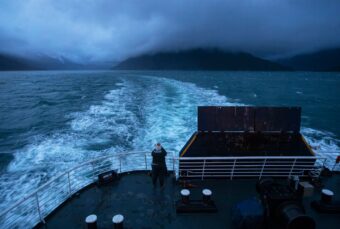
A person takes a photograph of Chilkoot Inlet while on the MV LeConte shortly after departing Haines for Juneau on Sunday, Nov. 13, 2022. (Emily Mesner / ADN)

The administration of Gov. Mike Dunleavy has signed a $28.5 million contract for work on a new ferry terminal north of Juneau, days after an oversight board said the state had not proved that the project is economically viable.

Dunleavy administration officials say the new terminal at Cascade Point, located 30 miles north of an existing terminal in Auke Bay, will cut ferry time from Juneau to Haines and Skagway by two hours.

But the chair of the Alaska Marine Highway Operations Board — which was created by Dunleavy four years ago — says the department hasn’t shared “some kind of business plan or feasibility study” to establish that the terminal is necessary and economically viable.

“The Alaska Marine Highway System has been plagued for 50 years with one-off projects that get foisted upon it, that create operational challenges, that then the system and the users have to deal with,” said Wanetta Ayers, chair of the board, during a Friday meeting.

“This is another one of those situations where it’s going to get foisted upon the system and we’re going to have to cope with it for 20 or 30 years until somebody admits it’s not going to work,” Ayers added.

The Cascade Point ferry terminal is planned on land owned by Goldbelt Inc., a Juneau Alaska Native corporation. It has been under consideration since Dunleavy took office in 2019. In May, his administration announced its intention to seek bidders for the first phase of the project.

After receiving two bids, the transportation department signed a contract Monday with K&E Alaska Inc., an Oregon-based company with an office in Sitka. The contract, which has a 2027 completion date, covers engineering and environmental permitting, a bridge over Cascade Creek, a gate, site preparation and retaining wall construction.

The contract does not include any funding for the ferry terminal itself, which is set to cost tens of millions of dollars. The state expects to pay for the terminal using primarily federal funds.

Ayers said Friday that the Dunleavy administration had not provided answers to board members’ previous questions, and she is troubled by “the pursuit of this project in what is a very unconventional process, where design and now construction are way ahead of operational feasibility and customer service.”

Katherine Keith, a deputy transportation commissioner, said during the Friday meeting that the department had commissioned an independent economic analysis of the project, but it was still in “draft form” and had not been released. She did not provide any specifics on when it would be available to members of the board or the public.

“We continue to believe that this is a strong benefit to the state, to the system and the public, which is why we’re moving forward with expenditure of public dollars, but understand we haven’t communicated that in a complete narrative document to make it more accessible and comprehensive,” said Keith.

Keith pointed out that the Cascade Point project had been recommended in 2020 by a marine highway reshaping working group commissioned by Dunleavy.

Ayers, who served on the working group, said that report and its accompanying recommendations “came together on a wing and a prayer at the last minute to meet the governor’s deadline.”

“To stand on it as a justification for Cascade Point is, to me, a pretty big stretch,” said Ayers.

One of the primary reasonings provided in the working group report for the new ferry terminal was that it would “avoid the need to modify the new Alaska Class ferries to add crew quarters” by allowing for trips between Juneau, Haines and Skagway to last less than the 12-hour crew day mandated by the Coast Guard.

But that reason is partially moot because the state has already committed to retrofitting the Alaska Class ferries with crew quarters, at a cost of roughly $30 million, and because the route length between Cascade Point, Haines and Skagway exceeds the 12-hour crew day, according to Marine Highway spokesman Sam Dapcevich.

The trip from Cascade Point to Haines and Skagway, as envisioned by transportation planners, would run up against the 12-hour work limit for crew, “requiring full staffing and accommodations,” Dapcevich said in an email last week.

“A more efficient service model,” which wouldn’t necessitate crew sleeping onboard, would require ferry trips from Cascade Point to go either to Haines or to Skagway, rather than visiting both communities on a single trip, Dapcevich said. The Marine Highway System would then have to use a yet-to-be-constructed “shuttle” ferry between Haines and Skagway.

‘Standing on a cliff’

Ayers wasn’t alone among board members to raise concerns about the process used by the department to advance the Cascade Point project.

Board member Paul Johnsen, a former Marine Highway engineer, said it seemed that the board was “being ignored” by the transportation department. Member Bob Horchover, who was appointed to the board by Dunleavy, agreed.

“I’m against this until we have more information,” said Horchover. To move ahead with the project “without even a reason for doing it is, to me, a boondoggle,” he added.

Anthony Lindoff, vice chair of the board, said the department had not provided enough information for him to form an opinion of the project.

“I certainly don’t have enough information regarding Cascade Point to be unequivocal, one way or the other,” Lindoff said. “I’m just eager for more information.”

While the Dunleavy administration is moving ahead with the Cascade Point project, it is also working simultaneously on a study of a possible new road-and-terminal project on the west side of Lynn Canal.

A $2.4 million study of the project is set to examine multiple options, all of which are predicated on the existence of the Cascade Point ferry terminal, according to a service agreement signed in May.

The northern lights glow over Auke Bay as the Alaska Marine Highway ferry Kennicott approaches Juneau on February 25, 2024. (Marc Lester/ADN)

Keith told board members that the study, with initial findings expected in January, is set to examine connecting Cascade Point with new ferry terminals and road stretches on the west side of the canal, to better tie Juneau to the Alaska Highway. Keith said the “Chilkat Connector,” as the Dunleavy administration called it, would include construction of one or two new ferry terminals on the west side of the canal, along with several miles of new road.

Some board members said it appeared that Cascade Point would only be economical if paired with west Lynn Canal infrastructure, but with those infrastructure projects yet to be studied, moving ahead with Cascade Point was premature.

“If it was part of a larger infrastructure plan to build a road up the west coast of Lynn Canal, then that might have some more impact and be worth investing in that kind of a facility,” said Horchover.

“I’m a little concerned that we’re standing on the cliff and saying, ‘Why not? Let’s jump,’ ” he added.

Juneau Access

The Chilkat Connector study, like the Cascade Point ferry terminal, is funded using appropriations made by state legislators nearly 20 years ago for what is called the Juneau Access Project, a decades-old effort by the state to improve transportation options to the state’s capital that has been reimagined under each new governor.

Former Gov. Tony Knowles in 2000 nixed the idea of a 90-mile road north of Juneau toward Haines, saying its price tag — in the hundreds of millions — was too high. Former Gov. Frank Murkowski revived interest in the plan, and state lawmakers in 2006 approved $45 million for the Juneau Access Project, under a vision for a road from Juneau to the Katzehin River, allowing for quick ferry shuttles from there to Haines and Skagway and on to the mainland road system.

Former Gov. Sarah Palin paused the plan while she was in office, only for her successor, former Gov. Sean Parnell, to revive it, at a projected cost of more than $500 million.

The Parnell administration spent $5 million extending the Glacier Highway to the Goldbelt-owned land at Cascade Point. More than a decade ago, Goldbelt considered constructing a dock to transport Kensington Mine employees from Cascade Point to the mine. That hasn’t happened.

When Gov. Bill Walker was elected — and oil prices crashed — the Juneau Access Project was shelved again. Then came Dunleavy, who turned from the longer road to the Katzehin River to a plan that involved constructing the new Cascade Point terminal.

In 2023, the Dunleavy administration agreed to work with Goldbelt to study the feasibility of a terminal on land owned by Goldbelt. Members of the Alaska Marine Highway Operations Board wrote last year that “with the current information available to AMHOB and the public, we cannot see the merit of the proposed Cascade Point project.” The Dunleavy administration did not provide any further information to the board in response to their letter, members said.

A draft of the 20-year long-range plan for the Marine Highway System signed by Transportation Commissioner Ryan Anderson in February contains no recommendations regarding the Cascade Point terminal. It states that a feasibility study for the terminal was ongoing as of the time of the report’s publication. But department officials said this month that there is no ongoing feasibility study.

‘Rearranging the deck chairs’

Dunleavy vetoed a move by state lawmakers in May to reappropriate Juneau Access Project funding toward other transportation plans, stating the funds had already been obligated.

Since then, both the Skagway and Haines borough assemblies have formally expressed their opposition to the Cascade Point terminal.

“It is difficult to understand why the State is choosing to invest in the construction of a new marine facility rather than rehabilitating existing terminals, many of which — including those serving northern Southeast Alaska — are in urgent need of repair,” Skagway Assembly members wrote.

View of Auke Bay from the bridge of the Hubbard before it set sail to Haines and Skagway in Juneau on May 22, 2023. (Sean Maguire/ADN)

While Haines and Skagway leaders have bristled at the news that the Dunleavy administration is moving ahead with the terminal, one mining company celebrated the announcement.

Grande Portage, a Canada-based company with a plan to build a new gold mine near Juneau, said in a press release that it has an existing agreement with Goldbelt to cooperate on building a barge terminal at Cascade Point for transportation of ore.

Though the barge terminal is not contingent on the ferry terminal, “having the ferry terminal proceed first is highly advantageous as it would result in the development of infrastructure that will also be necessary for the ore terminal, particularly the new access road and bridge. This reduces the time and cost required for future ore terminal development,” Grande Portage wrote in its press release.

The work on Cascade Point comes as the Marine Highway System is wrapping up its work on a 20-year long-range plan. Ayers said work on that plan, and renewed focus on the system’s efficiency, have allowed it to move away from “just rearranging the deck chairs on the Titanic.”

“Here we are, spending lots of time and resources about planning and being strategic, and yet, the other hand is going to deliver us a one-off carbuncle,” said Ayers. “I feel like it’s undoing a lot of good progress.”

Trump wants to cut funds to public media. Here’s what that could mean for 27 radio and 4 TV stations in Alaska.

In 2012, radio reporter Sophie Evan works on her Yupik News broadcast in the newsroom of KYUK Radio in Bethel. (Bob Hallinen / ADN archive 2012)

Editor’s note: This story was reported and published by the Anchorage Daily News. It is republished here with permission. 

As the Trump administration works to end nearly all federal support for public broadcasting in the United States, the loss of that money for the state’s 27 public radio stations and four public TV stations could jeopardize remote Alaskans’ access to community connections and local and national news, and public safety, station managers across the state said this week.

Earlier this month, national news outlets reported that the White House drafted a memo asking Congress to rescind $1.1 billion in funds to the Corporation for Public Broadcasting — a nonprofit that Congress appropriates taxpayer dollars to for public media nationwide — for about the next two years. The memo leaves intact $100 million allocated for emergency communications, The New York Times reported. The unpublished memo — expected to be presented once Congress reconvenes Monday — gives Congress 45 days to approve the cuts or restore the spending, NPR reported.

President Donald Trump’s administration has called public media — particularly NPR and PBS — “a waste” of taxpayer dollars, saying it produces “radical, woke propaganda” with “zero tolerance for non-leftist viewpoints,” according to a White House statement Monday. Americans spend an average of $1.60 per year on public broadcasting through taxes, according to CPB.

Rep. Don Young is interviewed by the Alaska Public Radio Network’s Steve Heimel at election central in Anchorage after winning re-election in 2014. (Loren Holmes / ADN archive 2014)

While NPR receives 1% of its funding directly from the federal government, its close to 300 member stations rely on a much greater percentage, according to NPR. That includes stations across Alaska, which report they’re already strained without state funding. Gov. Mike Dunleavy has vetoed state funding toward public broadcasting each fiscal year since 2019.

“In many parts of Alaska — and communities throughout the country — public media is often the only locally operated, locally controlled broadcasting service,” said Ed Ulman, president and CEO of Alaska Public Media, in testimony before the House Committee on Oversight and Accountability in Washington, D.C., in March. “We are more than nice to have. We are essential, especially in remote and rural places where commercial broadcasting cannot succeed.”

Although Alaska has fewer public television stations — KAKM in Anchorage, KTOO in Juneau, KYUK in Bethel and KUAC in Fairbanks — they receive higher levels of federal funding compared to radio, Ulman said. That’s because television costs more to produce, and has a wider reach.

In Bethel, KYUK’s main radio broadcast reaches about 13,500 predominantly Yup’ik residents throughout the Yukon-Kuskokwim Delta in Southwest Alaska. Between their television and radio station, federal funding makes up about 70% of KYUK’s operating budget each year, said Kristin Hall, interim general manager.

“I would avoid closing at all costs, but that would mean a drastic change in our operations,” Hall said of a potential stop in federal allocations. KYUK currently broadcasts local news in English and Yup’ik three times a day with a news team of three full-time reporters, and a few part-time editors, translators and multimedia team members. Hall said the station’s robust coverage of a region roughly the size of South Dakota “wouldn’t be as realistic” without the funding to support it.

In 2012, then-KYUK general manager Mike Martz talks in the TV studio of KYUK AM/FM/TV in Bethel. (Bob Hallinen / ADN archive 2012)

KCAW in Sitka depends on federal funding to power about 30% of its annual budget, said manager Mariana Robertson.

Most of it helps pay to maintain specialized radio equipment that allows the station to stay on air and transmit information to eight communities throughout Southeast Alaska in the event of power loss.

“We’ve had a fatal landslide here in Sitka, we’ve had so many warnings, and so those are the kind of instances in which we really want to be on the air, sharing information with our community,” Robertson said. “That’s the investment in public safety (and) in our communities that the government is making when it funds through CPB funds.”

In the absence of federal funds, Robertson said the station will seek philanthropic support to try to make up the difference. Already, donor contributions make up 40% of their budget.

“We’re really asking our community for so much already, so we’re going to look to other sources of philanthropy,” Robertson said. “But really, we need this money.”

Lenora Ward, general manager at KOTZ radio station, listens to a musher interview while on-air at the station in Kotzebue on Wednesday, April 6, 2022. (Emily Mesner / ADN)

Juneau’s public radio and television station, KTOO, will be losing about a third of its budget, said General Manager Justin Shoman. Some employees traveled to Washington, D.C., in February to talk with lawmakers, and KTOO has posted a “Federal Funding” page on its website to communicate to listeners and members about the impact of a loss of funding, he said.

“We are trying to be very proactive in our approach to influencing this decision from an organizational perspective,” Shoman said.

In Utqiagvik, KBRW General Manager Jeff Seifert said that the loss of 40% of the station’s budget — the amount filled by CPB funding — could eventually mean lights out for their already bare-bones, roughly five-person operation.

“I’m thinking we could survive maybe two years,” Seifert said, referring to the station’s “nest egg” savings. “But everything is so expensive up here, there’s just no way to make up for that kind of a loss. Just keeping the lights on is hugely expensive. Probably we’d reduce our services to almost nothing.”

For a station like KBRW, which serves seven additional villages and Prudhoe Bay in an area that spans 95,000 square miles, people rely on the radio for everything from birthday wishes called in by a loved one, to local government meetings, to weather reports that could save lives, Seifert said.

“Right now is our spring whaling,” Seifert said. “Our whalers are out on the edge of the ice. They keep KBRW on 24 hours a day.” For company and entertainment, sure, but also for wind condition reports that inform how the sea ice might move and crack, he said.

Many of Alaska’s rural radio stations are the main source of local news in their area.

Rep. Mary Peltola addressed several topics, including fishing, transportation and education, during a 2024 interview at KUCB in Unalaska. (Lauren Adams / KUCB)

KUCB in Unalaska, a station that would lose about 40% of its budget if Congress moves forward with the Trump administration’s proposal, is one of them, said General Manager Lauren Adams.

“We’re the only ones providing news here in Unalaska, with reporters who live here year-round,” she said. Federal cuts would inevitably force staff reductions, which would decrease local reporting and change how KUCB sounds, she said.

“We would probably be more of a repeater station than a local station,” Adams said. “We would basically run local as often as possible, but a lot of our content would not come from Alaska.”

Most radio stations in Alaska have already received the federal funding that will carry them through the end of the federal fiscal year, which runs through September, Seifert said.

But a challenge is drafting a budget now that will take effect July 1, with unreliable funding sources, Seifert said:

“We’re kind of lost as to, how do you do a budget when you don’t know where 40% of the money is going to come from?”

Site notifications
Update notification options
Subscribe to notifications