Anchorage Daily News is our partner in Anchorage. KTOO collaborates with partners across the state to cover important news and to share stories with our audiences.

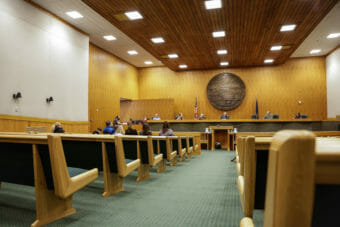
The Alaska Judicial Council holds a public hearing about applicants for two Anchorage Superior Court judge positions in the Boney Courthouse in Anchorage on Nov. 16, 2022. . (Photo by Matt Faubion/Alaska Public Media)
This story was originally published by ProPublica. ProPublica is a Pulitzer Prize-winning investigative newsroom. Sign up for The Big Story newsletter to receive stories like this one in your inbox.
Alaska’s Supreme Court has placed new limits on how long criminal cases can be postponed, part of an effort to reduce the time many criminal defendants wait to face trial in the state.
The court’s order, which takes effect May 12, directs state judges to allow no more than 270 days of new delays for criminal cases filed in 2022 or before. Court system data shows that about 800 active cases fall into that category, making each one more than 800 days old and counting.
The time to resolve Alaska’s most serious felony cases, such as murder and sexual assault, has nearly tripled over the past decade. Victims rights advocates had long complained that judges rubber-stamped delays, particularly in Anchorage, where about half of the cases impacted by the Supreme Court order are pending. Some cases dragged on so long that victims or witnesses had died in the meantime.
In addition to capping the duration of delays, the state Supreme Court’s order says judges must explain why they’ve allowed any request for delay.
“It’s a positive step by the court to be able to work with the lawyers to move cases along,” said state Sen. Matt Claman, D-Anchorage, chair of the Judiciary Committee, which held a hearing on pretrial delays in February.
Alaska Court System spokesperson Rebecca Koford said the new Supreme Court order, issued on March 12, tackles the “most pressing concern.”
The time needed to close out the oldest cases “is exceedingly long,” she said, “and we need to get them resolved.”
The Supreme Court order said judges in pre-2023 cases are to allow only 90 days of new delays at the request of the defense, 90 days for prosecutors and 90 days for “other periods of delay for good cause.”
Koford said that an example of why a case might be delayed for good cause would be when a witness is temporarily unavailable to testify. Additional efforts are in the works to reduce the time it takes cases to get to trial, she said.
“We do not view it as the solution; it is part of the solution,” Koford said.
Alaska criminal rules grant defendants the right to a trial within 120 days of being charged with a crime. Crime victims have the right to the “timely disposition” of their case under the state constitution.
The 120-day deadline is rarely met. One sexual assault case highlighted by the Daily News and ProPublica was filed in 2014 and has been delayed more than 70 times. That case has now been set for trial on April 1.
Several high-ranking state officials have spoken of the need to rein in delays since the news organizations highlighted the issue in January.
Chief Justice Susan M. Carney told state lawmakers on Feb. 12 that the court system was working to curb delays, noting recent news coverage of the issue. The Senate Judiciary Committee held a hearing focused on pretrial delays later that month, when court system General Counsel Nancy Meade told legislators that the cases recently highlighted in news stories were unacceptable but were outliers among criminal cases.
“The time it takes to resolve cases now is certainly longer than it was 20 years ago. Nobody is happy about that,” Meade testified.
The new order signed by Carney and other Alaska Supreme Court justices said that a 2023 judicial order had led to “some decrease” in what the court characterized as “persistent backlogs.” The current order, the court said, “is intended to facilitate the further reduction in the time to disposition of these older criminal cases without undue delay.”
The order also addresses delays caused when attorneys fail to provide evidence to the opposing party in a timely manner. It says that judges should consider sanctions, including dismissing the charges, when prosecutors fail to provide evidence or banning the missing evidence from being used at trial.
Left: William Farmer (Photo provided by Robin Farmer) Right: Lawrence Fenumiai (Photo provided by Simeona Galletes-Fenumiai)
The lives of William Farmer and Lawrence Fenumiai ran parallel before merging with deadly consequences at the Anchorage jail in December.
Both men were diagnosed with schizophrenia in their 20s, their relatives say. Both families struggled to find help.
And both Farmer and Fenumiai ended up in Alaska’s correctional system, where people with mental illness make up nearly a quarter of the in-custody population but can’t always get the therapeutic support they need.
On Dec. 17, less than 24 hours after the men began sharing a cell, Alaska State Troopers say Fenumiai fatally beat Farmer, who died in early January.
Now Fenumiai faces first-degree murder charges as both families question the way the Alaska Department of Corrections handled the challenge of housing two people with diagnosed mental health disorders in a crowded jail cell.
Why were Farmer and Fenumiai placed in the same cell to begin with? Why was that cell in a transitional intake area rather than the jail’s designated mental health unit? And why was Fenumiai still there after a judge dismissed the case against him a week earlier?
Farmer’s twin sister, Robin, said her brother had been struggling with mental turmoil and hallucinations and couldn’t always make choices that were in his own best interests.
“I remember thinking, ‘Well, at least he’s safe,’” she said of his arrest in December. “That’s not true. You’re not safe in jail either.”
‘They set him up for failure’
The Department of Corrections is conducting an internal investigation that is ongoing, state officials said this week. Such investigations are standard for any death connected to a DOC facility.
“We want folks to come into our system and leave our system better, and to have a negative outcome like that, it bothers all of us,” said Adam Rutherford, the department’s deputy director for health and rehabilitation services. “None of us want to see that type of event occur.”
Farmer was 36 when he died. He came from an Anchorage family with deep Alaska roots that included a few generations of bush pilots and ownership of a Mat-Su lodge.
Police said Farmer had just entered the jail after a string of robberies at several Midtown businesses in late November and early December.
He was placed in a cell with two other men. Instead of a bunk, he was provided a plastic “boat” on the floor in a cell designed to hold two people.
Fenumiai, a 33-year-old former football standout at Juneau-Douglas High School, was already in the cell when Farmer arrived. He was awaiting release after a judge found him incompetent to stand trial.
Fenumiai had entered the correctional system in May when he was arrested in Juneau after an outburst at his family’s home. He hit his father in the head, destroyed his iPhone and damaged a cabinet, according to a police report summary included with a criminal complaint.
Fenumiai’s mother, Simeona Galletes-Fenumiai, said she doesn’t understand why their son was in a shared cell when he was held alone in Juneau over concerns he could hurt himself or others.
“They set him up for failure,” Galletes-Fenumiai said.
She said she prayed for Farmer’s recovery in the days before he died.
The state’s only psychiatric hospital, Alaska Psychiatric Institute in Anchorage, has come under fire for years for a lack of beds that keeps mentally ill defendants waiting in jail for evaluations or facing monthslong wait lists for treatment.
The state’s overall lack of mental-health treatment capacity bleeds into the correctional system, officials say.
About 22% of people in the state’s jails and prisons “suffer from a severe and persistent mental illness,” according to Rutherford, the deputy state corrections director.
The Anchorage Correctional Complex. (Loren Holmes / ADN)
Corrections officials would rather see many of those people treated by professionals in the community, rather than behind bars in an environment not designed to be therapeutic, he said.
“We’re the largest behavioral health provider in the state, and we shouldn’t be, and we don’t want to be,” Rutherford said.
When December’s encounter occurred, Farmer and Fenumiai shared a two-person cell with a third man on an intake area known as Alpha mod. The unit includes 16 double-occupancy cells on the east side of the Anchorage Correctional Complex.
Alpha mod is considered a “specialty management” open population housing unit, according to Department of Corrections spokesperson Betsy Holley. The area houses people with mental health or addiction issues that may set them apart from the general population.
It’s designed for people who may need more support or observation when they enter custody, according to Holley.
Nursing staff visit that part of Alpha mod at least three times a day, corrections officials said. Mental health staff visit at least once a day.
The mod is not, however, part of the jail’s designated mental health unit.
Perpetual purgatory
Robin Farmer said her brother was a bright person fascinated by aviation and the kind of animal lover who adopted senior dogs at the shelter even though he knew they might not live long.
William Farmer with his sister, Robin. (Photo provided by Robin Farmer)
His personality started to change when they were in their 20s, she said.
William Farmer found their mother dead when he and his sister were both seniors in high school, Robin Farmer said.
It was a week before final exams, a pivotal time in both their lives. She now wonders if the trauma of that time served as some kind of trigger for the mental illness that was coming.
The family noticed that William’s community was shrinking as it became harder for him to stay engaged, she said.
“These symptoms and hallucinations, over time, kept increasing more and more and more,” Farmer said. “That kind of ended up leading to him being in and out jail, in and out of API, on and off medication.”
The family struggled to find treatment, but occasionally found success, she said. During one period in custody, her brother spent three months at API and was moved into transitional housing.
“That was something that was really great: to see him get healthier, get happier and just get more back to himself,” Robin Farmer said.
Several years later, by December, he was back in jail on robbery, theft and assault charges. Police said he stole merchandise from three stores and used or brandished pepper spray before fleeing.
Less than 60 seconds
The Anchorage Correctional Complex. (Loren Holmes / ADN)
The jail cell assault happened very quickly, according to official accounts.
The third man in the cell said Farmer was lying on the floor, talking to himself with phrases like “shut up” followed by an anti-gay slur, when Fenumiai came off his top bunk, according to a sworn affidavit filed with murder charges by the Alaska State Troopers.
The other cellmate told investigators Fenumiai told Farmer to “shut the f— up” before he started punching him in the head, according to the affidavit. The smaller man was unconscious in under a minute, troopers wrote.
Corrections officers couldn’t safely get into the cell to intervene right away, the affidavit said. When they did, Farmer was limp on the floor.
He was rushed to Providence Alaska Medical Center for treatment of a traumatic brain injury.
The family didn’t get to see Farmer until more than 24 hours after the assault, his sister said. His eyes were blackened, his face was swollen, and he was breathing with help from a ventilator.
His feet were handcuffed to the bed even though he was unconscious, she said.
Christmas week passed with no change in his status. The hospital classified Farmer’s condition as critical.
Robin Farmer said the family made the decision to take her brother off the ventilator on Friday, Jan. 3. William Farmer wanted to be an organ donor but too much time lapsed between the ventilator’s removal and when his heart stopped beating, his sister said.
He didn’t die for another three days, nearly three weeks after the attack.
“We had to go through the trauma of experiencing the fact that somebody did this to him and killed him but we also had to go through the weight and heaviness of having to choose to let a family member go,” Robin Farmer said. “Both of those things are pretty unbearable on their own, let alone compounded on top of each other.”
She visited daily and stayed in her brother’s hospital room until 10 p.m. on Jan. 5.
He died early the next morning. Their mother’s ashes sat nearby.
Sharing a crowded cell
Various decisions and delays factored into the paths that put Farmer and Fenumiai together in that cell.
Lawrence Fenumiai appeared in court in Anchorage on February 19, 2025. Fenumiai is charged with murder after the death of a fellow inmate at Anchorage Jail in December. (Marc Lester / ADN)
After his arrest in May, Fenumiai was housed in a segregation unit at Lemon Creek Correctional Center in Juneau, Department of Corrections records show. He was flown to Anchorage in June for assessment and stayed in custody in Southcentral after that.
None of the three men sharing that Anchorage cell on Dec. 17 met the criteria for segregation at that time, according to Holley.
Asked how any decisions to house Farmer and Fenumiai together were made, corrections officials said they couldn’t provide specifics due to confidentiality requirements and safety policies.
Generally, decisions about where to house inmates are made by mental health clinicians who assess people in custody and then make recommendations in collaboration with security staff, Holley said.
Given the limited number of jail cells and the fact that prisoners in specialty management can’t be housed with others, prisoners with similar custody or segregation levels often end up together, she said.
“We do try to avoid assigning three prisoners to a cell but occasionally it happens, especially in specialty housing situations,” Holley said.
Released too late
A Juneau judge dismissed Fenumiai’s charges in a hearing Dec. 13 but the paperwork ordering his release from jail and transport out of custody didn’t get to the right desk for days.
Juneau District Court Judge Kirsten Swanson found Fenumiai was not competent to stand trial in the assault case involving his father and dismissed the charges effective Dec. 16, according to a signed order. She wanted Fenumiai released to his family in Juneau instead of in Anchorage where he didn’t have a support network, state courts officials say.
Such a transport would generally involve at least one escort on a non-commercial flight.
While releases like this usually take two or three days, the court system and Department of Public Safety court services officials were still coordinating Fenumiai’s transport several days later, according to Alaska Court System spokeswoman Rebecca Koford.
Any delays in Fenumiai’s release were due to the challenges of arranging transport, Koford said.
The original release order was emailed on Dec. 13 to the Department of Corrections, she said.
The judge canceled the transport order on Dec. 19 — two days after the assault.
‘Other people’s beloveds’
Fenumiai’s mother believes the system failed both her son and Farmer.
Fenumiai, one of six siblings, was a Juneau high school athlete whose football talents earned him a full ride to Arizona Western College, his mother said.
It was while he was away at school that his family realized he had changed, keeping to himself and exhibiting signs of paranoia, according to Galletes-Fenumiai. The changes led to Fenumiai’s schizophrenia diagnosis.
Fenumiai left college and lived with his family in Juneau, staying in a room they built for him to provide some privacy as well as supervision.
The family managed her son’s diagnosis by trying to keep him on his medication, providing support, and remaining sensitive to his moods, Galletes-Fenumiai said. When he started getting irritated or ramping up, they would let him be alone until he was ready to rejoin them.
Galletes-Fenumiai said during December’s competency hearing process, the family was told her son needed treatment. There was a 140-day waitlist to get into API.
She and her husband traveled to his home country of Samoa for an important ceremony after the mid-December competency hearing. They had listened in by phone from Juneau. They didn’t realize he wasn’t released. They were excited he was coming home.
Galletes-Fenumiai learned about the December assault from an Anchorage Daily News reporter.
She said she is struggling to come to grips with the circumstances that left her son in a position to hurt someone so badly.
There’s a word in Samoan that means “other people’s beloveds,” Galletes-Fenumiai said.
“These people that work at DOC, in mental health and all that, this is what they have,” she said, becoming emotional. “I wish they would just take that thought of other people’s beloveds that are in their hands. Because this could have been avoided.”
This story was republished with permission from the Anchorage Daily News.
School buses parked at Wasilla High on Aug. 18, 2022. (Bill Roth / ADN)
JUNEAU — The U.S. Department of Education on Friday told state education officials that a one-time funding boost this year had resolved a dispute over how COVID-19 aid was disbursed to Alaska schools.
For months, the federal education agency said Alaska had not funded schools equitably during the pandemic, which was a condition of receiving $359 million in federal education funding.

Federal officials said Alaska effectively cut funding to several of its highest-need school districts during the pandemic.
As a result, they withheld $17.5 million in September for Alaska schools, which will now be disbursed to the state.
The Alaska Department of Education and Early Development consistently denied the school funding cuts took place. State officials said Alaska’s school funding formula had kept spending equitable.
“It is a triumphant day for Alaska’s students, as our Maintenance of Equity battle with the US Department of Education has ended, and Alaska’s stance on the matter has been vindicated,” Alaska Education Commissioner Deena Bishop said in a prepared statement.
The dispute between the federal and state education departments had escalated over the past year.
The Legislature appropriated $11.9 million to school districts as part of the budget in an effort to resolve the issue. Gov. Mike Dunleavy vetoed that funding in June, saying the need remained “indeterminate.”
In September, federal officials threatened to withhold $17.5 million in pandemic-era aid for Alaska schools — unless the state disbursed the same amount to several school districts.
On Friday, the U.S. Department of Education abruptly reversed course.
Adam Schott, principal deputy assistant secretary at the federal Office of Elementary and Secondary Education, told state officials that $175 million in one-time funding appropriated this year for Alaska schools had resolved the department’s equity concerns.
Schott did not immediately respond to a request for comment whether the state’s high-risk grantee status would now be lifted.
Dunleavy and education Bishop issued a statement Friday, celebrating the decision.
“From the very beginning, it was clear that the U.S. Department of Education’s allegations were meritless. Alaska was not going to back down because we knew we were right,” Dunleavy said.
He added that the dispute was evidence why he supported the concept of eliminating the federal education department.
Anchorage Democratic state Sen. Löki Tobin said she was led to believe that a one-time boost to school funding would not resolve the federal government’s equity concerns.
“I had asked this question several times to our federal partners and they said it had to be specific funds allocated and not funds for every district,” she said by text.
Tobin, chair of the Senate Education Committee, said she had no further comment about the letter sent Friday by Schott.
A kindergarten teacher helps a student with a writing project at Nunaka Valley Elementary in Anchorage. (Loren Holmes / ADN file)
The Alaska Department of Education and Early Development is considering a regulation change that would tighten restrictions onhow local governments fund schools.
Currently, municipalities can fund education in areas such as student transportation, school activities and preschool outside of school district’s operating funds. That allows local governments to fund education beyond a strict cap set in state law, which is intended to ensure funding is shared evenly among school districts.
The state of Alaska has chosen to impose that cap so that it can effectively deduct roughly $90 million from what it gives each year to school districts and use that money for other purposes. That is allowed under federal law.
Under that federal law, education funding must be evenly distributed among all of a state’s school districts — state, federal and local education funding in an urban school district can’t all add up to thousands more per student than the total amount of state, federal and local funding per student in a rural Alaska school district.
The state education department said the policy change is intended in part to ensure that local governments do not violate the state limit on local contributions. State education officials had long warned that the new restrictions could be coming.
A spokesperson for the state education department did not respond to a request for an interview, and instead asked that questions be submitted by email.
Lisa Parady, executive director of the Alaska Council of School Administrators, said requiring more local contributions to fit under the state’s limit could cause “essential services” to be cut for schools. From an initial survey, ACSA said the proposed policy change could affect 20% to 25% of Alaska school districts.
Anchorage and Juneau schools could be the hardest hit. The Anchorage School District couldeffectively face $11 million in cutsif the regulation is adopted as written. The Juneau School District could see even bigger cuts relative to its operating budget, proportionally, at close to $2.3 million.
“I’m a graduate of Alaska’s public schools, and I’ve been an educator in Alaska for nearly 30 years. I believe people statewide need to sit up and take notice of this,” Juneau Superintendent Frank Hauser said.
Clayton Holland, superintendent of the Kenai Peninsula Borough School District and the head of the Alaska Superintendents Association, said with flat state formula funding, more districts could be affected as costs increase with inflation.
“Really, whatever change happens is going to impact all of us,” he said.
The disparity test
The roughly $90 million in federal funding at stake comes from something called the Impact Aid program.
Alaska received $119 million last fiscal year in federal Impact Aid for education. That funding is intended to reimburse school districts for revenue that is effectively lost from federal land that is not subject to local taxes. Tribal land qualifies in that definition, and so do properties lived in by military families and military bases.
The Anchorage School District, with Joint Base Elmendorf-Richardson, was eligible for almost $17 million in Impact Aid last fiscal year. The Lower Kuskokwim School District — with vast expanses of tribal land — was eligible for $21 million, state data shows.
The state of Alaska was required to pass that $119 million in federal Impact Aid on to school districts. However, Alaska chooses to use an exception to that requirement, which is known as the disparity test.
The disparity test is a little-known federal rulethat measures how evenly education funding is shared among school districts. For the state of Alaska to pass the test, there must be less than a 25% difference in per-pupil funding between its highest- and lowest-funded school districts.
By passing the disparity test, the state of Alaska is able to count roughly $89 million of that federal Impact Aid as the state’s contribution to school districts.
A spokesperson for the U.S. Education Department said by email that Alaska is the only state currently using that process to effectively reduce its funding to school districts.
Outside the cap
For more than 25 years, there has been a limit on how much municipal governments can contribute to education to ensure Alaska passes the disparity test. If the state fails the test, it could be on the hook to pay the roughly $89 million to school districts.
The state education department acknowledged the federal government had not provided new information that Alaska was at risk of failing the disparity test.
The Municipality of Anchorage and the City and Borough of Juneau have long funded education beyond the state’s cap in areas they consider outside of operating expenses.
Anchorage is planning to contribute $9 million this fiscal year outside the cap for student transportation and $2 million for eight pre-kindergarten classrooms from alcohol tax revenue. Katie Parrott, senior director of the district’s Office of Management and Budget, said it was unclear if the preschool funding would be restricted by the new regulation.
“That’s certainly, I think, a question that we have as well,” she said.
Two fiscal years ago, Juneau paid $2.3 million for student transportation, child care, and sports equipment outside of the cap on local contributions, KTOO reported.
The new regulation could require that spending be placed in school district’s operating funds. Because Anchorage and Juneau fund schools beyond the state’s limit, both districts could need to make budget cuts if the new state restrictions are approved, local education officials said.
”What happens is that reduces the potential amount of money that is available for instructional programs,” Hauser said in a Wednesday interview.
The Alaska Superintendents Association has so far surveyed 25 of 53 Alaska school districts about the potential impacts of the regulation change. Eleven districts said they get the maximum local contribution for operating expenses.
Funding outside the cap has been used primary for extracurricular activities, pupil transportation and feeding students, according to the preliminary survey.
”If communities think this won’t affect them, think what transportation costs and food service contracts will cost five years down the road, and what happens as state funding continues to be outpaced by inflation?” Hauser said by email.
State’s concerns
A spokesperson for the state education department said the new draft regulation is being considered to “address an inconsistency in interpretation” of state law, and to ensure compliance with the federal disparity test.
For the current fiscal year, the state education department said that Alaska’s preliminary data show that it would pass the disparity test.
In an April letter to the Alaska Superintendents Association, the director of the federal Impact Aid Program said that staff “did not ask, or recommend” that the Alaska education department change its regulations.
According to the state education department’s letter to the Alaska Association of School Business Officials, the new regulation “is designed to better align with the original intent of the Alaska public education funding formula.”
Parady, executive director of the Alaska Council of School Administrators, said she did not understand why the state was “suddenly reinterpreting” the “original intent” of Alaska’s funding formula.
She said her organization had analyzed the latest state data and found the proposed regulation change would “not significantly” affect Alaska’s chances of passing the disparity test.
Anchorage Democratic Sen. Löki Tobin, chair of the Senate Education Committee, said the state’s concerns about local contributions could largely be addressed by an increase to the Base Student Allocation — the state’s per-pupil funding formula.
The BSA has not been significantly boosted since 2017. School administrators say that has eroded their spending power due to high inflation and rising fixed costs. Tobin said that if legislators boost state formula funding, local government contributions could also increase.
“If the state aid increased by, let’s say 15%, then that would equate to a commiserate increase into what the local contribution is,” she said.
The state department of education submitted the draft regulation last month to the Alaska Association of School Business Officials for initial feedback. Darcy Carter, the group’s executive director, said the organization “opposes the proposed regulation change” as presented.
“Based on our knowledge of Alaska’s school districts, we do not believe the proposed regulations will achieve the equitable outcome that is being sought by (the Alaska Department of Education and Early Development) with these changes,” she said.
The regulation is set to be presented to the state Board of Education in December. The board could then put it out for public comment, and consider it for final adoption in March. It would typically go into effect 30 days later, the state education department said.
Part of a continuing weekly series on Alaska history by local historian David Reamer. Have a question about Anchorage or Alaska history or an idea for a future article? Go to the form at the bottom of the ADN story.
“Japan Threatens China With War,” blared the banner headline on the Feb. 11, 1919 issue of the Alaska Daily Empire out of Juneau. Other front-page-worthy articles included news on boxer Jack Dempsey, fallout from the First World War, discord between Portugal and Spain, the ongoing Russian Revolution, and a fire in a local laundry. In all, war and labor strife were the dominant themes of the page, as there were also articles about strikes in Seattle, Arizona and London. The brutal murder of a woman in town was removed to the second page of an eight-page newspaper.
Myra Schmidt was a prostitute, a sporting girl, a sex worker. She was many other things besides, but in the social climate of Alaska then, her vocation unfairly defined her, most definitively in death. Rare was the article that did not describe her as a woman of the underworld, the more common term for sex workers of the day. In fact, the first article about her death called her a “woman victim” and “woman of the underworld” before offering her name. Had she been a waitress, her profession wouldn’t have been as integral to her identity. Had she been a waitress, perhaps her violent death in a small community might have made the front page.
Schmidt, also known as Molly Brown and Molly Smith, was last seen alive in the early morning of Feb. 8, 1919. Locals saw her leave a Japanese restaurant on her way back to the isolated cabin that was her home and workplace. That was Saturday. She was around 22 and had only been in Juneau for about six weeks. Like most prostitutes in Alaska then, she was her own boss, without pimp or enforcer. And she was successful. Her safety deposit box at a Juneau bank contained $410, roughly $8,000 in 2024 money, and a receipt for a sealskin coat. Bought in Seattle, the high-quality coat cost $305, roughly $6,000 in 2024 money.
Prostitution had an uneasy quasi-legitimacy in the larger Alaska towns. It was illegal for sure but typically allowed within limits. Many local officials encouraged such activity amid copious winks, nudges and bribes. In 1914, a Juneau city council motion to close every “bawdy house” in town failed for want of a second. Not a failed vote but a failed motion before a vote could be held. In 1915 Anchorage, railroad official Andrew Christensen built a convenient road to the red-light district just outside town.
When brothel houses and sex workers became too public, or too hesitant with their official donations, they could be and often were shut down. Likewise, there were periodic reformers who forced wider closures. Anchorage red-light neighborhoods were closed upon official order no less than five times between 1915 and 1942 alone. Still, they always came back. Officially allowed brothel districts — both called The Line — in Fairbanks and Seward lasted until federal intervention in the early 1950s. Seasoned Anchorage residents will well remember the massage parlors of the 1970s and their whisper-thin veneers of legitimacy.
After Schmidt missed several meals, a couple of female acquaintances dropped by her cabin. On Monday afternoon, Feb. 10, 1919, they discovered the hasp on her door broken, the lock dangling off. The glass windows were smashed, and the screen door damaged. Blood marked most of the surfaces in the small room, the telltale signs of a final struggle. Personal belongings had been searched, alternately scattered or taken. Schmidt’s body was on the bed next to a scarlet-stained towel that had been used to choke her. The killer pushed the towel down her throat, choking her to death.
As noted by several Alaska newspapers, Schmidt was one of several Alaska “women of the underworld” murder victims in recent years. There had been Rose Selberg in 1918 McCarthy and a woman in Douglas just a few months earlier. Over six months later, William Dempsey killed Marie Lavor in Anchorage and tossed her body down a well.
That same Monday evening, 56-year-old John “Whiskey Jack” Gaslow boarded the steamship Estebeth bound for Skagway. He was short, stout and rough-looking, worn by years in the north and with a drinking habit to fit the nickname. His nose and face bore the scars of countless boozy brawls. He had been in Juneau for about a month and had previously borrowed money to eat. Yet, before leaving town, he was coincidentally able to pay his debt and buy a new hat, all besides the steamer ticket itself. He also bore a fresh scratch on his face.
While purchasing a ticket, he dropped a yellow suitcase, which opened to reveal women’s clothing. Stumbling in his conversation with the agent, Gaslow admitted the bag wasn’t his. Instead, he claimed a woman in Juneau had asked him to deliver it to Skagway. The awkward, impromptu lies piled on themselves, including an improbable fake name that still incorporated his actual surname: Gaslow Florentine. Then, Gaslow sealed his fate. He told the agent, “When you return to Juneau, tell an officer about this grip and that it does not belong to me.”
John Gaslow in 1919 while a prisoner at McNeil Island, Washington. (National Archives photo)
If the suggestion was a bluff, it was ill-advised, given both the recency of the crime and his restricted movements aboard a steamer. An eroded conscience does not a smooth criminal create. The agent followed the murderer’s suggestion and sent word to marshals in Juneau. Detective skills were not as sophisticated in 1919 as they are now, but officers were immediately suspicious of the man fleeing Juneau with a woman’s belongings on the same day a robbed and murdered woman was discovered in Juneau.
At Skagway, the Estebeth was quarantined due to the influenza pandemic. Before the passengers could be cleared to disembark, officials there arrested Gaslow. He initially refused to let them search the suitcase, which was later identified as belonging to Schmidt. The case’s contents included a mink cape, mink hand muff, silk garters, silk panties, two pairs of women’s shoes, a bra and several other feminine articles, 77 of them in all. A sealskin coat matching the receipt from Schmidt’s safety deposit box was also present. Still, the most damning item was a picture of Schmidt, whom Gaslow maintained he had never met.
In short order, Gaslow was bound over for a grand jury while under a $5,000 bond, which he naturally could not pay. As he never learned when to shut up, he talked continually during his time in the Juneau jail, about the murder and anything else that happened to come up. On March 27, the grand jury returned an indictment.
The trial commenced on Sept. 15, but the intervening months had not been sufficient to provide the defendant or his court-appointed attorneys with a functional defense strategy beyond denying every fact in sight. For example, Gaslow never produced evidence of how he might have legitimately been handed the yellow suitcase. He also never explained his newfound wealth: the money for food, hats and steam tickets.
As might be expected by this point, Whiskey Jack was not the best witness to his innocence. When first arrested, he claimed that a delicate manicure set in the yellow suitcase was for trimming horse hooves. At the trial, he claimed they were for an unidentified “lady friend” in Dawson, an illusory Canadian girlfriend. Months later, he said he was referring to a pair of scissors, still inadequate for horses.
At 11 p.m. on Sept. 23, the case went to the jury, which met until 3:45 in the morning before returning with their decision. Despite the lack of direct evidence — witnesses of the crime or a confession — the jury found Gaslow guilty of murder in the first degree. On Oct. 10, he was sentenced to life imprisonment. His tour of this nation’s prisons took him from McNeil Island to Leavenworth to Seagoville, Texas, where he died in 1948. He maintained his innocence throughout his penitentiary tenure, thus ensuring a bond with his fellow inmates, most of whom were also ever so innocent, at least if you asked them.
Key sources:
“Death Caused Choking is the Verdict Given.” Alaska Daily Empire, February 13, 1919, 8.
“Evidence of Murder Found; Woman Victim.” Alaska Daily Empire, February 11, 1919, 2.
“Gaslow is Put on the Stand in Own Defense.” Alaska Daily Empire, September 20, 1919, 5.
“Jack Gaslow Under Arrest at Skagway.” Alaska Daily Empire, February 15, 1919, 8.
“John Gaslow is Found Guilty of Murder Charge.” Alaska Daily Empire, September 24, 1919, 8.
“John Gaslow is Given Life in Penitentiary.” Alaska Daily Empire, October 10, 1919, 8.
In this May 25, 2005, photo provided by the Southeast Alaska Sperm Whale Avoidance Project, a sperm whale swims near a fishing boat in Alaska. Sperm whales may be using the sounds of fishing boat engines as underwater “dinner bells” to hone in on valuable sablefish hooked by longlines in the Gulf of Alaska.
A Ketchikan fisherman has pleaded guilty in federal court to killing an endangered sperm whale in a first-of-its-kind case that highlights a long, little known conflict between the giant toothed whales and the fishermen whose sablefish catch they have learned to raid.
In a proposed plea agreement filed May 15, Dugan Daniels agreed to plead guilty to one charge of an illegal taking under the Endangered Species Act, a class A federal misdemeanor.
The charge stems from a March 2020 incident in which Daniels, 54, “knowingly took an endangered species of wildlife” by “having a crewman shoot the whale and trying to ram the whale with the F/V Pacific Bounty” in the Gulf of Alaska about 30 miles west of Yakobi Island, near the community of Pelican in Southeast Alaska, according to court filings in the case.
The case appears to be the first time someone has been criminally charged for taking a sperm whale in Alaska, according to the U.S. Attorney’s Office of Alaska.
Sperm whales can be more than 50 feet long and weigh up to 90,000 pounds. They’ve been listed as an endangered species since 1970.
Decades ago, sperm whales learned to pluck commercial fishermen’s catch from their gear, gaining an easy meal but costing fishermen a day’s work and ruining gear and putting whales at risk of entanglement or injury. Scientists call the phenomenon depredation, and an innovative collaboration between the fishermen and scientists in Alaska has long looked for ways to avoid conflicts.
For the most part, that collaboration has been successful, and fishermen have changed gear types to deter the whales from raiding their catch.
“I am deeply dismayed,” wrote Linda Behnken of the Alaska Longline Fishermen’s Association. “Longliners were proactive about seeking solutions to whale depredation and our organization worked hard to develop deterrents and avoid conflicts. Most eventually switched to pots as the most effective solution.”
“Whale depredation can be frustrating — I understand that— but I cannot comprehend what Mr. Daniels did,” she wrote.
Daniels also will plead guilty to a false labeling charge associated with black cod harvests he said took place legally in federal waters, but actually happened illegally in prohibited state waters. The plea agreement doesn’t discuss Daniels’ motive for illegally taking the whale.
Daniels’ federal public defender said she had no comment on the case.
It’s not clear how the National Oceanic Atmospheric Administration’s law enforcement arm caught wind of the incident, which happened in the open ocean, or why the case was charged more than four years later.
But the plea agreement suggests Daniels wasn’t quiet about it.
In text messages, Daniels “recounted these events — specifically, his crew shooting the sperm whale, his efforts to ram the whale with the vessel and coming within five feet of doing so, and his desire to kill the sperm whale,” according to the plea agreement.
It doesn’t say anything about what Daniels was fishing for on that day in March, or what kind of gear he was using or how he knew — and prosecutors knew — the shot whale died.
Sperm whales are found in every ocean on the planet. They were hunted heavily in the 19th century for a waxy substance produced by their digestive systems.
The 19th century classic “Moby Dick” was about a fisherman driven to madness in pursuit of a sperm whale.
Like humans, sperm whales love sablefish, also known as black cod, a fish prized for its rich, buttery taste.
Alaska fishermen used to harvest black cod in frenzied derby-style openings using longline gear. Then, in the 1990s the derby style opening was changed to a quota system, where fishermen with permits could harvest sablefish over a longer, monthslong commercial fishing season.
That’s when sperm whales started to regard the distinctive sound of longline gear dropping lines as something like a dinner bell.
“They use acoustic cues, sounds like a boat hauling gear. And they’re really deep-diving, capable of going to the bottom of a set,” said Suzie Teerlink, a marine mammal specialist with NOAA.
The whales would pluck an entire set worth of sablefish off longlines. For black cod fishermen, sperm whale depredation became not just an annoyance but a major financial and gear loss.
In 2003, a collaborative research project called SEASWAP was born, looking to understand the relationship between the whales and longline fishermen and to come up with ways to deter conflicts, said Jan Straley, a retired Sitka whale biologist who was a co-founder of the effort.
“The fishermen really drove the study,” said Straley.
In recent years, fishermen started to use a different kind of gear, called a slinky pot, that’s harder for marine mammals to break into than traditional longlines, said Teerlink.
An albatross flies over a surfacing sperm whale next to the US Fish and Wildlife Service research boat R/V Tiglax as it travels from Adak Island to Attu Island in 2015. (Bob Hallinen/ADN)
But not impossible: In the Bering Sea and Gulf of Alaska, there have been documented occurrences of sperm whales taking catch even from slinky pots, she said.
Sperm whales are so intelligent, it’s hard to stay one step ahead, Teerlink said.
“They’re really smart and are capable of learning human patterns and taking advantage of ways to get food.”
Daniels is set to appear in federal court on June 6 in Juneau.