Sexual Abuse & Domestic Violence

Man sentenced for 2017 death of Kake woman

Jade Williams. (Courtesy of Jeremy Williams)

More than eight years after 19-year-old Kake resident Jade Williams was killed at a party, a man has been sentenced for causing her death. 

On Wednesday, Superior Court Judge Marianna Carpeneti sentenced 33-year-old Isaac Friday to 20 years in prison for manslaughter. Friday has already spent several years in prison since his 2019 arrest. The judge suspended the remaining years of the sentence. 

Instead of serving more time in prison, Friday will be on probation for seven years, and if he violates his probation, he will face the remaining prison time.

Williams was found dead on August 15, 2017 at a party in her family’s house in Kake, according to court documents. Investigators from Juneau didn’t reach the scene until the next afternoon. Williams and Friday, who was 24 years old at the time, had been in a relationship, and the case was tried as a domestic violence case. 

Friday was first indicted in 2019 on four charges: two murder charges, a manslaughter charge, and a criminally negligent homicide charge. As part of a plea deal, Friday pleaded guilty to the manslaughter charge in February 2025. All other charges have since been dropped.

Jeremy Williams, Jade’s father, said at the sentencing hearing that his life hasn’t been the same since his daughter was killed. 

“I had one job — I failed — that was to protect her,” he said. “It eats at me every day.”

Williams said he believes the sentence is just a slap on the wrist, and that his family’s experience throughout the investigation and criminal proceedings has been traumatizing.

“I really don’t know what to make of this,” he said. “It’s been a nightmare”

He said Jade had plans to go to cosmetology school in Washington, and that seeing other kids graduate and go to college makes him feel her loss, even eight years later. 

But Williams said he hopes this sentencing means Jade’s family can begin to move forward. 

“I hope myself, my family, my friends, his family — we could start to heal,” Williams said.

Friday’s defense attorney Eric Hedland said at the hearing he believes it’s possible that his client didn’t kill Williams. He pointed to another man at the party, who Hedland said admitted that he had been in a fight with Jade that night and had injuries consistent with an altercation. Hedland said DNA evidence that came out years after Friday’s indictment pointed to that other man. The state never filed charges against that person in connection with Williams’ death.

“I don’t know what happened. I don’t think anybody does. I don’t think the state does,” he said. “And that troubles me.”

Friday himself took the chance to speak during the sentencing Wednesday, and said he wants to be able to serve his community again. 

“I’m ready to start giving back instead of taking,” he said. “I’m ready to help someone else rather than sitting in a room taking.”

Before delivering the sentence, Carpeneti said she also thinks the facts of the case remain muddled. 

“None of us will ever know with a lot of clarity every event that transpired that evening and all of the harm that was done to different people,” she said.

Carpeneti said she knows the legal system can’t fix the pain Williams’ death has caused.

“There is not a sentence in the world that will restore Mr. Williams, his family, Jade’s friends and the community of Kake,” she said.

But, she said, the court’s responsibility in a plea agreement is to find an outcome that both parties — the state and the defense — will accept. Friday’s sentence, which both parties agreed to, achieves that. 

National Native helpline for domestic violence and sexual assault to open Alaska-specific service

The tundra surrounding Bethel, Alaska turns red and gold in the fall.
The tundra surrounding Bethel, Alaska turns red and gold in the fall. Oct. 10, 2023. (Claire Stremple/Alaska Beacon)

A national support line for Native survivors of domestic violence and sexual assault has begun work to launch an Alaska-specific service.

Strong Hearts Native Helpline is a Native-led nonprofit that offers 24-hour, seven-day-a-week support for anonymous and confidential calls from people who have experienced domestic violence or sexual assault.

The line is staffed by Native advocates, but Strong Hearts Deputy Executive Officer Rachel Carr-Shunk said there are not yet any Alaska Native people answering phone calls.

That is set to change soon.

“Even though we’re a Native organization and all of our advocates are American Indian, we do recognize that there is a difference for our Alaska Native relatives who experience violence in that context, whether they live in a rural village or they just live in Alaska, which is a different experience,” she said.

Carr-Shunk expects the organization to launch the Alaska-specific line within the next calendar year, after building partnerships in the state.

“When Alaska Native survivors reach out, we want them to trust that they’re going to have someone who understands their experience as an Alaska Native person, or who understands that identity,” she said.

To that end, the organization has hired Anchorage-based Minnie Sneddy, who is originally from Hooper Bay. Sneddy is tasked with explaining Alaska’s regional differences and specific needs to the organization, as well as helping create a database of Alaska resources.

Sneddy has years of experience in behavioral health work and said that her career and life experience have shown her the lack of resources for people who face domestic violence and sexual assault — and how many of those people need mental health support.

“The years I lived in Hooper Bay, and here in Anchorage and Alaska, there’s so many (people) that need help and want help, but they feel like if they do come forward and get help, they get in trouble — not only with their families, but with OCS, Office of Children’s Services,” she said. “I feel like Strong Hearts Native Helpline can help at least allow a person to be heard, because the majority of time, people want to be heard. Everyone just wants to feel seen and be heard.”

Sneddy said she is reaching out to resources that already exist in the state, and Strong Hearts is working with the Alaska Native Women’s Resource Center to build out its state-specific service.

Alaska has the third-highest rate of intimate partner violence against women in the nation, and men kill women in Alaska at a higher rate than anywhere else in the country. In a state where nearly half of women have experienced domestic violence in their lifetimes, Alaska Native women are particularly vulnerable.

“We don’t have a voice, really, in the villages,” Sneddy said, adding that when abuse happens: “There’s no help for an individual. And if a woman decides to do something about it, she’s seen as a bad person.”

The Strong Hearts Native Helpline is available now for Alaskans, even though there are not yet Alaska Native advocates on the other end of the line. A full list of Alaska shelters and victim’s services providers can be found in the state directory at law.alaska.gov.

After a Juneau sexual assault case ended in mistrial, new defense team asks for more time to prepare next trial

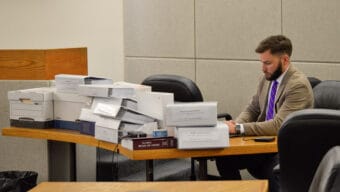
Public Defender Nico Ambrose in the Dimond Courthouse on Dec. 12, 2025. (Photo by Yvonne Krumrey/KTOO)

Three months after a trial against a former Juneau chiropractor accused of sexual assault ended in mistrial, the new public defense team is asking for more time to review the case before a second trial.

Fourteen former patients accused Jeffrey Fultz of sexual assault under the guise of medical care. They say the incidents took place during medical appointments between 2014 and 2020 while he was employed at Southeast Alaska Regional Health Consortium in Juneau.

In September, his trial ended in a hung jury on 14 counts of felony sexual assault, and two not guilty counts. One of the 14 counts has since also been dismissed. The state is attempting to retry the remaining charges that are eligible to be considered again.

The court assigned Fultz a public defender in October, Juneau’s Nico Ambrose. Private attorney James Christie represented Fultz for the last two years, and through the trial this summer. Ambrose appeared in court Wednesday for the first time since taking over Fultz’s representation.

Ambrose requested the next hearing date to be in April, which will mark five years since Fultz’s initial arrest. 

“There are just so many things in this case that need to be dealt with before we’re ready for trial,” he said. 

Ambrose said he has to review trial proceedings, which lasted six weeks this summer, and hasn’t yet received transcripts from the trial. Ambrose is Fultz’s third defense attorney since his 2021 arrest. 

Earlier this year, the Alaska Supreme Court issued a ruling that would limit delays in old cases, and while this case falls into that window, Ambrose said he doesn’t think it was written with a case like this in mind. 

“This case has not sat around for 5 years waiting to go to trial,” he said. “It has gone to trial.”

State Prosecutor Krystyn Tendy disagrees with scheduling the next hearing so far out and said the case has taken years, regardless of the recent trial. Some of the alleged crimes happened more than a decade ago. 

“We have seen how this case has dragged out and can drag out,” she said. 

Tendy said the court needs to set a new trial date, and should schedule a hearing in February. 

Ambrose said having hearings sooner than April — six months after he was assigned to the case — would be a waste of the court’s time.

Judge Larry Woolford scheduled the next hearing for this case on Feb. 11 at 11:30 a.m.

Officials, advocates say date rape drugging difficult to confirm, but an ongoing issue in Alaska

a drink
Commonly known date rape drugs are GHB and Rohyprol, or “roofies,” which are tasteless and odorless. But any kind of sedative can be used, like muscle relaxants, sleeping aids and anesthetics like Ketamine. (John Joh/Wikimedia Commons)

Content warning: The following story contains references to violence and sexual assault. 

Date rape drugging, or roofying, is the use of any sedative, usually mixed with alcohol, to incapacitate a victim and facilitate a sexual assault. While anecdotal stories of suspected roofying circulate around Alaska, cases and culprits are difficult to confirm.

Alaska Chief Medical Officer Dr. Robert Lawrence said that’s partially due to the nature of the crime.

“Many of these medications actually their mechanism, tragically, is memory loss,” he said. “One of your neighbors will have been assaulted, and know that an assault has occurred, but have no memory of how or when or what led up to it, just because of the way that the substance itself works. So that’s the reality of the situation that we’re in,” he said.

Substances can vary and are metabolized quickly in the body. GHB or Rhohyprol, most commonly identified as date rape drugs, are tasteless and odorless. They can cause intense inebriation, dizziness, memory lapses and pain, especially when mixed with alcohol, and are used to facilitate sexual assault.

The state does not track reports of suspected drugging or a drug facilitated sexual assault, according to officials with the Alaska Department of Public Safety and Department of Health. Lawrence explained that’s due to several reasons, but does not reflect the seriousness of the issue.

“We’re talking about sexual assault in Alaska, which is a very serious problem across the whole state. And then when you add to that the element of people using a sedating or incapacitating drug in order to make it more likely that someone could be assaulted, it becomes even a more serious issue,” he said.

He said the main reason the state does not track drug facilitated sexual assault is that data collection is variable. He said incidents are both medical and legal, so information can be reported to different agencies. State agencies are limited by whether a victim decides to report to authorities and when, and whether substances are detected in their systems. “Sometimes the medical record will include that, and sometimes not. And so the absence of that data doesn’t mean that there’s not still a problem,” he said.

Homer Police Department Lieutenant Ryan Browning says the department receives calls from the community periodically to report suspected roofying.

He said they received several calls in September, and one before Halloween weekend.

“Nothing concrete…and they were all very well after the fact,” Browning said. “And one of them was almost a week later, the other one was several days (later). People reporting that they suspected they were drugged at a bar, just based on how they woke up the next morning… typically it’s, ‘I don’t remember. I was at a bar. I was drunk, and I woke up feeling like I got hit by a truck.'”

When officers notice an uptick, the department will post an alert on the Homer Police Department’s Facebook page. He urged the public to remain aware, look out for friends, take note of suspicious individuals and any unwanted or inappropriate attention, and make a report if necessary.

“I’m a big proponent of ‘you are your first responder,’ right, and keeping yourself protected and safe as much as you can, and looking for signs and things like that when we’re out doing things and having fun,” he said.

Browning said none of the recent calls resulted in a reported sexual assault in Homer.

Criminal penalties can vary, Browning said, from criminal mischief charges of intending injury or tampering with food or beverages in an attempt to injure which are felonies. Misconduct involving a controlled substance like GHB is also a felony.

Sexual violence widespread in Alaska

Sexual violence is widely prevalent in Alaska. According to the 2020 Alaska Victimization Survey, the most recent data for Alaska, roughly 58% of Alaskan women had experienced intimate partner violence, sexual violence or both in their lifetime.

Current data is limited, but Alaska Native women experience the highest rates of violence and victimization. According to the Indian Law Resource Center, Alaska Native women have reported rates of domestic violence ten times higher than the rest of the United States.

In 2024, the rate of rape in Alaska was over three times the national average, according to available data by the FBI. That year, the FBI recorded 908 instances of rape statewide, or 122.5 per 100,000 people, compared to 37.3 per 100,000 people in the United States.

Only about one third of sexual assaults nationally are reported to law enforcement, according to an analysis by RAINN, the Rape, Abuse and Incest National Network, the nation’s largest anti-sexual violence organization. That’s due to a variety of reasons, including a fear of retaliation, belief it was a personal matter, or that police would not or could not do anything to help.

Women are disproportionately harmed by sexual violence, but men and LGBTQ+ populations are assault survivors as well. Most assaults, an estimated 60%, are perpetrated by someone known to the victim, according to RAINN, and 30% by a stranger.

Advocates offer resources and support, urge public awareness

Leslie Scroggin is an advocate and shelter manager at South Peninsula Haven House, a domestic violence shelter in Homer, and a member of the regional Sexual Assault Response Team.

“People typically, consistently seem to feel a sense of guilt over it,” she said. “I’ve heard people say things like it was careless of them to go out after work and to go drinking, or that they should have known better, or that type of thing. And it’s also a pretty disheartening experience, because it’s something that is just completely beyond their control… they don’t even have any sort of capacity to have any control over it.”

Scroggin said while public awareness is important, the larger issue is interrupting and addressing predatory behavior and the crisis of violence against mostly women.

“It’s the individuals that are causing harm that really need to be addressed, and they’re the ones that should be taking responsibility,” she said. “And obviously, we should always do whatever we can to protect ourselves. But that shouldn’t be something that we’re just constantly doing all the time.”

Scroggin said she has seen a rise in anecdotal reports of roofying in the summer months with increased tourism, but every situation is unique. She said people should seek medical care if they need it, and can make a report anonymously.

“The forensic nurse can do a sexual assault kit anonymously, and basically that just looks like collecting evidence and then putting it into a kit that is assigned a case number, but no one’s name will be attached to it,” she said. “So then they basically will just have that evidence there, and if the person who it got collected on should decide, you know, in three months, or even a couple of years that they would like to report then, then that will be available to them.”

Scroggin said the sooner a victim completes a sexual assault kit after an incident the better, but they have up to a week.

In Valdez, Tina Russell is a direct services coordinator with Advocates for Victims of Violence, Inc. a non-profit advocacy group and domestic violence shelter serving Valdez and the Copper River Basin region. She said she also notices an uptick in suspected date rape drugging in the summer months with more tourism and the fishing season, but has not seen any confirmed cases.

She says alcohol-related cases are more typical. “People under the influence of alcohol in a high amount, and then being taken advantage of to where they felt like they really didn’t give consent. And so they’ll come and talk to us about it, and or the hospital will call,” she said.

Russell said their organization is part of an unofficial sexual assault response team at the hospital in Valdez, and advocates, nurses and the local police department have training to respond and provide support to survivors, whether they choose to make an official report or not. “There’s so many different reasons that people don’t report,” she said. “You know, all of our statistics are so under-reported.”

Lawrence, as the chief medical officer, said Alaskans should know the risk, and look out for each other, both to prevent harm and to support people going through these experiences.

“All of us can be involved in the lives of people in a way that prevents individuals from being alone,” he said.

“All of us can be there as a neighbor or for someone who has suffered an assault,” he said. “I think that’s one of the most important things for people to have when they’ve suffered rape or sexual assault, is for there to be a caring adult who is there to walk with them through the process. That’s one of the most protective factors afterwards.”

If you or someone you know has experienced sexual assault, resources are available: 

Dismissed charges in Fultz case show limitations of Alaska’s sexual assault laws

Judge Larry Woolford in the Dimond Courthouse in Juneau on August 14, 2025. (Photo by Yvonne Krumrey/KTOO)

It’s been a month since the sexual assault trial against a former Juneau chiropractor ended with two acquittals and 14 charges declared mistrials. Although Jeffery Fultz wasn’t found guilty, those charges are still active and he could stand trial again. 

But earlier this month, the judge in the case dismissed one of those remaining charges. And this dismissal reveals a gap in state laws that makes it harder for alleged victims of sexual assault to achieve justice.

Listen:

More than a dozen former patients have accused Jeffrey Fultz of sexual assault under the guise of medical care while he worked as a chiropractor at Southeast Alaska Regional Health Consortium in Juneau. 

Judge Larry Woolford recently ruled that one alleged victim’s testimony doesn’t match the legal definition of the sexual assault by a medical provider charge. The acquittal order says the charge is being dismissed because the woman accusing Fultz was aware that the contact she received was “sexual and that it was not part of legitimate medical treatment.” 

In other words, Judge Woolford dismissed the charge because the victim knew she was being assaulted. That’s because a key part of the legal definition of sexual assault by a medical provider requires that the alleged victim isn’t aware of sexual contact happening at the moment.

State Prosecutor Jessalyn Gillum says the statute was originally written in response to a crime where a medical provider was sexually assaulting women behind a sheet, so they could not see the act. 

“Somebody who is receiving treatment and believing the behavior of the health care professional is consistent with that treatment, and then later finding out that that might not be the case,” she said. “That is a sort of a different kind of scenario than what was perhaps initially intended.”

So while that statute does apply to many of the women testifying against Fultz, some, like the one whose charge was dismissed after the trial, might fall through the gaps in the laws.

Jennifer Long is a former prosecutor and founded AEquitas, a nonprofit that advises prosecutors in sexual violence cases. She said that stipulation in the law doesn’t make sense. 

“To put that element in, that a victim is unaware that something is inappropriate, doesn’t really align with the dynamics of this kind of crime,” she said. 

She said that just because patients may realize that they are being assaulted doesn’t mean they are able to speak up or to leave an appointment immediately, especially when they are desperate for medical care. 

“You know what’s happened to you is wrong, and you have felt that it’s wrong, you may have still blamed yourself, or again, try to give the benefit of the doubt,” Long said. 

And Long said the power dynamic between a doctor and patient can be used to get patients to accept abuse or dismiss it. 

“This is just one other area where someone in a position of power is using a weapon, and it’s their power,” she said. “It’s no different than a gun. It’s no different than another threat. It’s just another way to get someone to comply.”

Let’s take a step back.

When the state first arrested Fultz in 2021 and charged him with assault, prosecutors were limited in what they could charge him with. 

At the time the alleged crimes were committed, the statute for sexual assault in Alaska required prosecutors to prove that the crime was committed under force, or threat of force. Almost all the alleged victims in Fultz’s trial said force was not involved.

The general sexual assault law changed in 2023, and the threat or use of force is no longer needed to prove assault. The new definition requires that a person did not freely give consent. But because that definition wasn’t law at the time of the alleged incidents, Fultz can’t be charged under it. 

The law change came amid a broader reckoning with sexual violence laws in Alaska. In 2018, an Anchorage judge faced public backlash, and was voted out, for accepting a plea agreement in a sexual violence case that he said reflected the state laws at the time.

So prosecutors in the case against Fultz had to choose between two limiting definitions of assault: one where there was a threat of force or one that specifies the defendant is a medical provider, and that the victim was unaware they were being sexually assaulted. They chose the second option. 

Fultz’s former defense did not respond to a request for comment on this acquittal, and a spokesperson from the Dept. of Law said over email that judges do not comment as a rule, “in order to maintain the integrity of their decisions.”

Three charges of the original 16 have now been dismissed.

The state plans to retry the 13 remaining charges. A status hearing to decide what will happen next in the case is scheduled for Oct. 15.

Former Juneau chiropractor accused of sexual assault has been assigned a public defender

Former Juneau Chiropractor Jeffrey Fultz and his defense team at the Dimond Courthouse in Juneau on Thursday, July 31, 2025. (Photo by Yvonne Krumrey/KTOO)

A former Juneau chiropractor accused of sexual assault now has a public defender. 

More than a dozen former patients have accused Jeffrey Fultz of sexual assault under the guise of medical care while he worked at Southeast Alaska Regional Health Consortium. 

Last month, his trial ended in a mistrial on 14 counts of felony sexual assault, and two not guilty counts. The state is pushing forward to retry the remaining charges that are eligible to be considered again.

Fultz’s new lawyer will be a public defender. People accused of crimes are generally eligible for a public defender if they can’t afford a private lawyer.

At a hearing this week, state prosecutor Krystyn Tendy said that Fultz is living in an expensive home in Colorado that he purchased for $900,000, and his high housing payments don’t make him eligible for a public defender. 

“He is choosing to spend over $5,500 a month on housing,” Tendy said. “I think there is a very, very big difference between somebody being unable to pay in terms of they’ve leveraged themselves, and somebody who is truly indigent.”

But Judge Larry Woolford ruled that he did qualify, despite his financial situation.

“It is certainly true that on paper, in some ways, the defendant is a man of some substance,” Woolford said. “It is also unquestionably true that he has for many years now been dealing with the legal consequences of the allegations against him, and that he has spent a significant amount of money doing so.”

Fultz disclosed that he has just under $200,000 in assets between his house and vehicles, but Woolford argued that those assets are not easy to sell to pay legal fees. 

A status hearing, when all parties meet with the judge to determine next steps in a case, is scheduled for Oct. 15.

Site notifications
Update notification options
Subscribe to notifications