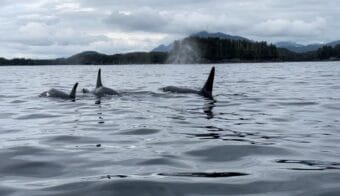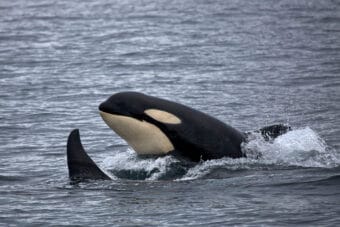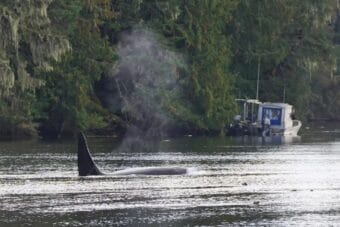
A killer whale, also known as an orca, swims in Alaska waters on July 25, 2013. Eleven killer whales were found ensnared in fishing gear this summer in Alaska’s Bering Sea and Aleutian Islands region, and 10 of them were dead. (Photo by Kaitlin Thoreson/National Park Service)
A federal investigation into the unusually large number of Bering Sea and Aleutian killer whales found dead this summer determined that most but not all of the deaths were killed by entanglement in fishing gear.
The National Oceanic and Atmospheric Administration’s Alaska Fisheries Science Center on Friday released some details about the deaths in the Bering Sea and Aleutians, which had spurred sharp criticism of seafood trawling practices.
Of the nine killer whales that were found ensnared in bottom-trawling gear, six were killed by those entanglements but two others were already dead before they were netted, the investigation found. The other whale was seriously injured by the gear entanglement but escaped alive, the agency said.
In addition to the nine whales found in bottom-trawl gear, there were two other cases of dead killer whales found entangled in other types of fishing gear.
The bottom-trawling gear that entangled the nine whales, also called orcas, was from vessels in what is known as the Amendment 80 fleet – roughly 20 large ships that both catch and process fish. These catcher-processors use trawl nets that sweep the seafloor to harvest Atka mackerel, yellowfin sole, rock sole and other flatfish species. They do not harvest pollock, the species that makes up the biggest volume of harvested Alaska seafood.
In the other two cases, one dead killer whale was found in trawl gear used by a vessel harvesting pollock, the agency said. That whale was determined to have been dead before it became entangled.
Alaska’s pollock harvesters do not use bottom-trawl gear; instead, their nets scoop fish in waters that are more in the middle range of the ocean depths.
The 11th case was a whale found dead in longline gear used by a NOAA Fisheries vessel to conduct an annual survey for sablefish and groundfish. It was the first killer whale death in the 30 years that NOAA Fisheries has been conducting the survey, the agency said.
Genetic analysis of samples that were collected from eight of the whales revealed that all were members of the Eastern North Pacific resident stock, the most plentiful of Alaska’s killer whale stocks. All were female, the agency said.
While the total number of dead killer whales was much higher than past years’ totals but not high enough to cause negative population effects, the investigation found.
A sablefish is seen on the seafloor off California in 2005. Sablefish are relatively valuable in commercial seafood markets, and Amendment 80 trawlers that mostly harvest cheaper bottom-dwelling flatfish are allowed to also harvest sablefish. (Photo by Rick Starr/National Oceanic and Atmospheric Administration)
“Given the high level of incidental catches of killer whales in 2023, we knew it was important to move as quickly as possible to better understand whether these incidental takes pose a conservation concern to any of the potentially affected killer whale stocks,” said Robert Foy, director, Alaska Fisheries Science Center. For that reason, the center expedited the genetic analysis to better understand potential impacts on Alaska’s different killer whale populations.
To Jon Warrenchuk, a senior scientist with the environmental group Oceana, the results raise some additional questions. He said killer whale deaths have been increasing in trawl fisheries.
“We’re well past the point for taking a hard look at the impacts of bottom trawling in Alaska,” Warrenchuk said.
And he noted that the flatfish being harvested by the ships involved in the deaths are generally lower-priced and of lower value. “The fact that it happened during the harvest of this low-value fish brings into question whether the value of that fishery is even worth the cost of killing all these whales,” he said.
Warrenchuk said it is possible that the trawlers involved in the whale entanglements were targeting sablefish, a more valuable species than the flatfish that make up the bulk of the vessels’ harvests. Amendment 80 vessels in past years were prohibited from targeting sablefish, but that has changed recently, and they now have quota rights to some of those higher-value fish, he noted.
Oceana has asked for more information about the specific locations and time of the whale incidents
Critics of Bering Sea trawling practices have said the killer whale deaths might be attributable to the discards of fish netted incidentally as bycatch. The whales have identified the trawlers as a source of food, the critics argue.
In particular, they have pointed to a practice known as “halibut deck sorting,” in which the Amendment 80 trawl vessels are allowed to return incidentally caught halibut to the sea without it counting against their bycatch limits as long as the fish are sent back to the ocean within 35 minutes and in good shape. However, a recent report submitted to the North Pacific Fishery Management Council shows a significant reduction since 2020 in observed incidences of killer whales feeding off Amendment 80 trawler discards.
There are other concerns about halibut bycatch by the Amendment 80 fleet. Last week, NOAA Fisheries enacted a new rule that could reduce the fleet’s halibut bycatch cap. The rule replaces the current fixed limit of 1,745 metric tons with one that can be reduced as much as 35% below that if halibut populations are low.
Rice’s whales are one of the most recently discovered whale species in the world — and already one of the most endangered. But protections for the Gulf of Mexico species have been repeatedly delayed. (KL Murphy for NPR)
Even before they saw one of the rarest mammals in the Gulf of Mexico, the two amateur fishermen were already feeling lucky. They had motored to their favorite spot 35 miles off the coast of Pensacola, Fla., downed a couple Miller Lites, and caught their third mahi mahi when they heard the sound of air escaping a blowhole.
“Then you start looking,” said Ben Renfroe, who grabbed his phone to film it. “Is that a dolphin or a whale?”
But dolphins in the Gulf don’t grow bigger than motorboats, and the dark figure Renfroe spotted just before it sank back into the water looked much larger than his 26-foot craft. Seconds later, the animal appeared above the horizon again, first showing off a small dorsal fin, then gliding its trunk over the waves like a surfacing submarine.
Back on shore, experts reviewed the video and agreed: It was almost certainly a Rice’s whale, one of the most endangered whales in the world. Authorities estimate only around 51 of the animals remain – and they don’t live anywhere but the Gulf. To avoid extinction, the U.S. government has estimated that no more than one can be killed or seriously injured by human activity every 15 years.
Which activities threaten the whales the most is not a mystery. The National Oceanic and Atmospheric Administration, or NOAA, has cited more than 20 risks, including energy exploration in the Gulf, vessel strikes and underwater noise. But although the agency has produced helpful science about the whales, NOAA has repeatedly delayed following rules and adopting measures that could help the whales survive those man-made threats.
“The bureaucratic apparatus is slow to catch up,” said Aaron Rice, an ecologist who studies the whales but is not related to scientist Dale Rice, for whom they are named. “It raises this philosophical question of values, like, how much do we value these animals that live in U.S. waters?”
“Shameful” delays for protections
On April 20, 2010, about 40 miles offshore from Louisiana, the BP drilling rig Deepwater Horizon caught fire. Within two days, 11 workers had died and the rig had sunk. The well that was left behind would gush more than 200 million gallons of oil into the Gulf of Mexico over the next three months. It was the largest marine oil spill in history.
Rice’s whales were some of the animals most harmed by the disaster. About one in five died after the oil slick engulfed their habitat, and those that survived became more likely to get sick or lose pregnancies. Their numbers dropped to fewer than 100.
A boat travels through crude oil leaked from the Deepwater Horizon wellhead near Louisiana. (Chris Graythen/Getty Images)
But the spill also prompted more attention to the whales. Before Deepwater Horizon, the animals were thought to be a type of Bryde’s whale, a kind of whale found everywhere from South Africa to Japan. After the disaster, researchers from NOAA and other groups analyzed bones that washed up on Gulf shores and conducted genetic tests. This was no subgroup, they soon realized. This was a completely new species. The ones in the Gulf were believed to be the last ones left on the planet.
The newest great whale was also one of the most endangered, and it was right in America’s backyard.
“Every animal counts at that point,” said Jane Davenport, a senior attorney at Defenders of Wildlife, a conservation nonprofit. “Every one you kill is another nail in the coffin.”
Losing the species would mean losing an animal that fuels the ocean’s productivity by transferring nutrients from the seafloor to the surface, and back again, with every dive. Great whales also reduce carbon emissions. When they die, they sink an average of about 33 tons of CO2 that they’ve stored in their bodies throughout their life to the bottom of the ocean. That’s more than 1,000 times the carbon a tree captures in a year. Experts say the whales’ extinction would be an ominous indicator of an unhealthy Gulf ecosystem.
And it would be a reflection of slow U.S. action to protect the whales. Federal laws mandate that NOAA list a marine mammal as endangered soon after a species is shown to be at risk with the best scientific data available. Typically no more than one year after the species is listed, the agency must also determine what habitat the animal needs to be protected. That earns both the animals and their physical home special consideration when projects are proposed nearby that could harm them – a constant threat in the Gulf. Nearly all the U.S. oil and gas extracted offshore is pulled from the Gulf of Mexico; industrial activity is a fixture of the area.
But NOAA has been years late meeting its deadlines, and though the whales were eventually added to the endangered species list, it still hasn’t designated the whales’ habitat. Conservation nonprofits have sued the agency three times since 2016 to urge it to comply with the law.
The agency is also required to publish a plan for how the government intends to help the Rice’s whale population recover to healthy numbers. NOAA hasn’t done that yet either, though the agency has released an eight page outline.
The chief of NOAA’s marine mammal branch in the Southeast, Laura Engleby, said the agency is limited by its staff and resources, and is doing the best it can to help the animals. She said the agency is in the middle of several restoration projects and is conducting outreach to spread awareness of the whale’s dwindling numbers. In November, a part of a skeleton that helped scientists determine that Rice’s whales were a new species will be added to a public exhibit at the Smithsonian National Museum of Natural History in Washington, D.C.
But Michael Jasny, a senior policy analyst for Natural Resources Defense Council, one of the nonprofits that has brought the agency to court for missing protection deadlines, said the repeated delays should be considered scandalous.
“It’s an extreme case showing the extent to which an agency will delay,” said Jasny. “And that is really shameful, given that the species that are being managed are on the verge of extinction.”
Ships remain serious threat to whales, NPR analysis shows
In 2021, a group of nonprofits grew tired of waiting for NOAA to act. They petitioned the agency to impose a speed limit to protect the animals from at least one of their immediate man-made threats: ships.
Gulf ports are busy; the port of Houston exports more tons of cargo than any other port in the country. Since 2009, two Rice’s whales have been killed or injured after ships hit them. And research on whales injured by ships over the past few decades shows that the strikes that seriously harm the mammals are often caused by big vessels that are moving quickly.
So the environmental groups recommended that when ships 65 feet or larger cross a portion of the whales’ habitat in the eastern Gulf, they be required to slow down to 10 knots or less. They also asked the agency to prohibit travel in that zone under the Florida panhandle at night, when the whales float near the surface and are harder to spot.
An aerial view of a North Atlantic right whale feeding off the shores of Duxbury, Mass., in 2015. (David L. Ryan/Boston Globe via Getty Images)
Slowing down ships to save whales isn’t a new idea. North Atlantic Right whales are also endangered; around 350 are estimated to remain in the American and Canadian Atlantic. Along the U.S. East Coast, a 10-knot limit has been in place to protect them for more than a decade. Research indicates that lowering speeds to that level works.
“Vessel speed is the low-hanging fruit,” said Davenport, the lawyer for Defenders of Wildlife, one of the nonprofits that petitioned NOAA. “That is the most important thing that we can do right now.”
But after NOAA invited public comments on the proposal this summer, the energy and marine industries pushed back fiercely – and politicians who represent states where those sectors are top employers drafted legislation against it.
On Aug. 18, Rep. Clay Higgins, R-La., proposed a House bill that would block NOAA from passing the speed limit until the government could show it wouldn’t negatively impact commerce. A Senate version of the bill was later introduced by Sen.Bill Cassidy, R-La.
Cary Davis, the president of the American Association of Port Authorities, a seaport industry advocacy group, told NPR that a limit for just a few Rice’s whales in the Gulf didn’t make sense.
“It’s wildly overbroad and ill-conceived to force a blanket slow-down if there’s only so many of them,” Davis said. “And time is money, of course.”
After reviewing the feedback, on Oct. 27, NOAA announced its decision. It denied the nonprofits’ speed limit petition.
In a statement, the agency said it needed to focus on other conservation priorities, and would try to get vessel operators to slow down voluntarily. But without a mandatory limit, the risk of ships injuring the whales is high across the Gulf.
NPR analyzed traffic data for over 6,000 ships that were 65 feet and larger. The data, collected by land and satellite receivers, indicated where the ships went and how fast they were going as they traveled across the 28,000-square-mile swath of the whales’ proposed critical habitat in 2022.
Out of all the journeys the ships took that crossed the whales’ habitat last year, 80% were traveling at an average of more than 10 knots. Without a limit in place, vessel speeds could continue to be a serious threat to the whales.
Environmentalists called NOAA’s denial of the slow-down petition absurd, given that ship strikes had already injured more Rice’s whales in the past 15 years than the government has said the species could afford to lose if it hoped to avoid extinction.
“To engage in yet more delay while the agency pursues paperwork is just an utter failure in conservation,” said Jasny, from NRDC. “I find no way to read this other than as an act of political cowardice.”
When it comes to underwater noise, another established threat to the whales, there are also few limits.
No noise limits
Rice’s whales let out deep, low moans that pulsate underwater for up to a minute.
Scientists say the calls are unique – nothing on the planet sounds like them – and that the whales may make them to survive. Marine mammals use their hearing to find mates and food, to maintain relationships, to navigate and to avoid predators.
But the Gulf is one of the loudest places underwater in the U.S.
Fast ships don’t just hit whales. At speeds of over 10 knots ship propellers start to generate intense cavitation noise. That sound causes most of the underwater sound pollution from the shipping industry, said Andrew Kendrick, a naval architect and consultant for the Canadian government. And when it happens near the whales, “they can’t hear themselves think.”
Scientists have observed that Rice’s whales have sometimes stopped making their own sounds in the presence of ships. But the noise from seismic air gun surveys is still more powerful.
The Maersk Idaho container ship is shown at the Port of Houston Authority in 2021. (Brandon Bell/Getty Images)
Air gun blasts are one of the most prevalent underwater sounds in the Gulf, and they overlap with the low frequency range in which Rice’s whales communicate. Because sound travels faster in water than in air, researchers have picked up the blasts on recorders located more than 400 miles away – about half the length of the Gulf.
“There is just this constant blanket of human noise,” said Rice, the ecologist.
And the air guns are not just noisy. When they’re dragged behind vessels to help identify the location of the oil and gas, they send explosions of compressed air into the water, for weeks at a time. Those blasts, which go off every 10 seconds, send waves of pressure downward powerful enough to penetrate miles beneath the bottom of the seafloor.
Technological alternatives do exist that can be less disruptive. Some air gun technologies that can survey the ocean up to ten times more quietly than conventional guns are on the market now. Brands sell kits that can transform old guns into quieter ones, which is cheaper than replacing every gun on the ship.
Scientists have observed that Rice’s whales have sometimes stopped making their own sounds in the presence of ships. (KL Murphy for NPR)
Upgrading the technology isn’t inexpensive. It can cost up to 10 million dollars, said representatives from Sercel, a company that sells both conventional air guns and alternatives that are friendlier to marine mammals. But that’s a tiny fraction of the income generated by just four of the largest energy companies working in the Gulf. Chevron, ExxonMobil, Shell and BP earned more in 2022 than any other year in history. Collectively, they earned around 160 billion dollars.
Still, the government doesn’t require the industry to use alternatives. Though excessive noise is prohibited on land, there are no limits to the amount of noise that can be sent into the ocean.
“If the regulations aren’t there,” said Robin Ellis, a vice president of sales at Sercel, “they’re not going to do it.”
After reviewing public documents, NPR found that’s the case in the Gulf. Of the 25 seismic survey projects that have cumulatively been approved to blast noise into the ocean for more than 1,000 days over the next three years, all but two energy companies have said they will use conventional airgun systems that stream multiple guns behind their boats.
Harming whales is not the industry’s goal, said Alex Loureiro, the scientific director for EnerGeo Alliance, a trade association that represents oil and gas companies. The alternative technologies are just not as efficient, she said.
“It’s going to take time for the industry to actually be able to use these technologies effectively,” said Loureiro.
When asked whether NOAA was doing anything to encourage industries to switch to quieter technologies that are better for whales, an agency representative pointed NPR to a document that said it wanted to reduce noise, but listed few concrete steps for changing the rules.
The skull used to determine that Rice’s whales were a new species in 2021 is stored at a Smithsonian facility in Maryland. (Catie Dull/NPR)
Environmental groups and scientists think sightings of Rice’s whales may become increasingly rare. In an open letter to the Biden administration they predicted a serious consequence if conservation action is not taken quickly: the first man-made extinction of a great whale species could happen under U.S. watch.
In October, Ben Renfroe and his friend put the prediction to the test. They went looking again for the Rice’s whales, hoping to repeat their summer luck. The two spent almost 10 hours in the mammals’ habitat, motoring more than 100 miles around the Gulf of Mexico. They spotted a few birds and accidentally hooked a shark with their fishing pole.
But this time, they saw little else. No blowholes. No fins. No sign of any whales.
Methodology
NPR downloaded Automatic Identification Systems (AIS) ship transponder data from MarineCadastre.gov, a cooperative effort between the Bureau of Ocean Energy Management and the National Oceanic and Atmospheric Administration (NOAA). This AIS data is collected by approximately 200 land-based receiving stations from the U.S. Coast Guard’s Nationwide Automatic Identification System. As the range of land receivers is usually limited to 40-50 miles off the coast, the data was combined with satellite-collected AIS data from Spire and processed by Global Fishing Watch to provide more comprehensive coverage of the Gulf of Mexico.
In NPR’s analysis of transits through the proposed critical habitat of the Rice’s whales, a transit was defined as an instance when a ship entered or exited the area. A new transit was also started if there was more than a day’s gap between two AIS broadcast points.
The speed of a transit through the critical habitat was calculated using a distance-weighted average speed, as detailed in a vessel speed rule assessment published by NOAA. This method corrects for variations in AIS transmission and reception rates, which can be influenced by the speed and type of the vessel.
Ships measuring less than 65 feet in length as well as law enforcement, search and rescue, and military vessels, were excluded from this analysis.
NOAA Fisheries encourages all boaters, anglers and others operating in Gulf of Mexico waters to report all suspected sightings of Rice’s whales by calling 877-WHALE-HELP (877-942-5343).
Barrie Hardymon edited this story and Noah Caldwell produced it. Robert Little and Graham Smith contributed editing and producing support. Research from Barbara Van Woerkom, and art direction and photo editing by Emily Bogle. Graphic by Daniel Wood.
Copyright 2023 NPR. To see more, visit https://www.npr.org.
European green crabs collected from Metlakatla’s Tamgas Harbor this week. The crabs were trapped in shrimp pots. (Photo courtesy of Dustin Winter)
Tammy Davis is the invasive species program coordinator for the Alaska Department of Fish & Game. During the Alaska Invasive Species Partnership workshop in Sitka on Thursday, she was teaching a roomful of people how to identify invasive green crabs – which, surprisingly, are not always green.
“They can be brown, they can be orangish, reddish, yellowish,” Davis continues. “They’re four inches — an adult is four inches across the back of the carapace.”
European green crabs first reached the Pacific coast in 1989, but it wasn’t until 2022 that they showed up in Alaska. Davis remembers the moment she learned that green crabs had been found in Metlakatla last summer.
“And I think we were all really close to tears, because we should have known they were coming,” Davis said. “But we didn’t think they would come this soon, I guess.”
Genelle Winter is the Climate & Energy Grant Coordinator for Metlakatla Indian Community. While Metlakatla is the only place in Alaska where green crabs have been positively identified, Winter said it’s likely that they’ve already spread.
“The numbers that we’re finding them in — we’re pretty sure that there are other places, we just haven’t found them yet,” Winter said. “And with that, right now, we’re just under 3000 crabs total that have been caught since discovering them in 2022.”
“The first thing that was found was the first shell,” Winter said. “And that triggered that response to really start intensifying our trapping and then modifying how and where to make sure that we were really actually putting the traps where the crab were. And now those guys, they have it dialed in something fierce.”
These crabs tend to decimate eelgrass beds, which are critical habitat for juvenile salmon and other critters. They are also voracious eaters of clams and other small crabs. They reproduce quickly, and can survive in a wide range of environments.
Davis said communities like Sitka should be on the lookout.
“It seems so frightening and negative to say it’s inevitable, but based on ocean currents, it’s likely,” Davis said. “We don’t actually have good oceanographic information about currents in the Alexander Archipelago, so some of our Southeast communities may be slightly more protected if currents tend to go out along the coast. Unfortunately, that puts Sitka more likely.”
Davis said that Alaskans can help by learning how to identify green crabs and looking out for them on beach walks. While collecting some invasive species requires a permit, Alaska beachcombers can collect potential green crabs for the purposes of reporting – but they should keep the crab in a container and report the find immediately. You can report invasive species online through the Alaska Department of Fish & Game website or by calling the invasive species hotline at 1-877-INVASIV.
An aerial photo of Tango, and his mother Sasha, from a NOAA permitted drone assessment on July 20, 2023 – approximately one month before Tango died (Photo by Jacek Maselko, NOAA Permit #24359)
A humpback whale calf known as Tango that washed up dead near Auke Bay earlier this summer was killed by a large boat, according to the post-mortem exam.
The fatal injuries included deep lacerations on the calf’s body and pectoral fin, likely caused by a propeller. And according to NOAA Marine Mammal Specialist Suzie Teerlink, Tango also had scarring from past injuries caused by smaller boats.
“This calf had interactions with several vessels during the course of its short life,” Teerlink said. “We see these sub-lethal interactions unfortunately pretty frequently.”
Tango was born this year to Sasha, a well-known whale that returns to the Juneau-area annually. Sasha herself is easily recognizable due to a distinct scar from entanglement in fishing gear.
“That’s I think a testament that they can survive lots of these human interactions,” Teerlink said. “But there’s a lot of risks out there.”
NOAA does not keep a formal record of vessel strikes or entanglement incidents in the region, but Teerlink said the area where Sasha and her calves tend to feed has high boat traffic. And she added that both the whale population and the number of boats in the Juneau area have been increasing in recent years, which could cause more injuries.
“There sometimes can be a misconception that whales know where boats are at all times,” Teerlink said. “They do pay attention to their surroundings. But you know, it’s not foolproof.”
Teerlink said the best way to keep whales safe is to reduce speeds. That gives whales more time to adjust and gives mariners more time to take a look around the area. NOAA guidelines also call for vessels to stay at least 100 yards away from whales.
A humpback whale breaches in Kenai Fjords National Park on June 12, 2013. Humpback whales, with their distinctive fins, are being increasingly spotted farther north in Arctic waters used by ice-adapted bowhead whales. (Photo by Kaitlin Thoreson/National Park Service)
Qaiyaan Harcharek was hunting for bowhead whales in the spring of 2007 when he first saw a humpback whale in the waters off Utqiagivik, his hometown and the nation’s farthest north community.
He and his fellow hunters had been “boating and boating and boating for days,” heading toward the site where a whale was spouting from its blowhole, when they encountered the humpback in the Beaufort Sea, well north of where that species usually swims.
“It should have been a bowhead because that’s all that’s ever up there that time of year,” Harcharek said
That is no longer the case. Humpback whales, better known in the waters between the tropics and the Bering Sea, are now commonly spotted in Alaska’s Arctic waters.
A bowhead whale and a calf in the Arctic on May 29, 2011. (Photo by Corey Accardo/NOAA)
A recently study co-authored by Harcharek reviews the multitude of sightings since his 2007 encounter, and it shows how they have increased exponentially.
Aerial surveys conducted form 2009 to 2019 by the National Oceanic and Atmospheric Administration’s Alaska Fisheries Science Center tallied 150 sightings of 220 humpback whales in the Arctic waters, with twice as many sightings between 2017 and 2019 as in the three years prior.
Most of the humpbacks were seen between about 67 and 68 degrees north latitude, which is slightly north of Kotzebue, according to the data. It appears that there is some sort of feeding hotspot near the Inupiat village of Point Hope that is drawing large numbers of humpback whales, said lead author Kate Stafford of Oregon State University’s Marine Mammal Institute.
Farther north, where Harcharek’s 2007 encounter with a humpback was one of the first ever reported in the waters off Utqiagvik, the total sightings have not been as numerous, but there has been a similar increase in recent years. Data collected by the North Slope Borough’s Department of Wildlife Management shows that from 2020 to 2022 there were six nearshore sightings of humpback whales in the far-north waters, some with multiple animals, according to the study. In one single event in 2022, 10 humpback whales were seen breaching and slapping their pectoral fins on the water.
Harcharek, who said he sees a humpback whale “darn near every time I go boating,” has mixed feelings about the new arrivals.
“It’s fascinating to see new species. However, we don’t know what impact that is going to have on the whales that we live off of,” he said. “It’s fascinating. It’s interesting. It’s also a little terrifying because we rely on the bowhead for so much.”
A bowhead whale skull, seen on Aug. 6, 2022, is one of several displayed on the beach at Utqiagvik. Bowhead skulls are thick enough to break through sea ice, and they are among the characteristics that allow the whales to thrive in Arctic waters. Bowhead hunting is an important part of Inupiat culture. (Photo by Yereth Rosen/Alaska Beacon)
The catalyst for the study, Stafford said, was a 2021 boat survey with the late Craig George, the renowned whale biologist who worked for decades at the North Slope Borough’s wildlife department. They were watching a whale feeding in the Beaufort Sea that they assumed was a bowhead. Looking closer, she said, they saw the distinctive fin of a humpback whale.
That led them to a search of records kept by the borough and to consultations with Inupiat residents. People were eager to share their knowledge with George, Stafford said.
“Of course, Craig was the go-to person when people saw something interesting,” she said. “Because people trusted him with their information and observations and because he would listen to them with respect and with consideration, people went to him.”
Bowhead whales, with their thick bow-shaped skulls that can break through ice, have evolved to thrive in the Arctic. Inupiat hunting tradition targets bowheads and belugas, another Arctic-dwelling species.
In contrast, Alaska’s humpback whales spend part of their lives in the warm climates, wintering in Hawaii, Mexico or the waters off Japan and the Philippines.
There are five population groups of North Pacific humpback whales, three of which summer in Alaska waters. They are commonly seen in Southeast or Southcentral Alaska and the Bering Sea. They were known to occasionally range as far north as the southern Chukchi Sea, above the Bering Strait, but those appearances were considered rare – until now.
A humpback whale’s characteristic stub-like, humpy back fin is seen in this undated photo. (Photo provided by National Oceanic and Atmospheric Administration)
The new study, published in the journal Marine Mammal Science, shows how that range has expanded farther north still.
A possible explanation for the expansion, the study said, is climate change. Long-term warming has reduced Arctic sea ice, not only in the summer melt season but, as the past year’s record shows, throughout the year.
If lack of sea ice is a factor, humpback whales are not the only species taking advantage to expand northward. Previous studies have shown how killer whales are increasingly present in Arctic waters used by bowheads. One of those studies, led by George and published in 2017, tracked trends for wounds in the bodies of harvested bowheads and found increasing incidence of killer whale bite marks; a related study, published in 2020, provided direct evidence of killer whales preying on Arctic bowhead.
Another factor that might be at play, also related to climate change, may be warmth-driven changes in the food web that created more favorable foraging conditions for humpback whales, Stafford said.
Another possible explanation is the steady increase in the North Pacific humpback population, she said.
Humpbacks have thrived sufficiently in recent years that some are no longer considered members of an endangered or threatened species. Previously, all humpback whales worldwide were listed as endangered, but in 2016 NOAA Fisheries identified 14 “distinct population segments” and determined that Endangered Species Act protections were no longer warranted for most of those.
Biologist Craig George stands on Utqiagvik’s beach on Oct. 4, 2018. George, who went missing while rafting the Chulitna River last week, devoted much of his research to the effects of sea-ice loss. In past decades, the waters here would have been frozen over by October; in 2018, there was no ice within sight. (Photo by Yereth Rosen/Alaska Beacon)
Of the three distinct population segments that swim in Alaska waters, one is classified as endangered, one as threatened and one, which winters in Hawaii, no longer has any Endangered Species Act listing.
George died in July in a rafting accident near Denali National Park and Preserve. The newly published study may not be the last to bear his name as an author due to his work before his death, Harcharek said.
“Honestly, I would not be surprised if there’s other work. Although he was retired, he was never going to be retired completely,” he said.
George’s death hit Utqiagvik hard, Harcharek said. “I’ve known him my whole life,” he said. “I’m sad. It sucks right now. We just lost an encyclopedia of knowledge of whales and ecosystems. That’s aside from just the amazing person he was.”
An American Seafoods Company vessel in the Port of Dutch Harbor in June 2020. (Hope McKenney/KUCB)
The U.S. Environmental Protection Agency has fined one of Alaska’s biggest fishing companies nearly $1 million for Clean Water Act violations.
American Seafoods Company is the world’s largest at-sea processor of Alaska pollock and holds the largest allocation of wild Pacific hake. The company operates a fleet of seven vessels in the North Pacific Ocean and Bering Sea.
The EPA cited the company and the owners of its vessels for hundreds of violations along the Oregon and Washington coasts, including discharging waste in a protected area, failure to monitor discharges and reporting inaccurate information in required annual reports, according to a Thursday statement.
“Discharge of seafood processing waste in prohibited areas and within the 100-meter depth contour of Washington and Oregon exacerbates already existing low-oxygen conditions which negatively impact most fishes, crabs and other marine life,” the EPA said.
An American Seafoods spokesperson said the company was notified of the allegations in March. Since then, he said the company has provided all documentation to the EPA, and that it’s assigned additional staff and updated its processes to ensure reporting is “complete, accurate and timely.”
The EPA found that American Seafoods and the owners of its vessels had noticeably more severe and much higher number of violations than other Oregon and Washington offshore fish processors during a compliance check of the industry. The vessels are the American Dynasty, American Triumph, Northern Eagle, Northern Jaeger and Ocean Rover.
The EPA is requiring American Seafoods to conduct “corporate-wide, systemic improvements” to ensure compliance with its permits, and requires they pay $999,000 in penalties.
“In amassing hundreds of violations from illegal discharges to sloppy and even non-existent record-keeping American Seafoods Company demonstrated a clear disregard for the fragile and valuable resources that sustain its business,” said Ed Kowalski, director of EPA’s Enforcement and Compliance Assurance Division in Seattle. “When issuing a permit, EPA confers to the permit holder the responsibility to protect our nation’s resources. We expect the company-wide, systematic overhaul of its operations will re-focus American Seafoods Company on the true value of its permit, the importance of tracking compliance with the permit, and the resources that permit entrusts it with protecting.”
When asked about the company’s Alaska operations, an EPA spokesperson did not say whether or not the agency is currently bringing any enforcement actions against them.