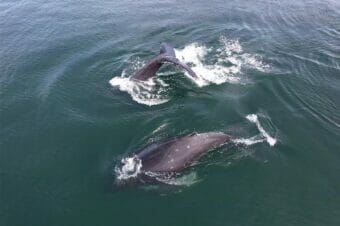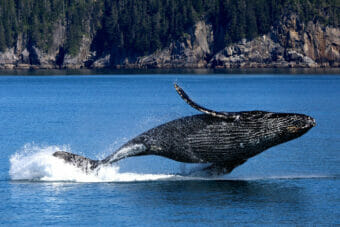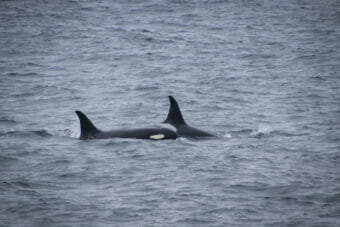
Orcas spotted in the Bering Sea in August 2023. (Courtesy Of Dustin Unignax̂ Newman)
Federal officials are looking into the deaths of nine orcas that were hauled up by groundfish trawlers in Bering Sea and Aleutian Islands fisheries this year, and conservation groups say more needs to be done to prevent such deaths.
According to NOAA Fisheries, a tenth whale was released alive, but the nine other orcas incidentally caught in trawl nets weren’t so lucky.
“NOAA Fisheries is analyzing collected data to determine the cause of injury or death and determine which stocks these whales belong to through a review of genetic information,” saidJulie Fair, public affairs officer with the federal agency’s Alaska office, reading from a statement published Thursday. She declined to be interviewed, except to read the statement aloud.
Killer whales are protected under the Marine Mammal Protection Act, which requires boat owners or operators to report the deaths and injuries of the mammals during commercial fishing and survey operations.
Fair said NOAA Fisheries monitors bycatch of protected species to determine whether the animals were dead before being caught or were killed or seriously injured by commercial gear.
The vessels involved in these incidents weren’t named, but Fair said the boats involved were all required to carry two federal observers on board.
“Nine, ten killer whales is too many,” said Shari Tarantino, head of the Seattle-based advocacy group Orca Conservancy, which advocates for the endangered Southern Resident killer whale population that roams from California to Southeast Alaska. “And if it’s just this year, something needs to be done in the future to mitigate these atrocities, frankly.”
Chris Woodley, head of the Groundfish Forum — the Seattle-based association that represents Bering Sea trawlers — declined to be interviewed, providing a written statement to KUCB instead. In it, he said that vessels are experimenting with gear modifications that may prevent whales from entering trawl nets, and that the Amendment 80 trawl boats voluntarily stopped fishing on Sept. 9, with more than three months left in the season, because of the orca bycatch.
Fishing boat encounters that harmed or killed orcas in Alaskan waters were rare until recently, according to the statement, first reported by the Anchorage Daily News. NOAA reported just seven killer whale mortalities or serious injuries resulting from fishing gear entanglement between 2014 and 2020.
“In 2023, our captains have reported an increase in the number of killer whales present near our vessels, where they appear to be feeding in front of the nets while fishing,” the statement reads in part. “This new behavior has not been previously documented and marine mammal scientists are not sure why this change has occurred.”
Tarantino said it’s important to protect orcas for future generations.
“We’re not saying stop trawling, even though I think trawling is unbelievably devastating to the ocean animals and the beings that live there,” she said. “But to continue taking this bycatch is just insane. It’s destroying our future, in my opinion. You know, if the ocean goes, we go.”
Biologist Deborah Giles, the science and research director for the Washington-based nonprofit Wild Orca, said she wasn’t surprised when she heard about the nine orca deaths.
“I was glad that [NOAA was] finally recognizing it publicly,” she said. “Of course, my cynical brain wonders how often this is happening when it was not reported — or at least not released publicly. I’m very glad that this is going to be investigated.”
Giles said the industry needs to figure out a safe way to keep animals from interacting with fishing vessels and reduce bycatch of non-targeted species.
“We’d ask NOAA to come up with some new protocols for ensuring that this doesn’t happen again in the future,” she said. “NOAA is responsible for marine mammals, like killer whales, and they’re also responsible for making sure that the fisheries are not jeopardizing non-targeted species. And especially in the trawl industry, bycatch is massive. And it’s unsustainable. Initially, what we need to know is what are they doing about this? What steps are going to be taken to minimize this?”
Activists with the “Stop Factory Trawler Bycatch” campaign planned to hold a protest Thursday outside the annual meeting of Genuine Alaska Pollock Producers at Seattle’s Four Seasons Hotel.
“Nothing I have seen yet clearly states which trawl vessels were involved,” anti-bycatch activist David Bayes said in a text message.
Genuine Alaska Pollock Producers did not immediately respond to a request for information Wednesday afternoon.
In a written statement, NOAA spokesperson Julie Fair said the agency is working quickly to evaluate the orca-harming incidents and will share findings as soon as possible.
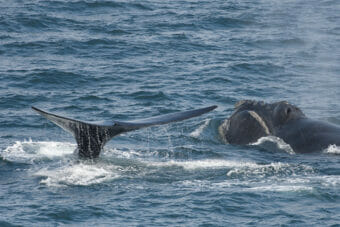
Two Eastern North Pacific right whales are seen swimming in the Gulf of Alaska in August of 2021. They were among four right whales spotted just south of Kodiak Island during a survey by scientists with the National Oceanic and Atmospheric Administration. Scientists believe there are only about 30 animals in the population, and sightings are rare. NOAA Fisheries is now considering a revision to its designated areas of critical habitat in waters off Alaska, a response to a petition from environmental groups seeking broader areas of protective zones for the right whales. (Photo provided by NOAA Fisheries)
Some of the world’s rarest whales could get enhanced protection under a plan announced by federal regulators on Tuesday.
The National Oceanic and Atmospheric Administration’s National Marine Fisheries Service said it will reevaluate the habitat designated as critical for the tiny population of right whales that swim in the waters off Alaska.
The move is in response to a petition filed last year by the Center for Biological Diversity and an organization called Save the North Pacific Right Whale. They argued that the areas of critical right whale habitat designated 15 years ago by NOAA Fisheries are far too small to effectively conserve the tiny population.
Scientists believe there are only about 30 animals in what is called the Eastern North Pacific right whale population. The critically endangered population that shares Alaska waters with fishing vessels and cargo ships is distinct from other highly endangered right whale populations in the world, including the few hundred in the Western North Pacific population and the North Atlantic population.
Critical habitat, as defined in the Endangered Species Act, is an area that is considered essential to conservation of a listed population. The act requires that any endangered or threatened listing be followed by a designation of critical habitat, as long as there is enough information available to do so. Within critical habitat, any activities requiring federal permits must be vetted for potential impacts to the listed species.
NOAA Fisheries in 2008 designated critical habitat consisting of 1,175 square miles in the Gulf of Alaska south of Kodiak Island and 35,460 square miles in the southeastern Bering Sea.
The environmental petitioners are seeking a vast expansion, to include a large swath south of the Alaska Peninsula and eastern Aleutian Islands and a larger chunk of the southeastern Bering Sea north of the Aleutians. Included in the groups’ proposed expansion is a heavily trafficked area called Unimak Pass, an important marine transit zone used by ships, marine mammals and fish traveling between the Gulf of Alaska and the Bering Sea through the easternmost section of the Aleutians.
A map shows existing critical habitat for North Pacific right whales in Alaska waters and an expansion proposed by environmental groups in a petition submitted in 2022 to the National Oceanic and Atmospheric Administration’s Fisheries service. The map also shows many of the locations where the rare whales were spotted in recent years. (Map provided by NOAA Fisheries)
NOAA Fisheries has not yet committed to any particular expansion, said Jenna Malek, the agency’s North Pacific right whale recovery coordinator.
“It’s unknown at this time what a revision is going to look like,” Malek said.
In addition to Unimak Pass, other areas the environmental groups are seeking to add as designated critical habitat overlap with areas used for commercial fishing and shipping. Malek said NOAA Fisheries will have to consider possible impacts to those industries as it evaluates options for critical habitat revisions.
Since 2008, there have been visual sightings or acoustic recordings of right whales in areas outside of that designated critical habitat, according to NOAA Fisheries.
In one notable case, an Eastern North Pacific right whale was spotted in 2018 well to the north of existing designated critical habitat in waters off St. Lawrence Island at the southern tip of the Bering Strait, then later in nearby waters off Russia. Another St. Lawrence Island sighting occurred in 2019.
Two North Pacific right whales were spotted in February of 2022 feeding in waters near Unimak Pass, according to NOAA. The most recent sighting was in February, made by people aboard a whale-watching ship off Monterey, California, Malek said. It is unclear whether they migrate and, if so, how they migrate, she said. “We know that they can be popping up pretty much anywhere any time of the year,” she said.
Sightings are rare. “Only a handful of folks have actually seen them,” she said.
While a couple of sightings of juveniles are considered encouraging, there are continued mysteries about the population, Malek said.
“There is a lot more that is unknown than is known about this species, unfortunately,” she said.
The North Pacific right whale population was once feared extinct, the victim of commercial harvests of past centuries. They were considered the “right whales” to hunt because they swim slowly and have such a high blubber content that they floated when killed.
A rare North Pacific right whale is seen swimming in the Gulf of Alaska in August of 2021. The whale, spotted during a scientific survey conducted by the National Oceanic and Atmospheric Administration, is demonstrating the distinctive V-shaped exhale for which right whales are known. (Photo provided by NOAA Fisheries)
Now the major threats cited are, along with climate change, ship strikes and entanglements in fishing gear. Such events have been documented among the North Atlantic right whale population, but so far not among the tiny Eastern North Pacific population swimming off Alaska, Malek said. But given the remoteness of the habitat, incidents are possible, she said. “We don’t have any evidence, but that’s not to say that it’s not happening.”
The groups seeking expanded critical habitat welcomed NOAA Fisheries’ action.
“I’m encouraged that North Pacific right whales may get these badly needed protections,” said Cooper Freeman, the Center for Biological Diversity’s Alaska representative, said in a statement. “There’s no time to waste in helping these whales, who are teetering right on the brink of extinction.”
Kevin Campion, founder of Save the North Pacific Right Whale, said in the statement: “As one of the rarest whales on the planet, North Pacific right whales require a dedicated effort to recover. … We’re grateful to NOAA for recognizing these areas are critical to the whale’s survival.”
However, the Center for Biological Diversity is critical of another federal action in waters used by right whales and other marine species.
The center last week sent a notice of intent to sue the U.S. Department of Transportation’s Maritime Administration over its recent decision to include barge routes in the Gulf of Alaska and Bering, Chukchi and Beaufort seas in the federal marine highway system.
The designation of what is being called the M-11 route through Alaska waters, announced last month by Transportation Secretary Pete Buttigieg, failed to consider impacts of increased ship traffic to endangered and threatened species, including North Pacific right whales, the center’s Sept. 21 notice said.
“There can be no doubt that vessel traffic on the M-11 Route ‘may affect,’ and is ‘likely to adversely affect,’ these listed species. Increasing vessel traffic heightens the likelihood and risk of ship strikes, strandings, and spills of fuel, oil cargo, or chemicals, intensifies vessel noise, and may adversely affect prey abundance,” the notice said.
A female humpback whale Glacier Bay National Park and Preserve biologists know as #219 surfaces in the waters near the park. (NPS photo by Janet Neilson taken under the authority of scientific research permit #21059, issued by the National Marine Fisheries Service)
There was a time when Christine Gabriele wondered if she’d ever see one of her favorite creatures again.
That 42-year-old female humpback whale — known as whale #219 to Gabriele and other biologists at Glacier Bay National Park and Preserve — had been missing from her favorite Icy Strait herring-fishing grounds in Alaska.
No one had seen the whale in two years.
Gabriele feared the worst. A heat wave from 2014 to 2016 that warmed the Gulf of Alaska and North Pacific Ocean had killed sea birds en masse. She and others also documented a nosedive in the Alaska population of humpback whales, likely because of warmer waters that did not favor the krill and small fish that marine mammals and seabirds eat.
But as she motored along doing her whale surveys in Glacier Bay, Gabriele hoped.
Then, one late August day in 2017, Gabriele’s colleague Janet Neilson spotted a familiar whale tail in Icy Strait, just southeast of Glacier Bay. It was 219.
“I was ecstatic,” Gabriele said recently from her office in Gustavus, Alaska, just before she stepped into her boat for another whale survey in late August 2023. “She is special to me. She’s one of the first I learned to recognize when I started to work as a whale biologist in the early 1990s.”
That whale, the mother of at least 13 calves biologists had seen in Alaska waters over the years, had traits that might serve her well in tough times.
“She’s very unflappable, solid and solitary. She’s a calm whale,” Gabriele said.
Though 219 has greatly enhanced the whale population during a lifespan that is similar to a human’s, she by chance did not have a calf alongside her in 2014. That was lucky.
“Females that had a calf at the start of the heat wave had it tough,” Gabriele said. “Gestation and lactation take a lot of energy, so they were starting out in a depleted state.”
Even though 219 made it through the warm period — when waters of the northeastern Pacific Ocean were 4 to 10 degrees Fahrenheit above normal from California to the Gulf of Alaska — she looked stressed.
“In 2018 and ’19, she looked skinny and her skin looked bad,” Gabriele said. “We could see her shoulder blades; that’s how thin she was. I would bet money she stopped reproducing during the marine heat wave, went somewhere else and came back looking terrible.”
The Alaska population of humpback whales migrate between here in the summer and Hawaii or Mexico in the winter. Gabriele thinks that 219 must have found adequate food somewhere other than Alaska in the summers she was missing from Icy Strait.
“I don’t know where she went, but she had to do something different,” Gabriele said.
Baleen whales like the humpback have an incredible ability to fast: When migrating in December, January and parts of February, humpbacks can survive on their fat reserves. But they rely on finding plentiful food when they return to Alaska waters in spring.
Gabriele and her colleagues estimated that Glacier Bay humpbacks declined by more than half during the recent marine heat wave. More recently, in 2019 to 2023 the whale population in the area has stabilized at about 70% of its previous abundance.
“It really hit home for me watching this very stable whale population fall apart,” she said. “I realized just how close whales and I are in the food chain. My dinner plate is not very far from the whales’.
Gabriele points out that biologists have executed the humpback population study every year since 1985 using the same method: photographing the whales’ tails — each as distinctive as a fingerprint — as the whales dive. That has helped tell a long-term saga of the whales.
“Lately, it’s a sad story to tell, but I’m glad we’re able to tell it,” she said.
On the bright side, Gabriele reported that she and Neilson have documented 11 calves in summer 2023, “a fairly good number.” When those calves return in the future, eventually the females among them bring their own calves, which builds the population.
And — yes! — they have also spotted and photographed 219 this summer. Seeing that familiar gray-black body arcing through blue Alaska waters is a comfort to those who know her.
“When the whales are doing well, we are too,” Gabriele said.
Tango, the whale calf that was found dead Friday evening near Juneau, pictured on August 21, 2023. (Photo courtesy of Suzie Teerlink, NOAA Research Permit 20648)
The body of a local humpback whale calf named Tango was found Friday evening on the shore of Hump Island, about 10 miles northwest of Auke Bay. NOAA is still investigating what happened to Tango, but a post-mortem exam on Saturday revealed injuries consistent with a vessel strike.
Mandy Keogh, who coordinates NOAA’s response when whales get stranded or struck, described collisions between boats and humpback whales in Southeast as “fairly common.”
“Unfortunately, vessel strikes with humpback whales do occur,” she said. “You can not see a whale until you are very close to them, or until you unfortunately might run into them.”
Keogh said Tango was born this year to Sasha, a local whale who visits Juneau in the summer. A statement from NOAA said Sasha had been seen near Juneau over the weekend and did not appear to be hurt.
Keogh said NOAA received two reports of vessel strikes in the days before Tango was found. Biologists searched for any animals that were acting unusual or showed signs of injury.
“In total, we found about 10 animals, and none of them had any evidence of any injuries,” she said.
Koegh said she doesn’t yet know if those reports are related to what happened to Tango. They also cannot say what kind of vessel struck Tango, but Koegh says all vessels operating in Alaska should be following NOAA’s guidelines for operating around whales.
“These are legal requirements that vessel operators have to undergo whenever they’re around a humpback whale within Alaska. And that includes maintaining certain distances,” she said.
Theguidelines, which call for vessels to stay 100 yards away from whales and to avoid disturbing their normal activities, can be found on the NOAA Fisheries website.
Graduate student Nikita Sridhar shows the underside of a sunflower star, with stomach protruding and urchin spines stuck to its arms. (Meredith Redick/KCAW)
Alaska has no shortage of marine predators – from orcas to Steller sea lions to salmon sharks. Over the past few years, researchers have identified a new, lesser-known predator that may play a key role in keeping Alaska’s kelp forests healthy.
Third-year graduate student Nikita Sridhar reaches deep into a tank in the basement lab of the Sitka Sound Science Center looking for what she calls an “underappreciated predator.” These creatures are such effective hunters that when they enter an area, it’s like you can hear the screams underwater,” Sridhar says. “Everyone’s just trying to flee the scene.”
Sridhar wrestles the creature out of the tank and holds it up to the light — a dinner-plate-sized purple sea star.
Sunflower stars are the focus of Sridhar’s research this summer through her work with Professor Kristy Kroeker at University of California, Santa Cruz. Sridhar hopes to build on previous research to learn more about how sunflower stars could help protect coastal kelp forests.
Sea stars may not intimidate us humans, but to a population of sea urchins, they’re a formidable predator.
“They basically throw their stomachs out, they lift up their arms, and then part of their stomach from the underside is thrown out,” Sridhar said. “And then they engulf the urchin.”
The sea star in her hands shows recent evidence of such grisly events — its stomach protrudes out of its body, and crushed urchin spines dot its many arms.
While unfortunate for the urchin, this kind of predation is good for the ecosystem. Urchins eat kelp, and too many urchins can decimate kelp forests that sequester carbon, which mitigates the effects of climate change, and provide homes to many critters.
“They’re like skyscrapers that create homes for all these different animals,” Sridhar said.
Keeping kelp forests healthy requires a balance of kelp-eating ‘grazers’, like urchins and abalone, and predators – like sea stars – who eat the grazers.
“If you lose one part of this puzzle – for example, you lose an important predator – then you might have too many grazers,” Sridhar said.
That’s happened before – a decline in the population of sea otters, a well-known predator of urchins and other kelp-eating critters, led to the spread of “urchin barrens” along the Pacific coast, where urchins have mowed down entire kelp forests.
Now, researchers are trying to figure out if, and how, other predators such as sunflower stars could play a complementary role in protecting the kelp forests.
Sunflower stars eat urchins, but Sridhar suspects that they may also affect urchin behavior in other ways. In her work this summer, she is trying to figure out if the mere presence of a sea star can cause urchins to eat less kelp.
“Just sensing this predator might lead to the urchins being scared into eating less kelp,” Sridhar said. “They might be investing their energy into running away from the predator or hiding in little crevices rather than just roaming on the seafloor, eating kelp as they please.”
In one experiment, Sridhar situates a caged sunflower star in the center of a tank full of urchins. She wants to see if the urchins move away from the cage, or eat less kelp, when they sense that a sea star is nearby. Out in Sitka Sound, her team is running similar experiments, tracking the path of a sunflower star and seeing how long it takes for urchins and abalone to return to those spots, or “whether that slime trail of a sea star is so strong that they’re too scared to come back, basically.”
If sunflower stars serve as vigilante kelp guardians, that’s exciting news for the kelp forests, especially if the sea star population rebounds. Sea star wasting disease has plagued the West Coast over the past decade, dissolving huge swathes of sea stars. Sunflower stars were hit especially hard by the epidemic.
Sridhar said they’ve seen more mature sunflower stars around Sitka Sound this summer than expected. That is, at least tentatively, cause for celebration.
“It’s exciting that we are seeing them this summer, and hopefully these populations persist through time,” Sridhar said. “We’ll see.”
Sridhar doesn’t have results back yet, but she’s excited to see how these sunflower stars might help protect kelp forests by creating what she cheerfully calls a “landscape of fear” for urchin populations.
Marine scientists Jan-Olaf Meynecke attaches video-enabled tracking tags to humpback whales near Brisbane, Australia. While collecting data for a larger project on the whales’ migration patterns and climate change, Meynecke and his colleagues discovered a new behavior they call “sand rolling.” (Jan-Olaf Meynecke)
Studying what whales do underwater has always been hard, but thanks to new video and geolocation technology, scientists are now able to snag little glimpses of life beneath the sea and bring them to the surface.
And what they’ve seen can be surprising and delightful — like humpback whales exfoliating themselves on the shallow ocean floor.
“There was definitely no intention to capture whales rolling in sand,” says Jan-Olaf Meynecke, who described the behavior in a recent paper in the Journal of Marine Science and Engineering. “The best thing about science is that you never know what you’re actually looking for.”
The new discovery reveals how innovative deployment of more precise instruments can help expand our understanding of elusive marine species. Behaviors once hidden from sight, like the humpbacks’ “sand rolling,” will help paint a more complex picture of their health needs and social life — and could help inform policy debates about offshore habitat conservation.
Meynecke did not set out to study cetacean skin care regimes. The marine scientist has been tracking the migrations of humpback whales since 2010, from his scientific home base at Griffith University in Brisbane, Australia.
It’s difficult and expensive work, often requiring long hours in boats under rough conditions.
In 2019, Meynecke and his colleagues started attaching tracking tags called CATS cams to humpbacks for brief periods, as they swam along the Australian Gold Coast, either heading north to warmer tropical waters for breeding, or south toward the colder waters off Antarctica, where they feed.
At a basic level, the digital data prove that migrating whales don’t travel in a straight line, coming up only to breathe or breach every once in a while. They’re busy under the water, doing all sorts of mammalian things: courtship, friendship, fights over females, and simply hanging out.
“We’ve seen whales that are just, you know, swimming around each other,” Meynecke says. “And they’re in no rush because they’re actually just spending some time together.”
The tags can capture a humpback’s fine-scale movements underwater, helping Meynecke and other researchers build a more accurate model of how the humpbacks backtrack, detour, and meander on their migrations. Through that, they can understand more about what habitats they frequent, and how much energy they spend along the way.
A humpback with the CATS cam digital tracker attached. The tags can be set to detach after a few hours of collecting data, and can then be retrieved. (Jan-Olaf Meynecke)
Meynecke explains that this research is critical because climate change will begin to impinge on their usual patterns: “The tropical waters will get too warm (above 28°C is not suitable for humpback whales) and Arctic waters will have less food to offer.”
It’s serious, data-driven work. But in a serendipitous surprise, video footage from these digital trackers revealed a previously unknown new behavior: humpback whales rolling and rotating in the sand and gravel in Australia’s Gold Coast Bay.
What were the humpbacks doing?
Although visually exciting, the video footage isn’t the focus for this particular project. Meynecke referred to the footage as a useful “add-on” that helps verify the other data, such as the whale’s speed and direction, and the depth and temperature of the water.
The team first caught the whales engaged in “sand rolling” while reviewing some footage from August 2021.
“I remember sitting there with my colleagues and we were laughing about it,” says Meynecke, “Like, what? What are the whales doing? Like, why are they rolling on the sand?”
At first Meynecke wondered if the whale was trying to scrape the digital tag off of its dorsal fin. But the camera simultaneously captured another whale nearby, untagged, also spiraling through the sand. So it couldn’t be that.
Marine scientist Jan-Olaf Meynecke waits for an opportune moment to attach a modified CATS cam digital tag near the dorsal fin of a migrating humpback off the Gold Coast of Australia. (Jan-Olaf Meynecke)
But what was it?
Video from two later expeditions also revealed humpbacks, both tagged and untagged, engaged in sand rolling.
Pieces of skin could be seen falling off the whales, and in some videos, fish known as silver trevally were observed eating the skin or darting in to pick skin directly off the whales.
The importance of skin care
The oceans are rich with microbes and parasites, as well as larger hitchhikers that ride on whales, like barnacles and remora suckerfish.
“One of the biggest problems for the whales is that there is constant shedding necessary, so that they can reduce infection from bacteria and viruses,” Meynecke says.
Shedding of skin seems to increase as whales migrate between colder and warmer waters. So the sand rolling may be a way for humpbacks to actively speed up that exfoliating process.
But it may also help remove young barnacles from hard-to-reach skin crevices in the head region, according to Meynecke. In the sand rolls captured on video, the whales were “slowly moving forward with their head first into the sand followed by rolling to one side or a full roll.”
One theory of why whales breach is that they’re trying to knock excess barnacles off when they land. Sand rolling might be another technique, Meynecke says
“From my experience, the whales definitely don’t want those barnacles on them,” he says. “They’re a burden when it comes to the dynamics. The swim speed is reduced and it’s weighing them down.”
Marine versus terrestrial mammals
Among terrestrial mammals — even the largest — scratching, rolling and other skin-care behaviors are well known, says Bruce Schulte, a biologist specializing in elephant behavior and conservation, and an associate vice president at Western Kentucky University.
“The epidermis is the largest organ that we have in the body. So you’ve got to take care of it,” he says.
Elephants cope with insects like mites and ticks by water-bathing with their trunk, rubbing against trees, and rolling in mud. The layers of mud help prevent bites, and also shield them from sunburn, Schulte says. If mud isn’t available, elephants, like many other species, will use dust — or add dust on top of the mud, to strengthen the coating.
A young elephant calf frolics in the mud near its family at a waterhole at Voi Wildlife Lodge in Tsavo East National Park, 2019. From an early age calves learn to wallow in the mud which helps with cooling down on hot days and protection from the sun and biting insects. (Lynn Von Hagen/Denver Zoo)
Among marine mammals, orcas have been observed rubbing up against rocky beaches in the Pacific northwest, and bowhead whales “rock-nosing” in the eastern Canadian arctic.
Could whale spas enhance social relationships?
Sand rolling by humpbacks in deeper waters is a newer discovery, and could help inform what scientists know about their social needs, in addition to their health.
“They all were in a similar area where they were rolling,” Meynecke says. “And it was always in a context of socializing as well. So they were not just doing it by themselves.”
The cameras captured a courting male and female sand rolling together, as well as three bulls who went sand rolling after an hour-long fight over a female.
“It was a very severe, heavy fighting with ramming into each other. It looked definitely brutal.”
Meynecke says if those three males sustained cuts or scrapes in the fight, then the sand rolling could help clean out the wounds. It’s a theory, he says.
But the fact that the adversaries dove underwater and went sand rolling together is intriguing, he adds.
“If they have these fights, then it would make sense that they also have a reset moment,” he says, especially considering that humpback whales are a highly social species, compared to other whales.
“It’s not like that they’re upset with each other for the rest of their lives,” he says. “They keep seeing, you know, the same individuals and keep meeting up again over the years. So we’re very certain that there [are] relationships amongst many, many of these individuals.”
These discoveries help underscore that seemingly-simple behaviors can have multiple benefits, says Bruce Schulte, the elephant specialist.
“Does it start out, sort of evolutionarily…to make you feel better, to get parasites off, to make you healthier?” he asks.
“But then because there might be better areas to do this than others, does it also become a bit of a social event?”
Making the case for hygiene habitats
A mud wallow used by elephants, or a coastal area with the right kind of sand for exfoliation, and helpful fishes — these are habitats that may be just as crucial for species health as areas used for feeding, breeding and migrating.
“These types of discoveries, where we find areas that aren’t used a lot, but they’re used critically, are really important for understanding what we need to conserve,” says Schulte.
This bull pauses for a rub on some dead wood after emerging from mudding in a waterhole at Ngutuni Wildlife Conservancy, Tsavo East National Park in 2021. Elephants use all types of objects (including each other) to scratch or rub, often as a way to respond to itches from biting insects. Some objects become favored scratching spots are rubbed smooth. (Lynn Von Hagen/Denver Zoo)
In future research, he wants to continue to map the locations that whales use for sand rolling, to ensure that these “whale spas” are protected and preserved.
“If we started dredging sand in these areas or if we have a lot of boating activity, well, that means the whales can’t go there or they won’t go there,” Meynecke says.
Copyright 2023 NPR. To see more, visit https://www.npr.org.
Close
Update notification options
Subscribe to notifications
Subscribe
Get notifications about news related to the topics you care about. You can unsubscribe anytime.