Oceans

Microplastics found in body tissues of walruses harvested by Alaska hunters

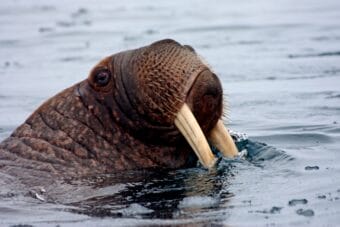
A walrus is seen in Alaska’s Chukchi Sea in June of 2010. Research by a University of Alaska Fairbanks student found microplastics, mostly tiny fibers, were lodged in muscle tissue, blubber and livers of walruses harvested by hunters from St. Lawrence Island and Wainwright. (Sarah Sonsthagen/U.S. Geological Survey)

For the first time, tiny bits of plastic have been found in body tissue of Pacific walruses, lodged in the animals’ muscles, blubber and livers.

The findings, from a University of Alaska Fairbanks student research project, add to growing knowledge about the widespread presence of microplastics in the world’s natural environment, even in remote locations.

“It’s a reflection of the plastic age we live in. It’s ubiquitous,” said Tony Blade, a UAF undergraduate who presented his findings in a presentation at last week’s Alaska Marine Science Symposium, a major science conference held annually in Anchorage.

Microplastics are tiny pieces of plastic, smaller than 5 millimeters – or one-fifth of an inch – in length, with some too small to be seen without microscopes.

Blade’s project, conducted under the supervision of UAF marine biology professor Lara Horstmann, examined body tissues of five walruses harvested by subsistence hunters. The samples were donated by hunters from Gambell and Savoonga, Siberian Yup’ik villages on St. Lawrence Island in the Bering Strait region, and from Wainwright, an Inupiat village on the Alaska mainland.

Every one of the 15 samples – muscle, fat and liver from each of the five walruses — held microplastics.

In all, there were 73 microplastics isolated from the tissues, almost all of them fibers. In four of the walruses, muscle tissue had the highest concentration of microplastics, though in one walrus from Savoonga, blubber had the highest concentration. Most of those found were clear; black fibers were the second-most prevalent.

Blade’s research shows that the plastic bits, far too small to be seen with the naked eye, are somehow getting beyond stomachs and digestive tracts and lodging directly into body tissues – a process that scientists call translocation. Although his work is the first to make such a finding in Pacific walruses, emerging research elsewhere is turning up microplastics in body tissues of other marine mammals.

Exactly how the plastics are passing through biological barriers to get into tissues is yet unknown, Blade said. Also yet to be understood, he said, is what the presence of plastic in their bodies does to the walruses. “We don’t know what that means as far as biological health of the animal,” he said.

Walrus cows and yearlings are seen resting on sea ice on April 18, 2004. (Photo by Joel Garlich-Miller/U.S. Fish and Wildlife Service)

Follow-up work by Blade and Horstmann is already underway, with samples from 20 walruses harvested by St. Lawrence Island hunters. That work will examine whether there are any age- or sex-related patterns to microplastics presence in body tissues, Blade said.

One reason that walruses were chosen for his project, he said, is that they are culturally important to Indigenous people of the region.

Another important reason is the way that they eat, he said. Walruses feed on clams, snails and other creatures that dwell on the ocean floor, the area of the sea known as the benthic zone.

“They’re digging through ocean sediment. And prior studies have shown that microplastics in the Bering Strait region are settling into the sediments of that area, as well as being taken up by organisms like mussels, crustaceans, invertebrates that walruses are eating directly,” he said.

The idea that walruses are more at risk for plastic consumption because of their benthic eating habits is consistent with recent findings by another UAF researcher who has focused on microplastics ingested by spotted seals in the Bering Strait region.

Alexandria Sletten, whose project was the thesis for her newly acquired master’s degree, also presented her findings at the symposium’s poster session in a follow-up to a presentation last year.

Of the 33 seal stomachs she examined, 32 had plastic. Those seals that fed more heavily at the benthic level – where walruses eat — had more plastics in their stomachs than the seals that fed on prey at the nearer-to-the-surface area known as the pelagic level, she found.

Blade’s walrus discoveries also fit with some groundbreaking findings by Duke University researcher Greg Merrill, who recently documented the presence of microplastics in body tissues of a variety of marine mammals.

Tony Blade, a University of Alaska Fairbanks student, stands by a poster summarizing his findings about microplastics in body tissue samples from five Pacific walruses. Blade discussed his findings at an evening session of the Alaska Marine Science Symposium on Jan. 30, 2024. (Photo by Yereth Rosen/Alaska Beacon)

Merrill, in a presentation at the symposium, described his findings about tissues from 22 marine mammals of 12 species.

Animals tested ranged from bottleneck dolphins and whales found dead after strandings in North Carolina and California to mammals harvested by subsistence hunters or found stranded in Alaska: bearded, spotted and ringed seals and beluga, gray, minke and fin whales.

Two-thirds of the animals tested had microplastics, mostly fibers, in at least one type of body tissue, according to Merrill’s study.

“Translocation is occurring. Plastic that is ingested, those microplastic particles, are moving around in the body and depositing into different tissues,” Merrill said in his conference presentation.

The marine mammals are consuming plastics indirectly, eating prey that acquired the microplastics at lower levels in the food web, Merrill said. But even if the consumption is indirect, the quantities can be staggering, he said.

Large filter-feeding baleen whales are taking in up to 10 million plastic particles a day, “which is a pretty staggering number.” While most are expelled out in feces, some are passing through to various body parts, he said.

Merrill was able to find microplastics in preserved samples dating back to 2001, indicating that microplastics have been finding their way into marine mammal bodies for decades.

“It’s a process that has been happening for quite some time, likely since plastics have been ending up in the environment, dating back to post-World War II,” he said.

This story originally appeared in the Alaska Beacon and is republished here with permission.

Paralytic shellfish poisoning toxin is high in some subsistence harvests, according to Knik Tribe’s data

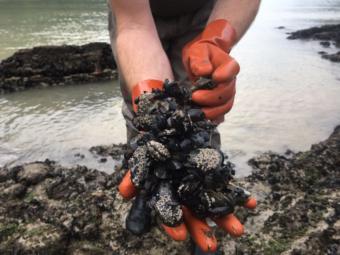
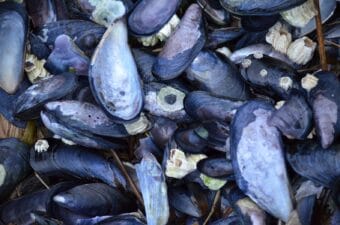
Blue mussels. Mussels and other shellfish were tested for the Paralytic Shellfish Poisoning toxin this year by the Knik tribe. (Credit Photo by Kathy Kartchner)

High levels of the toxin that causes paralytic shellfish poisoning showed up in samples of shellfish last year from the Aleutian Islands, according to an analysis by the Knik Tribe.

The Southcentral Alaska tribe’s scientists looked at shellfish samples from Sand Point collected in 2023, and some showed levels of the biotoxin almost 50 times higher than the U.S. Food and Drug Administration’s recommended limit. The Knik Tribe’s analysis of samples from Juneau, Kodiak, King Cove and Chignik Lagoon also showed some had levels of PSP toxin higher than the FDA’s cutoff.

The shellfish samples included clams, mussels, crab and cockles.

The toxin comes from algae and can collect in shellfish and the fish that eat them. If humans eat shellfish with high levels of the toxin, they can get sick. At its worst, PSP can cause partial or full paralysis and lead to death.

Though its traditional territory is not near abundant shellfish, the Knik Tribe tests samples that Alaskans send in from all over the state through its grant-funded program.

Not all of the state is at the same risk for PSP, said Bruce Wright, the Knik Tribe’s chief scientist. I’s especially a concern in places with relatively warmer water, he said.

“Right now the area that seems to be most affected is from Juneau to Unalaska,” Wright said. “Further out the Aleutians, the levels seem to be pretty low. It’s a different oceanography out there. Water temperatures are usually colder out there. And then up north, we’re starting to see more PSP activity.”

The tribe is working with public health officials in Nome to measure toxin levels in crabs, as well, Wright said.

Commercial fisheries also test shellfish for the toxin, he said, but there’s always some risk if people eat a subsistence harvest of shellfish.

“The best we can do is, you go out and you collect your clams, take them out of the ocean, throw them in the refrigerator or the freezer and contact us at Knik Tribe and get us a sample, and we’ll test them,” Wright said. “And then we’ll tell you what we think the risk factor is of eating that harvest.”

It’s important to test individual harvests, and the tribe does that for free for Alaskans, Wright said. Shellfish harvests even a quarter-mile away from each other might have very different levels of the PSP toxin, he said. And, Wright said, even if you see people eating shellfish from a beach, that doesn’t mean it’s safe.

“There’s a lot of wives’ tales out there that people use, one being that if you eat clams during the months with an R in them, because those are the colder months, that the clams will be safe to eat,” he said. “But that’s not the case. And that’s especially not true with butter clams. Once butter claims become toxic, they can maintain their toxicity for well over a year.”

Alaskans who want to test their subsistence harvests of shellfish can contact the Knik Tribe. You can also request data from the tribe about the harvests already tested.

Scientists and townspeople rescued 2 orcas trapped in a Southeast Alaska lake

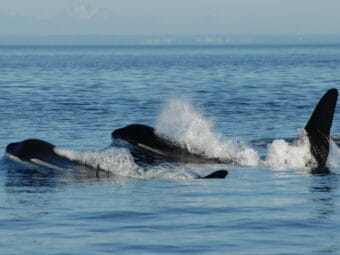
A killer whale surfaces in Barnes Lake during the live stranding rescue effort. (Photo courtesy of Jared Towers, collected under National Marine Fisheries Service Permit Number 24359)

Late this summer, two killer whales swam into an ocean-fed lake on Prince of Wales Island and got trapped. The effort to free the whales took a collaboration between scientists and residents of the remote island town of Coffman Cove — with some extra help from the whales’ friends.

It’s possible to get into Barnes Lake from the ocean, but only at high tide, in a small boat.

Doug Rhodes lives around the corner in Coffman Cove, an ex-logging town with a winter population of around 100 people. He says those entrances are the only way to get to the lake, and they’re only passable by small boats at high tide.

“The north entrance is like a class four rapids at maybe two hours after the tide, and the south entrance is a waterfall,” Rhodes said.

So it was a bit of a surprise when two killer whales found their way into the lake in mid-August. Rhodes says at first, people were more curious than concerned.

“It was kind of a novelty thing, you know, ‘There’s whales in Barnes Lake!’ Everybody just figured they’d get out on their own,” he said.

But the window around high tide is short, and the entrances to the lake are small. The whales didn’t get out on their own. After a couple of weeks, folks in Coffman Cove called the experts.

Mandy Keough from the National Oceanic and Atmospheric Administration whale stranding hotline gathered a group of researchers and scientists with experience in orca live strandings. They were concerned about the whale’s body condition. The lake is freshwater fed, so it’s less salty than the ocean, and orcas need salt water to survive.

Jared Towers is a killer whale specialist with Fisheries and Oceans Canada. He says he knew it was possible the whales could get out on their own, but there was another possibility.

“They end up dying in there,” he said. “And dying a slow death because they’re basically starving to death.”

That’s because these were Bigg’s, or transient, killer whales. They eat mammals, not fish. Barnes Lake is full of salmon, but not many seals and sea lions.

The response team decided that their best chance of getting the whales out was during the big tides in late September, a few weeks away.

They would need boats on the lake — more than a dozen. And the researchers said they needed at least three people in each boat. That meant nearly half the town would be out on the lake. Rhodes says that wasn’t a problem.

“As it went on the energy level in town kept building, and more and more people wanted to get involved,” he said.

They would use nets in the water, which the whales experience as a barrier. And they would herd the whales using sound — by submerging metal pipes in the lake and banging on the exposed end. Each required special equipment, which the volunteers made with what the had around town.

The townspeople kept the scientists updated on the whale’s health with photos. From the photos, Towers was able to identify the whales as T051, a 42-year-old male, and T049A2, a 16-year-old male. Towers even knew which orcas they’d traveled with in the past. Not only that, he had actual recordings of those travel partners. The recordings could be played under water to lure the stranded whales toward the sound, a technique called “playback.”

Chloe Kotik studies Bigg’s killer whales for her doctorate degree at the University of Alaska Fairbanks. She says the barrier nets and sounds of metal pipes are stressful to whales. She says playbacks can be really effective, but they’re also stressful.

“When you play a recording of a killer whale that isn’t really there, for them, it’s like seeing a ghost,” Kotik said.

Kotik and Towers arrived with two other scientists a few days before the high tides. More than six weeks after the whales were spotted, 14 small boats filed into Barnes Lake.

Towers and Kotik started the playbacks, luring the whales toward the north channel. Volunteers in the boats banged the submerged pipes to urge them on.

At first, it seemed to be working. The whales responded to the playbacks by breaching and slapping the water with their tales. They followed the sound and entered the north channel. The boats lowered nets to keep the whales from turning back. But a thick kelp bed was blocking the entrance to the channel.

Time was short — the tide was going out. Towers says they knew it was their only shot that day.

“If that whale and the other one didn’t make it through the kelp, our window was over,” he said.

Then the bigger whale turned and swam back into the lake, ignoring the nets and sounds of the pipes. The younger whale was close behind. Towers says even the boats were in danger of getting stranded in the lake. Rapids were forming in the channel.

“We just radioed the others and said, you know, our time’s up,” he said.

Kotik says based on the weather forecast, they likely only had one more day to get the whales out. But more than that, she was worried that they’d already asked too much of the volunteers.

“These people in Coffman Cove have already given us so much of their time and their energy and their help,” she said. “And we didn’t get them out today, how much can we really ask them, and are they going to be willing to help us out with this?”

But when they got to the dock at Coffman Cove, the volunteers were waiting, ready to make plans for the next day.

“It was such a weight off of my shoulders to realize like oh my god, they’re still in it with us,” she said. “They haven’t lost faith in us. They haven’t lost hope.”

The next day they started at the south entrance, which was free of kelp. This time, when the whales heard the playbacks, they were all business. Rhodes and Fecko were in a boat with nets.

“And so they got out in the middle and played this playback, and we looked up and we see the whales coming towards us, and they were picking up speed as he was playing the whale sounds,” Rhodes said.

“There was a bow wake in front of these whales, they were just bookin’ it!” laughed Fecko.

As they charged toward the playback of their friends, the whales called out. The scientists’ underwater microphone picked up the sounds.

“We were just standing there hearing whale sounds across the water as they came by and, oh geez, there were people whooping and hollering and cheering, there were people crying out there.”

As they neared the southern entrance, one the whales dove deep.

They had to wait to deploy the nets until they were both past and in the channel.

They got the net out behind the whales. But Rhodes said it hardly seemed necessary.

“At that point, those guys were probably going ten knots. They didn’t think twice, they just busted right on out of there,” said Rhodes.

The playback boat led the whales through the channel. The southern entrance is long and winding and rocky. Towers said it took 10 to 15 minutes to pass through.

“I was holding my breath for a long time,” he said. “I told myself, ‘Okay when they’re past the maple tree we’re good,’ because there’s this beautiful big Canadian maple on the shoreline at the beginning of the south channel.”

They passed the maple. They kept swimming, out into Lake Bay, and then beyond. The boat followed them for a couple hours.

Kotik says they weren’t sure how the pair would adjust to their freedom.

“Then we saw a kind of shift into this much more quiet, purposeful swim,” she said. “And I think it was because they were starting to hunt. And that moment of seeing that shift was such a relief of like, ‘I really do think they’re going to be okay.’”

Towers and Kotik skiffed back to Coffman Cove. They found a celebration in full swing. Doug Rhodes and Cheryl Fecko said the local bar got plenty of business that night.

“You couldn’t you couldn’t hear in that bar. Everybody was just chattering away,” said Fecko.

“The bar was hopping, everybody was in there. I don’t know if the scientists bought a drink that night at all,” laughed Rhodes.

Scientists don’t know where the pair is now, but they will be spotted eventually. Researchers keep tabs on killer whales through photos sent in by scientists and civilians.

Ecosystem reports show continuing effects of warming in Alaska’s marine waters

Massacre Bay at Attu. the westernmost of Alaska’s Aleutian Island, is seen on Aug. 23. 2017. Waters around the Aleutian Islands recorded their highest winter temperatures since 1900, according to an annual ecosystem status report issued by the National Oceanic and Atmospheric Administration’s Fisheries Service. (Photo by Lisa Hupp/U.S. Fish and Wildlife Service)

The waters off Alaska’s Aleutian Islands registered the warmest winter temperatures in over a century, part of a decade-long period of warming, according to a report issued by the National Oceanic and Atmospheric Administration.

The record-high temperatures in the western and central Aleutians moderated later in the year but warmer-than-normal conditions persisted for the rest of the year throughout the waters around the 1,100 mile chain extending from southwestern Alaska, according to the 2023 NOAA Fisheries Ecosystem Status report for the region.

The Aleutians report is one of three annual ecosystem status reports issued by NOAA Fisheries for marine areas of Alaska. The reports, compiled by large teams of scientists, were released earlier this month and presented to the North Pacific Fishery Management Council, the panel that sets regulated commercial fishing in federal waters off Alaska.

The annual reports provide snapshots of current conditions and clues about future conditions in a warming climate, information needed to manage fish harvests and other activities, NOAA Fisheries said in a statement.

“Warming at rates four times faster than the rest of the ocean, Alaska’s Arctic ecosystems are a bellwether for climate change. Now more than ever having ecosystem and climate-related data and information is essential to support adaptive resource management and resilient commercial, recreational and subsistence fisheries, and rural and coastal communities,” Robert Foy, director of NOAA’s Alaska Fisheries Science Center, said in the statement.

The Bering Sea and other marine waters off Alaska produce more than half of the nation’s commercially harvested seafood.

In the Aleutians, the fish most vulnerable to the warm condition are Pacific cod, according to the Aleutian ecosystem status report. There are several reasons for that, NOAA Fisheries biologist Ivonne Ortiz told the council in her presentation of the report.

“Pacific cod has a very narrow range of temperatures for the eggs to hatch,” Ortiz said. That range, from 3 degrees to 6 degrees, has been exceeded in the waters, she said.

Higher temperatures also increase Pacific cod’s energy needs, Ortiz said. “The cost of living is higher, the cost of growing, feeding, pooping, having sex, swimming around is higher, so they need to either consume prey that has higher caloric content or consume more prey to make up for that,” she said. But high-quality food for Pacific cod is less available in the Aleutian region, she said.

Also vulnerable and sensitive to higher temperatures are Atka mackerel, an important species for commercial harvests, according to the ecosystem status report. But pink salmon originating from eastern Kamchatka, on the Russian side of the ocean, appear to be thriving, with the third-highest population on record, the report said.

With warming temperatures come higher risks of algal toxins, and the past year’s record provides evidence of the association. Mussels found in June at Sand Point, Unalaska, False Point and Akutan, communities in the eastern Aleutians or at the western tip of the Alaska Peninsula, had levels of paralytic shellfish toxins that were 47 times the amount deemed safe for human consumption, according to the Aleutians ecosystem status report.

‘Cooled, but not cool’

The Bering Sea and Gulf of Alaska are recovering from extreme marine heatwaves that struck in recent years, according to the ecosystem status reports issued for those regions. Temperatures there have returned to more normal levels, but the unprecedented heatwaves have lingering effects, according to the reports.

The Bering Sea remains warmer than the long-term average, though it has cooled since the heatwaves, NOAA Fisheries biologist Elizabeth Siddon told the North Pacific Fishery Management Council in her presentation of the report.

“It has cooled but is not cool,” she said.

Ecosystem conditions there are mixed, complex and in some cases not easily explained, Siddon said.

On the negative side, some crab stocks have continued the decline that forced disruptive harvest closures, according to the report for that marine region. In the northern part of the Bering Sea, jellyfish – a less-nutritious prey for other fish in the food web and a competitor with groundfish for food – are proliferating. In the southern part of the eastern Bering Sea, there has been continuation of a decade-long slide in production of high-quality plankton that is the base of the food chains. This year, the concentration hit the lowest levels in several years in that part of the Bering Sea, Siddon said. Conversely, there was a continuation of a trend to high levels of coccolithophores, a type of phytoplankton that are considered poor quality food for the food web, she said.

On the positive side, according to the Bering Sea ecosystem report, were some increases in juvenile Chinook and chum salmon found in the northern region, hinting at possible improvement for Western Alaska salmon runs that collapsed in recent years. There was improved reproduction success for some seabirds, a result that follows years of successive bird die-offs, the report said.

In the Gulf of Alaska, where the marine heatwaves caused Pacific cod stocks to crash so drastically that harvests there were canceled in recent years, there is a continuing pattern of low populations of cod, as well as low population halibut and arrowtooth flounder, according to that region’s ecosystem status report. But populations of sablefish and perch, both commercially important species, continue to increase, according to the report.

On the lookout for El Nino effects

The spring warming that is expected with the ongoing El Nino weather pattern could further jar the Gulf of Alaska, NOAA Fisheries biologist Bridget Ferriss said in her presentation to the council.

Since larvae and juvenile groundfish are the most sensitive to changes in water temperature, warming seas could potentially harm the larvae of cod, pollock and northern rock sole,  NOAA Fisheries biologist Bridget Ferriss told the council. “These wouldn’t be the fish that we’re fishing on next year,” she said. However, that could harm future years’ stocks, she said. Some adults could be vulnerable, too, because warming would diminish quality and fat levels of zooplankton, she said.

Potentially vulnerable adult fish like pollock won’t necessarily be fewer in number, but their bodies might be changed, Ferriss said. “We might just see skinnier fish next year as they have a little bit of a poorer zooplankton prey base to feed upon,” she said.

Potentially benefiting from El Nino-driven warmth are sablefish, which have thrived in recent years, along with arrowtooth flounder, southern rock sole and halibut larvae, Ferriss said.

Marine heatwaves have profound effects, research has shown.

A new study details how the unusually warm conditions in the Bering Sea in 2018 – a year with the least amount of winter sea ice since records began in 1850 – altered the phytoplankton populations that make up the base of the food web.

Normally, spring sunlight stimulates algal growth on the underside of sea ice, and the algae continues to bloom as the ice melts. That phytoplankton later drops to the seafloor, serving as food for bottom-dwelling species that are part of what is classified as the benthic zone. But when ice is missing, the spring phytoplankton bloom occurs in open water, nourishing marine creatures swimming closer to the sea surface, considered the pelagic zone, but not reaching the benthic zone at the bottom.

Benthic species include clams and snails, which in turn are eaten by mammals like walruses and seals. Pelagic species include salmon, pollock and herring and fish-eating seabirds.

The new study, by scientists with NOAA, the University of Washington and other institutions, tracks the different Bering Sea spring blooms that occurred from 1998 to 2018. It found that while the timing of spring blooms did not shift over that period, the characteristics of the blooms did change.

If the pattern of warm years intensifies, the shift in spring phytoplankton blooms will continue to favor the pelagic species, even in the northern reaches of the Bering Sea, the study authors said.

Report details 37 known killer whale entanglements in Alaska over three decades

A pod of killer whales swims in waters off Southeast Alaska’s Chicagof Island in July of 2023. A new federal report describes the 37 killer whale entanglements that were documented in Alaska waters from 1991 to 2022. (Photo by Meghan Chamberlain/U.S. Forest Service)

Over the last three decades, 37 killer whales were entangled in fishing gear in Alaska, which resulted in 25 deaths, according to a new report issued by the National Oceanic and Atmospheric Administration.

The report from NOAA Fisheries covers documented cases from 1991 to 2022. It does not include this year’s unusually high number of cases, in which 10 killer whales were found ensnared in fishing gear — mostly bottom-trawl gear — with nine of them found dead. Those events sparked a special examination by the agency.

The cases documented from 1991 to 2022 involved a variety of fishing gear. Trawl gear caused 20 of the entanglements, longline gear caused 10 of them and assorted other gear was implicated in other cases.

Killer whales, also known as orcas, are found in oceans around the world but generally favor colder waters. Several populations of killer whales swim in Alaska waters; some eat fish exclusively and some feed on hunted marine mammals. They are among the marine mammals that are occasionally killed by human activities in marine areas.

Killer whales are known to follow vessels to feed on the fish caught by net, hook, pot or trap, sometimes at their peril. Some die from asphyxiation because they become pinned in place underwater, and even if they escape alive, some wind up with serious injuries that could result in death later, the report said.

But there are gear modifications and devices that have the potential for reducing harm to the whales, the report notes. Barrier ropes that prevent whales from swimming into nets, sleeves that cover hooked fish being pulled up on longline gear, acoustic instruments that ward off whales and other devices should be further studied to see if they can effectively reduce the toll on killer whales, the report said.

Not all of the 37 reported entanglements over the three-decade period involved fishing or marine gear of any kind.

In two of the reported cases, the whales were determined to have been enmeshed in strings of kelp. Those determinations were based on analysis of photographs – demonstrating the importance of collecting photo evidence, the report said.

Killer whales and other whales are known to interact with kelp and have been observed playing with it. There is also evidence that rubbing against kelp sooths whales’ skin. It is likely that there were many more kelp entanglement cases than the two that were documented, the report said.

The affinity for kelp is a signal of a potential future problem as kelp and seaweed farming proliferates, the report noted. “Killer whales have the potential to interact with kelp farms’ anthropogenic material as well as crops,” it said.

Alaska killer whales are classified by stock and by prey type. Resident whales are fish-eaters, while transient whales hunt marine mammals. Multiple stocks are found in Alaska waters.

NOAA Fisheries scientists were able to identify the stocks of 12 of the entangled whales through genetic testing. Nine were from the larger Eastern North Pacific Alaska Resident stock, and the other three were from the Eastern North Pacific, Gulf of Alaska, Aleutian Islands and Bering Sea Transient stock.

NOAA Fisheries estimates that there are 1,920 animals in the Eastern North Pacific Alaska Resident stock, which swims in the Gulf of Alaska and Bering Sea, and 587 in the Eastern North Pacific, Gulf of Alaska, Aleutians Island and Bering Sea transient stock. Past analysis by NOAA Fisheries has found that the Eastern North Pacific Alaska Resident stock can withstand losses of 19 animals a year, while the smaller transient stock can endure losses averaging 5.9 animals per year.

This story originally appeared in the Alaska Beacon and is republished here with permission.

Rare fin whale found dead near Kodiak

The fin whale washed up on her own without needing to be dragged higher onto the beach. (Courtesy Matt Van Daele/Sun’aq Tribe)

A fin whale washed up in the Pasagshak State Recreation Area, near the end of Kodiak Island’s road system, late last month. It’s unclear how it died, but the whale was in remarkably poor health.

Fin whales are the second largest whale species in the world after blue whales and are usually pretty rare around Kodiak.

Matt Van Daele is the natural resources director for the Sun’aq Tribe in Kodiak. Fin whales can live up to 90 years in the wild but Van Daele said this one was between 10 and 14 years old.

“She was extremely emaciated,” he said. “She was basically like a 53-foot-long snake and that was very sad to see.”

He said when they found the lone whale, she had several bruises all along her body.

“It’s possible that she may have stranded while she was still alive and then died during the night before anyone found her,” he said.

In all, about 40 people including volunteers, veterinary staff, and staff from the Sun’aq Tribe came to help with the necropsy last week.

Van Daele said whales dying near town used to be pretty rare for the island but now this is the second severely unhealthy whale they’ve done a necropsy for this year. The Sun’aq Tribe organized a necropsy for a humpback whale in September.

There isn’t enough data for biologists to declare a trend yet, but these whales are being found on the heels of an unusual mortality event for gray whales in the Pacific Ocean. Van Daele said these two starved whales in a single year doesn’t bode well for populations near the Kodiak Archipelago.

“I personally and scientifically am concerned about what we’re going to be seeing in the next couple of years with our local whales, if these things actually do turn into trends,” he said.

For now, all biologists can do is monitor populations and wait for their samples to get their lab results. Van Daele said the fin whale’s corpse is still on the beach for now, but they plan to bury it in the hopes they can save the skeleton to assemble and display in town.

“Nowhere in Alaska actually has a fin whale skeleton and we’d really like to have this be a community landmark,” he said. “That’d be pretty neat for our fin whale to stay home here so that we can enjoy it.”

The ground in the area is frozen after several days of freezing temperatures, but once it’s buried it will take a few years for it to decay to just a skeleton. Van Daele said while the whale might have had a sad death, they hope displaying it can be a source of pride for the community.

Site notifications
Update notification options
Subscribe to notifications