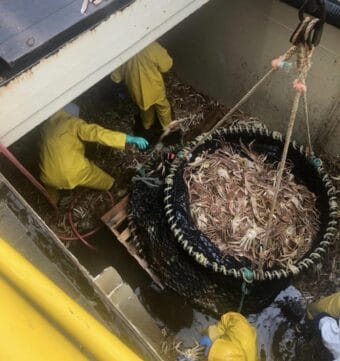
Fishermen load Alaska snow crab in the hold of a crabbing vessel. (Courtesy Tacho)
The Alaska Department of Fish and Game announced Friday afternoon that Bering Sea fishermen will be allowed to harvest a total of about 4.7 million pounds of opilio, also known as snow crab, for the first time in two years.
According to Fish and Game, estimates of total mature male biomass are above the threshold required to open the fishery.
The announcement comes as a surprise to many fishermen, after roughly 10 billion snow crabs disappeared from the Bering Sea over a span of four years, prompting Fish and Game to close the fishery in 2022. Recently, scientists have learned that the disappearance was likely due to ecological shifts, and there’s been little hope within the industry that stocks would recover anytime soon.
Still, the National Marine Fisheries Service and Fish and Game have analyzed the results from this year’s bottom trawl survey and agree that the volume of male crabs is at a safe limit for fishing. Fish and Game’s decision to open the fishery is based on the recommendation of the North Pacific Fishery Management Council, which met Friday morning to determine sustainable harvest limits for Alaska’s big three crab stocks.
Fish and Game has set the total allowable catch, or TAC, for snow crab at 4.72 million pounds, including Individual Fishermen’s Quota and Community Development Quota. The last time the fishery was open, harvesters were allotted 5.6 million pounds, although the year before they had a harvest of 40.5 million pounds.
The department also opened the Bristol Bay red king crab fishery, which closed for two years in 2021 and reopened last year. Fishermen will have 2.3 million pounds to catch this year, just above last year’s humble but welcome harvest.
Both the red king crab fishery and snow crab open Oct. 15.
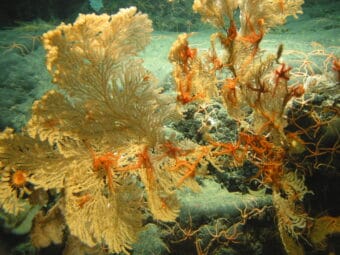
A large primnoid coral loaded with brittle stars, a marine relative of sea stars. The underwater image was captured on the Dickins Seamount during a 2004 research cruise in the Gulf of Alaska. A new lawsuit claims fishery managers have failed to adequately protect Gulf of Alaska corals and sponges. (Photo provided by the National Oceanic and Atmospheric Administration)
Until about 20 years ago, little was known about the abundance of colorful cold-water corals that line sections of the seafloor around Alaska.
Now an environmental group has gone to court to try to compel better protections for those once-secret gardens.
The lawsuit, filed Monday by Oceana in U.S. District Court in Anchorage, accused federal fishery managers of neglecting to safeguard Gulf of Alaska corals, and the sponges that are often found with them, from damages wreaked by bottom trawling.
Bottom trawling is a practice that harvests fish with nets pulled across the seafloor.
The National Oceanic and Atmospheric Administration’s National Marine Fisheries Service “ignored important obligations” to protect the Gulf of Alaska’s seafloor, under the Magnuson-Stevens Fishery Conservation and Management Act and the National Environmental Policy Act, the lawsuit said.
Corals and sponges are important marine habitat features, supporting fish populations and other sea life. Already vulnerable to the warming conditions caused by climate change and acidification caused by the ocean’s absorption of atmospheric carbon, corals and sponges are further imperiled by fishing gear that scrapes the seafloor, the lawsuit said.
“If not destroyed by trawling, some corals and sponges can live for hundreds or thousands of years. They provide complex habitat for fish and other species, including commercially important species like rockfish, crab, and prawns,” the lawsuit said. “Damage to long-lived, slow-growing, and sedentary species, like cold-water corals and sponges, can be irreversible.”
At issue in the lawsuit is the way managers identify and protect what is known as “essential fish habitat.”
The North Pacific Fishery Management Council, which sets policies that are carried out by the National Marine Fisheries Service, does periodic reviews to determine which areas should be considered essential fish habitat and what special protections should apply there. In December, the council passed a series of updates for habitat important to a variety of fish species; those changes got NMFS approval in July.
But a key omission from those updates are any new protections for coral gardens or sponge habitat in the Gulf of Alaska, Oceana argues.
A large bamboo coral is seen on a the Dickins Seamount 800 meters deep in the Gulf of Alaska during a 2004 National Oceanic and Atmospheric Administration expedition. (Photo provided by the National Oceanic and Atmospheric Administration’s Office of Ocean Exploration)
That leaves the swath of Gulf water that stretches from Yakutat to the Islands of the Four Mountains in the Aleutians as “the largest remaining area between San Diego and the Arctic that is largely open to bottom trawling,” said Ben Enticknap, Oceana’s Pacific campaign director and senior scientist.
More knowledge is being gained about Alaska’s corals and sponges and their role in the ecosystem, Enticknap said. “That type of information is really critical and should be incorporated into the council’s process for consideration,” he said.
At the June 2023 North Pacific Fishery Management Council meeting, Oceana submitted a proposal that would close about 90% of the Gulf to bottom trawling. The council did not take any action on that proposal, Enticknap said.
In the past, the council was a pioneer in cold-water coral protection, Enticknap said.
In 2005, the council closed a large marine area around the Aleutians to bottom trawling to protect the coral gardens that had been newly discovered there. Enticknap, then with the Alaska Marine Conservation Council, provided information that helped bring about what he considers to be a landmark policy change.
The 2005 rule did close some sections of the Gulf of Alaska to bottom trawling for the purpose of coral protections. But Oceana contends that much more area should be off-limits to bottom trawling.
A spokesperson for NMFS declined to comment on the lawsuit, citing the agency’s policy concerning pending litigation.
The agency itself is the prime source of new knowledge about Alaska’s corals and sponges.
NOAA scientists have been working for several years to identify and map Alaska’s corals, including those on the floor of the Gulf of Alaska. Underwater surveys, including those conducted last summer by NMFS in collaboration with an array of international agencies and institutions, have used sophisticated technology to capture images of the corals, sponges and the sea creatures that live among them. An important goal of the research, according to NMFS, is examining whether fishing, other human activities or climate change are harming the coral habitat and, if so, how that habitat should be protected.
The Oceana lawsuit is not the only effort to secure more protection for deep-water corals.
A bill sponsored by U.S. Rep. Mary Peltola, D-Alaska, seeks to restrict trawl fishing that touches the seafloor. Called the Bottom Trawl Clarity Act, it specifically lists corals and sponges as resources to be protected from trawling impacts.
Attorney Laura Wolff (bottom left) speaks on behalf of the State of Alaska in front of judges Mark Bennett, Milan Smith Jr., and Anthony Johnstone on July 18, 2024, from the 9th U.S. Circuit Court of Appeals in San Francisco. (Screenshot from video livestream)
On Thursday, the 9th District Court of Appeals heard cases for and against a lower court ruling that threatened to halt Southeast Alaska’s troll fishery for king or chinook salmon. Although there’s no decision yet, a panel of judges expressed sympathy for the coastal communities that could be hurt by the order.
With an opener the first week of July, Southeast Alaska trollers already got to fish for kings this summer. But the future of their fall season is in the balance at a courtroom over a thousand miles south in San Francisco, California.
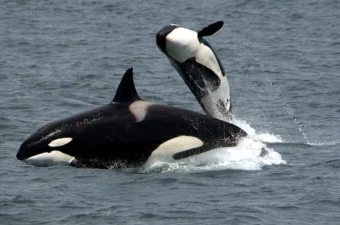
The Alaska Trollers Association, the State of Alaska, the National Oceanic and Atmospheric Administration and other entities appealed a lower court ruling that found NOAA broke the law by letting Southeast trollers catch too many kings — to the detriment of a population of endangered killer whales.
The Washington District Court order would have effectively stopped Southeast trollers from fishing for kings. But the case is now on hold in the appeals process and in the hands of judges Mark Bennett, Anthony Johnstone, and Milan Smith Jr.
Attorney Laura Wolff, who represents the State of Alaska, argued that keeping Southeast king trollers off the water wouldn’t only injure the region’s economy. She said it could demolish an entire way of life.
“There’s also huge social and cultural harms,” said Wolff. “There are multiple declarations that say, ‘if we can’t fish and earn, if half of our income is last we’ll probably not fish at all.’ So it forces people into poverty or choosing to leave these very small rural communities, and that [has] huge cascading effects. It’s not just harm to some fishermen — it’s remote, isolated communities.”
The Ninth Circuit Court of Appeals last year issued a stay on a lower court order allowing the fishery to stay open — for now. But the Washington-based Wild Fish Conservancy seeks to lift that stay, and keep Southeast king trollers tied up at the docks.
Their case rests on the idea that the trollers intercept salmon that would otherwise feed a population of endangered Puget Sound killer whales, called Southern Residents. Attorney Brian Knutsen, who represents the Wild Fish Conservancy, said trollers should think about fishing for something else to keep their economy going.
“If (the opposing counsel’s) position is that: if (trollers) are unable to harvest chinook, maybe nobody will fish anything,” said Knutsen. “But half — and even sometimes over half — the economic value of the troll fishery is from coho.”
Knutsen also presented research suggesting Southern Resident killer whales, who prefer to eat king salmon, will not recover without immediate and serious intervention.
“The condition is really bad,” said Knutsen. “These whales are continuing to die, and it’s gotten worse during the stay. There’s been no live births since 2023 … Sorry — there was one, but the whale died within a month. There’s been multiple late-stage pregnancies that do not produce calves. These whales need prey now.“
But Judge Mark Bennett was skeptical.
“There is a lot of uncertainty around everything here in terms of, is it going to help the whales,” said Bennett. “All we know for sure is that closing some of the fisheries is absolutely going to cause harm to inhabitants of Alaska, and their various subsistence and cultural practices.”
Thekla Hansen-Young is the attorney for NOAA Fisheries. She said that as the appeal moves through the courts, the federal government is rewriting the fisheries rules that were the basis of the Wild Fish Conservancy’s lawsuit. She said NOAA is on track to complete the new version of the rules by November.
And she told the judges she would accept it if they issued more limited instructions — like halting trolling for kings — if NOAA doesn’t finish their rules in time.
With that, the three-judge panel wrapped up the proceedings, with Judge Milan Smith Jr. declaring that he had finally resolved some of his confusion about dolphins and whales.
“I just want to add for the record that (a member of) the audience has informed me that killer whales aredolphins. So there you go,” Smith Jr. said, before tapping the gavel.
The judges may release their opinion on the appeal at any time.
Correction: This story has been updated to correct the spelling of Laura Wolff’s name and the phrasing of one of her quotes.
A Cook Inlet beluga whale mother and neonatal calf swim together. (Public domain photo by Hollis Europe and Jacob Barbaro/NOAA Fisheries)
A federal judge is sending Interior Department officials back to the drawing board after concluding a Cook Inlet oil and gas lease sale didn’t adequately consider the possible impacts on endangered beluga whales in the area.
The ruling temporarily suspends a lease held by dominant Cook Inlet producer Hilcorp. The privately held Texas-based oil and gas company won a 5,693-acre lease in a 2022 sale.
Hilcorp was the only bidder in the lease sale, which was mandated by the 2022 Inflation Reduction Act. At the insistence of West Virginia Democratic Sen. Joe Manchin, that climate-focused federal law also included provisions mandating oil and gas lease sales in Cook Inlet and the Gulf of Mexico.
A coalition of Alaska-based and national environmental groups challenged the Cook Inlet lease sale. They argued the Interior Department agency that offered the sale had not taken a hard enough look at the possible impacts of drilling on the endangered population of roughly 300 beluga whales that live in Cook Inlet. Oil and gas production involves loud undersea noises from things like piledriving, drilling and vessel traffic, and the groups argued that can interfere with belugas’ echolocation.
U.S. District Judge Sharon Gleason agreed, but she stopped short of vacating the lease sale entirely. She ordered the Bureau of Ocean Energy Management to come up with a supplemental environmental analysis and a range of alternative lease arrangements that better account for the possible impacts on Cook Inlet beluga whales.
“In sum, the Court finds that BOEM failed to consider a reasonable range of alternatives at the leasing stage in violation of [the National Environmental Policy Act] because it failed to consider any alternative that would offer for lease a reduced number of blocks that would meaningfully reduce overall impacts, could feasibly meet the purpose and need of Lease Sale 258, and would better allow for ‘informed decision-making and informed public participation,’” Gleason wrote in the 49-page order.
That could ultimately force the Interior Department to shrink or cancel Hilcorp’s lease, said Earthjustice attorney Carole Holley, who represented the Center for Biological Diversity, the Natural Resources Defense Council, Cook Inletkeeper, Alaska Community Action on Toxics and the Kachemak Bay Conservation Society.
“This ruling just confirms that the Inflation Reduction Act is far more limited in scope than industry and its allies, and in this case, the state of Alaska, have been pushing, and it does not override NEPA, or our other bedrock environmental laws,” Holley said by phone.
The National Environmental Policy Act is a Nixon-era law that requires federal agencies to evaluate the possible environmental impacts of their actions. Earthjustice and a variety of conservation groups are also challenging similar lease sales mandated by the Inflation Reduction Act in the Gulf of Mexico.
Though the state of Alaska and federal government often clash on resource development, Alaska intervened in the case to support the lease sale. Department of Law Communications Director Patty Sullivan said in a prepared statement that the state was disappointed by the decision.
“In 2022 Congress sought to provide certainty for this overdue and long awaited lease sale,” Sullivan said. “The state is disappointed with the continued uncertainty in leasing caused by the court’s order, which is counter to the intent of Congress to provide certainty.”
A spokesperson for the Alaska office of the Bureau of Ocean Energy Management did not respond to a phone call seeking comment. The agency manages oil and gas activity in federal waters, which generally begin three miles offshore. Most Cook Inlet oil and gas production occurs onshore or in state waters.
Oil and gas industry analysts point to long-term trends, including rising renewable energy production and higher production costs, as reasons for lackluster interest in recent oil and gas lease sales.
The Bureau of Ocean Energy Management will be required to update the court on its progress on a supplemental environmental analysis in six months, the judge ruled.
European green crabs collected from Metlakatla’s Tamgas Harbor this week. The crabs were trapped in shrimp pots. (Photo courtesy of Dustin Winter).
Alaska Department of Fish and Game announced on Friday that shells of the invasive European green crab were spotted along the shores of Bostwick Inlet on Gravina Island near Ketchikan.
European green crabs have the potential to wreak havoc on commercial and subsistence fisheries in Alaska — the crabs are highly competitive and very hungry. They eat clams, oysters, scallops, other crabs and are known to rip up seagrass in their search for food. Fish and Game said that as a result, they can displace local crab populations like the Dungeness crabs in Bostwick Inlet. They can also decimate eelgrass and saltmarsh habitats, disrupt ecosystem balance, and cheapen overall intertidal biodiversity.
Green crabs are believed to have first showed up in Alaska waters in 2022. That was when biologists with the Metlakatla Indian Community found the first evidence of the species, a handful of molted shells, on Annette Island.
The discovery of more molted shells on Gravina Island recently, a few miles across Nichols Passage from Metlakatla, marks the first time the crabs have been documented outside of the Annette Island reserve.
European green crabs were first reported on the Pacific coast in San Francisco in the late 1980s and have been expanding outward and northward since. In Washington and Oregon, the crabs have sabotaged a number of critical fisheries, and the states have spent decades trying to wipe them out, with no success.
Since the invading crustaceans were first discovered on Annette Island, the Metlakatla Indian Community has been doing damage control through a method called “functional eradication,” which involves trying to trap and kill as many as possible. Fish and Game said they’ve successfully thinned 3,000 of the crabs from local waters, including pregnant females which can lay hundreds of eggs. However, there’s no sure-fire way to eradicate the crabs once they’ve arrived.
Green crabs can sometimes be a misnomer — they can be several different colors. But Metlakatla’s tribal wildlife department has said one of the big giveaways is the five spines on either side of their eyes and three bumps in between their eyes.
Officials say if the crabs keep marching north, it could have serious effects on Alaska’s commercial and subsistence fisheries. They are asking people who think they’ve found a green crab or a green crab shell to take it to the nearest Fish and Game office, or take a photo of it and send it in.
For pictures or more information on the invasive crabs, you can visit theADF&G website. You can also report sightings of European Green Crabs to the Invasive Species Hotline:1-877-INVASIV. To submit photos and for more information about invasive species, contact: Tammy Davis, ADF&G Invasive Species Program coordinator: tammy.davis@alaska.gov or (907)465-6183.
Petersburg troller Mark Roberts working on his fishing vessel, the Cape Cross, on May 24, 2024. (Photo by Shelby Herbert/KFSK)
The federal government is considering a request that would grant Gulf of Alaska king salmon Endangered Species Act protections. The National Marine Fisheries Service recently found that the petition by the Washington-based conservation group Wild Fish Conservancy, which said that the species are under threat, warrants further scientific review. It’s just the first major step in a longer regulatory process, but many say it could have far-reaching implications.
Mark Roberts is docked in Petersburg, getting his fishing boat ready for the July 1 king salmon opener. He’s painting the exterior of the Cape Cross, his 46 foot long wooden troll boat that was built in 1948.
Roberts took a break from fishing for several months, because he just had one of his heart valves replaced. But he said he’s pushing through the pain this summer, because it would be financially impossible for him to sit out a whole season.
“Because of my heart situation… Well, I paid for it. I got to do twice the work this year. But, you know, I’m putting it back together. I just need sunshine!” Roberts said, gesturing towards the rainy sky over Petersburg.
Roberts has fished in the Gulf of Alaska for about 30 years. But he came very close to skipping the whole summer season last year, when the Wild Fish Conservancy sued the U.S. National Oceanic and Atmospheric Administration to halt commercial trolling for kings in Southeast Alaska. The conservation group, which is based in Washington State, argued that a closure would protect a declining population of killer whales near Seattle. The Ninth Circuit Federal Appeals Court issued a stay on the lawsuit, keeping the fishery open.
“I was basically ready to tie my boat up to the dock and not fish until August,” said Roberts. “But once they announced it… Boy. I started my engine and took off and went fishing and I was very grateful about it.”
That lawsuit is ongoing. But now, Roberts is staring down the barrel of another move against king salmon fishing by the same group, which filed a petition to list the fish with Endangered Species Act protections in January. NOAA announced it would move forward with its regulatory process for considering the request in late May.
The request could have a huge impact on how Alaskans fish across the entire Gulf. The petition asks for protections for an area more than a thousand miles wide — or, just a little longer than the distance from New York City to Orlando, Florida.
Roberts said it feels like another attack on his fishery, which he considers to be low-impact, and sustainably-managed.
“I want the salmon to come back too, and so it really surprises me that these people are coming after us, when we already are doing things to bring back the salmon,” said Roberts. “This will hurt everybody. It really surprises me that they’re coming after us like they are.”
But Emma Helverson, the director of the Wild Fish Conservancy, said it’s not personal. She said the petition folds in feedback from a lot of people across the state who are afraid the resource won’t be around for future generations.
“[There are] people throughout the state who, maybe aren’t even sure how they feel about Endangered Species Act protections,” said Helverson. “But they’re seeing these problems and they know something has to change.”
Helverson has heard from Alaskans like Willard Lind. He’s a citizen of the Chignik Lake Tribe, and he’s lived next to the Chignik River, on the Alaska Peninsula, for all of his 63 years.
Salmon runs collapsed on the Chignik in 2018. Sockeye salmon have slowly been returning to the river, but kings are still scarce.
Lind said he wants fishing for kings to stop — even in Southeast Alaska, hundreds of miles away.
“When I was a kid, the river used to be loaded with kings, man,” said Lind. “Holy cow — they’d be swarming all over the place. But nowadays you don’t see one king in a shallow waterhole anymore. I’m all for what they’re trying to do there, with the petition to stop these king fishers. I hope it goes through.”
King salmon landed in the commercial troll fishery in the summer of 2019. (Photo courtesy of Matt Lichtenstein)
Not all conservation groups are on board with the Wild Fish Conservancy’s request, though. For instance, the Alaska based environmental group Salmon State has come out against it.
Tim Bristol, executive director of Salmon State, has his eye on the decline. But he said the Endangered Species Act petition isn’t the right tool for the situation, and that this move will push away fishermen who are also sympathetic to the plight of king salmon.
“Frankly, it really upsets us, as longtime conservationists, to see the Endangered Species Act used in a way that I don’t think is appropriate,” said Bristol. “And it’s clearly going to cause all kinds of blowback from thoughtful people that maybe support the ESA. But it definitely will move them into the opposition category when you start using it.”
The Alaska Department of Fish & Game, which manages all king salmon stocks in the state, has also been one of the petition’s loudest critics. Doug Vincent-Lang is the department’s commissioner.
“It really was, of all the petitions I’ve ever seen come in for a listing of a species — by far the most poorly written petition I’ve ever seen,” said Vincent-Lang.
And the National Marine Fisheries Service did note in its findings that while the petition included numerous factual errors and unsupported conclusions the numbers were concerning.
Vincent-Lang said that if the petition is pushed through, it would effectively federalize management of king salmon as a resource in Alaska.
And, he said, if king salmon are endangered, the federal government will have to establish what’s called “critical habitat.” Which means any river or lake in Alaska where king salmon spawn could be subject to more federal oversight too.
“This [has] fairly far-reaching implications in terms of how salmon, or king salmon, could potentially be managed into the future,” said Vincent-Lang.
But the commissioner isn’t the only one thinking of the future. The Metlakatla Indian Tribe in Southeast Alaska recently reopened the doors of their century-old cannery, the Annette Island Packing Company, to buy king salmon. Albert Smith, Metlakatla’s mayor, said the tribe has always subsisted on king salmon. It’s been part of their way of life since the beginning of time. “Especially now, with how much it costs to go to the grocery store,” he said.
The Wild Fish Conservancy acknowledges the criticism lobbed against the petition. But Helverson, the Wild Fish Conservancy director, said that, regardless, the process will generate data that could lead to important localized recovery for king salmon. But it’s likely that if Alaska’s kings do make the list, the protections would be applied in a piecemeal fashion in specific places across the Gulf.
The National Marine Fisheries Service’s findings will set off a more rigorous scientific review, and the public has until July 23 to share their thoughts on the potential endangered species listing.
Close
Update notification options
Subscribe to notifications
Subscribe
Get notifications about news related to the topics you care about. You can unsubscribe anytime.