Oceans

Alaska harvesters and scientists are concerned about the health of black seaweed

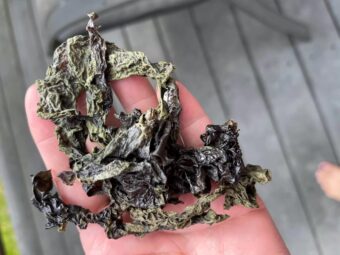
This dried, black seaweed has a light green color that traditional harvesters say isn’t normal and “tastes off.” (Photo courtesy of Irene Dundas)

Irene Dundas has harvested black seaweed her whole life – near Kake when she was young and near Ketchikan as an adult. The harvest happens in May when the seaweed is exactly the right size. Dundas and family members travel by boat to specific large rocks far from shore. It must be low tide so they can pull the seaweed off the rocks.

“When you’re grabbing it in your handful, it looks like you’re grabbing a handful of long, thick black hair,” Dundas said.

Black seaweed is found in more treacherous areas. It needs nutrients that only come from lots of moving water.

Dundas harvests about 50 gallons to share with family and friends. Processing is lengthy, drying the seaweed into bite-sized pieces.

“It’s kind of crunchy like a piece of popcorn,” she said. “But the flavor is like the black seaweed that you put on sushi. It’s that exact flavor. So delicious.”

Dorian Dundas, Irene Dundas’ daughter, collects black seaweed. (Photo courtesy of Irene Dundas)

She transfers the wet seaweed in pillowcases and puts it outside on several large tables to dry. But in the years 2021 and 2022, she noticed something was wrong.

“The seaweed that I picked had a very distinct strong, strong smell,” Dundas said. “There was a discoloration, this light green color. I felt like it had a little bit more metallic taste to it.”

To get any good seaweed this year, she traveled for hours by boat near the Canadian border. Her past harvests, she threw away.

“I was alarmed and very, very, very upset,” said Dundas. “I had no clue what was going on.”

Keolani Booth has similarly concerns. He collects black seaweed on the outer waters near Metlakatla and southern Prince of Wales Island.

“This year, I hardly had anything of a harvest,” he said. “I usually give out quite a bit to our community members that can’t go out. And I was only able to get a minute amount and it was kind of heartbreaking because you know, some of these people depend on me to bring them some seaweed for the year.”

Booth says black seaweed could be like a canary in a coal mine – a warning of what could come from climate change.

“It’s a very hard seaweed to try to cultivate,” Booth said. “It’s very sensitive, which you know, you realize that in the open ocean, it’s a precursor to all the things that are stronger in the ocean.”

The Metlakatla tribe got a grant to start researching the problem two years ago. That research is ongoing. And last month, Dundas and Booth carried their concerns to a meeting in Juneau, hosted by the Sealaska Heritage Institute. Harvesters and scientists discussed what to do.

Jennifer Clark from Vancouver brought a Western science perspective. She works for a kelp company but studied the effects of climate change on seaweed for her Ph.D.  In a post-doctoral project, she worked with Indigenous groups in central British Columbia about black seaweed disappearing there.

“In 2016, it’s almost completely missing from the intertidal shoreline,” she said.

Clark’s research linked the disappearance to an enormous hot water mass in the Northern Pacific known as The Blob. In 2014-2015, The Blob moved from the Gulf of Alaska down to California. It was followed by more heat from El Nino, which elevated seawater one to two degrees, enough to destroy the black seaweed.

“These heat waves are kind of unprecedented,” said Clark. “They just cause disruptions in life cycles and disturbances in the intertidal, which most of the seaweeds that you find are intertidal-subtidal, so they’re getting extreme changes in their habitat.”

She learned that black seaweed couldn’t survive past 64 degrees. As temperatures cooled in the years after The Blob and El Nino double whammy, BC’s seaweed started to come back. But not like before. Clark doesn’t know if Alaska’s black seaweed problem was also affected by The Blob – she says it would take more research. But she does know that black seaweed anywhere has challenges ahead if climate predictions come true.

“I think if it was persistent, like if we were to increase two degrees – 2050, I think that’s the projection is one and a half degrees – then maybe they won’t be so resilient, and they’ll just kind of exist as much as they can until they’re, they’re wiped out,” Clark said.

Wet black seaweed dries on tables outside. It will be ground into bite-sized pieces. Harvesters in Southeast Alaska collect it by the gallons. (Photo courtesy of Irene Dundas)

Rosita Worl is the president of Sealaska Heritage Institute. She says the seaweed is critical to many communities in and out of Alaska because it’s shared and traded.

“Black seaweed is really important to us as a food source, but also for its cultural components,” Worl said. “It’s like a glue that binds our community together through our widely sharing patterns. It also has spiritual dimensions. Black seaweed is distributed and consumed during our ceremonies.”

Sealaska Heritage Institute is creating a committee comprised of harvesters and scientists to start researching the problem. They’re also documenting the historical practices of the harvest and how it’s changed in recent years.

They hope the information will help them figure out if there’s any way to save black seaweed.

Tsunami warning canceled following strong earthquake off Alaska Peninsula

Boats in Sand Point left the harbor around 11:30 p.m. Saturday due to a tsunami warning, which was later canceled. (Theo Greenly/KUCB)

A tsunami warning issued late Saturday after a strong earthquake off the Alaska Peninsula has now been lifted.

The magnitude 7.2 earthquake hit roughly 60 miles south of Sand Point at 10:48 p.m. Saturday and was followed by several aftershocks, according to the Alaska Earthquake Center.

It triggered a tsunami warning for the Alaska Peninsula and Kodiak Island. Sirens sounded in local communities, with officials urging residents to seek higher ground. The tsunami warning was later downgraded to an advisory and was canceled altogether by 1 a.m. Sunday.

The National Tsunami Warning Center said the maximum observed height of waves off King Cove and Sand Point was half a foot. It said some areas may continue to see small sea level changes.

The tsunami warning also stirred Anchorage residents late Saturday, with some reporting that they got the emergency alert on their phones.

an emergency alert on a cellphone
Some Anchorage residents got this alert to their cellphones late Saturday. (Tegan Hanlon/Alaska Public Media)

Geologists have previously said it’s unlikely that an earthquake could generate a large tsunami in Anchorage. The Tsunami Warning Center has had issues in the past with the alerts going to city residents.

At 11:32 p.m. on Saturday, the National Weather Service posted on Twitter: “Anchorage is NOT in the area affected by the Tsunami Warning. We will look into this issue.”

Alaska Public Media’s Tegan Hanlon and KUCB’s Theo Greenly contributed to this story.

78 pilot whales were slaughtered near a cruise ship carrying marine conservationists in Europe

A group of fisherman drive pilot whales towards the shore during a hunt in the Faroe Islands in May 2019.
(Andrija Ilic/AFP via Getty Images)

A cruise line is apologizing to passengers who witnessed the killing of dozens of pilot whales near their docked ship this week in the Faroe Islands.

Passengers aboard the cruise ship Ambition, owned by the U.K.-based Ambassador Cruise Line, had just arrived Sunday in the port of Tórshavn in the Danish territory when they caught the spectacle, part of a long-standing and highly scrutinized local tradition.

Among those passengers were conservationists with ORCA, a marine life advocacy group that seeks to protect whales and dolphins in European waters. Since 2021, Ambassador has paid for ORCA staff to join their cruises in order to educate tourists on marine wildlife and collect data on the animals.

In an account shared by ORCA and confirmed by Ambassador, the conservationists said over 40 small boats and jet skis herded the whales to a beach where 150 people worked to haul the animals ashore with hooks and slaughter them with lances.

In total, the hunt lasted about 20 minutes, ORCA said. Some of the animals, which included nine calves, took over 30 seconds to die.

Ambassador Cruise Line said it was “incredibly disappointed” that the hunt unfolded near the ship and that it continues to “strongly object to this practice.” The company asks their guests not to support the hunters by purchasing local whale and dolphin meat.

“We fully appreciate that witnessing this local event would have been distressing for the majority of guests onboard,” Ambassador said in a statement to NPR. “Accordingly, we would like to sincerely apologise to them for any undue upset.”

A representative for the Faroe Islands government did not immediately respond to NPR’s request for comment on Sunday’s hunt.

Long-finned pilot whales, which are technically a species of dolphin, are a medium-sized marine mammal that dwells in the North Atlantic, known for their bulbous head and sickle-shaped flippers. They’re protected under the Marine Mammal Protection Act, but not currently listed as an endangered species.

The mammals live in social pods of up to 20 individuals, organized into a larger school of hundreds of animals — a social structure that makes them easy targets for whalers, according to the National Oceanic and Atmospheric Administration.

In the Faroe Islands, the hunting of pilot whales is known as the “grindadrap” or “grind.” The Faroese view the tradition as central to their cultural identity and a sustainable way to gather food, according to a local government website.

The government says the killing is not highly commercialized. Each catch is “distributed for free in the local community” but “in some supermarkets and on the dockside, whale meat and blubber is occasionally available for sale.”

Multiple hunts can occur throughout the year, and each is carried out by people with a required license and supervised by elected officials. Local legislation stipulates the killing must be carried out as “quickly and efficiently as possible.”

The government says the average catch is around 800 animals, an insignificant impact on the overall pilot whale population, which it says is around 778,000 animals.

But a record single-day killing of more than 1,400 white-sided dolphins in 2021 brought the practice into intensified scrutiny. The chairman of the Faroese Whalers Association told the BBC that the size of that killing was purely accidental.

That Sunday’s slaughter unfolded near the cruise ship made it seem as if the whalers were “flaunting the hunt and taunting the tourists,” many of whom were hoping to catch a glimpse of marine life in the wild, ORCA CEO Sally Hamilton said.

“It defies belief that the Faroese authorities allowed this activity to take place in clear sight of a cruise ship packed with passengers,” she wrote in a statement shared with NPR. “At some point, the Faroese authorities will have to decide if its marine life is a more attractive tourist proposition when it is alive than when it is being killed.”

The cruise ship was docked for a stop in Tórshavn, the main harbor of the 18-island territory between Iceland and the Shetland Islands. While the local government has invested more into its tourism sector, fishing and marine-related industries still remain the region’s top economic driver.

Researchers found a rare octopus nursery off the coast of Costa Rica

Researchers found Muusoctopus nursery grounds on a low-temperature hydrothermal vent off the shore of Costa Rica. (Schmidt Ocean Institute)

Scientists working off the coast of Costa Rica say they’ve discovered the world’s third known octopus nursery.

The international 18-person research team found the site nearly 2 miles below sea level and believe that in the process they may have also discovered a new species of Muusoctopus, a genus of small to medium sized octopus lacking an ink sack.


View this post on Instagram


A post shared by NPR (@npr)

“The discovery of a new active octopus nursery over 2,800 meters beneath the sea surface in Costa Rican waters proves there is still so much to learn about our Ocean,” Dr. Jyotika Virmani, executive director of the Schmidt Ocean Institute, said in a statement.

According to a press release, researchers witnessed Muusoctopus eggs hatch. They said it demonstrated that the area, known as the Dorado Outcrop, was hospitable to young octopuses.

Scientists working off the coast of Costa Rica say they’ve discovered the world’s third known octopus nursery. (Schmidt Ocean Institute)

When the Dorado Outcrop — an area roughly the size of a football field — was first discovered in 2013, researchers believed octopuses couldn’t grow there because they didn’t observe any developing embryos at the site.

Scientists said the discovery also indicated that some deep-sea octopus species brood their eggs in low-temperature hydrothermal vents, such as the one where the nursery was discovered, where fluid heated in the Earth’s crust is released on the seafloor — like hot springs.

Researchers found Muusoctopus nursery grounds on a low-temperature hydrothermal vent off the shore of Costa Rica. (Schmidt Ocean Institute)

The research vessel for the trip was provided by the Schmidt Ocean Institute, a nonprofit research organization founded by former Google CEO Eric Schmidt and his wife, Wendy.

The trip was led by Beth Orcutt of the Maine-based Bigelow Laboratory for Ocean Sciences as well as Jorge Cortes of the University of Costa Rica.

According to the researchers, areas like the Dorado Outcrop are still vulnerable to human activities such as fishing, and some Costa Rican scientists on the trip were trying to discern if the underwater seamounts should be legally protected.

“The information, samples, and images are important to Costa Rica to show its richness and will be used for scientific studies, and outreach to raise awareness of what we have and why we should protect it,” Cortes said.

Copyright 2023 NPR. To see more, visit https://www.npr.org.

Unalaska readies to deploy traps for invasive European green crabs

In much of the state, scientists have had their eyes on the crab for years. In communities around Kachemak Bay, they’ve been setting traps for about two decades. (Hope McKenney/KBBI)

Unalaska is preparing to start monitoring for European green crabs. That’s after the invasive species was first found in Alaska last July.

The crabs could cause a big problem. They destroy habitat and outcompete native species.

Biologists with the Alaska Department of Fish and Game say the monitoring program is crucial in the nation’s largest fishing port. They’re preparing to deploy traps later this summer.

“We don’t have any reason to believe that European green crab are here or established in the region, but we’re also not currently doing any monitoring,” said Ethan Nichols, the assistant area manager for shellfish with ADF&G in Dutch Harbor. “With European green crab steadily moving up the West Coast, through British Columbia, and into southern Southeast Alaska as of last year, I think it’s important that we start monitoring here in the Port of Dutch Harbor, given the amount of international ship traffic that we have.”

Twenty green crabs laid out in rows on a table, with a bucket full of green crabs next to them
European green crabs collected from Metlakatla’s Tamgas Harbor last fall. The crabs were trapped in shrimp pots. (Photo courtesy of Dustin Winter).

In much of the state, scientists have had their eyes on the species for years. In communities around Kachemak Bay and Prince William Sound, they’ve been setting traps for about two decades.

Tammy Davis is the invasive species program coordinator with the Department of Fish and Game in Juneau. She says European green crabs — which are native to coastal Europe and North Africa, and were introduced to the Atlantic coast through ballast water in the early 1800s — are so concerning, because although they’re small, they’re incredibly aggressive.

They reduce eelgrass (important nursery habitat for juvenile fish) and populations of clams, oysters, mollusks and other invertebrates that live on or in the seafloor. They can also prey on juvenile native crabs, like Dungeness — something that could impact Aleutian Island fisheries down the line, if their habitats overlap.

“Green crab are considered one of the top 100 invasive species globally,” Davis said.

Like anywhere else, Davis said, they would have impacts on the nearshore environment, putting organisms that rely on that intertidal and subtidal habitat at risk.

“They behave differently in different environments,” she said. “There’s, of course, some sort of general parameters of temperature triggers for reproduction, and tolerance for temperatures and so forth. But they’re very hardy organisms, and we don’t know what the potential impacts are in an environment like Dutch Harbor at this point.”

Davis said biologists are concerned the species could be introduced into Dutch Harbor through ballast water discharge, or by currents carrying larvae out the Aleutian Chain.

She said they hope to identify coastal areas with high-value commercial, recreational and subsistence harvests and use intensive trapping as a way to monitor and control green crab populations as they start to spread across the state.

Setting traps also helps them understand what species use these areas and are at risk of green crab predation, according to Davis.

“Whatever ends up in our traps also uses this part of the nearshore. Those are the species that are at risk from green crab,” she said.

Davis said although it’s not likely they’ll be able to get rid of green crabs if they establish themselves in the Aleutians, early detection is crucial.

“You’re keeping the population of green crab low enough that the negative impact they have on the native species and the native habitat is not greater than the native species can handle,” she said.

ADF&G plans to launch the monitoring program in the Port of Dutch Harbor this summer. Five traps are on their way to the island now.

If you find what you think might be a European green crab, you can call ADF&G’s invasive species hotline at 1-877-INVASIV or visit their website.

New estimate for Cook Inlet belugas shows hope for endangered population

A gray beluga whale calf and three adults swim together in Cook Inlet. A newly released population estimate shows signs of recovery, or at least stablization, among the endangered whales. The unprecedented marine heatwave known as The Blob is believed to have taken a toll, but the population has increased since that heatwave dissipated. (Photo by Paul Wade/NOAA Alaska Fisheries Science Center)

The number of endangered beluga whales swimming in Alaska’s Cook Inlet increased slightly in the past four years, providing “a glimmer of hope” for a population that crashed in the 1990s and remained at a low number long after that, according to a new estimate released on Thursday by federal biologists.

The latest population estimate for endangered Cook Inlet belugas is between 290 and 386, with a median estimate of 311, the National Oceanic and Atmospheric Administration said. That compares to NOAA’s’ Alaska Fisheries Science Center 2018 median estimate of 279 and a range of 250 to 317 animals.

The new population estimate is based on aerial surveys conducted in the summers of 2021 and 2022.

In a NOAA Fisheries statement, one of the biologists who compiled the new estimate expressed tempered optimism.

An educational sign about endangered Cook Inlet belugas is seen on March 7 at the small boat launch Anchorage’s Port of Alaska. The sign was designed and erected to raise public awareness, part of a wide-ranging strategy to help the endangered whales recover. Cook Inlet belugas’ habitat overlaps with a lot of human uses, including those at the port. (Photo by Yereth Rosen/Alaska Beacon)

“While this is certainly encouraging news, it is important to recognize that abundance estimates can vary from year to year due to a number of factors,” Kim Goetz, an Alaska Fisheries Science Center marine mammal biologist listed as the lead author of Thursday’s report, said in the statement.

Cook Inlet belugas numbered about 1,300 in 1979, according to NOAA. The steep decline that started in the 1990s was blamed on overhunting, but even after Indigenous subsistence hunting ceased, the population continued to decline. In 2008, Cook Inlet belugas were listed as endangered.

Now, a slight upturn of less than 1% a year appears to have been happening for at least a few years, according to the new population estimate.

Recent analysis of the past two decades shows that there was likely a steady increase in Cook Inlet beluga numbers from 2004 to 2010, but the population dropped over the next eight years before increasing again.

While the reasons for the 2010-2018 decline are yet unknown, the report said, a likely suspect has emerged: the sustained and unprecedented northeast Pacific marine heatwave that disrupted fish stocks and triggered die-offs in various wild populations.

Informational sign at Anchorage’s Earthquake Park, seen on Jan. 27, describes the belugas and salmon found in Cook Inlet. Salmon make up much of the belugas’ diet, so the endangered whales suffer when runs are poor. (Photo by Yereth Rosen/Alaska Beacon)

Among the cascading effects of that heatwave, which became known as The Blob, were a near-total loss in the northern Gulf of Alaska of capelin, an important and oil-rich forage fish; mass die-offs of birds, including Alaska’s biggest die-off of common murres on record; a die-off of large whales; and a sharp decline in Pacific cod, which triggered some Gulf of Alaska commercial harvest closures. Cod are also important to Cook Inlet belugas, the report noted.

There may have also been overlapping human-caused problems for the belugas during the period of decline, said the report. Nonetheless, the increase in abundance since 2018 shows signs that the population is slowly growing or at least stable, the report said.

Cook Inlet belugas live in Alaska’s most populous and developed region. Scientists say they face a myriad of threats and potential disturbances from forces like climate change, habitat degradation, pollution, industrial noise and ship traffic in Alaska.

At the same time, they have also been the subject of numerous conservation and protection efforts. A task force with representatives from multiple government agencies, businesses, academia and other organizations has been guiding recovery work.

This story originally appeared in the Alaska Beacon and is republished here with permission.

Site notifications
Update notification options
Subscribe to notifications