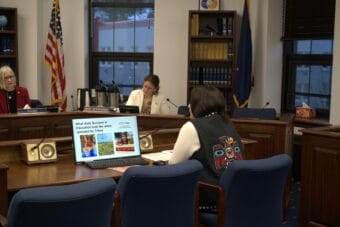
Central Council of the Tlingit and Haida Tribes of Alaska Education Liaison Mischa Jackson testifies in front of the Alaska House Tribal Affairs Committee on Feb. 6, 2025. (Photo by Jamie Diep/KTOO)
The Central Council of the Tlingit and Haida Tribes of Alaska has been working on expanding its education programs for years. One of the tribe’s next steps is building an educational campus in Juneau focused on culturally relevant, place-based learning.
This is one of many efforts Alaska Native tribes around the state are working on to improve educational outcomes for Native students. The state is joining in by working with tribes to develop an education compacting program.
An education compact is an agreement between tribal and state governments that allows tribes to run their own public schools. Alaska’s Department of Education and Early Development is working with tribes to kick start a compacting program and give tribes sovereignty over education.
Gov. Mike Dunleavy’s administration is moving things along with a bill proposal that would approve a pilot program for tribally compacted public schools. The House Rules Committee introduced it as House Bill 59 last month.
Mischa Jackson is an education liaison with Tlingit and Haida – one of five tribes that would be part of a pilot program to see if the compact works.
“Compacting is the mechanism to provide tribes an opportunity to play a role in the operation of schools,” Jackson said.
Jackson presented to lawmakers in a state House Tribal Affairs Committee meeting last Thursday. She talked about what education compacts could look like in the state.
Tlingit and Haida — along with the King Island Native Community and the Village of Solomon, Inupiat Community of the Arctic Slope, Ketchikan Indian Community and Knik Tribe — negotiated with the Department of Education and Early Development, or DEED, to create a report on how compacting could work. According to the report, the program came out of a list of education priorities the state Board of Education is following. It aims to close the achievement gap between Native and non-Native students in the state.
State testing results in recent years show a gap in Alaska Native students and other students of colors achieving proficiency in math and language arts when compared to all students.
Results from the Alaska System of Academic Readiness exam shows fewer Alaska Native and other students of color consistently reach advanced or proficient levels in math and language arts when compared to all students. The same goes for students experiencing homelessness and students in foster care.
Jackson said she’s really excited to implement the program.
“This has long term gains we’re really excited about, and I would say we have a pretty strong team and a lot of Indigenous educators throughout Southeast Alaska that are really excited to help contribute to this project,” she said.
Jackson said many Alaska Native tribes aren’t structured in a way that allows them to receive federal funding for education. Compacting would allow them to do that. She said the program would give tribes more say over education they don’t have under current state law, even if they operate as a charter school within a school district.
“For the vision that a lot of tribes have for education, we’ve never had the true opportunities to be able to work as an education system with the level of authority and autonomy,” Jackson said.
Joel Isaak is a consultant with DEED for tribal compacting. In an interview, he said the program would give tribes the ability to oversee many aspects of running their own schools.
“The tribes are the ones carrying out the education in the classroom, and the state is the one that’s providing the fiscal backing, and then ensuring safety and adequacy,” Isaak said.
This means tribes would be able to hire teachers, design curriculum and create a governing body like a school board to run the schools, as long as it follows state requirements. Isaak said tribes can also create training requirements for teachers.
While some tribes may want to require their teachers to simply get a teaching degree at a university, he said others may want teachers to be trained in place-based or cultural learning.
“It allows the tribe to really direct how they weave together the culture, language with those regulated skill sets around, for example, reading or math or science,” he said.
Tribally compacted public schools would also receive state funding. To determine how much funding they receive from the current formulas in place, they would be treated as Regional Educational Attendance Areas. These are educational districts in places without a taxing authority like a borough.
This bill also includes start-up funds for carrying out the program. A fiscal note for the bill estimates it could cost close to $17.5 million for the next fiscal year. This includes both foundational funding and start-up funds for all five pilot schools.
Isaak said compacting is a way to improve the state’s education system.
“It does not fix every single thing in education, but it brings in another person to help carry the weight and to help think about how you get there more efficiently, or how you get there with everybody,” he said. “And that’s why it’s a systems transformation, that’s really powerful.”
Washington is the only state that uses education compacts since approving it in 2013. The New Mexico Legislature is also considering a bill to allow the state to enter tribal education compacts.
Jackson, with Tlingit and Haida, said the tribe is already working on building an education campus in Juneau behind Fred Meyer.
If the bill doesn’t pass, Jackson said the tribe is ready to find other sources of funding for the campus.
“Our movement towards the education campus is going to happen whether this bill passes or not,” she said. “This will just be another vehicle towards supporting the infrastructure, and what will go inside of the buildings. The education in itself is going to move forward.”
If the bill passes, Isaak said DEED will negotiate compacts with the tribes to get the schools running.
The House Tribal Affairs Committee will hold a hearing on the bill on Thursday at 8 a.m.
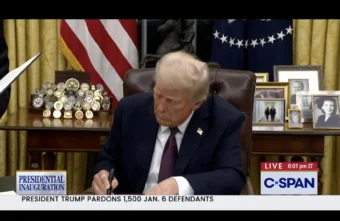
President Donald Trump signs an executive order at the White House supporting natural resource development in Alaska on Monday, Jan. 21, 2025 in Washington. (C-Span screenshot)
U.S. District Judge John C. Coughenour issued a ruling on Thursday temporarily blocking President Trump’s executive order that aimed to end birthright citizenship for children born to migrants in the U.S. temporarily or without legal status. Coughenour issued the temporary restraining order after a hearing in Seattle.
The judge signed the temporary restraining order in response to a lawsuit brought by Oregon, Arizona, Illinois and Washington state, one of several suits opposing the administration’s effort to curb the right of citizenship for anyone born on U.S. soil.
In a standing-room-only courtroom in downtown Seattle, Coughenour interrupted the attorney for the Justice Department, Brett Schumate, to tell him how unconstitutional he thinks the administration’s order is.
“I’ve been on the bench for four decades, I can’t remember another case where the question presented is as clear as this one is,” Coughenour said, describing Trump’s order as “blatantly unconstitutional.”
“There are other times in world history where we look back and people of goodwill can say, ‘Where were the judges? Where were the lawyers?’ ” the judge said, according to KUOW News.
Coughenour’s order blocks federal agencies from implementing the executive order, signed Monday by Trump, while the case is under review.
“Obviously, we’ll appeal it,” Trump said, referring to the judge’s ruling during an appearance at the White House on Thursday.
A spokesperson for the U.S. Justice Department told NPR in email that the new administration will “vigorously defend” Trump’s executive order. “We look forward to presenting a full merits argument to the Court and to the American people, who are desperate to see our Nation’s laws enforced,” the DOJ official said.
Outside the courtroom, Washington state Attorney General Nick Brown applauded the judge’s skepticism.
“This is step one,” Brown said. “But to hear the judge from the bench say that in his 40 years as a judge, he has never seen something so blatantly unconstitutional sets the tone for the seriousness of this effort.
Brown is among 22 Democratic state attorneys general who have joined lawsuits to block the executive order. In a statement after Thursday’s ruling, Brown said the “unconstitutional and un-American executive order will hopefully never take effect.”
Another attorney general who sued, California’s Rob Bonta, said in an interview with NPR that he expects a “similar reception from courts throughout the United States. Any court that is fair, that is objective, that looks at the facts and applies the law, I believe will find the same way.”
Bonta said there are about 25,000 children born every year in California who would be entitled to birthright citizenship. If Trump’s executive order went into effect, those children would be “deportable at any time, wouldn’t have access to federal programs that provide food assistance or housing or health care, things like Medicaid or our Children’s Health Insurance Program, and many other services, programs and privileges of citizenship.”
The 14th Amendment of the U.S. Constitution grants full citizenship to all persons “born or naturalized in the United States, and subject to the jurisdiction thereof.” That provision has been interpreted for decades to grant American citizenship to everyone born in the U.S. Some conservatives believe babies born to migrant families without legal status in the U.S. should be excluded.
In his executive order, Trump said the “privilege of United States citizenship is a priceless and profound gift.” This case is expected to be decided by the U.S. Supreme Court.
Law enforcement correspondent Martin Kaste contributed to this story.
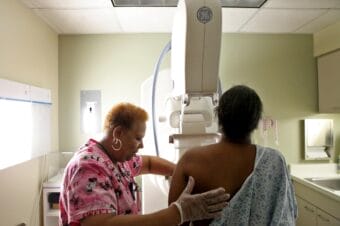
The most recent recommendation of the U.S. Preventive Services Task Force is that all women 40 to 74 get mammograms every other year. A previous recommendation said screening should start at 50. One doctor suggests that people “test smarter, not test more.” (Heather Charles | Tribune News Service via Getty Images)
New research makes the case for educating women in their 40s — who’ve been caught in the crossfire of a decades-long debate about whether to be screened for breast cancer with mammograms — about the harms as well as the benefits of the exam.
After a nationally representative sample of U.S. women between the ages of 39 and 49 learned about the pros and cons of mammography, more than twice as many elected to wait until they turn 50 to get screened, a study released Monday in the Annals of Internal Medicine found.
Most women have absorbed the widely broadcast message that screening mammography saves lives by the time they enter middle age. But many remain unaware of the costs of routine screening in their 40s — in false-positive results, unnecessary biopsies, anxiety and debilitating treatment for tumors that left alone would do no harm.
“In an ideal world, all women would get this information and then get to have their further questions answered by their doctor and come up with a screening plan that is right for them given their preferences, their values and their risk level,” said social psychologist Laura Scherer, the study’s lead author and an associate professor of research at the University of Colorado School of Medicine.
Of 495 women surveyed, only 8% initially said they wanted to wait until they turned 50 to get a mammogram. After researchers informed the women of the benefits and the harms, 18% said they would wait until 50.
“We’re not being honest”
Learning about the downsides of mammograms did not discourage women from wanting to get the test at some point, the study showed.
The benefits and the harms of mammography came as a surprise to nearly half the study’s participants. More than one-quarter said what they learned from the study about overdiagnosis differed from what their doctors told them.
“We’re not being honest with people,” said breast cancer surgeon Laura Esserman, director of the University of California San Francisco Breast Care Center, who was not involved with the research.
“I think most people are completely unaware of the risks associated with screening because we’ve had 30, 40 years of a public health messaging campaign: Go out and get your mammogram, and everything will be fine,” she said in an NPR interview.
Esserman sees women who are diagnosed with slow-growing tumors that she believes in all likelihood would never harm them. In addition, mammography can give women a false sense of security, she said, like it did for Olivia Munn.
The 44-year-old actress had a clean mammogram and a negative test for cancer genes shortly before her doctor calculated her score for lifetime breast cancer risk, setting off an alarm that led to her being treated for fast-moving, aggressive breast cancer in both breasts.
Toward a personalized plan for screening
Esserman advocates for a personalized approach to breast cancer screening like the one that led to Munn’s diagnosis. In 2016, she launched the WISDOM study, which aims to tailor screening to a woman’s risk and, in her words, “to test smarter, not test more.”
The National Cancer Institute estimates that more than 300,000 women will be diagnosed with breast cancer and 42,250 will die in the U.S. this year. Incidence rates have been creeping up about 1% a year, while death rates have been falling a little more than 1% a year.
For the past 28 years, the influential U.S. Preventive Services Task Force has been flip-flopping in its recommendations about when women should begin mammography screening.
From 1996 until 2002, the independent panel of volunteer medical experts who help guide physicians, insurers and policymakers said women should begin screening at 50. In 2002, the task force said women in their 40s should be screened every year or two. In 2009, it said that 40-something women should decide whether to get mammograms based on their health history and individual preferences.
The new study was conducted in 2022, when the task force guidelines called for women in their 40s to make individual decisions.
New guidelines
In 2024, the panel returned to saying that all women between the ages of 40 and 74 should be screened with mammograms every other year. Rising breast cancer rates in younger women, as well as models showing the number of lives that screening might save, especially among Black women, drove the push for earlier screening.
An editorial accompanying the new study stresses the need for education about mammography and the value of shared decision-making between clinicians and patients.
“For an informed decision to be made,” states the editorial written by Dr. Victoria Mintsopoulos and Dr. Michelle B. Nadler, both of the University of Toronto in Ontario, “the harms of overdiagnosis — defined as diagnosis of asymptomatic cancer that would not harm the patient in the future — must be communicated.”
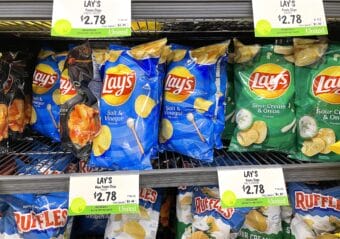
PepsiCo said sales of its Frito-Lay snacks slumped in the most recent quarter as shoppers became more sensitive to rising prices. (Justin Sullivan | Getty Images North America)
Grocery prices are no longer climbing as much as they did in the last two years — but many Americans are still frustrated by what it costs to put food on the table.
Some people have apparently hit their limit. One of the biggest snack makers said this week that its sales fell this spring as grocery shoppers became more sensitive to rising prices.
Here are three things to know about food prices these days — and why it still feels more expensive at the checkout lane of your favorite grocery store.
What is going on with food prices?
It may not feel like it, but grocery prices have actually leveled off for the most part.
The latest consumer inflation report, out this week, showed grocery prices rose just a little over 1% in the last 12 months. That’s a big improvement from the previous year, when prices jumped nearly 5%, and the year before that, when they soared by double digits.
However, leveling off is not the same as prices coming down, and the U.S. is still feeling the cumulative effect of those earlier increases.
And that leads to frustration for shoppers like Cindy Seinar, a retired autoworker in Lynchburg, Virginia.
“You go in for one thing, and you come out and it’s $45,” she says, describing her experiences at the grocery store.
And for Seinar, just like for many other Americans, the frustration is compounded by “shrinkflation.” That’s when companies reduce package sizes, meaning you get less than you used to for the same or sometimes even higher prices.
“Sugar is only 4 pounds,” Seinar says. “You’re not even getting a 5-pound bag anymore.”
Grocery prices are particularly noticeable because they are such a significant chunk of the typical family’s budget, accounting for about 8% on average, according to government data. For lower-income families, it’s often more than that.
How are people adjusting to higher prices?
For a while, many people just gritted their teeth and paid up — but Americans are starting to push back.
PepsiCo, which reported earnings this week, said sales of its Frito-Lay snacks actually fell during the most recent quarter. Some of that is because shoppers are balking at the higher prices by cutting back on chips altogether or by switching to cheaper store brands.
Amanda Whitworth stocks grocery shelves at a Target store in Florida. She often finds herself steering customers to the in-house bargains at the discount retailer.
“You may not ever have considered the Market Pantry bread, but it’s $1.39 for a big loaf of it,” Whitworth says, referring to Target’s private label. “While that may not be someone’s first choice, it’s a quarter of the price of some loaves.”
Grocery prices rose just a little over 1% in the last 12 months, according to the latest consumer inflation report, out this week. (Frederic J. Brown | AFP via Getty Images)
Whitworth also does the food shopping for her family and says she has made similar substitutions of her own.
“Before, we would have bought a big bag of frozen chicken nuggets for our son. And the particular bag went up three extra dollars,” Whitworth says. “So we started making homemade chicken nuggets, which we’ll probably never switch back because they’re so good.”
That sends a message to the big food producers. When PepsiCo and others start losing market share, they grow more cautious about pushing up prices. In some cases, they start to offer discounts — and that’s one reason grocery prices aren’t climbing as fast as they had been.
So are grocery prices finally going to come down?
To some degree.
The prices of some individual grocery items have come down. Fruit and vegetable prices have dropped over the last year, for example. So have milk and cheese prices.
However, the overall cost of groceries is unlikely to fall substantially.
But there is a silver lining. As grocery inflation slows, wages are catching up.
Over the last year, average wages have risen 3.9%, or about three and a half times as fast as grocery prices.
The typical worker now has to work about the same number of hours to buy a week’s worth of groceries as in 2019, before the COVID-19 pandemic.
That’s good news — even if for many Americans it doesn’t feel that way.
Transcript:
SCOTT SIMON, HOST:
How much would you pay for a bag of potato chips? Well, some people are apparently hitting their limit. One of the biggest snackmakers say that its sales fell this spring because of rising prices. Grocery prices are not climbing nearly as fast as they had been, but many Americans are still frustrated by what it costs to put food on the table. NPR’s Scott Horsley joins us. Scott, thanks for being with us.
SCOTT HORSLEY, BYLINE: Good morning. Good to be with you.
SIMON: Of course, a lot of people will be in supermarkets this weekend. What kind of prices might they see?
HORSLEY: Well, the good news is supermarket prices have largely leveled off. We got an inflation report this past week showing grocery prices rose just a little over 1% in the last 12 months. That is a big improvement from the previous year, when prices jumped almost 5%, and the year before that, when they soared by double digits. But leveling off is not the same as coming down, and we are still dealing with the cumulative effect of all those earlier price increases. When we asked NPR listeners, where do you feel the sting of inflation most? – a lot of people said the supermarket.
CINDY SIENAR: I think that groceries stand out the most just because we’re always at the grocery store, and you have to eat.
HORSLEY: Cindy Sienar is a retired autoworker who lives in Virginia. Like a lot of people, she’s bothered by what economists call shrinkflation and the feeling she’s paying more and getting less.
SIENAR: You go in for one thing, and you come out, and it’s $45. And sugar is only four pounds. You’re not even getting a five-pound bag anymore.
HORSLEY: And people notice because, you know, they buy groceries week after week. It’s a significant chunk of the typical family’s budget, about 8% on average. For lower-income families, it’s often more than that.
SIMON: And how are people reacting to these higher prices?
HORSLEY: You know, for a while, they just grit their teeth and paid up, but we are starting to see more pushback now. Pepsi, which reported its earnings this past week, said, sales of FritoLay snacks were actually down during the most recent quarter, which suggests we have reached the crunch point on tortilla chips. You know, maybe shoppers are cutting back altogether or they’re switching to cheaper store brands.
Amanda Whitworth stocks grocery shelves at a Target store in Florida. She often steers customers to the discount retailer’s in-house bargains.
AMANDA WHITWORTH: I like being able to point people in certain directions and be like, well, you may not have ever considered the market pantry bread, but it’s $1.39 for a big loaf of it. And you know, while that might not be someone’s first choice, you know, it’s a quarter of the price of some loafs.
HORSLEY: Whitworth also does the food shopping for her family and says she’s made some substitutions of her own.
WHITWORTH: Before, we would have bought a big bag of frozen chicken nuggets for our son, and the particular bag went up three extra dollars, and at that point, I was like, oh, goodness. So we started making homemade chicken nuggets, which – we’ll probably never switch back ’cause they’re so good.
HORSLEY: That sends a message to the big food producers. You know, when Pepsi and others start losing market share, they get more cautious about raising prices, and, in some cases, they start to offer discounts.
SIMON: Scott, are food prices, grocery prices, likely to come down any time soon?
HORSLEY: You know, the price of some individual items will certainly come down. We’ve seen that over the last year with fruits and vegetables and milk and cheese. But in terms of what you pay at checkout for the whole grocery cart, that’s not likely to drop very much.
The good news is as grocery prices level off, wages are catching up. Over the last year, average wages have risen about 3 1/2 times as fast as grocery prices. So one way to think about this is, how long do I have to work to buy a week’s worth of groceries? For the typical worker, it now takes about the same number of hours as it did back in 2019, even if it doesn’t yet feel that way.
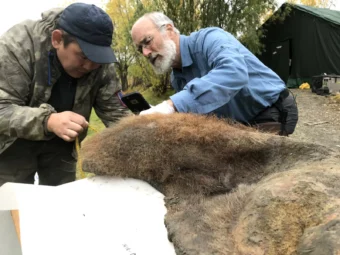
Valerii Plotnikov (left) from the Academy of Sciences of the Republic of Sakha, Yakutsk, Russia, and Daniel Fisher of the University of Michigan examine a woolly mammoth unearthed during a 2018 expedition. (Love Dalén)
Scientists have recreated the three-dimensional structure of the woolly mammoth’s genetic blueprint.
The accomplishment, described Thursday in the journal Cell, marks what is believed to be the first time scientists have been able to produce a multidimensional version of the genome of a complex extinct species.
The advance should provide important new insights into the biology of a creature that has long sparked fascination. In addition, the work could aid efforts to breed a living version of the animal, the researchers and others said.
“It’s exciting,” says Erez Lieberman Aiden, a professor of of molecular and human genetics and director of the Center for Genome Architecture at the Baylor College of Medicine in Houston. “We think it’s going to be very valuable.”
For years, scientists have been able to peer back in time by analyzing fragments of ancient DNA recovered from bones, fossilized teeth, mummies and even strands of hair.
“In biology, one of the most powerful tools for understanding the history of life on this planet is ancient DNA,” Aiden says. “It’s an incredibly powerful tool for understanding the history of life.”
But there’s only so much scientists could learn from snippets of DNA. So Aiden and his colleagues launched an international effort to try to recreate the three-dimensional structure of the DNA, including the chromosomes, of an extinct creature.
“In so doing, you would be able to see exactly how that chromosome was shaped in a living cell, and you’d be able to both get a deeper understanding of the genomes of ancient and extinct species and how those genomes worked – which genes were on and off in particular tissues,” Aiden says.
Searching for mammoth samples on eBay
The scientists focused on the wooly mammoth, a big, shaggy species of elephant that roamed the tundra thousands of years ago.
“Initially we had embarrassingly bad ideas. I’m a little ashamed to admit it,” Aiden told NPR. “We said, ‘Oh, you know, that looks like a good-looking piece of mammoth on eBay. Let’s try that.’ It’s kind of a little cringe, right, to tell you that. Ebay is a bad place to get your mammoth samples.”
After searching for five years, the team finally found a well-preserved mammoth sample: skin from behind the ear of a 52,000-year-old female that was discovered freeze-dried in Siberia in 2018.
“It was a piece of a mammoth skin that was, you know, wooly. True to the name — it was indeed woolly mammoth skin,” says Olga Dudchenko, an assistant professor at the Baylor Center for Genome Architecture who worked on the research. “And that’s actually not as trivial as it sounds because very often the hair would be lost. So this one was hairy. And that actually is an interesting indicator in and of itself that this is a sample of substantial quality. And that immediately piqued our attention.”
Scientists can look at individual mammoth genes
In fact, the quality of the sample enabled the team to extract DNA and use a technique known as Hi-C to reconstruct the three-dimensional structure of all 28 of the mammoth’s chromosomes — the extinct creature’s entire genome, the researchers reported.
“We were able to assemble the genome of a woolly mammoth just as 25 years ago humans were excited for the first time to assemble our own genomes,” Aiden says. “Now we can do that for animals that were long extinct. That’s obviously a milestone.”
Not only that, the team has been able to peer into the genome to start learning what individual genes did.
“And that’s really exciting to be able to look at an extinct creature and be able to say, ‘Oh, yes. I can see this gene was on. That gene was on. This gene was off. Oh, isn’t that surprising?’” Aiden says. “To be able to do all these specific things in a woolly mammoth is exciting.”
In fact, by comparing the mammoth genome to DNA from modern elephants, the scientists have already discovered clues to what made the woolly mammoth woolly.
“We’ve been internally discussing whether we should start Hair Club for mammoths?” Dudchekno jokes.
Genetic findings could aid efforts to bring back mammoths
“I do think that this can be helpful for de-extinction,” Aiden says.
Other scientists praised the work.
“I think it’s pretty cool,” says Vincent Lynch, an associate professor of biological sciences at the University at Buffalo who was not involved in the research.
But Lynch isn’t a fan of trying to bring back the mammoth. The unintended consequences of that could be disastrous, he says. And the money for such a project would be much better spent trying to save the elephants that still roam the planet today.
“There’s an huge potential for unintended consequences,” Lynch says. “Just think about all the other invasive species that are in the world. You don’t really know the effect that species is going to have in the environment until it gets there.”
And Karl Flessa, a professor of geosciences at the University of Arizona agrees on the scientific accomplishment and the foolishness of trying to bring back the extinct pachyderm.
“The preservation of genetic architectures from the woolly mammoth is really remarkable,” Flessa says. “But just because you can do it, doesn’t mean that it should be done. A genetically modified Asian elephant is not a wooly mammoth. And releasing such an animal into the wild would be arrogant and irresponsible.”
Others disagree.
“It’s exciting to see that 3D architecture can be preserved in ancient samples. This will help move toward a complete de novo assembled mammoth genome, which could reveal features of the genome that might be relevant to mammoth de-extinction,” Eriona Hysolli, who leads a project to create an Asian elephant with mammoth traits at Colossal Laboratories & Biosciences in Dallas, wrote NPR in an email.
Still, Robert Fleischer, a senior scientist for the Center for Conservation Genomics at the Smithsonian’s National Zoo & Conservation Institute in Washington, says that prospect is exciting.
“If I was a 12-year-old in my science class in junior high school I’d probably think this was pretty cool,” Fleischer says. “And I still think it’s pretty cool.”
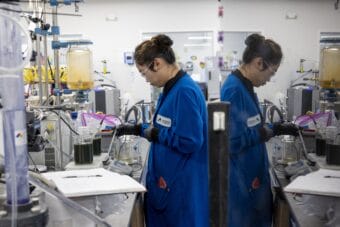
Xin Li, a research and development associate, works at Ascend Elements in Westborough, Mass., on June 13. The company is one of several that are scrambling to build recycling plants that can recover minerals from electric vehicle batteries without using dirty techniques like burning them — or wasting energy by shipping them overseas. (Amanda Andrade-Rhoades for NPR)
WESTBOROUGH, Mass. — Plastic bags of dark powder sit on a metal shelf. The powder contains minerals that came from lithium-ion batteries and are destined to be made into batteries again. That, in itself, is not revolutionary.
But where this shelf is located — in an unassuming industrial park an hour west of Boston — symbolizes how the battery-recycling industry is on the cusp of change.
Today, key steps in the battery-recycling process mostly happen overseas, particularly in Asia. Companies there have spent years building up a battery supply chain in which recycling and building batteries are closely connected.
But more and more batteries spend their lives powering electric vehicles in the United States. Shipping minerals halfway around the world costs money, creates carbon emissions, adds supply chain risks and, from the U.S. perspective, pushes some jobs and profits overseas.
That’s why the U.S. government is pouring money into an effort to bring the whole battery-recycling ecosystem to the United States. Meanwhile, automakers and battery companies, as they build new battery and EV plants across North America, want recycling close by; they’ll have a lot of batteries to scrap in the years ahead as electric vehicle sales rise.
These minerals in their 25-pound plastic bags, recycled by a company called Ascend Elements, epitomize the new geography of battery recycling. They were ground up in Georgia, processed in Massachusetts and headed to Michigan for manufacturing — every step happening in the United States.
Keeping battery minerals closer to home
Lithium-ion batteries are hazardous waste if they’re discarded, but they’re a valuable resource if they’re recycled.
Because they’re hazardous, some states legally require battery recycling. And because they’re valuable, EV batteries are often recycled even where it’s not mandated: Vehicle dismantlers can sell the batteries for money.
But how does it work? Step 1 is safely collecting batteries, discharging them and then disassembling and shredding them. The result is a black powder that’s called “black mass” in the battery-recycling industry. This happens at locations scattered across the U.S., including at an Ascend Elements facility in Georgia.
Chemical operator Pedro Servones works on a tank at Ascend Elements on June 13. (Amanda Andrade-Rhoades for NPR)Brian Gaulin picks up a scoop of “black mass,” the material left after batteries are shredded and sifted, at Ascend Elements on June 13. (Amanda Andrade-Rhoades for NPR)
Then that powder of jumbled-up minerals is frequently shipped overseas to get turned back into something useful. In Westborough, Mass., Ascend Elements is doing those steps closer to home. The powder gets combined with sulfuric acid, where some minerals dissolve and others don’t, making it easier to sort them apart.
Ascend takes out (and in some cases, sells off separately) everything except the nickel, cobalt and other costly minerals that go into a battery’s cathode. The levels of each mineral get fine-tuned, and the mixture is dried back into a powder again.
Last month, the company began shipping the powder coming off the line — precursor cathode active material (pCAM), to use its technical term — to a buyer that will put the material into batteries for heavy-duty vehicles. Ascend believes this is likely the first time that pCAM made wholly in the U.S. from recycled materials is being used in commercial manufacturing.
Newer, cleaner processes for recycling batteries
In some cases, recycling processes, not just locations, are also changing. An older method relied on burning battery materials, which wasted many of the minerals and created pollution.
A newer method involves dissolving the minerals in acid instead, recovering more minerals with less waste (or potentially no waste, if companies reuse water and find uses for all their chemical byproducts). “Recyclers all across the world are adopting this technology,” says battery expert Beatrice Browning.
Meanwhile, Ascend is skipping several steps by not isolating all the minerals separately, like most acid-based processes do. “That’s extracting 98% of the material because you’re worried about the 2% of impurities,” co-founder and Chief Technology Officer Eric Gratz explains. “So we flip the problem around, and we’re extracting the 2% of impurities and keeping the nickel, manganese and cobalt together.”
Eric Gratz, co-founder of Ascend Elements, poses for a portrait at the company’s battery-recycling facility in Westborough, Mass., on June 13. (Amanda Andrade-Rhoades for NPR)
Imagine you have a large Lego creation and you want to make a different Lego creation. Melting the whole thing down would be a brute-force waste of energy. Taking it apart and sorting all the bricks is more finicky but much more effective — like extracting out each mineral one by one. What Ascend is doing is more like breaking it down but not sorting all the bricks, just keeping them together in a big pile.
Meanwhile, some companies are working on a form of recycling called “direct recycling” that would take the battery apart without shredding it at all. It’s like keeping big chunks of Lego bricks together and reusing them as a single unit. And still other companies are exploring new ways to use electricity or other technologies to refine how metals are, well, refined.
A dual purpose: cutting emissions, boosting profits
Ascend’s production line is built right behind the company’s research and development lab, where Matthew Valdiviezo is watching a vivid teal liquid spin in a beaker as he explains that chemistry is all about rules. And his work is all about manipulating those rules — “to make us money in the long run,” he says, “and help the planet, of course.”
For many environmentally conscious drivers, battery disposal is a major concern. And it’s true that if batteries wind up in landfills, they would be a serious problem. But environmental advocates see a huge opportunity in recycling.
“Battery recycling can play, in the long run, a really big role in making electric vehicles more sustainable,” says Dale Hall of the International Council on Clean Transportation. “Decades from now, we’ll need very little new virgin raw materials to build new EVs. And that’s very different from what you have now with combustion engine vehicles, where you’re going to always have to be producing new virgin oil and feeding tons and tons of that into the vehicles over their lifetime.”
Meanwhile, Valdiviezo’s other motivation — the bottom line? That’s real too, and lots of other companies are chasing it.
Redwood Materials, started by a Tesla co-founder, is building multibillion-dollar plants in Nevada and South Carolina. “There is an incredible opportunity to create this closed-loop supply chain here domestically for the first time,” the company’s vice president of government relations and communications, Alexis Georgeson, told NPR in an interview earlier this year.
And, she noted, battery recycling is profitable today.
Cirba Solutions, another big player, is working on plants in Ohio and South Carolina. “We’re building as fast as we humanly possibly can build,” says CEO David Klanecky. “And I think we’re going way too slow, to be honest with you.”
A scientist measures precursor cathode active material (pCAM) at Ascend Elements on June 13. (Amanda Andrade-Rhoades for NPR)Battery materials engineer Alfred Nkhama works at Ascend Elements on June 13. (Amanda Andrade-Rhoades for NPR)
“It’s not fast enough”
The pressure for speed might seem counterintuitive. EV batteries can last more than a dozen years (maybe much longer — the first mass-market EVs aren’t old enough to have much data beyond that). Some outlive their vehicles and could have a second life, like storing backup power for a building. And there aren’t that many EVs on the roads — yet.
But EVs from the first generation are starting to reach the end of their lives. Recalled batteries or those damaged in vehicular accidents also need to be recycled, as does scrap material coming from the production lines of plants manufacturing new batteries. Meanwhile, the nascent battery-manufacturing industry in the U.S. is hungry for materials, especially ones that meet made-in-America requirements for federal incentives.
That’s pushing companies to move fast. “Two years ago, there was nothing in here,” says Ascend senior process engineer Zain Nasir at the plant in Westborough. “The amount of hours everybody’s put in trying to get this place to where it is is just incredible.”
In the lab where she was testing products to confirm their quality, Rebecca Neslusan laughed when I asked her about the timeline. “The pressure is on,” she said. “As fast as we can do it, it’s not fast enough.”
In fact, the milestone that Ascend hit in June — that first commercial shipment out of this manufacturing line — is itself proof of the sense of urgency. For a chemical plant, the production line here in Massachusetts is tiny. It was originally meant to be a pilot, a proof of concept. But the demand is too high.
“We’re shipping here because the customer wants and needs the material as soon as possible, you know, basically faster than we can build our facilities,” says Gratz, the company’s co-founder and CTO.
His billion-dollar plant in Kentucky is due to open early next year.
Transcript:
JUANA SUMMERS, HOST:
There’s a race underway in the world of electric vehicles, but it is not about sprint times. This race is about who’s going to recycle EV batteries here in the U.S. Right now, much of it happens in Asia, and shipping valuable minerals halfway around the world has costs in terms of money, carbon emissions, U.S. jobs. NPR’s Camila Domonoske takes us to one of the companies trying to remake the geography of battery recycling.
CAMILA DOMONOSKE, BYLINE: Past a lab with liquids spinning and dripping in giant beakers – quick pause for safety gear.
ERIC GRATZ: So let’s grab some goggles.
(SOUNDBITE OF PLASTIC RUSTLING)
DOMONOSKE: Through a nondescript door…
(SOUNDBITE OF DOOR SQUEAKING)
DOMONOSKE: …There’s a miniature chemical plant tacked onto the back of Ascend Elements’ R&D facility in Massachusetts. Now, miniature is relative.
GRATZ: I mean, we have tanks that are up to 18 feet tall.
DOMONOSKE: Eric Gratz is Ascend’s co-founder and chief technical officer.
GRATZ: And then this one here, which is taller than me, is one of our smallest tanks.
DOMONOSKE: But this is a fraction of the size of the factory Ascend is building in Kentucky. This month, this little plant sent its first commercial shipment of battery materials fully recycled in the U.S. The company thinks that’s a first for their kind of product. They’ll go back into batteries for things like electric construction vehicles. If you don’t recycle batteries, they’re hazardous waste, but if you do, they’re a valuable resource. The more you recycle, the less you need to mine. Step one is collecting and pulverizing batteries. Employee Brian Garland scoops some black powder for me.
BRIAN GARLAND: Hang on, let me just give you a little so you can see it. And that’s what we get from shredding the batteries.
DOMONOSKE: Literally shredding them – this step has been happening in the U.S. for a while. But today, that powder of jumbled up minerals mostly gets shipped to Asia, where companies had a big head start on building battery supply chains for the next steps. These molecules are going on a short journey here in the states. Gratz leads the tour.
GRATZ: Then you get pumped down to that leaching tank there where you’ll be dissolved in sulfuric acid.
DOMONOSKE: Some of the minerals, like nickel and cobalt, dissolve. The graphite in the mix doesn’t. That helps sort them apart.
GRATZ: Then you’re going to go over to our impurity removal station.
DOMONOSKE: The exact combination of minerals gets fine-tuned, and finally, it’s dried back into a powder, currently sitting on a shelf in 25-pound bags.
GRATZ: So it comes in as a powder, and it’s leaving as a powder. It’s just coming in, you know, very impure and – but leaving very pure.
DOMONOSKE: Doing this whole process in the states is a priority for the Biden administration. The idea is to promote jobs and secure supply chains as well as fight climate change. The federal government is pouring money into this industry. But it’s not just where this is happening that’s different. Companies are trying to make the process more efficient and cleaner. At Ascend’s R&D lab right next to that production line, Matthew Valdiviezo, standing before a beaker of swirling bright teal liquid, says chemistry is all about rules.
MATTHEW VALDIVIEZO: So we’re trying to manipulate the rules here to make us money in the long run, you know, and help the planet, of course.
DOMONOSKE: Environmental groups do think battery recycling can help the planet if it’s done right. To explain how these processes are improving – imagine you have a big LEGO creation, and you want to make a different LEGO creation. Melting it down to make new Lego bricks would obviously be a huge waste of energy. Taking it apart and sorting all the bricks – that’s more finicky, but cleaner. Now, Ascend figured out you don’t even have to sort all the bricks.
GRATZ: We’re just removing the 2% that we don’t want and keeping the 98% that we want together.
DOMONOSKE: Lots of companies with different approaches are scaling up battery recycling in the states and trying to do it quickly. At Ascend, Rebecca Neslusan is testing samples and feeling a sense of urgency.
REBECCA NESLUSAN: The pressure is on to, you know, make this product. And as fast as we can do it, it’s not fast enough even then.
DOMONOSKE: In fact, the very existence of this mini chemical plant is a testament to this pressure. This is a research lab. There was never meant to be a commercial line here, but the EV industry is demanding recycled minerals now. And Ascend’s billion-dollar plant in Kentucky – it’s due to open next year.
Camila Domonoske, NPR News, Westboro, Mass.
(SOUNDBITE OF DANILO PLESSOW AND THE MOTOR CITY DRUM ENSEMBLE’S “THE STRANGER”)
Close
Update notification options
Subscribe to notifications
Subscribe
Get notifications about news related to the topics you care about. You can unsubscribe anytime.