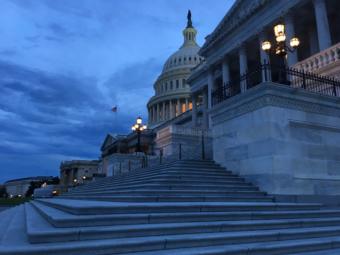
The U.S. Capitol building. (Photo by Liz Ruskin/Alaska Public Media)
U.S. Sen. Lisa Murkowski struck a note of skepticism in her reaction to Saturday’s military operation ousting Venezuelan leader Nicholas Maduro.
“While I am hopeful that this morning’s actions have made the world a safer place,” Murkowski wrote in a social media post Saturday, “the manner in which the United States conducts military operations, as well as the authority under which these operations take place, is important.”
She said the Trump administration hasn’t given Congress enough information to evaluate the legal basis for it.
Murkowski is among a handful of Republicans in Congress to raise questions or doubts about the operation. In November, she was one of only two GOP senators who voted to support a measure that would have blocked military action in Venezuela without the approval of Congress.
Sen. Dan Sullivan’s response was more in line with the majority of congressional Republicans. He issued a statement praising President Trump and commending the military for its skill and courage. Sullivan’s post did not directly address Trump’s pronouncement that the U.S. would temporarily “run” Venezuela, but it did reference “painful and difficult lessons learned” from the U.S. invasion of Iraq in 2003. That invasion rid a country of its dictator but enmeshed the United States in an eight-year war.
Alaska Congressman Nick Begich also praised Saturday’s military action in Caracas, calling it a “flawless execution of American power and capability.”
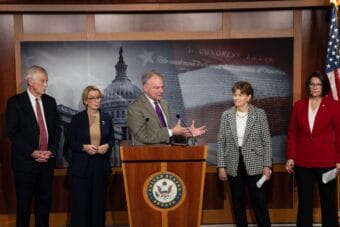
Sen. Tim Kaine, D-Va., speaks during a press conference following a vote on Capitol Hill on Sunday. The Senate convened for a rare Sunday session in an attempt to end the government shutdown. (Anna Rose Layden/Getty Images)
A bipartisan group of Senate Democrats and Republicans reached a deal to reopen the government after the longest shutdown in U.S. history, voting on the first procedural step on the measure.
The agreement would fund the government through Jan. 30 and include full-year funding for a trio of appropriations bills, including full funding for the Supplemental Nutrition Assistance Program, or SNAP, through Sept. 30, 2026, or the end of the fiscal year.
The vote late on Sunday was 60 to 40, with seven Democrats and one independent joining with most Republicans to advance the measure.
It marked the first, but crucial, step towards passing the measure in the Senate. Once the bill cleared the 60 votes needed to overcome a filibuster, any remaining Senate votes need just a simple majority. However, the legislation still needs to pass the House before the shutdown would end, enabling air traffic controllers and other federal workers to get paid and federal food benefits to resume, among other things.
Senate Democrats had earlier voted against more than a dozen short-term spending measures in their fight to preserve health care subsidies. But as the pain of the shutdown continued to bite, some agreed to more modest changes in the latest framework.
The continuing resolution to fund the government until the end of January would also include language to reverse any reductions in force of federal employees that happened during the shutdown, as well as protections against further such layoffs through the end of the fiscal year, and backpay for all federal employees during the shutdown.
“I have long said that to earn my vote, we need to be on a path toward fixing Republicans’ health care mess and to protect the federal workforce,” Sen. Tim Kaine (D-Va.) said in a statement. “This deal guarantees a vote to extend Affordable Care Act premium tax credits, which Republicans weren’t willing to do.”
The agreement to reopen the government is also expected to include a Senate vote on health care by the second week of December, on a bill of Democrats’ choosing. That informal deal is not part of the legislative text.
Democrats are deeply divided about the compromise measure, which was opposed by Senate Minority Leader Chuck Schumer.
“I think it’s a terrible mistake,” Sen. Elizabeth Warren (D-Mass.) said of the deal. “The American people want us to stand and fight for healthcare.”
Democratic divisions over legislation
Several top Democrats in the House also vowed to vote against the bill.
House Minority Leader Hakeem Jeffries, D-N.Y., panned the agreement in a statement before the Senate vote.
“We will not support spending legislation advanced by Senate Republicans that fails to extend the Affordable Care Act tax credits,” Jeffries said in a statement. “We will fight the GOP bill in the House of Representatives, where Mike Johnson will be compelled to end the seven week Republican taxpayer-funded vacation.”
And Democrat Rep. Greg Casar of Texas called the deal a “betrayal” and a “capitulation” because it doesn’t reduce health care costs.
The House has not held a vote since Sept. 19, and previously passed a government funding measure without Democratic support.
The Senate deal on government funding comes after Democrats cruised to a series of electoral victories in the last week, giving some in the party newfound political confidence to continue to fight for health care extensions.
Many Democrats believed that keeping the government shut down gave them their only legislative leverage, with Republicans still in control of Congress and the White House.
Moderate Democrats defended their votes, with some telling reporters that it’s the best deal they could do.
Kaine, one of the Democrats who voted for the measure on Sunday, defended his support, saying Democrats would be able to put important health care legislation up for a vote.
“Lawmakers know their constituents expect them to vote for it, and if they don’t, they could very well be replaced at the ballot box by someone who will,” he said in his statement.
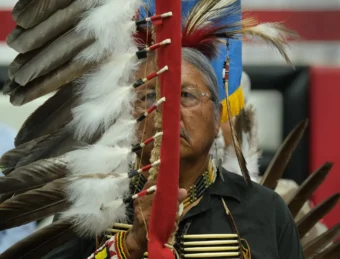
James Nells, Navajo, a U.S. combat veteran, carries an eagle staff as part of the color guard presentation beginning the “Road to Healing” hearing at Riverside Indian boarding school in Anadarko, Oklahoma, on Saturday, July 9, 2022. Survivors of boarding schools told then-U.S. Interior Secretary Deb Haaland, Laguna Pueblo, of the abuses they sustained at the schools. (Photo by Mary Annette Pember/ICT)
WARNING: This story contains disturbing details about residential and boarding schools. If you are feeling triggered, here is a resource list for trauma responses from the National Native American Boarding School Healing Coalition in the U.S. In Canada, the National Indian Residential School Crisis Hotline can be reached at 1-866-925-4419.
For Ponka-we Cozad, the National Day of Remembrance for Indian boarding school survivors is personal.
Members of her family attended boarding schools and shared hurtful stories about their days in the schools.
“In some way, shape or form, as Native peoples, we all have a story to share about the Indian boarding school era,” said Cozad, director of policy and advocacy at the National Native American Boarding School Healing Coalition. Cozad is Tohono O’odham Nation of Arizona and the Ponca Tribe of Indians of Oklahoma.
“This is why I’m doing this work; when we talk about something always being in our hearts, it’s personal,” she told ICT.
The annual National Day of Remembrance for U.S. Indian boarding school survivors on Sept. 16 in Washington, D.C., includes a special event sponsored by the coalition, known as NABS, from 5-7 p.m. EST at the Indian Gaming Association building.
A number of other gatherings are scheduled across Indian Country to commemorate the Day of Remembrance with vigils, prayers, and other events in museums, churches and local communities.
September is an important month on both sides of the U.S. border. September 30 is the National Day for Truth and Reconciliation in Canada, known as Orange Shirt Day, in memory of the residential school students and the harsh conditions they endured. It became a national holiday after more than 1,000 unmarked graves were found at residential schools, including at the Kamloops Indian Residential School.
In the U.S., where thousands of Native children died in boarding schools, the National Day of Remembrance provides an opportunity for tribal leaders, survivors, descendants of survivors as well as congressional members and the public to come together to honor and recognize children who never returned home from the schools.
This year, the event coincides with the National Congress of American Indians Tribal Unity Impact Days, Sept. 16-18, also in Washington, D.C.
During the Impact Days, NCAI organizes sessions in which tribal leaders can meet with members of Congress and federal agency officials in order to advocate for priorities such as fiscal year 2026 appropriations, public safety, economic development, housing, self-determination and other issues.
The Day of Remembrance also coincides with the fall session of the U.S. Congress, which convened on Sept. 2, giving lawmakers another opportunity to consider passing the Truth and Healing Commission on the Indian Boarding School Policies Act (S.761). The act would establish a commission to investigate, document and report on the histories of Indian boarding schools, develop recommendations for federal efforts based on those findings and promote healing for survivors and descendants.
Although the bill passed the Senate with a unanimous vote in December 2024, the House of Representatives did not bring the bill up for a vote before the legislative session ended.
In March, 2025, U.S. Sens. Lisa Murkowski, a Republican from Alaska, and Elizabeth Warren, a Democrat from Massachusetts, reintroduced the bill. It is now awaiting further consideration and a full vote in the Senate.
At the event in Washington, a light reception and candlelight vigil will be held, and will include remarks from Deb Parker, the chief executive officer of NABS and a citizen of the Tulalip Tribe and descendant of the Yaqui and Apache tribes.
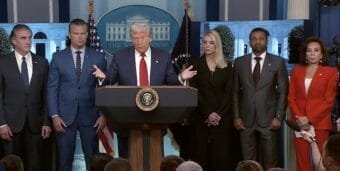
President Donald Trump announces a “crime emergency” in Washington, D.C., during a White House press conference on Aug. 11, 2025. Standing behind Trump are, from left to right, Interior Secretary Doug Burgum, Defense Secretary Pete Hegseth, Attorney General Pam Bondi, FBI Director Kash Patel and U.S. Attorney for the District of Columbia Jeanine Pirro. (Image via White House livestream)
Four days before a scheduled meeting with the president of Russia, Vladimir Putin, over the possibility of a ceasefire that could pause the Russian invasion of Ukraine, President Donald Trump has yet to announce a firm location or timing.
Trump said last week on social media that he would meet Putin in Alaska on Friday.
Speaking to reporters Monday at the White House, Trump said he would seek to temporarily end the fighting that has resulted since Russia invaded Ukraine in 2022.

He said he isn’t certain what a long-term peace deal would involve, but it likely would entail “some swapping … some changes in land,” he said.
“We’re going to change the lines, the battle lines. Russia has occupied a big portion of Ukraine. They’ve occupied some very prime territory. We’re going to try and get some of that territory back for Ukraine. But they’ve taken some very prime territory,” Trump said.
In a video address Sunday, Ukraine President Volodymyr Zelenskyy appeared to reject the idea of surrendering land for peace, saying in part that “Ukrainians will not gift their land to the occupier.”
Zelenskyy has not been invited to Trump’s talks with Putin.
In meandering remarks Monday, Trump twice appeared to misstate the location of the expected talks, saying at one point, “We’re going to Russia,” before correctly returning to Alaska as the location.
“I thought it was very respectful that the president of Russia is coming to our country instead of us going to his country or a third-party place. I think we’ll have constructive conversations, and then after that meeting, immediately — maybe as I’m flying out, maybe as I’m leaving the room — I’ll be calling the European leaders who I get along with very well and have a great relationship with, I think, all of them,” Trump said Monday.
“I get along with Zelenskyy, but I disagree with what he’s done, very very severely disagree. This is a war that shouldn’t have happened … but I’ll be speaking with Zelenskyy. The next meeting will be with Zelenskyy and Putin, or Zelenskyy, Putin and me. I’ll be there if they need, but I want to have a meeting set up between the two leaders,” Trump said.
Asked what he would consider a good deal between Russia and Ukraine, the president said he hasn’t made up his mind.
“I’ll tell you after I hear what the deal is, because there could be many definitions,” Trump said.
“We’re going to have a meeting with Vladimir Putin,” he said, “and at the end of that meeting, probably in the first two minutes, I’ll know exactly whether or not a deal can be, because that’s what I do.”
Donald Trump gives a speech at a rally at the Alaska Airlines Center on Saturday, Jul. 9 2022. (Kendrick Whiteman/Alaska Public Media)
President Donald Trump said he will meet with Russian President Vladimir Putin on Aug.15 in Alaska. Trump made the announcement on his social media platform, Truth Social, on Friday.
“The highly anticipated meeting between myself, as President of the United States of America, and President Vladimir Putin, of Russia, will take place next Friday, August 15, 2025, in the Great State of Alaska,” Trump wrote in the post.
Trump’s post did not specify where in Alaska the meeting would take place and said more details would come soon.
The meeting comes amid frustration from the Trump administration over continued fighting between Russia and Ukraine, more than three years after Russia’s invasion in 2022. The Associated Press reports that the president said he will meet with Putin before any sit-down meeting involving Ukrainian President Volodymyr Zelenskyy.
This will be Trump’s first trip to the state since being reelected last year, but it won’t be his first time in the state as president. In 2019, he visited Joint Base Elmendorf-Richardson while flying back to the U.S. from a summit in Vietnam. He also held a campaign rally in Anchorage in 2022 to show support for U.S. Senate candidate Kelly Tshibaka and U.S. House candidate Sarah Palin.
This is a developing story. Please check back for updates.
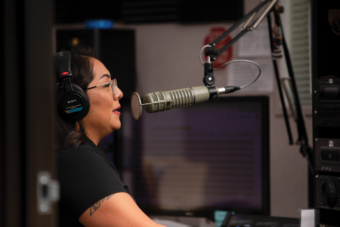
KUYI-Hopi Radio general manager Samantha Honani Molina on the air at the station in Arizona in June. (Photo by Deidra Peaches/High Country News)
Samantha Honani Molina was about 20 when KUYI-Hopi Radio first came on air. She was attending college, hours and miles from her home village, and every time she tuned in, she felt connected, hearing her community’s songs and language.
“I was struggling to find my place, because when you’re coming from the rez, you’re trying to find your space in a city or town, and there’s nothing of who you are and where you come from. You feel the sense of, not lost, but just uncertainty, and missing home and stuff like that,” said Molina. “By hearing language on the radio, it brings the sense of cultural identity that almost highlights and strengthens that — no matter where you are, even here at home. If you don’t hear yourself represented in large spaces, you’ll just get enveloped and folded into the mainstream.”
After graduating, she returned home and later became general manager of KUYI-Hopi public radio, a position she’s held for three years. Previously, she was the program director for the Hopi Foundation, the station’s radio licensee and parent nonprofit, which provides several year-round programs on topics ranging from youth leadership to community development. The station — located in Lower Sipaulovi, below Second Mesa on the Hopi Reservation in northern Arizona — made its on-air debut in 2000 and began broadcasting online in 2010. It is the only news outlet of its kind that focuses on the Hopi community, and uses the Hopi language, Hopìlavayi.
And now, as it celebrates its 25th anniversary, KUYI has to contend with the reality of losing a significant portion of its funding, possible cuts and changes to the ways it operates.
Currently, 42 Western radio stations are considered vulnerable because over 30% of their annual funding comes from the Corporation of Public Broadcasting. Twenty of those stations serve Indigenous communities and are located in the rural reaches of reservations and Alaska Native villages.
In May, President Donald Trump signed an executive order ending CPB’s congressionally approved funding of National Public Radio and the Public Broadcasting Service. NPR, PBS and various local stations filed lawsuits in response. In early June, Trump asked Congress to claw back the $1.1 billion it had already set aside for public media. The House of Representatives narrowly approved that legislation, which the Senate approved in mid-July despite receiving pushback from both Democrats and Republicans.
Molina said the bill would be “devastating” to KUYI.
“KUYI radio capacity is at a place where we’re able to provide all these avenues of service, which is safety, education and entertainment. We’re finally just beginning to really explore its possibilities,” Molina said. “If pulling public media funding is done, it would destabilize not only the progress made but also jeopardizes the essential safety and cultural services we provide daily.”
“By hearing language on the radio, it brings the sense of cultural identity that almost highlights and strengthens that …”– Samantha Honani Molina, general manager of KUYI-Hopi Radio
The station, which has five full-time staff members and a newly built modular studio, broadcasts at 60,000 watts across northern Arizona down to Winslow as well as online on its website. CPB funding accounts for over 48% of its operating budget, according to a June 30 letter the Hopi Tribe sent to the Senate, urging it to preserve funding for public media.
Native Public Media and the National Federation for Community Broadcasters have held summits over this, and Molina said that many broadcast organizations are already planning for cuts, regardless of whether the legislation is ultimately passed.
The immediate and significant budgetary impacts are obvious, but the long-term losses and their ramifications are incalculable. Stations like KUYI provide more than news and information: They’re community hubs where Indigenous languages can thrive, a space to preserve and grow Indigenous people’s connection to their culture and their own place within the world.
At KUYI, volunteer DJs host music and news segments, often providing bilingual weather and community updates, even a “Hopi Word of the Day” that introduces new words and tells listeners how to use them in conversation — mavasta, for example, which means “to aim” in the Hopi language.
KTNN in St. Michaels, Arizona — “The Voice of the Navajo Nation” — not only broadcasts sports events and other announcements, it also delivered essential information during June’s Oak Ridge Fire, all in Diné Bizaad, the Navajo language.
In Barrow, Alaska, the northernmost community in the United States, KBRW offers an hourlong five-day-a-week program called Uqalugaat Inupiat Stories that also teaches Inupiaq words and phrases. The late Fannie Kuutuuq Akpik-Piquk gave lessons on-air, explaining that misiġarriuq means “to make seal oil from blubber.”
Every day, the Talking Drum and Language Hour show on KWSO in Warm Springs, Oregon, plays Indigenous drum music and offers language lessons featuring the Ichishkin, Kiksht and Numu languages of the Confederated Tribes of Warm Springs.
In 2024, the United Nations Education, Scientific and Cultural Organization conducted a study recommended by the United Nations Permanent Forum on Indigenous Issues. UNESCO’s report highlighted the need for developing accessible Indigenous-produced media that provides news, entertainment and cultural programming. The report found that radio is the most widespread media and accounts for 34% of Indigenous media use. Indigenous media in general contribute significantly to the preservation and promotion of Native languages, cultural practices and traditional knowledge, helping “foster a sense of belonging and recognition.” But there are still barriers to providing Native language content on the radio, including technical hurdles, programming quotas and the heavy reliance on voluntary efforts that require long-term support.
Altogether, Indigenous radio and media help Indigenous communities engage and grow in their understanding of their language and show them how they can better connect with their culture.
Tiffany Lee, a Native American studies professor at the University of New Mexico, researches language reclamation and identity for Native youth. She promotes the benefits of immersive bilingual education for Indigenous students and adults, noting that having access to learning one’s language is key to revitalizing it.
“The number-one issue for language revitalization today is making sure our youth, our families, all have access to learning in some way and in multiple ways,” said Lee. “Just one isn’t going to work and isn’t always the best method for learning, so you need a diverse array of accessing the language and learning it.”
“If pulling public media funding is done, it would destabilize not only the progress made but also jeopardizes the essential safety and cultural services we provide daily.” – Samantha Honani Molina, general manager of KUYI-Hopi Radio
Indigenous language use on the airwaves bolsters the other places where Native languages are spoken, including schools and other immersion language programs. Examples in the Southwest include organizations like Saad K’idilyé — of which Lee is a board member — and Hopitutuqaiki, which teach Navajo and Hopi respectively in culturally relevant ways.
For Lee, learning one’s language is not just about being able to communicate within the community.
“I have this shirt that says ‘Indigenous language education is education,’ and I love that shirt and that saying because it’s so true,” Lee said. “It’s not just learning the mechanics of speaking your language — it’s an education unto itself. You’re learning your community and your culture’s worldview; you’re learning how language is tied to cultural practice, how it is cultural practice.”
No one understands the impact of sending Indigenous languages out onto the airwaves more than Navajo radio broadcaster L.A. Williams.
Williams, who’s been a radio broadcaster for 32 years, is widely known for reporting Phoenix Suns games in Diné Bizaad, providing play-by-play commentary, making the sport more accessible for people who speak only that language. Williams said the language continues to thrive largely because of its continued use.
“We’re not losing our language,” she said. “Our language is what puts us further in life as it makes us live longer into life by knowing the Navajo language.”
Throughout her career, Williams has seen broadcast opportunities as another way of encouraging use of Diné Bizaad at home, bridging the connection between elders who are fluent and youth who lack full command of the language. This creates a connection between past and future, reminding people that tribal history and culture will continue.
KUYI-Hopi Radio staff (from left) Darion Kootswatewa, Samantha Honani Molina, Brennyn Masawytewa, and Josh Sakenima. Molina and Masawytewa hold dolls of the station’s mascot. (Deidra Peaches/High Country News)
Despite the national threat to public media and funding cuts’ impact on rural and tribal stations, Williams is confident of the persistence and resilience of Indigenous languages.
“As far as the language, the tradition, the culture, that goes on,” she said. “That life goes on into the future.”
Meanwhile, Molina and Lee remain hopeful that current U.S. policy, including proposed funding cuts to Indigenous public media, won’t derail the conviction and resilience of people who are determined to preserve and reclaim their traditional ways of life.
“The number-one issue for language revitalization today is making sure our youth, our families, all have access to learning in some way and in multiple ways.” – Tiffany Lee, a Native American studies professor at the University of New Mexico
“Thankfully, we have a good parent organization, the Hopi Foundation, who is stepping up to see how they can supplement during this loss,” Molina said. “But they can’t carry us for that long. We’ll see what they’re able to do to help us fundraise or carry us for a little bit, but it’s not going to sustain — it won’t sustain.”
Despite the uncertainties and hardship, Molina said it’s been humbling to witness the outpouring of support from other radio stations and their listeners. The station’s 25th anniversary in August serves as a reminder of what really matters.
“That’s a really pivotal point for us to reflect on,” Molina said. “Then go forward with strength and resilience, just like our people have always done. It’s an opportunity for us to really show what we can do to support something so important, and I’m really excited to see what that looks like.”