National News

National Park workers in Alaska say a Trump agency fired them illegally. A judge agrees

Eileen and James Kramer in Alaska’s Lake Clark National Park where they’ve worked for about the past decade. After getting promotions, they were both suddenly fired by the Trump administration earlier this month. (Courtesy of Eileen and James Kramer)

Two weeks ago, Eileen Kramer and her husband James each received termination letters in their email inboxes.

“They were saying we were underperforming, which isn’t true,” Eileen said.

The couple, who live and work in the sprawling 4-million-acre Lake Clark National Park in Alaska, may soon have to vacate the house they’re living in because it is owned by the Park Service.

“It’s more than just losing our job,” James said. “We’re losing our life.”

“We’ve given so much to this place and we’ve created a life here,” explained Eileen, “and that’s being taken away dishonestly.”

The couple has worked in Lake Clark for about 10 years. She’s in logistics, he’s a biological science technician. They were both recently promoted. Those promotions put them into probationary status in their new positions.

The Trump administration has fired tens of thousands of federal workers with “probationary” status, which usually means newer workers, and makes them easier to let go. But those workers still have some rights and protections, and many say the administration has used false pretenses to fire them.

On Thursday, a federal judge in San Francisco sided with the workers in a lawsuit brought by unions and civic organizations. The judge ruled specifically that the Trump administration’s Office of Personnel Management (OPM) exceeded its authority by directing federal agencies to carry out these mass firings. The government had argued it didn’t because each agency made its own decisions. But U.S. District Judge William Alsup, an appointee of former President Bill Clinton, said he didn’t believe that.

“Plaintiffs … have mustered a mountain of evidence that points in the other direction, from a broad range of federal agencies,” the judge wrote in his order.

It’s not yet clear exactly how the ruling is going to affect the thousands of workers who were already let go.

“ I got an award in efficiency last year”

A federal agency is allowed to fire a probationary worker for bad performance or conduct.

The OPM sent letter templates to agency officials in its guidance about firing probationary workers, and the administration fired many for poor performance — even though workers like James and Eileen Kramer say that’s a lie.

They obviously didn’t look at our personnel file because we have evidence showing that we’re great performers and we’ve exceeded expectations and we’ve received performance awards,” James said.

 I got a regional award specifically in efficiency last year,” Eileen said. “So it’s a little bit ironic to me that I’m being terminated as part of this government efficiency initiative,” referring to the Elon Musk-aligned Department of Government Efficiency.

The Trump administration has maintained that it is simply trying to root out waste, fraud and inefficiency among the federal workforce of 2.3 million people.

But the lawsuit filed in federal court in San Francisco on behalf of thousands of federal workers claimed that the only fraud here is being committed by the administration.

“[The Trump administration] in one fell swoop has perpetrated one of the most massive employment frauds in the history of this country, telling tens of thousands of workers that they are being fired for performance reasons, when they most certainly were not,” the lawsuit stated.

The White House hasn’t responded to that specific accusation of fraud, but the government had said in a court filing that the “probationary period is part of the hiring process; agencies are not required to hire every employee whose performance is ‘satisfactory.’ ”

In his order, Judge Alsup agreed that the firings were not in fact based on performance: “It is unlikely, if not impossible, that the agencies themselves had the time to conduct actual performance reviews of the thousands terminated in such a short span of time. … It is even less plausible that OPM alone managed to do so.”

Michelle Bercovici is a lawyer working on another legal effort to help probationary federal workers who were let go.

“They had good performance, a good relationship with their supervisor, and were terminated using the same letter,” Bercovici said. “This is an attempt to circumvent various procedures, policies or requirements designed to protect employees.”

Bercovici has petitioned a federal watchdog entity, the Office of Special Counsel, and managed to secure a stay forcing the rehiring of a small initial group of six federal workers. Working with the nonprofit Democracy Forward, she is hoping to expand the stay to reach thousands of other federal workers.

“We are trying to advocate for as broad a stay as possible,” Bercovici said.

Bercovici says if a government agency wants to do a mass layoff, that’s known as a “reduction in force” and there are rules that need to be followed.

“ It’s a fair, clearly laid-out process,” she said. “It requires a lot of planning.”

Eileen and James Kramer in 2019 by a National Park Service airplane after an aerial telemetry mission tracking radio collared caribou to estimate population. (Courtesy of Eileen and James Kramer)

At the National Park in Alaska, Eileen and James Kramer said there was no apparent planning behind the layoffs there. They said half the staff who live onsite at the park were fired, including a 20-year veteran employee at the park who they say was the one person who knew how to keep all the boats, heaters, trucks, snowmobiles and all sorts of other equipment running.

Since he recently became a supervisor they say he was in probationary status too.

“He’s also emergency response, he’s a boat captain,  he’s the one that’s gonna come rescue you if you get in trouble in the backcountry,” Eileen said.

James added: “The superintendent even said, ‘You can fire me, the park will still run without me, but without Warren, we can’t do anything.’ ”

The couple said none of these firings appeared to have anything to do with waste or inefficiency.

They say their former supervisors haven’t yet been told by the National Park Service if the ruling in federal court will result in them being reinstated to their old jobs.

“But we are heading into the weekend with somewhat lighter hearts,” Eileen said.

Eileen and James Kramer with Lota their Karelian Bear Dog, a breed they say is especially good at scaring off hungry bears in the wild and around their home in the park. The couple is feeling more hopeful that they may get their jobs back after a court ruling in San Francisco this week. (Courtesy of Eileen and James Kramer)

Have information you want to share about ongoing changes across the federal government? NPR’s Chris Arnold can be reached at carnold@npr.org or contacted through encrypted communications on Signal at ChrisArnold.07.

Sweeping cuts hit recent federal hires as Trump administration slashes workforce

U.S. Forest Service Juneau Ranger District headquarters on Backloop Road. (Photo by Heather Bryant/KTOO)

Federal workers have begun receiving layoff notices as the Trump administration moves ahead with plans to drastically downsize the government.
While the full scale of layoffs isn’t yet clear, the first round of cuts appeared to target employees who were recently hired and still on probationary status, according to multiple federal officials and staffers who spoke to NPR on condition of anonymity, because they were not authorized to speak to the press and feared retaliation from the Trump administration.

The firings are affecting a wide swath of federal workers, and include employees responsible for education, small business grants, and the nation’s nuclear weapons stockpile.

Probationary periods vary by federal agency but typically last one or two years. According to government data, around 220,000 federal employees had less than one year of service in March 2024, the most recent time period available. Another 288,000 had between one and two years of service at that time.

President Trump signed an executive order on Tuesday directing federal agencies to start preparing to, quote, “initiate large-scale reductions in force.” Trump and his advisor Elon Musk have said they want to cut what they say is excessive government spending.

Compensation for federal employees amounted to around 3% of the federal budget in the 2024 fiscal year, according to government data.

The Department of Energy began firing its probationary employees on Thursday, according to two officials at the agency who spoke to NPR on condition of anonymity because they were not authorized to speak to the press.

The employees, who have worked for less than two years in the federal government, were being let go without any notice or severance. Although a formal letter was being prepared, some employees were being fired verbally.

Mass terminations of probationary workers also swept through the National Nuclear Security Administration, a semi-autonomous agency within the Energy Department that oversees the nation’s nuclear weapons.

According to an NNSA employee, roughly 300 of the agency’s 1,800 staff had been fired after the agency was denied a national security exemption. The small organization is responsible for maintaining and upgrading America’s arsenal of nuclear weapons, combatting nuclear terrorism, and preventing proliferation around the world.

According to one Energy Department official, the Office of Personnel Management (OPM) had suggested the agency use a template that cited “performance reasons” as the cause of the firings. The official said the Energy Department letter had removed that phrasing because many of the employees had performed well during their probationary period. The Energy Department’s press office did not immediately respond to a request for comment.

Probationary employees at the U.S. Office of Personnel Management were also terminated on Thursday, according to an official with the American Federation of Government Employees, which represents more than 800,000 civil servants, including workers at OPM, the Department of Education, the Small Business Administration, and other federal agencies. The union official spoke with NPR anonymously in order to share internal discussions.

Over a Microsoft Teams call with about 100 people, OPM staffers were told the reason for their dismissal was that they didn’t take the Trump administration’s “Fork in the Road” deferred resignation offer, the union official said. That offer gave two million civilian federal employees the option to resign while retaining pay and benefits through the end of September, or remain in their positions with the caveat that their jobs would not be not guaranteed.

The affected OPM employees were given until 3 p.m. ET Thursday to leave the building, the union official said. AFGE officials were not given access to the building.

“This administration has abused the probationary period to conduct a politically driven mass firing spree, targeting employees not because of performance, but because they were hired before Trump took office,” AFGE president Everett Kelley said in a statement late Thursday.

“Agencies have spent years recruiting and developing the next generation of public servants. By firing them en masse, this administration is throwing away the very talent that agencies need to function effectively in the years ahead,” Kelley said.

Probationary staff at the Department of Education began receiving written notifications on Wednesday night that they were being terminated effective immediately, according to four employees who shared their notices with NPR on condition of anonymity for fear of reprisal.

At least 60 probationary staffers across the Education Department received termination notices, according to the union official.

“This is just devastating to me,” one department staffer told NPR on the condition their name not be used for fear of retribution. “When I took my oath, that was the proudest moment of my career.”

In response to a request from NPR to confirm the firings, a spokesperson said the agency does not comment on personnel matters.

At the General Services Administration, many probationary employees were called into meetings on Wednesday afternoon and told they would be let go, according to three GSA employees who spoke to NPR. Some were told they had a final chance to take the government’s deferred resignation offer, which was officially closed hours later. As of Thursday, many affected GSA workers still had not received formal termination notices in writing, the GSA sources said.

At some agencies, the notification process has been confusing and chaotic.

At the Small Business Administration, probationary staff received emailed termination notices last Friday, only to be told in another email on Monday that that was an error, according to the union official. Then, on Tuesday, the SBA staffers got another termination notice. The union official said dozens of SBA probationary employees were let go.

Termination letters emailed to probationary employees at the Consumer Financial Protection Bureau on Tuesday appeared to have been the result of a failed mail merge, according to two terminated employees who got the letters.

The resulting notices were missing personal details, reading: “MEMORANDUM FOR [EmployeeFirstName] [EmployeeLastName], [Job Title], [Division]”.

CFPB’s union has identified approximately 73 “bargaining-unit” employees in their probationary period who were terminated, according to Jasmine Hardy, the executive vice president for NTEU Chapter 335.

Have information you want to share about the ongoing changes across the federal government? Reach out to these authors: Shannon Bond is available through encrypted communications on Signal at shannonbond.01, Geoff Brumfiel is on Signal at gbrumfiel.13, and Andrea Hsu is on Signal at andreahsu.08

NPR’s Stephen Fowler, Jonaki Mehta and Laurel Wamsley contributed to this report.

Tribal education compact bill takes next step into bringing tribal sovereignty into public education

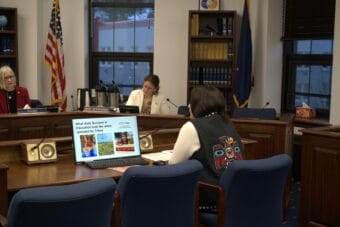
Central Council of the Tlingit and Haida Tribes of Alaska Education Liaison Mischa Jackson testifies in front of the Alaska House Tribal Affairs Committee on Feb. 6, 2025. (Photo by Jamie Diep/KTOO)

The Central Council of the Tlingit and Haida Tribes of Alaska has been working on expanding its education programs for years. One of the tribe’s next steps is building an educational campus in Juneau focused on culturally relevant, place-based learning.

This is one of many efforts Alaska Native tribes around the state are working on to improve educational outcomes for Native students. The state is joining in by working with tribes to develop an education compacting program.

An education compact is an agreement between tribal and state governments that allows tribes to run their own public schools. Alaska’s Department of Education and Early Development is working with tribes to kick start a compacting program and give tribes sovereignty over education.
Gov. Mike Dunleavy’s administration is moving things along with a bill proposal that would approve a pilot program for tribally compacted public schools. The House Rules Committee introduced it as House Bill 59 last month. 

Mischa Jackson is an education liaison with Tlingit and Haida – one of five tribes that would be part of a pilot program to see if the compact works.  

“Compacting is the mechanism to provide tribes an opportunity to play a role in the operation of schools,” Jackson said. 

Jackson presented to lawmakers in a state House Tribal Affairs Committee meeting last Thursday. She talked about what education compacts could look like in the state.

Tlingit and Haida — along with the King Island Native Community and the Village of Solomon, Inupiat Community of the Arctic Slope, Ketchikan Indian Community and Knik Tribe — negotiated with the Department of Education and Early Development, or DEED, to create a report on how compacting could work. According to the report, the program came out of a list of education priorities the state Board of Education is following. It aims to close the achievement gap between Native and non-Native students in the state. 

State testing results in recent years show a gap in Alaska Native students and other students of colors achieving proficiency in math and language arts when compared to all students.

Results from the Alaska System of Academic Readiness exam shows fewer Alaska Native and other students of color consistently reach advanced or proficient levels in math and language arts when compared to all students. The same goes for students experiencing homelessness and students in foster care.

Jackson said she’s really excited to implement the program.

“This has long term gains we’re really excited about, and I would say we have a pretty strong team and a lot of Indigenous educators throughout Southeast Alaska that are really excited to help contribute to this project,” she said.

Jackson said many Alaska Native tribes aren’t structured in a way that allows them to receive federal funding for education. Compacting would allow them to do that. She said the program would give tribes more say over education they don’t have under current state law, even if they operate as a charter school within a school district.

“For the vision that a lot of tribes have for education, we’ve never had the true opportunities to be able to work as an education system with the level of authority and autonomy,” Jackson said.

Joel Isaak is a consultant with DEED for tribal compacting. In an interview, he said the program would give tribes the ability to oversee many aspects of running their own schools.

“The tribes are the ones carrying out the education in the classroom, and the state is the one that’s providing the fiscal backing, and then ensuring safety and adequacy,” Isaak said.

This means tribes would be able to hire teachers, design curriculum and create a governing body like a school board to run the schools, as long as it follows state requirements. Isaak said tribes can also create training requirements for teachers. 

While some tribes may want to require their teachers to simply get a teaching degree at a university, he said others may want teachers to be trained in place-based or cultural learning.

“It allows the tribe to really direct how they weave together the culture, language with those regulated skill sets around, for example, reading or math or science,” he said.

Tribally compacted public schools would also receive state funding. To determine how much funding they receive from the current formulas in place, they would be treated as Regional Educational Attendance Areas. These are educational districts in places without a taxing authority like a borough.

This bill also includes start-up funds for carrying out the program. A fiscal note for the bill estimates it could cost close to $17.5 million for the next fiscal year. This includes both foundational funding and start-up funds for all five pilot schools.

Isaak said compacting is a way to improve the state’s education system.

“It does not fix every single thing in education, but it brings in another person to help carry the weight and to help think about how you get there more efficiently, or how you get there with everybody,” he said. “And that’s why it’s a systems transformation, that’s really powerful.”

Washington is the only state that uses education compacts since approving it in 2013. The New Mexico Legislature is also considering a bill to allow the state to enter tribal education compacts.

Jackson, with Tlingit and Haida, said the tribe is already working on building an education campus in Juneau behind Fred Meyer. 

If the bill doesn’t pass, Jackson said the tribe is ready to find other sources of funding for the campus.

“Our movement towards the education campus is going to happen whether this bill passes or not,” she said. “This will just be another vehicle towards supporting the infrastructure, and what will go inside of the buildings. The education in itself is going to move forward.”

If the bill passes, Isaak said DEED will negotiate compacts with the tribes to get the schools running.

The House Tribal Affairs Committee will hold a hearing on the bill on Thursday at 8 a.m.

White House response adds to confusion on federal funding freeze

President Trump is seen here after signing a range of executive orders on Jan. 23. (Anna Moneymaker/Getty Images)

The Office of Management and Budget has rescinded its call for a pause on payments for federal grants and other programs, the White House announced on Wednesday. But the administration said that only the original memo calling for the freeze had been rescinded — not its effort to review federal spending.

Details about the rescinded order were spelled out in a copy of an agency memo shared by Democracy Forward, which led a legal challenge over the effort. The new memo says the heads of executive departments and agencies should contact their general counsels “if you have questions about implementing the President’s Executive Orders.”

“Facing legal pressure from our clients and in the wake of a federal judge ruling in our case last evening, the Trump-Vance administration has abandoned OMB’s ordered federal funding freeze,” Democracy Forward said in a statement on Wednesday. “We are proud of our courageous clients — who represent communities across the nation — for going to court to stop the administration’s unlawful actions.”

But Karoline Leavitt, the White House press secretary, told reporters that the move simply meant a rescinding of the original Monday directive.

Efforts to “end the egregious waste of federal funding” will continue, according to Leavitt, who said the OMB memo was rescinded “to end any confusion on federal policy created by the court ruling and the dishonest media coverage.”

After widespread confusion from the initial memo calling for a halt in federal assistance, pending review, the White House tried Tuesday to further clarify which programs would not be affected, later specifying that the halt would not impact Medicaid and the Supplemental Nutrition Assistance Program, for example.

This latest statement from the White House is likely to add to the confusion rather than clarify it. Leavitt said the administration expects that rescinding the memo will end the court case against it, but that executive orders on funding reviews issued by President Trump “remain in full force and effect and will be rigorously implemented by all agencies and departments.”

Wednesday’s developments follow a federal judge’s order Tuesday that temporarily blocked the effort to pause federal payments for grants and other programs.

Under the original OMB memo obtained by NPR, a temporary pause in funding was set to take effect Tuesday evening, but a senior administration official said that the pause could be as short as a day if an agency determined its programs were in compliance.

The official said the directive should not be interpreted as a full funding freeze. The official, who was not authorized to publicly discuss the internal memo, said that agencies are supposed to review their grants, loans and programs to ensure that they align with the new administration’s priorities.

Administration officials have insisted that the impacts are misunderstood, but the actual text of the memo is far-reaching and the follow-up guidance has been criticized as vague. On Tuesday afternoon, the White House issued a fact sheet that said “the pause does not apply across-the-board” and that “any program that provides direct benefits to Americans” — like Social Security, Medicare and food stamps — “is explicitly excluded.”

The memo quickly drew legal challenges on Tuesday.

The nonprofit organizations that won the temporary stay Tuesday had claimed in their filing that the memo “fails to explain the source of OMB’s purported legal authority to gut every grant program in the federal government.” The groups also said that the memo failed to consider the interests of grant recipients, “including those to whom money had already been promised.”

Shortly after the decision by the federal judge on Tuesday, a group of attorneys general from 22 states and the District of Columbia filed a separate challenge in federal court.

Congressional reaction

The order provided an early litmus test for just how willing Republicans in Congress would be to cede their power of the purse in deference to the leader of their party — even temporarily.

The order came late Monday night, as House Republicans were gathered at an annual conference in Trump’s backyard at his Trump National Doral Golf Club.

As Democrats like Washington’s Sen. Patty Murray denounced the measure as “brazen and illegal,” most congressional Republicans who spoke about the memo said it was a means to an end to implement Trump’s agenda, which is his prerogative.

House Speaker Mike Johnson, R-La., called it “an application of common sense” and said it would “be harmless in the end.”

At least one person at the retreat, Rep. Don Bacon, R-Neb., said a heads-up would have been helpful.

“How are we supposed to defend [it] if we don’t know what’s coming out and what it really means? And I’ve got constituents calling, so it’s just part of life,” he said.

Back on Capitol Hill, Sen. Susan Collins, who chairs the Appropriations Committee, stopped short of criticizing the memo on Tuesday, saying she was “surprised by its breadth.” On Wednesday, she said she was pleased it was rescinded.

“While it is not unusual for incoming administrations to review federal programs and policies, this memo was overreaching and created unnecessary confusion and consternation,” she said in a statement.

As chair of the committee, Collins will be one of the lawmakers directly responsible for negotiating federal spending under Trump.

Another member of the appropriations committee, Democrat Chris Coons of Delaware, said the original order “caused alarm bordering on chaos in my state.” Coons told reporters on Wednesday he was waiting for the administration’s next move.

“We’ll see what the next order is. I’ll remind you that in the first Trump term, he issued a so-called Muslim ban. It was enjoined or overturned, so they reissued it,” Coons said.

“There is a persistent attempt at trying to sort of shake the system and see if savings can be identified,” he added. “I would have urged a profoundly different approach to that.”

Sen. Kevin Cramer, R-N.D., acknowledged that the move questions the authority of Congress, but said he wasn’t concerned.

“[Trump’s] testing his own authority,” Cramer told reporters Tuesday. “He’s getting some guidance that presidents have more authority than they’d traditionally used.”

Cramer said he supports a pause to reevaluate spending, but acknowledged the memo represented a “major test of separation of powers.”

Sen. Jim Risch, R-Idaho, put it more bluntly.

“For all of you who haven’t noticed, this is a different day in Washington, D.C.,” he told reporters Tuesday.

Judge pauses Trump’s federal funding freeze as confusion and frustration spread

President Donald Trump has promised to greatly curtail the federal government and a memo released Monday by the Office of Management and Budget aims to follow through on that promise by halting a large swath of federal grant programs. (Kent Nishimura/AFP via Getty Images)

A federal judge has temporarily blocked an effort by the Trump administration to pause federal payments for grants and other programs, suspending a plan that caused widespread confusion on Tuesday.

The order by U.S. District Judge Loren L. AliKhan ensures that federal agencies, states and other organizations that receive money from the federal government should continue to receive funds beyond a previously set deadline of 5 p.m. ET.

“This is a sigh of relief for millions of people who have been in limbo over the last twenty-four hours as the result of the Trump Administration’s callous attempt to wholesale shutter federal assistance and grant programs that people across this country rely on,” said Skye Perryman, president and CEO of the group Democracy Forward, which led a legal challenge to the policy.

The challenge included the groups the National Council of Nonprofits, the American Public Health Association, Main Street Alliance and SAGE. The judge’s pause on the order is in effect until Monday, Feb. 3.

What the order said

The Office of Management and Budget memo, obtained by NPR, had said that a temporary pause in funding would take effect at 5 p.m. ET Tuesday, but a senior administration official told NPR that the pause could be as short as a day if an agency determines its programs are in compliance.

The official said the directive should not be interpreted as a full funding freeze. The official, who was not authorized to publicly discuss the internal memo, said that agencies are supposed to review their grants, loans and programs to ensure that they align with the new administration’s priorities.

Administration officials have insisted that the impacts are misunderstood, but the actual text of the memo is far-reaching and the follow-up guidance has been vague. On Tuesday afternoon, the White House issued a fact sheet that said “the pause does not apply across-the-board” and that “any program that provides direct benefits to Americans” — like Social Security, Medicare and food stamps — “is explicitly excluded.”

The memo followed dozens of executive actions signed by President Trump over the past week. Those documents included calls for reviews of various programs and funding. Trump has explicitly said all DEI programs should be halted, for example, and is generally pushing for more government efficiency and less spending by the federal government.

The new administration is also seeking to make broad changes to the federal workforce.

Critics call the demand for a funding freeze unlawful because Congress has already approved the money to be spent, but the administration is arguing that this action is not full impoundment — and instead a temporary review.

Court challenges to the order are growing

The spending memo quickly drew legal challenges on Tuesday.

The nonprofit organizations that won the temporary stay had claimed in their filing: “The Memo fails to explain the source of OMB’s purported legal authority to gut every grant program in the federal government; it fails to consider the reliance interest of the many grant recipients, including those to whom money had already been promised; and it announces a policy of targeting grant recipients based in part on those recipients’ First Amendment rights and with no bearing on the recipients’ eligibility to receive federal funds.”

Several states, including New York, also signaled plans to challenge the policy in court. New York Attorney General Letitia James wrote on X: “These chaos cuts jeopardize resources that millions of Americans rely on.”

Confusion and concern from providers

White House Press Secretary Karoline Leavitt faced a string of questions about the memo during her first daily briefing for the press from the Brady Briefing Room of the White House. (Roberto Schmidt/AFP via Getty Images)

The order stirred confusion among the public, across government agencies and in Congress.

Oregon Democratic Sen. Ron Wyden said his staff confirmed that Medicaid spending portals were down in states across the country Tuesday, but White House press secretary Karoline Leavitt wrote on X that the “White House is aware of the Medicaid website portal outage. We have confirmed no payments have been affected — they are still being processed and sent.”

Experts said that a slew of federal programs, like community health programs and childcare, could be significantly affected by even a short pause in funding.

Rricha deCant — director of legislative affairs at the Center for Law and Social Policy, which advocates for assistance for people with low incomes — told NPR that it appeared many federal programs wouldn’t be exempt from this pause because funding first goes “to the states or to local entities, and then it’s distributed to the individual people.”

And even a short pause in funding, deCant said, could force providers to consider pausing some services.

“If people are not able to access the databases, if they’re not able to draw down funds tomorrow, I think that’s very, very disheartening because a lot of these places don’t have a lot of reserve funds for emergencies,” she said. “They rely on sort of the steady flow of federal dollars coming in and there’s not really a contingency plan.”

Sharon Parrot, the president of the left-leaning Center on Budget and Policy Priorities, said it’s likely some programs could face a long period without funding as agencies figure out what programs align with the recent executive orders. And the longer the pause, she said, the more likely some organizations will have to close their doors altogether.

“We could see services stop and we could see service providers be unable to make payroll, unable to pay their rent,” Parrott said.

Republican lawmakers face questions about separation of powers and impact of orders

Republican lawmakers gathered in Miami, Fla., at Trump’s Doral Resort on Tuesday for an annual issues conference. Republican leaders have not addressed the order freezing federal grants during Tuesday’s program, according to multiple GOP attendees. And as lawmakers left the various sessions, few, if any raised concerns about the legality or impact of the order.

The one House Republican who did raise concerns publicly, Nebraska Rep. Don Bacon, told reporters it “would have been wise” to notify Congress.

He said, “How are we supposed to defend if we don’t know what’s coming out and what it really means and I’ve got constituents calling so it’s just part of life.”

Bacon originally raised questions about the order, telling reporters, “There are real people that depend on these grants” and that his constituents were calling his office about the cuts.

Rep. French Hill, R-Ark., said he hadn’t read the order but that he believed that the president “under his executive order has the right to look at spending by category.”

Asked about whether the move amounted to impounding money already approved by Congress, Hill said, “I don’t think the courts have supported that over the years. Let’s wait and see. Let’s let him do his review and see what the result is.”

Rep. Ryan Zinke, R-Mont., backed Trump’s move to freeze grants, saying, “I think it’s a fair proposition that the taxpayers know where the money goes.”

Zinke, who served as interior secretary in Trump’s first term, said he reviewed grants then and as a member of the foreign affairs panel. He said it’s “shocking” that there is no database on foreign aid, and that grantees should agree to an audit and demonstrate there is no conflict of interest.

Asked about Trump taking away Congress’ power of the purse, Bacon said that the president “likes a little bit of disruption and we’re getting it.”

Democrats warn of a constitutional crisis

Senate Minority Leader Chuck Schumer, D-N.Y., speaks at a news conference on Capitol Hill on Tuesday. Senate Democrats blasted the administration’s plans, warning it would hurt groups and individuals who rely on federal funding, and damage the relationship between Congress and the president. (Anna Moneymaker/Getty Images)

Top Senate Democrats were warning about the massive potential impacts of a freeze — both for groups and individuals who rely on federal funding and for the relationship between Congress and the president.

“In an instant, Donald Trump has shut off billions, perhaps trillions, of dollars, that directly support states, cities, towns, schools, hospitals, small businesses and most of all American families,” Senate Minority Leader Chuck Schumer of New York said on Tuesday.

Schumer and other leaders emphasized that the move would affect American families in red and blue states who rely on federal funding.

Schumer specifically pointed to funding for disaster relief efforts, local law enforcement, rural hospitals, food assistance, aid to the elderly, infrastructure programs, cancer research and opioid addiction treatment, among other things.

“They need tax cuts for the ultra-wealthy, and these cuts they think will fund them,” he said.

Senate Democrats said their offices have been deluged with calls from people in a panic about what a lack of funding — even a temporary pause — would mean for their programs.

Sen. Patty Murray, D-Wash., vice chair of the Senate appropriations committee, called the administration’s action “unprecedented.”

“Last night, in a brazen and illegal move, the Trump administration is working to freeze huge amounts of federal funding passed into law by Republicans and Democrats alike,” she said at a press conference on Tuesday. “Trump’s actions would wreak havoc in red and blue communities everywhere. This is funding that communities are expecting, and this memo is creating chaos and confusion about whether these resources will be available to them.”

Murray said she is calling on the Senate budget chair, Republican Lindsey Graham of South Carolina, to postpone a committee vote on Russ Vought, Trump’s nominee to head the Office of Management and Budget. That vote is currently scheduled for Thursday.

“Republicans should not advance that nomination out of committee until the Trump administration follows the law,” she said.

This story has been updated with new information. 

U.S. judge temporarily blocks Trump’s birthright citizenship order

President Donald Trump signs an executive order at the White House supporting natural resource development in Alaska on Monday, Jan. 21, 2025 in Washington. (C-Span screenshot)

U.S. District Judge John C. Coughenour issued a ruling on Thursday temporarily blocking President Trump’s executive order that aimed to end birthright citizenship for children born to migrants in the U.S. temporarily or without legal status. Coughenour issued the temporary restraining order after a hearing in Seattle.

The judge signed the temporary restraining order in response to a lawsuit brought by Oregon, Arizona, Illinois and Washington state, one of several suits opposing the administration’s effort to curb the right of citizenship for anyone born on U.S. soil.

In a standing-room-only courtroom in downtown Seattle, Coughenour interrupted the attorney for the Justice Department, Brett Schumate, to tell him how unconstitutional he thinks the administration’s order is.

“I’ve been on the bench for four decades, I can’t remember another case where the question presented is as clear as this one is,” Coughenour said, describing Trump’s order as “blatantly unconstitutional.”

“There are other times in world history where we look back and people of goodwill can say, ‘Where were the judges? Where were the lawyers?’ ” the judge said, according to KUOW News.

Coughenour’s order blocks federal agencies from implementing the executive order, signed Monday by Trump, while the case is under review.

“Obviously, we’ll appeal it,” Trump said, referring to the judge’s ruling during an appearance at the White House on Thursday.

A spokesperson for the U.S. Justice Department told NPR in email that the new administration will “vigorously defend” Trump’s executive order. “We look forward to presenting a full merits argument to the Court and to the American people, who are desperate to see our Nation’s laws enforced,” the DOJ official said.

Outside the courtroom, Washington state Attorney General Nick Brown applauded the judge’s skepticism.

“This is step one,” Brown said. “But to hear the judge from the bench say that in his 40 years as a judge, he has never seen something so blatantly unconstitutional sets the tone for the seriousness of this effort.

Brown is among 22 Democratic state attorneys general who have joined lawsuits to block the executive order. In a statement after Thursday’s ruling, Brown said the “unconstitutional and un-American executive order will hopefully never take effect.”

Another attorney general who sued, California’s Rob Bonta, said in an interview with NPR that he expects a “similar reception from courts throughout the United States. Any court that is fair, that is objective, that looks at the facts and applies the law, I believe will find the same way.”

Bonta said there are about 25,000 children born every year in California who would be entitled to birthright citizenship. If Trump’s executive order went into effect, those children would be “deportable at any time, wouldn’t have access to federal programs that provide food assistance or housing or health care, things like Medicaid or our Children’s Health Insurance Program, and many other services, programs and privileges of citizenship.”

The 14th Amendment of the U.S. Constitution grants full citizenship to all persons “born or naturalized in the United States, and subject to the jurisdiction thereof.” That provision has been interpreted for decades to grant American citizenship to everyone born in the U.S. Some conservatives believe babies born to migrant families without legal status in the U.S. should be excluded.

In his executive order, Trump said the “privilege of United States citizenship is a priceless and profound gift.” This case is expected to be decided by the U.S. Supreme Court.

Law enforcement correspondent Martin Kaste contributed to this story.

Site notifications
Update notification options
Subscribe to notifications