National News

President Biden’s apology for abusive Indian boarding schools seen only as the beginning

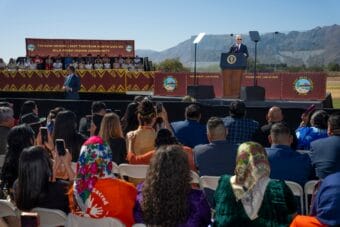
President Joe Biden delivers remarks at the Gila Crossing Community School, Friday, October 25, 2024, in Laveen Village, Arizona. (Photo by Oliver Contreras/White House)

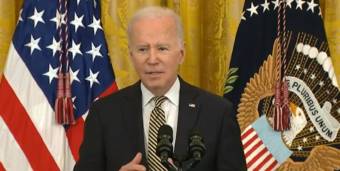
President Joe Biden did what no president has ever done last Friday. He apologized for the harm done to generations of Native American children, who were taken from their homes and forced to attend federal boarding schools.

From 1878 to almost a hundred years later, Alaska had more than a hundred federally funded schools for Native children – a time in which they were punished for speaking their language, as well as physically and sexually abused.

President Biden chose the Gila Reservation near Phoenix to make his apology. He said he was glad to hear the voices of young people singing traditional songs at the start of the ceremony — voices that boarding schools had once silenced.

“I formally apologize, as President of the United States of America, for what we did,” Biden said. “I formally apologize.”

President Joe Biden says he believes his apology for abuses at federal Indian boarding schools was 50 years overdue. (Photo by Oliver Contreras/White House)

The president told the gathering that his apology was among the most consequential things he’d ever done in his whole career as President of the United States.

“It’s an honor, a genuine honor, to be in this special place, on this special day,” Biden said.

“Quite frankly, there’s no excuse that this apology took fifty years to make. The pain it causes will always be a significant mark of shame, a blot on American history. For too long, this all happened with virtually no public attention, not written about in our history books, not taught in our schools.”

Jim LaBelle sat among the boarding school survivors in the crowd. LaBelle is an Alaska Native, and a member of the National Native Boarding School Healing Coalition. He says, before the president gave his apology, he and his Interior Secretary, Deb Haaland, together hugged Jim Labelle and his wife.

“It’s almost indescribable, how to express that feeling of acknowledgement. It was just a very spiritual moment,” Labelle said. “He just understood why we were there. “

LaBelle says the president’s apology was a powerful gesture, one that stirred memories of those who never recovered from boarding school trauma and died young, from addiction and suicide.

“When I heard the apology today,” he said, “I was thinking of them, hoping their spirits will feel the words and feelings.”

During his speech, President Biden mentioned Rosita Worl, who he recently awarded the National Medal of Arts for the Humanities in a White House ceremony. He talked about how she was taken from her family at the age of six and sent to a boarding school. He called her story one of truth and healing. The president said, as a leading anthropologist, she helped to usher in an era of understanding.

Benjamin Jacuk watched the livestream of the president’s apology from his office at the Alaska Native Heritage Center in Anchorage, where he’s the head researcher for Indigenous history.

Benjamin Jacuk says much of his research has focused on the connections between Indian boarding schools and the cross-pollination of cruel policies. (Photo by Rhonda McBride)

Across from his desk, you’ll find a wall covered with pieces of string connected to photographs and sticky notes, almost like what you see in TV detective homicide units.

Jacuk says the spider web of strings is, in a way, the map of a national crime scene.

“That’s exactly what we’re doing at this point, mapping out the genocide of not only Alaska Native peoples, but all, really, at the end of the day, all Indigenous peoples.”

Jacuk is currently looking at the connections between boarding schools and the ideas that flowed between them. Jacuk says it’s important to understand what shaped some of the cruel, militaristic policies that were designed to erase the children’s Native identity. Some of them, he says, stem from schools in Alaska.

Children from the Holy Cross Mission on the Yukon River, dressed in military-style uniforms. Boarding school researchers like Benjamin Jacuk say it reflects attempts to militarize the education of Native children. (Library of Congress, Frank Carpenter collection)

Jacuk calls the president’s unprecedented apology “a big deal” but still falls short of what’s needed.

“While an apology is welcome and amazing, the work should never end right here, because this is just the beginning.”

Jacuk says without truth there can be no healing.  And without action, there is no meaningful apology.

The Alaska Federation of Natives had praise for President Biden’s apology but called for tangible steps towards healing and justice

“We appreciate President Biden’s acknowledgment of the pain and trauma caused by the boarding school policies,” said AFN President Ben Mallott in a statement. “This apology is an important step forward, but it must be accompanied by meaningful actions addressing these historical injustices’ ongoing impacts.”

AFN has called for:

  • A comprehensive inquiry into the Indian boarding school era
  • Revitalizing the Native languages and cultures that boarding schools nearly destroyed.
  • Bringing home the remains of Alaska Native children who died at boarding schools, so they can be laid to rest with their families and in their communities.

Earlier this month at AFN’s convention, delegates passed a resolution in support of Senate and House bills that would establish a Truth and Healing Commission on Federal Indian Boarding School Policies Act. The legislation also addresses repatriation of children’s graves.

Biden to issue landmark apology over Native American boarding schools

President Joe Biden delivers remarks on Wednesday, March 16, 2022, on the reauthorization of the Violence Against Women Act. (Image from C-SPAN)

President Biden is expected to issue a formal apology for the federal government’s Native American boarding schools during a visit to Arizona on Friday, according to the governor of a Native American tribe.
Gila River Indian Community Gov. Stephen Roe Lewis told NPR that the formal apology is coming as part of Biden’s first official visit to an Indigenous community as president.

Biden’s message would be the first public apology from a sitting U.S. president in response to a federal policy that wreaked havoc on tribal communities.

Biden is expected to visit Gila Crossing Community School to issue his formal apology, Lewis said. The apology was confirmed by a person familiar with the White House’s thinking who wasn’t authorized to speak publicly about the announcement yet.

Also traveling with the president is Interior Secretary Deb Haaland, who has also visited the tribe as a part of her “Road to Healing” tour aimed at giving survivors “the opportunity to share with the federal government their experiences in federal Indian boarding schools for the first time.”

The Interior Department earlier this year released a report that confirmed at least 973 American Indian, Alaska Native and Native Hawaiian children died while attending boarding schools in the system.

“This is going to really start the healing and the reconciliation and the redeeming of this sad part of history, not only for the boarding school survivors. A significant, very important part of this apology is admitting that this happened,” Lewis said in an interview ahead of the trip, where he is expected to travel with Biden on Air Force One.

Lewis said the visit comes full circle after Vice President Harris also paid a visit to the community earlier this month.

“There’s going to be a sense of redemption, of confirmation, of what these boarding school survivors have been through,” he said.

Between 1819 and 1969, the federal government operated more than 400 boarding schools across the country and provided support for more than 1,000 others, according to the Interior department’s investigation. The goal was complete cultural assimilation.

On Haaland’s tour, tribal members have recounted physical abuseneglect, and efforts to erase their Native languages and culture.

Rodney Butler, the chairman of the Mashantucket Pequot Tribal Nation, Mark Macarro, president of the National Congress of American Indians and chairman of the Pechanga Band of Luiseño Indians, and Whitney Gravelle, chairwoman of the Bay Mills Indian Community, are also expected to fly with Biden to Arizona for the visit.

“It’s almost like we’re bringing him — we literally are bringing President Biden, flying with him, bringing him to Indian Country, bringing him to my community,” Lewis said. “This is the last leg of this journey to healing as part of President Biden’s administration.”

The landmark visit by the president, which comes less than two weeks before Election Day, fulfills a promise Biden made to tribal leaders two years ago.

“I’ve spent a lot of time in Indian Country as a senator and vice president. But I can say here today I intend to make official presidential visits to Indian Country to make it official,” Biden said during the 2022 tribal summit at the White House.

Trump and Harris will meet face-to-face for the first time on Tuesday’s debate stage

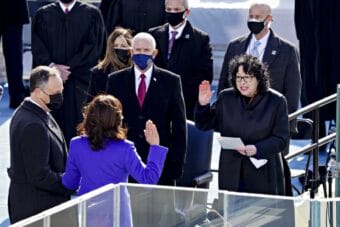
Supreme Court Justice Sonia Sotomayor (right) administers the oath of office to incoming Vice President Kamala Harris in front of the U.S. Capitol on Jan. 20, 2021, as outgoing Vice President Mike Pence (wearing blue mask) watches. (Kevin Dietsch/Getty Images)

Tuesday night’s presidential debate isn’t just the first matchup between former President Donald Trump and Vice President Kamala Harris. It’s their first time meeting in person.

“I was a little bit surprised, people might be surprised to hear that you have never interacted with him, met him face-to-face,” CNN’s Dana Bash said to Harris during their August interview.

Trump and Harris served in the federal government at the same time, but some logistical quirks and unusual decisions kept them from interacting directly in recent years.

Harris was elected to represent California in the U.S. Senate in 2016, during her second term as the state’s attorney general. Trump donated twice to reelect Harris as California attorney general, in 2011 and 2013, though she did not keep the money.

Trump won the presidential election the same year Harris was elected to the U.S. Senate, and both were sworn in to their respective positions in early 2017.

Harris was a member of the Senate during Trump’s first impeachment, in 2019, and voted to impeach him on both counts (he was ultimately acquitted along party lines).

Presidential candidate Trump and vice presidential candidate Harris didn’t meet in person during the 2020 election (granted, the COVID-19 pandemic had forced much of the world online).

Harris did debate Trump’s running mate, Mike Pence, in October 2020. Remember the fly?

Trump and Harris might have crossed paths at President Biden’s inauguration in January 2021, two weeks after the Capitol riot that Trump is accused of stoking. But Trump decided not to attend, becoming the first former president to skip his successor’s inauguration since Andrew Johnson in 1869.

KTOO will carry the debate live on the radio starting at 5 p.m. AKST. 

Costco says it’s going to start cracking down on membership sharing

Sun shines on Costco in Juneau on March 26, 2019. (Photo by Jeremy Hsieh/KTOO)

Are you craving that $1.50 hot-dog-and-soda combo from Costco? Be sure to have your own membership card handy.

Over the coming months, shoppers will have to start scanning their membership cards at the entrances to Costco warehouses rather than just presenting them to a store employee, the retail giant announced.

The Washington-based company is the latest to crack down on membership sharing, as businesses seek to prevent consumers from glomming onto their friends’ and families’ paid accounts without forking over membership fees themselves.

Costco members with active memberships will have to scan their physical or digital cards at a machine at the store’s entrance. Members who have cards without a photo will have to show a valid photo ID, and guests will only be able to enter a Costco store with an active member.

“If you have any questions or concerns, there will always be an attendant at the door to assist you!” Costco said in a statement.

Costco isn’t the only company out to stop some consumers from getting a free ride. Disney recently announced that it would start blocking Disney+ account holders from sharing their passwords to the streaming service outside their households.

similar move by Netflix last year led to an uptick in subscribers but may also have damaged the company’s reputation, Fast Company reported.

Costco executive Richard Galanti told MarketWatch in January that the company was aiming to prevent nonmembers from dodging fees by using a member’s card to shop, an issue that emerged after the company introduced self-checkout lines.

Costco relaxed the enforcement of its rules during the height of the COVID-19 pandemic, Galanti said, when people asked others to shop for them to avoid going outside.

In response to the problem, the company announced that it would begin asking customers in self-checkout lines — in addition to regular checkout lines — to show their membership cards and a photo ID.

Costco has 128 million members and reported that it earned $4.6 billion in revenue from membership fees last year.

Costco’s annual membership fees are set to increase beginning in September, from $60 to $65 for Gold Star members and from $120 to $130 for Executive members.

Deb Haaland’s push to protect Indigenous people disappoints some Native leaders

""
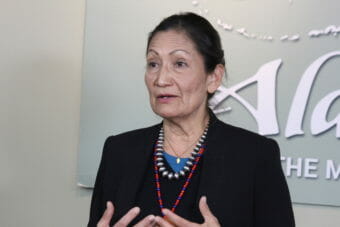
Interior Secretary Deb Haaland speaks at a news conference at the Bureau of Land Management-Alaska headquarters in Anchorage on Thursday. (Photo by Wesley Early/Alaska Public Media)

The murder rate in Indigenous communities nationwide is more than twice the national average. It’s a statistic then-U.S. Rep. Deb Haaland cited four years ago at a legislative hearing.

“While there are many programs and resources that can be used to combat violent crimes in Indian Country, there’s no overarching plan or strategy to do so,” she said.

Prior to her appointment as the nation’s first Indigenous Cabinet secretary, Haaland, a Laguna Pueblo citizen, was a crusading member of congress, representing New Mexico.

“More importantly, a real solution cannot be found without the voices of Indigenous survivors,” Haaland said, “which is what is so special about this bill.”

The law established a commission to study where the departments of Justice and Interior could do better. Both have lots of influence over law enforcement in Alaska and Indian Country.

After it was signed into law in 2020, Haaland said her Not Invisible Act, would hold the federal government accountable for the overwhelming number of Indigenous people who go missing or are murdered in the U.S. each year.

Haaland said it was essential for Alaska Natives and American Indians to help write a comprehensive plan to focus federal resources to fight crime where they live. A year later, she was appointed U.S. Secretary of Interior — leader of one of the agencies she’d taken to task.

It’s a crisis playing out even in remote communities, like Aniak, in western Alaska. The tiny community of about 500 people live nestled on the banks of the upper Kuskokwim River.

The Not Invisible Act Commission identified lots of reasons why Indigenous people in places like Aniak experience high rates of violent crime. One is substance abuse.

Laura Simeon is administrator of the Aniak Traditional Council. (Emily Schwing)

In 2017, an intoxicated man shot his girlfriend and killed another man here with an AK-47.

“And not only the family of the victim, the whole community became victims,” said Aniak Traditional council Administrator Laura Simeon.

The commission also identified a severe shortfall in funding for things like tribal courts, victim specialists and services to combat domestic violence. In many cases crimes go unreported.

“We can’t reach out and ask people if they need help. They have to come and ask for help,” said Breanna Simeon. She works with victims of crime on behalf of the Aniak tribe.

The tribe has a makeshift domestic violence shelter, two bedrooms in a small house that used to serve as tribal offices. Both are empty, save for a few dead house flies that litter the floor. It’s a resource only available to Aniak Tribal members, who account for about half of Aniak’s total population.

The Not Invisible Act Commission says Indigenous communities face an “alarming deficiency” of emergency shelters. And, it says, there just aren’t enough police.

There used to be a state-funded local police officer next door, but hiring an officer who is from the community is challenging and that position hasn’t been filled since at least 2017. Simeon says things felt safer back then.

“I think so,” she said. “My friend and I used to go late-night running and like conditioning, get in shape, and we were out past curfew and he made us run all the way home …”

Two state troopers work in Aniak, on two-week rotations. They also serve 15 other roadless communities spread across more than 200,000 square miles. They declined to be interviewed.

The Alaska State Trooper post in Aniak is only staffed part-time. (Emily Schwing)

Laura Simeon said people here don’t rely on them.

“And then maybe the trooper will show up the next day … or a couple days after. It’s not on the spot, when they’re most likely needed the most,” Simeon said.

There are similar problems in the Lower 48 — like on the Navajo Nation in the Desert Southwest — which covers as much territory as the state of South Carolina.

“So, one of the big issues that we are facing on the Nation is that we are at a shortage of manpower when it comes to public safety,” said Eugenia Charles-Newton.

A Navajo Nation council delegate, Charles-Newton, also chairs the Nation’s Law and Order Committee. She also said there isn’t enough law enforcement and even if there were, police alone won’t reduce violent crime.

“So, it’s a combination of resources, it’s a combination of changing the laws and a really big part of that too is that Congress needs to understand that these things are happening here in Indian Country,” she said.

Back in November, the Not Invisible Act Commission submitted its final report. It offered more than 300 recommendations for changes at the US Departments of Justice and Interior.

Both agencies missed the legally required deadline to respond by more than a month.

“For me personally, we don’t want this commission report to sit on the shelf,” said Tami Jerue, an Alaska based Not Invisible Act commissioner.

The Departments of Justice and Interior’s response only directly addressed a fraction of the commission’s recommendations. It noted many would require additional funding approved by Congress or changes to federal law.

“It seems like it’s a bit of a non-response and only because, you know, needing action is the important aspect of this report,” Jerue said. She’s among a number of Commissioners who have expressed disappointment in a process they said was rushed. Over eight months, the commission hosted several field hearings, but commissioners say the setting wasn’t supportive enough for Native people who traveled long distances to offer often gut-wrenching testimony about their experiences in their communities.

Indigenous people have held Deb Haaland in high regard since she became the first-ever Indigenous cabinet secretary, so a lot of people are hesitant to criticize her. But a number of commissioners say their confidence in her ability to champion Indigenous needs is slipping.

Secretary Haaland’s staff declined multiple requests for interviews. Staff with the Department of Justice also declined to comment.

Commissioner Tami Jerue is working on a counter-response for agencies because she’s eager to see action taken on the commission’s actions moving forward.

Widespread technology outage disrupts Alaska 911 service, global flights and banking

An airport information screen displays an error message rather than travel information at San Francisco International Airport on Friday after a computer problem unraveled systems in the U.S. and dozens of other countries. (Talia Smith/NPR)

A technological meltdown left employees of airlines, banks, hospitals and emergency services around the world staring at the dreaded “blue screen of death” on Friday as their computers went inert in what is being described as a historic outage.

“This is basically what we were all worried about with Y2K, except it’s actually happened this time,” internet security analyst Troy Hunt said via X.

From continent to continent, Microsoft users reported being suddenly knocked offline, and the culprit was determined to be cybersecurity company CrowdStrike, which says one of its routine software updates malfunctioned.

“CrowdStrike is actively working with customers impacted by a defect found in a single content update for Windows hosts,” the company said in a statement.

Customers using Mac and Linux operating systems were not affected, CrowdStrike said.

When the faulty update crashed computer systems, scores of airport travelers were stranded, hospital appointments were delayed and live news broadcasts were cut short.

How big is the outage?

It is massive, far-reaching and sudden.

Some computer problems cascade, creating ripples of failures. But in this case, the flaw permeated Microsoft systems worldwide nearly immediately. The company says its Windows 365 Cloud PCs, apps and services were affected.

While server-related outages are common, the scale of the CrowdStrike disruption was astonishing to many tech observers.

“This IT outage is a stark reminder of how dependent we are on technology and many other things that happen behind the scenes that most of us are unaware of,” said Louisville-based tech executive Adam Robinson on X. “Modern society and the many comforts we enjoy is a fragile thing.”

What kinds of companies and services went offline?

Delta Airlines, United Airlines and American Airlines grounded all flights.

In some states, including Alaska and Ohio, 911 phone lines were down overnight Thursday, although Alaska State Troopers said on Facebook that service was restored by 4:30 a.m. Friday.

In Germany, some hospitals canceled non-emergency operations.

The London Stock Exchange’s news service stopped working.

Broadcasters around the world were also hit. In France and Australia, live television broadcasts were knocked offline.

Sky News, a major U.K. news channel, was off air for a time on Friday morning. It later returned, but without “full capabilities,” its chairman, David Rhodes, said on X Friday afternoon. A post on Australia’s ABC News website said the broadcaster was experiencing a “major network outage.”

How do people fix their computers?

CrowdStrike says the problem was not a cyberattack, but rather a software glitch. The company said the issue has been identified and that a fix was sent to customers.

It also published a workaround that involves booting a Windows machine in a recovery environment, deleting a single file in the CrowdStrike directory, and restarting.

What is CrowdStrike?

It’s a U.S. cybersecurity firm based in Austin, Texas. The company went public in 2019 and is currently in the S&P 500 index. As of early July, CrowdStrike’s stock had been riding months of gains. But share prices fell sharply in early trading Friday.

“This is clearly a major black eye for CrowdStrike,” said WedBush analyst Dan Ives.

CrowdStrike made headlines in 2016, when the company was hired by the Democratic National Committee to investigate a breach of its data systems. CrowdStrike determined that the hack was a case of foreign interference — the work of Russian-backed hacking groups.

The company’s marquee product is its “Falcon” cybersecurity software — and it traced the current problem to a change in a sensor in that system. That also helps explain how and why the resulting failures spread so quickly: Rather than being stored locally, the Falcon security platform “is 100% cloud-based.”

Site notifications
Update notification options
Subscribe to notifications