Politics

Sullivan laces annual address to Legislature with partisan complaint

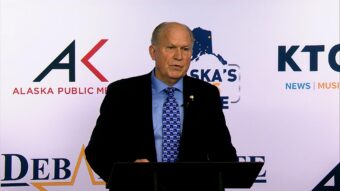
Sen. Dan Sullivan addresses the Alaska Legislature on Feb. 18, 2026.
Sen. Dan Sullivan addresses the Alaska Legislature on Feb. 18, 2026. (Eric Stone/Alaska Public Media)

U.S. Sen. Dan Sullivan, in his annual address to the Alaska Legislature, slammed national Democrats as bent on ruining Alaska.

“Now, I’m not being partisan here. These are just the facts,” he said at one point during his speech Wednesday. “And Alaskans should know who wants to help us and who wants to hurt us.”

As in past years, he blamed the Biden administration for trying to shut down Alaska. But under President Trump, he said, Alaska is in the midst of a comeback, with renewed emphasis on military expansion, resource development, Coast Guard icebreakers and a new rural health care fund.

“Our state will receive from this fund approximately $1.4 billion over the next five years to transform our health care system,” Sullivan said, to resounding applause in the state House chamber.

As he describes it, though, Democrats are still targeting Alaska. Sullivan referred to the U.S. Senate’s top Democrat, Chuck Schumer, at least nine times.

Sullivan spoke for about 50 minutes and took questions from half a dozen legislators and then from reporters at the Capitol.

He doesn’t often take challenging questions in large public forums, so his yearly address to the Legislature is closely watched, especially now that he’s running for reelection, aiming to serve his third six-year term.

Rep. Genevieve Mina, D-Anchorage, who chairs the health committee, challenged Sullivan on the $1.4 billion achievement. She said she’s discovered that Alaska isn’t allowed to use the health care fund to help self-employed people cope with rising premiums, on clinic expansions or to build housing for health care workers, among other priorities.

“You helped shape the Rural Health Transformation Program Funds. Why are these funds so difficult for us to use to address Alaska’s core issues?” she asked Sullivan. “And how will this finite fund help address the thousands of Alaskans who will lose their health insurance?”

She cited a new analysis finding that up to 12,000 Alaskans risk losing their Medicaid insurance coverage because of another provision in the same bill.

Sullivan said wasn’t aware of the report or of all the restrictions on how Alaska can spend its share of the health care fund.

“This is not going to be a panacea that solves everything,” he said, though he also said that the government might be able to remove some of the limits.

Sen. Forrest Dunbar, D-Anchorage, contrasted Sullivan’s negative take on Biden with his positive stance on Trump and asked how far his loyalty goes.

“You’ve said yes to Trump many times. I’m wondering if you’re willing to say no,” Dunbar said. “For example, if we saw a deployment of federal forces to Alaska, like we’ve seen it seen in Minnesota, or if the federal government demands we purge our voter rolls, will you say no to Trump?”

Sullivan seemed irritated at Dunbar.

“I think you were the guy who asked me last year about Medicaid,” Sullivan recounted, and he began his answer there.

“You know who cut Medicaid for Alaska? Chuck Schumer, right? That’s a fact,” Sullivan said. “So I wish that you and others could have gone to Schumer and said, ‘Hey, why are you cutting Medicaid for Alaska?'”

Schumer didn’t cut Medicaid funding for Alaska, but Sullivan had tried to get an increase in the Medicaid payment rate for the state. Opposition was bipartisan.

As for Dunbar’s current question, Sullivan said he goes after Trump administration officials when they deserve it, sometimes publicly.

“You want to put out a tweet smashing them on certain issues or criticizing them? Sometimes that works,” Sullivan responded. “But sometimes, if you want results, that’s not always the best way to get results.”

Rep. Ashley Carrick, D-Fairbanks, said the speech was “par for the course” for Sullivan. Still, she said, the tone was jarring in the House chamber.

“His hyper-partisanship really showed in the speech today, and it does present a sharp departure from Alaska’s bipartisan coalition governance and the spirit of Alaskans to not affiliate with parties as often as not,” she said.

She found it “surprising” that Sullivan suggested Alaska legislators lean on Schumer.

“We don’t really have that authority to, you know, make demands of those that are not our senators,” she said. “And the insinuation that it’s only Democrats in the United States Senate that are holding back progress is a mischaracterization of some of the biggest and most challenging problems that we have.”

It takes bipartisan solutions to solve the complex disputes facing the country, she said.

Sen. Lisa Murkowski is scheduled to address the Legislature late next month.

Alaska’s race for governor picks up 16th candidate, a former state legislator from Sitka

Jonathan Kreiss-Tomkins is seen on Jan. 17, 2026, in Sitka, Alaska, in this photo provided by Kreiss-Tomkins. (Campaign handout photo)

Former state legislator Jonathan Kreiss-Tomkins, a Democrat from Sitka, is running for governor, he said Tuesday.

Kreiss-Tomkins, frequently known as “JKT,” served in the Alaska House of Representatives between 2013 and 2023. He becomes the 16th candidate and third Democrat to enter this year’s gubernatorial election.

Incumbent Gov. Mike Dunleavy is term-limited and unable to run for a third term.

In Alaska, the top four vote-getters, regardless of political party, advance from the August primary to the November general election. In November, Alaskans use ranked-choice voting to name their preferences.

Kreiss-Tomkins said he’s running because Alaska has big problems and he’s interested in solving them.

“I really enjoy working with people from diverse backgrounds and different viewpoints and perspectives to try to forge compromise and get things done,” he said.

While in the Legislature, Kreiss-Tomkins was a member of the bipartisan, bicameral fiscal working group that in 2021 drafted a plan intended to bring the state’s finances in line over the long term.

Though that plan was never enacted, its components resemble the fiscal plan introduced this year by Gov. Mike Dunleavy.

“We’re in a perpetual budget uncertainty,” Kreiss-Tomkins said, identifying the state’s fiscal situation as his No. 1 issue.

Since oil prices plunged in 2015, legislators and governors have struggled to balance Alaska’s budget on an annual basis, occasionally bringing the state to the brink of a government shutdown.

“We’re living and dying by the price of oil, and we have a structural budget deficit, so the state’s finances are not especially in order, and that is, I think, probably the highest-order problem,” Kreiss-Tomkins said.

He said Dunleavy hasn’t been able to work across party lines and hasn’t been successful with the Legislature. Kreiss-Tomkins contrasted that with his own experience as a member of a Democratic-independent-Republican coalition majority in the state House.

“I feel like we need that same spirit in the executive branch, and if we could have a governor and an executive with that approach and mindset … there’s a tremendous amount of good that we can get done for Alaska,” he said.

Kreiss-Tomkins said the campaign season will show how he differs from the other two Democrats in the race: former state Sen. Tom Begich, and current state Sen. Matt Claman.

When it comes to the number of other candidates in the race, Kreiss-Tomkins said it’s not a bad thing for Alaskans to have so many choices.

“Seeing so many people willing to run sort of reflects the importance of the election and the gravity of the problems facing Alaska,” he said, adding that he expects “some winnowing of the field as time goes on.”

Candidates for Governor

  • Former state Sen. Tom Begich (Democrat)
  • Former state Sen. Click Bishop (Republican)
  • Former Anchorage Mayor Dave Bronson (Republican) and Lt. Gov. candidate Josh Church (Republican)
  • Former state revenue commissioner Adam Crum (Republican)
  • Current state Sen. Matt Claman (Democrat)
  • Lt. Gov. Nancy Dahlstrom (Republican)
  • Matanuska-Susitna Borough Mayor Edna DeVries (Republican)
  • Kasilof resident Jessica Faircloth
  • Anchorage podiatrist and state medical board member Matt Heilala
  • Former state Sen. Shelley Hughes (Republican)
  • Former state Rep. Jonathan Kreiss-Tomkins (Democrat)
  • Author Hank Kroll (Registered Republican) with Lt. Gov. candidate Tommy Nicholson (Undeclared)
  • Angoon resident and former teacher James William Parkin IV (Republican)
  • Former Attorney General Treg Taylor (Republican)
  • Palmer resident Bruce Walden (Republican)
  • Businesswoman Bernadette Wilson (Republican) with Lt. Gov. candidate Mike Shower (Republican)

Race for cash is well underway for Alaska’s U.S. Senate and House campaigns

moonrise over Capitol, with dome to the left and purple sky.
Moonrise over the U.S. Capitol in 2021. (Brett Davis)

WASHINGTON — We’re only one month into election year 2026 and it’s already clear that the incumbents in Alaska’s federal races have a lot of money to defend their seats.

U.S. Sen. Dan Sullivan raised nearly $7.5 million last year, according to his latest campaign finance report.

“We’re feeling incredibly strong about where our campaign is,” campaign spokesperson Nate Adams said. “Our fundraising is on track, and our support continues to grow.”

The campaign of Democratic challenger Mary Peltola is also touting its fundraising success. Peltola has only been in the race a few weeks and hasn’t had to disclose her contributions yet. But a Peltola campaign press release says she raked in $1.5 million on the first day after she announced. The campaign declined an interview request.

Campaign strategist Jim Lottsfeldt, who led a 2020 group that tried to unseat Sullivan, said the senator’s $7.5 million actually doesn’t give him much of a head start.

“Mary Peltola is in the middle of a money bomb, and she will raise every bit of that and more, and I think ultimately outspend Dan Sullivan,” Lottsfeldt said.

The U.S. Senate race is, so far anyway, a referendum on how people feel about President Trump, he said, and money doesn’t tell the whole story.

“The problem with money in this race is there’s going to be so much of it that most people will shoot their TVs and their computers,” he said. “And I’m not sure how it’s going to all get spent in a way that actually is effective.”

In the U.S. House race, Congressman Nick Begich’s campaign raised $3.2 million last year. Paul Smith, a consultant to the Begich campaign, said that’s an Alaska record for a U.S. House race in a non-election year.

“We feel really good about it and are proud of the start that he has to this election cycle, on the fundraising side,” Smith said.

Democratic challenger Matt Schultz, an Anchorage pastor, filed to run against Begich in October. He reported contributions of $300,000 by year’s end.

Schultz campaign manager Mai Linh McNicholas, said it’s a good foundation, with contributions from more than 2,000 people. She said Schultz set a fundraising record, too.

“It’s the most that any first-time candidate has raised, in an off-year, for this seat in Alaska,” she said.

An Independent candidate is also running for U.S. House — fisherman and retired educator Bill Hill. He hasn’t had to file a campaign finance report yet but his team says he’s raised, like Schultz, more than $300,000, and he did so in his first week.

The reports show Sullivan and Begich, like most incumbents, get significant money from Political Action Committees affiliated with corporations, trade associations and political groups. About half of their 2025 contribution totals are from individuals. The rest largely came from PACs, or “other authorized committees.”

Yes, it’s another government shutdown, but Alaska impacts might be minimal

The U.S. Capitol building.
The U.S. Capitol building. (Photo by Liz Ruskin/Alaska Public Media)

WASHINGTON — The U.S. Senate on Friday passed a bill funding the departments of Defense, Health, Labor and Transportation, among others, with both Alaska senators voting yes.

Still, hours later, at 8 p.m. Alaska time, funding will lapse for those departments, comprising much of the government. The U.S. House still has to pass the bill, and House members don’t return to the Capitol until Monday.

The shutdown, or lapse in funding, could last just one weekday. That would be minimal compared to the 43-day shutdown in 2025, the longest in U.S. history.

Nonetheless, the Office of Management and Budget says it will follow its usual shutdown practices.

Unless they’re told otherwise, all federal employees who would normally report to work on Monday should still go, according to the OMB’s plans. It’s standard practice on the first weekday after a funding lapse for federal workers to be on duty to launch the orderly shutdown procedures.

Then, if the shutdown continues, agencies are expected to notify their employees if they are essential and have to come to work, or if they will be put on furlough.

This time, the impact on Alaskans will be more limited than the shutdown last fall, because Congress has already funded many departments for the rest of the fiscal year. Those include NOAA and the departments of Commerce, Interior, Justice and Veterans Affairs.

Democrats held up a funding bill for the Department of Homeland Security. They demanded reforms to curb the kind of harsh immigration enforcement tactics deployed in Minneapolis, where agents shot and killed two U.S. citizens.

Now, Congress and the White House have two weeks to reach an agreement on what those reforms will be. Both of Alaska’s senators say they support some type of reform.

Republican Sens. Murkowski and Tillis call for Noem to resign

woman surrounded by people extending their iphones to her, aimed at her face
Sen. Lisa Murkowski was surrounded by reporters outside the U.S. Senate chamber last year. (Liz Ruskin/Alaska Public Media)

WASHINGTON — Sen. Lisa Murkowski said Secretary of Homeland Security Kristi Noem should be held accountable over a fierce immigration crackdown that has killed two citizens in Minneapolis and that she should resign.

“She has — through her words, and I think in her actions — she’s taken a direction that has not been helpful to the situation, and I don’t think that it helps the country,” Murkowski told reporters.

She said Noem has an obligation to maintain control of what the agencies in her jurisdiction are doing. Instead, Murkowski said, Noem has inflamed tensions. She noted that almost immediately after Border Patrol agents shot and killed nurse Alex Pretti, Noem claimed, without evidence, that Pretti was a “domestic terrorist.”

Murkowski spoke to reporters on her way to a Senate vote as lawmakers returned to the Capitol from a week away. She called it a good sign that the administration has removed top Border Patrol official Gregory Bovino from Minneapolis. But, she said, accountability rests with Noem.

Reporters pressed her on whether Noem should resign.

“I voted for her,” Murkowski said, referring to Noem’s Senate confirmation. “I think the President needs to look at who he has in place as a secretary of Homeland Security. I would not support her again, and I think it probably is time for her to step down.”

Murkowski was among the first Republicans in Congress to openly criticize the tactics of the immigration enforcement operation after agents killed Pretti. The group of GOP critics remains small.

But minutes before Murkowski spoke, Sen. Thom Tillis, R-N.C., also castigated Noem. He said the enforcement operations need to focus on the serious criminals President Trump promised to target and not pursue nonviolent people.

“I think that what she’s done in Minnesota should be disqualifying. She should be out of a job,” Tillis said of Noem. “And I mean, really, it’s just amateurish. It’s terrible. It’s making the president look bad on policies that he won on.”

Tillis is retiring from the Senate after his term ends in a year. He’s become one of the more outspoken Republicans in Congress when it comes to criticizing and voting against the Trump administration.

Unlike Murkowski and Tillis, Sen. Dan Sullivan, R-Alaska, didn’t issue a social statement or a press release this weekend to condemn Pretti’s death or call for reform.

His office provided a statement to reporters on request. Sen. Sullivan “strongly supports our law enforcement and their ability to do their jobs,” it says, while calling any loss of life tragic. It also says he hopes that “the temperature in Minnesota on both sides can be lowered.”

On his way to the Senate chamber to vote Tuesday, Sullivan held his phone to his ear as he walked through a crowd of reporters, fending off approaches.

Crum deviated from state law and policy when investing Alaska’s savings, review finds

Adam Crum speaks to reporters on Oct. 4, 2022 at the Alaska Scientific Crime Detection Lab in Anchorage while serving as health commissioner.
Adam Crum speaks to reporters on Oct. 4, 2022 at the Alaska Scientific Crime Detection Lab in Anchorage while serving as health commissioner. (Wesley Early | Alaska Public Media)

Former Alaska Revenue Commissioner Adam Crum deviated from state policy and failed to perform the necessary due diligence before committing millions in state savings to a private equity fund, according to an outside review ordered by Gov. Mike Dunleavy after Crum’s decision came to light last summer.

In its report, the D.C.-based law firm WilmerHale said its investigation had raised “significant concerns” about whether Crum met his fiduciary duties under state law. Investigators also found Crum engaged outside lawyers to represent the state in the investment without obtaining the approval of the attorney general “in apparent contravention” of state law, according to the report.

“Mr. Crum’s process for selecting the DigitalBridge fund and the two other private funds in which he intended to invest did not involve rigorous due diligence, and Mr. Crum did not follow Department of Revenue protocols designed to assist him in meeting his fiduciary duties in connection with the investment,” the report states.

The state ultimately invested some $50 million from its primary rainy-day fund, the Constitutional Budget Reserve, with the private equity firm DigitalBridge. The investigation found that Crum intended to invest $75 million with the firm.

The investment came to light shortly after Crum left office to run for governor. The state ultimately sold the investment to an Israeli insurance company and lost roughly $859,000, according to a letter sent to the state House and Senate’s finance committees. A portion of the $50 million sent to DigitalBridge that was not invested yielded $325,000 in interest, offsetting a portion the loss, according to the letter.

“Clearly, this was an unsuitable investment for the (Constitutional Budget Reserve). No question about it,” said Sitka Republican Sen. Bert Stedman. “The ex-commissioner broke his fiduciary duty to execute it.”

Shortly after the legislative session began in Juneau this month, Stedman introduced a bill that would bar the state from doing business with DigitalBridge.

The report, which cost the state an additional $350,000, found no evidence of criminal wrongdoing or self-dealing. And it said Crum had the authority as revenue commissioner to commit money to the private equity fund. But that’s only if he had done the requisite due diligence, and the report says there’s reason to believe he didn’t.

In a phone interview, Crum said he tried his best to keep everything above board. The private equity investment was an effort to simultaneously boost the returns of the savings account and spur investment in Alaska, and he kept in touch with the Department of Law and the governor’s office about the investment, he said.

“I actually had multiple communications with (the Department of) Law, even with Treasury staff, trying to actually figure out what — I would send emails and ask the questions that say, have we met all of the legal duties in order to actually fulfill this?” Crum said.

But according to the investigation, he chose not to inform the governor’s budget office, the legislative auditor, or members of the Legislature as state policy requires. He wrote on a checklist outlining the policy for so-called “non-routine investments” — created after a state investment misadventure in 2015 — that “Treasury must not abdicate its statutory authority.”

Crum also failed to inquire with the Department of Law whether the investment met his fiduciary obligations under state law, according to the investigation.

Crum casts the issues the investigation raises as “procedural.” Details, he said, were not his mandate as revenue commissioner.

“It’s not about being technically proficient on all that stuff. It’s knowing the overall concepts,” he said. “Making sure that you actually are the expert on the actual delivery of that thing — no, that is not the case. That’s why you have staff. Otherwise, why do you have staff?”

The report included four recommendations aimed at avoiding similar issues in the future. As it was released, Gov. Mike Dunleavy issued an administrative order implementing many of the recommendations by placing additional checks on the revenue commissioner’s authority to invest in unconventional assets.

In the order, Dunleavy said the changes were intended to “enhance the transparency of investment decisions.”

Site notifications
Update notification options
Subscribe to notifications