Politics

Alaska Senate Republicans pick Tok Sen. Mike Cronk as new minority leader

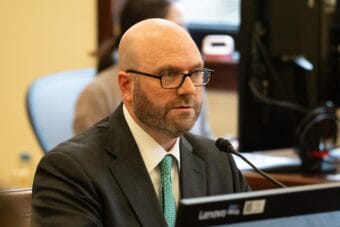
Tok Republican Sen. Mike Cronk speaks during a news conference on January 21, 2025.
Tok Republican Sen. Mike Cronk speaks during a news conference on January 21, 2025. (Eric Stone/Alaska Public Media)

Tok Republican Sen. Mike Cronk is the state Senate’s new minority leader. The six-member minority caucus in the state Legislature’s upper chamber announced Tuesday its members had elected Cronk to replace former Wasilla Republican Sen. Mike Shower, who resigned to run for lieutenant governor earlier this year.

Cronk is a former schoolteacher and construction worker who first joined the state House in 2021. Last year, he won a seat in the Senate representing a massive swath of Interior Alaska that includes Glennallen, Tok, southeast Fairbanks, Delta Junction and much of the Yukon River.

In a phone interview, Cronk said he was looking forward to working on a fiscal plan that Gov. Mike Dunleavy plans to unveil next month.

“Obviously, we are in the minority, but I’m hopeful to, you know, work with the majority, to — can we get some of these things solved?” Cronk said.

The caucus includes six of the 11 Republican members in the Senate. Five others caucus with Democrats in a bipartisan majority that controls the chamber.

Fairbanks Republican Sen. Robb Myers will remain minority whip, the caucus’s the second-in-command.

Cronk will lead a caucus with two new members after Gov. Mike Dunleavy picked two House Republicans, now-Sens. Cathy Tilton and George Rauscher, to replace Shower and former Sen. Shelley Hughes, who is running for governor. Cronk said he would keep his seat on the Senate Finance Committee, but he said the caucus is still finalizing other senators’ committee assignments.

Cronk’s elevation to minority leader follows a leadership shakeup in the House’s minority caucus. That means both minority caucuses will have new leaders when lawmakers return to Juneau next month.

Murkowski defends Democrats Trump accuses of ‘seditious behavior’

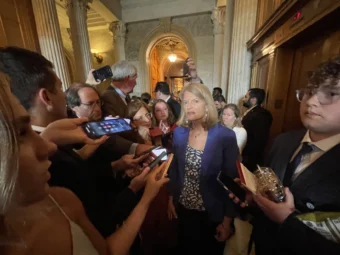
A woman in a blue shirt attends a press briefing.
Sen. Lisa Murkowski in Anchorage on Aug. 5, 2025. (Matt Faubion/Alaska Public Media)

WASHINGTON — Sen. Lisa Murkowski is sticking up for six Democratic members of Congress whom President Trump has called traitors for a video they made aimed at military members.

On the video the Democrats face the camera and tell servicemembers they can or should refuse orders that are illegal.

The Pentagon now says it’s investigating one of the six, Sen. Mark Kelly of Arizona, a retired military officer. Nearly all Republicans in Congress have stood by the president, or stayed quiet, as Trump accused the six of “SEDITIOUS BEHAVIOR, punishable by DEATH!”

Murkowski, though, bucked the partisan norm with a social media post Tuesday that defends Kelly and the other Democrats and says their message is accurate.

“Senator Kelly valiantly served our country as an aviator in the U.S. Navy before later completing four space shuttle missions as a NASA astronaut. To accuse him and other lawmakers of treason and sedition for rightfully pointing out that servicemembers can refuse illegal orders is reckless and flat-out wrong,” her post reads. “The Department of Defense and FBI surely have more important priorities than this frivolous investigation.”

Sen. John Curtis, R-Utah, also issued a statement that, while less specific, praises Kelly’s public service.

House members who filmed the video say they’ve been told the FBI is investigating them.

Trump said Friday he was not threatening the six Democrats with death but said they’re in serious trouble.

Even with no election, the Alaska Legislature is in flux ahead of the regular session

The front of the Alaska State Capitol in Juneau is seen on Wednesday, April 12, 2023. (Photo by James Brooks/Alaska Beacon)

Alaska Gov. Mike Dunleavy is now considering who may fill two legislative seats vacated by state senators seeking higher office.

Sen. Mike Shower, R-Wasilla, resigned Nov. 3 to run for lieutenant governor, and Sen. Shelley Hughes, R-Palmer, resigned Nov. 14 to run for governor.

On Sunday, Republicans in Hughes’ district proposed three local residents to fill her seat: Rep. Cathy Tilton, R-Wasilla, Matanuska-Susitna school board member Tom Bergey, and Gerrie Deal of Palmer.

Under state law, Dunleavy does not have to pick any of the three, but Republican Party rules state that local party officials will propose nominees to the governor in the event of a vacancy.

Dunleavy has until Dec. 14 — 30 days after Hughes’ resignation — to fill the seat.

The deadline to fill Shower’s vacant seat is coming up sooner: Republicans in his district have nominated Reps. Kevin McCabe, R-Big Lake, and George Rauscher, R-Sutton, for the vacancy, as well as Ryan Sheldon, a former aide to Rep. Julie Coulombe, R-Anchorage.

Any person picked for the Senate must be confirmed with a majority vote by the Senate’s Republican members, which includes four remaining members of the all-Republican Senate minority as well as the five Republicans who are in the Senate’s majority caucus.

If Dunleavy picks a current member of the state House for either seat, he will create a vacancy that he must fill within 30 days.

That person — or those people — will almost certainly join the House’s 19-person all-Republican minority caucus, whose leadership is in flux.

On Saturday, House Minority Leader Mia Costello, R-Anchorage, said she would resign immediately as minority leader.

The resignation came after two members of the minority met with her and said there were enough votes to remove her as leader. That meeting was first described by Jeff Landfield of the Alaska Landmine.

Her resignation, which had not been requested, leaves the minority’s position uncertain ahead of the legislative session. The minority leader is traditionally in charge of opposition messaging and is the main negotiator between the House majority and minority caucuses.

This past year, members of the House minority repeatedly diverged on key topics, including a vote on whether or not to override Gov. Mike Dunleavy’s education funding vetoes.

The Alaska House is currently controlled by a 21-person majority that includes Republicans, Democrats and independents.

Begich, like rest of U.S. House, votes to release Epstein files

Advocates of releasing the Epstein files protested at the Capitol Nov. 18, 2025, before the House vote.
Advocates of releasing the Epstein files protested at the Capitol Nov. 18, 2025, before the House vote. (Liz Ruskin/Alaska Public Media)

WASHINGTON — The U.S. House voted nearly unanimously to force the Justice Department to release documents and investigative materials on the late sex offender Jeffrey Epstein.

Alaska’s lone member of the House, Republican Rep. Nick Begich, voted for the bill, too. And Begich said he would have voted yes even if President Trump was still urging Republicans to block it.

“The American people deserve transparency,” Begich said Tuesday, before the vote. “This (investigation) is a product of the taxpayers’ investment. A lot of money has gone in to investigate these crimes, and I think the people deserve to know what’s there.”

For months President Trump pressed Republicans to block the Epstein bill. That put House Republicans in a political bind: Should they follow Trump, or his MAGA followers, who voted for Trump in part because he promised to release the files?

Trump abruptly reversed course over the weekend and said Republicans should vote for it, releasing his House allies from their dilemma.

The Epstein bill goes next to the Senate, where one of the controversies is whether to make changes.

Begich said he agrees with House Speaker Mike Johnson that the bill needs to be amended, to allow the Justice Department to redact or withhold information to better protect victims and investigative methods.

“I think Leader (John) Thune in the Senate has provided some strong indications to House leadership that those will be addressed once this bill goes over to the Senate,” Begich said. “I think that’s important.”

House Democrats and the four Republicans who signed a discharge petition bringing the Epstein bill to a vote say the bill doesn’t need amendment. They say the bill already protects victim identities and investigative sources and methods.

Survivors of Epstein’s abuse cheered from the House gallery when the 427-1 vote was announced. Many House members turned to face the House gallery, applauding victims who spoke out and have campaigned to release the documents.

The cheers and applause was still underway as the clerk read the procedural rule for the next measures — to repeal Biden administration rules that put the brakes on oil development in the Arctic National Wildlife Refuge and, to the west, in the National Petroleum Reserve-Alaska.

Senators take first step toward reopening the government after historic shutdown

Sen. Tim Kaine, D-Va., speaks during a press conference following a vote on Capitol Hill on Sunday. The Senate convened for a rare Sunday session in an attempt to end the government shutdown.
Sen. Tim Kaine, D-Va., speaks during a press conference following a vote on Capitol Hill on Sunday. The Senate convened for a rare Sunday session in an attempt to end the government shutdown. (Anna Rose Layden/Getty Images)

A bipartisan group of Senate Democrats and Republicans reached a deal to reopen the government after the longest shutdown in U.S. history, voting on the first procedural step on the measure.

The agreement would fund the government through Jan. 30 and include full-year funding for a trio of appropriations bills, including full funding for the Supplemental Nutrition Assistance Program, or SNAP, through Sept. 30, 2026, or the end of the fiscal year.

The vote late on Sunday was 60 to 40, with seven Democrats and one independent joining with most Republicans to advance the measure.

It marked the first, but crucial, step towards passing the measure in the Senate. Once the bill cleared the 60 votes needed to overcome a filibuster, any remaining Senate votes need just a simple majority. However, the legislation still needs to pass the House before the shutdown would end, enabling air traffic controllers and other federal workers to get paid and federal food benefits to resume, among other things.

Senate Democrats had earlier voted against more than a dozen short-term spending measures in their fight to preserve health care subsidies. But as the pain of the shutdown continued to bite, some agreed to more modest changes in the latest framework.

The continuing resolution to fund the government until the end of January would also include language to reverse any reductions in force of federal employees that happened during the shutdown, as well as protections against further such layoffs through the end of the fiscal year, and backpay for all federal employees during the shutdown.

“I have long said that to earn my vote, we need to be on a path toward fixing Republicans’ health care mess and to protect the federal workforce,” Sen. Tim Kaine (D-Va.) said in a statement. “This deal guarantees a vote to extend Affordable Care Act premium tax credits, which Republicans weren’t willing to do.”

The agreement to reopen the government is also expected to include a Senate vote on health care by the second week of December, on a bill of Democrats’ choosing. That informal deal is not part of the legislative text.

Democrats are deeply divided about the compromise measure, which was opposed by Senate Minority Leader Chuck Schumer.

“I think it’s a terrible mistake,” Sen. Elizabeth Warren (D-Mass.) said of the deal. “The American people want us to stand and fight for healthcare.”

Democratic divisions over legislation

Several top Democrats in the House also vowed to vote against the bill.

House Minority Leader Hakeem Jeffries, D-N.Y., panned the agreement in a statement before the Senate vote.

“We will not support spending legislation advanced by Senate Republicans that fails to extend the Affordable Care Act tax credits,” Jeffries said in a statement. “We will fight the GOP bill in the House of Representatives, where Mike Johnson will be compelled to end the seven week Republican taxpayer-funded vacation.”

And Democrat Rep. Greg Casar of Texas called the deal a “betrayal” and a “capitulation” because it doesn’t reduce health care costs.

The House has not held a vote since Sept. 19, and previously passed a government funding measure without Democratic support.

The Senate deal on government funding comes after Democrats cruised to a series of electoral victories in the last week, giving some in the party newfound political confidence to continue to fight for health care extensions.

Many Democrats believed that keeping the government shut down gave them their only legislative leverage, with Republicans still in control of Congress and the White House.

Moderate Democrats defended their votes, with some telling reporters that it’s the best deal they could do.

Kaine, one of the Democrats who voted for the measure on Sunday, defended his support, saying Democrats would be able to put important health care legislation up for a vote.

“Lawmakers know their constituents expect them to vote for it, and if they don’t, they could very well be replaced at the ballot box by someone who will,” he said in his statement.

Sullivan votes to block Senate measure intended to preempt American bombing of Venezuela

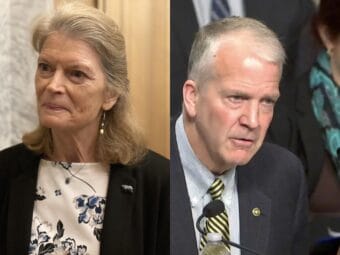
Alaska Republican U.S. Sens. Lisa Murkowski and Dan Sullivan.
Alaska Republican U.S. Sens. Lisa Murkowski and Dan Sullivan. (Alaska Beacon file photos)

Alaska’s two U.S. senators split on a vote that would have allowed the U.S. Senate to take up a resolution that sought to prevent President Donald Trump from unilaterally ordering the bombing of Venezuela.

Fifty votes were needed in the Senate to take up the resolution, but only 49 senators — all the Senate’s Democrats, plus Republican Sens. Lisa Murkowski of Alaska and Rand Paul of Kentucky — voted in favor of the procedural action needed to force a vote.

Sen. Dan Sullivan joined a majority of Senate Republicans and voted against taking up the resolution, which was sponsored by Sen. Tim Kaine, D-Virginia.

Thursday’s vote, and the split decision by Alaska’s senators, was similar to a vote that took place last month, when the Senate declined to consider a resolution intended to curtail America’s killing of suspected drug dealers without trial.

Since September, the United States has killed 67 people aboard boats in both the Caribbean Sea and the Pacific Ocean, according to tallies kept by the New York Times and CNN. There have been 16 known military strikes since Sept. 2, each targeting a boat that the U.S. government claims was carrying drugs.

It is illegal for the U.S. military to intentionally kill civilians who are not actively taking part in hostilities against the United States.

In October, Murkowski joined Paul and all but one of the Senate’s Democrats in voting to take up a resolution intended to curtail the strikes. Sullivan joined the rest of the Senate’s Republicans, and Pennsylvania Sen. John Fetterman, D-Pennsylvania, in voting to support the strikes.

Since that vote, Trump has said that he has authorized covert CIA operations in Venezuela and is considering military strikes against the country, which is governed by dictator Nicolás Maduro.

The U.S. military has positioned large numbers of soldiers and aircraft near Venezuela’s coastline, possibly in preparation for attack.

In a statement after Thursday’s vote, Murkowski said she has “been briefed multiple times and reviewed classified documents that provide insight into the administration’s factual justification” for attacking Venezuela.

“Even with this additional context, I do not believe their case has met the standard of clarity and rigor that Congress needs to fully evaluate the legality and scope of these operations,” she said.

Devyn Shea, a spokesperson for Dan Sullivan, said by email after the vote, “In both Democrat and Republican administrations, Senator Sullivan has consistently voted against limiting the authority of the President as Commander-in-Chief to protect the national security interests of the country.”

Sullivan “believes that under Article II of the Constitution, President Trump as Commander-in-Chief has the authority to defend our homeland from Venezuelan narcoterrorists, just as President George H.W. Bush did when he ordered the full military invasion of Panama in 1989 to remove the drug-trafficking dictator Manuel Noriega,” Shea said.

Site notifications
Update notification options
Subscribe to notifications