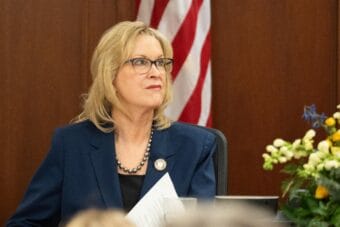
Alaska U.S. House Rep. Nick Begich III has a new challenger.
Bill Hill, a Bristol Bay fisherman and retired teacher and school administrator, filed to run for the congressional seat as an independent candidate.
He cites the late Alaska Congressman Don Young as an inspiration.
“That’s kind of who I hope to, in some respect, mold myself after,” he said. “What’s good for Alaskans first and, you know, we need to start putting distance between politicians that are just cozying up to billionaires and special interests. And we need people that are going to work for Alaskans.”
A day after launching, Hill’s campaign announced he’d raised $200,000.
Hill has retained the campaign consulting firm Ship Creek Group, the same agency that brought early success for Mary Peltola when she launched her bid for U.S. House in the 2022 special primary election.
If elected, Hill isn’t committing to joining either the Republican or the Democratic House caucuses.
“I think that decision needs to be done thoughtfully, and that needs to be done at the appropriate time with whatever the structure of Congress looks like at that time,” he said.
Public records show he made small donations last year, through the ActBlue platform, to Rep. Alexandria Ocasio-Cortez, D-N.Y., and Sen. Bernie Sanders, I-Vt., and larger ones to Democrat Les Gara for his campaign in 2022 for Alaska governor.
Hill is Athabaskan, raised on Lake Iliamna and now lives in Naknek. He worked as a teacher in Naknek and Juneau, an administrator in the Lake and Peninsula School District and as superintendent of the Bristol Bay district. He’s also lived in Fairbanks and worked in construction jobs and ran a small business.
Begich, a freshman Republican, has raised more than $2 million for his re-election campaign. Democrat Matt Schultz, a Presbyterian minister from Anchorage, is also campaigning for the seat. He hasn’t had to file a fundraising report yet.
U.S. Rep. Mary Peltola smiles for a photo at a meet and greet in Juneau on Saturday, Jan. 27, 2024. (Clarise Larson/KTOO)
Former Alaska Congresswoman Mary Peltola will be in Juneau Friday evening at the Crystal Saloon bar downtown to celebrate her campaign launch for U.S. Senate.
Last week, she announced she’s running for U.S. Senate against Republican incumbent Senator Dan Sullivan.
Peltola, a Democrat, served both a partial and full term in the U.S. House until the 2024 election, when she narrowly lost her seat to Republican Nick Begich. She became the first Alaska Native person elected to Congress when she won the 2022 special election.
Peltola has historically seen strong support from Juneau. During the 2024 election, Peltola outpaced Begich in every Juneau precinct – even in the precincts from the Juneau International Airport to Mendenhall Valley that went for Trump, according to the Alaska Division of Elections.
Her bid for the congressional seat, if successful, would give Democrats a shot at winning a majority in the Senate.
Her meet and greet will be at the Crystal Saloon on Front Street, Friday evening from 5 p.m. to 7 p.m.
“I voted” stickers are seen on display in the headquarters offices of the Alaska Division of Elections in Juneau on Tuesday, Nov. 12, 2024. (James Brooks | Alaska Beacon)
“In the coming weeks, the DOE will inform the voters registered as affiliated with the AIP that the party is no longer recognized,” the department said in a notice published Wednesday. “These voters will have the option to select a new party or group affiliation if they wish. If they do not update their registration — by phone, email, in person, or through the online form — within 30 days of receipt, the Division plans to change their registration status to ‘undeclared.'”
The Alaskan Independence Party’s leadership formally dissolved the organization in a vote on Dec. 7, then released a statement at the end of the year about the decision.
That statement said the party elected a new board of directors in April 2024, and that board analyzed the state of the party.
“The board carried out its work and found that the current party membership is either apathetic to the goals of the party, believes that the party is a branch of the Republican party, or is registered to the AIP by mistake,” the statement said in part.
“The party has for some time been legally alive yet spiritually dead,” the statement said.
The AIP’s origins date to the early 1970s, when interior Alaska gold miner Joe Vogler attempted to rally opposition to federal land control after statehood.
Vogler ran for governor as an independent in 1974, and the AIP developed out of his Libertarian-like vision for the state — local control, limited government, and a new statewide referendum on whether Alaska should be a state, commonwealth, territory or fully independent.
For decades, AIP members contended that Alaska’s 1958 statehood vote was not valid because it did not present Alaskans with a full set of options.
The party peaked in 1990, when conservative Republicans abandoned their support of Sen. Arliss Sturgulewski for governor, who they deemed too moderate on abortion and environmental issues.
Hickel and Coghill won the three-way election with just under 39% of the vote, marking the AIP’s sole statewide electoral win.
That was the party’s high-water mark; Hickel governed as a Republican in all but name and rejoined the Republican party before his term ended.
Vogler was murdered in 1993, and the party became an annual also-ran in statewide races. In 2024, when John Wayne Howe ran as the party’s candidate for U.S. House, he received just 4% of Alaskans’ first-choice votes.
Danish Foreign Minister Lars Løkke Rasmussen, center, and U.S. senators spoke to reporters at the Hart Senate Office Building on Jan. 14, 2026. (Liz Ruskin/Alaska Public Media)
WASHINGTON — Sen. Lisa Murkowski was among a group of senators who met with the foreign ministers of Denmark and Greenland Wednesday, trying to provide an assurance that they couldn’t get from the White House: That Greenland is safe from a U.S. military incursion.
“I think it’s important to send the message that here in the Congress, we recognize and support the sovereignty of the people of Greenland,” Murkowski, the sole Republican in the meeting, told reporters afterward.
President Trump continues to say that the United States must take Greenland, for strategic purposes.
Murkowski and Sen. Jeanne Shaheen, D-N.H., co-sponsored a bill this week to prohibit the administration from spending any funds to “blockade, occupy, annex or otherwise assert control” over Greenland or the territory of any NATO ally.
“This is a message that I think it’s very clear, and very strong,” Murkowski said. “And, quite honestly, one that I never thought I would have to author and introduce into the United States Congress.”
Murkowski didn’t say whether any other Republicans agreed to support the bill, though Sen. Mitch McConnell, R-Ky., gave a speech on the Senate floor Wednesday saying an aggressive move on Greenland would be a calamity and gain the United States nothing.
He, like Murkowski, say seizing Greenland would shatter the NATO alliance.
Murkowski said it’d be better if the president changes his rhetoric on his own, without Congress having to pass her bill.
“I hope it’s ultimately not necessary,” she said. “But we are operating in times where we’re having conversations about things that we never thought even possible.”
Whether Congress has any appetite to rein in the president is unclear.
Sen. Angus King, I-Maine, said the legislative branch isn’t living up to its constitutional duty to check and balance presidential authority.
“Congress has abdicated its power, largely,” King said. “I’d say it’s the seventh inning. We’re behind four to three, but the game isn’t over.”
Minutes after he said that, the Senate voted to reject a resolution that would have curtailed Trump’s future use of military force in Venezuela.
Alaska’s senators, as expected, split on the issue. Murkowski, like King and all the Senate Democrats, supported the resolution, which would have required Trump to seek Congressional approval for further military action. Sen. Dan Sullivan opposed it.
The vote in the Senate on whether to block the measure was 50-50, requiring Vice President J.D. Vance to cast the tie-breaker.
Mary Peltola, then Alaska’s U.S. representative, at the Alaska Federation of Natives convention in Anchorage in 2023. (Matt Faubion/Alaska Public Media)
WASHINGTON — Democrat Mary Peltola announced Monday that she’s running for U.S. Senate, taking on Republican incumbent Sen. Dan Sullivan.
Her announcement Monday came with a video portraying her salmon-centered family life on the Kuskokwim River. She repeats her previous campaign slogan: “Fish, family, freedom.” She also hearkens back to Alaska senators who served in less partisan times.
“Ted Stevens often said, ‘To hell with politics. Put Alaska first,'” Peltola says on the video. “It’s about time Alaskans teach the rest of the country what Alaska first and, really, America first looks like.”
(Peltola modified Stevens’s oft-repeated quote. The late senator’s catchphrase was actually “To hell with politics. Just do what’s right for Alaska.”)
Nationally, Democrats believe that with Peltola on the ballot, Alaska presents one of their best hopes of flipping a seat. Political analyst and statistician Nate Silver said in a social media post last week that Democrats still have an uphill battle to win back the Senate majority but that Peltola’s candidacy moves their chances in Alaska from a long-shot to plausible.
Sullivan has already raised $6 million this election cycle. He has President Trump’s endorsement and maintains a strong alignment with Trump.
But, in what Democrats took to be a sign that he’s feeling the political heat, Sullivan last month unexpectedly voted to extend health insurance subsidies. He’s also touting a new bill that targets one of Peltola’s primary issues: Bycatch, or the accidental catch of salmon by the pollock fleet.
For U.S. Sen. Lisa Murkowski, Peltola’s candidacy presents a dilemma. They’re both moderates, and Murkowski endorsed Peltola in the past, despite their party differences. The senator declined to pick a side when a reporter asked before Christmas. But Thursday Murkowski said she’d made a decision: She’s endorsing her Republican colleague.
“We’ve had a pretty solid team here in the Senate for the past 12 years, so we want to figure out how we’re going to keep in the majority,” she said. “And Dan delivers that.”
Both sides are expected to pour tens of millions of dollars into the race.
Sullivan’s last race in 2020 was one of the most expensive elections in state history, with spending by the campaigns and outside groups totaling more than $57 million.
Sullivan was outspent but beat independent candidate Al Gross by a substantial margin.
Peltola lost her House seat to Republican Nick Begich. After ranked ballots were tallied in 2024, she had almost 49% of the vote to his 51%. (The rankings had little impact on the final result in that race. Before voters’ second- and third- choices were counted, Begich’s lead was slightly smaller.)
Sullivan and Peltola will face off first in a nonpartisan primary in August. The top four candidates will advance to a ranked-choice ballot in November.
“I voted” stickers are seen on display at a polling station in Juneau’s Mendenhall Valley on Tuesday, Aug. 16, 2022. (Photo by James Brooks/Alaska Beacon)
One of Rep. Nick Begich III’s uncles is endorsing his main Democratic opponent, Matt Schultz, in next year’s election. Tom Begich’s name was atop a list released to the Alaska Beacon by Schultz’s campaign this month.
Begich’s endorsement of his nephew’s opponent won’t surprise people familiar with Alaska politics — he’s a longtime figure in the state’s Democratic scene, has been publicly critical of his nephew’s actions and is running as a Democrat in the governor’s election — but Schultz’s list and a similar list of endorsements by Republicans for Begich III shows how the state’s political establishment is settling on a two-person race for U.S. House, unlike the crowded contest for governor.
“It will be awkward. It’s always awkward,” Tom Begich said of the endorsement, “ but my mom taught us to learn to live with disagreement, to move beyond it. It doesn’t change the fact that I love my nephew. Just, I’m not supporting him in this election.”
Tom Begich is among 14 people — 12 Republicans and two Democrats — who have registered to run for governor in next year’s election.
Incumbent Gov. Mike Dunleavy is term-limited and unable to run.
While there are plenty of candidates for the governor’s seat, the number of people running for federal office is tiny. Incumbent U.S. Sen. Dan Sullivan, a Republican, doesn’t have a well-known challenger yet. Former U.S. Rep. Mary Peltola, a Democrat, has been rumored as a possible opponent but has yet to file.
The same is true on the Democratic side, where support for Schultz appears almost entirely united.
“I’m very pleased to support him and glad he’s running,” said state Sen. Matt Claman, D-Anchorage and the other Democratic candidate in the governor’s race.
“I think he’s more connected with the general, broad spectrum of values in Alaska, more connected with some of the challenges we’re facing. He’s really looking carefully at how we’re dealing with homelessness, and I think he’s concerned about some of the affordability issues that are particularly a challenge in rural Alaska,” Claman said of Schultz.
Among the other people endorsing Schultz are independent state Rep. Alyse Galvin, who ran unsuccessfully for U.S. House in 2020 and 2018, and Forrest Dunbar, a Democratic state senator who ran unsuccessfully for House in 2014.
One notable absence is Peltola, who held Alaska’s U.S. House seat for one term before Begich III defeated her in the 2024 election.
Also missing is longtime Democrat Mark Begich, the incumbent Republican’s other uncle and Alaska’s U.S. senator from 2009 to 2015.
“There’s definitely been a lot of support from Democrats all around the state, and I’m very grateful for that. It seems to be a lot of coalescing support,” Schultz said by phone.
A pastor in Anchorage, Schultz spoke on the day that the U.S. House announced that it would not vote to renew subsidies for health insurance policies purchased on the federal marketplace.
Without those subsidies, the prices of many policies will spike with the start of the year.
“That’s really, really sad and disturbing,” Schultz said. “It seems like it should be a no-brainer that you start out by making sure that people can afford their lifesaving medicine.”
Schultz said that as he’s gone around seeking early support for his campaign, he’s found joy and excitement among people who want to find a common good.
“It really is this wonderful excitement to say — just like we pulled together as a nation to go to the moon, we can pull together as a state to provide food and health care to people. It’s a goal that matters so much and is so basically good at its heart that people can’t wait to start working for it,” he said. “I think there’s a hope out there that has felt absent in the last decade or so.”
Close
Update notification options
Subscribe to notifications
Subscribe
Get notifications about news related to the topics you care about. You can unsubscribe anytime.