National Elections

Alaska delegation split on bill requiring voters to prove citizenship at registration

Congressman Nick Begich in his Washington, D.C. office, a few hours after the House passed the budget reconciliation bill
Congressman Nick Begich in his Washington, D.C. office last year. (Liz Ruskin/Alaska Public Media)

WASHINGTON — Alaska Congressman Nick Begich said it’s just common sense to require a photo ID to vote and to make sure that only citizens can register.

“For years, there have been questions levied, on both sides of the aisle, about the integrity of elections,” he said in an interview Tuesday. “We can’t have that. That’s not healthy for our democratic republic to be questioning the nature of elections.”

The SAVE America bill will restore trust in election integrity, he said.

The U.S. House passed it on Wednesday. It requires people to show proof of citizenship to register to vote and to show photo ID to get a ballot.

Begich signed on as a co-sponsor Monday, though the bill’s requirements for proving citizenship asks more of voters than he first thought.

Also called the SAVE Act, the legislation is a huge priority for Republicans. President Trump, Elon Musk and a host of right-wing influencers are pressuring the Senate to pass it. They say the survival of American democracy depends on ensuring that non-Americans don’t cast ballots.

Many surveys and audits show illegal voting by noncitizens is rare. Democrats say what the SAVE Act will really do is prevent millions of eligible people from voting.

Begich cites polling that shows more than 80% of Americans want to require photo identification at the polls. The bill won’t be hard to comply with, he said.

To vote, he said, Alaskans could just show their REAL ID card at their polling place, or another type of photo identification listed in the bill.

Where a person would have to prove citizenship is when they register. Begich said that requirement, too, is as simple as showing a REAL ID.

“The REAL ID was acquired in a manner that is demonstrative of your citizenship status,” he said in an interview Tuesday.

But that’s not correct, as a Begich staffer acknowledged in an email after the interview. States issue REAL ID cards to noncitizens, such as green card holders, who are not allowed to vote.

If the SAVE bill becomes law, a person would have to bring other documentation of citizenship, like a passport or a birth certificate, with them when they register to vote. Technically, the bill doesn’t end registration by mail or online, but the applicant would still have to present documents “in person to the office of the appropriate election official” before the registration deadline.

“The Congressman’s view is that for most Americans, including most Alaskans, this is documentation they already possess and use for other routine purposes (employment verification, travel, obtaining a REAL ID, applying for benefits, etc.),” the email from Begich’s office says.

Voting advocates say the bill imposes several requirements that will discourage people from participating in elections, like requiring that mailed ballots include a photocopy of the voter’s ID card.

“This is creating incredible barriers to voting,” said Michelle Sparck, director of Get Out the Native Vote.

It would be especially hard on communities off Alaska’s road system and those that are far from government services, she said.

“It’s just asking way too much of a lot of demographics and pockets in the state,” she said.

Sen. Lisa Murkowski calls the bill federal overreach. The Constitution gives states the authority to determine the “times, places and manner” of federal elections, and Murkowski said states know best the on-the-ground realities.

“I’m not saying you shouldn’t have identification,” she said. “I’m saying that it is left to the states to determine how you provide that proof.”

Begich and other sponsors of the SAVE Act say the Elections Clause in the Constitution leaves a lot of authority to the states but not everything.

“It continues,” Begich said, reading the end of the clause. “‘… But the Congress may at any time, by law, make or alter such regulations.'”

That, Begich said, gives Congress the power to impose the SAVE Act.

The bill, so far, does not have the 60 votes it needs to pass the Senate.

Fortyeight Republicans are co-sponsors, including Sen. Dan Sullivan. He did not respond to an interview request. His office sent a statement saying the bill wouldn’t disenfranchise Alaskans.

New poll shows Peltola neck-and-neck with Sullivan, if she were to run for U.S. Senate

Mary Peltola
Rep. Mary Peltola at a campaign event in Bethel, March 15, 2024. (Sage Smiley/KYUK)

The last Democrat elected to statewide office, former Alaska Congresswoman Mary Peltola, is about even in a head-to-head match with Republican U.S. Sen. Dan Sullivan, a new poll shows.

Peltola hasn’t declared her intention to run in any race for 2026 but is considered a potential candidate for Senate or governor.

The progressive firm Data for Progress conducted the poll, at its own expense. Jason Katz-Brown, an Anchorage-based advisor at the firm, said the results in the Senate race are largely holding steady from its last poll.

“Earlier this summer we had her down by one (percentage point). Now we have her up by one, but that’s well within the margin of error,” he said. “I think we can’t conclude anything about that race. It’s just super, super close, if Peltola were to run for Senate.”

The poll also had Peltola leading in a field of nine candidates for governor – the others being Republicans who actually are running for the office.

It shows Anchorage businesswoman Bernadette Wilson in second place. But once lower-ranking Republicans are removed, former Anchorage Mayor Dave Bronson comes in second.

A large factor is name recognition, Katz-Brown said.

Pollster Ivan Moore of Alaska Survey Research said the Data for Progress results mostly track his own findings – that Peltola leads the field in the governor’s race. But, Moore points out, the other candidates have not had a chance to campaign yet.

“So the idea that this is going to be a cake walk and she can just stroll into the governor’s office is misguided,” Moore said. “She’s just streaks ahead of everyone else because she’s built this following, but it’s not going to be the same in a year.”

The latest poll found Alaskans evenly split on whether they have a favorable opinion of President Donald Trump. The poll had 823 respondents and the pollsters used weighted averages to better reflect Alaska voters.

Alaska Capitol’s ‘worst-kept secret’ is that Gov. Dunleavy may leave office to join Trump

President Donald Trump and Alaska Gov. Mike Dunleavy pose for a photo aboard Air Force One during a stopover at Joint Base Elmendorf-Richardson in Anchorage in 2019. (Sheila Craighead / White House photo)

Alaska lawmakers expect bipartisan coalitions to control the state House and Senate when the Alaska Legislature convenes in January, but they don’t know who the state’s governor will be.

Gov. Mike Dunleavy’s second term isn’t over until December 2026, but in a series of interviews, legislators say they believe he may be offered a job in the new administration of President Donald Trump, and in interviews, the governor has indicated that he’s open to taking a job with Trump.

“I think the expectation has been that Gov. Dunleavy will take a position with the Trump administration,” said Sen. Bill Wielechowski, D-Anchorage. “I mean, that’s probably the worst-kept secret in Juneau.”

Senate President Gary Stevens, R-Kodiak, said he’s been looking for Dunleavy’s name to be mentioned as a candidate for various cabinet positions, but he hasn’t seen it yet.

In October, Dunleavy told reporter Nat Herz that he hadn’t had a conversation with the president-elect about a job, but that he wouldn’t rule out the possibility.

The governor’s office declined an interview request by email on Thursday and said the governor hasn’t had any discussions with Trump about a cabinet position. A spokesperson referred to a Wednesday TV interview in which the governor said, “I’m more than happy to have a discussion with the President about anything, as long as it can move Alaska forward.”

On Friday, Dunleavy’s social media account shared a video from Trump in which the president-elect said he intends to accelerate development of the long-planned trans-Alaska natural gas pipeline.

“Thank you to your great governor,” Trump said. “We’re going to work together just like we have in the past, and it was a very special relationship, Mike. Thank you very much. I look forward to a long and enduring future relationship.”

If Dunleavy were to leave office, Article III, Section 11, of the state constitution would kick in automatically, and Lt. Gov. Nancy Dahlstrom would become governor. The state’s adjutant general, Torrence Saxe, is currently the No. 3 person in the state’s line of succession, and he would become lieutenant governor. Saxe leads the Alaska National Guard and the state Department of Military and Veterans Affairs.

There wouldn’t be a special election unless Dahlstrom were to also leave office, making Saxe governor.

Wielechowski said that if Dunleavy leaves, it could be a net positive for progress on a variety of issues where lawmakers have significantly different views from the governor.

Last year, legislators overwhelmingly passed a bill that would have permanently increased funding for public schools. Dunleavy vetoed it, and lawmakers failed by a single vote to override that veto.

Dunleavy also vetoed a swath of projects from the Legislature-passed budget and a series of policy bills, some of which passed by wide margins.

“I think the governor has burned a lot of bridges with the Legislature in the last few years,” Wielechowski said. “I think the state’s due for a fresh start there.”

Rep. Andrew Gray, D-Anchorage, offered a similar view on Election Day in a streamed broadcast, saying that if Dunleavy were to join Trump in Washington, “that is a silver lining for Alaska.”

Stevens said he’s trying to stay prepared to work with whoever occupies the governor’s office in January.

“If he’s still here, we’ve got to work with him. He’s the governor, and he stays through the next two years. We’ve got to find a way to make it work, and we haven’t in the past. You know, he’s vetoed our budgets. He’s not agreed with us in so many areas, so that’s a real concern. We’ve got to make sure that we are able to work with him. So I don’t — the last thing I want to do is offend the governor,” he said.

“If you want things to work for Alaska, you’ve got to work together. So we’re prepared to work with whoever the governor is,” said Rep. Louise Stutes, R-Kodiak and the House’s incoming rules chair.

Asked whether Dunleavy had burnt his bridges with the Legislature, Stutes said she doesn’t personally think so.

“My job is to represent my constituents and work with whoever the governor might be, and if he hurt my feelings last year, let’s start over this year.”

A Dunleavy departure wouldn’t be without precedent: former Alaska Gov. Wally Hickel left office in 1969 to become secretary of the Interior for President Richard Nixon.

Nixon fired Hickel from the job after about a year.

During his first term in office, Trump didn’t announce his cabinet picks until late November or early December.

Sen. Löki Tobin, D-Anchorage, said she doesn’t know whether Trump will appoint Dunleavy, and “If I’m looking at a crystal ball, I don’t really have an answer other than that the president cannot appoint their cabinet until Congress is seated, and that means after the inauguration, and so I anticipate on Dec. 15, we will have a budget from Gov. Dunleavy,” she said. “I anticipate when I swear into office, Gov. Dunleavy will still be our sitting governor. And after that, I don’t know what will happen, but either way, I am preparing myself for an administration in the state of Alaska, who is in a different political party than myself and may have different views.”

Juneau voters favored Peltola in this election — even the ones that voted for Trump

People voting early at the Mendenhall Mall on Monday, Nov. 4, 2024. (Clarise Larson/KTOO)

Former Republican President Donald Trump is set to return to power and preliminary election results show Republican Nick Begich III leads the race for the state’s sole U.S. House seat.

But in Juneau, there’s a slightly different story unfolding. Though voters were split on who should be president, there’s little question about who voters in the capital city wanted in the U.S. House – Democratic incumbent Mary Peltola. 

Peltola outpaced Begich in every Juneau precinct – even in the five precincts from the Juneau International Airport to Mendenhall Valley that went for Trump. Downtown and Douglas voters overwhelmingly leaned blue in both races. 

That’s different from the rest of the state. Though preliminary results show Peltola is leading in rural and coastal Alaska communities, Begich controls much of the area surrounding Anchorage and Fairbanks. And with nearly all state precincts counted as of Wednesday afternoon, the race tilts in his favor by about 10,500 votes.

Begich is an entrepreneur who lives in Chugiak. He’s a conservative from a well-known Democratic family in the state. His grandfather won the same U.S. House seat as a Democrat back in 1970.

Peltola’s favor among Juneau voters isn’t all that surprising. She already won in Juneau in her last two elections. She became the first Alaska Native person elected to Congress when she won the 2022 special election. She beat Begich then, along with Republican Sarah Palin. Months later, she also won reelection in the 2022 regular election, again beating Begich and Palin. 

In the 2020 presidential election, Juneau voters overall opted for the Democratic choices as well — Joe Biden for president, Al Gross for U.S. Senate and Alyse Galvin for House. 

Election results are not yet final. Begich holds 49.6% of the vote to Peltola’s 45.5% as of Wednesday evening. The current vote tally is just first-choice ballots. If neither candidate secures more than 50% of the vote, ranked-choice tabulation will determine the winner on Nov. 20.

The Alaska Division of Elections on Wednesday did not give a clear timeline of when updated results would be released.

Juneau’s local delegation in the Alaska Legislature are all Democrats. In this election, incumbent Sen. Jesse Kiehl, Rep. Andi Story and Rep. Sara Hannan ran unopposed. They will all serve another term.

Donald Trump has won the presidential election and will return to the White House

Republican former President Donald Trump, joined by, from right, Melania Trump and Barron Trump, arrives to speaks at an election night watch party. (Alex Brandon/AP)

WEST PALM BEACH, Fla. — Former President Donald Trump will return to the White House, according to a race call by the Associated Press.

Trump won the key states of Wisconsin and Pennsylvania, with a combined 29 electoral votes to clinch the 270 necessary to win the presidency. As of 5:34am ET Wednesday, Trump had 277 electoral votes total.
Prior to the race call for Wisconsin, and before the Associated Press had called the race in his favor, Trump spoke at Palm Beach Convention Center in West Palm Beach, Fla., where he stood flanked by family and staff and spoke to a crowd of supporters.

“We overcame obstacles that nobody thought possible,” Trump said.

“Every single day I will be fighting for you and with every breath in my body, I will not rest until we have delivered the strong, safe and prosperous America that our children deserve and that you deserve. This will truly be the golden age of America,” he said.

“We’re going to help our country heal, help our country heal,” Trump said.

Trump said that he won the popular vote, but those results have not been fully tabulated.

He will return to the White House after falsely claiming the 2020 election was rigged and stoking the Jan. 6 attack on the Capitol. He is also the first convicted felon to win the White House.

Republicans say Trump won the election for one simple reason. Voters felt that they were better off four years ago than they were today.

“Voters have really short memories,” said Alex Conant, a Republican strategist who helped lead Senator Marco Rubio’s presidential campaign in 2016. “And while I think everyone is appalled by what happened on January 6, they’re also appalled by what they have to pay for eggs today. People think about inflation every single day when they’re buying gas, when they’re going to the grocery store.”

The former reality star and real estate magnate weathered crisis after crisis, each one career ending for most any politician. But he maintained steadfast and unwavering support among his base and convinced just enough Americans to send him back to the White House.

The results were a blow not only to Vice President Harris, but also to the legacy of President Biden whose administration struggled with border challenges, high inflation and increasing uncertainty around the world.

This story has been updated. 

Effort to repeal Alaska’s ranked choice voting still holds narrow lead

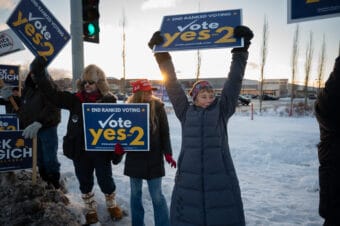
Dorthy Smith (right) waves a sign in support of Ballot Measure 2 in Anchorage on Monday, Nov. 4, 2024. (Matt Faubion/Alaska Public Media)

Ballot Measure 2, the effort to repeal Alaska’s ranked choice voting and open primaries, was winning slightly as election results continued to come in early Wednesday, with about 97% of Alaska precincts counted.

Wednesday results showed Ballot Measure 2 ahead by 4,289 votes, out of a total of more than 256,000 ballots cast. That’s a margin of less than 2 percentage points.

The other initiative on Alaska voters’ ballots, to increase the state’s minimum wage, appeared headed to victory, with a margin of 13 percentage points.

Loren Leman, a former Republican lieutenant governor who worked with the campaign to repeal ranked choice voting and open primaries, pointed to the Ballot Measure 2 campaign being outspent 100-to-1.

“I think just the very fact that the numbers are that close, even after they spent all the money, says that Alaskans don’t really want the complexities of ranked choice voting, and it’s confusing to a lot of people and it’s unnecessary,” Leman said.

View the full results here.

Anchorage attorney Scott Kendall, an architect of the 2020 ranked choice voting law and an opponent of 2024’s Ballot Measure 2, said he was feeling positive as results showed the margin between “yes” and “no” votes narrowing late Tuesday.

“We knew this would be a tight race,” Kendall said. “However, when it comes to outstanding votes, it’s like real estate: location, location, location. It’s noteworthy that in our strongest core of support in rural Alaska, very few votes are in.”

Alaskans had narrowly adopted the voting method in 2020. It was first deployed in 2022, in a special election for U.S. House that Democrat Mary Peltola won.

The system’s fans say it encourages bipartisanship and gives candidates an incentive to appeal to a broader swath of the electorate.

But opponents, especially conservatives and the state’s Republican Party, never liked it.

Jeff Fenske, who was waving campaign signs in Midtown Anchorage before polls closed, said he didn’t trust the tabulation process and he really resented that the opponents of repeal were able to raise so much money from out of state to keep ranked choice voting.

“It doesn’t help the conservative cause at all,” Fenske said. “You know, they just made up a bunch of stuff, and they have so much money for those ads that they were able to manipulate people’s opinion.”

The new system did away with partisan primaries. Instead, candidates of any party and stripe appeared on the same August ballot. The top four finishers — or more, in the case of presidential elections — advanced to the November ballot.

In the general election, ranking gave voters the opportunity to participate in an “instant runoff.” Voters could choose their favorite and also rank the remaining candidates to indicate where they’d like their ballot to go if their No. 1 choice was eliminated.

Toby Ovod-Everett of Anchorage waved on “No on 2” at rush-hour traffic. He said the open primary and ranked choice voting produces “less bickering and more governing.”

“I’d like to see more centrist candidates, candidates that I would agree with less, but that I could feel like were maybe beginning to combat this hyper-partisanship that is taking over the country,” Ovod-Everett said.

No on 2 ran a $14 million campaign, pitching the issue as one of “voter freedom” — meaning the freedom to vote a ballot that includes all the primary candidates, regardless of party. Some of their ads suggested veterans would be “forced to join a political party in order to vote for the candidate we want.”

Before the 2020 election reforms, the Republican party limited access to its ballot but still allowed unaffiliated voters to vote in its primary. Leman called the No on 2 claims misleading, because no one was forced to join the Republican party to vote in the GOP primary.

“It was an open primary, or you can say a semi-open: It was open to all voters, 80% of the voters of Alaska, except for those who chose to be registered to another party,” he said.

The Yes on 2 campaign raised barely more than $150,000.

Thousands of ballots remain to be counted over the next 15 days, but if Ballot Measure 2 passes, parties would regain the right to close their primaries to the extent they choose.

If voters do end up approving Ballot Measure 1, the state’s minimum wage would increase in steps, to $13 an hour in 2025, $14 in 2026 and $15 in 2027. The initiative would also require that the state’s minimum wage is set at least $2 more than the federal minimum wage and require paid sick leave for many employees.

This story has been updated. 

Find the latest election results at ktoo.org/elections

Site notifications
Update notification options
Subscribe to notifications