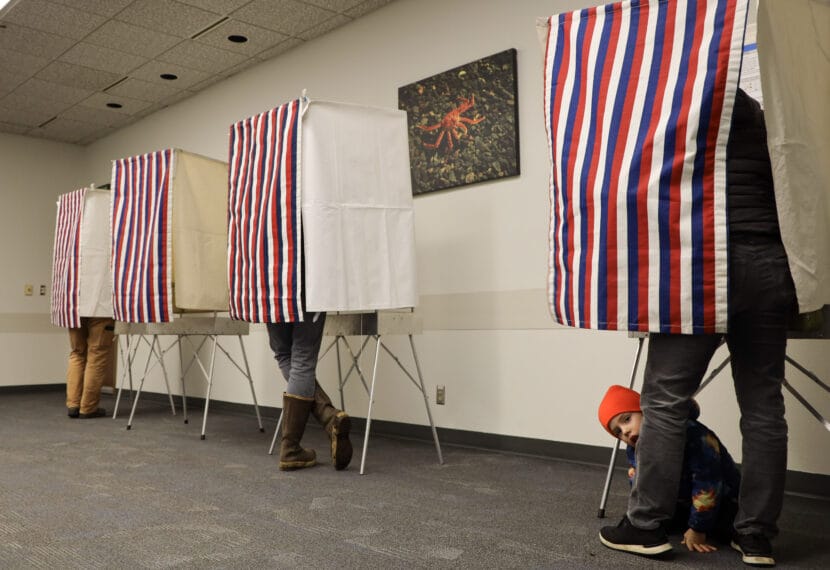
McClain Taylor-Manning, 4, waits patiently as his mother, Jackie Manning, votes at Centennial Hall on Tuesday, Nov. 5, 2024. (Clarise Larson/KTOO)
Election Day was stormy in Juneau, but voters moved steadily through polling places as they dispatched their civic duty.
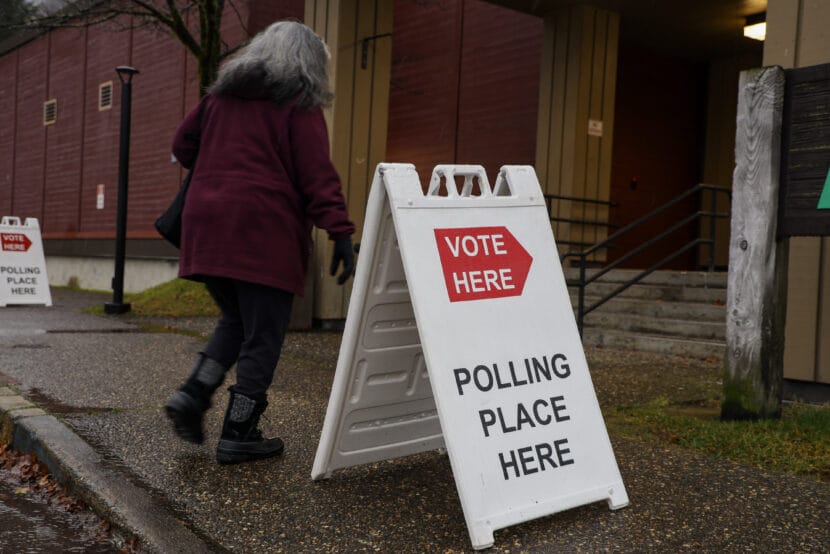
Out at the Auke Bay Ferry Terminal, gusts of wind kept knocking down the “vote here” sign. While election workers tacked it back up, voters trickled in and out of the voting center.
David Gaudet has been voting in Juneau since 1984.
“I have never missed an election. I just think it’s our duty to do that,” he said.
Gaudet wouldn’t say which candidates he chose, but he said he’s glad he got to express his support of ranked-choice voting.
“I was unhappy to see it trying to be repealed. But I was happy to be able to vote that I like it again,” he said.
This year was Oliver Sheufelt’s first time voting in a presidential election in Juneau.
“Everybody’s got to chip in and do your civic duty, just like taking out the trash and going to the dentist. It’s just one of those things for societal health that’s important,” they said.
They also said that it was important for them to vote to keep ranked-choice voting and that they chose Mary Peltola for Alaska’s U.S. House seat and Vice President Kamala Harris for President.
At the University of Alaska Southeast Rec Center, Valley residents stopped to vote in between work, classes and family obligations.
James Pietan said he voted to repeal ranked-choice voting and for former President Donald Trump.
Gunnar Tarver said he also voted for Trump. He reflected on the historical importance of voting and American democracy.
“Like for the generations before us, they all fought on the line with their lives, and they got us this right, and so I think it’s good for us to exhibit it,” he said.
Linda Blefgen said she’s always voted.
“It’s part of being a citizen and having a voice, and this election, particularly as a woman, this is not one to miss,” she said.
Blefgen said she’s a Harris vote and she’s supporting ranked-choice voting, too.
A voter heads into the Centennial Hall voting precinct on Tuesday, Nov. 5, 2024. (Clarise Larson/KTOO)
At Centennial Hall downtown, Liam Parrott, a member of the U.S. Coast Guard, said he also cast a vote to keep ranked-choice voting. He said that’s the only thing he really cared about on the ballot.
“I’m gonna be honest, I really don’t like any of these people that are running,” he said. “It’s pretty obvious that it’s only gonna be Kamala or Trump because everybody’s so polarized. It’s been very polarized for a long time now, and I don’t see it getting very better.”
A short while later, Shawn Hatt Cohen also steps out of Centennial Hall. She said she votes every election. She voted Democrat, like she always does.
“It’s just sort of the civic duty that I take very seriously,” she said. “I want to make sure democracy stays alive and well.”
Hatt Cohen said she supports Harris’ policies for reproductive rights and price gouging. Her eyes brimmed with tears when she shared what democracy means to her.
“I think it’s the freedom to live our lives as we choose,” she said.
Find live election results once the polls close at ktoo.org/elections. KTOO will carry Alaska Public Media’s live state election coverage from 9 p.m. to 11 p.m. Tuesday on 104.3 FM and online. That follows special live national coverage from NPR.
U.S. House Republican challenger Nick Begich III and Congresswoman Mary Peltola, a Democrat, presented their views Thursday at Debate for the State at Alaska Public Media. (Matt Faubion/Alaska Public Media)
The major candidates running for Alaska’s U.S. House seat squared off Thursday night in a debate in Anchorage, drawing out contrasts on abortion rights and presidential elections, and in personal style.
Democratic Congresswoman Mary Peltola made a forceful case for ensuring women have the right to end their pregnancies, especially because their lives are on the line.
“Being pregnant and delivering a baby is one of the most lethal things a woman can do in her lifetime,” Peltola said. “This is one of the deadliest propositions a woman can undertake. Myriad things can go wrong, and it is not anyone’s place in D.C. or in the state Legislature to get between a woman and her doctor.”
Republican challenger Nick Begich III said he didn’t support a national law banning abortion, nor one protecting abortion rights. He said each state should decide.
Begich, who has the endorsement of former President Donald Trump, voiced a variation on Trump’s false claim of election fraud. Begich alleged that election rules were changed in swing states in 2020 and that Google suppressed free speech as techniques to produce Joe Biden’s win.
“I think it’s acceptable and reasonable for any American to question, hey, is this reasonable? Is this what we expect in a free and fair election?” he said. “And I think the answer is a clear no.”
In other parts of the debate, Begich, a tech entrepreneur, spoke in business terms, about T-bills, liquidity and using cryptocurrency “as a hedge asset class for a devalued dollar.”
Peltola more often exuded empathy, such as for homeless children and victims of disaster and war. To a question about balancing gun rights and school safety, she said the common thread linking school shootings was an isolated perpetrator.
“We need to make sure that every child — every child in our community, every child in our school — feels seen and heard,” she said.
Begich raised competitive youth shooting leagues as a solution to school shootings.
“I believe that training responsible firearm ownership at an early age is a great way to push back against the risk that was just described,” he said.
As she has before, Peltola declined to endorse Kamala Harris, the Democratic nominee for president, or say whom she’d vote for. She said she’s running her own race.
“I don’t know why I would use up any of my gas on a race I don’t have any control over,” she said.
Debate for the State was broadcast from Alaska Public Media’s studio in collaboration with Alaska’s News Source.
After the broadcast ended, the candidates traded notes on the rigors of debating and campaign travel. They shook hands, and both said they wished they’d remembered to do that while the cameras were still rolling.
Donald Trump speaking at a campaign event in Michigan on Sept. 17. (C-SPAN)
Republican U.S. House candidate Nick Begich III has won the endorsement of former President Donald Trump.
Trump initially supported Lt. Gov. Nancy Dahlstrom for the seat, but she finished behind Begich in the primary and dropped out of the race. Two years ago, Trump endorsed former Alaska Gov. Sarah Palin and not Begich for Alaska’s sole seat in the House.
But in a social media post Tuesday Trump praised Begich as a successful small businessman who will help enact MAGA policies.
Also Tuesday, Trump seemed to confuse the name of an air base in Afghanistan with the controversy over whether to drill in the Arctic National Wildlife Refuge, or ANWR.
“We just have the best,” Trump said at a campaign event in Flint, Mich., referring to energy resources. “We have Bagram, in Alaska. They say it might be as big – might be bigger — than all of Saudi Arabia. I got it approved. Ronald Reagan couldn’t do it. Nobody could do it. In their first week they terminated. Check that one out: Bagram.”
About 30 seconds into his discussion on the subject, Trump seemed to realize his mistake and said “ANWR,” loosely linking the Arctic refuge to the U.S. departure from Bagram Air Base.
Trump’s style of speech has drawn attention in the campaign, especially now that he’s the oldest candidate in the race. He often jumps from subject to subject. He insisted Tuesday he doesn’t ramble.
“I give these long, sometimes very complex sentences and paragraphs, but they all come together,” he said.
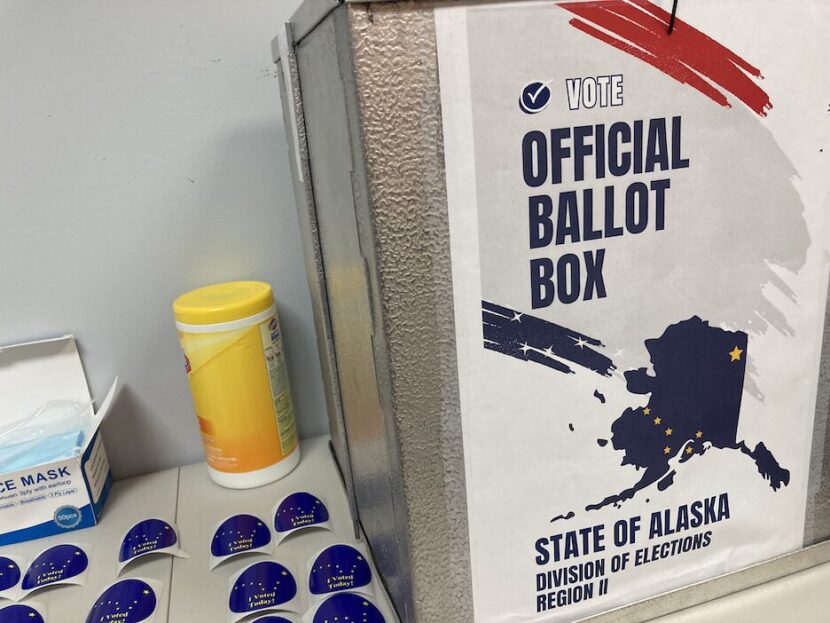
A ballot box containing absentee ballots dropped off at Anchorage City Hall is seen on Aug. 19, 2024. (Photo by Andrew Kitchenman/Alaska Beacon)
Alaska’s first ranked choice presidential election will include eight candidates, according to the final roster approved by the Alaska Division of Elections.
Because Alaska’s top-four primary election doesn’t apply to the presidential race, voters will be able to rank all eight options if they choose to do so.
The first ballots for the Nov. 5 general election are already being printed and are scheduled for mailing to international voters starting Friday.
On the front of the ballot are eight options for president:
Democratic candidate Kamala Harris
Independent Robert F. Kennedy Jr.
Libertarian Chase Oliver
American Solidarity Party nominee Peter Sonski
Independent Jill Stein
Constitution Party nominee Randall Terry
Republican candidate Donald Trump
Aurora Party nominee Cornel West
Kennedy announced in August that he would be suspending his presidential campaign and that he was endorsing Trump, but his campaign failed to remove his name from Alaska’s ballot after the August primary election.
Nationally, Stein is the Green Party’s presidential candidate; the Green Party of Alaska is unaffiliated with the national Green Party.
Alaska will be the second state to use ranked choice voting in a presidential election, following Maine’s experience in 2020.
But Maine’s experience is incomplete; its 2020 election didn’t need to use ranked choice tabulation because the winners of that election had at least 50% of the vote.
In Maine, as in Alaska, if a candidate earns more than 50% of the first-choice votes, they win without a need for ranked choice tabulation.
Maine distributes its Electoral College votes by congressional district and by statewide vote. In 2020, Democratic candidate Joe Biden won the statewide vote — worth two Electoral College votes — and one of the state’s congressional districts, while Republican candidate Donald Trump won the other congressional district.
In every one of Alaska’s presidential elections since 1992, the winner of the state has earned more than 50% of the overall vote.
Four years ago, Republican presidential candidate Donald Trump won Alaska’s three Electoral College votes after earning 52.8% of the state’s presidential votes. Democratic candidate Joe Biden had 42.8% of the vote here.
Four years before that, Trump earned 51.3% of the vote.
Back in 1992, independent candidate Ross Perot claimed 28.4% of the state’s presidential vote. Eventual winner, and Republican nominee, George H.W. Bush had 39.5% of the state’s vote.
The only other time that a candidate won with less than 50% of the state’s vote was in 1968, when Richard Nixon took 45.3% of the tally.
Alaska has voted for a Republican presidential candidate in every election since statehood except for 1964, when Democrat Lyndon Johnson won as part of a national landslide.
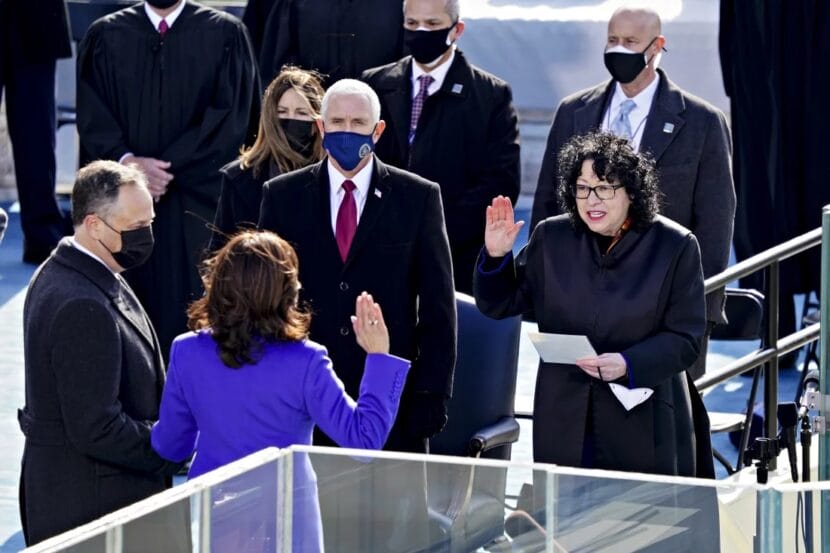
Supreme Court Justice Sonia Sotomayor (right) administers the oath of office to incoming Vice President Kamala Harris in front of the U.S. Capitol on Jan. 20, 2021, as outgoing Vice President Mike Pence (wearing blue mask) watches. (Kevin Dietsch/Getty Images)
“I was a little bit surprised, people might be surprised to hear that you have never interacted with him, met him face-to-face,” CNN’s Dana Bash said to Harris during their August interview.
Trump and Harris served in the federal government at the same time, but some logistical quirks and unusual decisions kept them from interacting directly in recent years.
Harris was elected to represent California in the U.S. Senate in 2016, during her second term as the state’s attorney general. Trump donated twice to reelect Harris as California attorney general, in 2011 and 2013, though she did not keep the money.
Trump won the presidential election the same year Harris was elected to the U.S. Senate, and both were sworn in to their respective positions in early 2017.
Presidential candidate Trump and vice presidential candidate Harris didn’t meet in person during the 2020 election (granted, the COVID-19 pandemic had forced much of the world online).
Harris did debate Trump’s running mate, Mike Pence, in October 2020. Remember the fly?
Trump and Harris might have crossed paths at President Biden’s inauguration in January 2021, two weeks after the Capitol riot that Trump is accused of stoking. But Trump decided not to attend, becoming the first former president to skip his successor’s inauguration since Andrew Johnson in 1869.
KTOO will carry the debate live on the radio starting at 5 p.m. AKST.
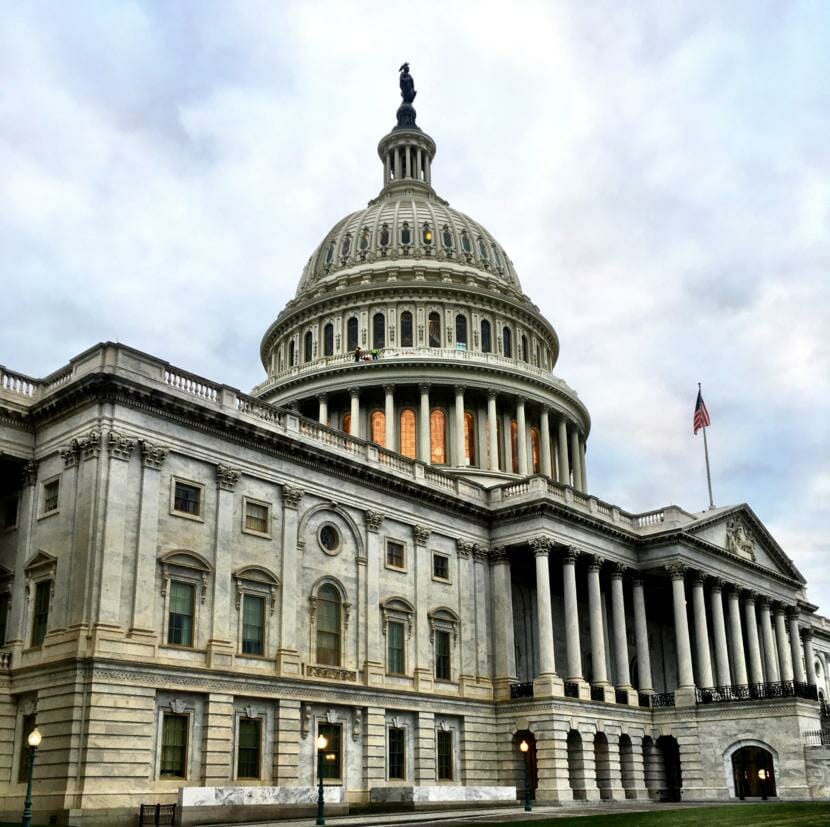
The U.S. Capitol building in Washington, D.C. (Photo by Liz Ruskin/Alaska Public Media)
Seattle has more power in the U.S. House of Representatives than the state of Alaska.
And yet, ahead of this year’s House elections, there’s as much at stake with Alaska’s race than all four of the contests in King County combined.
The vast majority of the 435 seats in the House are firmly Democratic or firmly Republican. Alaska is among a dwindling number of exceptions that could go in any direction.
More than that, it’s one of just five places in the country that voted for Donald Trump as president in 2020 yet elected a Democrat to the House in 2022.
The House is almost equally divided between Republicans and Democrats, and in a series of interviews and speeches throughout this year, current and former candidates for Alaska’s House seat have said the race could help decide which party controls the House.
In turn, that could affect the country’s direction on issues ranging from abortion to oil development to international affairs.
“We are down to the tiniest margins we’ve ever seen, like three or four people in the House and one in the Senate,” said Rep. Mary Peltola, the incumbent Democrat, in a January interview.
Control of the House will impact whoever wins the presidential race. A Republican-controlled House will support Donald Trump or act as a brake on Kamala Harris. The opposite is true if Democrats control the chamber.
“That’s exactly how I see it,” said Lt. Gov. Nancy Dahlstrom, a Republican candidate for House this year.
“I have President Trump’s endorsement. And so what that tells people is that when President Trump needs to talk to a congressperson from Alaska, he wants to call me, and he’s going to pick up the phone and call me, and he knows that we can work together, and we’re going to get things done together. You know, I think that’s important,” she said.
Candidates on the issues
Ahead of the primary, the Alaska Beacon asked all of the House candidates their opinions on 15 different issues suggested by you, our readers, and our reporters. Ten of the 12 candidates responded. See our questionnaire to read how they answered.
The candidates for the House include the Democratic incumbent, four Republicans, three nonpartisan candidates, one who didn’t declare a party, an additional Democrat, a member of the Alaskan Independence Party and a member of the No Labels Party.
Thousands of Alaskans are already voting absentee, and early voting begins Monday.
Election Day, for those who haven’t already voted, is Aug. 20. The four candidates who get the most votes will advance to the November general election.
Republican challenger Nick Begich said he thinks Alaska is at a “pivotal point” in its history.
“There’s really two camps as I see it,” he said in February. “There’s one camp that believes that Alaskans have a role as guardians of the state, that development should be diminished or eliminated. There’s another group of Alaskans who believe that our responsibility in Alaska extends to increasing development and that we have a role to play in our nation … as a source for critical minerals, base metals, energy in the form of oil and gas.”
And what’s at stake extends beyond what’s happening within Alaska itself.
“This time around, they’ve got some major issues they’re facing,” said Santa Claus, a socialist-leaning independent who finished sixth in the 2022 special U.S. House primary election.
He proceeded to rattle off a partial list: Social Security and Medicare; Russia and Ukraine; issues of abortion and contraception; student loans; education and libraries; LGBTQIA-Two Spirit issues, including with sports; wearing masks in schools should the pandemic or some other medical issue arise; gun control; cannabis and hemp; and oil and gas mining, fracking, pipelines and carbon capture.
“Issues like that, I think they’re all important, because this election is going to have a profound impact on how the American people view and deal and cope with those particular issues,” he said.
Democratic incumbent tries to focus on Alaska topics
Peltola is a Democrat who was elected twice in 2022: Once in a special election to fill the remainder of Republican Rep. Don Young’s term after his sudden death, and then again for a two-year term of her own.
Through March, she voted with her fellow Democrats on 88% of the votes in the House, a figure that appears to be high, but is the fourth-lowest among House Democrats.
Since Harris replaced Joe Biden as the Democratic presidential nominee, Peltola has declined to endorse her, in part because the congresswoman isn’t sure that Harris would support oil drilling within the state.
Like her Republican opponents, Peltola has repeatedly voted in favor of measures to allow more drilling here. The support hasn’t been universal — shevoted presentonone high-profile Arctic drilling bill because of a clause she disapproved of — but that was an unusualexception.
Peltola has also bucked her Democratic colleagues by voting against gun control measures and this year became the first Democratic member of Congress since 2020 to be endorsed by the National Rifle Association.
Speaking in January, Peltola said that in places where one member of Congress represents an entire state, “it doesn’t give the one representative for the entire state much latitude to be championing issues that aren’t directly Alaska-related.”
“Alaska is so big and so young that whoever is in the position that I’m in — in Congress — we are up to our eyeballs in issues,” she said.
That’s why, she said, she’s focused on fisheries issues, on energy topics and on consumer issues like her opposition to the grocery-store merger of Albertsons and Kroger.
That has upset some Democratic voters, who want her to take a stand against Israel’s attacks that have killed civilians in Gaza.
A Peltola fundraiser in Juneau was disrupted by a pro-Gaza speaker, and Claus, who previously endorsed Peltola, withdrew his support over the issue.
“I care about international issues of course,” Peltola said. “I want peace and prosperity across the world. But Alaskans sent me to Washington, D.C., to champion Alaska issues.”
Significant differences on reproductive health
Peltola differs from her principal Republican competitors on reproductive issues. Since entering office, she’s co-sponsored bills that would prohibit restrictions on abortion, birth control, and in vitro fertilization.
Some Republicans have expressed interest in using a 19th century law, the Comstock Act, to restrict birth control and abortions, and Republican control of the House or the presidency may cause a significant change in existing federal policy.
Republican Lt. Gov. Nancy Dahlstrom said in an interview that she is “pro life with exceptions of rape, incest and life of the mother,” but that abortion is “best left up to the states.” Republican candidate Nick Begich has said that while he supports the idea of allowing states to restrict abortion at a local level, he also would eliminate Medicaid funding for the practice and stop pharmacies from distributing mifepristone, a drug used in many abortions.
Among the nine lesser-known candidates in the race, Alaskan Independence Party candidate John Wayne Howe referred to abortion as “child murder” but said he doesn’t think Congress will act to restrict abortion.
“The people will not at the current time quit killing their children, as they are oppressed, and see only small value even in their own life,” he wrote.
Republican Gerald Heikes is strongly against abortion rights, saying in June that “there are no Christians in the Democratic Party” because of the party’s stance on abortion.
“When you vote for people that believe in the sacrifice of children, in abortion and abortion bills, you’re responsible for that innocent blood,” he said.
For Republicans, hopes of helping Trump — and oil
Heikes and another Republican candidate, Matthew Salisbury, haven’t received significant amounts of financial donations or support from local or national Republican Party officials.
They could nevertheless advance to the November general election under Alaska’s top-four primary, which winnows the candidate field to four people, regardless of party.
Howe, of the Alaskan Independence Party, could also be one of the four. During a May interview, he said he sees Alaska as a puppet of the federal government and believes the federal income tax system should be replaced with a program that allows people to choose which programs to support.
“Ideally, we would vote with our funds, if we didn’t have this tax structure that we do,” he said. “Ideally, all of the oil money that comes into the state would be given to individuals first, and then the individual would have a chance to state which department the money goes to.”
That isn’t a view shared by the two leading Republican candidates, Begich and Dahlstrom. Both have received substantial support from within and without the state, but each has expressed similar views about the state’s need to be allowed to drill for oil and mine for minerals in order to grow its economy and benefit its residents.
While Peltola may support oil drilling in Alaska, her Democratic counterparts in Congress and the White House generally do not, Begich and Dahlstrom have said, and regardless of Peltola’s views, electing her could result in further restrictions on development here.
“Oil and fossil fuels are and always will be central to Alaska’s economy. We have an abundant supply — very much contrary to the media spin saying otherwise — that we are not tapping into due to leftist policies pushed by Joe Biden and Mary Peltola,” Dahlstrom wrote in response to a question from the Alaska Beacon.
Both Begich and Dahlstrom have expressed hopes that Donald Trump will be reelected as president. During his first term in office, Trump signed the bill that opened parts of the Arctic National Wildlife Refuge to drilling, and he has pledged to renew that program, which was stopped by the Biden administration.
Begich has received support from members of the House Freedom Caucus, a group of more conservative Republicans who are sometimes at odds with the House’s current Republican leadership. Dahlstrom, meanwhile, has received support from the Republican House leadership and has Trump’s endorsement.
At the state Republican convention and in local meetings since, Republican officials within Alaska have thrown their support behind Begich, endorsing him for House even if it puts them at odds with Trump.
Dahlstrom, during an interview in late July, said she doesn’t think those local officials speak for all Republican voters in the state.
Begich, a firm opponent of ranked choice voting, has said that if he finishes behind Dahlstrom in the race, he will drop out in order to consolidate support behind her. Dahlstrom hasn’t made a similar promise.
Correction: The initial version of this article incorrectly described how Peltola voted on an Arctic drilling bill that contained a clause she disapproved of. She voted present on the bill, not against it.
Close
Update notification options
Subscribe to notifications
Subscribe
Get notifications about news related to the topics you care about. You can unsubscribe anytime.