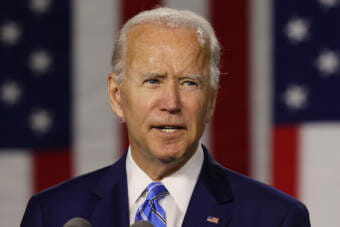
Former Vice President Joe Biden speaks at the Chase Center July 14, 2020 in Wilmington, Delaware. From the moment he launched his campaign, Joe Biden focused on what he called a “battle for the soul of our nation.” (Photo by Chip Somodevilla/Getty Images)
Updated at 4:15 p.m. AK
President-elect Joe Biden has realized a political dream that began nearly three decades ago. On Saturday, he crossed the 270-electoral vote threshold to win the presidency after securing Pennsylvania and its 20 electoral votes, according to the AP and other networks.
Biden is set to give remarks to the American people at 8 p.m. ET. Watch live here when it begins.
The former vice president’s path to being elected the 46th president of the United States was a tumultuous one, marked by unprecedented campaign challenges because of the coronavirus pandemic and an incumbent opponent who declared a premature victory.
President Trump on Saturday signaled that he has no intention of conceding the race.
Biden’s triumph came in the midst of a series of last-minute legal actions taken by the Trump campaign, seeking to halt the processing and counting of mail-in ballots in some contentious swing states while pushing for a recount in others.
Beginning very early on in his bid for reelection, Trump and his surrogates sought to undermine the democratic process, falsely asserting that the increase in mail-in ballots, largely driven by the pandemic, would lead to widespread fraud. That stance primed the president’s supporters for his eventual false claim that Democrats were trying to steal the election.
Early data suggests about 160 million Americans voted this election, according to the U.S. Elections Project, a turnout-tracking database run by University of Florida professor Michael McDonald.
Updated at 8:12 a.m. AK
Former Vice President Joe Biden has been elected the 46th president of the United States, narrowly emerging victorious from a contentious White House campaign that stretched days past election night, as vote tallies in several swing states were slowed by an unprecedented surge in mail-in ballots.
Biden edged President Trump, who in the days since voting ended has falsely claimed a premature victory and baselessly said Democrats were trying to steal the election. The Trump campaign is still contesting the process in several states, and said in a statement on Saturday: “This election is far from over.”
Despite the president’s rhetoric, Biden’s team projected confidence as ballots were tabulated, knowing that large chunks of the vote still to be counted were in diverse Democratic strongholds like Milwaukee, Detroit and Philadelphia.
The Associated Press called the race for Biden on Saturday when it said that Pennsylvania’s 20 electoral votes put him over the 270-vote threshold needed to win the Electoral College.
It’s a fitting tipping point state. Biden was born in Pennsylvania and launched his campaign with rallies in Pittsburgh and Philadelphia. He spent Election Day visiting his childhood home in Scranton and then rallying supporters in Philadelphia.
“America, I’m honored that you have chosen me to lead our great country,” Biden tweeted on Saturday. “The work ahead of us will be hard, but I promise you this: I will be a President for all Americans — whether you voted for me or not. I will keep the faith that you have placed in me.”
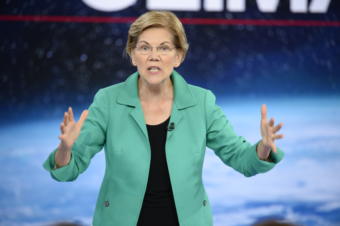
Massachusetts U.S. Sen. Elizabeth Warren was one of two candidates to say the word “Alaska” at the CNN Democratic Presidential Town Hall on climate change in New York on Wednesday. But it was only a passing reference. (Photo by CNN)
Ten Democratic candidates devoted a total of seven hours to the issue of climate change at a CNN town hall Wednesday. But they never discussed Alaska, according to transcripts, even though the state is is the fastest-warming in the country.
“They’re in that election, East Coast bubble and that’s what they talk about,” said Mark Begich, a Democrat who represented Alaska in the U.S. Senate between 2009-2015.
Begich said it was “amazing” that there wasn’t more discussion of his home state, given that it’s “ground zero” for the effects of climate change.
“You betcha, they’ll get a few comments from me,” he added, referring to the Democratic presidential candidates. “I will send off some texts to the ones that I communicate with and say, ‘Don’t forget Alaska.’”
Rep. Andy Josephson, D-Anchorage, speaks during a hearing at the Capitol in March. (Photo by Skip Gray/360 North)
“Look at the impacts, especially in the Arctic,” Begich said. “We’re like the lab of climate change that encompasses every element of the environment.”
The Democratic presidential candidates did devote ample time to policies that would affect national and global carbon emissions — which could in turn affect the rate of warming in Alaska. Many of them endorsed the idea of carbon taxes or fees, and some proposed banning the leasing of federal lands and offshore areas for fossil fuel production.
The word “Alaska” was uttered five times during the debate, according to transcripts — and three of those were references by Bill Weir, CNN’s climate correspondent, to a recent trip to the state.
The fourth time was when Massachusetts U.S. Sen. Elizabeth Warren said that in thinking about climate change, “We have to think about the whole world.”
“We can’t just think about cleaning up the United States of America,” she said. “We cannot think about from the East Coast to the West Coast, plus Hawaii and Alaska.”
The only other mention was a quick reference by New Jersey U.S. Sen. Cory Booker, when he was arguing for a ban on offshore drilling.
“Why? Because when we know they drill, they spill,” he said. “Ask Alaska. Ask California. Ask the Gulf Coast.”
Casey Steinau, the Alaska Democratic Party chair, said she and other party leaders try to bring up the subject of global warming in their conversations with national figures. And she noted that Democratic former President Barack Obama visited the state in 2015 to highlight his climate policies.
The state party, she added, will have a climatologist, Brian Brettschneider, deliver the keynote speech at its gala next week.
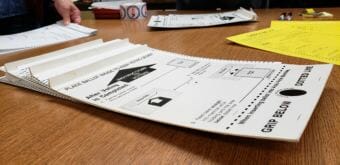
A poll worker at the Juneau Fire Station lays out ballot privacy folders on Oct. 2, 2018, Juneau’s municipal Election Day. (Photo by Jeremy Hsieh/KTOO)
Nationwide, local election officials are dealing with a myriad of issues ahead of November’s contentious midterms, not least of which is securing systems from malicious actors. One lesser-known problem that continues to concern them is the national shortage of poll workers.
They greet you at the plastic folding table set up in your neighborhood’s library, church or fire station, asking you for your name, address and, depending on your state, photo ID before handing you a ballot or directing you to a voting machine. More than just glorified receptionists, these underpaid few are really the gatekeepers to democracy.
Poll workers can be the difference between a smooth election and long lines, mass confusion and miscounted ballots. But poll workers are older, less prepared and becoming scarcer.
In its 2016 biennial survey, the U.S. Election Assistance Commission found that two-thirds of jurisdictions had a hard time recruiting enough poll workers on Election Day, compared to fewer than half of officials in 2008 and 2012.
Solving the Shortage
The shortage is a matter of recruitment and retention, said Aerion Abney, the Pennsylvania state director for All Voting is Local, a project of the Washington, D.C.-based nonprofit Leadership Conference Education Fund.
“I recognize that being a poll worker is not the most glamorous job,” Abney said. “People might not even be aware of it. Being a poll worker is an underappreciated job, but they provide a critical service to the public. We want to make sure people know this is an opportunity that exists.”
All Voting is Local organizers claim it is the first multistate effort to recruit poll workers. The project launched its online campaign last month, while also targeting Arizona, Florida, Ohio, Pennsylvania and Wisconsin through billboard, digital newspaper, radio and social media ads.
Organizers want to make sure poll workers reflect the communities in which they serve to make voters feel more welcome, focusing especially on people of color and younger people.
Poll workers tend to be middle-aged or elderly. Indeed, 56 percent of poll workers in 2016 were 61 and older, according to the Election Assistance Commission survey. Younger people often have work or school conflicts, Abney said.
He has traveled around Pennsylvania, showing up at community events and local election offices to spread the word of their initiative. After all, he tells people, it’s an opportunity to be civically engaged and get paid. There is no set salary for poll workers statewide, but poll workers in Allegheny County, for example, earn between $115 and $140 a day.
The group’s efforts seem to be working. Nationally, organizers have recruited more than 2,400 people — 924 of whom live in Pennsylvania, where organizers have spent more time because needs are more acute.
Cherie DeBrest was ready to sign up to be a poll worker in Pennsylvania. For 18 years, she worked with parents and caregivers as a social worker at the Children’s Hospital of Philadelphia, guiding them through the obstacles of medical care. Over the last three presidential elections, DeBrest, 49, led voter registration drives at the hospital, registering staff and the family members of patients whenever she could.
Until this election, though, she never sought to become a poll worker on Election Day. For years, she’s noticed poll workers were much older than her. Who, other than retirees, has the time to take off work on a Tuesday, she thought. But when she saw the city was looking for new poll workers, she figured it was time to act. “I was already thinking about it,” she said. “There’s no time like the present, so I got on the website and signed up.”
Counties and states have tried to recruit new poll workers for years. Local election officials are even targeting high schoolers for the job.
After Hamilton County, Ohio, implemented electronic poll books in 2015, county officials partnered with local pizza chain LaRosa’s to hold a countywide competition to see which high school could contribute the most poll workers. The winning school gets a pizza party, and students who serve earn $181.50 for the day.
The benefits of younger poll workers are undeniable, said Sherry Poland, the director of elections in Hamilton County, Ohio. They bring enthusiasm, energy and a familiarity and comfort with technology like electronic poll books and optical ballot scanners, she said. They also are more likely to remain poll workers for future elections.
“It sparks an interest in voting and civic engagement at an early age that might last a lifetime,” Poland said.
Hamilton County had only four high school poll workers in 2012, Poland said. In 2016 it had 367 — 14 percent of the county’s poll workers that year, she added.
In 2016, Ohio, California, Delaware and Michigan were the only states where more than 10 percent of poll workers were 25 or younger, according to the Election Assistance Commission. (Washington, D.C. also beat the 10 percent standard, which was the national average.) A quarter of poll workers in California were 25 and younger.
Hamilton County, however, still struggles to get enough poll workers for elections, following the national trend, Poland said. It’s an “extremely long day,” she said, and getting people to commit to a four-hour training class, a two-hour precinct set-up, and a 15-hour Election Day is difficult.
More than half of states allow students over 16 or 17 years old to serve as poll workers, according to the Election Assistance Commission.
The Training Gap
In 2013, President Barack Obama ordered a review of election procedures after the 2012 presidential election was plagued with long lines. One of the “signal weaknesses” of the U.S. election system, a national commission found, was “the absence of a dependable, well-trained corps of poll workers.”
The primary causes of the problem, according to a 2014 report from New York-based think tank Demos, are a lack of uniform training before Election Day, disparate wages, and little recruitment among public employees and high school and college students.
The study found that only 30 states require that all poll workers receive training. Good poll workers boost voters’ confidence in elections, according to a poll of 2016 voters from nonprofit Democracy Fund. Jurisdictions across the country need to find creative solutionsto recruit and train new poll workers, the foundation said.
In some places, that’s already happening. Employees of Maricopa County, Arizona, for example, can serve as election workers without taking personal time off. Franklin County, Ohio, recruits new poll workers from local businesses, while Brevard County, Florida, has invited 1,700 poll workers since 2012 to receive additional, hands-on training before Election Day.
In certain states, nonvoters, many of whom speak a foreign language, also can serve as poll workers. Since 2013, lawful permanent residents in California have been able to serve as poll workers, and many may be able to help the over 2.6 million eligible voters in the state who aren’t fully proficient in English, according to Asian Americans Advancing Justice-Los Angeles.
At least 24 percent of Los Angeles County’s poll workers are required to be bilingual in one of 16 languages, according to the Orange County Register.
In February, Gwinnett County, Georgia, held recruitment events in the Atlanta area to try to find 350 Spanish-speaking poll workers.
When DeBrest went into her training last week, she had plenty of questions and was ready to learn as much as she could before Election Day. She wants to be ready if a voting machine malfunctions, a voter needs language assistance, or a person with a disability has an access problem.
She’s also recruited some of the hospital’s language interpreters to help at some of Philadelphia’s precincts. The two Spanish speakers and one Arabic speaker she brought on may not have the right to vote as noncitizens, she said, but they can still assist in the electoral process in a meaningful way.
She hopes her friends and colleagues at the children’s hospital will join her as poll workers in future elections.
“I’m passionate about putting my words into action and bringing people with me,” she said. “Hopefully, when they see that I followed through on everything I was preaching about voter engagement, they will feel motivated to do the same.”
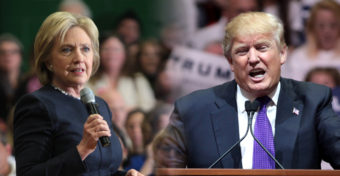
Hillary Clinton speaks at an event in Manchester, New Hampshire, Jan. 22, 2016, and Donald Trump speaks with supporters at a campaign rally at the South Point Arena in Las Vegas, Nevada, Feb. 22, 2016. (Creative Commons photos by GageSkidmore)
FBI Director James Comey said this week that he is “mildly nauseous” at the idea that the FBI may have swayed the presidential election results. A new report may ease that nausea if only a little.
“We would conclude there is at best, mixed evidence to suggest that the FBI announcement tipped the scales of the race,” wrote a panel of polling experts in a report released Thursday, about the FBI’s Oct. 28 announcement that it was investigating new information regarding Hillary Clinton’s emails.
The new report, from the American Association for Public Opinion Research, goes far beyond the Comey letter, however. More than a dozen pollsters and public opinion experts worked for months to determine what might have led polls to overestimate Clinton’s support. They found that state-level polls were particularly far off from the final election results, leading many forecasters to overestimate Clinton’s chances of winning.
In response, the experts called for improvements in state-level polling to ensure that the polling profession doesn’t suffer another “black eye” in coming years.
Here’s a summary of which polls were off and the reasons for the miss, according to the researchers — as well as factors that, as it turned out, didn’t seem to affect things much.
State polls were “historically bad”
By far, more Americans believed Clinton would win than Donald Trump. Ahead of the election, half of Americans thought she would, per one Economist/YouGov poll, compared with only 27 percent who believed it would be Trump. Forecasting models doubtless contributed to that belief for at least some voters. Predictions from some of the most popular models (FiveThirtyEight and the New York Times‘ Upshot, for example) ranged from giving Clinton a 71 percent to 99 percent chance of winning.
So when she lost, everyone (including NPR) tried to answer the question: Why did polls — and, therefore, forecasting models — so often point to a Clinton win?
First of all, only some polls were off, and it wasn’t the national polls. Clinton won the popular vote by 2.1 percentage points, and polls had her winning the popular vote by an average of 3 points. That’s not much of a gap at all, compared with past presidential polling.
But state polls were off by an average of 5 points, the largest average since 2000. This is where the researchers drilled down into the whys of what went wrong.
Late deciders in swing states ended up going significantly pro-Trump
Part of the discrepancy between votes and polls was that voters did change their minds late — but it wasn’t necessarily because of Comey. The decline in Clinton’s support, the report finds, may have begun as early as Oct. 22, whereas Comey’s announcement came on Oct. 28. That doesn’t disprove that Comey’s letter changed things, but it does suggest other factors were depressing Clinton’s support at around the same time.
“The question is whether the letter made the decline more severe or somehow prevented her support from rebounding,” said Courtney Kennedy, director of survey research at the Pew Research Center and a co-author of the report, at a Thursday event at the National Press Club. “I think that’s an important question, but it’s not knowable with the data available to us.”
Altogether, about 13 percent of voters nationally made up their minds in the final week, according to Pew data reviewed by the researchers. That’s in line with past elections. However, in the swing states of Wisconsin, Florida, Michigan and Pennsylvania, those late-deciding voters were far more likely to vote for Trump than for Clinton.
Nationwide, 45 percent of the late-deciding voters ended up voting for Trump, compared with 42 percent for Clinton. But in Michigan, for example, it was 50 percent for Trump and 39 percent for Clinton — and that was the smallest margin of these four states. In Wisconsin, meanwhile, it was 59 percent Trump and 30 percent Clinton.
“If we look back about the campaign events at that time, it was in those states — Wisconsin, Michigan — where you had the campaigns shifting their strategy at the very end of the campaign,” Kennedy said.
Critics lambasted Clinton’s swing state strategy, saying she did not invest enough time or manpower in places like Wisconsin and Michigan, particularly in the final days of campaigning.
Voters’ education was another area that seemed to throw pollsters off. Voting patterns by education ended up being far different from what they had been in 2012.
In particular, the authors point out, the data show a U-shape in 2012 — people with high school diplomas only and postgrad degrees tended to vote more Democratic that year, while people in the middle (with college degrees or some college) were less Democratic. In 2016, it was more linear: The lowest-educated people were relatively more likely to vote for Trump.
Among higher-educated groups, people were more likely to vote for Clinton, with postgraduates by far the most likely to vote for her.
The problem is that pollsters didn’t account for that, Kennedy said. Survey researchers do know that higher-educated people are more likely to participate in surveys. However, not all surveys factor that in.
“In 2016, that mattered,” she said. “Some elections you might get by without adjusting on education, but in 2016, you had to adjust on education.”
One final factor that could have thrown polls off is turnout. Turnout patterns clearly boosted Trump. The counties where President Obama performed worst in 2012 had higher turnout increases, while the counties that highly favored him had lower turnout increases, as the report points out.
The question is whether that different kind of turnout pattern threw off how pollsters adjusted their results. That seems plausible, said one researcher.
“To the extent that pollsters relied on 2012 as a model for the electorate either demographically or otherwise, there’s the potential that that introduced error,” said Mark Blumenthal, head of election polling for SurveyMonkey and one of the report’s authors, at Thursday’s event. “For that reason, our conclusion is that turnout probably was one of the two or three things that introduced error into this process; it’s just very difficult for us to quantify it. It’s kind of an incomplete. It’s a story that’s not completely told.”
What probably didn’t affect the polls (much)
“Shy Trump voters” came up a lot in the run-up to the election, referring to the worry that Trump voters were reluctant to tell a live pollster that they supported him.
That doesn’t appear to be true.
“The committee tested that hypothesis in five different ways,” said Kennedy. “And each test yielded either no evidence whatsoever to support that hypothesis or weak evidence.”
If there were this “shy Trump voter” effect, the authors wrote, there should be some sort of evidence that robopolls (that is, automated phone polls) and Internet polls consistently showed Trump doing better than the phone polls, for example. That didn’t happen. Robopolls did tend to show Trump with better support than in live-phone polls, but Internet-only polls tended to show him doing worse.
One other issue that didn’t seem to matter much was “nonresponse bias.” This is the idea that certain groups will respond to polls more often than others, thus biasing the results. There’s a reason survey researchers worry about this: People participate in phone polls far less often than they did in the past.
As explained above, some groups (like less educated Americans) often participate in polls less than others. But when the researchers broke this down by geography, they did not find that pro-Trump areas were any less likely to be represented, on average, than pro-Clinton areas. Furthermore, they didn’t find that the relatively correct national polls were right just because Clinton- and Trump-favoring polls nationwide canceled each other out.
What now?
Though many 2016 polls were indeed off, the authors hope it won’t sour Americans on polling altogether. “The difficulties for election polls in 2016 are not an indictment on all of survey research or even all of polling,” the report said.
They also voiced some anger about the fact that a few bad polls can make all pollsters look bad.
“It is a persistent frustration within polling and the larger survey research community that the profession is judged based on how these often under-budgeted state polls perform relative to the election outcome,” they wrote.
For that reason, they propose a greater investment in state-level polling: “Well-resourced survey organizations might have enough common interest in financing some high-quality state-level polls so as to reduce the likelihood of another black eye for the profession.”
And one more thing: The researchers wag a collective finger at election forecasters, saying that “they helped crystalize the belief that Clinton was a shoo-in for president, with unknown consequences for turnout.”
What to do about that is unclear — even some of the people producing those forecasts advised caution. The pollsters even point to a quote from FiveThirtyEight’s Nate Silver in this regard.
“It’s irresponsible to blame the polls for the overconfidence in Clinton’s chances,” he said. “They showed a competitive, uncertain race.”
Copyright 2017 NPR. To see more, visit http://www.npr.org/.
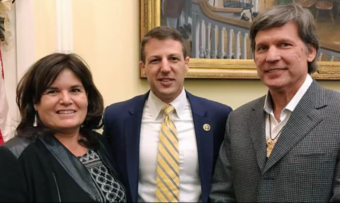
Central Council of Tlingit and Haida Indian Tribes of Alaska Fourth Vice President Jacqueline Pata, left, poses with Trump Native American Coalition Chairman Markwayne Mullin and Tlingit-Haida Central Council Second Vice President Will Micklin during a mid-December listening session. (Photo courtesy Central Council of Tlingit and Haida Indian Tribes of Alaska)
President Donald Trump angered many Native activists by moving to restart Dakota Access Pipeline construction.
Thousands have protested the line, saying a portion of it could poison the Standing Rock Sioux’s water supply. They also see the move as an affront to tribal sovereignty.
But before Trump’s inauguration, his transition team met with Native leaders to ask what they wanted out of the new administration.
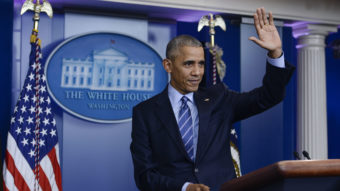
The coalition, formed just before November’s election, is chaired by Republican U.S. Rep. Markwayne Mullin, a member of the Cherokee Nation of Oklahoma.
“There are things in this administration’s agenda that we can find common ground on, like infrastructure development, like improving the economies of our communities,” she said. “But tribal leaders made it really clear tribes are governments and should be treated as such and respected as such.”
She said tribal leaders brought up health care, government contracting, education and resource extraction. That included opposition to the Dakota Access Pipeline.
“Tribal leaders said things like, ‘We’re not opposed to development. But we want to be able to make sure that we have a meaningful place and that our consent is part of the process of evaluating the permits that may affect our lands,'” she said.
Some leaders went into the mid-December meetings angered by reports that the coalition’s chairman wanted to take tribal lands out of tribal hands.
Tlingit-Haida Central Council’s Will Micklin, who also attended the meeting, said those reports were refuted.
“He assured me he had no intention of privatizing tribal lands,” he said. “It was a misinterpretation of his desire to make productive the tribal estate, which are tribal lands.”
Micklin said an overriding issue was the future of Obamacare.
“We’re concerned that the repeal of the affordable health care act not also repeal the Indian Health Care (Improvement) Act and not reduce funding for it from our other funding sources,” he said.
Another issue to watch was land into trust, which allows tribal governments to transfer title to the federal government and protects the land from taxation or seizure.
Alaska Native tribes have just begun using the program.
Mark Trahant is an independent journalist, professor and blogger on Native issues. (Photo courtesy Trahant Reports)
Mark Trahant is a former University of Alaska journalism professor and a blogger on Native issues. He’s a member of the Shoshone-Bannock Tribe now teaching at the University of North Dakota.
“That was kind of evolving late in the Obama administration. And now, (if) organizations and tribes want to follow through they’re going to need some sort of mechanical side to make the process work. And whether or not resources are put into that by the administration, I think will be interesting to see,” he said.
Changes in the state’s far north are also being watched by some Alaska Native leaders.
Trahant worries the new administration doesn’t know much about it, beyond the potential for oil and gas production.
That’s especially since Trump and members of his administration question the human role in climate change.
“Even thinking about the United States as an arctic nation and a changing arctic nation and what does that mean and what are the policy implications,” Trahant said. “The Obama administration had pushed very hard on the environmental side of that. But now you may see things like more interest in shipping lanes and resource extraction and that sort of arctic issues.”
Trahant predicts tribes will have fewer problems with Ryan Zinke, Trump’s pick to lead the Interior Department.
He said the Montana congressman understands tribal sovereignty and other key issues.
“The person who’s been nominated for Interior secretary is an avid fisherman,” Trahant said. “He understands the language of that and recognizes the importance of a healthy fishery, both as a food source and subsistence.”
Trump takes over from an administration that expanded relations with tribal governments and other Native groups.
Each department had a Native liaison who reached out and addressed concerns.
Tlingit-Haida Central Council’s Pata is among those hoping that continues in some form. But they say Obama will be a hard act to follow.
“What made a big difference was President Obama went to Indian country and when he saw it, it compelled him,” she said. “I’m hoping that we do get high-level officials from the Trump administration into Indian country and they will fulfill their desire to bring some of their drive for economic opportunity to Indian country as well.”
While most attended the Trump team’s Native coalition meetings were encouraged by the interest, they know many of their concerns don’t mesh with the new administration’s goals.
That’s certainly the case with the Dakota pipeline.
In his final press conference, Obama looked back on eight years, but pressing questions about Russian hacking and violence in Syria took center stage. Leigh Vogel/WireImage
President Obama held his final news conference of 2016 and painted a rosy picture of his tenure as president — from economic growth to foreign policy. So how did he hold up on the facts and what context did he leave out?
We look at five different quotes:
1. “The Syrian regime and its Russian and Iranian allies are trying to obfuscate the truth. The world should not be fooled, and the world will not forget.”
President Obama accuses Russia and Syria of trying to “obfuscate the truth” in the city of Aleppo but says the world will not be fooled and will not forget. He says they are to blame for the atrocities unfolding there. The president says he does feel responsible, too. He is defending his decision, though, not to take any military action to tip the balance in Syria. He says it couldn’t be done on the cheap. The Obama administration often argued that the choice was between diplomacy or military action, though activists argued there were other options short of sending in thousands of troops uninvited, including safe zones or targeted strikes on Syrian airfields to take out helicopters that were dropping barrel bombs and chlorine bombs on civilian areas.
— Michele Kelemen, diplomacy correspondent
2. “So with respect to Syria, what I have consistently done is taken the best course that I can to try to end the civil war while having also to take into account the long-term national security interests of the United States. And throughout this process, based on hours of meetings — if you tallied it up, days and weeks of meetings … we went through every option in painful detail with maps and we had our military and we had our aid agencies and we had our diplomatic teams, and sometimes, we’d bring in outsiders who were critics of ours.
“Whenever we went through it, the challenge was that short of putting large numbers of U.S. troops on the ground uninvited, without any international law mandate, without sufficient support from Congress, at a time when we still had troops in Afghanistan and we still had troops in Iraq and we had just gone through over a decade of war and spent trillions of dollars …”
President Obama talked about the only other option in Syria being large numbers of troops, but that’s not necessarily so. His national security advisers four years ago wanted him to arm and train the rebels on a large scale. He decided against it. One of those advisers was Gen. James Mattis, Donald Trump’s choice to run the Defense Department. Another was Hillary Clinton, as well as Obama’s former CIA Director David Petraeus.
Obama said permission, but he just sent 200 more. And Turkey never got permission but already has sent in combat troops, heading to Al Bab. — Tom Bowman, Pentagon reporter
3. “There was a survey some of you saw where — not this just one poll, but pretty credible source, 37 percent of Republican voters approve of Putin. Over a third of Republican voters approve of Vladimir Putin, the former head of the KGB. Ronald Reagan would roll over in his grave.”
Obama appears to be referring to a YouGov poll that showed a recent spike in Republicans’ favorability of Vladimir Putin. Pollster Will Jordan tweeted a chart of this on Wednesday:
“Back in July 2014 just 10 percent of Republicans held a favorable view of Putin, according to a poll conducted by the Economist and YouGov. By September of 2016, that number rose to 24 percent. And it’s even higher today: 37 percent of Republicans view Putin favorably, the poll found in December.”
Republicans’ favorability of Putin is still negative, but it is a sharp increase from where they were as recently as September. — Danielle Kurtzleben, political reporter
4. “[T]he median household income grew at the fastest rate on record. In fact, income gains were actually larger for households at the bottom and the middle than for those at the top.”
This is right — the median household income in the U.S. climbed by 5.2 percent between 2014 and 2015, to $56,516. That’s the biggest jump since the Census Bureau started keeping track in 1967.
U.S. Census Bureau
In addition, income growth at the bottom and middle was stronger than it was at the top by those census data. Growth at the 10th percentile level was around 7.9 percent, a rate that declined as one went up the income ladder toward the median (that is, the 50th percentile). Median income grew by 5.2 percent. For people at the 90th percentile, it grew by nearly 2.9 percent.
That said, how good the numbers look for lower income levels depends upon how they are sliced, not to mention which data one uses. As economist Emmanuel Saez pointed out at the Center for Equitable Growth in July, IRS data showed that incomes for people in the top percent of earners grew by 7.7 percent in 2015, compared with 3.9 percent for the bottom 99 percent. That’s still solid growth for the 99 percent, and it could still mean strong growth in the bottom tiers of earners, but it suggests that in the top sliver of earners, income growth was once again stronger than for many people in lower classes.
— Danielle Kurtzleben
5. “And where Democrats are characterized as coastal, liberal, latte-sipping, you know, politically correct, out-of-touch folks, we have to be in those communities. And I’ve seen that, when we are in those communities, it makes a difference. That’s how I became president. I became a U.S. senator not just because I had a strong base in Chicago, but because I was driving downstate Illinois and going to fish fries and sitting in VFW halls and talking to farmers.”
There’s no way of knowing how widespread the perception of Democrats as precious, out-of-touch, urban coastal elites is, nor how much it may have hurt Clinton and other Democrats in the election. However, it is altogether possible that the isolation from and resentment toward political power that many Americans feel pushed them to vote for Republicans. As one political scientist explained to NPR this year, that may be a force behind many rural Americans rejecting Clinton in favor of Trump.
And Clinton really did tend to do far worse in rural areas than in urban areas. Her performance in those rural areas was also worse than Obama’s in 2012, which in turn was worse than Obama’s performance in those areas in 2008. Those declines in rural areas were much larger than any declines that took place over those same periods in suburban or urban areas. — Danielle Kurtzleben
Copyright 2016 NPR. To see more, visit http://www.npr.org/.
Close
Update notification options
Subscribe to notifications
Subscribe
Get notifications about news related to the topics you care about. You can unsubscribe anytime.