Nation & World

Alaskans greet the Trump-Putin meeting with worry, hope and Ukrainian flags

man poses in front of a hotdog stand on an urban street.
Mike Bialy operates the Red Umbrella hotdog stand, two miles from the military base where Presidents Trump and Putin will meet. “I just hope everything goes smoothly,” he said. (Liz Ruskin/Alaska Public Media)

Mike Bialy operates a hotdog stand on Fourth Avenue in Anchorage, just two miles from Joint Base Elmendorf-Richardson, where President Donald Trump and Russian President Vladimir Putin plan to meet.

“I just hope everything goes smoothly, because I know a lot of the United States is kind of tense right now,” Bialy said, between customers. “And a lot of European countries, especially Ukraine, is really tense right now.”

Alaska has a long relationship with Russia, its across-the-strait neighbor. Alaska was once a Russian colony, served as a defensive bulwark for North America during the Cold War, and saw a period of warmer relations after the Soviet Union fell that has since cooled again.

While the Ukraine war is the main subject of the presidential meeting, many Alaskans wonder whether Putin will express Russia’s long-simmering sellers’ regret while he’s here. Czar Alexander II sold Alaska to the U.S. in 1867 for pennies an acre. The notion that Alaska should belong to Moscow is a theme among Russian patriots today. The Kremlin has not seriously proposed taking Alaska back, but some Alaskans are bracing for Putin to raise the issue, maybe as a joke, or to say that borders can be fluid to try to legitimize his seizure of Ukrainian territory.

Still, Lewis Baker thinks the meeting could be a boon for Anchorage.

Lewis Baker and his dog L.E. (pronounced “Ellie”). If the meeting leads to a peace accord, Anchorage “could be the new Versailles,” he says. (Liz Ruskin/Alaska Public Media)

It “puts us in the spotlight for a little bit,” he said, walking his brown retriever, L.E., down Fourth Avenue. “And if something good comes of it — which hopefully there will be — people would remember that.”

Anchorage, Baker said, might become a name associated with a peace deal or treaty, making Alaskans proud.

“It could be the new Versailles,” he said.

(Baker may be the first person to associate Anchorage, founded as a tent city in 1915, to the opulent French palace built in the 1600s where the Treaty of Versailles was signed.)

After the Ice Curtain of the Cold War melted, Alaskans could go to Russia and get to know their Russian neighbors. Civic and cultural organizations were established. Rick Mystrom was the mayor of Anchorage in the 1990s and traveled to Anchorage’s Russian sister city, Magadan. During a particularly tough winter, Mystrom helped organize coat drives for the community.

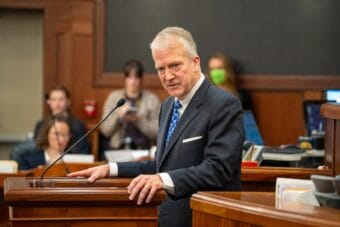
Rick Mystrom was mayor of Anchorage in the 1990s, when Alaska’s relationship with Russia’s Far East flourished. (Liz Ruskin/Alaska Public Media)

“We ended up sending three airplanes full of clothes and food to Magadan that year,” Mystrom recalled.

He said he still feels the spirit of those times.

“But my continued good feelings about the people of Russia doesn’t extend to Vladimir Putin,” he said.

Mystrom calls Putin a killer, citing the suspicious deaths of Kremlin opponents and critics, as well as the war on Ukraine.

“If I were mayor, I think I would have a hard time to give him a warm welcome to Anchorage,” Mystrom said. “I would be polite, but probably cold.”

Some in Anchorage plan to protest. Karen Colonell bought a dozen Ukrainian flags for the occasion and hopes Alaskans will show the world they stand against Russian aggression.

“We have some values that we need to uphold, and freedom is one of them,” she said.

Bill Gallanger questions the wisdom of waving the Ukrainian flag in Putin’s face. Gallanger grew up during hotter phases of the Cold War. He recalls doing duck-and-cover exercises in school.

“I don’t know why you’d want to be antagonistic to a leader of a nuclear country,” he said. “Seems like the normal thing is to be welcoming of a world leader that’s willing to come to America to discuss negotiations of great proportion, keeping us out of World War III.”

Retiree Bill Gallanger questions the wisdom of antagonizing the leader of a nuclear country. (Liz Ruskin/Alaska Public Media)

The White House has tamped down expectations for this meeting, calling it a “listening exercise.” And those who protest will have to do it from afar, since they won’t be allowed on the military base.

12 things to know about the historic Trump-Putin meeting in Anchorage

Army barracks on Joint Base Elmendorf-Richardson. (Emily Russell/Alaska Public Media)

President Donald Trump and Russian President Vladimir Putin will meet Friday at Anchorage’s Joint Base Elmendorf-Richardson.

Here are 12 things to know about the historic, and controversial, summit.

1. Where is the meeting taking place and when?  

Anchorage’s military base: Joint Base Elmendorf-Richardson.

But the White House has, so far, released few other additional details, like at what time they’ll meet and how long they’ll be here.

2. Wait. Why are they meeting in Anchorage? 

President Trump announced last Friday that they’d meet in Alaska. We’re not totally sure how they landed on the location.

Meetings like this often take months to plan, but this one came together in a week. CNN reported that scrambling organizers weighed other Alaska cities, too, and determined Anchorage was the only viable option. Within the city, only JBER met security requirements.

Also, Anchorage is about 4,300 miles from the Kremlin, and about 3,300 miles from the White House, so you could argue it’s sort of a midway point.

Otherwise, Alaska has a long and complicated history with Russia. Russia sold Alaska to the United States in 1867 and, during the Cold War, the Anchorage base was key in countering the Soviet Union.

3. Do we know what they’re talking about? 

Russia’s war with Ukraine.

This will be the first time Trump and Putin will meet face-to-face since Russia’s full-scale invasion of Ukraine.

But the White House has tamped down expectations of a breakthrough that might lead to a ceasefire. White House press secretary Karoline Leavitt said Tuesday that the meeting will be a “listening exercise” for Trump.

“Only one party that’s involved in this war is going to be present,” Leavitt said. “And so this is for the president to go and to get, again, a more firm and better understanding of how we can hopefully bring this war to an end.”

4. Has Putin ever visited the U.S. before? 

Several times. Most recently, in 2015, he was at the U.N. in New York for tense talks with then-President Obama over Ukraine and Syria. In 2001, he made a state visit, stopping in Washington, D.C., New York and Texas. In 2007, he visited then-President George W. Bush at the family compound in Kennebunkport, Maine. He’s also attended multiple international summits.

But this will be the first time Putin, or any Russian president, has visited Alaska.

5. But it’s not uncommon for world leaders to stop at JBER, right?

Right. In its prior incarnation, Elmendorf Air Force Base hosted many visits from presidents and world leaders, often because it was a convenient refueling stop for flights between Washington, D.C., and Asia, or between Europe and Asia. President Nixon and Emperor Hirohito met at the base in 1971, the first time the reigning monarch of Japan set foot on foreign soil. The next year, on his way home after his historic trip to China, Nixon spent the night at the home of Elmendorf’s top general.

Most presidents since statehood have landed at Elmendorf and met with local dignitaries or made some kind of address, including former President Biden and Trump during his first term. President Obama went farther afield on his 2015 trip to Alaska, even visiting Snow City Cafe in downtown Anchorage where he took selfies with fans and ordered cinnamon rolls.

President Donald Trump addresses troops at Joint Base Elmendorf-Richardson in 2019. (Air Force Staff Sgt. Westin Warburton)

6. Aside from the meeting, do we know what else Trump and Putin are doing in Alaska? 

So far, it looks like they are making a day trip of it. We’ve heard no plans for either of them to leave JBER.

7. Will there be any street closures or other traffic impacts I should know about? 

Not that we know of…yet.

As of Wednesday afternoon, Shannon McCarthy with the Alaska Department of Transportation said there were no anticipated street closures and no known traffic impacts in the city. Any updates on Friday will be posted to 511.alaska.gov.

8. I’m flying in or out of Anchorage on Friday. How will this affect my flight?

The Federal Aviation Administration issued a Temporary Flight Restriction over Anchorage airspace for Friday from 9:15 a.m. to 4:15 p.m. This restriction mainly impacts all non-commercial flights out of Anchorage airports, including sites like Merrill Field and Lake Hood.

But most commercial flights shouldn’t see any major disruptions, said Lex Yelverton at Ted Stevens Anchorage International Airport. She said some flights in and out of Ted Stevens on Friday may experience minor schedule changes or delays of anywhere from 15 to 45 minutes. It’s likely that the airport won’t receive exact information on which flights will be affected until Friday, so Yelverton said anyone travelling should be prepared for delays and build some extra time into their schedules. She said commercial airlines will have the most up-to-date information about specific flights.

9. Anchorage School District students return to class Thursday and Friday. What’s the district doing to prepare? 

In a message to students and families on Wednesday, ASD said school will go on as planned this week. The message said that schools around JBER, including the three public elementary schools on base, might experience “minor traffic disruptions, depending on how things play out once both presidents arrive.” In some areas of the city, there may be increased security or air activity, but ASD said they’re expecting any impacts to schools to be minimal.

10. What will security be like in the city?

Anchorage Police Department spokesman Chris Barraza said city police will have an increased presence around town, with additional officers on patrol starting late Thursday night. There will also be increased security on Friday at Ted Stevens Anchorage International Airport, according to the airport spokesperson.

11. Do we expect a big influx of people in the city for the meeting?

Yes.

Barraza, at APD, estimated 700 journalists from all over the world will be arriving in Anchorage this week. As of Wednesday afternoon, he couldn’t provide an exact number for dignitaries or other visitors related to the summit. And, of course, there are already a lot of visitors here because it’s peak tourism season in Alaska.

12. Are there any protests or rallies planned? 

Yes. There are protests and demonstrations planned all over the state in support of Ukraine and democracy, including in Homer, Fairbanks, Sitka and Petersburg.

In Anchorage, there are a few planned demonstrations: a peaceful protest in solidarity with Ukraine at 4:30 p.m. Thursday near the Midtown Mall, at the intersection of the Seward Highway and East Northern Lights Boulevard. Another protest is planned for noon on Friday on 510 L Street. Plus, Anchorage Stands with Ukraine plans to put up a massive Ukrainian flag on the Park Strip Friday afternoon.

The Alaska Republican Party is also planning a rally in support of Trump near the Midtown Mall on Friday from 11 a.m. to 1 p.m.

It’s JBER: Anchorage military base to host Trump-Putin summit

Joint Base Elmendorf-Richardson
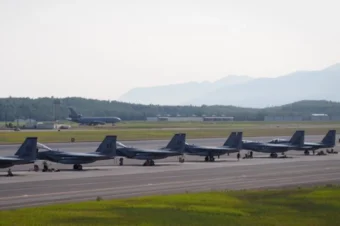
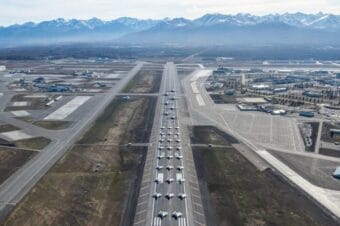
Fighter, support and transport aircraft assigned to Joint Base Elmendorf-Richardson fill a runway during a 2020 “elephant walk” demonstration. (Staff Sgt. Curt Beach/U.S. Air Force)

The White House has selected Joint Base Elmendorf-Richardson for Friday’s meeting of President Trump and Russian President Vladimir Putin, multiple media outlets are reporting. The reports don’t mention what time the leaders will meet.

The Trump administration has announced few details so far, but White House press secretary Karoline Leavitt said Tuesday that the meeting will be a “listening exercise” for Trump and that the two presidents are expected to meet one on one to discuss Russia’s war with Ukraine.

“Only one party that’s involved in this war is going to be present,” Leavitt said. “And so this is for the president to go and to get, again, a more firm and better understanding of how we can hopefully bring this war to an end.”

Meanwhile, progressives in Anchorage are planning demonstrations. Stand UP Alaska and Alaska March On, among other groups, announced they plan to demonstrate Thursday at 4:30 in Midtown and Friday at noon outside the Anchorage offices of Alaska’s U.S. senators.

Alaska woman submits Guinness bid for world’s largest mouth

Marie Pearl Zellmer Robinson’s open jaw clocks in at roughly three inches. (Photo courtesy of Marie Pearl Zellmer Robinson)

For most people, being told you have a big mouth is fighting words. But for one Alaskan, it could mean a world record.

Marie Pearl Zellmer Robinson of Ketchikan is going for the Guinness record for “largest mouth gape (female).” That’s how wide you can open your mouth vertically. Robinson says she’s wanted to be in the Guinness Book of World Records for a long time.

“Every time I see somebody do something amazing, I’m like, ‘Well, I can’t do that,’” she said. “But this one was one that I could do, and I surprised myself even.”

With her mouth closed, Robinson looks like anyone else. But not when she tilts her head back and opens wide. Robinson can easily fit a 12-oz. aluminum can between her teeth.
The current record, set by Samantha Ramsdell of Connecticut, is 6.52 centimeters. Ramsdell also holds the record for “world’s widest mouth” — she’s popular on social media for pushing things like wine bottles and Pringles cans past her shockingly wide-spread lips.

But when Robinson saw the height of Ramsdell’s open mouth, she thought she could do better. So she submitted an application to Guinness, and they accepted it.

But then she had to prove it. According to Robinson, there’s a very strict verification process. When she first went for the record over a year ago, she didn’t get the witness statements and the filming quite to Guinness’s exacting standards.

When she tried again, her gaping mouth had grown by a couple millimeters, which she attributes to practice. With her husband recording and local dentist David Albertson measuring with a set of steel calipers, Robinson’s open jaw clocked in at 7.62 centimeters. That’s about three inches — more than a centimeter larger than Ramsdell’s. The video and the numbers have been submitted to Guinness World Records.

Marie Pearl Zellmer Robinson’s open jaw clocks in at roughly three inches.
(Photo courtesy of Marie Pearl Zellmer Robinson)

Robinson has known she has a world-class mandible since she was a kid.

“I used to, as a child, shove large objects in my mouth for fun because, you know, when you have siblings you tend to stick stuff in your mouth,” she said. “To show off.”

Robinson said she doesn’t think the skill runs in the family, but it still may be genetic.

“I’m pretty sure what happened is my jaw is just positioned in such a way that it’s just slightly further back, like I can feel my jaw in my ear canal. Which most people apparently don’t,” she said.

Robinson and her husband co-founded a local delivery service called Ketch-A-Courier. Their white cars with a halibut on the side are hard to miss around town. But she says she was inspired to reach for fame by an earlier Ketchikan record.

A little over a decade ago, nearly 2,000 Ketchikan residents broke the world record for “largest rainboot race,” donning rainboots and marching across the Third Avenue Bypass. They were soon dethroned by an athletic club in Ireland.

Now it’s a waiting game for Robinson. She is hoping to see herself flexing her wide open mouth in the world record book by next year, if not sooner.

Ukraine invasion anniversary draws Fairbanks protest

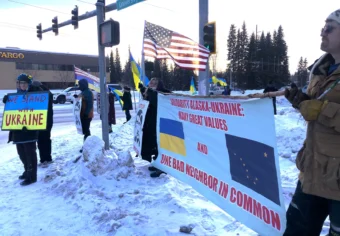
Protesters mark the third anniversary of the Russian invasion of Ukraine at the corner of Geist Road and University Avenue on Monday, Feb. 24, 2025. (Photo by Robyne/KUAC)

A couple dozen Fairbanksans sang songs and rallied on a main street corner this week, in an impromptu protest marking three years since Russia’s invasion of Ukraine.

The Monday crowd at Geist Road and University Avenue waved Ukrainian and American flags and carried anti-Russian banners and signs.

Women had sunflowers in their headpieces wrapped in yellow and blue ribbons over their coats.

Sveta Yamin-Pasternak says Alaskans need to take note of what’s happening in Ukraine because they have much in common.

“And I think especially it is relevant for all of us as Alaskans because we truly do share the same values with Ukraine,” Yamin-Pasternak said. “We’re also, unfortunately, currently sharing a hostile neighbor.”

She held a banner that said: “Solidarity Alaska and Ukraine, many great values, one bad neighbor in common.” Ryan Tinsley held up the other end.

“You have a full-on assault against Western democracy, led in part by Putin and his misinformation,” Tinsley said. “So, I think there is more and more in common with the fight in Ukraine, and with the West and Europe — you know, Western Europe and the U.S.”

Stacy Fritz has joined a small group on this street corner several times in the last three years. She’s hoping for peace, but she doesn’t think it will come through President Trump.

“His first effort to make peace excluded the Ukrainians. That’s the opposite of a sincere good effort to make peace,” Fritz said. “And today he refused to go along with the UN resolution condemning Russia for illegally invading Ukraine.  Sure, everybody wants the war to end. There’s a simple, simple way to do that.  Russia and Putin can get out of Ukraine.”

Igor Pasternak holds a sign comparing Russian president Vladimir Putin to Nazi dictator Adolf Hitler. (Photo by Robyne/KUAC)

Katerina Vrebecka  commented on recent statements made by Trump about Ukraine’s president, Volodymyr Zelensky.

“Zelensky is offering to step down from his position if Ukraine will be part of NATO, which is showing the whole world that he’s not a dictator, but he is the true president who actually cares about his country and the true peace,” Vrebecka said.

Vrebecka is a dual citizen of the United States and the Czech Republic, which she said gives her perspective on Russian occupation.

“Because we were occupied by the Soviet Union for over 20 years, so that’s one of the reasons why I’m here — to support Ukraine, because I know how it feels,” she said. “I lived under the occupied country just for a little bit, but I know it from my parents and of course from the history.”

She joined in signing a traditional Ukrainian song that has become symbolic for resistance against Russia after it was sung on a main square in Kiev a few days after the invasion, on Feb. 24th, 2022.

Musician Paul Krejci played a small accordion.

“I am half Czech myself. My father was a Czech refugee who escaped from (the) Soviet Union,” Krejci said. “And I learned a lot about the importance of fighting for a cause.”

Krejci said music is a way to build solidarity, and show where one is standing on an issue. He feels betrayed by a major reversal of U.S policy toward Ukraine, as Trump bargains for Ukraine’s rare earth minerals. Last week, he withdrew weapons and financial support for Ukraine’s fight against the Russian invasion.

“I think many people who have grandfathers, grandparents who fought in World War II would be, just — find this revolting,” he said. “It’s traitorous, I would say. And to have someone who is the President of the United States leading this cause? It is something that is a sucker punch to those who have fought for freedom for this country since its birth.”

He started up another song, and was joined by Marianne Babij. She’s Ukrainian-American, born in Chicago after her parents fled Russian occupation 90 years ago.

“I feel, frankly, terrified and, and impotent. That’s why it was so good to sing that song and I’m still kind of choked up about it, honestly,” Babij said. “I’m here to support my ancestors and their fight for democracy.”

Alaska sends National Guard, other help to hurricane-hit states in the Lower 48

Approximately six feet of debris piled on the bridge from Lake Lure to Chimney Rock in North Carolina, blocking access. (Photo by Melissa Sue Gerrits/Getty Images)

The state of Alaska is sending 50 National Guardsmen to Florida to help that state recover from hurricanes Helene and Milton.

The latter hurricane is expected to make landfall early Thursday near Tampa, according to the National Weather Service.

“We are moving forward with planning and preparations with the intention of sending them via commercial air by the end of the week,” said Alan Brown, director of communications for the Alaska National Guard.

Disaster-relief staff with the Alaska Department of Military and Veterans Affairs have already traveled east to help North Carolina recover from Hurricane Helene, said Jeremy Zidek, a spokesperson for the department.

A two-person operations support team is working with the state operations center, he said, and on Thursday, a four-person team is headed east to help an individual county’s disaster recovery.

The state also sent two volunteer agency liaisons — people in charge of connecting organizations that provide help with disaster victims who need it.

One of those liaisons is in Florida, the other is in Virginia, he said.

“We have other requests coming in from the states that were affected by the hurricanes,” Zidek said. “We’re going to look at our staffing needs in Alaska … we’ll send whatever support we can.”

Alaska is a participant in the 50-state Emergency Management Assistance Compact, which allows states to share staff in case of disaster.

Zidek said the program is beneficial for everyone who participates. Alaska disaster-recovery staff get experience dealing with problems, and recipients of the aid benefit from having more hands on site.

“In Alaska, we get a tremendous amount of experience because we experience disasters on such a regular basis,” he said.

That makes Alaskans particularly helpful in the field, and they return skills to the state.

Zidek said he’s personally deployed four times to other states, learning in the process.

“Each time, I’ve brought back something that can help Alaska,” he said.

Site notifications
Update notification options
Subscribe to notifications