Nation & World

Public media call-in show ‘Native America Calling’ honored by the White House

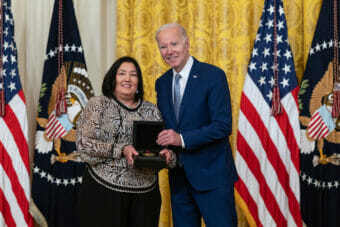
President Joe Biden presents Jaclyn Sallee, on behalf of Native America Calling, with the 2021 National Humanities Medal at a ceremony in the East Room of The White House in Washington, D.C. on Tuesday, March 21, 2023. (Photo by Cheriss May for The National Endowment for the Humanities.)

On March 21, President Joe Biden hosted a ceremony at the White House, presenting medals of honor for arts and humanities.

Sharing the stage with the president and celebrities like Sir Elton John and Julia Louis-Dreyfus was Shawn Spruce, host of the public radio program Native America Calling. The show was one of two Native American recipients of a National Humanities Medal.

Spruce is Laguna Pueblo. He told KTOO’s Juneau Afternoon that he felt conflicted being at the White House as a Native person.

Shawn Spruce is the host of Native America Calling. (Photo courtesy of Native America Calling).

“Because you know the history there, you know where the building stands,” he said. “But at the same time, we’re Americans, and I’m proud, proud to be an American. And that day there in the White House, I’ve never been prouder to be there in that setting.”

Spruce said there was a full day of activities planned for the ceremony and that it was an inspiring and exciting day.

“It was very surreal in that moment when we were all seated there in the East Room, and they announced the president, the first lady and they played Hail to the Chief,” he said. “And for a moment I thought I was like in a movie or something.”

Native America Calling is a production of Koahnic Broadcast Corporation, based in Anchorage. The daily call-in radio show has been around for almost 30 years. It airs on 139 stations, and more than half of them are Native-owned or controlled.

Spruce attributes the show’s success to finding cohesive themes for Native communities coast-to-coast, while also recognizing the nuances and differences that exist across Native America.

“If you’re a Native person, and you listen to that show — and it might not be a show topic that definitely correlates directly with your community. But we always give every Native person something to take away from every one of these shows, something for them to connect with,” he said.

Twelve National Humanities Medals were given out this year. Cheyenne elder Henrietta Mann received a medal for her work in education. She’s credited with creating many of the country’s Native American Studies programs at both tribal and state universities.

KTOO’s Bostin Christopher contributed to this story.

Traveling overseas this summer? There’s huge demand for passports, so get yours ASAP

A Passport Processing employee uses a stack of blank passports to print a new one at the Miami Passport Agency June 22, 2007 in Miami, Fla. Passport processing times are high due to increased demand. (Joe Raedle/Getty Images)

If you’re planning a summer getaway outside of the country, make sure you get your paperwork in order sooner rather than later.

Passports are in “unprecedented demand,” U.S. Secretary of State Antony Blinken said Thursday during a House Appropriations subcommittee budget hearing. In 2022, the State Department issued a record 22 million passports — and 2023 is “on track to break” that record, Blinken said.

The U.S. State Department is fielding half a million passport applications a week, Blinken said. “That’s 30 to 40% above last year, so it’s dramatic.”

The standard processing time for a passport is 10-13 weeks, and an expedited request takes about seven to nine weeks. That doesn’t include mailing time, which can take up to two weeks each way.

“Processing times fluctuate throughout the year depending on demand and we anticipate that they will rise, especially as we approach the busier travel season,” according to a State Department news release.

During the pandemic, “demand went way down,” Blinken said, and the department pulled back the number of staff dedicated to processing passport and visa requests. “Emerging from COVID, we’ve had to build back.”

He said the State Department has hired more staff, authorized overtime and opened satellite offices to process passport applications more quickly.

As pandemic restrictions eased, travel ramped up, with 52% of Americans planning to travel in the next six months, according to the U.S. Travel Association. Travel spending and demand for flights are both higher than 2019’s pre-pandemic levels.

Demand used to be cyclical, with a busy season starting in March and ending in late summer, Blinken said, but now it’s consistently high.

Americans who already have a passport soon will be able to renew it online. The department halted a pilot program “to make sure that we can fine-tune it and improve it before we roll it out in a bigger way,” Blinken said, but “65% of renewal customers for passports will be able to do so online, once this program is fully up and running.”

For those looking to travel to the U.S., the median wait time for visitor visa interview appointments is about two months, half as long as a year ago, and it’s shorter in many parts of the world. Blinken said the department is prioritizing visas with economic impact, like those for students, temporary workers and business travelers.

“In category after category, we’re actually getting back to and even better than pre-pandemic levels,” Blinken said, touting the fact that so far in fiscal year 2023, the department has issued 18% more non-immigrant visas than the same period in fiscal year 2019.

Immigrant visas “are a whole other issue,” Blinken said.

Copyright 2023 NPR. To see more, visit https://www.npr.org.

In Florida, far-right groups look to seize the moment

Members of the white nationalist group National Socialist Florida use a laser projector to display white nationalist and anti-LGBTQ images on the side of the CSX building and other high-rise buildings in Jacksonville, Fla. (Jim Urquhart for NPR)

JACKSONVILLE, Fla. — It’s an unseasonably cool January evening. Helicopters buzz overhead as a NFL playoff game gets underway. In a downtown alley not far from the stadium, masked men have their sights on the 37-story Wells Fargo Center.

Two of the men wear white gaiters with the acronym of their white nationalist group, National Socialist Florida, written in the typeface of German WW II propaganda posters. One of the men kneels down in the alley and takes off his backpack. He removes a commercial grade laser projector that retails for about $3,000. Smaller than a loaf of bread, compact, powerful and mobile.

Josh Nunes, the leader of the small band of white nationalist extremists, keeps a lookout for police while the other man aims the laser onto the skyscraper, careful to avoid helicopters flying overhead and possible detection. He projects a rolling ticker tape onto the building that reads, “Why are child friendly drag shows legal? @ Ron DeSantis.” Nunes cranes his neck to see how it looks.

This demonstration might not seem like much, but for these far-right groups, it’s a way to punch above their weight and get noticed.

“What we’re really going for is people putting it on social media and spreading it around and pushing the conversation in the public arena,” Nunes says.

Finding people with like minds

Nunes and his group first tried the laser projections last year during a college football game. They projected a message onto the stadium that read, “Kanye is right about the Jews!” The line was a nod to recent antisemitic rants by the artist and business mogul Ye, formerly known as Kanye West. On that night Nunes says he brought along the leader of another small neo-Nazi group in Florida to observe and “to see if it was worth picking up.”

Nunes and his group regularly coordinate with other far-right groups, forming what the advocacy organization Anti-Defamation League calls an unprecedented level of coordination among white nationalist groups in Florida.

“What we have seen is certain types of activism definitely gets interest and recruitment up. And that’s where like the drag queen shit — like everybody wants to be a part of the team shutting that down,” says Nunes, referencing the manufactured hysteria over children and drag events stoked by politicians and pundits and spurred on by extremists like himself.

Nunes and his group are intentionally choosing messages meant to resonate with a mainstream conservative audience. At the same time, mainstream political figures like Florida Gov. Ron DeSantis have fused some far-right talking points into their political rhetoric.

This year, the governor tapped into outrage fueled by disinformation over Critical Race Theory by threatening to end high school advanced placement courses in African American Studies. Last year, DeSantis signed the so-called “don’t say gay” law that barred classroom discussion about sexual orientation or gender identity in kindergarten through third grade.

There were 141 incidents of anti-LGBTQ protests and threats targeting specific drag events last year according to the Gay & Lesbian Alliance Against Defamation, an advocacy organization. In addition, protests against drag shows have been a growing target among far-right groups, according to data from The Armed Conflict Location & Event Data Project.

“We’ve just seen the largest upticks in recruitment from the drag stuff,” Nunes says.

He says the group began with just a handful of followers going out to protest drag shows last year. But it’s been growing, with demonstrations becoming a monthly occurrence.

“It’s not uncommon to show up with 20 dudes now,” says Nunes. “We’re hoping by the end of this year maybe we got 30 or 40 guys.”

A nice way to go about it

“Hang on one second. Hello?” says Nunes, pulling out his phone. “Cross the bridge and I’ll drop you a pin.” Moments later, the man Nunes was talking to appears and walks into the alley. He covers his face with a black gaiter and doesn’t want to give his name. Two more men will join the same way, covering their faces and withholding their names. The group continues projecting different messages onto the building, most of them about drag shows.

“A lot of this is pretty boring, to be honest with you,” Nunes says. “Most of the time we don’t have much interaction.”

Nunes oversees this campaign to spread hate like a foreman watching his crew pour cement. “So it’s like when we’ve got two or three guys out here, we’re not trying to have people accost us,” he says, explaining that they’re looking to avoid confrontations with pedestrians or police.

Nunes touts tolerance even as his group spreads noxious hate. “Obviously, we’re critical of racial issues” he says, couching racist rhetoric in civility. “But there’s a nice way to go about it, that’s not gonna get your teeth punched out of your head.”

The group is careful mostly to avoid attracting the attention of Antifa, far-left activists who would look to stop Nunes and his crew through physical force. Antifa has become a boogeyman of sorts for the right, even being called Nazis themselves in some right-wing media. Nunes and his group find that frustrating – it’s a mantle they’d like to claim.

“They’re like, ‘Antifa’s the real Nazis,’ ” Nunes says in exasperation. “You know, they say stuff like that and it’s like, ‘Yeah, you know, I don’t know.’ ”

An unhoused man in the alley can’t sleep with some of the noise Nunes and his crew are making. He gets up and asks what they’re doing. Nunes offers the man some homemade coffee he brought for the guys in the group, brushing away questions. Nunes suspects a police helicopter might be overhead. They begin packing up to move to a different spot. They take off their gaiters and walk through downtown Jacksonville unnoticed.

People flood out from the bars and restaurants. It’s a mixed crowd: white, Black, Latino. The five men mask up and set up again near the waterfront, keeping a lookout for police. One of the men shines an image onto the CSX building. “That’s a cross and a swastika,” Nunes says with pride. At five stories tall, the image is visible for miles.

Projecting power

In 2021, the Department of Homeland Security designated white nationalists the biggest domestic threat the U.S. faces. Experts say there’s a strategy behind the kinds of things Nunes is doing.

“These groups are looking to sanitize this imagery like this,” says Ben Popp, a researcher with the Anti-Defamation League’s Center on Extremism. Over the past two years, the ADL has tracked over 400 instances of white nationalist literature being disseminated in Florida. Popp says the normalizing of racist imagery is one way that white nationalists look to gain a foothold.

“They want the community to view this as a normal occurrence, so they’re attempting to make it a normal occurrence by going out every weekend and using these laser projectors to do this,” Popp says.

These kinds of actions, he adds, are meant to project power, to portray the group as larger and more powerful than they are – which, for the moment, is a handful of masked men standing at the waterfront on a Saturday night.

But Nunes’ small group continues to grow, as once-fringe white nationalist rhetoric and ideas gain traction. A 2022 poll by The Associated Press–NORC Center for Public Affairs Research found that 1 in 3 Americans believe in certain aspects of “Replacement Theory” when it comes to immigration, subscribing to the idea that liberal elites are trying to replace native born Americans with immigrants for electoral gains. It’s a false conspiracy theory long circulated amongst white nationalists and now part of popular political parlance, and regularly cited by right-wing mainstays like Fox News’ Tucker Carlson.

“It’s a good way to relate to normal people.”

Nunes believes he is able to draw men into the group by offering community to men who are looking for meaning, trapped in a digital culture.

“I think our society is pretty fractured. It’s like, for the average male in America right now, a lot of dudes don’t have one friend,” he says. “They don’t have one person they can call and borrow $500 if they needed to. And that is a thing that’s real within this group. If one of our buddies needs help, we’re gonna help them. There is a fraternity there.

“We’re like regular working-class white people that are racially aware. And so we’re Nazis, right?” Nunes says while overseeing the Saturday night laser projections, “And so stuff like this, we feel like it’s a good way to relate to normal people.”

Nunes is emblematic of today’s white nationalists, embracing whiteness as descendants of Europeans rather than obsessing over Aryan bloodlines. He says he’s half-Portuguese – in a movement historically fixated on perceived purity that would’ve been a barrier to entry in the past.

“I’ve definitely got some Iberian blood. And there’s, you know, there’s all types in the movement. There’s people that are, like, super hard, purity spiralers. But it’s like, at the end of the day, that’s never going to work in America,” Nunes says.

The face of hate

“I think it’s tempting to look for simple explanations for complex behaviors,” says Mike German, former FBI agent and current fellow at the Brennan Center for Justice. He worked undercover in the 1990s infiltrating white supremacist groups. German says those who adhere to white nationalist ideology today or who traffic in it don’t always fit the stereotype of people marching with jack boots and swastika tattoos.

“They are part of our society. And it’s not as fringe as we’d like to believe. There are people in law enforcement who subscribe to these ideas. There are people in government, people in elected office. White supremacists just had dinner with the former president of the United States,” German says, referencing Donald Trump’s meeting late last year with Ye and white nationalist Nick Fuentes. Fuentes and Ye have formed a bizarre alliance over a shared love of Hitler and antisemitic rhetoric.

As the nation grapples with how to confront the rise of domestic extremism, local city governments face their own challenges with people like Josh Nunes. The city of Jacksonville has passed a city ordinance that makes it illegal to project images onto buildings without the building owner’s consent — a misdemeanor offense. But it’s unclear how such a move will bear up under legal scrutiny. Many political groups have used projectors in public areas as forms of demonstration, an act that lower courts have historically upheld as protected by the First Amendment.

Copyright 2023 NPR. To see more, visit https://www.npr.org.

The number of mothers who die due to pregnancy or childbirth is ‘unacceptable’

A traditional birth attendant massages a pregnant woman before assisting in delivering her baby in the Kibera slum of Nairobi, Kenya.
(Photo by Brian Inganga/AP)

There’s been virtually no progress in reducing the number of women who die due to pregnancy or childbirth worldwide in recent years. That’s the conclusion of a sweeping new report released jointly by the World Health Organization and other United Nations agencies as well as the World Bank.

The report estimates that there were 287,000 maternal deaths globally in 2020 — the most recent year these statistics cover. That’s the equivalent of a woman dying every two minutes — or nearly 800 deaths a day.
And it represents only about a 7% reduction since 2016 — when world leaders committed to a so-called “sustainable development goal” of slashing maternal mortality rates by more than a third by 2030.

The impact on women is distributed extremely unequally: Two regions – Australia and New Zealand, and Central and Southern Asia – actually saw significant declines (by 35% and 16% respectively) in their maternal mortality rates. Meanwhile, 70% of maternal deaths are in just one region: sub-Saharan Africa.

Many of these deaths are due to causes like severe bleeding, high blood pressure and pregnancy-related infections that could be prevented with access to basic health care and family planning. Yet the report also finds that worldwide about a third of women don’t get even half of the recommended eight prenatal checkups.

At a press conference to unveil the report, world health officials described the findings as “unacceptable” and called for “urgent” investments in family planning and filling a global shortage of an estimated 900,000 midwives.

“No woman should die in childbirth,” said Dr. Anshu Banerjee, an assistant director general of WHO. “It’s a wake-up call for us to take action.”

He said this was all the more so given that the report doesn’t capture the likely further setbacks since 2020 resulting from the impacts of the COVID pandemic and current global economic slowdowns.

“That means that it’s going to be more difficult for low income countries, particularly, to invest in health,” said Banerjee. Yet without substantially more money and focus on building up primary health care to improve a woman’s chances of surviving pregnancy, he said, “We are at risk of even further declines.”

Copyright 2023 NPR. To see more, visit https://www.npr.org.

Juneteenth and Indigenous Peoples Day are now Anchorage municipal holidays

Celeste Hodge-Growden, president of the Alaska Black Caucus, speaks in favor of an Anchorage Assembly ordinance making Juneteenth and Indigenous Peoples’ Day city holidays on Feb. 21, 2023. (Wesley Early/Alaska Public Media)

Juneteenth and Indigenous Peoples Day are now municipal holidays in Anchorage.

That’s after the Anchorage Assembly voted Tuesday night to add the two holidays to the list of paid holidays for municipal employees. Initially, the ordinance would’ve also removed Seward’s Day from the municipal holidays list, but Mayor Dave Bronson amended the ordinance to keep it in.

The celebration of Juneteenth dates back to June 19, 1865, the day that the last slaves in the Confederacy were informed of their freedom following the Emancipation Proclamation. It’s often considered the oldest holiday among Black Americans, signifying the effective end of slavery in the United States.

Celeste Hodge-Growden, president of the nonprofit Alaska Black Caucus, said she hoped the city would follow the lead of the nation, where Juneteenth is a federal holiday, and the state, where a proposal to make it a state holiday is being considered.

“It’s more than giving employees a day off,” Hodge-Growden said. “It will give residents a day to think about the future that we want while remembering the inequities of the past. I’m elated the Assembly is considering this ordinance.”

Indigenous Peoples Day is a holiday commemorating Alaska Native and Native American history. Typically it’s held in lieu of Columbus Day. It’s been a state holiday since 2017. Anchorage resident Ayyu Qassataq, who’s Inupiaq, testified in support of both holidays.

“Recognizing Indigenous Peoples Day and Juneteenth Freedom Day are but one step in elevating public consciousness of the rich and sometimes unjust histories of the vibrant peoples whose stories deserve to be recognized and respected,” Qassatuq said by phone.

The ordinance was passed unanimously.

Climate change and a population boom could dry up the Great Salt Lake in 5 years

The Great Salt Lake is roughly 8-9 feet lower than it should be. A snowy winter recently has helped lake levels some. (Kirk Siegler/NPR)

Trekking along the shoreline of the Great Salt Lake — the largest remaining saltwater lake in the western hemisphere — can feel eerie and lonely.

“These might even be my footprints from last week,” says Carly Biedul, pointing to indents in the mud. Biedul is a biologist with the Great Salt Lake Institute. She’s bundled up in an orange puffy jacket, gloves and hat. Most important she’s wearing thick, sturdy, rubber boots.

The mud with a frozen, slick layer of ice on top gets treacherous. One thing that’s hard to prepare for though, is the stench: a pungent odor like sulfur and dead fish. But it’s actually a good thing, a sign of a biologically healthy saline lake.

“People have been saying that they miss the lake stink because it just makes them feel like home,” Biedul says. “It’s just not here [much] anymore, so you’re lucky that it gets to smell so bad.”

Lucky? Maybe one small bright spot in an otherwise grim story of a looming ecological disaster. The lake doesn’t really stink anymore because it’s drying … and dying.

Scientists point to climate change and rapid population growth — Utah is one of the fastest growing states and also one of the driest — as the culprits. A recent scientific report from Brigham Young University warned that if no action is taken, the Great Salt Lake could go completely dry in five years.

Over two decades of the western megadrought, water diversions from rivers that feed the lake have increased in order to support farms and thirsty, growing cities.

Utah leaders and activists are springing into action.

A drying lake could lead to an environmental and economic collapse

Carly Biedul and her team of researchers and students from Westminster College are on the front lines of the crisis and the fight to save the state’s signature lake.

Once a week they hike out to try to collect brine fly larva samples, with the idea that they could keep some alive in their lab back in the city should more water re-enter the lake in the near future.

The larvae are harder and harder to find. On a recent cloudy, bitter cold morning, Biedul pointed out mounds or “lumps” of lake deposits called microbialites. They should be mostly submerged, but this day were protruding out along the receding shore. She dug out a refractometer to measure the water’s salinity. Researchers have been worried the current levels — upwards of 17% in places — are too salty to sustain life.

“We’re kind of at the threshold,” Biedul says. “If things get any saltier we’re super worried.”

Carly Biedul of the Great Salt Lake Institute is collecting lab samples on a recent chilly morning on the lake’s receding south shoreline. (Kirk Siegler/NPR)

Consider the disappearing brine flies as an indicator species. They’re at the bottom of the food chain, and feed the brine shrimp, which sustain the thousands of migrating birds and so on. The environmental consequences of a dried up lake are far reaching, and the economic fallout scenarios are dizzying — from the lake’s brine shrimp fishing industry to mineral harvesting, to Utah’s famous ski resorts that benefit from extra lake effect snow.

But the most pressing concern right now in the Salt Lake Valley as the lake dries is shaping up to be air pollution. Salt Lake City already has some of the dirtiest air in the country. In the winter its natural topography causes cold air inversions, and emissions from vehicles and industrial sources form a haze in its bowl-like valley.

The big unknown is how bad dust storms could get from a dried up lake bed. There is precedent. Along California’s Eastern Sierra Nevada mountains, years of water diversions from the Owens River by the city of Los Angeles caused downstream saline Owens Lake to dry up. Dust storms from that lake bed became the largest single source of dust pollution in the nation.

In Utah, the Great Salt Lake is more than seven times larger than the historic footprint of Owens Lake.

“This other piece of the dust coming in really scares people,” Biedul says.

Doctors sound the alarm about vulnerable populations

Scientists warn the Great Salt Lake has high concentrations of neurotoxins and cancer causing carcinogens — including arsenic and mercury.

“If the lake bed dries up, and we’re having winds blowing dust storms into our neighborhood, the heavy metals are going to land right on top of this neighborhood,” says Turner Bitton, a community activist in Glendale, a traditionally working class neighborhood in Salt Lake City’s west valley.

Much of the area is zoned for manufacturing, but it’s also one of the last bastions of affordability in the city. Bitton’s neighborhood is already hemmed in by two busy freeways, an international airport, and it’s close to Utah’s largest oil refinery.

He says many local families are alarmed at the prospect of the air getting even worse.

“We’re talking about something that could potentially make these neighborhoods, I don’t want to say uninhabitable, but for those that are vulnerable, for those that have lung issues, uninhabitable,” Bitton says.

Researchers have found higher rates of asthma and cardiovascular disease in neighborhoods like these. One University of Utah study even showed that students in schools here scored lower on tests during bad air days.

“We need to put more water in the lake now, we cannot let this wait,” says Dr. Brian Moench, president of the group, Utah Physicians for a Healthy Environment.

Moench says the state should have declared an emergency years ago.

“A lot of people think that dust is pretty benign because it’s quote — natural,” he adds. “Well that’s not the case, and in the case of dust from the Great Salt Lake, it is particularly toxic, because we know that it is laced with high concentrations of heavy metals.”

The majority of Utah’s 3.3 million population lives near the lake, just to the east along the Wasatch Mountains. The lake is about nine feet lower than normal. And locals are already complaining of dust storms. Moench counted more than a dozen in the past year — when a decade ago there were none.

On Utah’s Capitol Hill, state lawmakers are debating a roughly $500 million spending package geared toward saving the lake. (Kirk Siegler/NPR)

Utah leaders insist they won’t let the lake dry up

At the state capitol, lawmakers this session are facing pressure to save the lake, and Gov. Spencer Cox is under the gun to call a state of emergency. In his state of the state address last month, Cox nodded to the BYU study which warns that in just “five short years,” the Great Salt Lake will completely disappear: “Let me be absolutely clear, we are not going to let that happen.” Cox said.

Earlier this week, a bipartisan group of state lawmakers unveiled bills ranging from expanding turf-reduction programs in cities, to providing more incentives to farmers to divert less water from rivers that feed the lake. Some pledged to spend upwards of a half billion dollars to save the lake.

“Even though the Great Salt Lake has risen a foot so far, we know that one wet winter is not going to wipe out two decades of very, very, very dry climate here in Utah,” said Brad Wilson, the Republican House Speaker.

Some ideas that have been floated sound like something out of a science fiction novel — including cloud seeding, and even a plan to build pipelines to pump in water from the Pacific Ocean.

“We are getting some really fantastical suggestions from some of our lawmakers as to how to solve this,” says Moench, of Physicians for a Healthy Environment.

Moench and environmental activists are arguing for buying out alfalfa farmers so more water will return to the Great Salt Lake. But some are encouraged that at the very least saving the lake is one of the top priorities of this legislative session.

From Utah’s Capitol Hill, there’s a sweeping view of the Salt Lake City skyline, and to the west, past the airport, the receding lake is visible, shimmering gray at dusk. It’s an ominous sight, but if nothing else, hard for state leaders to ignore.

Down at the lake, Carly Biedul of the Great Salt Lake Institute is doing her best to keep positive. She thinks there’s still time to save this lake, but not much.

“It’s really pretty right now, you can see the reflections of the mountains on the water,” she says. “And that’s kind of what we’re been trying to do is find these moments of beauty when it’s so … sad.”

Copyright 2023 NPR. To see more, visit https://www.npr.org.

Transcript :

STEVE INSKEEP, HOST:

A popular 19th-century book describes the Great Salt Lake. In the 1840s, that lake was well known to local people, but not on the East Coast. The Western mapmaker John Charles Fremont described boating on the lake to an island. He accidentally left the cover to a spyglass on that island and mused that some future explorer might find it. Unless something changes, future explorers of that island may be able to walk there because the lake is drying up. A report says climate change and population growth in Utah may destroy it in five years. NPR’s Kirk Siegler takes us there.

KIRK SIEGLER, BYLINE: The Great Salt Lake is the largest remaining saltwater lake in the Western Hemisphere.

(SOUNDBITE OF FOOTSTEPS SLOSHING IN WATER)

SIEGLER: Now, trekking along its receding shoreline, especially if it’s the dead of winter, can feel eerie and lonely.

CARLY BIEDUL: These might even be my footprints from last week.

SIEGLER: Carly Biedul is a biologist with the Great Salt Lake Institute. She’s bundled up in an orange, puffy jacket, gloves and hat. And most importantly, she’s wearing thick, sturdy rubber boots. The mud with the frozen, slick layer of ice on top – it’s treacherous.

(SOUNDBITE OF FOOTSTEPS SLOSHING IN WATER)

SIEGLER: Well, the only thing we’re not really prepared for is the stench.

This is pungent right here.

BIEDUL: (Laughter) Yeah.

SIEGLER: Smells like dead fish almost.

The stink is a sign of a biologically healthy saline lake.

BIEDUL: People have been saying that they miss the lake stink because it just makes them feel like home, and it’s just not here anymore. So you’re lucky that it gets to smell so bad.

SIEGLER: It doesn’t really stink anymore because it’s drying and dying. Biedul hikes out here weekly, trying to collect samples of brine fly larva, which are getting harder and harder to find.

BIEDUL: I’m going to get my jar out.

SIEGLER: Brine flies are at the bottom of the food chain, feed for the brine shrimp, which sustain the migrating birds and so on. Most of the water that’s left here is too salty now.

BIEDUL: The threshold is – we’re kind of at the threshold. So if things get any saltier, we’re super, super worried.

SIEGLER: So what brought us to this brink? Two decades of a Western megadrought and water diversions from rivers upstream for farms and suburbs.

BIEDUL: Yeah, sorry. This is our crossing point.

SIEGLER: Now, if this lake goes away, just the economic fallout alone is dizzying, from brine shrimp fishing to mining to Utah’s ski resorts that benefit from extra lake effect snow. And then there’s the pollution.

BIEDUL: The inversions here in the winter that we get just from being in the valley is already a big problem. And so having this other piece of the dust coming in really scares people.

SIEGLER: Partly because of those inversions, Salt Lake City already can have some of the dirtiest air in the U.S.

(SOUNDBITE OF CAR HORNS HONKING)

SIEGLER: And the lakebed has high concentrations of mercury and arsenic.

TURNER BITTON: If the lake bed dries up and we’re having winds blowing dust storms into our neighborhood, the heavy metals are going to land right on top of this neighborhood.

SIEGLER: Turner Bitton is a community activist in Salt Lake City’s West Valley. These more working-class neighborhoods are already hemmed in by busy freeways, an international airport and Utah’s largest oil refinery.

BITTON: I mean, we’re talking about something that could potentially make these neighborhoods – I don’t want to say uninhabitable – but for those that are vulnerable, for those that have lung issues, uninhabitable.

SIEGLER: He’s not being dramatic. Researchers have found higher rates of asthma and cardiovascular disease in neighborhoods like these. And one University of Utah study even showed that students in schools here scored lower on tests during bad air days. Dr. Brian Moench is president of Utah Physicians for a Healthy Environment. He says the state should’ve declared an emergency years ago.

BRIAN MOENCH: A lot of people think that dust is pretty benign because it’s, quote, “natural.” Well, that’s not the case. And in the case of dust from the Great Salt Lake, it is particularly toxic because we know that it’s laced with high concentrations of heavy metals.

SIEGLER: And most of Utah’s 3 million or so residents live just east of the lake along the Wasatch Mountains. The lake is about 9 feet lower than normal right now, and locals are already complaining of dust storms. The crisis is all over the mainstream news here.

(SOUNDBITE OF NEWS MONTAGE)

UNIDENTIFIED PERSON #1: And, you know, even with all of this snow, Utah still remains in a drought.

UNIDENTIFIED PERSON #2: Now to what some tonight are calling a looming environmental nuclear bomb in Utah. The mighty Great Salt Lake is drying up. And as…

UNIDENTIFIED PERSON #3: As the Great Salt Lake…

SIEGLER: At the state Capitol, lawmakers this session are under pressure to save the lake. Some ideas floated sound like sci-fi – cloud seeding, even a pipeline to pump Pacific Ocean water in. Right now, lawmakers are debating a half-billion-dollar package that would do things like pay farmers in cities to use less water. Here’s Republican Governor Spencer Cox in his recent State of the State address.

(SOUNDBITE OF SPEECH)

SPENCER COX: Earlier this month, a report predicted that in just five short years, the Great Salt Lake will completely disappear. Let me be absolutely clear. We are not going to let that happen.

SIEGLER: Now, from up here on Capitol Hill, there’s a sweeping view of the Salt Lake City skyline. And when you look to the west, past the airport, there’s the receding gray lake shimmering at dusk. It’s an ominous sight but hard for lawmakers to ignore.

(SOUNDBITE OF FOOTSTEPS SLOSHING IN WATER)

BIEDUL: We can see the reflection of the of the mountains on the water. It’s really pretty right now.

SIEGLER: Now, for her part, down at the lake, biologist Carly Biedul is keeping positive.

BIEDUL: And that’s kind of what we’ve been trying to do – is find these moments to see the beauty when it’s so sad.

SIEGLER: Sad because Biedul says there’s very little time left to save this lake.

Kirk Siegler, NPR News, Salt Lake City. Transcript provided by NPR, Copyright NPR.

Site notifications
Update notification options
Subscribe to notifications