Nation & World

America needs carpenters and plumbers. Try telling that to Gen Z

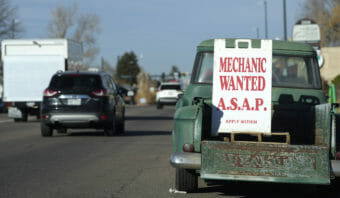
A sign advertising the need for a mechanic stands in the back of aged Chevrolet pickup truck.
Employers are struggling to find young workers to take jobs in the skilled trades. (David Zalubowski/AP)

Justin Mwandjalulu, 20, loves to build stuff.

These days, as a carpentry apprentice, he installs drywall in houses with the rest of his construction crew. But he said he likes concrete the best.

“At the end of the day, you see how you poured everything. The result of your hard work,” he said.

Mwandjalulu dreamed of becoming a carpenter or electrician as a child. And now he’s fulfilling that dream. But that also makes him an exception to the rule. While Gen Z — often described as people born between 1997 and 2012 — is on track to become the most educated generation, fewer young folks are opting for traditionally hands-on jobs in the skilled trade and technical industries.

Gen Z interest in trades and skilled work has dropped

The number of young people seeking technical jobs — like plumbing, building and electrical work — dropped by 49% in 2022 compared to 2020, according to data from online recruiting platform Handshake shared with NPR.

Researchers from Handshake tracked how the number of applications for technical roles vs. the number of job postings has changed over the last two years.

While postings for those roles — automotive technicians, equipment installers and respiratory therapists, to name a few — saw about 10 applications each in 2020, they got about five per posting in 2022.

The typical rate is about 19 applications per job on Handshake, according to Christine Cruzvergara, the company’s chief education strategy officer.

While the creation of technical positions has continued to grow, the number of students interested in applying for them — hasn’t.

Occupations such as auto technician with aging workforces have the U.S. Chamber of Commerce warning of a “massive” shortage of skilled workers in 2023.

“For a long time, our society has not talked favorably about the skilled trades,” said Cruzvergara. “We’ve instead encouraged students to all go to college, all go to four-year institutions, graduate, go out into white collar jobs.”

One path does not fit all

Mwandjalulu, who lives in Iowa City, Iowa and is in his second year of a four-year carpentry apprenticeship, found school difficult.

He immigrated with his family to the United States from Benin, Africa, when he was a freshman.

“Man, it was hard,” he said. While his twin brother, now studying to work in banking, excelled, Mwandjalulu said he struggled with writing and English.

“I’m not the type of guy that likes being in the same spot all day long, dealing with papers and stuff,” he said.

Around high school graduation, Mwandjalulu said he got depressed because he didn’t know what he wanted to do with his life. Many of his older friends who went to college and graduated were struggling to find jobs.

“I didn’t want to look like them,” he said. “I didn’t want to just spend money and have a lot of loans and not use my papers,” he said, referring to a degree and a diploma.

According to the Department of Education, about 45 million people in the United States owe nearly $1.3 trillion in student debt.

But Mwandjalulu, who makes nearly $24 an hour as a carpenter, said he’s still had trouble convincing his friends, whom he keeps in touch with on Facebook and Snapchat, to follow his path.

“There’s not a lot of people, especially immigrants, that think outside of school,” he said.

The narrative is shifting

Paul Iversen, a labor educator with University of Iowa’s Labor Center, hopes to change that.

Iversen, who helps helps run a pre-apprenticeship program, said one of the reasons participation in the skilled trades is low among Gen Z is because the work was once typically passed down in families.

“It used to be word-of-mouth,” said Iversen. “But there’s more of a need for carpenters, pipefitters, plumbers and electricians than you can fill with the family members of current people.”

That reality is hitting home for farmer John Boyd Jr.

Boyd, 57, owns a 300-acre farm in Virginia where he grows soybeans, corn and wheat and raises cattle — just as three generations did before him. But now, none of his three children want to take over when he retires.

“Everybody on my farm is over the age of 50,” said Boyd, who is the president of the National Black Farmers’ Association. “We need some young people with some energy and hustle and innovation.”

Michael Coleman, 28, is one of them. He received a scholarship from the NBFA in 2015 to study animal science at the University of Nebraska.

Coleman is now an animal health technician with the U.S. Department of Agriculture and dreams of one day owning his own farm. But, at times, he’s found it a lonely field.

The average age of a U.S. farmer is 57.5, according to the 2017 US Agriculture Census, up from 54.9 in 2007, and Coleman said he’s only met a couple other farmers around his age.

“We kind of stick together,” he said.

There is plenty of need

But Coleman said he’s seen more young people express interest in agribusiness and other technical industries, particularly after the pandemic.

“Especially with student loans and everything, it’s a lot cheaper to get a trade and make a lot of money,” said Coleman. Most young folks just haven’t had people show them the ropes,” he said.

Still, filling trade and technical jobs takes active recruitment, said Iversen, who pays frequent visits to high schools around Iowa City and works with school counselors to place students in the pre-apprenticeship program.

Now especially, there’s an urgency to fill open posts, said Iversen, as the federal government funnels billions into projects to upgrade roads and transit systems across the country.

“We have to recruit people to do these things or else our bridges are going to fall apart,” Iversen said.

Copyright 2023 NPR. To see more, visit https://www.npr.org.

Thousands of airline passengers are stranded. Here’s what to do if you’re one of them

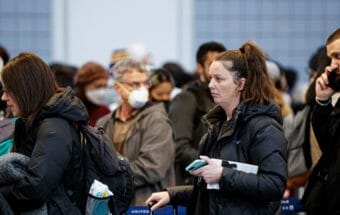
A crowd of worried-looking people in an airport.
Travelers wait in line for their security screening at O’Hare International Airport on Dec. 22 in Chicago. (Kamil Krzaczynski/AFP via Getty Images)

Thousands of flights have been canceled since Christmas weekend, leaving passengers scrambling to find a way back home.

It’s the result of a chaotic holiday season of travel with a turnout that resembled pre-pandemic numbers. Nearly 113 million Americans were expected to journey at least 50 miles or more from home from Dec. 23 to Jan. 2, according to the American Automobile Association.

And already overwhelmed airports experienced another challenge: a massive winter storm that forced airlines to cancel, or delay, thousands of flights. One major airline, Southwest, canceled 5,400 flights in less than 48 hours, stranding passengers across the country.

And as travelers attempt to find their way back home, the trouble persists. As of 5:30 p.m. Eastern Standard Time, over 3,000 flights were canceled on Tuesday, with over 5,300 delayed, according to FlightAware.

It is without a doubt a frustrating experience for consumers, who through no fault of their own find themselves in such a precarious position. Unfortunately, there appears to be little recourse for those seeking to recoup the additional costs from airlines, which are not beholden to federal regulations when it comes to this type of consumer protection.

What happens if my flight is delayed? Am I entitled to compensation from the airline?

The U.S. Department of Transportation says no.

“There are no federal laws requiring airlines to provide passengers with money or other compensation when their flights are delayed,” according to the DOT.

Some airlines do offer to pay for meals or hotel accommodations when there are long delays, but it is not a policy across the board. The department says one can ask the airline to cover such costs, but it is entirely at the discretion of the company.

Can I switch to a different flight?

Maybe. Passengers can ask to be booked on another flight on the same airline. But the DOT cautions travelers to check whether the airline will charge an additional fee to make the switch or charge a higher fare for the new reservation.

It is also possible to request a seat on another airline if a seat is available. “However, there are no federal regulations requiring airlines to put you on another airline’s flight or reimburse you if you purchase a ticket on another airline,” the DOT says. This could also create new problems tracking or flying with checked luggage.

There’s been a significant delay. Can I just get my money back?

Sometimes yes, sometimes no. But the DOT has not defined “significant delay,” so the department “determines whether you are entitled to a refund on a case by case basis.”

Eek! My flight was canceled. What happens now?

The good news is that most airlines will rebook you for free on their next flight to your destination as long as the flight has available seats. If there are none available, get ready to put on your most courteous voice. The DOT suggests asking to have your ticket transferred to another airline.

Here’s one piece of potentially good news: If you choose to scrap your trip after a flight cancellation, “you are entitled to a refund for the unused transportation — even for non-refundable tickets,” the DOT says. “You are also entitled to a refund for any bag fee that you paid, and any extras you may have purchased, such as a seat assignment.”

If you can, try to get your money rather than a voucher, which can expire or sometimes carry restrictions, blackout dates, advanced booking requirements and limits on the number of seats.

The airline overbooked the flight and I’ve been bumped. What do I do?

These are called involuntary bumps, and George Hobica, founder of airfarewatchdog.com, told NPR they rarely happen because passengers are often booked on alternative flights.

But in cases where it is not possible to get you to your destination close to your originally scheduled arrival time, you could be entitled to as much as $1,550, or 400% of your one-way fare, according to the DOT.

I bought my ticket with a credit card. Can they help?

Yes! It turns out some credit cards offer much better protections than the government.

In many cases, benefits programs include trip cancellation/interruption insurance, trip delay insurance and baggage insurance. Credit card companies can also help arrange new itineraries and reimburse travelers for expenses resulting from delays or other postponements, including additional hotel stays, rental cars or extra meals. Some offer trip delay insurance, which “kicks in if your trip is delayed by a specified number of hours, or if it requires an unanticipated overnight stay,” CNBC reports.

Copyright 2022 NPR. To see more, visit https://www.npr.org.

2022 marked the end of cheap mortgages and now the housing market has turned icy cold

A house for sale with signs for an open house in front of it
Children ride scooters past a house for sale in Los Angeles. Home sales have slowed as mortgage rates have climbed.
Allison Dinner/Getty Images

Evan Paul and his wife entered 2022 thinking it would be the year they would finally buy a home.

The couple — both scientists in the biotech industry — were ready to put roots down in Boston.

“We just kind of got to that place in our lives where we were financially very stable, we wanted to start having kids and we wanted to just kind of settle down,” says Paul, 34.

This year did bring them a baby girl, but that home they dreamed of never materialized.

High home prices were the initial insurmountable hurdle. When the Pauls first started their search, low interest rates at the time had unleashed a buying frenzy in Boston, and they were relentlessly outbid.

“There’d be, you know, two dozen other offers and they’d all be $100,000 over asking,” says Paul. “Any any time we tried to wait until the weekend for an open house, it was gone before we could even look at it.”

Then came the Fed’s persistent interest rates hikes. After a few months, with mortgage rates climbing, the Pauls could no longer afford the homes they’d been looking at.

“At first, we started lowering our expectations, looking for even smaller houses and even less ideal locations,” says Paul, who eventually realized that the high mortgage rates were pricing his family out again.

“The anxiety just caught up to me and we just decided to call it quits and hold off.”

Buyers and sellers put plans on ice

The sharp increase in mortgage rates has cast a chill on the housing market. Many buyers have paused their search; they can longer afford home prices they were considering a year ago. Sellers are also wary of listing their homes because of the high mortgage rates that would loomover their next purchase.

“People are stuck,” says Lawrence Yun, chief economist with the National Association of Realtors.

Yun and others describe the market as frozen, one in which home sales activity has declined for 10 months straight, according to NAR. It’s the longest streak of declines since the group started tracking sales in the late 1990s.

“The sellers aren’t putting their houses on the market and the buyers that are out there, certainly the power of their dollar has changed with rising interest rates, so there is a little bit of a standoff,” says Susan Horowitz, a New Jersey-based real estate agent.

Interestingly, the standoff hasn’t had much impact on prices.

Home prices have remained mostly high despite the slump in sales activity because inventory has remained low. The inventory of unsold existing homes fell for a fourth consecutive month in November to 1.14 million.

“Anything that comes on the market is the one salmon running up stream and every bear has just woken up from hibernation,” says Horowitz.

But even that trend is beginning to crack in some markets.

At an open house for a charming starter home in Hollywood one recent weekend, agent Elijah Shin didn’t see many people swing through like he did a year ago.

“A year ago, this probably would’ve already sold,” he says. “This home will sell, too. It’s just going to take a little bit longer.”

Or a lot longer.

The cottage first went on the market back in August. Four months later, it’s still waiting for an offer.

Copyright 2022 NPR. To see more, visit https://www.npr.org.

Transcript :

STEVE INSKEEP, HOST:

This country’s home-buying frenzy is really, definitely over. Home sales have fallen for 10 straight months. It’s the longest streak of declining sales in more than two decades. NPR’s Arezou Rezvani spoke with buyers and sellers.

AREZOU REZVANI, BYLINE: Thirty-four-year-old Evan Paul went into 2022 thinking this would be the year his family would finally buy a home.

EVAN PAUL: We just kind of got to that place in our lives where we were financially very stable. We wanted to start having kids, and we wanted to just kind of settle down.

REZVANI: Paul and his wife, who both work in the biotech industry, did end up having a baby, a little girl, just a couple of weeks ago. But they never did move up and out of their two-bedroom condo. Initially, it was because of high home prices in their city of Boston. A year ago, low interest rates unleashed a home-buying frenzy, and they were outbid every time.

PAUL: There’d be, you know, two dozen other offers, and they’d all be $100,000 over asking.

REZVANI: Then the Fed started raising interest rates. And after a few months, it was the high mortgage rates that priced the Pauls out again.

PAUL: Yeah. Eventually, the anxiety just caught up to me. And we just decided to call it quits and hold off.

LAWRENCE YUN: There are far fewer buyers in the marketplace.

REZVANI: That’s Lawrence Yun, chief economist for the National Association of Realtors. He says while buyers like the Pauls have been pulling back, sellers are also reluctant to jump into the market because they’d also be slammed by a pricey mortgage.

YUN: To reenter the market today, they would have to give up that 3% and possibly get the new loan at much higher interest rates.

REZVANI: And that right there is what’s contributing to something of a freeze in the housing market, says Susan Horowitz, a New Jersey-based real estate agent.

SUSAN HOROWITZ: The sellers aren’t putting their houses on the market. And the buyers that are out there – certainly, the power of their dollar has changed with rising interest rates. So there is a little bit of a standoff.

REZVANI: Surprisingly, that standoff hasn’t had much of an impact on prices. Home prices have remained high despite the slump in sales activity.

HOROWITZ: Because there’s no inventory. So anything that comes on the market is the one salmon running upstream. And every bear has just woken up from hibernation.

REZVANI: But even that trend is beginning to crack in some markets.

It’s been slow going lately at agent Elijah Shin’s open house in Los Angeles, where he sweeps the sidewalk, waiting for the occasional visitor to swing by.

ELIJAH SHIN: Well, I think we’re in the transition again. And, of course, no one knows the future, but we do look like we need a market correction here and there. It was a few crazy years.

REZVANI: He gives a thorough tour to anyone who comes through…

SHIN: And this can be a closet. And this is the entire master suite.

REZVANI: …And connects with prospective buyers however he can.

SHIN: You want a flyer? We’ll be here Tuesday and Thursday if you want to…

REZVANI: But things are just different now.

SHIN: Well, a year ago, this property would’ve already been sold. I think this home will sell, too. It’s just going to take a little bit longer.

REZVANI: Or a lot longer. This little starter home in one of the more coveted neighborhoods of Hollywood first went on the market back in August. Four months later, it’s still waiting for an offer. Arezou Rezvani, NPR News, Los Angeles.

(SOUNDBITE OF KYLE MCEVOY AND EZZY’S “GARDEN”) Transcript provided by NPR, Copyright NPR.

American life expectancy is now at its lowest in nearly two decades

In 2021, the three leading causes of death were heart disease, cancer and COVID-19. (Andy Ryan/Getty Images)

The average life expectancy for Americans shortened by over seven months last year, according to new data from the Centers for Disease Control and Prevention.

That decrease follows an already big decline of 1.8 years in 2020. As a result, the expected life span of someone born in the U.S. is now 76.4 years — the shortest it has been in nearly two decades.

The two reports, released by the CDC on Thursday, show deaths from COVID-19 and drug overdoses, most notably synthetic opioids like fentanyl, were the primary drivers of the drop in life expectancy.

“It’s not a good year for the data, let’s put it that way,” says CDC statistician Kenneth Kochanek.

It’s rare to see such big changes in life span year to year, but the pandemic claimed nearly 417,000 lives last year — more than even the year before — making COVID-19 the third leading cause of death for the second consecutive year.

Kochanek and his colleagues had hoped the release of new vaccines might make for a healthier 2021, and didn’t anticipate deaths from COVID-19 would top the prior year. But they were wrong. In fact, COVID-19 accounted for about 60% of the decline in life expectancy.

Preliminary data from 2022 so far indicate deaths from COVID-19 are on the decline, but Kochanek says that doesn’t mean life expectancy will rebound quickly in years to come, because COVID-19 was, by no means, the only contributor to the higher death toll in 2021.

Heart disease, the leading cause of death in the U.S., along with other top killers like cancer, diabetes and kidney disease also proved more lethal in 2021.

Meanwhile, deaths from Alzheimer’s, flu and pneumonia declined, perhaps because the coronavirus hit the elderly population particularly hard.

The new numbers also speak to the acute mental health crisis that’s run parallel to the pandemic: Deaths from drug overdoses reached over 106,000 last year — another major factor reducing life expectancy, according to the second CDC analysis released on Thursday.

Deaths by suicide and from liver disease, or cirrhosis, caused by alcohol also increased — shortening the average American life span.

“The majority of those deaths are to younger people, and deaths to younger people affect the overall life expectancy more than deaths to the elderly,” Kochanek says.

Men and women saw a similar decline in life expectancy last year, but women are living, on average, until over 79 years old, which is about six years longer than men

The CDC also found that death rates for certain racial and ethnic groups actually decreased last year, specifically among Hispanic and Black men. Death rates increased for almost all other groups, although it was most pronounced among white men and women, as well as American Indian or Alaska Native women.

Copyright 2022 NPR. To see more, visit https://www.npr.org.

Alaska Rep. Eastman claims Oath Keepers were in Capitol to protect police, not overthrow government

Alaska state Rep. David Eastman acknowledged at a trial this week that he’s a member of the Oath Keepers and that he went to Washington, D.C., on Jan. 6, 2021, to then-President Trump’s rally protesting the election. But Eastman maintains neither he nor the Oath Keepers were interested in overthrowing the government.

His attorney, Joe Miller, portrayed Oath Keepers as do-gooders whose bylaws don’t allow insurrection.

“Those bylaws … make it very clear that you cannot, as an Oath Keeper, do anything to overthrow the government,” Miller said at the non-jury trial. “I mean, it’s specifically stated.”

Terrorism experts call Oath Keepers an anti-government militia. Leaders of the group were convicted last month of seditious conspiracy for actions leading up to the Jan. 6 attack on the U.S. Capitol.

That’s problematic for Eastman. He did not enter the Capitol that day, but he’s the subject of a civil lawsuit brought by a former supporter who alleges his membership in the group disqualifies him from public office, due to a disloyalty provision in the state Constitution.

Eastman testified that he hasn’t condemned the group and that he remains a member.

The plaintiff’s attorney, Goriune Dudukgian, tried to get Eastman to acknowledge that he knew Oath Keepers used force in the Capitol to stop the certification of the presidential election. Dudukgian reviewed the way Oath Keepers wore combat gear and moved in a tight line as they forced their way into the building.

“And in the military, that would be called a stack formation,” Dudukgian asked

“That’s probably not what I would describe as a stack formation,” said Eastman, an Army veteran. “That was just people walking through a crowd, you know, holding on to each other.”

“And your understanding of what they were doing in the Capitol on that day was that they were proceeding in that fashion to help the police?” the lawyer asked, with audible skepticism. “That’s your understanding?”

Eastman said it was.

“And you are aware, though, sir, that at least three of those individuals have now pled guilty to seditious conspiracy charges, right?” Dudukgian continued.

“I’ve heard that,” Eastman said.

“And you’re aware that in the plea agreements, or in their statements of offense, they admitted to not only marching in those formations, but to using force while inside the Capitol building, right?” the attorney asked.

“Those aren’t documents that I’ve reviewed, no,” Eastman said.

The disloyalty provision has never been tested at a trial before. It says that no one can serve in public office who belongs to an organization that advocates overthrowing the government by force.

The trial, which has been conducted largely by Zoom, is likely to continue into next week. Miller says he intends to call the Oath Keepers leader, Stewart Rhodes, who would testify from jail.

Lessons from Germany to help solve the US medical debt crisis

A doctor checks a man's blood pressure.
Dr. Eckart Rolshoven examines a patient at his clinic in Püttlingen, a small town in Germany’s Saarland region. Although Germany has a largely private health care system, patients pay nothing out-of-pocket when they come to see him. (Pasquale D’Angiolillo for KHN)

PÜTTLINGEN, Germany — Almost every day, Dr. Eckart Rolshoven sees the long shadow of coal mining in his clinic near the big brownstone church that dominates this small town in Germany’s Saarland.

The region’s last-operating coal shaft, just a few miles away, closed a decade ago, ending centuries of mining in the Saarland, a mostly rural state tucked between the Rhine River and the French border. But the mines left a difficult legacy, as they have in coal regions in the United States, including West Virginia.

Many of Rolshoven’s patients battle lung diseases and chronic pain from years of work underground. “We had an industry with a lot of illnesses,” said Rolshoven, a genial primary care physician who at 71 is nearing the end of a long career.

The Saarland’s residents are sicker than elsewhere in Germany. And like West Virginia, the region faces economic hurdles. For decades, German politicians, business leaders and unions have labored to adjust to the mining industry’s slow demise.

But this is a healthier place than West Virginia in many respects. The region’s residents are less likely to die prematurely, data shows. And on average, they live four years longer than West Virginians.

There is another important difference between this former coal territory and its Appalachian counterpart: West Virginia’s economic struggles have been compounded by medical debt, a burden that affects about 100 million people in the U.S. — in no state more than West Virginia.

In the Saarland, medical debt is practically nonexistent. It’s so rare in Germany that the federal government’s statistical office doesn’t even track it.

The reason isn’t government health care. Germany, like the U.S., has a largely private health care system that relies on private doctors and private insurers. Like Americans, many Germans enroll in a health plan through work, splitting the cost with their employer.

But Germany has long done something the U.S. does not: It strictly limits how much patients have to pay out of their own pockets for a trip to the doctor, the hospital or the pharmacy.

Rolshoven’s patients pay nothing when they see him. That not only bolsters their health, he said. It helps maintain what Rolshoven called social peace. “It’s really important not to have to worry about these problems,” he said.

German health officials, business leaders and economists say the access to affordable health care has also helped the Saarland get back on its feet economically, bolstered by the assurance that workers could get to the doctor.

“Without this, the Saarland would be dead,” said Beatrice Zeiger, managing director of the Arbeitskammer des Saarlandes, a regional labor group. “It’s unthinkable.”

While health costs rise in the U.S., Germany contains them

In West Virginia, whose wooded valleys and decaying industrial plants could be mistaken for the Saarland’s, access to health coverage has been important as the state weathered the decline of its mines.

A decade ago, state leaders moved to expand the Medicaid insurance program through the Affordable Care Act. And as of last year, just 6% of state residents were uninsured, less than half the rate before the 2010 law.

But growing numbers of West Virginians without government insurance are in private health plans with deductibles that require they pay thousands of dollars out of their own pockets before coverage kicks in.

The typical individual health plan an American gets through work now comes with a more than $1,500 deductible, a particularly big sum in a state like West Virginia where residents often earn less than residents of other states.

That, in turn, is driving medical debt. A quarter of West Virginians with a credit report have medical bills in collections, almost twice the national rate, according to data compiled by the nonprofit Urban Institute. In several counties in the state, the rate is about a third.

And those figures likely understate the problem. Many more people put medical bills on their credit cards, borrow from family or enroll in installment plans with a hospital or other providers to pay off their bills.

“It’s a huge problem here,” said Jessica Ice, executive director of West Virginians for Affordable Health Care. “Folks with medical debt aren’t able to apply for loans to start a business or buy a starter home for their family. It’s really preventing people from climbing up the economic ladder.”

In German health plans, known as sickness funds, there aren’t typically deductibles.

Physician visits are almost always free for patients. Copays for most prescription drugs are capped at 10 euros or less, about $10. And people admitted to the hospital pay only 10 euros a day.

“Access to medical care with minimal costs for patients has been essential,” said Armin Beck, regional director of the Knappschaft Bahn See, of KBS, a health insurance plan whose roots stretch back to the 13th century, when miners set up a mutual aid society to protect one another in case of injuries or accidents. “This has been a foundation of our community,” Beck said.

‘So glad we don’t have to worry’

Along the Saar River in Germany, rusting steelworks and shuttered coal-fired power plants bear testament to the region’s economic struggles. Many towns like Püttlingen carry on in the shadow of hulking mounds of debris — Berghalde, as they are called — the detritus left behind as coal was separated from the rocky earth hauled up from underground.

An aerial photo of a coal mine in a clearing in a forest.
The now-shuttered Bergwerk Saar coal mine in Germany’s Saarland closed in 2012, ending centuries of mining in the region. Coal from the Saarland helped fuel Germany’s industrialization and once employed tens of thousands of workers. (Pasquale D’Angiolillo for KHN)

Today, new challenges confront the region. Ford, which has operated a car factory here for decades, plans to shutter the plant in a few years and move production to Spain.

But at Rolshoven’s clinic — a small set of offices tucked into a residential neighborhood — few patients can conceive of the burdens that medical bills put on Americans.

Andrea Fecht, 63, who has diabetes and came to see Rolshoven because recent tests revealed a concerning rise in her blood sugar, estimated she pays 120 euros a year, or about $125, to fill all six of her prescriptions, including her daily insulin.

In the U.S., the average price for insulin alone is nine times that in Germany, according to a recent report from Rand Corp., a research group.

Andreas Mang, a former miner who left the industry 20 years ago after a series of accidents, would likely pay even more out-of-pocket for his family’s drugs. Mang’s wife recently underwent a course of chemotherapy that would cost thousands of dollars if not for Germany’s limits on medical bills, Rolshoven said.

“I can’t imagine what it would be like not to have this support,” Mang said.

Christine Wagner said she’s had a glimpse of what Americans face. Wagner’s 18-year-old son, Jonas, has Down syndrome and has required more than 20 surgeries.

In global Facebook groups with other parents who have children with disabilities, Wagner said she’s amazed to see how much fundraising American parents do to pay family medical bills. “I’m so glad we don’t have to worry about that,” she said. “We have enough to do looking after Jonas.”

Countries where health care is actually affordable

International surveys underscore the difference Wagner observed between her experiences and those of American families.

In one recent study of health care in 11 high-income countries, the nonprofit Commonwealth Fund found that 44% of Americans had out-of-pocket medical expenses that topped $1,000 in the previous year. Just 16% of Germans reported paying that much. The rates were even lower in France, at 10%, and Great Britain, where only 7% reported similar medical expenses.

U.S. patients were also more than twice as likely as patients in any of the 10 other countries studied to say they had serious problems paying medical bills.

“Many Americans may not understand how affordable health care is for patients in other countries,” said Reginald D. Williams II, who oversees international research at the Commonwealth Fund. “Medical debt is a largely U.S. phenomenon. It just doesn’t happen in other countries.”

Most wealthy countries in Western Europe, East Asia and elsewhere limit patients’ out-of-pocket costs.

In the Netherlands, where patients enroll in private health plans as they do in Germany, insurers typically cover all medical expenses after patients pay a standard deductible of 385 euros, or about $400. Physician visits are fully covered.

In Great Britain, where medical care that is “free at the point of service” has been a foundation of that country’s government-run National Health Service for almost 75 years, there are rarely any doctor or hospital bills.

When the government asked Britons who’d gone into debt about the causes, just 2% cited paying for medical treatment. A similar share attributed their debt to gambling or another habit.

In the U.S., 41% of adults currently have debt from medical or dental bills, according to a KFF poll.

How Germany regulates hospital, doctor and drug prices

Germany’s strict limits on medical bills have periodically stoked concerns about patients overusing the health system.

But when health plans tried implementing a copay of 10 euros for physician visits, it was quickly rolled back amid criticism from patients and frustration among doctors, who didn’t like chasing after their patients for bills.

A man sits behind a desk wearing a stethoscope around his neck.
Germany’s limits on how much patients pay out-of-pocket at the doctor’s office have been critical to ensuring people get needed care, especially in a mining region where many battle lung diseases and chronic pain, says Dr. Eckart Rolshoven. “We had an industry with a lot of illnesses,” he says. (Pasquale D’Angiolillo for KHN)

At the hospital in Püttlingen, which is operated by the Knappschaft, Dr. Marion Bolte said asking patients to pay more isn’t worth the risk, even if it might bring in more money.

“It’s better to have 20 unnecessary visits than to have one patient get harmed because they didn’t come to the hospital because they were worried about how much it would cost,” said Bolte, the chief medical officer. “We don’t want patients to worry about money. We want them to worry about getting better.”

Nationally, German patients are less likely than Americans to die from conditions that can be treated with good access to medical care, such as heart attacks, diabetes, pneumonia and some cancers, according to regional data compiled by the Paris-based Organization for Economic Cooperation and Development.

Germans are also less likely than Americans to say they had to wait to see a doctor, surveys show.

Lower-cost health care that protects workers from going into debt has meant fewer concerns for the Saarland’s policymakers, as well. “All that our predecessors had to worry about was creating jobs,” said Oliver Groll, a senior official at IHK Saarland, the regional chamber of commerce. “Health care took care of itself.”

As mining jobs disappeared, the Saarland shifted toward other industries, such as auto manufacturing, which has been a major employer since Ford opened its factory in 1970, sparking the development of a robust auto parts sector. The chamber and other business leaders are now working to lure technology and pharmaceutical jobs to the region.

For Mang, the former miner whose wife had cancer, knowing that medical bills wouldn’t drive him into debt helped give him the peace of mind to switch careers. “I never had to think about how much health care would cost me,” said Mang, who is now a nurse.

Maintaining this system has required that Germany do something else that U.S. policymakers have historically eschewed. Germany, like most wealthy nations, regulates the prices that hospitals, doctors and drugmakers can charge. This regulation occurs through a highly structured system in which insurers negotiate collectively with physician and hospital groups to set prices.

American hospitals and other medical providers for decades have fiercely resisted limits on their prices, spending millions to fight government regulation.

Price regulation can put more financial pressure on providers, who, unlike their American counterparts, can’t just demand higher prices from insurers to bolster their bottom lines.

Mario Schüller, the hospital administrator who runs the Knappschaft hospital in Püttlingen, said hospitals must instead compete to attract patients with better care and better customer service. Those that can’t compete may close, he said.

But Schüller said he wouldn’t want to charge patients more, even if he could.

“If I had to bill patients and then try to collect from them, I’d have to pay for all that,” he said. “We’d need new staff, who would have to get paid. And if we used collections companies, they’d have to be paid, too. It becomes a devil’s bargain.”

Copyright 2022 Kaiser Health News. To see more, visit Kaiser Health News.

KHN (Kaiser Health News) is a national newsroom that produces in-depth journalism about health issues. Together with Policy Analysis and Polling, KHN is one of the three major operating programs at KFF (Kaiser Family Foundation). KFF is an endowed nonprofit organization providing information on health issues to the nation.

Site notifications
Update notification options
Subscribe to notifications