Nation & World

Twenty years after the Columbia disaster, a NASA official reflects on lessons learned

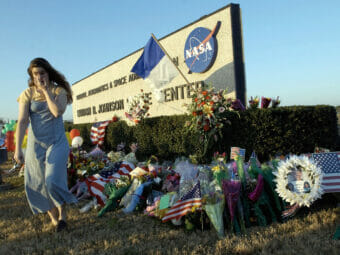
Mourners left a makeshift memorial outside NASA’s Johnson Space Center in Houston after the Columbia disaster on Feb. 1, 2003. (Brett Coomer/Getty Images)

It’s been exactly 20 years since the Space Shuttle Columbia disintegrated as it returned to Earth, killing all seven astronauts on board: commander Rick Husband, pilot Willie McCool, mission specialists Kalpana Chawla, Laurel Clark, Michael Anderson, David Brown and payload specialist Ilan Ramon of Israel.

Their mission — the 28th flight for Columbia, which became NASA’s first shuttle to fly in space some two decades earlier — was focused on research on physical, life and space sciences. The crew spent their 16 days in space conducting some 80 experiments before preparing to return to Florida’s Kennedy Space Center on the morning of Feb. 1, 2003.

Instead, the shuttle broke apart over northeast Texas, near Dallas, shortly after reentering Earth’s atmosphere and minutes before it was due to land.

Debris from the space shuttle Columbia streaks across the Texas sky as seen from Dallas on Feb. 1, 2003. (Jason Hutchinson/AP)

Temperature and tire pressure readings from the left side of the shuttle vanished, Mission Control lost contact with the crew and Texas residents saw streaks of smoke in the sky as debris began falling to the ground.

Pam Melroy, NASA’s deputy administrator and an astronaut who helped lead part of the Columbia investigation, told Morning Edition‘s Steve Inskeep that she remembers that day: She was in Florida getting ready to greet the crew.

“The space shuttle is coming back through the Earth’s atmosphere at Mach 25, and so it’s going to arrive within a second of when it’s predicted,” she recalled. “And so it was a moment where we all looked around and said, ‘How could this be happening? The space shuttle isn’t here.’ And that’s when we realized it wasn’t coming back.”

An investigation blamed physical and cultural problems

Columbia Space Shuttle debris covers the floor of the RLV Hangar Kennedy Space Center, Florida in May 2003. (NASA/Getty Images)

Over the next few weeks, NASA recovered thousands of pieces of debris, including the crew members’ remains, across parts of Texas, Arkansas and Louisiana.

And an investigation board released a report later that year detailing the physical and cultural problems behind the disaster.

A piece of foam insulation had broken off the shuttle’s propellant tank and hit the edge of its left wing just over a minute into its Jan. 16 launch, which was captured on camera. But the exact location and extent of the damage was not clearly visible to engineers, and NASA management reportedly did not address their concerns during the shuttle’s time in space because they believed little could be done about it.

The report found that a hole on the left wing allowed atmospheric gasses to enter the shuttle during its reentry, which caused it to overheat and break apart. It said there were things NASA could have done, like having the crew repair the wing damage or rescuing them from the shuttle.

It also blamed “cultural traits and organizational practices” for minimizing safety issues over the years, as well as low funding and strict scheduling. Investigators called on NASA to be more proactive in its efforts and replace the shuttle with a new system, as well as for more government support.

NASA officials including Deputy Administrator Pam Melroy, far left, visit the Space Shuttle Challenger Memorial at Arlington National Cemetery during NASA’s Day of Remembrance in January 2022. (Bill Ingalls/NASA via Getty Images)

Melroy says Columbia was top of mind when she commanded a mission to the International Space Station in 2007, especially because she had been part of the 2003 investigation, looking at crew training, equipment and procedures.

“I was very focused on doing everything in my power to use that learning to protect the crew in case of a mishap,” she said. “And I think all commanders feel that way, but I know it was very much on my mind throughout the whole mission to use that knowledge and ensure that the crew was as safe as possible. Fortunately, I didn’t have to.”

NASA suspended space shuttle flights for two years after the Columbia tragedy and went on to retire the space shuttle program altogether in 2011.

NASA says lessons from the past shape its future goals

NASA recovery team members watch as NASA’s Orion Capsule approaches after splashing down in the Pacific Ocean, west of Baja, Calif., following a successful uncrewed Artemis I Moon Mission on December 11, 2022. (Mario Tama/Getty Images)

Melroy says the Columbia disaster had a substantial impact on NASA, as did two other major disasters: the Apollo 1, which caught fire during a pre-launch test in 1967, and the Challenger, which exploded seconds after liftoff on Jan. 28, 1986. She thinks the agency “evolved more” after each of those incidents.

“If people died for this knowledge, we’re going to learn from it,” she said. “And I think that was the first step. But beyond that, the key lesson that we learned from Columbia was around schedule pressure but also around organizational silence — making sure that voices are heard inside the agency that have concerns about safety and making sure that those concerns get elevated to the right decision-makers.”

NASA holds an annual Day of Remembrance to honor astronauts who died in the line of duty. This year’s had a special focus on the Columbia anniversary, as Houston Public Media reported.

Evelyn Husband Thompson, the wife of Columbia’s commander, spoke on behalf of family members, according to HPM.

“In the past twenty years, the Columbia families have had celebrations, and sorrow, and life experiences,” she said. “One of us became a parent, and some of us are now grandparents.”

A portrait of the STS-107 crewmembers aboard the Space Shuttle Columbia in early 2003. From the left (bottom row), wearing red shirts to signify their shift’s color, are Kalpana Chawla, Rick D. Husband, Laurel B. Clark, and Ilan Ramon. From the left (top row) are David M. Brown, William C. McCool and Michael P. Anderson. (NASA/Getty Images)

NASA is now preparing for a new era of spaceflight, hoping its Artemis mission will put the first woman and first person of color on the lunar surface by 2025.

Will lessons learned from tragedies like Columbia play a role in those efforts?

“Absolutely,” Melroy says. “We are very proud of the lessons that we’ve learned and we’re incorporating them now.”

The audio for this story was produced by Ziad Buchh and Mansee Khurana, and edited by Jan Johnson.

Copyright 2023 NPR. To see more, visit https://www.npr.org.

FDA moves to ease restrictions on blood donations for men who have sex with men

""
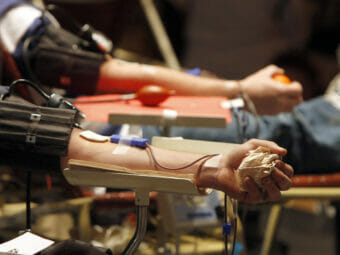
An expected change in FDA policy would make it easier for men who have sex with men to donate blood. (Toby Talbot/AP)

The U.S. Food and Drug Administration issued proposed guidance Friday to ease restrictions on blood donations by men who have sex with men.

The change is expected to take effect after a public comment period.

The restrictions on donating blood date back to the early days of the AIDS epidemic and were designed to protect the blood supply from HIV. Originally, gay and bisexual men were completely prohibited from donating blood. Over time, the FDA relaxed the lifetime ban, but still kept in place some limits.

Under the current policy — last updated in 2020 — men who have sex with men can donate blood if they haven’t had sexual contact with other men for three months.

The new proposed policy would eliminate the time-based restrictions on men who have sex with men (and their female partners) and instead screen potential donors’ eligibility based on a series of questions that assess their HIV risk, regardless of gender. Anyone taking medications to treat or prevent HIV, including PrEP, would not be eligible.

The risk assessment would include questions about anal sex. Potential donors who’ve had anal sex in the last three months with a new sexual partner or more than one sexual partner would not be eligible to give blood.

The changes are aimed at addressing criticism that the current policy is discriminatory and outdated, as well as one more barrier to bolstering the nation’s blood supply. Blood banks already routinely screen donated blood for HIV.

“We are moving now to an inclusive policy for blood donation,” said Dr. Peter Marks, who leads the Center for Biologics Evaluation and Research at the FDA during a briefing Friday.

“We will continue to work to make sure that we have policies that allow everyone who wants to donate blood to be able to donate blood within what the science allows to make sure that the blood supply remains safe.”

In crafting the new guidance, the FDA has been looking to the results of a study of about 1,600 gay and bisexual men to develop screening questions that can identify potential donors who are most likely to be infected with HIV.

Reaction to the news from advocates, medical groups and blood banks has been positive.

“The blood community is very excited about the proposed changes,” says Kate Fry, CEO of America’s Blood Centers. “We have advocated for a decade now for a move to an individual risk assessment model. So this is very welcome by blood centers across the country.”

She stressed that all donated blood is carefully screened for HIV and that testing has improved dramatically to ensure the safety of the blood supply.

For many years, the American Medical Association, the American Red Cross and LGBTQ+ advocacy groups have pushed for a change to the federal rules on blood donations.

“These changes are 40-plus years in the making and they’re a tremendous leap forward in elevating science over stigma,” says Tony Morrison, a spokesperson for the advocacy group GLAAD.

But GLAAD and other groups say the changes still don’t go far enough. They argue that some of the remaining restrictions are still unnecessary and stigmatizing, such as the prohibition against donations by people taking medication PrEP to prevent HIV.

“When we limit and defer people who are being proactive in their sexual health that stigmatizes them. The misconception is that people on PrEP are promiscuous or have a higher risk of HIV infection — that’s categorically false,” says Morrison.

So his group will continue to lobby the FDA to further ease restrictions.

The proposed changes in the blood donation rules will be open for public comment for 60 days. The FDA will then review those comments and issue a final rule, probably later this year. So monogamous gay men could start donating blood again sometime in 2023.

Copyright 2023 NPR. To see more, visit https://www.npr.org.

Biden administration invites ordinary citizens to help resettle refugees

Alight recruits and trains sponsor groups, ensuring that sponsors receive high-quality support and refugees integrate smoothly into their new communities. (Alight photo)

The Biden administration is appealing to private citizens to directly sponsor refugees resettling in the United States from around the world, as part of the biggest shift in the U.S. program for displaced people since its launch in 1980.

Under “Welcome Corps,” launched last week, ordinary Americans will handle the logistics and financial commitments necessary to help refugees coming to the United States. Several other countries, including Canada and Australia, already have similar programs in place.

Alight is part of a consortium of non-profit organizations receiving federal funding to recruit, train and support the volunteers from places like book clubs and community centers for the American pilot program.

“This is a really amazing opportunity for the U.S. to see what it looks like for us to be the type of country that welcomes in refugees, that’s able to provide safe haven and opportunity and a pathway to a rich and desirable future for people that have experienced such trauma, have experienced such hardship in their lives,” Alight CEO Jocelyn Wyatt told NPR’s A Martinez.

“And so this is a moment for America to be as generous as we know that we can be as a country.”

Welcome Corps builds upon other recent emergency initiatives overseen by the Department of Homeland Security that have provided support for Afghan and Ukrainian refugees, as well as expedited processes for Cubans, Haitians, Nicaraguans and Venezuelans.

But the DHS programs only provide temporary support, while Welcome Corps supports permanent resettlement.

Alight Guides meeting refugees at Przemysl, Poland train station. Alight Guides work in the US and around the world to support both refugees as well as US sponsor groups through the entire journey. (Alight photo)

Wyatt said many of these refugees have been waiting years, if not decades, for resettlement from places like Rwanda and the Democratic Republic of Congo.

“This is such an incredible opportunity to really start to transition folks out of refugee camps into more permanent resettlement opportunities in a country like the United States, where so many refugees have such a strong desire to to move to and resettle in,” she added.

American hosts are vetted and receive training, as well as regular monitoring and check-in meetings with refugee groups.

Groups of at least five people eager to sponsor a refugee family must raise $2,275 to support each refugee during their first three months in the country with needs such as apartment deposits and furniture.

In mid-2023, private sponsors will also be able to identify refugees abroad they want to help.

A host’s responsibilities include helping find housing and employment, enrolling children in school and connecting refugees with essential local services.

The State Department hopes to find at least 10,000 Americans eager to sponsor 5,000 refugees in the first year of the program. And so far, the response has been enthusiastic.

WelcomeCorps.org had 28,000 unique visits and 62,000 page views in its first 24 hours, according to the Community Sponsorship Hub, which leads the consortium of organizations implementing the program.

The group found that more than 4,000 people signed up to get more information.

“Because we speak the same language as the refugees, we can understand their needs better,” said Anatoliy Cherednichenko, an Alight guide who assists hosts on the ground with Ukrainian refugees. “And because we have that insider perspective, we can share it with the American sponsors so that they kind of have that insight as well.”

Alight sponsors based in Minneapolis take a walk with two sisters from Ukraine who moved to the U.S. with their family. (Alight)

The hosts will facilitate arrivals and expand U.S. capacity to take in refugees, but the non-profit groups will still lead resettlement efforts.

In the 2022 fiscal year, the U.S. received around 25,000 refugees — just 20% of the allocated slots. For the current fiscal year, which began on October 1, the administration has set a target of 125,000 refugees once again. But in the three months that ended in December, just 6,750 refugees arrived.

Welcome Corps also provides great benefits to the hosts, according to partner organizations.

“Everyone that we talked to who has had the opportunity to connect with the new arrivals or serve as a sponsor, has told us that the experience has been absolutely transformative for themselves and their families,” Wyatt said, referring to hosts who supported refugees through temporary programs.

“They have built such strong, meaningful, long lasting, what we expect will be lifelong relationships with the new arrivals and the refugees.”

Copyright 2023 NPR. To see more, visit https://www.npr.org.

A recession might be coming. Here’s what it could look like

Traders work on the floor of the New York Stock Exchange during the opening bell in New York City on Jan. 18, 2023. Survey after survey shows economists and CEOs expect a recession, but there’s no certainty of what an economic contraction would look like – or if the U.S. economy will suffer one at all. (Angela Weiss/AFP via Getty Images)

Slowcession? Richcession? Or just recession?

Whether in the supermarket aisle, or the corporate suite, a lot of people are expecting a recession – even if there’s no certainty there will be one at all.

Survey after survey shows fears of recession are high. It’s easy to see why.

The Federal Reserve is increasing interest rates in the most aggressive fashion since the early 1980s as it races to bring down inflation. And a recession is often the consequence when the central bank starts raising borrowing costs.

The prospect of recession is certainly scary. But even if the U.S. is headed for one, it’s worth keeping in mind that no two recessions are alike.

A recession could be blip-ish, like the short, pandemic-induced one in 2020, or more like the economic tsunami that followed the 2008 housing meltdown.

So, from recession with a small r to the so-called soft landing, here are some of the current predictions of what kind of economic slowdown the U.S. could be facing.

The recession with a small r

In a recent poll of economists, the World Economic Forum found that nearly two-thirds of the respondents believe there will be a recession in 2023.

But here’s the good news: Many analysts expect a relatively mild and short recession, or what is sometimes referred to as recession with a small r.

Unlike the early 1980s, when the Fed’s steep rate hikes sparked a brutal recession, this time around the economy still appears to be reasonably resilient despite grappling with the highest inflation rate in around 40 years.

A big reason is the health of the labor market. Yes, there have been high-profile layoffs at companies such as Google and Amazon recently. But those announcements were largely about paring back staff after these companies over-hired during the pandemic. In fact, the overall data still shows employers continue to hire.

A “We Are Hiring” sign is posted in front of a restaurant in Los Angeles on Aug. 17, 2022. The labor market remains resilient, raising hopes that any recession would be mild. (Frederic J. Brown/AFP via Getty Images)

Employers added 4.5 million jobs last year, marking a pretty spectacular comeback from the depths of the pandemic.

Of course, the Fed’s rate hikes will likely lead to some job losses. The Fed in December projected the unemployment rate would rise to 4.6%, from the currently near-record low of 3.5%.

But that still would be a historically low number.

The ‘slowcessation’

Trying to come up with catchy terms to describe an event is something of a tradition in economics, though they rarely actually catch on, with a few exceptions such as “the Great Resignation” or “skimpflation” (which was coined in this newsletter).

Moody’s Analytics is now giving it a try.

“Slowcessation” is a forecast that the economy will undergo a difficult period of almost no growth but will ultimately avoid an actual contraction. It’s an argument that others also believe.

In a report laying out its thesis, Moody’s argues that the economy still has plenty of things going for it, including healthy household finances, as well as strong corporate balance sheets.

A woman shops outside of a store in Manhattan in New York City on July 28, 2022. Retail sales are starting to decline after staying strong during the pandemic, a potential early sign the economy is slowing down. (Spencer Platt/Getty Images)

Moody’s believes those could help offset the economic consequences of raising interest rates, such as higher borrowing costs, lower economic growth, and more volatile financial markets.

“Under almost any scenario, the economy is set to have a difficult 2023. But inflation is quickly moderating, and the economy’s fundamentals are sound,” writes Mark Zandi, Moody’s chief economist.

“With a bit of luck and some reasonably deft policymaking by the Fed, the economy should avoid an outright downturn. If so, we may dub it a slowcession.”

The ‘richcession’

This one was coined by Wall Street Journal columnist Justin Lahart. Yes, journalists also try hard to come up with catchy terms, with a similarly poor track record of success.

“Richcession” refers to a recession or near-recession that impacts the rich more than lower-income folks. That would be unusual because recessions typically hurt the relatively less well-off the most.

Poorer people are already suffering in the current downturn, but Lahart and others say that if we do slip into recession, lower-income workers may find themselves more insulated than in previous recessions.

The labor shortages during the pandemic forced many businesses to boost wages to recruit staff. Wage gains at the bottom of the income scale were proportionately larger than those at the top, although many workers’ wage gains were partially eroded by inflation.

Inflation is now easing but the wage gains remain. That factor should help lift the overall net worth of lower income workers as they face a potential recession.

And the most recent labor data shows sectors that typically hire lower-income workers such as leisure and hospitality continued to hire strongly as Americans continued to dine out and take vacations. In fact, retail businesses, still remembering the nightmare of recruiting workers during the pandemic, are more keen to hold onto staff.

That’s also raising hope that those with lesser means could be spared some of the impact of an economic downturn.

The soft landing

Of course, there’s no certainty the U.S. will have to endure a recession at all.

The Fed has continued to argue it has a path to raise rates without sparking a recession, instead steering the U.S. into what’s called “a soft landing” – a scenario in which the economy slows but doesn’t contract, and unemployment doesn’t spike significantly.

Federal Reserve Chair Jerome Powell speaks during a news conference after a Fed policy meeting on Dec. 14, 2022 in Washington, D.C. The Fed is raising interest rates in the most aggressive fashion since the early 1980s. (Alex Wong/Getty Images)

Some recent indicators point toward that more optimistic scenario.

Inflation continues to moderate, with the annual rate falling to 6.5% in December from a peak of 9.1% in June.

Some of the factors that especially worried the Fed are also trending in the right direction, including, most prominently, cooling wage and price increases.

That has allowed the Fed to moderate the size of its rate hikes, and analysts now expect the central bank will raise rates by only a quarter percentage point at its meeting next week.

Furthermore, China’s end to its COVID-19 restrictions has raised hopes for a stronger global economy, which can have a positive impact in the U.S. as well. This cuts both ways, though, as increased demand for energy to power China’s economy could result in higher oil and gas prices.

The hard landing

In an unpredictable world, no scenario can be ruled out – and neither can the prospect that the Fed’s rate hikes will help spark a tough recession, or a hard landing in economic lingo.

For one, the Fed could overdo the rate hikes, raising them more than necessary. Managing interest rates is an inexact science and mistakes can be dire. The Fed was widely blamed for keeping rates too low in the lead-up to the 2008 Global Financial Crisis, for example.

Meanwhile, Russia’s invasion of Ukraine continues to weigh on the global economy. Nobody can predict how the war there will ultimately end.

There is another, big potential risk on the horizon: the looming fight over the debt ceiling.

Failure to raise the ceiling would leave the federal government unable to pay all of its bills, triggering a default. That would rattle financial markets around the world. Even if the government manages to avoid an actual default, simply coming close could raise borrowing costs and put a dent in people’s retirement savings.

In an interview with CNN, Treasury Secretary Janet Yellen warned not raising the country’s debt limit has the potential to spark another “global financial crisis.”

A worst case scenario, for sure, and one that would likely end up sparking a recession — with a capital R.

Copyright 2023 NPR. To see more, visit https://www.npr.org.

FDA considers major shift in COVID vaccine strategy

""
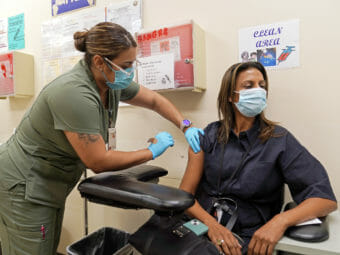
Licensed vocational nurse Denise Saldana vaccinates Pri DeSilva, associate director of Individual and Corporate Giving, with a fourth Pfizer COVID-19 vaccine booster at the Dr. Kenneth Williams Health Center in Los Angeles, Nov. 1, 2022. (Damian Dovarganes/AP)

The Food and Drug Administration is considering a major shift in the nation’s COVID-19 vaccine strategy.

The goal is to simplify vaccination against COVID and perhaps adopt an approach similar to what is used for the flu vaccine, with annual updates to match whatever strain of the virus is circulating. This is according to a federal official who spoke under the condition of anonymity because they were not authorized to speak publicly.

NPR reported the proposed shift early Monday morning, and later Monday the FDA outlined it publicly in a set of documents released in advance of a meeting Thursday of the agency’s Vaccine and Related Biological Products Advisory Committee (VRBPAC). The committee will vote on the agency’s proposal.

Currently, people who want to be fully vaccinated against COVID have to first get their primary vaccinations — two shots of the original vaccine spaced weeks apart. That’s followed at least two months later by a booster, currently the bivalent shot that’s tailored to protect against omicron.

Under the new approach, most people would be advised to simply get whatever the latest version of the vaccine is annually each fall like the flu vaccine. They wouldn’t have to worry about how many shots they’ve already gotten and which one they got when. Those who still need to receive two doses initially, such as young children and older people, would use the same formulation for all three shots.

Vaccine makers would update the annual shot through a process that would begin each spring to try a match the vaccine as closely as possible to whatever variant will likely be dominant in the coming winter. That’s how the flu vaccine is formulated each year.

“FDA anticipates conducting an assessment of SARS-CoV-2 strains at least annually and to engage VRBPAC in about early June of each year regarding strain selection for the fall season,” the FDA wrote in its briefing document, adding that updated vaccines would be readied for use by September each year.

The agency notes that if a more dangerous COVID variant were to emerge, it might reconsider the vaccine strain at other times of the year on an “as-needed and emergent basis.”

Some immunologists and vaccine researchers say simplifying the process along the lines of the flu vaccine is appropriate at this point in the pandemic. However, many questions remain about emerging booster strategy.

“As far as the tools that we have right now, I think it just makes the most sense to plan to update each year as close as we can to the currently circulating variant,” says Deepta Bhattacharya, an immunologist at the University of Arizona. “So I think all the things the FDA is considering make a lot of sense.”

Questions about efficacy of updated shots

There’s an intense debate about the wisdom of updating the COVID vaccines regularly to try to match new variants. Some researchers question whether that really makes the vaccines more effective. They also argue the low demand for the latest booster shows the public has little appetite for continued boosting with the vaccines, even if they’ve been updated with new strains.

“The public is voting with their arms if you will and said, ‘No. I’m not going to get this. This doesn’t make sense to us,'” says Dr. Gregory Poland, a vaccine researcher at the Mayo Clinic.

While endorsing continued boosters for those at high risk, such as the elderly, some question whether the current bivalent vaccines updated to target omicron have enhanced protection compared to the original vaccines. Most people are still well-protected against severe disease by the immunity they already have, they say.

“We have no solid data about the performance of the bivalent boosters,” says John Moore, an immunologist at Weill Cornell Medical College. “The hard evidence is lacking, and the evidence that is out there is at the very least inconclusive and to me trends towards saying the bivalent boosters were little if no better.”

Moore and others argue the virus is changing so fast that it’s pointless to constantly try to match the vaccines to the latest variants.

“We shouldn’t really be chasing these variants, which are evanescent and are often gone by the time you’ve created the vaccine,” says Dr. Paul Offit of the University of Pennsylvania, one of the FDA’s advisers.

Offit and others also question whether everyone will necessarily need to be boosted regularly, or just those at high risk, like the elderly.

Arguments for alternate vaccine strategies

Critics of the FDA’s proposed new strategy argue it would be better to invest in developing better vaccines that might be more appealing to people, and in campaigns to get more people vaccinated. Better vaccines could include those that could keep people from catching the virus in the first place not just from getting seriously ill — such as a nasal spray vaccine. Or perhaps vaccines that provide longer protection or are administered in pill form, to make them more acceptable to the needle-averse.

“Particularly now when Congress is not allocating new funds for COVID response, we have to be especially judicious in how we spend our money and what would be most cost-effective,” says Dr. Celine Gounder, a senior fellow at the Kaiser Family Foundation. “It’s unclear whether updating the booster formulations and repeatedly boosting people is the most effective approach to controlling COVID at this stage.”

Another concern some researchers have is that the FDA continues to rely on antibody levels to test vaccine efficacy.

“I think we need to raise the bar and require more evidence of clinical efficacy,” says Dr. Eric Rubin, a professor of immunology and infectious diseases at Harvard who is also a member of the advisory committee. For instance, Rubin says the FDA should require proof the updated vaccines are actually reducing the risk of getting infected, getting sick, hospitalized and dying.

Others say updating the vaccines make sense to make sure people are as well-protected as possible while researchers continue to try to develop new vaccines.

“Even if you don’t have a booster that matches 100% what’s circulating, you will have a booster that matches 75% to 80% to 90% of what’s circulating,” says David Martinez, an immunologist at the University of North Carolina, Chapel Hill. “And that will be good enough. It would probably benefit most people.”

The FDA looks ahead to endemic COVID

Some researchers think it’s too soon to rely on annual boosters. COVID hasn’t quite settled into a seasonal pattern like the flu, they note, and the SARS-CoV2 virus is changing more quickly than the flu virus. So people may need to be boosted more frequently, especially since protection against severe disease may only last about four to six months, they say.

“We’re going to be reaching that pretty soon with the early adopters of the bivalent boosters, like myself,” says Dr. Peter Hotez, co-director of the Center for Vaccine Development at Texas Children’s Hospital and dean of the National School of Tropical Medicine at Baylor College of Medicine. “I don’t know if an annual strategy is going to cut it.”

The FDA’s plan comes as COVID appears to be moving toward becoming an endemic disease. That doesn’t mean it’s going away or it’s not a threat anymore. The disease will continue to be a threat for the foreseeable future, making many people sick and even potentially killing hundreds a day, making it a major public health problem and a leading cause of death, health experts say.

But unless some more dangerous version of the virus suddenly emerges, the world might finally be settling into a more predictable co-existence with the virus. The federal official NPR spoke to says the goal of the new vaccine strategy is to make the vaccines, which are the major weapon for protecting ourselves, simpler and hopefully therefore more appealing. The latest boosters have found very few takers.

The thinking is that at this point in the pandemic the overwhelming majority of people have a significant levels of immunity, either from having gotten vaccinated and boosted, or infected one of more times, or both. And while that immunity appears to protect most people from severe disease, that protection does appear to fade with time.

The FDA is also considering making the shots interchangeable. That way people wouldn’t have to worry which brand they’re getting. Again, the change is aimed at making COVID shots more like the flu shots. People don’t typically worry about the brand of the flu vaccine they receive.

The vaccine would still be administered at different doses for different ages. And very young children and older people would still get two shots each year, much like the flu vaccine.

If the FDA advisory committee endorses the approach Thursday, the FDA would work with the vaccine companies and Centers for Disease Control and Prevention to finalize the details. And the FDA advisers would meet again in the spring to pick the specific strain or strains of the virus the new shots should target.

Copyright 2023 NPR. To see more, visit https://www.npr.org.

Anti-Defamation League survey finds a spike in antisemitic beliefs

A police car parked outside a synagogue
A police vehicle sits near the Congregation Beth Israel synagogue in Colleyville, Texas, on Jan. 16, 2022. Four people were held hostage at the synagogue for more than 10 hours by a gunman before being freed, one of a spate of antisemitic acts that took place last year. (Brandon Bell/Getty Images)

The percentage of Americans who believe in a number of antisemitic tropes has spiked in the past three years, according to the results of an Anti-Defamation League survey released Thursday.

ADL leaders say years of antisemitic rhetoric from former President Donald Trump, along with emboldened violent extremism and lax social media policies are to blame.

The survey, which asked respondents to rate the truthfulness of 14 different traditional negative stereotypes about Jews, found that about one in five American adults say they agree with at least six such sentiments. That’s compared to about one in nine in 2019, the last time this survey was conducted.

The 2022 survey, conducted last fall among 4,000 respondents, found roughly 70% agree with the statement “Jews stick together more than other Americans” and more than half agree with “Jews in business go out of their way to hire other Jews.” One in three respondents agreed that “Jews do not share my values” and about 26% agreed with “Jews have too much power in the business world.”

“What these findings represent, what they tell us, and what creates such urgency is the fact that large, huge numbers of Americans hold dangerous, false ideas about the Jewish people,” ADL CEO Jonathan Greenblatt said in a news conference. “While it is very encouraging that the vast majority of our country doesn’t hold these ideas, 50 plus million people is worrisome and it means we’ve got work to do.”

The organization has measured agreement with these anti-Jewish tropes since 1964. Findings from that initial survey represented the peak of antisemitic beliefs, showing nearly a third of American adults then agreed with six or more of the statements. The numbers in 2022 are the highest since 1992. The decades in between show relatively lower levels of belief in antisemitic tropes. The ADL expressed alarm over the sudden jump from roughly one in nine Americans’ belief in several antisemitic tropes in 2019 to one in five in 2022.

Separate data collection by the ADL has found the volume of documented reports of antisemitic harassment, vandalism and violence rising consistently since about 2015, in contrast to the more recent spike in anti-Jewish attitudes.

Matt Williams, vice president of the ADL’s Center for Antisemitism Research, said that researchers have found that people are being more honest about their biases compared to decades ago.

“So one of the things we could be seeing is people agreeing with these [tropes] more. Another thing that we could be saying is people willing to admit that they agree with these [tropes] more. Both of which are cause for different kinds of concern,” Williams said.

Copyright 2023 NPR. To see more, visit https://www.npr.org.

Site notifications
Update notification options
Subscribe to notifications