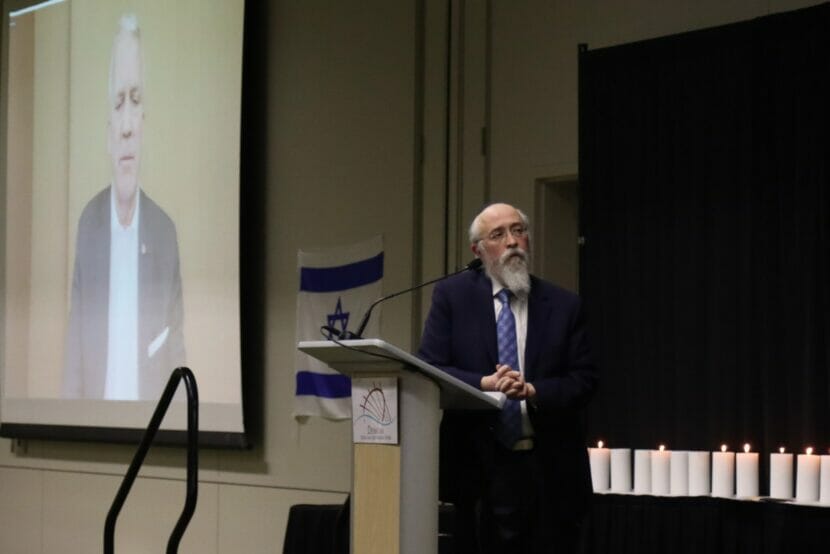
Rabbi Yosef Greenberg listens to U.S. Sen. Dan Sullivan speak through a video conference at the Dena’ina Center in Anchorage on Oct. 11, 2023. Sullivan condemned Hamas’ attack on Israel and pledged support for Israel. (Jeremy Hsieh/Alaska Public Media)
Anchorage rabbis and Alaska politicians led an event attended by about 200 people Wednesday night to show solidarity with Israel.
Speakers at the Dena’ina Center event mourned the Israeli civilians killed and led prayers for hostages, the wounded and Israeli Defense Force soldiers.
Rabbi Yosef Greenberg leads the Lubavitch Jewish Center of Alaska, which organized the event.
“We ask ourselves, where have we gone wrong? How did ‘never again’ became ‘ever again?’” he said, referencing the Holocaust.
U.S. Sen. Dan Sullivan addressed the crowd live by video conference. He called Saturday’s attack on Israel pure evil.
“There is no moral equivalence between a barbaric terrorist group committing these kinds of savage atrocities against innocents in a nation fighting to defend its very right to exist,” he said. “No moral equivalence. Period.”
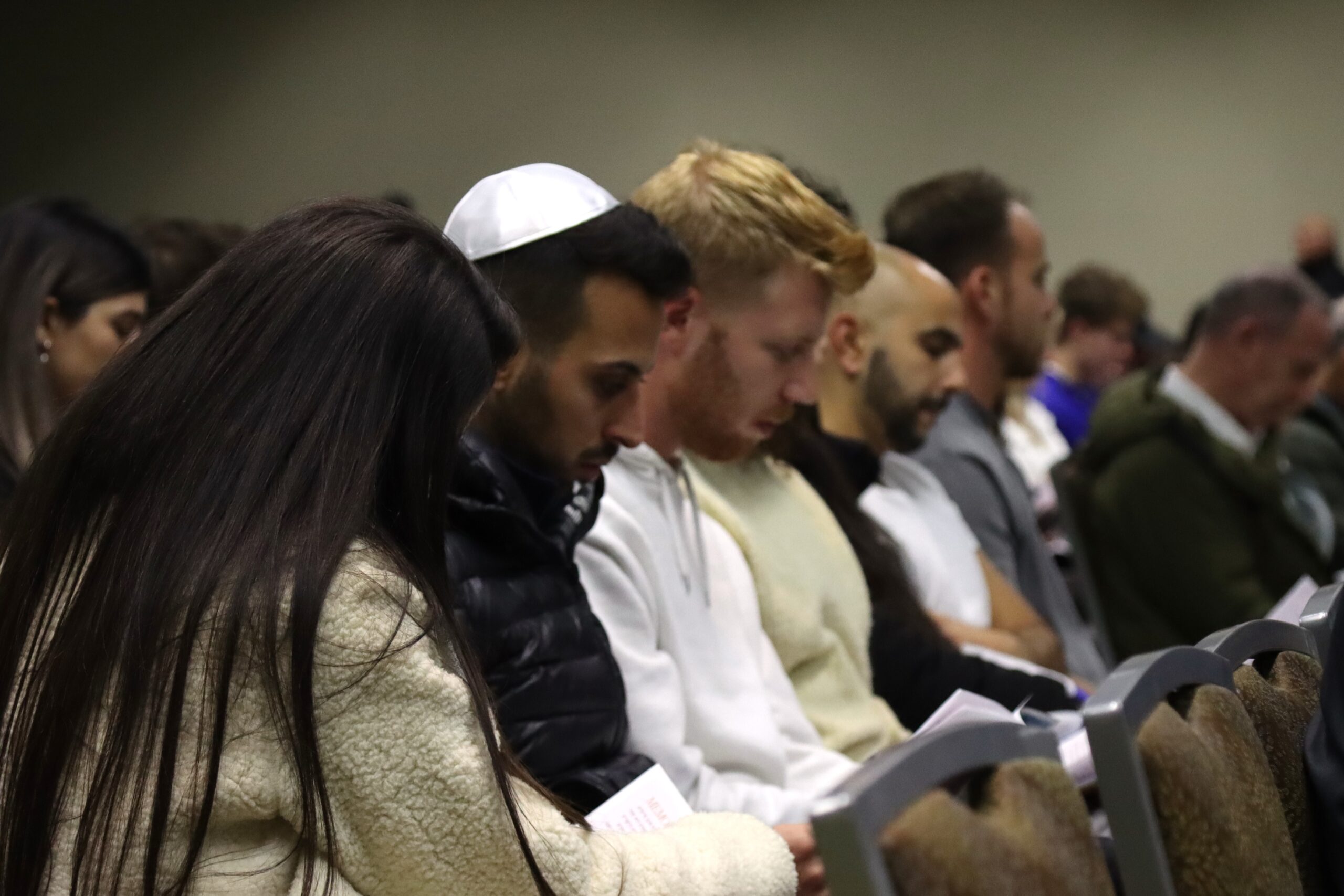
About 200 people attended an event to show solidarity with Israel at the Dena’ina Center in Anchorage. Aviel Levi, in the white kippah, said he plans to travel to Israel next week to serve in the Israeli Defense Force. (Jeremy Hsieh/Alaska Public Media)
Other speakers included Lt. Gov. Nancy Dahlstrom, Anchorage Mayor Dave Bronson and Christian faith leaders. They voiced support for Israel and condemned Israel’s attackers as monsters.
“I’m devout Christian,” Bronson said. “As a devout Christian, I am compelled quite frankly to be a Zionist. And I am. Because Israel is for Jews. And Jews are for Israel. And Israel has the right to defend itself.”
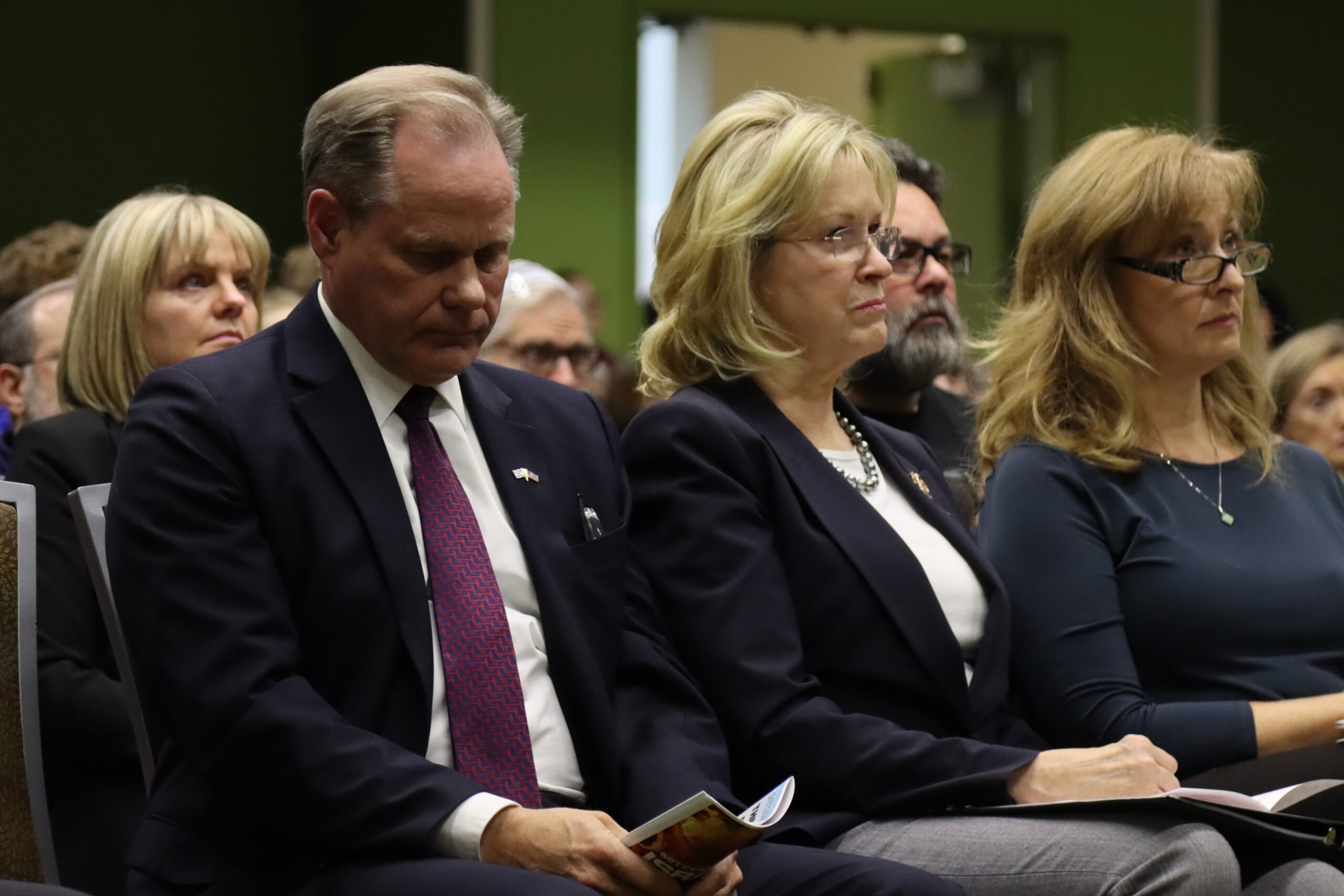
Anchorage Mayor Dave Bronson and Alaska Lt. Gov. Nancy Dahlstrom listen to Jewish religious leaders speak at the Dena’ina Center. Bronson and Dahlstrom pledged their support for Israel and condemned Hamas’ attacks on Israel. (Jeremy Hsieh/Alaska Public Media)
NPR reports that Israel’s retaliatory air strikes in Gaza have killed more than 1,000 people, with more than half women and children.
Michael Patterson, an organizer with the Party for Socialism and Liberation Anchorage, called for a demonstration in Delaney Park this past Sunday in support of Palestine. He said a handful of people attended the event. He described Saturday’s attack as a “counter-offensive against the Israeli apartheid regime.”
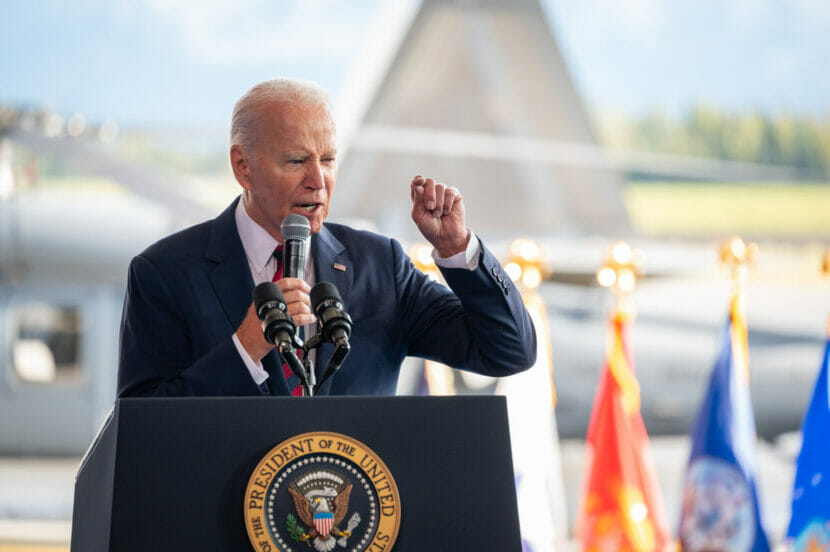
President Joe Biden speaks at a 9/11 memorial held at Joint Base Elmendorf-Richardson in Anchorage on Sept. 11, 2023. (Matt Faubion/Alaska Public Media)
President Joe Biden led a memorial at Joint Base Elmendorf-Richardson in Anchorage Monday on the anniversary of the 9/11 attacks. He described that day, 22 years ago.
“My fellow Americans, September 11, 2001 tested our strength, our resolve and our courage,” Biden said. “The billowing smoke and ash, the dark and the clear blue sky that September day. Those shredded steel concrete slabs that rained down from the World Trade Center. The plume of fire that shot up in the sky and Pentagon.”
Biden stopped at JBER on his way back from the G20 summit in India and a diplomatic visit to Vietnam.
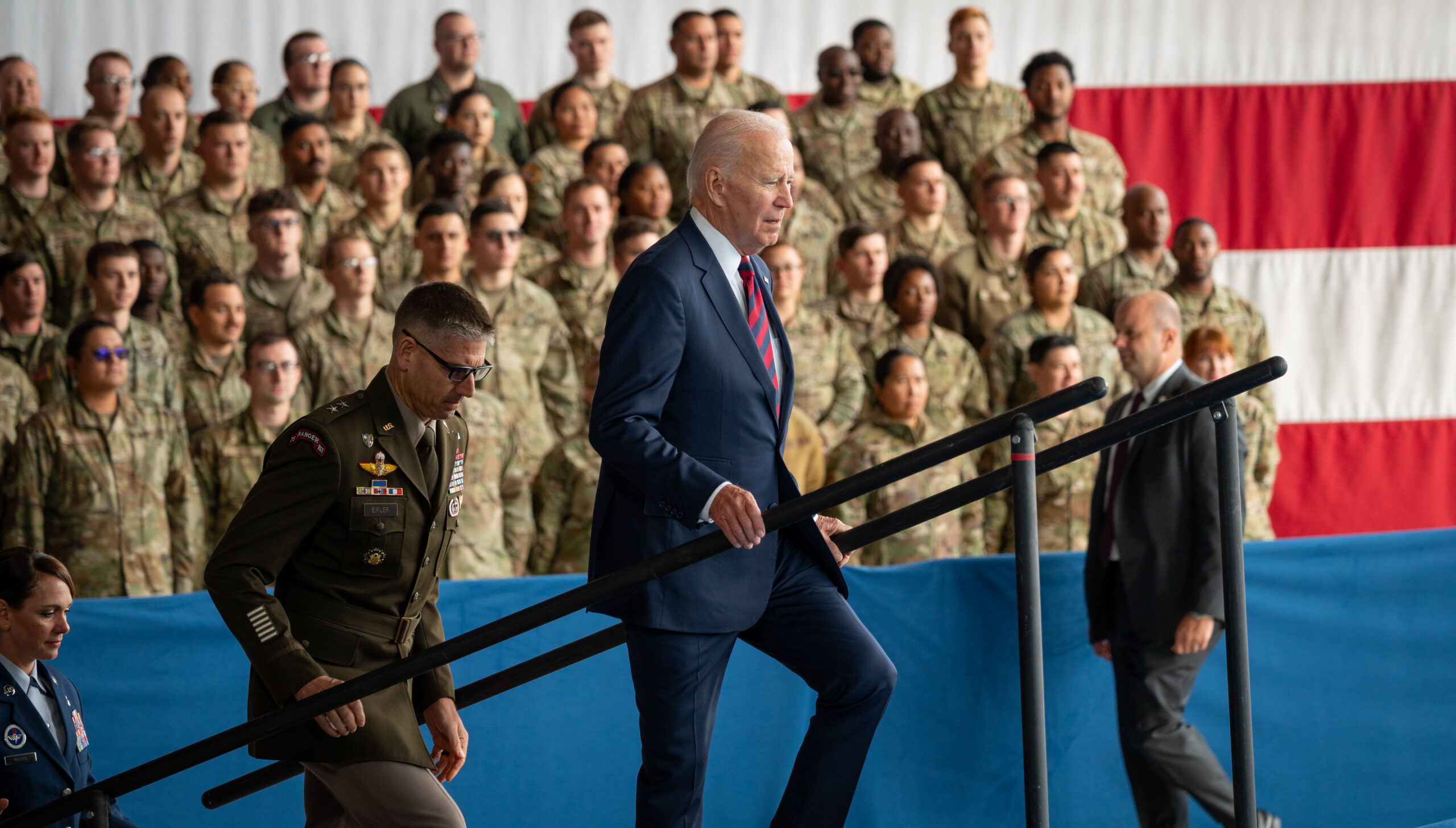
He spoke for more than 15 minutes in a hangar filled with Alaska-based military members and their families, as well as more than a dozen politicians and policymakers, including Gov. Mike Dunleavy, U.S. Congresswoman Mary Peltola and Anchorage Mayor Dave Bronson.
President Joe Biden walks up to the podium at Joint Base Elmendorf-Richardson. (Matt Faubion/Alaska Public Media)
The president said though JBER was thousands of miles away from the World Trade Center and the Pentagon, the distance “did not dull or diminish the pain.”
“We know that on this day, 22 years ago from this base, we were scrambled on high alert to escort planes through the airspace,” the president said. “Alaskan communities opened their doors to stranded passengers. American flags sold out in every store, were placed in front of seemingly every home.”
Biden decried terrorism — not only foreign, but domestic and ideological violence as well. He also used the remembrance to call for national unity.
“That’s how we truly honor those we lost on 9/11,” Biden said. “By remembering what we can do together. To remember what was destroyed, what we repaired. What was threatened, that we fortified. What was attacked, and an indomitable American spirit prevailed over all of it.”
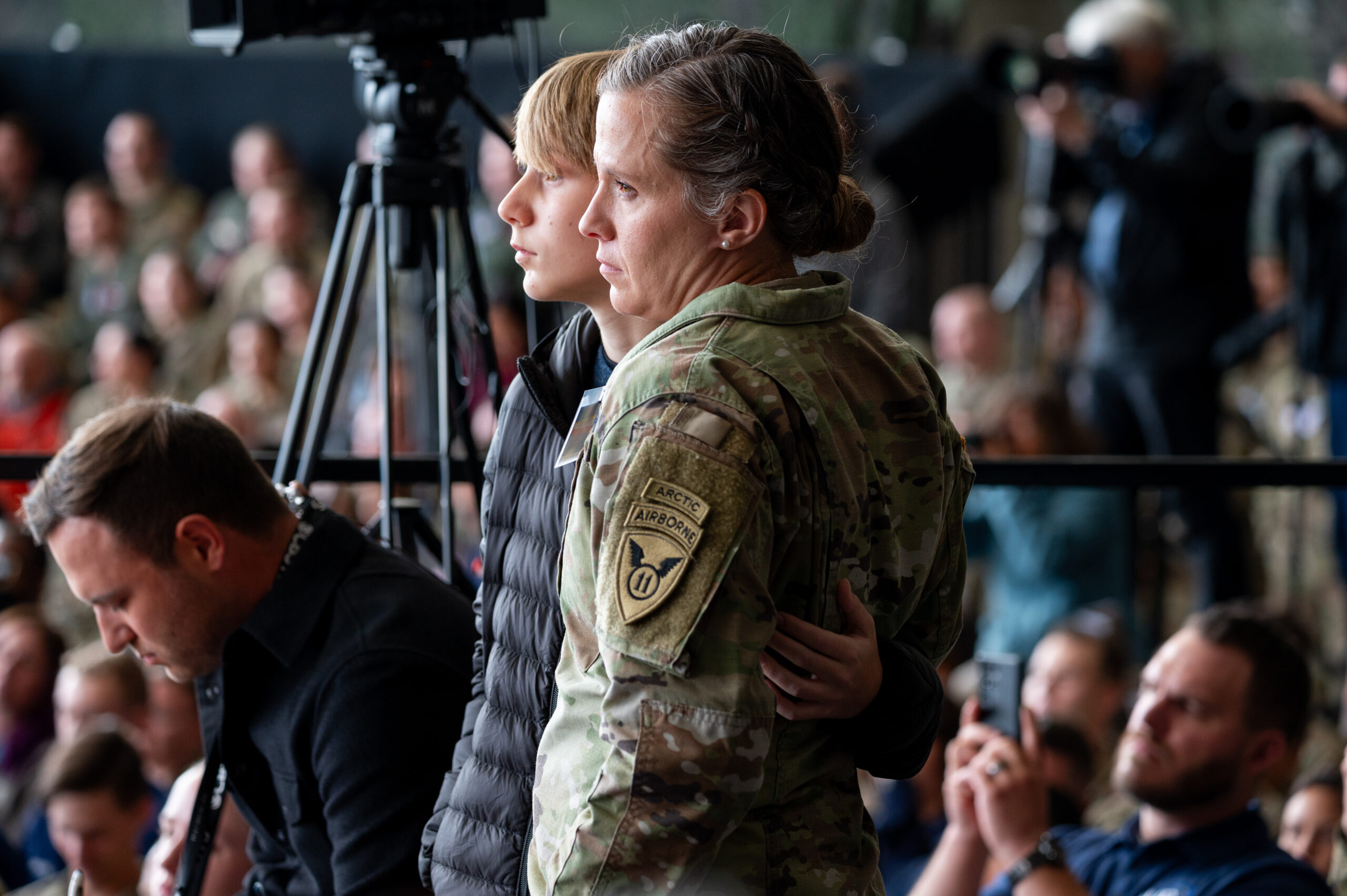
A woman and her son listen to President Joe Bidens remarks at Joint Base Elmendor-Richardson. (Matt Faubion/Alaska Public Media)
Biden’s stop in Anchorage comes five days after his administration canceled oil leases in the Arctic National Wildlife Refuge, a move blasted by Alaska’s congressional delegation and Gov. Dunleavy. In the president’s remarks, he sought to find some common ground with the Republican governor: their hometown.
“We’re both from Scranton, Pennsylvania,” Biden said. “I wish I had him playing in my high school ball club when I was playing. I could’ve been an All-American having you in front of me.”
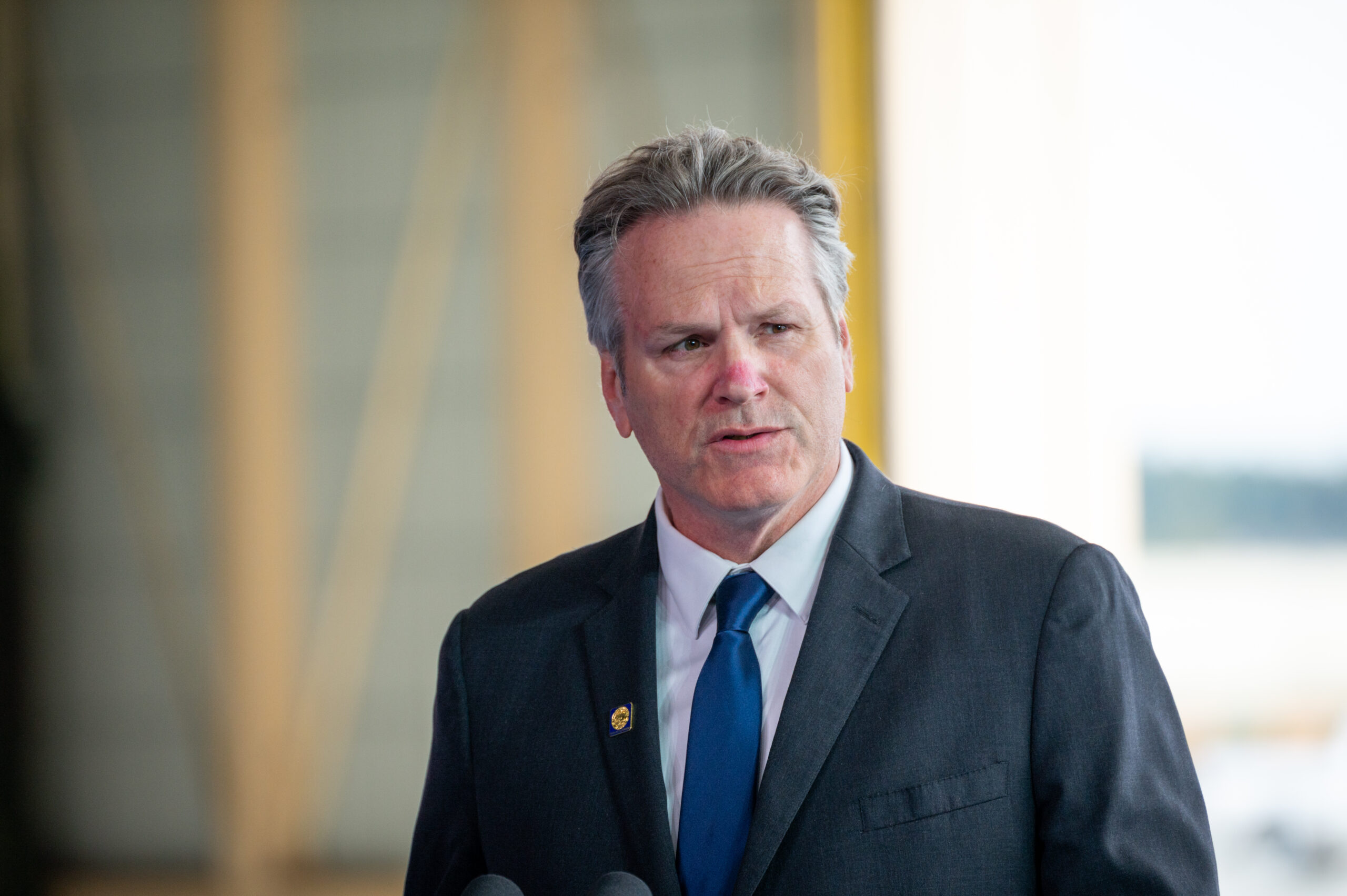
Dunleavy spoke before the president, and while he didn’t mention ANWR, he did note Alaska’s strategic military position in the world.
“Parts of Alaska are just 2.4 miles away from one of our nearest neighbors, Russia,” Dunleavy said. “Servicemen and women here at JBER intercept Russian fighters on a regular basis. Alaska is also within reach of Korean missiles, and Chinese warships ply the waters just off our coast.”
Gov. Mike Dunleavy speaks at the 9/11 memorial on Joint Base Elmendorf-Richardson. (Matt Faubion/Alaska Public Media)
Rep. Peltola spoke ahead of the president’s remarks as well. While she also didn’t mention ANWR, she spoke about resource extraction in Alaska broadly, calling Alaska energy, “one of our nation’s best defenses against foreign aggression.”
“Today our president is returning from meeting partners in Asia, who seek independence from the influence of authoritarian states,” Peltola said, “and see Alaska’s resources as a means of achieving their own freedom, showing that America remains a beacon of hope around the world.”
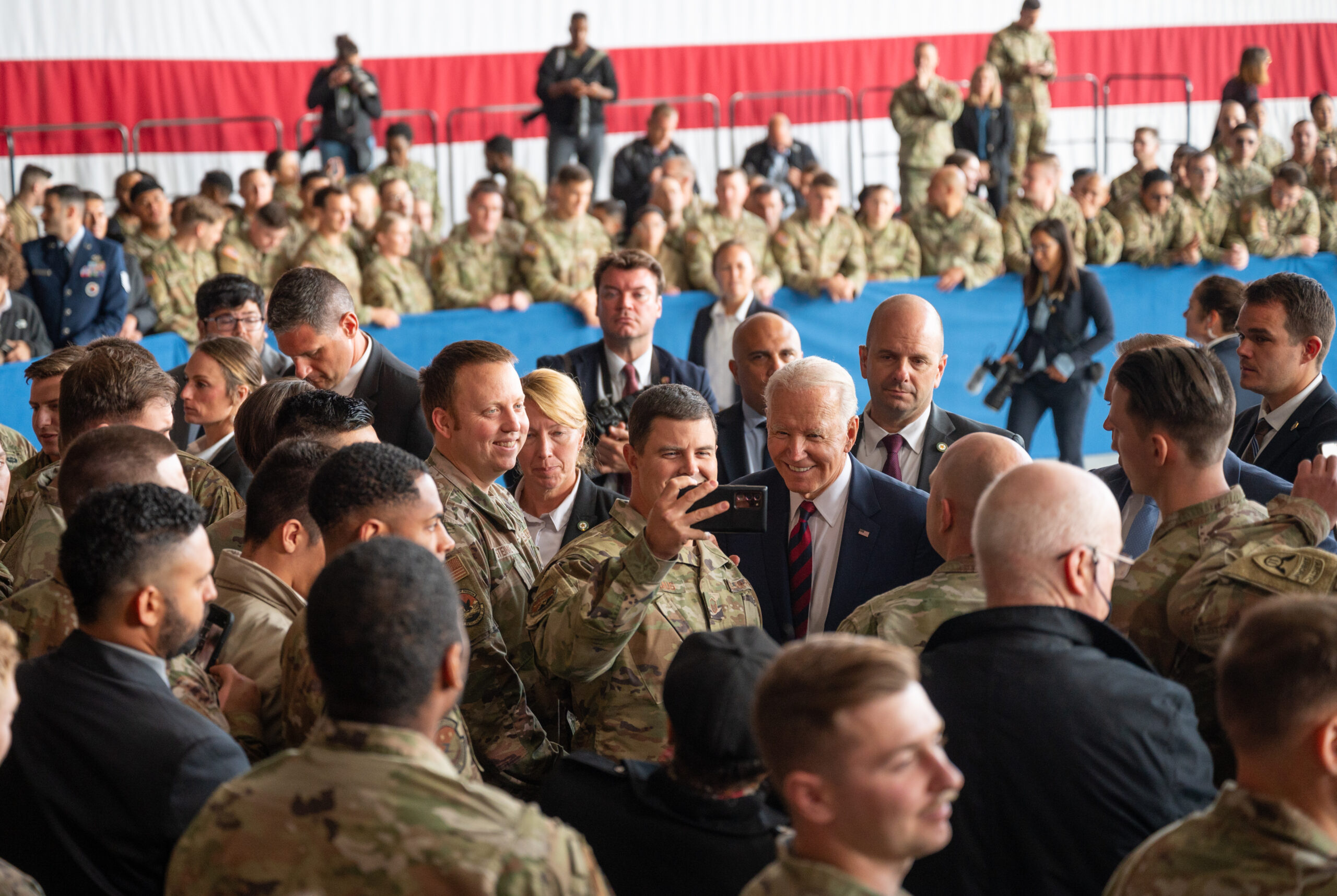
After his remarks, the president shook hands with audience members for nearly an hour before departing on Air Force One back to Washington, D.C.
President Joe Biden takes a selfie. (Matt Faubion/Alaska Public Media)
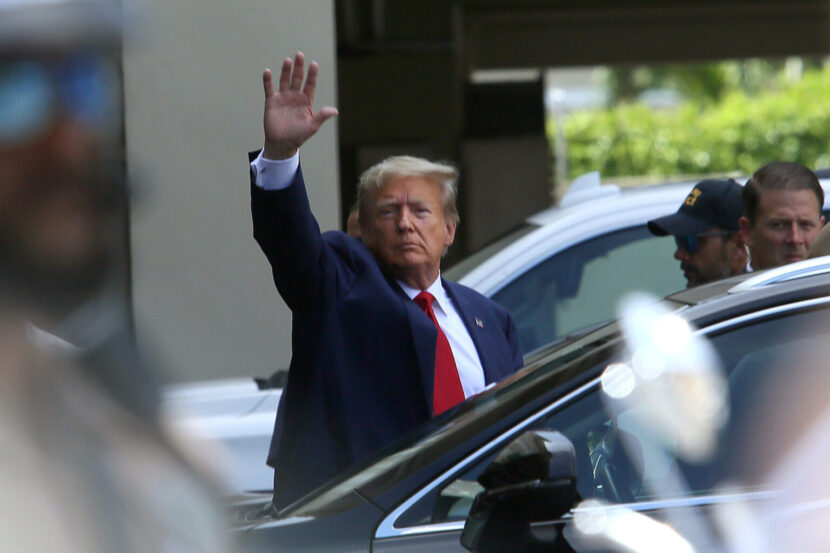
MIAMI, FLORIDA – JUNE 13: Former U.S. President Donald Trump waves as he makes a visit to the Cuban restaurant Versailles after he appeared for his arraignment on June 13, 2023 in Miami, Florida. Trump pleaded not guilty to 37 federal charges including possession of national security documents after leaving office, obstruction, and making false statements. (Photo by Alon Skuy/Getty Images)
WASHINGTON — A federal grand jury in Washington, D.C., indicted Donald Trump on Tuesday, alleging that Trump and co-conspirators attempted to subvert the 2020 election to keep the former president in power through a series of illegal actions that culminated in the Jan. 6, 2021, attack on the U.S. Capitol.
The former president faces four charges in U.S. District Court for the District of Columbia stemming from his actions following the November 2020 election, including conspiracy to defraud the United States; conspiracy to obstruct an official proceeding; obstruction of, and attempt to obstruct, an official proceeding; and conspiracy against rights.
“Each of these conspiracies — which built on the widespread mistrust the Defendant was creating through pervasive and destabilizing lies about election fraud — targeted a bedrock function of the United States federal government: the nation’s process of collecting, counting and certifying the results of a presidential election,” the indictment states.
Special Counsel Jack Smith said during a brief statement on Tuesday evening that Trump’s lies about election fraud caused the “unprecedented assault on the seat of American democracy” on Jan. 6.
“As described in the indictment, it was fueled by lies,” Smith said. “Lies by the defendant aimed at obstructing a bedrock function of the U.S. government.”
Smith said he would seek a speedy trial, so the evidence prosecutors have gathered can be tested in court. He added that investigations into other individuals, possibly including six unnamed co-conspirators listed in the indictment, would continue. He did not take questions.
The indictment lists Trump’s false statements about election results in Arizona, Georgia, Michigan, Nevada, New Mexico, Pennsylvania and Wisconsin.
The 45-page indictment says Trump knew that his statements about the election were false. Despite declarations from state leaders and elections officials that no fraud occurred, Trump continued to say vote totals were in his favor and worked with co-conspirators to influence state legislators to decertify results, according to the indictment.
“Despite having lost, the Defendant was determined to remain in power,” the indictment reads. “So for more than two months following election day on November 3, 2020, the Defendant spread lies that there had been outcome-determinative fraud in the election and that he had actually won.”
“These claims were false, and the Defendant knew that they were false,” it reads.
The indictment later adds: “These prolific lies about election fraud included dozens of specific claims that there had been substantial fraud in certain states, such as that large numbers of dead, non-resident, non-citizen or otherwise ineligible voters had cast ballots, or that voting machines had changed votes for the Defendant to votes for Biden.”
Trump is leading the field of Republicans vying to become the party’s nominee for president in the 2024 election. The first GOP primary debate is scheduled for later this month. Republicans largely rebuked the indictment, with many dismissing it as partisan.
In a statement from his campaign, Trump denied wrongdoing and called his prosecution politically motivated.
“This is nothing more than the latest corrupt chapter in the continued pathetic attempt by the Biden Crime Family and their weaponized Department of Justice to interfere with the 2024 presidential election, in which President Trump is the undisputed front-runner, and leading by substantial margins,” a statement from the Trump campaign read.
The plans for fake electors
The indictment focuses on plans by Trump and co-conspirators — four unnamed attorneys, a U.S. Justice Department official and a political consultant — to replace legitimate electors in seven key states, which Joe Biden in fact won, with fraudulent electors pledged to Trump.
Federal prosecutors listed five steps Trump took, escalating as each effort failed to bring his desired result.
According to the indictment, Trump and his co-conspirators pressured state legislators and election officials in key states to switch the legitimate election results in those states from Biden to Trump.
Trump and his team organized fraudulent slates of electors, which they sought to have replace the legitimate Biden electors, according to the indictment.
Trump ordered “sham” U.S. Justice Department investigations into election crimes in certain states, and considered having DOJ officials send letters outlining supposed concerns with the elections in those states. Those concerns could then be used as a pretext to advance the fraudulent electors, the indictment reads.
Trump and his co-conspirators then pressured Vice President Mike Pence to use his ceremonial role to certify the election results on Jan. 6 to authenticate the fraudulent electors, the indictment reads.
When Pence, who did not have the legal authority to replace the electors, declined to participate, Trump repeated to supporters who had gathered in Washington that Pence did have the authority to change the election result and “directed them to the Capitol to obstruct the certification proceeding,” the indictment said.
As the crowd turned violent, Trump and his co-conspirators used the chaos to continue launching claims of election fraud and attempting to convince members of Congress to delay the proceeding, prosecutors alleged.
False statements about election fraud
Trump “pushed officials in certain states to ignore the popular vote; disenfranchise millions of voters; dismiss legitimate electors; and ultimately, cause the ascertainment of and voting by illegitimate electors in favor of the Defendant,” the indictment says.
Trump and his co-conspirators worked to establish fraudulent electors in seven states by “attempting to mimic the procedures that the legitimate electors were supposed to follow under the Constitution and other federal and state laws,” according to the indictment.
Those false electors in Arizona, Georgia, Michigan, Nevada, New Mexico, Pennsylvania and Wisconsin met on the same days as legitimate electors, casting fake votes for Trump and then signing certificates where they falsely claimed they were the actual electors.
“Some fraudulent electors were tricked into participating based on the understanding that their votes would be used only if the Defendant succeeded in outcome-determinative lawsuits within their state, which the Defendant never did,” reads the indictment.
Those false election certificates were then sent to the vice president and other government officials, in an attempt for them to be counted instead of the legitimate electors when Congress convened on Jan. 6, 2021 to certify the vote.
That morning an associate of Trump’s, who isn’t named in the indictment, worked to get false election certificates from Michigan and Wisconsin to an unnamed U.S. senator, who was supposed to deliver those to Pence, according to the indictment.
A staffer for Pence later rejected efforts to put those false electors into the vice president’s hands, according to the indictment.
Trump’s pressure on Pence
The indictment details Trump’s efforts to “enlist” Pence to alter the election results, using Trump and his co-conspirators’ fraudulent slate of electors.
The vice president has a ceremonial role in certifying presidential election results.
When Pence remained unconvinced by the scheme, Trump began rallying supporters to amass in Washington, D.C., on the day Pence would preside over the certification, the indictment states.
The indictment recounts Trump’s Dec. 19, 2020, post on Twitter, in which he wrote “Big protest in D.C. on January 6th. Be there, will be wild!”
Days later, on Dec. 23, Trump re-posted a memo titled “Operation ‘PENCE’ CARD,” that falsely stated Pence could disqualify electors from the states where Trump falsely claimed voter fraud. That same day, a person identified in the indictment as “co-conspirator 2,” identified as John Eastman by his attorney, circulated a memo detailing plans for Pence to unlawfully declare Trump the winner.
The indictment details multiple phone calls and conversations in which Trump pressures the vice president, including a call from Pence to wish the president “Merry Christmas” that quickly turned into Trump asking Pence to reject electoral votes on Jan. 6.
“‘You know I don’t think I have the authority to change the outcome,’” Pence told Trump, according to the indictment.
The two spoke by phone again on New Year’s Day when Trump “berated” Pence and told him, “You’re too honest” after the vice president opposed a lawsuit seeking to give him authority to reject or return votes to the states.
Within hours of the phone call, Trump again took to Twitter to promote the rally. “‘The BIG Protest Rally in Washington, D.C., will take place at 11:00 A.M. on January 6th. Locational (sic) details to follow. StopTheSteal!,’” according to the indictment.
The pressure campaign continued into the early days of January, including a meeting on Jan. 4 during which Trump and “co-conspirator 2” tried to convince Pence, his chief of staff and his legal counsel, that Pence should reject or return to the states Biden’s legitimate electoral votes.
Pence’s notes from the meeting detail Trump’s false statements he “won every state by 100,000s of votes,” according to the indictment.
Despite acknowledgement from both “co-conspirator 2” and Trump’s senior advisor that the plan would not stand up in court, Trump ordered a second meeting on Jan. 5 between Pence’s staff and Eastman.
On each meeting occasion, Trump’s senior advisor and Pence’s counsel respectively expressed concern of “riots in the streets,” and of a “disastrous situation” where the election might “have to be decided in the streets.”
Also on Jan. 5, Trump met with Pence alone and warned him that he “would have to publicly criticize him,” the indictment states. Pence’s chief of staff, concerned for the vice president’s safety, alerted his Secret Service detail.
As Trump’s supporters amassed at the Ellipse on Jan. 6, the then-president told them “I hope Mike is going to do the right thing. I hope so. I hope so. Because if Mike Pence does the right thing, we win the election,” the indictment recounts.
Trump continued to fire up the crowd, falsely telling them that the Pennsylvania Legislature wanted “to recertify their votes.”
“But the only way that can happen is if Mike Pence agrees to send it back,” he told them.
They began to chant “send it back.”
Trump continued, telling the crowd “we fight like hell. And if you don’t fight like hell, you’re not going to have a country anymore.”
“During and after the Defendant’s remarks, thousands of people marched toward the Capitol,” the indictment states.
Third indictment for Trump
The allegations mirror conclusions that the U.S. House Select Committee to Investigate the January 6, 2021, Attack on the U.S. Capitol made following the panel’s two-year probe.
The Democratic-led committee placed Trump at the center of the attack, saying his and his close allies’ consistent lies about the election and voicing of conspiracy theories inspired the armed insurrection.
The U.S. House, then under Democratic control, impeached Trump in the waning days of his presidency for inciting the attack. A majority of the U.S. Senate — 57 senators, including seven Republicans — voted to convict him, but fell short of the two-thirds required for conviction.
A sweeping Georgia 2020 election interference probe also could lead to high-profile criminal indictments being handed down for Trump and potentially others in Fulton County Superior Court.
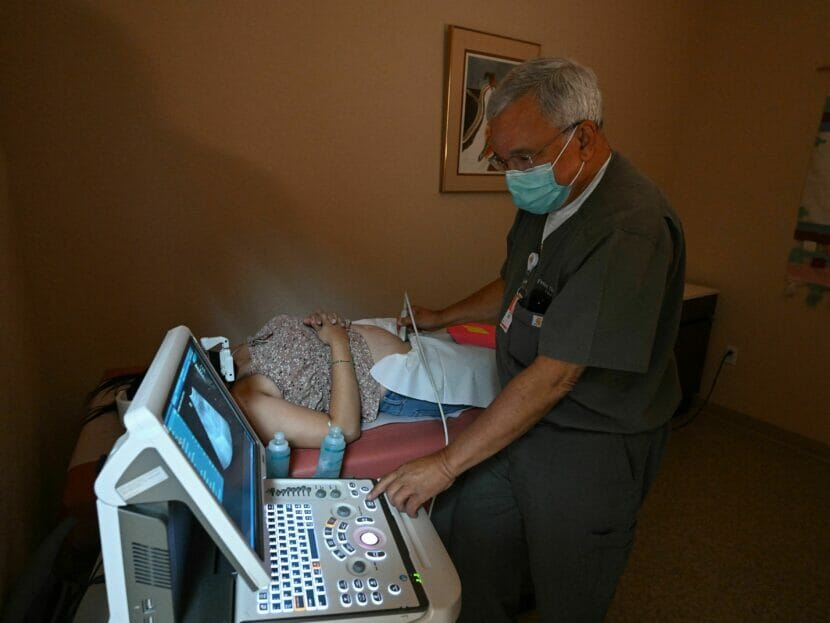
Dr. Franz Theard performs a sonogram on a patient seeking abortion services at the Women’s Reproductive Clinic in Santa Teresa, New Mexico, a state that has not banned abortions. (Robyn Beck/AFP via Getty Images)
The rush in conservative states to ban abortion after the overturn of Roe v. Wade is resulting in a startling consequence that abortion opponents may not have considered: fewer medical services available for all women living in those states.
Doctors are showing — through their words and actions — that they are reluctant to practice in places where making the best decision for a patient could result in huge fines or even a prison sentence. And when clinics that provide abortions close their doors, all the other services offered there also shut down, including regular exams, breast cancer screenings, and contraception.
The concern about repercussions for women’s health is being raised not just by abortion rights advocates. One recent warning comes from Jerome Adams, who served as surgeon general in the Trump administration and is now working on health equity issues at Purdue University in Indiana.
In a recent tweet thread, Adams wrote that “the tradeoff of a restricted access (and criminalizing doctors) only approach to decreasing abortions could end up being that you actually make pregnancy less safe for everyone, and increase infant and maternal mortality.”
Medical ‘brain drain’
An early indication of that impending medical “brain drain” came in February, when 76% of respondents in a survey of more than 2,000 current and future physicians say they would not even apply to work or train in states with abortion restrictions. “In other words,” wrote the study’s authors in an accompanying article, “many qualified candidates would no longer even consider working or training in more than half of U.S. states.”
Indeed, states with abortion bans saw a larger decline in medical school seniors applying for residency in 2023 compared with states without bans, according to a study from the Association of American Medical Colleges. While applications for OB-GYN residencies are down nationwide, the decrease in states with complete abortion bans was more than twice as large as those with no restrictions (10.5% vs. 5.2%).
That means fewer doctors to perform critical preventive care like Pap smears and screenings for sexually transmitted diseases, which can lead to infertility.
Care for pregnant women specifically is at risk, as hospitals in rural areas close maternity wards because they can’t find enough professionals to staff them — a problem that predated the abortion ruling but has only gotten worse since.
In March, Bonner General Health, the only hospital in Sandpoint, Idaho, announced it would discontinue its labor and delivery services, in part because of “Idaho’s legal and political climate” that includes state legislators continuing to “introduce and pass bills that criminalize physicians for medical care nationally recognized as the standard of care.”
Amplified risks
Heart-wrenching reporting from around the country shows that abortion bans are also imperiling the health of some patients who experience miscarriage and other nonviable pregnancies. Earlier this year, a pregnant woman with a nonviable fetus in Oklahoma was told to wait in the parking lot until she got sicker after being informed that doctors “can’t touch you unless you are crashing in front of us.”
A study from University of Buffalo researchers in the Women’s Health Issues journal finds that doctors practicing in states that restrict abortion are less likely than those in states that allow abortion to have been trained to perform the same early abortion procedures that are used for women experiencing miscarriages early in pregnancy.
But it’s more than a lack of doctors that could complicate pregnancies and births. States with the toughest abortion restrictions are also the least likely to offer support services for low-income mothers and babies. Even before the overturn of Roe, a report from the Commonwealth Fund, a nonpartisan research group, found that maternal death rates in states with abortion restrictions or bans were 62% higher than in states where abortion was more readily available.
Women who know their pregnancies could become high-risk are thinking twice about getting or being pregnant in states with abortion restrictions. Carmen Broesder, an Idaho woman who chronicled her difficulties getting care for a miscarriage in a series of viral videos on TikTok, told ABC News she does not plan to try to get pregnant again.
“Why would I want to go through my daughter almost losing her mom again to have another child?” she said. “That seems selfish and wrong.”
Make birth free?
The anti-abortion movement once appeared more sensitive to arguments that its policies neglect the needs of women and children. An icon of the anti-abortion movement — Rep. Henry Hyde (R-Ill.), who died in 2007 — made a point of partnering with liberal Rep. Henry Waxman (D-Calif.) on legislation to expand Medicaid coverage and provide more benefits to address infant mortality in the late 1980s.
Few anti-abortion groups are following that example by pushing policies to make it easier for people to get pregnant, give birth, and raise children. Most of those efforts are flying under the radar.
This year, Americans United for Life and Democrats for Life of America put out a joint position paper urging policymakers to “make birth free.” Among their suggestions are automatic insurance coverage, without deductibles or copays, for pregnancy and childbirth; eliminating payment incentives for cesarean sections and in-hospital deliveries; and a “monthly maternal stipend” for the first two years of a child’s life.
“Making birth free to American mothers can and should be a national unifier in a particularly divided time,” says the paper. Such a policy could not only make it easier for people to start families, but it could address the nation’s dismal record on maternal mortality.
But a make-birth-free policy seems unlikely to advance very far or very quickly in a year when the same Republican lawmakers who support a national abortion ban are even more vehemently pushing for large federal budget cuts in the debt ceiling fight.
That leaves abortion opponents at something of a crossroads: Will they follow Hyde’s example and champion policies that expand and protect access to care? Or will women’s health suffer under the movement’s victory?
KFF Health News, formerly known as Kaiser Health News (KHN), is a national newsroom that produces in-depth journalism about health issues and is one of the core operating programs at KFF — the independent source for health policy research, polling, and journalism.
Copyright 2023 KFF Health News. To see more, visit KFF Health News.
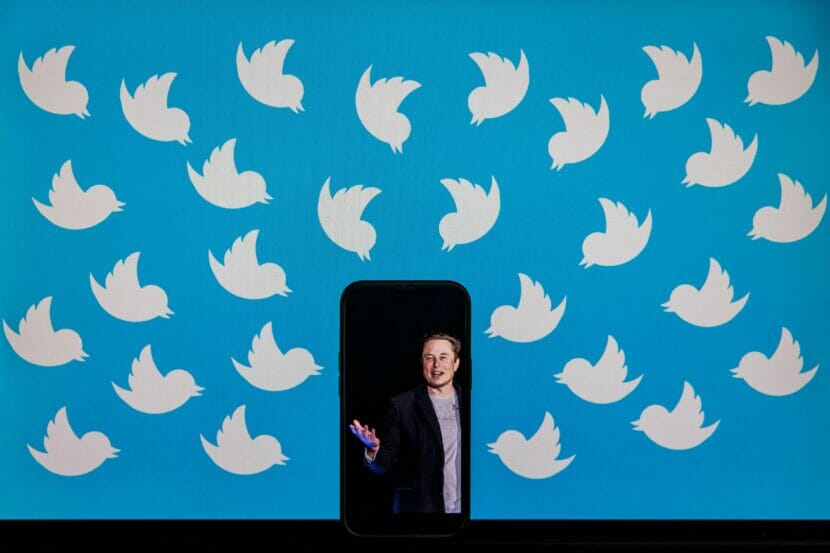
Under Twitter CEO Elon Musk, the company has stopped its previous practice of limiting the spread of tweets from Russian, Chinese and Iranian government media accounts. (Samuel Corum/AFP via Getty Images)
Dmitry Medvedev, a leading government official and former president of Russia, took to Twitter earlier this month to denigrate Ukraine in a post using language reminiscent of genocidal regimes.
And Twitter didn’t stop him.
In his 645-word tweet titled, “WHY WILL UKRAINE DISAPPEAR? BECAUSE NOBODY NEEDS IT,” Medvedev called Ukraine a “Nazi regime,” “blood-sucking parasites” and “a threadbare quilt, torn, shaggy, and greasy.”
The post garnered more than 7,000 retweets and 11,000 likes.
One response, though, asked Twitter CEO Elon Musk why he allowed Russian officials to broadcast tweets like this, especially when they used language often associated with genocide.
“All news is to some degree propaganda,” Musk responded. “Let people decide for themselves.”
Musk’s stance of allowing Russian government posts to pop up freely on people’s feeds has now become company procedure. And it’s a radical departure from the so-called “shadow bans” — or in Twitter parlance “visibility filtering rules” — that were previously placed on those accounts.
NPR has confirmed this was a deliberate decision from within the company.
The previous guardrails on government accounts in Russia, China and Iran have now been removed, according to two former Twitter employees who spoke to NPR on the condition of anonymity for fear of retribution.
“What I understand to have happened is, at Elon Musk’s direction, Twitter’s Trust and Safety Team, or what’s left of it, took a chainsaw to the visibility filtering rules,” said one of the former employees, who was an executive at the company.
The former executive said they learned this information by talking to current employees, former employees and people observing the situation.
Twitter applies “visibility filtering rules” to certain accounts to make sure less eyeballs see those accounts’ tweets.
In the past, the company’s Trust and Safety Team has used them for Russian government accounts and state-affiliated media accounts from countries “that limit access to free information.” Medvedev’s account was included in that cohort, according to the former employee.
Without visibility filtering, these accounts can now be more easily amplified and reach a much wider global audience. The implications could mean an increase of pro-government propaganda across Twitter and lead to real-life consequences for people who disagree with the authorities.
Taking the restraints off state-affiliated media accounts could also lead to more general disinformation on Twitter, said Sarah Cook, a senior advisor at the nonprofit Freedom House who researches China, Hong Kong and Taiwan and authored the report Beijing’s Global Megaphone.
“It’s not just about making the Chinese Communist Party look good. It’s not just about making activists or Hong Kong-ers look bad,” Cook said. “In some cases, it’s also about spreading disinformation about COVID or sowing divisions within Taiwan or the United States.”
Spike in engagement
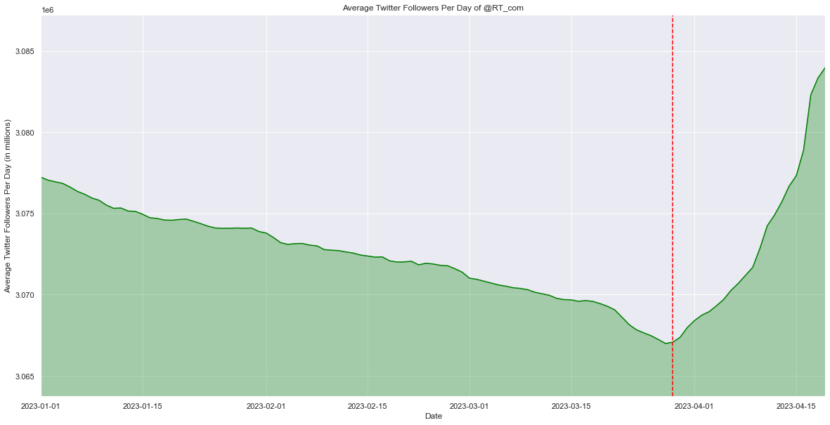
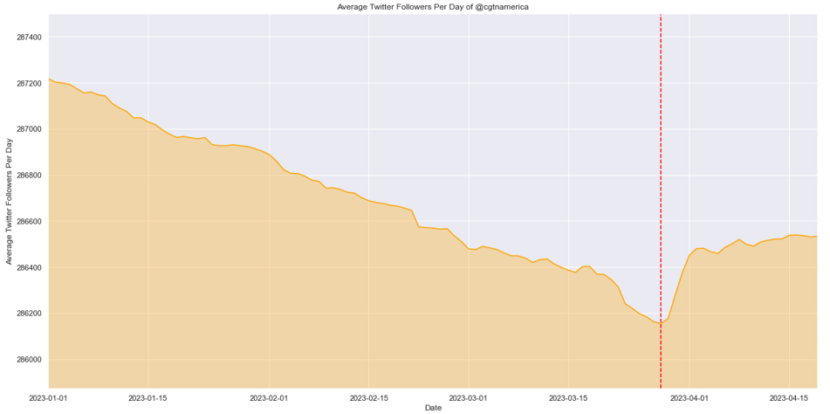
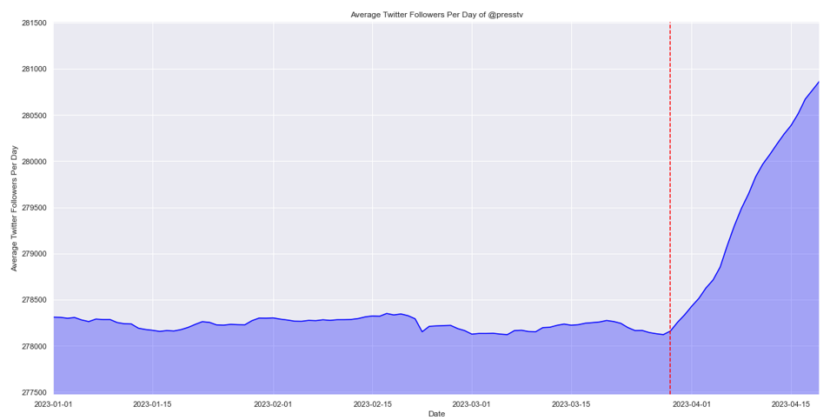
Since Twitter removed the visibility filters on state-affiliated media, researchers have seen a sharp uptick in followers on many of these accounts.
Russia’s English language RT account, @RT_com, saw a sharp increase in followers per day starting around March 28. The red line indicates that date. (Atlantic Council)
In the months prior, these accounts had been “hemorrhaging followers,” the Atlantic Council said.
While not all accounts experienced a spike, the fact that several major ones from three separate governments simultaneously saw rapid gains “strongly suggests a platform-wide algorithmic change.”
On April 6, several days after the uptick began, the group noticed the company’s “Platform Use Guidelines” were quietly amended to remove a sentence saying “Twitter will not recommend or amplify” state-affiliated media accounts.
“This whole episode shows what happens when we cede public debate to tech companies,” said Alyssa Kann, who works for the Atlantic Council’s Digital Forensic Research Lab and reviewed the government accounts.
“When we have the public square in what is effectively one man’s private billionaire playground, I think things like this can happen,” she said.
China’s CGTN America account, @CGTNAmerica, experienced an uptick of average followers per day beginning March 29, after a slow decline. The red line indicates that date. (Atlantic Council)Iran’s PressTV account, @presstv, saw a dramatic spike in followers starting March 29. The red line indicates that date. (Atlantic Council)
When NPR emailed Twitter for comment for this story, the company replied with its usual response to reporters—a poop emoji. Ella Irwin, Twitter’s vice president of product for trust and safety, didn’t respond to a request for comment.
Along with revoking the visibility filtering for government accounts, Twitter has also stopped its previous practice of letting researchers and developers freely access its data through a tool known as API. That means it’s far more difficult for watchdogs to keep checks on the spread of government propaganda on the platform.
The Atlantic Council said it’s now using third-party programs, but they’re not as comprehensive or reliable.
Because of all the changes at Twitter, it said much of the research into state media and other government actors that had once been commonplace just isn’t possible anymore.
“Until Twitter 2.0, this was kind of settled,” said Graham Brookie, the Atlantic Council’s vice president for tech programs. “And it was settled in a bunch of the places around the world where it really matters.”
How it started… how it’s going
When Twitter first launched its visibility filtering system for state-affiliated media accounts in 2020, the Trust and Safety Team consulted with various researchers and human rights groups. The way the filters worked was those accounts labeled state media wouldn’t be recommended or amplified.
For example, if someone wasn’t following RT and typed it into the search bar, the account wouldn’t show up.
After running a controlled experiment, Twitter found the reach of Russian state media tweets decreased by 30% with the filtering. When the company began filtering Russian government accounts at the start of the Ukraine war, it saw engagement per tweet decrease by 25%.
While government officials in Russia, China and Iran have Twitter accounts, access to the site is banned in those three countries. That means ordinary citizens aren’t allowed to voice their opinions and experiences, which can create a lopsided flow of information where governments drown out regular people.
The visibility filtering was meant to fix some of that.
It’s unclear exactly when Twitter stopped the visibility filtering, but, like the Atlantic Council, Voice of America reporter Wenhao Ma first noticed it at the end of March. He did some experiments and found Twitter was automatically recommending to him Chinese state-affiliated media accounts that he wasn’t following.
Just a few days later, Twitter slapped the state-affiliated media label on NPR.
Twitter’s previous policy on state-affiliated media said news organizations that receive state funding but have editorial independence “like the BBC in the UK or NPR in the US” would not be labeled. (NPR gets less than 1% of its funding from the government).
What ensued was a chaotic few days.
In an email exchange, Musk told NPR reporter Bobby Allyn that maybe that label wasn’t accurate. Twitter then changed the label to “government-funded media” and also applied it to PBS and the BBC. As a result, NPR quit Twitter.
Around that time, Twitter adjusted its policy on how it defines “government-funded media” and linked to a Wikipedia page on public broadcasting as its source.
On Thursday night, that policy page disappeared from Twitter’s website. As did the labels from NPR, PBS and the BBC’s accounts.
Labels on Russian, Chinese and Iranian state-affiliated media also evaporated, along with the “Russia government official” label on Dmitry Medvedev’s account.
“We talked to experts and researchers,” said the former Twitter executive. “And now, these decisions get made because Elon Musk sees a tweet from Catturd and decides that’s what Twitter is going to be like.”
“It’s disheartening to see labels that were built to inform people be used as a tactic to mislead,” the former executive added.
Disclosure: This story was reported and written by NPR Tech Correspondent Dara Kerr and edited by Business Editor Lisa Lambert. NPR’s Shannon Bond contributed to this report.Under NPR’s protocol for reporting on itself, no corporate official or news executive reviewed this story before it was posted publicly.
Copyright 2023 NPR. To see more, visit https://www.npr.org.
U.S. Rep. Mary Peltola joined host Lori Townsend on “Talk of Alaska” for a discussion about the issues facing Alaskans on April 4, 2023 (Matt Faubion/AKPM)
Congresswoman Mary Peltola declined again Tuesday to pass judgment on the case against former president Donald Trump.
“I personally feel like, as a member of the legislative branch, it’s not really my place to comment on things in the judicial branch,” she said on Talk of Alaska.
Peltola said she trusts that the case against Trump will be decided fairly in court. But she says the loud ruckus outside the court today discouraged her.
“I think it’s a bleak day for Americans, because this is just one more divisive issue,” she said. “And we’re such a deeply divided country.”
Two callers asked about gun violence and banning assault rifles. Peltola reiterated her support of the Second Amendment. She says she’s open to solutions but is leery of supporting bills that don’t have a chance of passing.
When news of the indictment broke last week, Alaska’s two U.S. senators issued statements, before the charges were made public. Sen. Dan Sullivan, like many other Republicans in Congress, denounced the prosecutor and said he didn’t have “credible, airtight evidence” of a serious crime. Sen. Lisa Murkowski remained more neutral.
Close
Update notification options
Subscribe to notifications
Subscribe
Get notifications about news related to the topics you care about. You can unsubscribe anytime.

9(MDEwMjQ0ODM1MDEzNDk4MTEzNjU3NTRhYg004))
9(MDEwMjQ0ODM1MDEzNDk4MTEzNjU3NTRhYg004))