U.S. Sen. Dan Sullivan stands with acting Coast Guard Commandant Adm. Kevin Lunday during the after the commissioning ceremony for the Coast Guard icebreaker Storis on Sunday, Aug. 10, 2025, in Juneau, Alaska. (Photo by James Brooks/Alaska Beacon)
A $300 million project to build a new Coast Guard base in Juneau for the icebreaker Storis likely will not be complete until at least 2029, the service’s top admiral said in a U.S. Senate hearing last week.
The Commandant of the Coast Guard, Adm. Kevin Lunday, testified Thursday in front of the U.S. Senate’s subcommittee on Coast Guard, Maritime, and Fisheries, chaired by Sen. Dan Sullivan, R-Alaska.
During the hearing, Sullivan pushed Lunday on his timeline for work in Alaska. Congress approved almost $25 billion earlier this year for new Coast Guard construction, including hundreds of millions for work in Alaska.
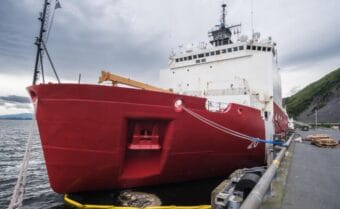
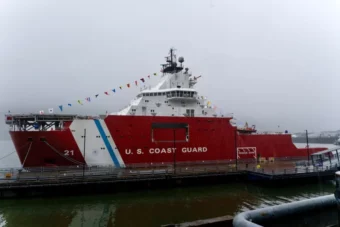
In August, the Coast Guard commissioned the icebreaker Storis, a converted oilfield services ship, at a ceremony in Juneau. The Storis will be based in Juneau, the Coast Guard has said, but not until new facilities are built.
“Are we on time, on schedule?” Sullivan asked.
“We’re moving quickly to be able to execute that funding and have that pier and infrastructure there ready by 2029,” Lunday said.
The Coast Guard had previously said its target was 2028.
“They’ve talked about 2028 before with regard to Juneau and the Storis,” Sullivan said in a phone call with reporters afterward. “He did mention 2029, but part of my job is to make sure we have the money, make sure they make the decisions early, and impress them in oversight hearings like this, to get them to keep their timelines if they put them out there, but also try to move them closer in.”
Lunday was only recently confirmed to his position after President Donald Trump controversially fired Adm. Linda Fagan after the start of his term.
Sullivan said it’s only natural for a new appointee to play it safe.
“I think the default position is to be a little conservative on the timelines,” Sullivan said.
Sullivan also pressed Lunday on his plans for a series of new icebreakers the Coast Guard intends to build in coming years.
Sullivan has been campaigning to have several medium icebreakers based in Alaska in addition to the Storis. Lunday was evasive when Sullivan asked him when he would make a decision and whether he would choose Alaska.
“As (my team) develop options, one of the first ones that I want them to present among a range of options for consideration … is for homeporting of up to four icebreakers in Alaska,” Lunday said. “Although we are still pending a decision, that’s clear guidance I’ve given to the team.”
Afterward, Sullivan said he tried to pin Lunday down on the issue because he sees it as important.
“I love the Coast Guard, but I have had real issues with how slow they are,” he said.
While Lunday didn’t make a firm commitment, Sullivan said he viewed the day as “progress.” Sullivan said he wants to see the ships in Alaska because basing them here has an economic benefit that he termed “a virtuous cycle” — the ships create demand for local shipyard work and stores to sell things to the Coast Guard, members of the Coast Guard and their families.
Housing any new arrivals remains an unsolved issue, he noted. Communities throughout Alaska are experiencing critical shortages of housing and child care.
“In almost every community, housing is an issue, and it’s an issue throughout the whole state,” he said.
“This is where we need to get the state, the cities, the boroughs also, to come to the table and say, ‘Hey, we have land here that we can provide. … We have financing that we can help incentivize housing,’” Sullivan said.
He said the Coast Guard is contributing financially for housing, but that he has encouraged elected officials to look for ways to ease the issue.
Migrants detained in the Trump administration’s immigration crackdown are led to a plane bound for Guantánamo Bay, Cuba. (U.S. Department of Homeland Security)
The business arm of Southeast Alaska’s largest tribe has earned nearly $40 million from U.S. Navy contracts in Guantánamo Bay, Cuba – money some tribal members are concerned comes from supporting immigrant detention.
While tribal corporation leadership says their operations are separate from the detention center on the military base, what’s happening on the ground may tell a different story.
Guantánamo Bay is the site of an active U.S. Navy base with about 6,000 military personnel living and working there. It also houses a detention facility. That facility’s main purpose was to detain people accused of orchestrating the Sept. 11 terrorist attacks.
The Trump administration has been using the detention facility to detain migrants as part of its aggressive deportation policies that many deem inhumane and unconstitutional.
Tlingit Haida Tribal Business Corporation is the business arm of the Southeast Alaska tribal government — the Central Council of the Tlingit and Haida Indian Tribes of Alaska. The corporation currently has a contract in Guantánamo Bay.
In 2018, the corporation’s subsidiary, KIRA, announced a contract with the U.S. Navy to provide maintenance services, port operations and waterfront administration for the base. That contract lasted until 2022. According to a government website that tracks contracts, a similar contract started two months before it ended and is set to last until February 2028. The value of the two contracts together has so far reached just under $40 million. Tlingit and Haida said the corporation’s contract provides services to the Navy base; it does not support detention operations at the base. But some tribal members, like Clarice Johnson, have doubts about that.
Tribal involvement in Trump’s detention operations
Johnson said she’s been concerned about the contract since it began seven years ago. But when the Trump administration vowed to hold thousands of immigrants in Guantánamo, it brought new urgency to her concerns.
“It makes me ill to think of Tlingit and Haida making money off the abuse of other people,” Johnson said. “Especially those who are just looking for a better life.”
Guantánamo Bay’s detention center has been known for human rights violations for decades. It’s also notoriously secretive.
In 2023, a United Nations investigator researched the facility and reported “ongoing cruel, inhuman, and degrading treatment.” The report suggested that the facility be closed. But two years later, the second Trump administration pledged to use it for migrant detention.
In the rest of the United States, Indigenous people are questioning their own tribal governments’ involvement in detention centers.
When stories about inhumane conditions at Akima-run detention centers surfaced this fall, Johnson said she started posting in a Facebook group called “Shareholders of Sealaska,” to make sure tribal members like her knew Tlingit and Haida also had connections to Guantánamo Bay.
“I didn’t want people to forget that whenever they’re criticizing other corporations for doing this, that our own tribe was also participating,” she said.
Her posts garnered discussion with other tribal members, who posted their own concerns. In response to public criticism, Tlingit and Haida posted a statement in early December saying the contract is “strictly limited to the operation and maintenance of multiple watercraft and port facilities,” and that the corporation is obligated to continue the work until the contract ends.
What Tlingit Haida Tribal Business Corporation is doing in Guantánamo Bay
But Johnson is worried that some of those watercraft transport migrants to the detention center in Guantánamo Bay.
Richard Rinehart is the CEO of Tlingit Haida Tribal Business Corporation. He said it’s against taking on contracts that assist in immigration detention.
“We don’t have anything to do with that,” Rinehart said.
Instead, the corporation contract relates tovessel operation and maintenance, he said.
“We run a ferry that goes from the leeward side, which is where the airport is, to the windward side, which is where the naval base is,” he said. “Goes back and forth.”
However, Rinehart said he’s heard that the ferry the corporation operates is used to transport detainees. But, he said, he and his staff aren’t involved with that process.
“There are times — I hear, I’ve not seen this — but my manager there tells me that they do come across and they’ll put somebody on the ferry. It’s usually late at night, and it’s all just their vehicles, all their staff,” he said. “They move across and they go to the airport, but we have the only ferry going from the airport to the windward side, where everything is.”
In an email to KTOO in response to follow-up questions, Rinehart said he could not speak to how many migrants have been transported via the ferry the tribal corporation maintains and operates.
KTOO could not confirm whether or not there is another way migrant detainees are transported from the airport to the facilities they are held in.
From the corporation’s perspective, he said involvement in migrant transport is “outside our visibility and control and is not tracked, directed, or managed by [Tlingit Haida Tribal Business Corporation] as part of our contractual duties.”
Though Guantánamo Bay is often linked with the detention facility, Rinehart says he doesn’t think a lot of people realize it’s primarily a naval base with about 6,000 military personnel. And that’s who Rinehart said the contract serves.
Johnson said even incidental involvement in migrant detention is still too close for her comfort.
“I understand why they want to claim six degrees of separation from ICE,” she said. “But I think that their actions at Guantánamo Bay place them in much closer proximity than many tribal citizens realize.”
And she wants to know if the tribal corporation will take a stance on migrant detention as more opportunities to profit from it arise.
“Will Tlingit and Haida jump on the money train?” Johnson said. “Or will they actually have guidelines on which contracts they will bid on, as some corporations have?”
Rinehart said most Tlingit Haida Tribal Business contracts are with the U.S. military. And those contracts, he said, support the corporation’s mission: create more funding for the tribe.
Clarification: This story has been updated to reflect that Tlingit Haida Tribal Business Corporation has earned nearly $40 million from U.S. Navy contracts in Guantánamo Bay.
Photo of Anthony “Bone” Lekanof (Courtesy of Michael Livingston)
For those who haven’t filed for their Native allotments, Alaska Native veterans don’t have much time to claim 160 acres of federal land. The window for applications closes permanently on Dec. 29.
ANCSA ended 1906 Native allotment program
The land grants were part of a government program created over a hundred years ago, to promote homesteads and private property ownership. But the 1906 Native allotment program shut down in 1971, after Congress passed the Alaska Native Claims Settlement Act passed.
But in the years leading up to the land claims act, Natives scrambled to file for their land allotments. But during that time, a lot of Native Vietnam veterans missed out, because they were stationed overseas. Many were engaged in combat.
The Alaska Congressional delegation eventually succeeded in passing legislation to fix this. In 2019, President Trump signed a bill into law that opened a five-year window for Natives vets to claim their allotments. But despite the special exemption to apply for the land, it isn’t easy to do. There are still many hurdles.
Application process is “onerous”
“It’s one thing to make laws,” said Jim LaBelle, an Inupiaq Vietnam veteran. “But it’s quite another thing when the bureaucracy kicks in and starts developing these onerous processes that were never really anticipated.”
Jim and Kermit LaBelle at the Mount Edgecumbe boarding school in Sitka. (Photo courtesy of Jim LaBelle)
LaBelle’s challenges began before the war when he and his younger brother, Kermit, were in boarding school. He says they were unable to qualify for their allotments, because they were far from home and couldn’t prove they worked the land they hoped to receive.
(Photos courtesy of Jim LaBelle)
Then both brothers went to fight in the Vietnam War, and Kermit was killed in action at the age of 18.
After the war, LaBelle had about given up on efforts to claim his land but tried again. A few years ago, the government finally accepted his application.
Veterans unhappy with federal land available
“It took a little doing, but I managed,” he said. “And I can’t say I was very happy with the lands that I got.”
LaBelle wound up with land near the Interior Alaska community of Tok, far away from his Inupiaq homelands.
“It’s an area I’m not familiar with but was available at the time,” LaBelle said. “The way I look at the map, I’d have to have a helicopter to fly in.”
LaBelle is now focused on getting his late brother Kermit’s allotment. To do that, he needed a death certificate.
“I have to prove that he was killed in Viet Nam. I also have to prove that he had a CIB, Certificate of Indian Blood,” LaBelle said. Michael Livingston has volunteered to help vets like Jim LaBelle apply.
Michael Livingston, an Alaska Native veteran’s advocate, has volunteered to help vets like Jim LaBelle apply.
“It’s not a user-friendly process,” he said. “Out of the 2000-some veterans that are eligible, only about 500 of them have applied, so that’s only about 25 percent.”
Livingston believes the limited land available to veterans has discouraged them from applying but says age is probably the biggest barrier. He says most of the veterans he’s worked with are now in their 70’s and 80’s. Many are in poor health and don’t have the computer and internet skills it takes to navigate the bureaucracy, so they’ve given up.
Livingston says it also takes a lot of persistence, which he is willing to supply.
“So far, I’ve helped about 50 Alaska Native veterans apply for about 160 acres of land,” he said. “And that adds up to over 8,000 acres that potentially is going to return to the hands of Alaska Natives. So, in that sense, it’s been pretty rewarding.”
Livingston encourages Native vets to file before the Dec. 29 deadline, even if their application is incomplete. He says if veterans need help, it’s OK for them to email him at the following address: michaelpocatelloATgmail.com.
Sen. Dan Sullivan offers staff assistance
Alaska U.S. Senator Dan Sullivan also says vets shouldn’t worry about filing a complete form, that it’s more important to meet the deadline.
“Get your application in, we can work with you,” Sullivan said. “We can help. If it needs to be updated, we can do that.”
Sulllivan says staffers in his Alaska offices are prepared to assist. For now, he is racing against the clock to get a bill passed to extend the program.
“I just wish we could get my colleagues to see that this is not a big ask,” the Republican senator said. “Believe it or not, the bill is a two-word change. It’s from five years to ten years.”
Screen grab from Sen. Dan Sullivan’s Senate floor testimony on Nov. 19, 2025. In making a case to extend the deadline for Alaska Native Veterans to apply for Native allotments, he complained that attempts by Democrats to block his bill were part of an ongoing pattern to lock up Alaska federal land. (U.S. Senate)
In his advocacy for the extension, Sullivan reminds his colleagues that Alaska Natives veterans have some of the highest rates of service of any ethnic group in the nation.
“You’ll go to a small Native community and ask how many veterans there are,” Sullivan said, “and like, almost all the men in the town hall you’re doing, raise their hand.”
Although Sullivan has attempted to make new lands available for veterans to claim, his current bill, S785 and its companion House bill, HR410, does not include new land. It simply extends the application period to December 2030.
Sullivan says his bill has Republican support – and he’s worked with Democrats to attach his legislation to other bills that include things they want. But the senator believes they continue to block his extension, because they think it’s a backdoor attempt to usher in more development, which he says is not true.
“They’ve just been very reluctant to get more people land and access to federal lands in Alaska,” said Sullivan, who remains hopeful he’ll be able to win an extension in time.
“But just to be safe, get your application in before the end of the year,” he said.
The U.S. Coast Guard icebreakers Polar Star (at background), Healy (at left) and Storis (at foreground) are seen together at Coast Guard Base Seattle on Oct. 26, 2025, marking the first time since 2006 that the Coast Guard had three active polar icebreakers in the same place at the same time. (Lt. Christopher Butters/U.S. Coast Guard)
On a dreary November day in Seattle, the U.S. Coast Guard put its past and future on display.
Within sight of the Space Needle, three eye-catching red icebreakers towered over Pier 36. It was the first time since 2006 that the Coast Guard has had three active icebreakers in the same place at the same time.
In the coming years, that scene will become more common, and not just in Seattle. After years of underfunding, the Coast Guard’s icebreaker fleet is undergoing a massive expansion, with almost $9 billion for new ships.
On Tuesday, the U.S. government signed the Icebreaker Collaboration Effort — or ICE Pact — a three-nation agreement with Finland and Canada that will see some of those ships built in Finland, whose shipyards will train Americans to build more.
“It’s an exciting time to be a polar icebreaker sailor,” said Capt. Jeff Rasnake, commanding officer of the Polar Star, America’s only heavy icebreaker.
So many ships are about to join the Coast Guard’s fleet that the agency isn’t yet sure where it will put them all. The Coast Guard has earmarked millions for a port expansion in Seattle to accommodate three heavy icebreakers, plus another $300 million for Juneau to serve as a port for a medium icebreaker.
More space will be needed on top of that, and Sen. Dan Sullivan, R-Alaska, said his intent is to have as many of the new ships based in Alaska as possible.
“We want home port decisions on these icebreakers sometime in early 2026,” he said. “That is my goal.”
Eric Boget, a research engineer aboard the U.S. Coast Guard Cutter Healy (WAGB 20), prepares to throw a grappling hook to recover an Arctic Mobile Observing System (AMOS) mooring while Healy operating in the Arctic Ocean, July 21, 2025. Boget is a member of the scientific research team recovering data from the AMOS moorings. (Petty Officer 3rd Class Chris Sappey/U.S. Coast Guard Pacific Area)
The need for new icebreakers is clear: As the Earth warms amid climate change, no place is warming faster than the Arctic. Melting ice is opening new routes for shipping, places to mine and drill, and seas to fish or view from the deck of a cruise ship.
In many cases, control of those new routes is being disputed among nations.
“Right now, things are heating up in the Arctic, and not just on the ice,” said Capt. Kristen Serumgard of the icebreaker Healy.
Russia is expanding its military presence in the Arctic, including with icebreakers, and as NATO confronts Russian aggression in Europe, there’s been international concern that the United States and NATO should be prepared to match Russia in the Arctic as well.
China is operating significant numbers of icebreakers in the Arctic, as are European nations, each interested in maintaining their right to access the area.
“It’s a geopolitical hotbed up there,” Serumgard said.
Rasnake, who typically works in the comparatively calm Antarctic, said that “with lines being drawn and a lot of different contested (seafloor) land claims, it’s — I wouldn’t say the wild, wild West, but maybe the wild, wild North.”
Shipping traffic through the Arctic Ocean is on the rise, with more ships traveling Russia’s Northern Sea Route and the Canadian-American Northwest Passage each summer.
As yet, the Northwest Passage isn’t regularly used by commercial shipping, said Steve White, executive director of the Marine Exchange of Alaska, which monitors the area for safety risks.
While that’s the case, “we are seeing a trend of more and more traffic, though, going through the Bering Straits, both on the US side and on the Russian side,” he said.
With more ships comes more risk. On Sept. 6, the Dutch cargo ship Thamesborg ran aground in Franklin Strait, part of the Northwest Passage. The accident didn’t release any pollution and no one was injured, but it took 33 days for the ship to be freed and sent on its way.
The Northwest Passage and the Northern Sea Route each funnel through the Bering Strait, which is split between American and Russian control.
“The reason this is so important for people to understand is that the Bering Strait — you’ve only got about (51) miles between the US and Russia, and you have the biodiversity, the wildlife that’s there,” White said. “This comes at a time where we’re getting more storms, the communities are struggling up there with food security and the top priority, the salmon returns … the fabric of our Alaskan communities up there is under threat, and it’s under threat from what’s going on with the weather changing and increased traffic.”
The U.S. Coast Guard is the federal government’s nautical Swiss Army knife — it performs rescue operations, enforces fishing laws, stops drug smugglers, runs border patrols, performs safety inspections, anti-pollution patrols, counter-piracy patrols, and enforces America’s maritime laws.
The U.S. Navy runs submarines under the Arctic ice, but it doesn’t operate icebreakers. It leaves the Coast Guard to do that — on the Great Lakes, on American rivers, and in the Arctic and Antarctic.
But for years, the national icebreaker fleet has been underfunded.
When Nome, home to the endpoint of the Iditarod Trail Sled Dog Race, ran short of fuel in 2012, the U.S. Coast Guard struggled to muster a single icebreaker, the Healy, to escort a Russian icebreaking tanker to the town.
At the time, the Healy was the Coast Guard’s lone operating icebreaker. Soon afterward, it reactivated the Polar Star, which had been mothballed because it was old and needed maintenance.
While both ships continue to operate, they’re less capable than modern ships and have suffered mechanical breakdowns, some significant.
Last year, the Healy caught fire and had to abbreviate its summer patrol. While it returned to service in the fall and went on to discover a volcano-like mountain on the Arctic seafloor, it’s now due for an extended period of maintenance.
“She’s 25 years old and been breaking ice for 25 years, right? That is hard on a ship,” Serumgard said.
The U.S. Coast Guard Cutter Storis uses dynamic positioning to maintain its position near the Johns Hopkins Glacier in Glacier Bay National Park and Preserve, Alaska, Aug. 5, 2025. The Storis is equipped with Dynamic Positioning Class 2 capabilities which provide redundancy and ensure station-keeping even with the failure of a critical component, such as a generator or thruster. (Petty Officer 3rd Class Ashly Murphy/U.S. Coast Guard Arctic)
Two American icebreakers in the Arctic Ocean in 2025
If America’s icebreaking fleet is near a low ebb, this summer saw the first steps toward the planned resurgence.
As a stopgap until new ships arrive, Congress last year ordered the purchase of the Aiviq, an oilfield services ship designed to work in the Arctic Ocean.
Eight years ago, following a disaster that saw the Aiviq lose control of a drilling rig during a storm, the Coast Guard deemed the ship “not suitable for military service without substantial refit.”
Since then, the ship has been overhauled and the Coast Guard’s opinion has changed.
After Congress appropriated the money, the Coast Guard purchased the Aiviq, quickly converted it, and in August this year, commissioned it as the icebreaker Storis.
At the time of that commissioning, commanding officer Capt. Corey Kerns said the ship and its crew would “need to learn to crawl” before they could get fully up and running.
In addition, there were unanswered questions about how well the Storis would handle the kinds of storms that troubled the Aiviq.
In October, Kerns sat down for another interview after returning from the Arctic.
“One of the things that kind of surprised me was that it went smoother than maybe I would have expected,” he said.
“She was able to perform, get through the whole thing without any major issues,” Kerns said of the ship’s first patrol.
As a result, Kerns felt confident enough to guide the Storis into the Arctic Ocean, where it worked with the icebreaker Healy to shadow two Chinese research ships in parts of the ocean that the United States claims.
If China and Russia are present in the region, it behooves the United States to be there too, Kerns said in August.
“The ability to be present guarantees your ability to to maintain sovereignty. And that’s what we’re trying to get at here in the Arctic. We need more icebreakers to be present in our waters and be clear what is our waters,” he said.
The Coast Guard cutter Waesche, a “thin-hulled” ship, also monitored the Chinese ships. Both it and the Storis participated in Arctic Edge 2025, a military training operation near the Russian border that also included Canadian forces.
There’s still work to be done with the Storis, Kerns said. It hasn’t been certified to host Coast Guard helicopters yet, and it hasn’t done a full icebreaking test.
“We got into the ice and we showed that she could break flat ice to some extent, at certain speeds, but … probably not a fully worthy test of capability in the ice, so we’re discussing that now,” he said.
Coast Guard Chief Petty Officer Kevin Rambo gives a demo of a machine gun aboard the Coast Guard icebreaker Storis on Nov. 12, 2025, in Seattle. Four were mounted on the new Coast Guard icebreaker after its acquisition from a private offshore oilfield services company. (Tom Banse for the Alaska Beacon)
Thirteen years ago, the Aiviq lost control of the drilling rig Kulluk, causing it to run aground on Kodiak Island. That disaster took place after rough seas flooded the Aiviq’s fuel tanks and caused it to lose power.
This summer, as the Storis sailed across the Gulf of Alaska, it again encountered rough seas.
“There were a few nights where you didn’t sleep as well, but it was perfectly safe,” Kerns said.
He said his crew are already overhauling equipment and preparing for next summer in the Arctic, working in conjunction with the Healy.
“We know more about the surface of the moon than we know about the seafloors, so it’s kind of a really amazing area of exploration,” Serumgard said.
En route back to Seattle, the Healy was diverted to help search and rescue efforts in Southwest Alaska following Typhoon Halong, which devastated the region and left hundreds of people homeless.
In Seattle, the Polar Star was preparing to leave on a five-month roundtrip to Antarctica, where it will help supply research outposts across that continent.
Rasnake said he believes the Polar Star is in the best shape it’s been since being reactivated in 2013, and he looks forward to it possibly breaking the record of the most Antarctic missions by any Coast Guard icebreaker. That would come — if all goes well — in December 2026 or January 2027.
The U.S. Coast Guard icebreaker Polar Star is seen in Seattle on Nov. 12, 2025. (Tom Banse for the Alaska Beacon)
A huge expansion of the fleet is on the horizon
If the Polar Star does break that record, it may not have many opportunities to expand on it. The Coast Guard’s first new heavy icebreaker since the Polar Star is now under construction in Mississippi.
Named the Polar Sentinel, it’s expected to be complete by 2030. The Republican-backed budget plan that President Donald Trump nicknamed the “Big Beautiful Bill” includes funding for two other heavy icebreakers after the Sentinel.
Thirteen other icebreakers were funded in that bill, said Sullivan, the Alaska senator.
“There’s funding for three to four Arctic Security mediums. Those are the target ones for our state. And then there’s 10 light icebreakers. Those are smaller. Those do work in the Great Lakes and other things like that,” he said.
The medium icebreakers, known as “Arctic Security Cutters,” are among 11 planned ships being built by two separate industry groups. Canada’s Davie Shipbuilding is planning to build five ships — two in Finland, and then three at a to-be-expanded Texas shipyard.
The second group, which includes American, Canadian and Finnish firms, will build two ships in Finland and a third simultaneously in the United States, then build three others in the United States.
The first five ships are expected to be delivered to the Coast Guard within 36 months of a contract being signed, meaning they could be patrolling the Arctic Ocean before the end of the decade.
The newly commissioned Storis will also need upgrades to complete its conversion from a civilian ship. First on the docket may be additional military communications gear, but Kerns said the Coast Guard is also considering how to fit more crew aboard.
In the longer term, Kerns — who has a nautical engineering background — is working with his crew on plans for a deeper refit that could allow the Storis to serve as a kind of “logistics ship.”
As currently built, it carries several large holds originally intended for drilling mud and other materials needed for oil wells at sea. Those could be repurposed, he said this month, and his crew is coming up with ideas for the ship’s first major refit, expected sometime after summer 2026.
The new ships and the changes to the Storis are only part of the Coast Guard’s plan in the coming years. Each ship will also need people and equipment ashore for maintenance and support. The Coast Guard is involved in an ongoing struggle to acquire acreage to expand its Seattle base, which the port authority is reluctant to cede.
Pier space at the Coast Guard’s Alameda base, in California, is also constrained.
“We’re looking for space in all possible areas,” said Capt. Brian Krautler, chief of operations for the Coast Guard’s Pacific Area.
The Big Beautiful Bill included $300 million to build a base in Juneau to host the Storis. Other places in Alaska — Seward, Kodiak, Nome, or Dutch Harbor — might also accommodate one or more of the new Arctic Security Cutters. Kodiak is home to the largest Coast Guard base in the country.
Speaking this week at the signing of the so-called ICE Pact, Secretary of Homeland Security Kristi Noem said that the Trump administration sees the expansion of the icebreaker fleet as a top priority.
“Today is a major milestone in the race to secure the Arctic for all of our countries,” she said. “The Arctic is the world’s last, most wild frontier, and our adversaries are racing to claim its strategic position and its rich natural resources for their own. If we give up that high ground, then we will condemn future generations to permanent insecurity, and we’re not going to let that happen on our watch.”
U.S. Army National Guard UH-60L Black Hawk aviators, assigned to the 207th Aviation Troop Command, transport supplies to Napakiak, Alaska, Nov. 19, 2025, while supporting Operation Halong Response efforts. (Tech. Sgt. Daniel Robles/U.S. Air National Guard)
Officials with the Alaska National Guard said they are preparing and training a response force of 100 service members to deploy to Washington D.C. and support civil authorities, as directed by the Pentagon and Gov. Mike Dunleavy.
The update on Tuesday from Maj. Gen. Torrence Saxe, Adjutant General of the Alaska National Guard and Commissioner of the Alaska Department of Military and Veterans Affairs, was in response to a letter from state legislators on the Alaska Joint Armed Services Committee. The lawmakers raised concerns around the implications of a Pentagon directive to Alaska to prepare 350 National Guard personnel for rapid deployment for “civil disturbance operations.”
In his letter, Saxe said Gov. Mike Dunleavy requested that the force be deployed to Washington D.C. to join a joint federal task force in March of 2026.
A spokesperson with the governor’s office confirmed Thursday the request came from the U.S. Secretary of the Army and Dunleavy approved it.
“Governor Dunleavy approved the request because he wants to help the Trump Administration restore public trust and improve the quality of life in the nation’s capital,” said Jeff Turner, the governor’s director of communications, by email.
But the request may turn out to be moot, after a federal judge temporarily blocked the deployments to Washington D.C. on Thursday, declaring the use of troops is likely unlawful. There is a pause on the order until Dec. 11, which gives the Trump administration time to appeal.
Turner declined to comment on the federal ruling.
Saxe said in the letter that 100 Alaska service members are being trained to align with “national level requirements.”
“The team will consist of Alaska Army and Air National Guard personnel trained in mission sets that may include site security, roadblocks and checkpoints, civil disturbance control, critical infrastructure protection, and personnel security,” Saxe wrote. “All training activities are integrated into existing unit schedules and do not alter the organization’s operational commitments.”
The Alaska National Guard is currently active in the disaster relief effort after Typhoon Halong devastated communities of Western Alaska, with an estimated 200 service members deployed there, officials said.
Saxe repeated that the development of this “quick response force” is not new for the National Guard, and it will be structured to “respond quickly to protect lives, property, and critical infrastructure.”
“At the request of Alaska Gov. Mike Dunleavy, members of the Alaska NGRF (National Guard Response Force) will activate to Washington, D.C., in March 2026 to support Joint Task Force–District of Columbia, a federally coordinated effort that brings together National Guard elements, civic leaders, and partner agencies to enhance safety, stewardship, and community engagement,” he wrote.
Officials with the National Guard declined interview requests on Wednesday and Thursday.
In August, officials with the governor’s office said there were “no plans” to deploy the Alaska National Guard to Washington D.C., as reported by the Anchorage Daily News.
The Trump administration’s deployment of National Guard troops to primarily Democratic-led cities has been challenged and repeatedly blocked as illegal in federal courts. On Monday, a Tennessee judge barred the National Guard deployment to Memphis, and said it was only allowable if there was a rebellion or invasion. On Thursday, a federal judge temporarily ordered an end to the monthslong deployment of National Guard to Washington D.C. to tackle crime, declaring the use of troops as likely unlawful.
Rep. Andrew Gray, D-Anchorage and co-chair of the Alaska Joint Armed Services Committee, said he was grateful for the commissioner’s response and additional information on the specialized force, but remains concerned about the capacity and purpose of such a mission.
“It’s important to note that the American taxpayer will be paying their salary while they’re on this mission. They’ll be paying for their room and board,” he said. “So when the National Guard does a mission like this, we just don’t have unlimited money. So we are redirecting money away from training and work here in Alaska.”
Gray said while the Trump administration may have the authority to call the National Guard to Washington, a federal district, he remains concerned at military service members being deployed against civilians and used for police or immigration enforcement.
“Are these police departments saying that they’re overrun, that they’re unable to perform their law enforcement mission, that they need to have their force doubled, tripled, quadrupled in numbers?” he said. “Because that’s what’s happening.”
There are currently 2,866 National Guard service members enlisted in the state, with 1,676 in the Alaska Air National Guard and 1,190 in the Alaska Army National Guard.
Gray, a veteran of the Alaska National Guard who deployed to Kosovo in 2019, said he also worries about the erosion of trust and regard for the military doing these kinds of missions, and deploying against civilians.
“I love the U.S. military. I am proud of my service in the Alaska Army National Guard,” he said. “I think this is going to hurt the military’s standing in the public’s mind. I think that this is going to cause folks to lose some of the admiration that has been so foundational in our country for the military. Our country has long admired, respected and praised its military, and the moves that we are seeing, directed by Secretary Pete Hegseth and the President of the United States are going to lose our military’s standing, not only internationally, but domestically as well.”
Gray said he has requested a meeting with Saxe, and is asking for continued public communication and transparency as the quick response force is developed.
Alaska Air National Guard C-17 Globemaster III aircrew, assigned to the 176th Wing, offload gear and supplies at Bethel, Alaska, while supporting storm recovery operations following Typhoon Halong, Oct. 15, 2025. (Staff Sgt. Joseph Moon/Alaska National Guard)
Alaska legislators with the state Joint Armed Services Committee are raising concerns that a federal directive to prepare the Alaska National Guard to deploy domestically for civil unrest could divert service members from disaster relief efforts.
A spokesperson said the Alaska National Guard has received the directive to prepare a 350 member “quick reaction force” by Jan. 1 but said the state’s National Guard has not begun any specific training outside typical readiness training.
“This mission requirement does not impact our support to ongoing Typhoon Halong response operations, and we continue to meet all state and federal mission requirements,” said Dana Rosso, a public affairs officer for the Alaska National Guard, via email.
Rep. Andrew Gray, D-Anchorage, is co-chair of the Alaska Joint Armed Services Committee and a veteran of the Alaska National Guard. He said he’s concerned about the possibility of a quick response force being used to quell “civil unrest” in Alaska and across the country.
“The fear is, of course, that when you have a tool, an expensive tool, at your disposal, that you’re going to find a reason to use it. And so I think the fear about having this quick response force locked and loaded is that they could be used when it’s inappropriate to use them,” he said. “Peaceful protest would be the perfect example.”
Rep. Andrew Gray, D-Anchorage, speaks Friday, April 26, 2024, on the floor of the Alaska House of Representatives. (James Brooks/Alaska Beacon)
The federal directive said National Guard members should be training in crowd management and riot control, including the use of batons, body shields, Tasers and pepper spray.
Lawsuits, protests and federal courts have repeatedly challenged and barred the Trump administration deploying National Guard troops to American cities to assist police and immigration enforcement, asserting it is illegal and an abuse of executive powers.
Additionally, an estimated 200 Alaska service members are now deployed to assist with disaster relief efforts one month after the devastation of Typhoon Halong, officials said. It’s deemed the largest off-the-road-system response by the National Guard in the state’s history.
Gray and committee co-chair Sen. Scott Kawasaki, D-Fairbanks, sent a letter expressing concerns to Maj. Gen. Torrence Saxe, Adjutant General of the Alaska National Guard, who is also Commissioner of the Alaska Department of Military and Veterans Affairs.
“The broad and vague nature of this mandate raises serious questions about its intent and implications, particularly regarding the potential use of these forces in domestic law enforcement situations,” the letter said, in part.
Gray published an op-ed in the Anchorage Daily News on Monday saying the committee has yet to receive a response from Maj. Gen. Saxe about the Alaska National Guard’s plans.
Gray served for nine years in the Alaska Army National Guard as a medical provider and deployed to Kosovo in 2019. He commended the agency’s work and unprecedented disaster relief effort.
“I don’t want to disregard the enormous amount of stress and pressure on them right now for this particular disaster response,” Gray said. “That may very well be a valid reason why they haven’t been able to meet to discuss this issue. But that would be really good and reassuring information for the public.”
Gray said he’s requested a meeting with the leadership of Alaska National Guard for an update, but so far his questions have not been answered.
“Most importantly,” he said, “under what circumstances does our leadership in Alaska expect to be utilizing this force?”
Leaders with the Alaska National Guard declined repeated interview requests. Gov. Mike Dunleavy’s office also did not respond to questions about what circumstances would trigger the deployment of the quick response force, whether in Alaska or nationally, or the concerns raised in the legislators’ letter to Commissioner Saxe.
In an email, Rosso said that preparing a reaction force is not a new mission for the National Guard. “It has existed for two decades as a rapid-response capability designed to assist civil authorities when requested by a governor. Each state’s NGRF (National Guard Reaction Force) is organized as a temporary task force under state control and can respond quickly to protect lives, property, and critical infrastructure,” he wrote.
Rosso said the Alaska National Guard has not begun any specific training, but that some readiness tasks “such as security operations and initial protective equipment training,” are already part of the National Guard’s ongoing training. He said they are conducting an inventory on equipment and weapons listed in the memo, like Tasers, batons and pepper spray.
“Many units already use authorized protective equipment and training devices as part of their annual readiness training. Before making any new equipment purchases, we are assessing what capabilities already exist,” he wrote.
Rosso said the Alaska National Guard had no further communication from the Pentagon on the mission of the National Guard response force. “We have not received any official taskings for NGRF support or deployment,” he said.
The Oct. 8 memo signed by Maj. Gen. Ronald Burkett, the director of operations for the Pentagon’s National Guard Bureau, orders all states to prepare National Guard forces, totaling 23,500 troops nationwide, to be ready within a 24 hour notice. The memo cites Trump’s executive order to address the “crime emergency” in Washington D.C., which has come under intense criticism and legal challenges, which has continued as more troops were mobilized to Los Angeles, Memphis, Portland and Chicago.
Retired Lt. Colonel Daniel Maurer, a veteran active-duty Army officer and former Judge Advocate General, testified on the topic to the Alaska Joint Armed Services Committee on Wednesday. He is now an associate professor of law at Northern Ohio University.
But Maurer said none of the Trump administration’s justifications for the order are legally accurate, because he says they’re not based on credible, factual evidence.
The Trump administration has claimed illegal immigration is a national security threat, and troops are needed in U.S. cities for illegal immigration enforcement, as well as to combat protesters accused of being part of “Antifa” or a “domestic terrorist threat.”
“As a result, the military is being ordered in situations where they lack sufficient training and sensitivity to the constitutional rights and protections of those civilian protesters,” he said. “It puts soldiers in terribly awkward positions where they must act like police, and police fellow Americans on American civil streets.”
The remarks were part of a broader discussion at the committee hearing on constitutional concerns and politicization of the U.S. Department of Defense policies and actions in 2025.
The military is prohibited from enforcing civilian law under the Posse Comitatus Act, unless authorized by Congress or by the U.S. Constitution. Only under the Insurrection Act can the president deploy the military to suppress an insurrection.
Maurer said there is no evidence of such a need.
“It is extreme, especially what is predicated on flat out lies. The triggers that these laws are based on aren’t being triggered. They’re just not happening on the ground. Court after court after court have said it’s not,” he said, adding that troops are being used to intimidate protesters.
“There was no problem to fix with the military,” Maurer said. “It is simply an effort to show force — muscular, robust camouflage, armed force — to show protests, because this president does not like protests.”
Gray said he’s also worried about the National Guard intimidating voters around the 2026 midterm elections, including in Alaska. He pointed to Trump’s criticism of recent elections won by Democrats and a social media post falsely calling California’s elections approving redistricting by mail-in voting “rigged.” There’s no evidence the National Guard was involved or used to intimidate voters in recent elections this month, and the memo does not call for such use.
Gray said he’s also concerned that the National Guard would assist in immigration enforcement operations in Alaska like it already has in other parts of the country, especially as the Trump administration has revoked protections and legal status for refugees, like Ukrainians fleeing from war.
“People are afraid to leave their homes. We’ve heard these stories about folks who have to have food brought to them. You know, they won’t even go to the grocery store because they see things happen, like what happened in Fairbanks with the woman literally going to the grocery store and being picked up off the street by ICE,” he said, referring to a Fairbanks woman and mother of six detained by ICE for two months over her immigration status, and recently released.
Gray said based on his own National Guard experience, he also questions whether 350 Alaska service members will be available for rapid deployment. He said in 2019 Alaska was not able to coordinate the 220 service members called on to deploy to Kosovo, so he said others were recruited from Wyoming. “So I’m curious about how easy it would be to do 350 at a moment’s notice,” he said. “Without having it have an impact on folks, families, jobs, etc.”
But his main concern is for transparency about where, when and why Alaska service members could be called to respond to civil unrest.
“Again, we need to be able to ask those questions,” Gray said. “We need to find out what our leaders in Alaska’s interpretation of the use of that quick reaction force is. How will it be used here? How will it not be used here?”
Close
Update notification options
Subscribe to notifications
Subscribe
Get notifications about news related to the topics you care about. You can unsubscribe anytime.