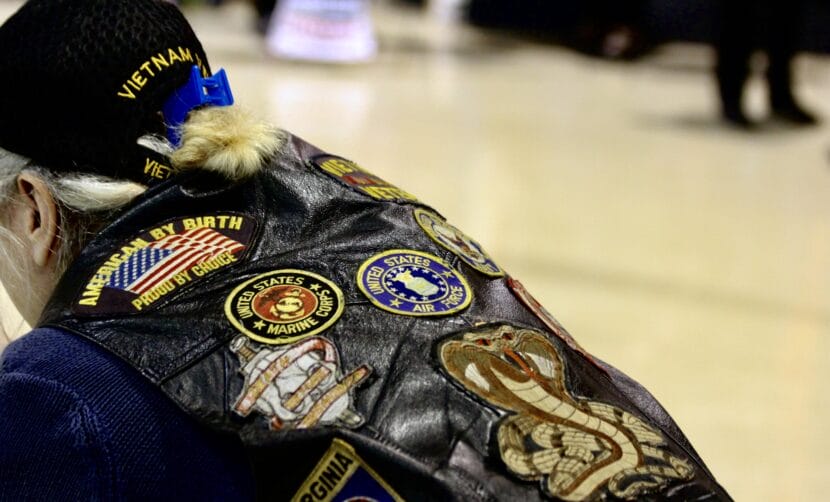
A veteran’s vest at a Veterans Day ceremony at Joint Base Elmendorf-Richardson on Nov. 11, 2019. (Joey Mendolia/Alaska Public Media)
Alaska has the highest percentage of veterans in the country, according to new economic data from the state Department of Labor. Roughly 59,000 residents are veterans, making up 8% of the state’s population. The national average is 5%.
State economist Dan Robinson said the military brings many service members to the state. He said many of them make Alaska home after they retire.
“A lot of people see Alaska and because there’s something about us that they like, they choose to stay here or come back here when their service is done. We also have a relatively high percentage of our population that enlists in the military,” he said.
The study describes a veteran as someone 18 or older who has served on active duty in the Army, Air Force, Navy, Marines, or Coast Guard, or in the U.S. Merchant Marine during World War II. Those who’ve served in the National Guard or reserves are only considered veterans if they were called or ordered to active duty, the study says.
Alaska has long had a higher share of veterans than any other state. More than 35% of veterans in the state are over the age of 65, according to the data. Almost a third are between 35 and 54 years old.
Montana, Wyoming and Maine also have large shares of veterans, while New York and New Jersey have the lowest rates. The data suggests there’s a lifestyle preference among veterans for a certain quality of life, Robinson said.
“Alaska would share a lot of those things with all three of those states: rural, hunting and fishing, natural beauty,” Robinson said.
“You look at the states at the other end, and you confirm that a little bit.”
Alaska’s veterans most commonly live in Anchorage, the Matanuska-Susitna Borough and the Fairbanks area.
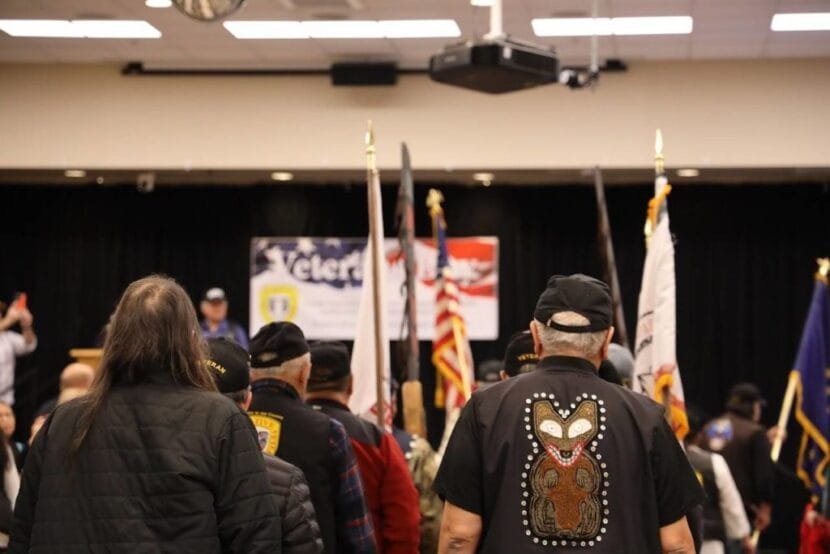
Southeast Alaska Native Veterans carry flags to the stage at Elizabeth Peratrovich Hall on Veterans Day in 2022. (Photo by Clarise Larson/KTOO)
Tuesday is Veterans Day and there are several ceremonies honoring veterans in Juneau.
The Central Council of the Tlingit and Haida Indian Tribes of Alaska and the Southeast Alaska Native Veterans group will host its annual Veterans Day ceremony and luncheon starting at 11 a.m. at Elizabeth Peratrovich Hall.
It will feature performances by the Elders and Yaaw Tei Yi Dance Groups and keynote remarks by Col. Jeff Philippart of the U.S. Air Force and Col. Erica Iverson of the U.S. Army.
Tlingit and Haida President Chalyee Éesh Richard Peterson said honoring veterans shouldn’t be limited to just one day a year.
“Their example strengthens our tribe and inspires our young people to lead with integrity and care,” he said. “We just want to continue to lift them up with the support and the recognition and the resources that they deserve every day.”
The VFW Taku Post 5559 and the American Legion will also host their annual public ceremony at Centennial Hall at 11 a.m., followed by a dinner at 5 p.m. at the American Legion’s lodge in Auke Bay.
Duff Mitchell is a veteran of the Army National Guard and Commander of American Legion Post 25. He said it’s important to reflect on the impact of veterans’ service.
“It doesn’t matter what political end of the spectrum you are, but freedom of speech and your other freedoms are very well protected in this country,” he said. “And, veterans have a lot to say of why we have those freedoms here.”
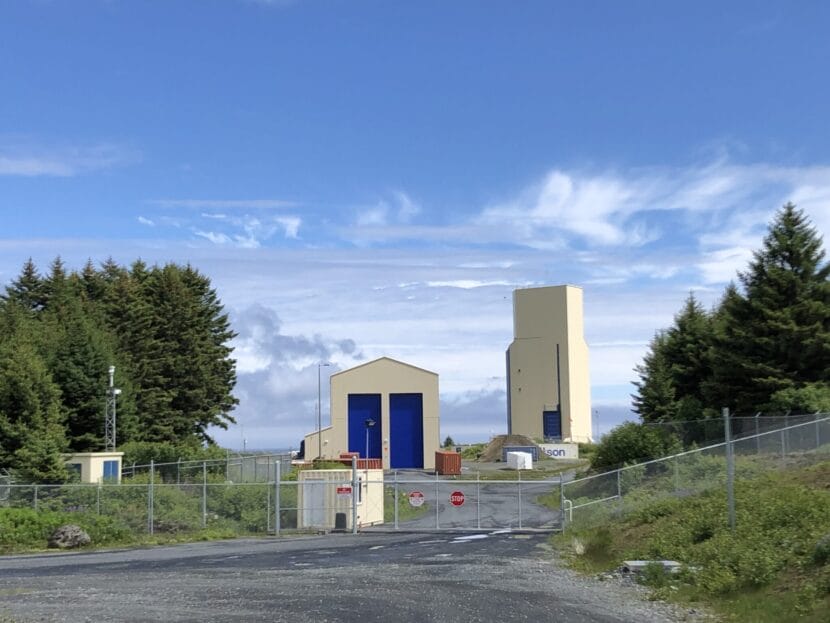
The state-owned Pacific Spaceport Complex is seen on July 13, 2021, in Kodiak. (Photo by James Brooks/Alaska Beacon)
Alaska’s state-owned Pacific Spaceport Complex on Kodiak Island launched a secret U.S. Department of Defense missile last week during what observers believe was a hypersonic weapon being tested by the U.S. military.
Hypersonic missiles are those that can travel at least five times the speed of sound.
While long-range ballistic missiles — produced since World War II — frequently exceed that threshold, they cannot typically maneuver to avoid defenses and are locked on a fixed trajectory.
Modern hypersonic missiles, under development by several countries, would be able to avoid anti-missile systems being deployed by the United States, Israel and other countries.
KMXT-FM public radio and the Kodiak Daily Mirror first reported the launch, which was preceded by warnings to navigators and road closures on Kodiak, home to Alaska’s state-owned spaceport.
The spaceport is owned and operated by the Alaska Aerospace Corporation, a state-owned public corporation created in the late 1990s as part of legislative efforts to diversify Alaska’s economy.
Officials issued a written statement the day after saying that “a successful government rocket launch” took place Thursday night and that it was the 35th launch from the Kodiak spaceport since its creation in 1998.
“The residents of Kodiak should be proud of yesterday’s achievement and the significant contribution their community provides to the space legacy of the United States,” the statement said in part.
The corporation did not state the purpose of the launch.
Warning messages issued ahead of the launch are similar to those that observers saw in 2021, when the Department of Defense twice attempted and failed to launch a hypersonic missile from the Kodiak spaceport.
The corporation declined to answer questions asking about the launch on Monday.
John Oberst, president and CEO of the corporation, said by email, “The Alaska Aerospace Corporation considers transparency with Alaskans a priority. On occasion, there are some launches, like the one last week, that do not permit us this latitude. Thank you for your interest in our business.”
Research scientist Dr. Marco Langebroek, who tracks space launches from his home in the Netherlands, observed that the warnings to navigators match a planned three-stage missile test splashing down near the U.S. military’s rocket site at Kwajalein, Marshall Islands in the central Pacific Ocean.
Four years ago, the U.S. Army published documents indicating that it intended to test a hypersonic missile from Kodiak. The information in those documents matches the warning messages published ahead of last week’s flight.
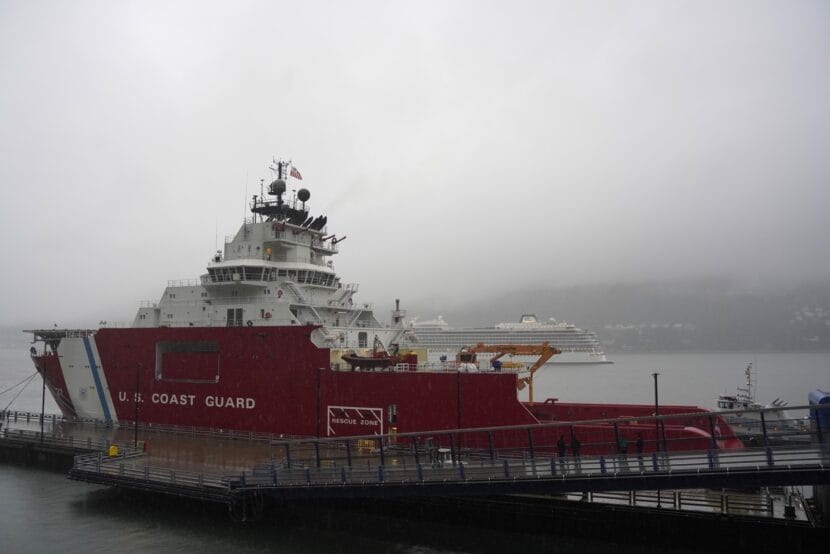
USCGC Storis (WAGB-21) at the cruise ship docks in downtown Juneau on Aug. 9, 2025. (Photo by Alix Soliman/KTOO)
Listen here:
The U.S. Coast Guard officially added the first icebreaker to its fleet in over 25 years during a ceremony on Sunday in Juneau – its future home port.
The ship’s commissioning signals an expanding U.S. military presence in the Arctic Ocean. But the icebreaker is also looking to overcome its past after a tumultuous maiden voyage more than a decade ago.
Down in the engine room of the Storis on Saturday, U.S. Coast Guard Lieutenant Commander George Greendyk walked in narrow passageways between loud diesel engines that slowly thrust the ship through the placid waters of Stephens Passage.
“We’re getting to the point where we’re pretty comfortable pretty much with the majority of the ship’s operations,” Greendyk said. “Now we just need to get control of the things that pop up only every once in a while.”
The Storis joins the Healy and the Polar Star as the third polar icebreaker that the U.S. military owns.
Juneau residents may have glimpsed the large red and white ship through the fog over the weekend, but it was only here for a little while before heading north.
Captain Corey Kerns said the icebreaker’s mission over the next couple of months has two main purposes: assert U.S. sovereignty and learn how to operate the ship, which is unlike any other in their fleet.
“In this case, we need Arctic presence was the most important thing.
He said that the U.S. has failed to keep pace with other nations, including Russia and China, in building polar icebreakers capable of navigating the waters of the far north. So Congress made the Coast Guard buy this one from the American company Edison Chouest Offshore for $125 million dollars.
“So we’re willing to take some risk or forced into it, because our shipbuilding projects are so behind, you know, to be honest,” Kerns said.
The ship was originally called Aiviq and was built to support oil drilling in the Arctic. It famously lost control of a Shell oil rig off the coast of Kodiak during its maiden voyage in 2012.
After the oil rig ran aground, government reports concluded there were issues with how the icebreaker was designed and with how the crew handled it in dangerous waters.
One of the main issues was the location of the fuel vents. Seawater flowed into the vents and caused the diesel engines to fail. Kerns says they’ve fixed that issue.
“So those were raised a little bit higher, which means you could take more water in vicinity of them before it would down-flood,” he said. “So not that it couldn’t possibly happen again, but it’s less likely.”
In addition to raising the fuel vents, the other major changes to the ship were painting the hull red, installing military satellite communication systems and adding an armory.
Kerns said the crisis with the oil rig was also a result of how the crew made decisions at the time.
“If you’re towing 100,000-ton ship in like 40-foot seas, that’s restricting the movement of your ship. No amount of design is going to save you from a bad, bad situation,” he said.
Before getting a ride-along for press and families of the crew underway, the ship sat at Auke Bay Ferry Terminal. The voyage was delayed for around two hours.
Kearns said a propeller malfunction was to blame. But it would be a quick fix once they got downtown.
“That’s some of the growing pains of us learning,” he said.
They’re learning from a civilian crew with Edison Chouest that is contracted to train the Coast Guard.
Commander Philip Baxa, chief of the Coast Guard’s Aids to Navigation and Ice Capabilities Division, helped negotiate the purchase of Storis. He said the ship’s home port will be Juneau — once the infrastructure is built.
“It doesn’t just stop at the waterfront with a pier. It’s the warehouses and workshops for our maintainers, but it’s also the housing units for the crew members and their families,” Baxa said.
The recent Trump-signed funding bill allocated $300 million to build the port. Baxa said it will take around a decade and that building sites have not yet been decided. He expects roughly 100 crew members and maintenance workers will be stationed in town.
The ship is planning to visit Seward, Kodiak and Dutch Harbor, then will head north through the Bering Strait over the next couple of months. Port calls are subject to change.
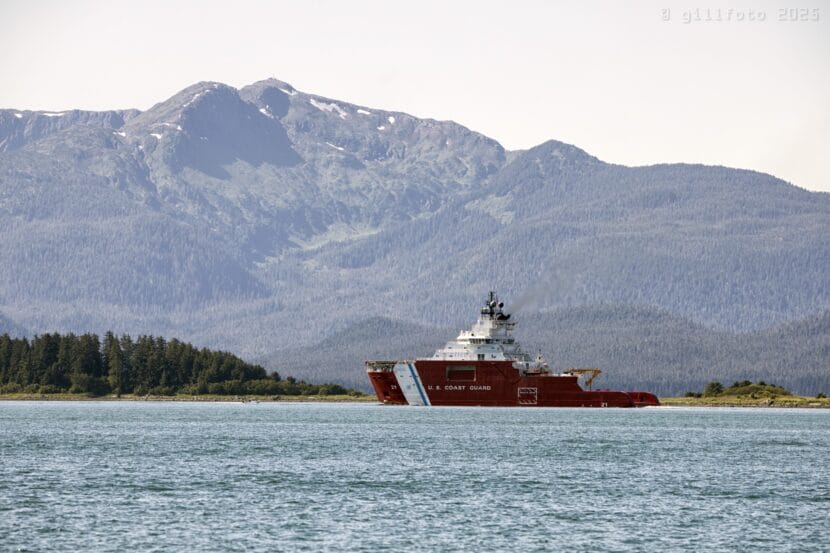
The U.S. Coast Guard icebreaker Storis passes Portland Island on its way to Juneau on Wednesday, Aug. 7, 2025. (Photo courtesy/ gillfoto)
The U.S. Coast Guard’s new polar icebreaker Storis arrived in Auke Bay on Wednesday afternoon. It’s the ship’s first visit to its future home port of Juneau.
The 360-foot ship is designed to operate in the Arctic and expand U.S. presence in the region. It’s a stopgap while the Coast Guard builds a new fleet of icebreakers called Polar Security Cutters.
Coast Guard officials say it will likely be a few more years before the ship is officially homeported in Juneau, bringing an estimated 190 Coast Guard personnel and their families to town.
Alaska’s congressional delegation – particularly Sen. Dan Sullivan – has discussed plans to dock an icebreaker in the capital city for years. Last year, the Coast Guard made the official announcement after Congress passed a spending bill that appropriated money for the ship’s purchase.
A ProPublica investigation of the ship published earlier this year revealed it has a design problem and a history of failure.
The ship was previously named the Aiviq, but was renamed the Storis in honor of another Coast Guard ship that was stationed in Juneau in the 1950s. The Alaska State Library, Archives, and Museum will host a free screening of a documentary about the original vessel and its history on Saturday at 1 p.m.
The Storis is only visiting for the weekend and will dock in downtown Juneau on Saturday afternoon. The Coast Guard will hold a commissioning ceremony for the ship downtown on Sunday morning.
The ship is open for free public tours on Thursday at the Auke Bay Ferry Terminal from 2 to 4 p.m. and Friday from 8 to 10 a.m.
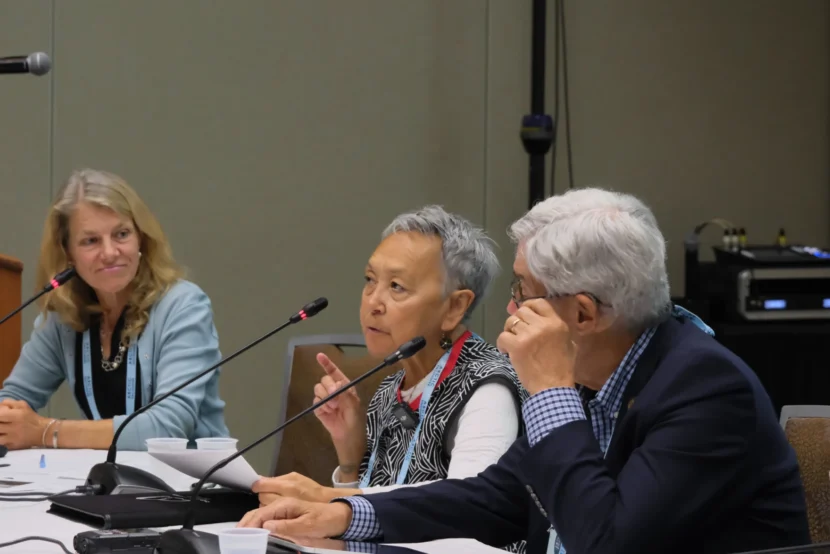
Vera Kingeekuk Metcalf (center) and Margaret Williams (left) speak during the Arctic Encounter Summit in Anchorage on July 31, 2025. Metcalf is the executive director of the Eskimo Walrus Commission. Williams is a senior fellow with the Arctic Initiative of the Harvard Kennedy School. (Photo by Alena Naiden/KNBA)
Growing political tensions, a need for partnerships and the importance of including Indigenous leaders in policy decisions were some of the themes at the Arctic Encounter Summit in Anchorage last week.
More than 700 participants, including leaders from around the circumpolar North, gathered at the Dena’ina Civic and Convention Center for the conference.
Mike Sfraga is a former U.S. ambassador to the Arctic who recently stepped into the interim chancellor role at University of Alaska Fairbanks. He spoke about how national, personal and environmental security are interconnected, especially for people who live in the Arctic.
“We’re talking about water security, food security, community security, health security. So it’s all nested in there,” Sfraga said. “But it’s highlighted by, obviously, our homeland and national security.”
Ties and tensions with Russia
The geopolitical climate in the Arctic has undergone a major shift since Russia invaded Ukraine in 2022. Margaret Williams, a senior fellow with the Arctic Initiative of the Harvard Kennedy School, said that it put an end to partnerships between Russia and the U.S. on wildlife research and planning for potential oil spills.
“Since that time, all of this important collaboration and communication has stopped,” Williams said.
Russia has also been strengthening its relationship with China while growing its shipping, fishing and military activities in the Arctic, Williams said — all of which have increased tensions with the U.S..
Vera Kingeekuk Metcalf is the executive director of the Eskimo Walrus Commission. She was born in Savoonga, a small village on St. Lawrence Island in the Bering Sea, which is closer to eastern Russia than it is to the rest of the U.S. Metcalf said Savoonga residents have a lot in common with their Russian neighbors.
“We have neighbors across the waters in Chukotka sharing the same concerns with Alaskans,” Metcalf said. “We know that we have the same issues that we’re dealing with, especially with marine mammal migration patterns changing because of climate change. Our coastlines are eroding, cliffs are crumbling, really challenging our community harvesters, affecting our food systems.”
Metcalf said she hopes that with time, Russian and American scientists and locals will collaborate again to protect marine subsistence resources and exchange cultural knowledge.
“As long as we focus on people-to-people, community-to-community ways — communicating with our neighbors,” Metcalf said.
Need for cooperation
The Arctic Encounter brought representatives from 27 nations to Anchorage. Some came from the European Union, Japan, Canada and Greenland.
During the final day of the conference, Sen. Lisa Murkowski acknowledged there is also friction between the U.S. and Western Arctic countries. Murkowski said the White House’s focus on tariffs and rhetoric around expansion hasn’t helped to build trust and diplomatic partnerships — President Donald Trump has talked about annexing Greenland and about Canada becoming the 51st state.
Murkowski said what can be helpful is having other officials who articulate the country’s priorities differently.
“It’s important to have elected representatives who can talk about the important relationships that we want to have with Canada, with Greenland, without suggesting that it has to be adversarial, confrontational or exploitative,” Murkowski said. “We cannot maintain a zone of peace if we erode the circle of trust and treat even our closest allies and friends like a common enemy.”
Murkowski said she sees examples of international collaboration in the Arctic in wildfire management. She said other examples are strengthening defense through military training and the inclusion of Sweden and Finland into the North Atlantic Treaty Organization.
“We have now a new task on the U.S. side, and that is to work to rebuild trust and relations, not with Russia, which has shown that it deserves neither, but with our fellow Western Arctic nations, our closest allies and our long standing partners,” she said. “My commitment is to ensure that America is a reliable partner, will be a reliable partner, so that in the Arctic, we can all advance together.”
Listening to Indigenous people of the North
Several Arctic Encounter panels focused on sovereignty. Speakers agreed that policy decisions about the Arctic should go hand-in-hand with listening to local communities.
Sara Cohen is a deputy head of mission at the Canadian Embassy in the U.S., where she focuses on foreign policy and national security.
“You can’t have safe people without having a safe environment. You can’t have safe people without them having a safe and secure access to a future that is characterized by dignity in Canada,” Cohen said. “That’s very much also part of our reconciliation with Indigenous peoples.”
Doreen Leavitt is the director of natural resources at the Iñupiat Community of the Arctic Slope, a tribal entity representing several communities on the North Slope. Leavitt said people living in the Arctic can represent themselves best.
“When decisions are made about us, we are diminished, and when we the tribes are ignored, it directly erodes our self determination and our sovereignty,” Leavitt said. “At the end of the day, no one else is going to know what is best for our people and our lands than we do.”
After the three-day conference in Anchorage, Arctic Encounter participants visited Fairbanks. The event repeats annually.
Copyright 2025 KNBA
Close
Update notification options
Subscribe to notifications
Subscribe
Get notifications about news related to the topics you care about. You can unsubscribe anytime.