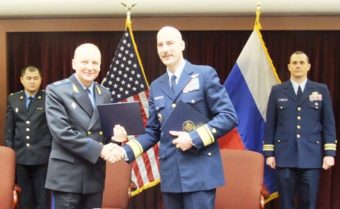
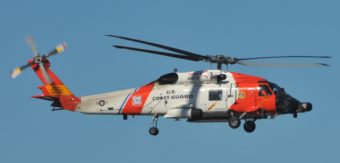
Not that long ago, the Coast Guard Cutter Sherman was intercepting illegal drugs off the coast of sunny and warm Costa Rica. Her captain was the Coast Guard’s attaché in Mexico City.
Now Sherman is headed to the cold and wet of the far north.
The cutter arrived in Juneau Wednesday, put to the test by the big wind and rain storm that slammed Southeast Alaska. Rosemarie Alexander talked with Commanding Officer, Capt. Joe Hester, about the trip from the Sherman’s home port of San Diego — where the weather is nearly always nice — to Alaska.
The 43-year-old ship is one of a class of ships being decommissioned by the Coast Guard, to be replaced by bigger, faster cutters. Here are more stories about the ship and her crew.
As far as Coast Guard assets go, Petty Officer Joe Baxter says nothing beats the style, class and comfort of the new medium response boats.
Petty Officer Phillip Ketcheson pilots Coast Guard Station Juneau's new medium response boat. (Photo by Casey Kelly/KTOO).
“Crew accommodations, we have an actual toilet, marine toilet (a head), and we’ve got a microwave, a sink, creature comforts that were never on any other Coast Guard boat this size,” Baxter says.
The 45-footers are replacing a fleet of 41-foot response boats used at Coast Guard stations nationwide. Station Juneau hasn’t had one in over a decade, using a 47-foot motor life boat instead. For the newer vessels, Baxter says the Coast Guard made sure to get input from medium response boat crews during the design phase.
“They did an excellent job getting operators on the boat taking recommendations and applying those recommendations,” he says. “So, we sit on this boat, things are where we want them as an operator.”
Response boats are primarily used for Coast Guard legacy missions like search and rescue and fisheries and law enforcement. With twin 825 horse power engines, the new vessels can really fly. Top speed is 40 knots, or about 40 miles per hour.
“So we can get on scene a lot quicker,” says Baxter.
Of course, there are some major changes. A lot of the older boats in the Coast Guard fleet use outboard engines, but the new ones have a water jet propulsion system. Petty Officer Phillip Ketcheson says that means learning a new steering method.
“The direction you turn the outboard is the direction your stern will go. This is now the opposite. So rather than, we’ve taught the guys backing down, you kind of stare at your stern. On this boat, we’re teaching them to drive the bow. So wherever you turn your nozzle is the direction the bow is now going to go,” Ketcheson says.
The new medium response boats have been in the works for about 10 years. The Coast Guard ordered 180 of them. The first one was delivered to Station Little Creek Virginia in 2008. Each one costs about 2-million dollars. When the second one arrives in Juneau in October, it will be based at Auke Bay. The new response boat that’s already here is stationed downtown.
The Coast Guard is monitoring the condition of a fisherman who suffered cuts to the inside of his mouth aboard the 98-foot vessel Shellfish.
Chief Petty Officer Kip Wadlow says the boat rolled while the 25-year-old crewmember was in the engine room with a flashlight in his mouth, causing cuts on his tongue and the back of his throat. The Coast Guard launched two helicopters from Air Station Sitka last night, but Wadlow says weather prevented them from doing a hoist.
“Coast Guard flight medics are keeping appraised of his situation. Right now, he’s kind of out of the danger zone. He still has the injuries, but they are non-life threatening,” Wadlow said.
When the call came in at about 6:30 Thursday night, Wadlow says the boat was about 270 miles west of Sitka, where it’s headed. At last check it was travelling about 7 knots.
Wadlow says the Coast Guard will attempt another hoist if the weather improves.
There are over 1200 buoys and other navigational aids placed all along the U.S. coastline. Somebody’s got to repair them and make sure they all stay in position. That’s the responsibility of the Coast Guard’s buoy tenders; the black-hulled ships crewed by what could be described as the blue-collared members of the service.
Eight tenders from Alaska, British Columbia, Washington, and Oregon converged on Juneau this week for the annual Buoy Tender Round-Up. It’s chance for as many as 300 crewmembers to train together, and compete against each other. The Buoy Tender Olympics is the highlight. Events are based on day-to-day routines: the Chain Pull and Rescue Line Heave, Survival Suit Relay Swim, Crane Boom Spotting, Tug o’ War, and the Heat & Beat.
The National Transportation Safety Board says deficient oversight by the Coast Guard was partly responsible for an accident that killed a child and injured four other boaters.
The report issued July 12th follows an investigation into the collision between one of the Coast Guard’s small patrol boats and a recreational boat in San Diego in December of 2009.
The 33-foot boat – designated as ‘special purpose craft – law enforcement’ — with five crewmembers from Station San Diego was dispatched to check on a possible grounding. They were underway at high speed at night, in an area with heavy traffic just before a holiday boat parade, when they hit and ran up on the 24-foot Sea Ray from dead astern. Thirteen people, including the boy, were on the boat.
The Coast Guard boat was planing, or traveling at least 19-knots and perhaps as high as 42-knots.
NTSB investigators concluded that the Coast Guard boat was traveling too fast for conditions, and the reported grounding did not require such a high speed. The Coast Guard boat also had obstructions to forward visibility. Some of the crew – who could’ve been helping as look-outs — was apparently distracted with cell phone calls and text messaging. The NTSB also says that oversight of safe small boat operations at Station San Diego was “ineffective.”
The NTSB recommended that the Coast Guard implement procedures to get around the boat’s forward visibility issues, reexamine small boat operations service-wide, and establish procedures for safe operating speeds.
The NTSB had earlier recommended the Coast Guard implement a policy for the use of cell phones or wireless devices aboard their vessel.
Close
Update notification options
Subscribe to notifications
Subscribe
Get notifications about news related to the topics you care about. You can unsubscribe anytime.