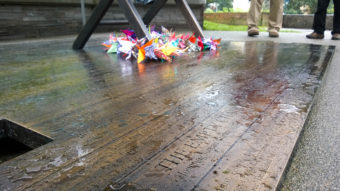
The planks of the Empty Chair memorial are etched with a narrative about Japanese internment during World War II and the names of the 53 internees from the Juneau area. (Photo by Jeremy Hsieh/KTOO)
Juneau’s Empty Chair statue has been honored as one of 31 outstanding public art projects created in 2014 by the nonprofit Americans for the Arts.
The sculpture is a memorial to Japanese-Americans from Juneau interned during World War II. It was inspired by John Tanaka, valedictorian of the Juneau High School class of 1942. Before that year’s graduation, Tanaka and his family were imprisoned at Minidoka internment camp in Idaho. His classmates set up an empty chair at the commencement ceremony in his place.
The Empty Chair statue was created by artist Peter Reiquam. The names of 53 Japanese-American internees from Juneau are etched onto its bronze floor.
John Tanaka died in 1977. His family and friends raised money to pay for the memorial. The City and Borough of Juneau donated space at Capital School Park, where the statue is located.
The Empty Chair and other public art projects were honored today at Americans for the Arts’ annual convention in Chicago.
The Juneau Assembly last night unanimously approved more than $673,000 in additional spending for the current fiscal year that ends June 30.
The bulk of that is $500,000 for the Juneau School District, bringing the city’s local contribution for the current year to the maximum allowed under state law.
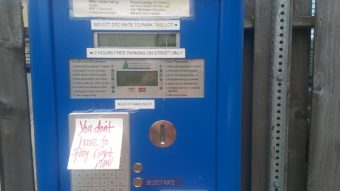
The Assembly also approved additional spending for the Juneau Airport, Eaglecrest Ski Area, the city law department, and downtown parking.
The money to cover the increased expenditures will come from various reserve funds.
Juneau has been engaged in litigation with Aparc Systems since 2013. (Photo by Justin Heard/KTOO)
A federal judge has awarded Juneau $1.2 million in the city’s lawsuit against a Nevada company that sold it a defective downtown parking system.
City Attorney Amy Mead says the judgment was issued in U.S. District Court last week in the city’s case against Aparc Systems. However, Mead said Aparc filed for bankruptcy on May 20.
“They did not notify the federal court that they had filed for bankruptcy,” Mead said at a Juneau Assembly meeting Monday evening. “So, normally filing for bankruptcy works an automatic stay by virtue of the bankruptcy court.”
Mead says the city will argue that the stay should be lifted and the district court order against the company should go into effect. But she says it’s unlikely the city will see its $1.2 million.
“According to Aparc’s bankruptcy documents they have listed, I think — if I’m recalling correctly — $50,000 in assets,” Mead said.
Even if there’s no money to recover, she says it’s important for the judgment to stay in place.
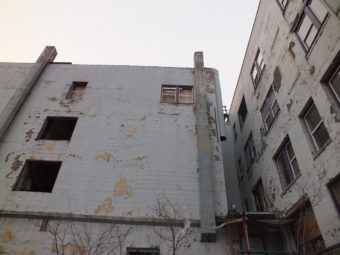
The City and Borough of Juneau has issued a demolition order to the owners of the Gastineau Apartments, which were largely destroyed by fire in 2012. (Photo by Casey Kelly/KTOO)
Juneau officials have served the owners of the Gastineau Apartments with a demolition order.
James and Camilla Barrett own the building, largely destroyed by fire in 2012. The city accelerated efforts to force them to do something about it, after another fire in March brought renewed attention to the downtown eyesore.
The Barretts were served with the demolition order on May 30.
“They have 10 days from the date of service, or until June 10, to accept or reject the terms of the order. They have 20 days to appeal the order to the Building Review Board,” Mead said at a Juneau Assembly meeting Monday night. “We have not heard from either one of them.”
The Barretts have said they plan to tear down the apartments, but progress has been slow.
The city’s latest action comes after the Assembly decided against trying to take the property by eminent domain. Assembly members had hoped to seize the property and work with a private builder to turn it into affordable housing. But an Alaska Housing Finance Corp. report estimated demolition would cost at least $1.2 million, increasing the cost of redevelopment and taking that option off the table.
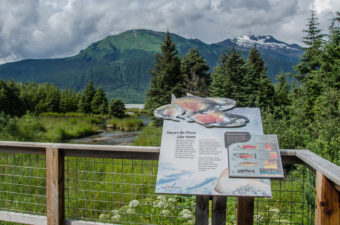
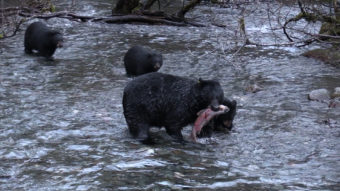
The Steep Creek Trail with its platforms where visitors can view salmon and bears is one of the areas the U.S. Forest Service will start charging people to use starting next summer. (Photo by Heather Bryant/KTOO)
Starting next summer, the Mendenhall Glacier Visitor Center in Juneau will increase its entry fee and start charging for use of nearby trails and amenities.
Visitor center director John Neary says it’ll be the first increase since they first started charging fees 16 years ago. Back then, the center got about 200,000 visitors annually. This year, he says they expect to top 500,000.
“That’s really what it comes down to,” Neary says. “We don’t have an increasing budget scenario, yet we do have very much an increasing number of people who want to see the Mendenhall Glacier and the whole recreation area use has increased dramatically.”
The increase takes effect May 1, 2016. Fees are only charged during tourist season, May through September. For the rest of the year the Mendenhall Glacier Visitor Center and nearby facilities are free.
The fee to get into the center will go from $3 to $5 a day for people age 16 and older. That $5 also will cover the cost of using the pavilion between the parking lot and Mendenhall Lake, the Photo Point Trail, the Steep Creek trail, bus shelters, and bathrooms near the visitor center. Currently those facilities are free year-round.
Neary says the increase will be used to improve services for visitors. He says traffic congestion is a big issue both in the bus parking area and on trails near the visitor center.
“Which is great,” says Neary. “We really want to connect people to their national forests, right? But there’s lots of costs associated with the platforms themselves, the maintenance of our trails, the staffing to ensure good safety.”
The cost of a season pass also will go up next year, from $10 to $15. Neary recommends frequent visitors take advantage of the passes, as well as various National Park Service and Forest Service programs that cover access to the Mendenhall Glacier Visitor Center.
Bear 103 fishes Steep Creek with cubs in October 2014 in this this still from a video provided by the U.S. Forest Service. (Video still courtesy Jos Bakker, USFS bear volunteer)
East Glacier Trail near the Mendenhall Glacier has reopened, but the U.S. Forest Service is warning users that a protective mother bear and her cubs are still in the area.
Officials closed the trail last week after a series of encounters with the sow, who started acting aggressively toward hikers, mountain bikers and off-leash dogs.
Mendenhall Glacier Visitor Center Director John Neary says in a release that the bear and her cubs have been moving around the Dredge Lakes area.
“She remains protective of her cubs and should be given plenty of space,” he says.
The mama bear is known to wildlife officials as “Bear 103” because of the yellow tag on her ear that says “103.”
Close
Update notification options
Subscribe to notifications
Subscribe
Get notifications about news related to the topics you care about. You can unsubscribe anytime.