Men in Juneau earn significantly more money than women, according to an economic indicator in a recent JEDC newsletter.
The Juneau Economic Development Council analyzed data from the US Census Bureau’s American Community Survey that shows men in the Capital City make 42 percent more than their female counterparts.
Of course the problem isn’t unique to Juneau. Nationwide, the same survey indicates men earn 29 percent more than women. Statewide it’s 37 percent.
But as always, numbers only tell part of the story. Casey Kelly has more.
You might think we’re trying to sell you the moon with this next story…
A long lost piece of moon rock, given to the State of Alaska by President Richard Nixon more than 40 years ago, is now the subject of a legal battle between the state and a former resident turned Deadliest Catch boat captain, who claims to have found it when he was a teenager.
Casey Kelly has more on this truly bizarre tale.
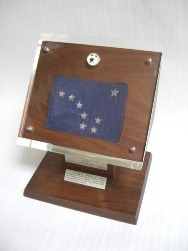
This Apollo 11 moon rock was given to the State of Alaska in 1969 by President Richard Nixon. Until recently, it was believed to have burned in a fire. (Photo courtesy Alaska State Museum)
From 1969 through 1972, NASA’s six Apollo missions returned to Earth with hundreds of pounds of moon dust. The Nixon White House mounted samples of the dust onto plaques and called them Goodwill Moon Rocks – given to all 50 states, hundreds of countries, and a few individuals. The moon rock Alaska received from the 1969 Apollo 11 mission ended up at the State Museum in Juneau, which loaned it out to other facilities until it went missing in the early ‘70s.
“I kinda figured we’re never going to find this moon rock,” says Elizabeth Riker, a University of Phoenix criminal justice graduate student from Detroit. As part of a class assignment she began investigating Alaska’s missing lunar fragments. Last August she wrote about it for the Capital City Weekly.
“I got quite a few emails from citizens in Alaska, asking me questions and saying they remember seeing the moon rock when they were in elementary school,” says Riker. “But obviously they all said this was back, late ‘60s, 1970, that time frame. But nobody had seen it since.”
So, what do moon rocks have to do with criminal justice? Riker’s professor, Joe Gutheinz is a retired Senior Special Agent with NASA’s Office of Inspector General.
“I would conduct criminal investigations and civil investigations impacting NASA,” says Gutheinz. “And in 1998, I went undercover in Operation Lunar Eclipse to recover the Honduras Goodwill Moon Rock.”
Gutheinz says there’s no shortage of missing moon rocks, so the investigation assignment is one he commonly gives to his students.
“About 160 moon rocks are missing that were given to the nations of the world,” he says. “And we’ve also determined that 18 Apollo 11 moon rocks given to the states and nine Apollo 17 Goodwill Moon Rocks given to the states are also missing. Lost, destroyed, or stolen.”
In December, a man named Coleman Anderson filed a lawsuit against the state seeking clear title to Alaska’s Apollo 11 moon rock. Anderson claims his step father was the curator of the State Transportation Museum in Anchorage when it was destroyed by arson in 1973. In the days after the fire, Anderson – 17 at the time – says he found the moon rock in a trash heap. Daniel Harris is Anderson’s Seattle-based attorney.
“The curator of the museum, basically signed off on him taking them,” Harris says. “And they sat in Coleman’s basement or wherever for about 30 years and then he read about somebody having sold moon rocks and he said, ‘Boy, maybe I have something of value here.'”
According to Harris, Anderson currently resides somewhere in the southern United States and hasn’t lived in Alaska for several years. But he was the captain of a Bering Sea crab vessel – even appearing in season one of the reality show Deadliest Catch.
On the black market moon rocks have been known to go for millions of dollars. So, if Anderson is awarded ownership, he could sell the Alaska rock for quite a bit of money. But Harris says his client is interested in cutting a deal with the state.
“We’re very open to ideas as to how a compromise could be reached,” Harris says.
The moon rock Anderson claims as his hasn’t been authenticated. Nevertheless, the state has filed a counterclaim against him charging that he trespassed and assumed ownership of state property without permission. In addition, the state is seeking return of the moon rock and its plaque, and damages for the years in which residents lost use of them. Bob Banghart is chief curator of the Alaska State Museum.
“I think that would be appropriate, if it turns out to be the real thing,” Banghart says of having Anderson return the moon rock. “It would be part of the mission for us. We don’t like to lose things, no matter how it occurs.”
Retired Special Agent Joe Gutheinz – now an attorney in private practice – agrees.
“And I’m not talking about the law. I’m talking about morality here,” Gutheinz says. “And my opinion: That moon rock was given to the children of Alaska.”
Remember that Honduras moon rock Gutheinz recovered in 1998? It was the subject of a 5-year court battle before a judge ordered it to be returned to the US government, which gave it back to Honduras. Whether Alaska gets its moon rock back remains to be seen.
The State of Alaska today (Friday) released thousands of pages of e-mails Sarah Palin sent and received during her time as governor. The national media descended on Juneau earlier this week in anticipation of the release, which comes nearly three years after the initial public records request. KTOO’s Casey Kelly has more.
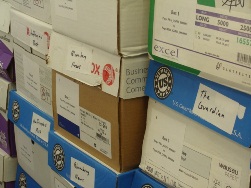
Boxes of former Governor Sarah Palin's emails sit in a Juneau office building waiting for the national and international press corp to pick them up. (Photo by Casey Kelly/KTOO)
Reporters, camera men and bloggers from nearly every major national news organization crammed into the third floor hallway of the Court Plaza Building – known in Juneau as the Spam Cam. About a dozen dollies lined the hall, piled five feet high with boxes of documents.
When the time came, Governor Sean Parnell’s Spokeswoman Sharon Leighow released them to the media.
“It’s all yours, let ‘er rip,” Leighow said.
Each set of six boxes contained more than 24-thousand pages of Palin’s e-mails. Leighow – who also worked for Palin – says the documents were culled from the state accounts of 55 current and former Alaska officials, whom Palin emailed using her private Yahoo account.
“Employees who had frequent communication with the governor. For instance, the lieutenant governor, the chief of staff, deputy chief of staff, her press people, special assistants.” said Leighow.
The state is charging $725 for a complete copy of the records to cover the cost of printing. Governor Parnell’s office will only make one public review copy available throughout the entire state. That frustrates Republican Activist and Palin critic Andree McLeod, who says the state should have made the records available electronically.
“It would have lowered the barriers of the access for information, which technology does. It democratizes information. But the Parnell administration has not caught up with that yet, and I don’t believe they’re interested in doing so,” McLeod said.
Some state lawmakers have ordered copies that will be available to the public in Anchorage, Fairbanks and Kenai. And many of the news organizations that paid for the documents have already posted them online.
MSNBC.com, working with a team of Juneau volunteers, has hired electronics investigation company Crivella West to sort through the records. Co-founder and CEO Arthur Crivella says within minutes of them being posted on the web, they’re sent to computers at the company’s headquarters in Pittsburgh. The computers then study the e-mails for language that may be interesting to Crivella’s trained researchers.
“Essentially we’re looking for personal language, we’re looking for emotional language,” says Crivella. “Where anybody in their administration is emotional about something, alarmed, the language of deception.”
MSNBC.com Investigative Reporter Bill Dedman admits the document dump could be complete waste of time. But he says someone has to vet Palin with her profile as a national political figure.
“Some of what we get out of public records like this is not some blockbuster scandal. I don’t think it’s about that at all,” said Dedman. “I do think that you get some sense of tone, of character.”
The documents were first requested in 2008 by news organizations following Palin’s vice presidential bid. Palin resigned in July 2009 after 966 days in office. It took 997 days to fulfill the records request.
Close
Update notification options
Subscribe to notifications
Subscribe
Get notifications about news related to the topics you care about. You can unsubscribe anytime.