Tourism

Is this empty gravel lot about to become downtown Juneau’s newest tourist attraction?

Snow covers the Archipelago Lot on South Franklin Street on Friday, Feb. 20, 2026. (Photo by Clarise Larson/KTOO)

A large gravel lot in the heart of downtown Juneau’s tourism corridor has sat empty for years. But that might soon change. 

On Tuesday, the city’s planning commission will consider whether to approve a conditional use permit for the construction of a two-story retail and entertainment building called “Alaska Fly & Dive.”

According to the permit application, the project will bring tourists coming off cruise ships into an immersive theater experience of Alaska’s natural wonders, like local glaciers and underwater adventures. The development would include three large interactive theaters/rides, a retail store and some office space. 

The project, estimated to cost at least $60 million with hopes of opening in 2027, would turn into a civic and educational venue in the tourism off-season. 

This is a drawing of the proposed Alaska Fly & Dive building in downtown Juneau. (City and Borough of Juneau)

“I know it’s private property. They should be allowed to develop as they do, but I just don’t know that it will benefit Juneau, as I know it, or the Juneau that is here after the tourists leave,” former Juneau Assembly member Loren Jones said in an interview.  

Back in 2019, the Juneau Assembly negotiated a land swap with property owner Archipelago Properties LLC, a subsidiary of Morris Communications based in Georgia and the former owner of the Juneau Empire newspaper. The negotiation was so that the city could develop bus staging and additional pedestrian space along the seawalk. Plans for Morris Communications to develop something on their property have been discussed for at least close to a decade. 

Jones voted against the land trade deal. He was skeptical about how any development there would benefit the community as a whole. 

At the time of the deal, a representative for the property said they wanted to develop the lot into retail shops and restaurants starting in 2020. That never happened. 

Instead, the nearly 1-acre property adjacent to the downtown library and parking garage — along South Franklin Street and under the watchful eyes of the Elizabeth Peratrovich mural — has remained largely empty. That’s despite the property’s extreme proximity to where 1.7 million cruise ship tourists walk off ships and into downtown Juneau each summer.

Jones said he’s not totally against the current “Alaska Fly & Dive” project — but needs more convincing that it will actually benefit Juneau.

“I don’t see anything in there that tells me that somebody in the middle of winter is going to leave their home in the valley and go,” he said. “I can’t imagine any of us going down in the middle of winter to take a simulated boat ride or a simulated submarine ride.”

Still, the new project has received letters of support from the Juneau Economic Development Council, Travel Juneau, the Downtown Business Association and the Society of St. Vincent de Paul. According to its application with the city, the development is in collaboration with Melvern Entertainment, a company that develops theater attractions for Disney, Universal Studios and Six Flags.

The proposed theaters include a 60-person 4D theater, a 72-person flying theater, and three 20-person ocean simulator theaters. The flying theater and ocean simulator theater would also be rides, taking guests via immersive films to see local glaciers and landscapes, and on underwater adventures.

This is a concept design of the Alaska Fly & Dive’s flying theater. (City and Borough of Juneau)

Liz Perry with Travel Juneau said in an interview that she’s excited to see the empty lot turn into something new. 

“This would be a terrific year-round addition to our offerings for both visitors and residents — it will create something that hasn’t been in that lot,” she said. 

And before you ask – no, they’re not planning to build any housing there. At least not in this application. Alix Pierce is Juneau’s Visitor Industry Director. In an interview, she said she thinks the project could help with managing the number of tourists that come into town each day in the summer. 

“I think having something downtown on the waterfront that’s indoors and helps manage congestion by pulling people into an activity, is a positive thing,” she said. 

The applicant for the permit is Reuben Willis, a local insurance Agent for State Farm. He declined an interview with KTOO to speak about the project before the meeting on Tuesday. In the application, it states that he signed a sales agreement for the lot, which is in a “due diligence period.” Morris Communications has also not responded to multiple requests for comment. 

The Juneau planning commission will decide whether to approve a conditional use permit for the project’s construction, along with two other variance requests related to the project, on Tuesday at 6 p.m. at City Hall. 

‘Can you survive another crisis?’ New documentary chronicles pandemic in Skagway

Skagway residents attended a local screening of a new documentary about how the community fared during the pandemic.
Skagway residents attended a local screening of a new documentary about how the community fared during the pandemic. (Avery Ellfeldt/KHNS)

The smell of buttered popcorn wafted through the Skagway School as dozens of people streamed inside. They were there to watch a new documentary — one about their own community during one of its darkest periods in recent history.

The film depicts life in Skagway between 2020 and 2022, when the cruise industry shut down amid the COVID-19 pandemic. It’s named “Last Call in the North.”

Andrew Cremata was Skagway’s mayor at the time. He said the ordeal forced what may have been the community’s first serious reckoning over its complete dependence on the industry.

“I don’t think there’s ever been any real meaningful conversations about it as a community, either on a governmental level or on a social level,” he said.

That conversation was the film’s throughline, said Stan Bush, who wrote and directed the film.

“What happens when your main economic driver is completely shut off?” Bush said in an interview last week.

Former Skagway resident Stan Bush wrote and directed the film, “Last Call in the North.” (Avery Ellfeldt/KHNS)

In many ways, COVID-19 was Skagway’s worst nightmare. With the town’s tourism-based economy shuttered for one full season and much of a second one, families and businesses went without income for an excruciating 22 months.

Bush went to middle and high school in town, but he hasn’t lived here since then. He said he was developing a project idea in Skagway before the pandemic, focused on the struggling local newspaper.

But Bush pivoted when COVID-19 hit the community in earnest, and the industry that had fueled the town for decades disappeared overnight.

“We’ve seen that when things are going great, they’re going really great. And when things go bad, here, they go really bad,” Bush said. “I think that’s a conversation for the community to have. Can you survive another crisis like this?”

The film follows a few key characters, including Cremata, the former mayor. In an interview after the screening, he raised questions about the long-term sustainability of the town’s economy.

“My fear was that when things got back to normal, people would kind of just go back to normal, right? Go back to the way things were before the pandemic,” Cremata told KHNS. “That’s really exactly what’s happened.”

The film also focuses on struggling small businesses — a jeweler who had to leave town, the owner of an outdoor guiding company who eventually shut his doors, and the former co-owners of the Skagway News. That includes Melinda Munson, the current KHNS news director.

Another key voice was Jaime Bricker, Skagway’s tourism director and the president of the Skagway Traditional Council, a local tribe.

After the premiere, Bricker said she was impressed by the videography and storytelling. She added that she could imagine how difficult it would be to tell the full story in just 90 minutes.

“I think I’ve heard different observations from just about everybody I’ve talked to, and rightfully so,” Bricker said. “We’re all a bunch of individuals in this community, and there were so many pertinent stories of that period of time that, you know, weren’t showcased.”

Bricker added that she thinks the film presents an opportunity for renewed reflection.

“Are there opportunities to plan as we look towards the future, given this particular COVID experience?” Bricker said. “Are there things that we can be doing differently in the future, to better prepare for an economic stop?”

Bush said prompting conversation was one of his main goals – not only locally but in similar communities across the state, country and world. As he sees it, what happened in Skagway could happen anywhere where the presence of one industry is the difference between economic survival and economic collapse.

Disclosure: This film features KHNS News Director Melinda Munson and her family, when Munson was co-owner of the Skagway News. Munson did not review this story before publication.

Some countries are cutting this source of marine pollution. Will Alaska do the same?

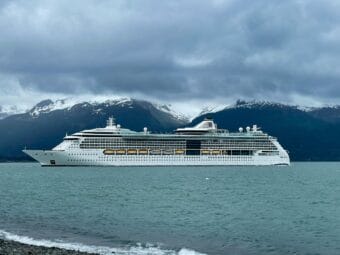
Two cruise ships docked in the foreground of a copper blue body of water, with snow-capped mountains on the opposite shore.
Cruise ships docks in Skagway during the 2025 summer season. (Avery Ellfeldt/KHNS)

In July, a state inspector boarded a cruise ship in Juneau for a routine review. The inspector’s report includes a photo that shows a metal drum full of chunky, black sludge — a mixture laden with sulfur and heavy metals.

That particular drum was slated to be offloaded on land, in British Columbia. But on many ships, systems known as scrubbers ensure the toxic sludge never materializes on board. That’s because it’s diluted with sea water and released back into the ocean.

Now, state Sen. Jesse Kiehl is looking to address the issue. The Juneau Democrat is drafting legislation in hopes of cracking down on the technology, which produces a largely invisible – and little regulated – source of water pollution.

“There’s still dirty fuel belching sulfur into Alaska. And that’s a problem,” Kiehl said in an interview last month.

The issue is not isolated to Alaska. And neither are efforts to address it. A growing list of ports, states and countries are zeroing in on the problem, which stems from rules adopted by the International Maritime Organization in 2020.

Cutting air pollution led to new water pollution

The IMO wanted to cut air pollution, namely sulfur pollution, from ships that burn heavy marine oil. While some cruise and shipping companies complied by using cleaner fuels, known as distillate fuels, others invested in scrubbers.

The technology allows them to continue burning dirty fuels by using seawater to remove pollutants from ship exhaust. So-called “open loop” systems send that contaminated water right back into the sea.

Experts say each individual open loop scrubber can produce up to 3,600 metric tons of water per hour. And some ships run multiple scrubbers at once.

When exhaust with high levels of sulfur and other pollutants is released into the air, they can increase the risk of cancer, respiratory complications and cardiovascular diseases. 

Scientists have been studying what happens when those pollutants are released into the ocean. But a growing body of research indicates it can harm marine life, including mussels and crustaceans, like crab, said Eelco Leemans, an advisor to the Clean Arctic Alliance, a global coalition focused on the shipping industry.

“The evidence is so clear that we have no reason to doubt that,” Leemans said.

Regulatory challenges

A tangled web of rules and regulations surrounds the issue. The IMO sets the global standard. And for now, the international body allows ships to use scrubbers to comply with its air pollution rules.

But there’s a growing push for that to change. Just this week, the agenda for an IMO subcommittee meeting in London featured more than a dozen proposals from member states and other organizations related to scrubber regulation.

“We believe that scrubbers do not provide the solutions that they were designed for, because basically they transfer air pollution to water pollution,” Leemans said during a recent webinar hosted by the Clean Arctic Alliance ahead of the meeting. “In the end, IMO should really do something about this.”

In the meantime, governments are taking matters into their own hands. In July, for example, 15 nations and the European Union moved to prohibit scrubber discharge in internal waters and port areas – and will consider extending the ban to about 12 miles offshore.

The U.S. has taken a less aggressive approach. The Environmental Protection Agency regulates scrubbers by way of a permit that sets limits for the concentration of pollutants in discharge. But at least in Alaska, the agency has rarely enforced those limits – despite hundreds of violations in some years.

The EPA did not respond to a request for comment by press time.

State regulators in Alaska, for their part, conduct routine environmental inspections on ships, which often entails observing scrubber operations and reviewing washwater data. In some cases, they flag problems for the EPA.

But in the end, the state Department of Environmental Conservation says it can’t enforce the EPA’s scrubber regulations themselves.

“Scrubber washwater is not addressed in State statutes, regulations, or the State’s general permit for vessels, and the State currently has no authority to enforce a federal permit,” Ben Eisenstein, DEC’s cruise ship program manager, wrote in an email.

Kiehl says that puts Alaska and other states in a bind.

“It’s really difficult with the federal government stepping in and telling the state: ‘You have nothing to say about scrubber discharge,'” he said.

Clean fuel regulations

So localities and states can’t punish ships for violating federal standards. But some are pursuing – or have already implemented – other ways to get at the problem.

Kiehl, the state lawmaker, didn’t provide more details about what his legislation might entail, or when he might introduce it. But he said he’s exploring a range of options, and nodded to other governments that have largely taken one common path: addressing the type of fuel that vessels use in the first place.

Most experts point to California. The state adopted a rule in 2008 that required ships to use cleaner, lower-sulfur fuels within 24 miles of shore. The goal was to reduce air pollution – plus cancer and other public health risks – from dirty fuels.

The California rule predated the proliferation of scrubbers. But it means the state dodged the problem before it even existed. Ships are already using low-sulfur fuels in California waters and don’t need to scrub them clean.

“We don’t have the issues with wastewater discharge because (scrubbers are) not a compliance option,” Bonnie Soriano, of the California Air Resources Board, told KHNS.

Soriano was among experts who said that cleaner fuels don’t require new technology or systems; ships can simply swap them in. She also said most vessels already carry them.

“There are some differences in prices, but likely they have the fuel on board if they’re doing a string that involves California,” Soriano said.

Meanwhile, in Washington state, the legislature is mulling a similar approach. A bill there would require cleaner fuels within 3 miles of shore.

State Rep. Debra Lekanoff is the bill’s sponsor. She’s originally from Yakutat but now represents communities in northern Washington, including the San Juan Islands. During a January hearing, she drew a connection between her two homes.

“What’s happening in my own backyard, where my Tlingit name Xixch’I See comes from, is the very impact that happens upon the Salish Sea,” Lekanoff said.

A growing list of tribes and organizations support Alaska taking a similar approach. Just one example: The Skagway Traditional Council in October adopted a resolution that called on the state to require the use of cleaner fuel – and on the shipping industry and the IMO to do their part, too.

Industry opposition

The cruise and shipping industries have opposed efforts to require clean fuels or eliminate scrubbers – a dynamic that is already playing out in Washington.

During the same hearing, industry representatives said a clean fuel requirement would be burdensome and unnecessary, and that it would amount to a roundabout attempt to address a water pollution problem by way of an air pollution regulation.

“This unnecessarily restricts authorized environmental technologies,” said Donald Brown, a vice president of Cruise Lines International Association.

The trade group did not respond to a request for comment. But pushback in Washington state and beyond suggests that any potential legislation in Alaska could have a long road ahead.

Aaron Brakel, of the Southeast Alaska Conservation Council, said he doesn’t expect any potential legislation would be signed into law this year.

“What’s really important, though, is getting a chance for the Legislature to start considering the issue,” Brakel said.

“To be having a conversation about the state of Alaska taking action on dirty fuel and exhaust scrubbers is a huge step in the right direction,” he added.

Federal lawsuit could scrap Mendenhall Glacier Visitor Center improvement plan

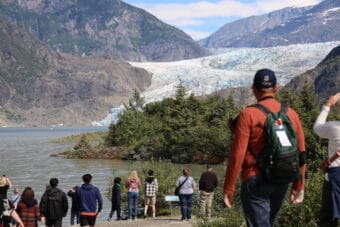
The Mendenhall Glacier Visitor Center on Friday, Feb. 21, 2025. (Photo by Clarise Larson/KTOO)

Listen to this story:

A U.S. Forest Service plan to revamp the Mendenhall Glacier Visitor Center to accommodate more tourists could be upended by a lawsuit brought by a nearby homeowner. 

Katharine Miller has lived in the Dredge Lake area near the visitor center for about 22 years. 

“It’s my backyard,” she said. “I do spend quite a bit of time there.”

Last July, she sued the Forest Service, claiming the agency violated the National Environmental Policy Act, or NEPA, when it designed its visitor center improvement plan. The plan expands facilities and increases the cap on the number of visitors allowed to come through commercial tour operators. 

Miller’s lawsuit argued that the Forest Service planned the project to accommodate more tourism without considering other options, which it’s legally required to do. In September, a federal court agreed and ruled in her favor.

Now, she’s requesting that the U.S. District Court for Alaska throw out the improvement plan altogether. The Forest Service is asking the court to leave the plan in place, arguing there’s a serious possibility the agency would reach the same decision to deal with existing overcrowding, and that revisions can be made instead. 

But Miller said it matters how the federal government arrives at decisions.

“Federal agencies like the Forest Service manage resources on behalf of the U.S. public,” she said. “They’re public resources, and I think it’s important to hold agencies accountable to include us in that process in a realistic way.”

Miller said she had objected to the agency’s process before the plan was finalized, but felt ignored.

On top of increasing the number of visitors tour companies can bring to the area, the improvement plan includes building a new welcome center and five new cabins, improving the existing visitor center, paving more parking lots and expanding trails. According to the court decision, the improvements are based on an assumption that tourism will grow 2% per year and the agency’s position that it should strive to meet the demand. 

In its ruling, the U.S. District Court for Alaska found the agency’s options for improving the facilities were all narrowly focused on facilitating more tourism. None focused on restricting the number of visitors.

Miller said the Forest Service should have considered a wider range of options beyond supporting tourism growth. 

“Because this isn’t something that’s necessary, it’s something that you want to do,” she said in reference to the Forest Service. “So you need to explain, you know, why that’s better than figuring out a better carrying capacity.”

The annual visitor capacity for the Mendenhall Glacier Visitor Center is a little more than half a million. The improvement plan allows for nearly double that — bringing the cap to 999,000 — with 87% allowed to be allocated to commercial use.

The U.S. Department of Justice’s brief on behalf of the Forest Service argues the agency can delay raising the capacity and revise parts of the plan that mention the 2% projected tourism growth. 

Despite citing significant congestion, the Forest Service doesn’t have a system for consistently tracking exactly how many people go to the visitor center each year, according to Paul Robbins, a spokesperson for the Tongass National Forest. He said a safe estimate is probably around 700,000 per year. He wrote in an email to KTOO that an estimated million or so people visit the wider Mendenhall Glacier Recreation Area annually.

According to a court file the Forest Service submitted, the area’s busiest days over the summer of 2025 ranged from 3,849 to 6,257 visitors.

Robbins declined to comment on the status of the improvement plan due to the ongoing lawsuit. He said agency staff plan to address deferred maintenance at the visitor center in the fall of 2026, work that was supposed to happen this year. It includes things like lighting, HVAC, flooring and painting. He said this maintenance is not part of the improvement project.

It’s unclear when the court will decide whether to throw out the improvement plan as Miller wants, or choose a different way to address the Forest Service’s violation. 

City now accepting ideas for how Juneau spends marine passenger fees

The Norwegian Joy docks in downtown Juneau on Saturday, April 26, 2025. (Photo by Clarise Larson/KTOO)

The City and Borough of Juneau is seeking ideas from Juneau residents about how to spend the fees paid by cruise ship passengers this coming year. More than $20 million is expected to be available for tourism-related projects. 

Juneau residents and businesses can now submit proposals to the city through Dec. 31. The last round of funding paid for things like free public Wi-Fi downtown and increased bus service to the Mendenhall Valley.

Alix Pierce, the city’s visitor industry director, said community suggestions play a critical role in what gets funded and what doesn’t. 

“We do get a lot of good ideas for what residents are feeling the need for in the community,” she said. “And, not spending general fund on our waterfront infrastructure and our visitor services does free up budget elsewhere in the city to do other things.” 

Every cruise season, the city collects a $5 fee from each passenger who comes into town from a ship. The fees can fund tourism projects that benefit visitors and locals in Juneau. In the past, these fees have funded upgrades to downtown public restrooms and improvements at Marine Park.

The city expects to collect about $22 million in fees this year. But the money collected can’t go toward paying for just anything. A lawsuit the cruise industry filed and settled with the city in 2019 clarifies the limits on how and where the city can use the funds, and some projects require approval by the cruise ship industry. 

Pierce said that people often don’t understand those parameters and that leads to a lot of proposals being rejected. 

“It’s unfortunately not money that’s just available to fill the hole in the city budget,” she said. “We are restricted in how we use those funds.”

Usually, the projects are downtown near the waterfront area, where the impacts of tourism are felt the most. But other parts of town can still secure funding for projects, like near the Mendenhall Glacier, as long as tourism reaches that area and the project would benefit tourism. 

Residents can submit their suggestions for projects in a few different ways. The city has a web form where people can submit proposals. It outlines what types of projects would fit the criteria. The Assembly will ultimately decide which projects to fund during the spring budget cycle.

Clarification: This story has been updated to reflect that the lawsuit settled between the City and Borough of Juneau and the cruise ship industry in 2019 lays out constitutional limits on how passenger fees can be spent. 

Juneau revives task force to tackle big tourism questions

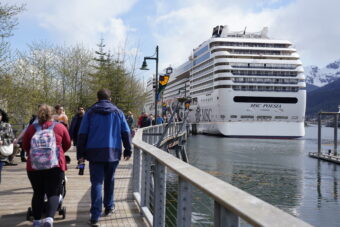
Cruise ship passengers walk down the docks in downtown Juneau on Wednesday, July 9, 2025. (Photo by Clarise Larson/KTOO)

With major cruise tourism developments on the horizon in the capital city, the City and Borough of Juneau is resurrecting a task force to look at whether its current approach to managing tourism is working.  

At a Juneau Assembly committee meeting Monday night, members approved the relaunch of the Visitor Industry Task Force and its members. Mayor Beth Weldon said the task force will be crucial in informing the direction the city takes to guide any future growth. 

“There is some issues that need to be addressed, and our tourism director relies heavily on these recommendations on how to move forward with her job,” she said. 

Juneau saw another record-breaking cruise ship tourism season this past summer, with more than 1.7 million passengers coming off ships and into town. 

The task force launches as Goldbelt Incorporated is planning a new $500 million cruise ship port on the backside of Douglas Island. And, that plan coincides with another dock development by Huna Totem Corp., an Alaska Native village corporation based in Hoonah. The Assembly approved the corporation’s plan to build a new cruise ship dock in downtown Juneau this spring. 

Weldon said she wants the task force to make big picture recommendations, like a 10-year tourism plan for Juneau. She also wants them to tackle more specific issues like addressing crowding and congestion in Auke Bay, regulating the whale watching industry and reducing ship emissions.  

Juneau Assembly member Ella Adkison will chair the committee, along with eight members that Weldon handpicked. They are Kirby Day, Kirsa Hughes-Skandijs, Sarah Lowell, Matt Catterson, Meilani Schijvens, Adrienne Scott, Shem Sooter and Jeremy Timothy.

Some members are returning from the previous task force, which originally sunsetted in 2020. Weldon said they represent a wide range of perspectives on tourism’s future. 

“I would say this community is no longer deadly against — as a community as a whole — deadly against tourism,” she said. “Nor are we a community that’s opening our gates wide for tourism.”

The task force has until the end of June to submit its recommendations to the Assembly. The first ship of the 2026 cruise season is slated to arrive in late April. 

Site notifications
Update notification options
Subscribe to notifications