Tourism

Skagway gets first look at possible plans for expensive and complicated rock fall mitigation

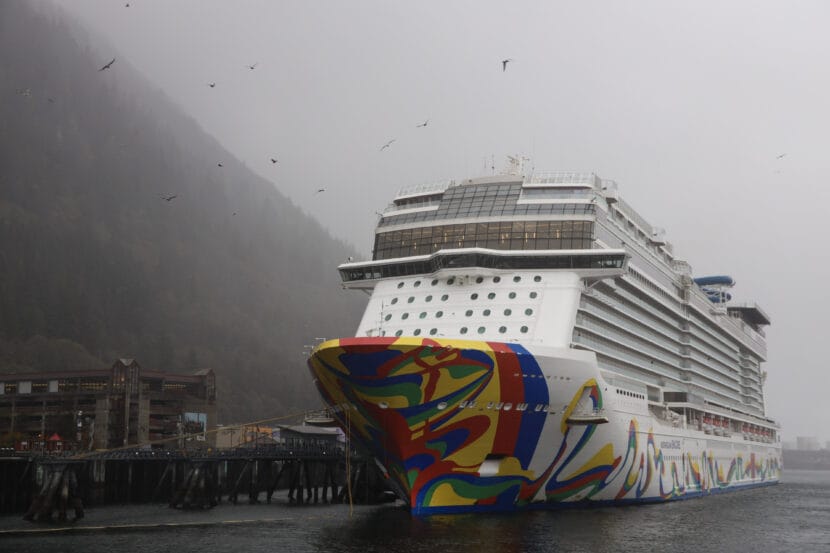
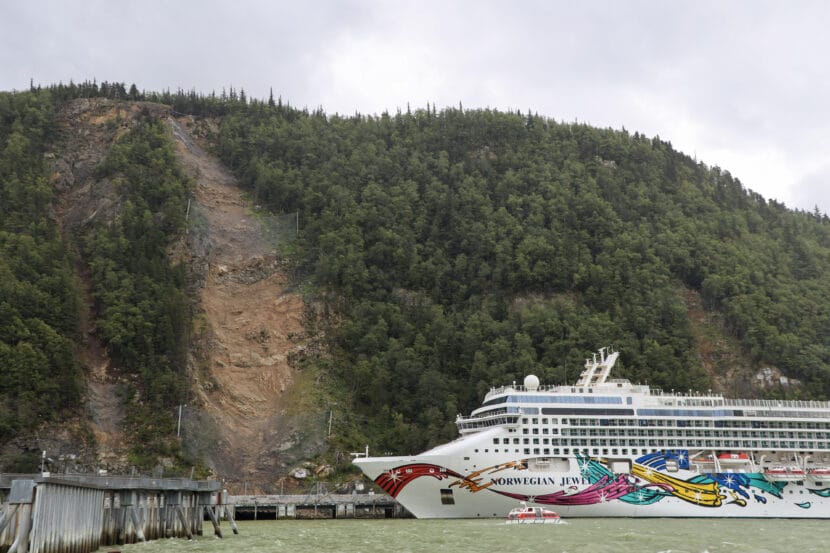
The Norwegian Jewel berths below the Railroad Dock in Skagway on Friday, Sept. 6, 2024. (Photo by Clarise Larson/KTOO)

A major rockslide has been threatening Skagway’s busiest cruise ship dock in recent years. Numerous industry experts were in town recently to present options for long-term mitigation. None of the choices were easy or cheap.

A rockslide above Railroad Dock in 2022 prompted a study by the geological firm Shannon & Wilson. That report stated the firm’s opinion that “the slide mass will eventually fail and the consequences of such failure will be catastrophic in nature with significant risks to life and property.”

Since then, the municipality has been doing routine scaling work, which is basically removing loose rock. Crews installed additional fencing and netting and instruments to measure ground movement. During tourist season, they send someone up the mountain each morning to take photographs. But, these are all admittedly short-term solutions.

“Nobody wants the big failure to happen and then not be ready for it,” said Kyle Brennan, project manager for Shannon & Wilson.

Brennan said the mountain needs long-term mitigation.

“We’re able to keep track of what’s happening up there. And right now, we have safe operation of the facility at the bottom,” he said. “But it’s time to move forward and take care of this larger hazard with these unstable rock masses at the top of the slope. Because predicting when that failure will eventually happen … is very difficult. And so right now, we have time. To be proactive about these things and take care of them is in the best interest of the community and everybody else.”

Shannon & Wilson presented four options. Option one concedes that the rock is too difficult to move and will therefore remain in place. The dock and everything below would be moved to a safer distance. Option two is excavating the unstable rock and sending it down the slope, where it is collected and hauled off-site. Option three leaves the rock mass in place and attempts to stabilize it. Brennan says this would be a “case study.” Option four would excavate the rock mass and move it up the slope, leaving it on the mountain.

The team wholeheartedly prefers option two.

“We’re looking at modifications to the dock,” Brennan said. “But for the most part, it’s just simply excavation and removal and letting gravity move the rock for part of it, and then picking it up and putting it somewhere else. This seems to be like our lowest risk option right now.”

The municipality was awarded a nearly $20 million grant for the project from the Federal Emergency Management Agency. But a majority of that money dissipated with President Donald Trump’s administration, leaving only the funds for the design portion of the project.

However, the municipality chooses to move forward, and however they manage to pay for the multi-million-dollar project, Brennan said it’s not going to be easy.

“It’s a tender site,” he said. “It’s going to take a lot of TLC to get that rock down. And so we want to make sure we’re doing it in a purposeful manner that’s safe, that’ll achieve the goal without catastrophe. The last thing I want to do is stand up here in front of you guys in a couple years and try to explain why everything went sideways…”

Skagway resident Lynne Davison was one of many intently listening to the presentation.

“And so I hear you talking about these alternatives and when the decision is made,” she said. “But how and who? How is that decision going to be made?”

“The decision, the ultimate decision is not one that Shannon & Wilson and our design team will make independently of anybody else,” Brennan answered. “The city will be involved with that decision. And ultimately will likely be the ones to make that decision based on our input and based on all of your input.”

Brennan said there will be at least two more public meetings before the construction phase. If funding is procured, that could start in 2026 and would take place between tourist seasons.

Project options can be found at Skagway.org.
Last year’s Alaska tourism season was a record year — but just barely

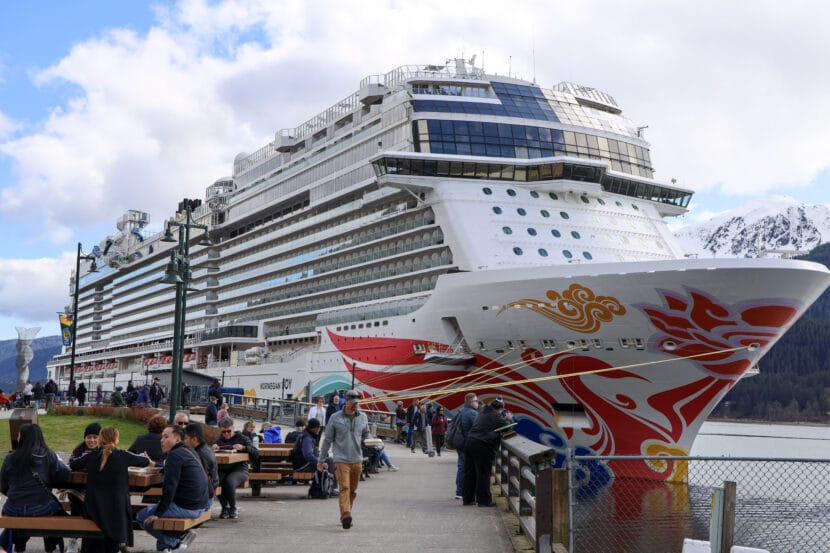
The Norwegian Joy docks in downtown Juneau on Saturday, April 26, 2025. (Photo by Clarise Larson/KTOO)

Over 3 million people visited Alaska during the tourism season that ended in April 2025 marking a new record for the state, according to data released at the Alaska Travel Industry Association’s annual convention in Anchorage Tuesday.

The Alaska Visitor Volume report includes data over the 12-month period starting in May 2024. It shows 33,000 more visitors came to Alaska compared to the previous travel season, an increase of 1.1%.

The association’s president and CEO, Jillian Simpson, said the increase was driven by the cruise sector, and that a few smaller communities saw big increases in visitation.

“There are some ports of call outside of Seward and Whittier that actually saw really big jumps in cruise visitation, and that is Kodiak, Alaska. But they were outdone by, can you guess who? Unalaska,” Simpson said.

Data in the report was gathered by McKinley Research Group. It found 88% of travelers that came to Alaska did so in the summer. Over half of visitors arrived on a cruise ship, followed by airline travel.

Juneau’s port had the highest number of passengers at 1.7 million – almost 4% higher than the previous year, according to the report. The majority of people who flew to the state came into Anchorage.

Winter travel to Alaska has been increasing over the long-term, but it dipped 5.5% last year, according to the report. Simpson said it’s the first decline since the association started tracking winter visitors in 2006. Fewer than 400,000 people came to the state during the winter months – a decline of 21,700 winter travelers from the previous season.

It’ll be months before tourism data for summer 2025 is available, but Simpson said early indicators show a slight decrease in cruise visitors and airline travel.

“On the cruise sector side, we did see essentially flat this year, which is what we were predicting with capacity,” she said. “It was ever so slightly down.”

The tourism sector supported 48,000 jobs in Alaska last year, according to the presentation.

Correction: This story previously has an incorrect byline. 

In Haines and Skagway, the feared Canadian boycott never quite materialized

A group of people standing outdoors holding signs supporting Canada and disapproving of tariffs.
Haines residents carry signs showing support for Canada during a rally and march through downtown in April. (Avery Ellfeldt/KHNS)

Escalating tensions between the U.S. and Canada last winter fueled fears that Canadians would respond by canceling cross-border visits to Alaska this summer, potentially hitting local economies.

New data shows fewer people did cross the Canadian border near Haines and Skagway this year compared to last year. Still, a full-scale boycott never seemed to materialize – at least in the upper Lynn Canal.

Skagway tourism director Jaime Bricker said she was concerned that Skagway would see fewer Yukoners specifically this season. In some cases, she did hear about people canceling trips to southeast Alaska’s northernmost town. But overall, her worries didn’t come to fruition.

“The majority of people that I’ve talked to have made a special exception to visit Skagway,” she said. “The south Klondike Highway feels like family — it doesn’t feel like one country versus another.”

That comes in sharp contrast to what happened across the country amid intensifying frustration in Canada over President Donald Trump’s trade war and his claims that the country should become the 51st state.

Nationwide border crossings from Canada into the U.S. between May and August of this year dropped by about 24% when compared to last year, according to U.S. Customs and Border Control data published last month by the federal Department of Transportation.

But in Skagway, not much changed at all, the data shows. The nearby port of entry sits just north of town. Between May and August this year, more than 68,000 passengers entered the U.S. there in personal vehicles. That marks about a 4% decrease from the same time period last year.

Bricker noted that she receives border data directly from customs agents stationed in Skagway. According to those figures, border crossings are actually up this year compared to last, not slightly down, as the data published by DOT showed. The reason behind the discrepancy is unclear.

Haines

The situation played out differently in Haines. The Dalton Cache Port of entry is about 40 miles outside town. And CBP data suggests 3,700 fewer people entered the U.S. there between May and August of this year. That represents a nearly 16% decrease.

Haines Borough Tourism Director Reba Hylton said she observed the dip, including at the local visitor center.

“We were definitely negatively impacted,” she said. “And we saw a lot less, not only Canadian travelers, but international travelers in general.”

The local economic impact is less clear. Alaska Sport Shop employee Gabe Long, for instance, said the fishing and outdoor gear store saw plenty of Canadians who have been coming to Haines for years – if not generations. But typically, they also serve a lot of younger Canadians visiting for the first time. That demographic, he said, didn’t seem to arrive in full force.

“We had about eight Saturdays where we had significantly less people than I’ve had last year,” Long said.

But it’s hard to say if that hurt sales, Long added. That’s due in part to the fact that two of the shop’s main competitors were closed this summer.

Haines Brewing owner Paul Wheeler, meanwhile, did notice a drop in business. One month over the summer, he said, sales were down about 20%. He said he observed fewer Canadians than normal, but also fewer Germans. He thinks that’s because German airline Condor canceled their direct flights to Whitehorse.

Other business owners said they really didn’t notice a shift at all. Ramie Carlson Clayton owns Ampersand, a local art gallery and said the season was business as usual. Rhonda Hinson, owner of local store Alaska Rods, echoed that point.

“The Canadian traffic this summer, I’d say, was pretty steady,” Hinson said. “I had folks in pretty much every weekend, and a lot of times throughout the week.”

Juneau’s 2025 cruise ship season comes to a close

The Norwegian Encore berths in downtown Juneau on Tuesday, Oct. 14, 2025. (Photo by Clarise Larson/KTOO)

The Norwegian Encore departs Juneau Tuesday night. It’s the last cruise ship of 2025, and it marks the end of a nearly 200-day tourism season. 

This year’s cruise season kicked off amid a lot of uncertainty. It began as the Trump Administration’s tariffs shook the global economy and dozens of residents in Juneau lost their jobs in waves of federal firings, leaving the Mendenhall Glacier Visitor Center with reduced staffing. 

The glacier is Juneau’s most popular tourist attraction, drawing more than 1 million people last year. The layoffs left the center barebones. But, Juneau’s Tourism Director Alix Pierce said other organizations stepped up to help U.S. Forest Service staff keep visitors safe this summer. 

“The situation at the glacier out there was really a testament to community collaboration and also how important that asset is to our community and visitor industry,” she said. 

The final tally of passengers who stepped off cruise ships into Juneau this year hasn’t been released yet, but Pierce said it’s expected to be between 1.6 and 1.7 million. Next year will be about the same, she said, but new measures are going into place to curb future growth. 

The 2026 season will be the first time that the city’s negotiated daily cap on passengers is in place. That will limit cruise ship visitors to 16,000 people on most days and 12,000 people on Saturdays. Right now, Juneau sees up to 21,000 visitors on the busiest days. Cruise ship companies also agreed to shorten Juneau’s season to exclude most of April and October. 

Pierce said the conversation on how to best manage cruise tourism in Juneau is far from over. 

“I think not having to brace for year-over-year growth and kind of understanding what the season is going to look like as we go into it has been helpful,” she said. 

Votes are still being counted for this year’s municipal election, which included a ballot question to create a seasonal sales tax starting next year. In preliminary results, voters appear to be rejecting the proposed increase during the summer months. 

The first ship of the 2026 season is slated to arrive on April 27 and the last is scheduled on Oct. 6.

Alaskans say cleaner fuels could solve cruise ship scrubber pollution

Holland America’s Noordam cruise ship in Juneau on Wednesday, July 9, 2025. It operates an open-loop exhaust scrubber and was found to violate federal water quality standards on 30 days in 2024, according to an EPA data analysis by SEACC. (Photo by Clarise Larson/KTOO)

Listen to this story:

Some Alaskans are fired up about water pollution from heavy fuel oil burned on large cruise ships. At a panel discussion in Juneau on Wednesday, members of tribes and conservation organizations said there’s a solution: using cleaner fuel.

Heavy fuel oil is the stuff from the bottom of the barrel — the waste product at the end of the oil refining process. It’s cheaper than distillate fuels and is used widely by most of the large cruise ships that travel along Alaska’s coastline every year. 

When it’s burned, heavy fuel oil exhaust releases sulfur oxide into the air, which can cause heart and lung disease and lead to acid rain. In 2020, the International Maritime Organization, or IMO, required ships that burn heavy fuel oil to use scrubbers, which filter the exhaust through seawater. 

Aaron Brakel is a clean water campaigner at the Southeast Alaska Conservation Council, which organized the panel. He said scrubbers didn’t solve the pollution problem — they just moved it into the ocean. 

“They spray the water, transferring pollutants from the air into the water from the exhaust,” he said. “Most of the scrubbers worldwide, most of the ones here in Alaska, are open-loop systems.”

That means they pump seawater infused with toxic exhaust back into the ocean instead of storing it and disposing of it at an onshore facility.

Nearly 80% of the cruise trips made in Alaska last year burned heavy fuel oil through open-loop or hybrid systems. Hybrid scrubbers can switch between dumping the effluent or storing it, depending on discharge regulations in the waters the ship is passing through.

Brakel probed into U.S. Environmental Protection Agency records and found that between 2023 and 2024, 17 ships using open-loop scrubber systems reported more than 700 water quality violations off the coast of Alaska, as Alaska Public Media reported last month. But the data doesn’t show exactly where the violations happened.

Kay Brown is the Arctic policy director at Pacific Environment, an advocacy nonprofit. Last year, she and her colleagues published a literature review of studies around the world on the negative effects of scrubbers.

“The big takeaway here is that scrubber pollution is toxic to marine life at very low concentrations,” Brown said. 

One study found scrubber wastewater at a concentration of 5% killed tiny crustaceans called copepods within one day, and called the wastewater a “witch’s cauldron” of toxic compounds. Another study found that exposure to scrubber discharge affected the reproduction success of some mussel and sea urchin species at even lower concentrations.

Several Southeast tribes have passed resolutions calling for cleaner fuel, including the Yakutat Tlingit Tribe, the Organized Village of Kake, the Organized Village of Kasaan and the Ketchikan Indian Community.

Ilsxilee Stáng Gloria Burns is president of the Ketchikan Indian Community. She said she wants cruise lines to take initiative.

“This practice of fuel dumping makes the cruise ships an extractive industry,” she said.  

Burns said the onus is on the cruise industry to build a relationship of reciprocity instead. 

Linda Behnken is the executive director of the Alaska Longline Fishermen’s Association and board president of Alaska’s Sustainable Fisheries Trust. She’s fished commercially for 40 years and says the statewide seafood marketing strategy is built on telling the story of Alaska’s healthy, pristine waters.

“To have this information, to me, where we know sort of that dirty secret, I feel like we’re being disingenuous by continuing to build our reputation on this,” she said. 

Behnken said Alaskans have a responsibility to protect the water from pollution. 

Cruise ships that burn heavy fuel oil are equipped to switch between fuel types.

Some regulations have already taken effect in U.S. waters. Last year, the IMO banned heavy fuel oil in Arctic waters, with some fuel tank exceptions. Scrubber discharge is restricted in Hawaii’s waters and banned within the Port of Seattle. California has long required ships to burn cleaner fuels upon entering its waters. 

Sen. Jesse Kiehl, D-Juneau, attended the panel. He said he’s concerned about water pollution from scrubbers, but hasn’t decided on a policy path yet.

He said he’s been meeting with a lot of people about it, including cruise companies. 

“We had some serious conversations and they presented some research, some of which I bought and some which I didn’t,” Kiehl said.

Cruise Lines International Association Alaska represents the cruise industry.

“There is no scientific basis to support a ban on [scrubbers],” CLIAA spokesperson Lanie Downs wrote in an email, adding that they “remain an important compliance option as the maritime sector continues to reduce air emissions.”

Alix Pierce, Juneau’s visitor industry director, said in an interview that there’s a long-standing voluntary commitment from the cruise lines to switch to marine gas oil when they’re in Gastineau Channel, while in Juneau’s cruise port and upon departure. 

“All we can do is make agreements and ask that they be followed, and even if we did have legislation, I don’t know what our compliance program would look like,” Pierce said. 

She said the city has no reason to believe ships aren’t honoring the commitment. But in 2019, Gov. Mike Dunleavy axed state funding for the Ocean Rangers program that had observers aboard cruise ships, so there is no longer oversight on oil slicks. The state’s wastewater permits and ship inspectors only address sewage and grey water, not scrubber wastewater dumping. 

Pierce said the city is working to help find alternative shipping fuels through a partnership between ports and cruise lines called the Pacific Northwest to Alaska green corridor project

“We’re excited to see how we can kind of continue to try to drive change in the alternative fuel space, because that’s really the future,” she said. 

She said the group will publish a report in the next few months looking at the feasibility of transitioning cruise ships to another fuel type called green methanol, which can be produced from municipal or agricultural waste. The IMO suggests it could cut carbon and sulfur oxide emissions. Pierce said the effort could move the needle beyond the scrubber problem and meet IMO’s goal to make shipping a net-zero emissions industry by 2050.

Juneau’s last cruise ship of the 2025 season will depart next Tuesday.

Correction: The panel discussion was on Wednesday. 

Haines, Skagway and Juneau to vote on seasonal sales tax proposals

Olerud's Market in Haines, pictured above in 2022.
Olerud’s Market in Haines, pictured above in 2022. (Corinne Smith/KHNS)

Haines might soon join communities across Southeast Alaska that have tweaked their tax policies to shift the local tax burden off year-round residents and onto tourists.

Voters this week will consider a ballot measure that would increase sales tax during the summer, when visitors flock to town, and reduce the rate in winter. Sweetening the deal is a provision that would exempt groceries from sales tax entirely during the winter months.

“Over the course of a year the visitors and seasonal residents will pay more and year-round residents (depending on who they are and what they buy when) should pay less or the same as they do now,” Haines Borough Finance Director Jila Stuart said in an email on Thursday.

Local sales tax in Haines is currently set at 5.5%. If the measure passes, it would boost the rate to 7% between April and the end of September. The rate would fall to 4.5% for the rest of the year – excluding groceries, which would not be subject to sales tax at all in winter.

The goal is to raise funds for two key purposes: school funding and road improvements.

“I think it’s an agreeable enough deal, in so much as folks will get 5.5% off groceries all winter long, and they’ll get 1% off everything else,” Haines Mayor Tom Morphet said in an interview this week.

Morphet has been a major proponent of the provision, which is modeled after versions adopted in communities across Southeast. Among them are Craig, Pelican, Seldovia, Ketchikan, Sitka and Skagway – Haines’ closest neighbor.

Each seasonal sales tax looks slightly different. But the goal generally speaking is to take advantage of the busy summer season to generate local tax revenue.

Consumers in Skagway for instance, currently pay a 5% sales tax in the summer and 3% in the winter. But that could soon change. On the Skagway ballot this year is a measure that would boost summer sales tax by another 2%. In exchange, the borough would waive local utility fees.

Juneau voters, for their part, will soon weigh in on their own seasonal sales tax proposal, which would bump sales tax from 5% to 7.5% in the summer and drop it to 3% during winter.

Morphet has done a handful of public presentations about the tax. He said he has heard some concerns, including extra administrative costs for businesses, and that the tax could discourage people from shopping in Haines.

All told, the tax is expected to generate about $280 thousand dollars – which amounts to a 6% boost to local sales tax revenue, according to the borough.

Morphet acknowledged that 6% is an “incremental” figure. But he emphasized it’s still a crucial sum given that the borough is grappling with a $1 million budget deficit that he says has to be made up somewhere.

The deficit is due in part to federal funding cuts and a senior tax exemption passed by voters last year. But it also resulted from the borough needing to kick in more than half a million dollars more for the school this year compared to last, to make up for insufficient state funding.

That’s a challenge facing communities across Alaska.

“Communities are responding by adopting a seasonal sales tax,” Morphet said. “In Craig, the seasonal sales tax goes entirely to the school. And you know, until we have a new governor, our hands are going to be tied.”

If passed, the Haines borough expects that year-round residents would spend roughly the same amount in sales tax that they currently do.

Someone who spends $30,000 per year on taxable goods and services – $7,000 of which is groceries – would spend about $80 less on tax under the new structure, according to a borough fact sheet.

That could look different depending on the person. The math might not pencil out as well for someone who spends a lot on gasoline in the summer, for instance, as opposed to groceries.

Site notifications
Update notification options
Subscribe to notifications