Tourism

Alaska-themed float will participate in Macy’s Thanksgiving Day Parade

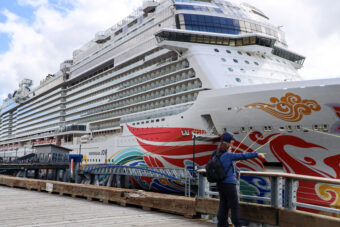
Officials with the cruise line Holland America announce an Alaska-themed float at the Macy’s Thanksgiving Day Parade in Juneau on Sep. 30, 2025.
Officials with the cruise line Holland America announce an Alaska-themed float at the Macy’s Thanksgiving Day Parade in Juneau on Sep. 30, 2025. (James Brooks/Alaska Beacon)

The cruise line Holland America will have a large Alaska-themed float in the annual Macy’s Thanksgiving Day Parade, the company announced Monday during a ceremony in Juneau.

Alaskans have occasionally participated in the parade in New York City, which is celebrating its 99th anniversary this year, but the company believes this will be the first time that the state will be represented by a float in the event.

The announcement came on one of the last days of Holland America’s summer cruise ship operations in Alaska’s capital city. Juneau will continue receiving occasional large cruise ships through October.

“The float will be named simply ‘The Land of Glaciers, Wildlife and Wonder,'” said Leanne Jones with Holland America official during a ceremony announcing the float and a $5,000 donation to Trail Mix, a local trail-building nonprofit in Juneau.

“This marks the first time Alaska will be featured in the iconic holiday event, and the first time Holland America Line has ever participated in this parade,” Jones said. The parade is scheduled to start at 4:30 a.m. Alaska time on Thursday, Nov. 27.

A mock-up of the proposed Alaska-themed float in the Macy’s Thanksgiving Day parade, sponsored by Holland America, is displayed in Juneau on Sep. 30,2025/ (James Brooks/Alaska Beacon)

A rendering displayed Monday shows a howling wolf, black bear and a moose at the back of the float. The main platform is a glacier and river with leaping salmon.

“Well, that’s a pretty exciting announcement,” said Juneau Mayor Beth Weldon. “And you know, after Macy’s parade, we do have a Fourth of July parade in Juneau.”

Goldbelt reveals details of proposed $500M cruise port on Douglas Island

Goldbelt Incorporated’s President and CEO, McHugh Pierre, presents to the Juneau Assembly about a proposed cruise ship port on Douglas Island on Monday, Sept. 29, 2025. (Photo by Clarise Larson/KTOO)

Goldbelt Incorporated is finally sharing more about its proposed $500 million cruise ship port on the backside of Douglas Island.

Its president and CEO, McHugh Pierre, presented the plan to the Juneau Assembly for the first time at a committee meeting Monday night. 

“We have some really big, bold ideas,” he said. 

Last fall, the local Alaska Native corporation announced plans to develop the new port in partnership with Royal Caribbean Group. At the time of the announcement, city officials said they felt blindsided by the news. 

But on Monday, Pierre and Goldbelt’s board chair presented to the Juneau Assembly in front of a packed audience to explain exactly what’s in store for the development called Goldbelt Aaní. 

Pierre said the goal of the semi-private cruise destination is to uplift Lingít culture and support Juneau’s economy moving into the future.

“We believe it’s our mission to invest in the community, grow opportunities, build certainty and provide that foundation for families to grow and have confidence to remain in Juneau,” he said. 

Goldbelt owns roughly 1,800 acres of land along the northwest coastline of Douglas between False Outer Point and Point Hilda. The port will be located on about 250 acres just beyond where the road ends on North Douglas.

The plan is to develop the port in phases, starting out with basic dock and welcome center infrastructure before moving into broader ambitions like developing a child care center, employee housing and a replica Lingít village.

This is a conceptual design of the Goldbelt Aaní port proposed by Goldbelt Incorporated on Douglas Island. (Courtesy of Port of Tomorrow)

Once developed, the land would be subject to property taxes. Pierre estimates the project will cost $500 million. Goldbelt says it would catapult the corporation to become the city’s #1 property taxpayer. 

“We’re excited to contribute to the community, to have a strong community, and to put our money where our mouth is,” he said. 

Assembly members had a lot of questions. Wade Bryson questioned the Douglas Highway’s ability to handle the traffic the port would bring.

“That’s the thought that is on many of our minds, ‘How do we deal with North Douglas Highway and trying to accommodate this development?’” he said. 

Mayor Beth Weldon asked how the corporation intends to curb concerns that the new port would overwhelm the community with cruise tourism. Pierre said Goldbelt believes the new port will actually help alleviate visitor traffic and congestion by containing visitors at the port. 

Pierre didn’t commit to a firm timeline for when the port will open. That’s because of all of the hurdles the corporation still needs to jump over to get permitting approvals with the city and other governmental agencies. The project’s website states 2028 as its grand opening. 

The project is adjacent to a lot of city land. City leaders say they want to thoroughly plan for the North Douglas area before Goldbelt starts development. Pierre pushed back at that. 

“Goldbelt would be happy to work with the city concurrently, but Goldbelt would not be happy to be sidelined and stopped altogether from development because the city wants to do something on its land or plan something around its land,” he said. 

The project will need approvals from both the city planning commission and the Juneau Assembly to move forward. Goldbelt has yet to apply for any city permits.

Pierre said the corporation intends to provide updates to the community as the project moves forward.

What do residents and tourists think of Juneau’s proposed seasonal sales tax this election?

Cruise ship visitors walk past the Alaska Shirt Company in downtown Juneau on Thursday, Sept. 18, 2025. (Photo by Clarise Larson/KTOO)

Voters will decide this fall whether to adopt a seasonal sales tax to make the most of the more than a million cruise ship passengers who visit Juneau each summer.

Some residents are wary of the idea.

It was a rainy September day on Thursday, but the wet sidewalks and streets were still lined with cruise ship passengers donning thin plastic ponchos and holding shopping bags.  

Mickey Hall and her friends, Russ and Pat Genzmer, stood outside the Alaska Shirt Company in downtown Juneau. They were all holding the store’s iconic, bright red shopping bags. 

“I got a sweatshirt, and my grandson got socks,” Hall said, laughing. 

They were in Juneau for the day, visiting off the Nieuw Amsterdam cruise ship. Without looking at their receipts, they couldn’t say how much they paid in local sales taxes on the souvenirs they just bought. 

“What is the sales rate?” Hall asked.

“I thought it was free,” Genzmer said, laughing. “I thought they had no sales tax in Alaska.”

That’s half true. While Alaska has no statewide general sales taxes, many municipalities have their own local taxes. In Juneau, that’s 5% on goods sold year-round. But that could soon change. 

Juneau voters will decide this October whether the city should implement a new seasonal sales tax system. The city would bump its tax rate up in the summer when tourists are in town to 7.5%, then lower it to 3% in the winter to give locals a break.

The change would apply to most residents, with a few exemptions. Advocates for the system say it’s meant to take advantage of the summer tourists while also giving some winter relief to year-round residents. Juneau Assembly member Neil Steininger supports the idea. He’s an economist and previously served as director of the Office of Management and Budget for the state.

“We have a lot of out-of-town visitors, and we have a lot of economic activity from non-residents in the summer, and so it allows us to shift some of that tax burden away from residents, making it even more affordable for individual residents in Juneau,” he said. 

While cruise ship passengers Hall and the Genzmers say they won’t lose sleep over the tax increase, not everyone is on board. 

Juneau resident Wayne Coogan is co-owner and general manager of Coogan Construction. He said he’s worried that implementing a seasonal tax structure in Juneau will disproportionately affect construction spending. 

“Everyone knows that the construction industry, to a great degree, goes to sleep in the wintertime,” he said. “They bed down and wait for the weather to come back for what’s called the construction season. And so the heavy spending occurs in the summertime.”

While Juneau’s city government does offer some sales tax exemptions for construction materials, it doesn’t cover everything. Coogan said the seasonal change will make buying goods in the summer more expensive, which will eventually trickle down to consumers.

But other locals, like Joel Ferrer, said he sees the logic behind the system. He lives in Juneau year-round and owns a tourist shop downtown. He says he is willing to try it.

“The bottom line is, like, there’s no perfect system. There’s always going to be a glitch, or some people will be affected in a positive way. Some will be a negative way,” he said. “No one’s going to be totally happy with whichever.”

Other Southeast Alaska tourism towns like Ketchikan, Sitka, Craig, Pelican and Skagway have already adopted seasonal tax structures. All of them see a significant amount of summer tourism. 

Ketchikan implemented a seasonal sales tax structure within city limits in 2023. The borough has a population of about 14,000 year-round residents, but it sees more than a million tourists each year. 

Ketchikan Mayor Bob Sivertsen said the tax structure just makes sense.  

“The reality of it is, the community sees our resources being used, our streets being crowded,” he said. “I think they see this as a positive way for the community to utilize the economy that we have, which is the seasonal economy, in the best interest of the community.”

The additional revenue the city takes in from the new system goes into its general fund and has paid for things like wage increases for city workers. Sivertsen said he hasn’t heard much backlash from the community about the system. 

“We all understand that we have to pay for the services we get, but if we can get the visitors to pay for a larger portion of that in a short period of time, it makes sense,” he said. 

Janice Walker runs Madison Lumber and Hardware in Ketchikan. She said while the new system hasn’t dramatically changed her business, it does cause some headaches. 

“It’s just something every six months we have to do, and then they also have a sales tax-free day down here, so you got to do it for that day,” she said. “Anyways, for the retailer, it makes it a little more difficult.”

She said she supports the change as long as the revenue that the city takes in goes toward services that benefit year-round residents. 

In Juneau, the sales tax boost in the summer is intended to offset another ballot question that would exempt essential food and residential utilities from local sales tax.

The cruise ship passengers on Franklin Street, Hall and the Genzmers, say go for it. 

“Good for you guys,” Hall said. “People live here — they deserve a break.”

But it’s not up to them. Juneau voters will decide.

The last day to vote in Juneau’s by-mail election is Oct. 7. Ballots will be mailed to registered voters on Friday. Completed ballots can be returned by mail, in city drop boxes starting Friday, or to city vote centers starting Monday. 

More information about when and how to vote can be found at juneau.org/elections

Find the latest local election coverage at ktoo.org/elections.

These Alaska cruise ships are racking up hundreds of water quality violations every year

Smoke can be seen rising from the stack of a large cruise ship
A cruise ship docks in Skagway during the 2025 summer season. Federal data shows the ship, which is named the Koningsdam, is among more than a dozen that have reported violations of scrubber discharge limits in recent years. (Avery Ellfeldt/KHNS)

Cruise ships are subject to federal rules that limit how much they can pollute the water with toxic chemicals that originate from their exhaust. Think: heavy metals and leftover fuel oil.

But federal data shows that a subset of ships violate those standards in Alaska hundreds of times a year. And regulators don’t appear to be doing much about it.

That’s the key takeaway from data released in August by the Southeast Alaska Conservation Council, a Juneau based group.

Every year, cruise ships provide annual reports to the U.S. Environmental Protection Agency that disclose how many times they’ve discharged water that does not meet federal safety standards.

Aaron Brakel, a clean water campaigner at the organization, dug through reports from 46 operators in 2023 and 2024. All told, he found that 17 ships reported more than 700 violation days in Alaska in the two-year time frame.

Those violations came exclusively from vessels that use open-loop scrubber systems. Those systems suck in sea water to “scrub” toxic chemicals, including sulfur, from engine exhaust – and then dump it back in the ocean. That’s different from closed-loop scrubbers, which dispose of the discharge onshore.

“It’s troubling that even with these very weak permit standards, and very weak self-reporting requirements, that the ships with open-loop scrubbers are still reporting hundreds of violations of the limits every year,” Brakel said.

Open loop systems help cruise ships comply with international air pollution requirements that took effect in 2020. They do so by allowing ships to emit less air pollution while still burning cheap, heavy fuel.

That in turn has created a relatively new source of ocean pollution in Alaska that critics say has major implications for marine ecosystems.

“That can have a tremendous number of impacts on organisms in the marine environment,” Brakel said.

One study, published in 2021, found that exposure to gas scrubber discharge led to “severe toxic effects” for a tiny crustacean, known as a Pelagic Copepod, near the bottom of the ocean food web.

Gene McCabe heads the water division at the Alaska Department of Environmental Conservation, which doesn’t regulate this type of discharge. He said federal standards for each pollutant were set using statistical data that suggests discharges that meet those standards shouldn’t harm people or marine life.

“Whenever we go beyond those water quality standards, we’re in a murkier area,” McCabe said. “We’re in a murky area because we can’t really say for certain that it is safe or that there will be damage or that there will be impacts.”

An EPA permit sets limits for pollutants including acidity, concentration of heavy metals and leftover fuel oil. But Brakel says violations of those standards have rarely led to federal enforcement.

“It’s a story of an orphaned permit, where these scrubber discharge requirements have never been enforced,” Brakel said.

In an emailed statement, the EPA declined to comment on enforcement matters. But the agency did note that it has taken enforcement actions against Carnival Corporation, including in 2017. That was after the company installed open-loop scrubbers on its ships starting in 2014.

By 2016, all but one of its Alaska vessels had violated federal acidity standards, according to state documents.

The company eventually paid a $14,500 fine and agreed to work toward addressing the issue, including by closely monitoring scrubber discharge pH and improving its scrubber systems.

But EPA also responded by loosening the existing standard while the company worked to remedy the problem – a policy Brakel said is still in place today.

McCabe, with the state, said he can’t speak to the federal enforcement strategy. But he emphasized that his department is still paying close attention.

“It is probably driving the reason why we are keeping an eye on scrubbers ourselves. Even though it’s not our permit, it’s still our water,” McCabe said. “And we want to at least have data where we can get it.”

Brakel, the conservationist, also took issue with the violation reports themselves. They don’t include when or where the violations took place. As he sees it, that keeps cruise towns from using the information to hold the industry accountable.

“If people can’t tell that this is happening, they have no way to respond to the industry to say,’ “Hey, what are you doing? Hey, these are our waters. Hey, this is our food,'” Brakel said.

The industry group Cruise Lines International Association did not respond to a request for comment.

Goldbelt shares more about proposed cruise dock project on North Douglas

This is a conceptual design of the Goldbelt Aaní port proposed by Goldbelt Incorporated on Douglas Island. (Courtesy of Port of Tomorrow)

Goldbelt Incorporated has unveiled more information about its proposed cruise ship port on the backside of Douglas Island, but city officials say they are still largely in the dark. 

Earlier this summer, the local Alaska Native corporation released a new website for the project that includes a timeline for the port’s opening, details about tourist attractions on the site, and conceptual drawings. The project is named Goldbelt Aaní.

Goldbelt originally announced plans to develop the new port last fall, in partnership with Royal Caribbean Group. At the time of the announcement, city officials said they felt blindsided by the news. And now, more than nine months later, Juneau’s Visitor Industry Director Alix Pierce said she still doesn’t know much about the project. 

“We haven’t received any sort of permit applications, we haven’t had any formal dialogue about their plans,” she said. 

Goldbelt President and CEO McHugh Pierre said the corporation plans to submit a conditional use permit application to the city, but declined to comment further.

Goldbelt is the beneficiary of the Alaska Native Claims Settlement Act and owns land along the northwest coastline of Douglas between False Outer Point and Point Hilda. The port will be located on about 250 acres just beyond where the road ends on North Douglas.

This is a conceptual design of the Goldbelt Aaní port proposed by Goldbelt Incorporated on Douglas Island. (Courtesy of Port of Tomorrow)

On its website, Goldbelt describes the port as an “immersive Tlingit-themed and inspired modern cruise destination.” It’s designed to replicate a Lingít village from the 1800s. The corporation says it plans to offer other tourist attractions like floatplane and whale watching docks, and wants to develop on-site employee housing and a child care center. 

The corporation says the new port will help reduce downtown visitor traffic and congestion, and will uplift Alaska Native culture in Juneau. 

The company has begun the groundwork for permitting the dock and amenities with the state and the U.S. Army Corps of Engineers. 

The project will need approvals from both the city’s planning commission and the Juneau Assembly to move forward. Pierce said it’s hard to say how long that process will take. According to the website, Goldbelt expects to welcome its first cruise ship during the 2028 tourism season. 

“There are a lot of considerations to developing in that area, but without seeing a formal application from them, it’s very difficult to speak to the process,” she said. 

Goldbelt’s plan coincides with another dock development by Huna Totem Corp., an Alaska Native village corporation based in Hoonah. The Assembly approved the corporation’s plan to build a new cruise ship dock in downtown Juneau earlier this year.

Rockslides have battered Skagway’s biggest cruise ship dock. What else is at risk?

A large cruise ship in the foreground, with a steep hillside gashed with bare rockslide paths right behind it.
A cruise ship docks below an active rockslide site in Skagway, pictured above in May, 2025. (Avery Ellfeldt/KHNS)

In Skagway, at the height of summer, hundreds of tourists wait in line – some patiently, some less so – to return to their cruise ships. But they can’t get there on foot. Instead, they wait for shuttles or small, orange boats.

Jeff Jarvie, of Riverside, California, experienced the rigmarole this week.

“It’s disappointing, because it’s a ship with so many people,” he said. “The water taxi takes a whole, like, process.”

But that process is in place for good reason. Skagway’s largest cruise ship dock, known as the Railroad Dock, has been off-limits to pedestrians since the summer of 2022. That’s when multiple rock slides tumbled toward the dock from a ridge to the east.

No one was injured. But the slides damaged infrastructure and resulted in dock closures that took a major toll on the local economy. An assessment by an engineering firm later concluded the entire slide area would eventually collapse, which it said would be “catastrophic in nature.”

That fueled widespread concern in the community.

“We know that we have this one spot that’s active,” said Reuben Cash, the environmental program coordinator for the Skagway Traditional Council, a local tribe. “Where else? Where else can we expect to see these geohazards show up?”

Geologist Josh Roering points to the Skagway harbor from atop a ridge to the east of town. (Avery Ellfeldt/KHNS)

That question is the driving force behind an ongoing research project that aims to study rockslide risk along the rest of that ridge and elsewhere in Skagway. The initiative is part of a regional effort that aims to help seven tribal governments understand and respond to local geohazards.

In Skagway specifically, the issue is rooted in the fact that the area for thousands of years was under miles of ice. Those glaciers retreated long ago. When that happened, they exposed the now slide-prone ridgeline.

“There’s no longer that support,” said Cash. “These valley faces, these slope faces, are beginning to topple because they don’t have anything holding them up.”

A landscape of wiggly rocks and leaning columns

That toppling effect is what brought Josh Roering, a University of Oregon geologist, to Southeast earlier this summer. He’s been visiting the area for research since 2022.

While out on a day-long hike along the town’s most prominent ridgeline in June, he said the project has a few main components.

First, mapping when and where rockfalls have happened before, modeling where they could happen later, and simulating where rocks would end up if they did fall. That work included analyzing hundreds of rockfall events in Skagway between 2005 and 2022.

“We identify that there are parts of this valley that are much more susceptible to rockfall runout than others,” Roering said.

That means some slopes are both rockslide-prone and oriented in a way that could put people and infrastructure in harm’s way.

Roering and Luka Silva, of the Sitka Sound Science Center, collect data during a field visit to Skagway in June. (Avery Ellfeldt/KHNS)

Another key component is gauging the ridge’s stability – and the extent to which rocks along it respond to everything from wind, frost and rain to trucks, trains and cruise ships. The researchers did that by placing 38 seismometers, which measure movement, in the area for about a month, two years ago. They’re now analyzing that data.

“The more wiggly these rocks are, the more sort of decoupled they are from the underlying mountain,” Roering said. “And so that is a relative measure of how potentially unstable they may be.”

Roering spent several days this summer going back to those sites and gathering more information. Along the way, he and another team member used photos and GPS data to pinpoint exactly where the sensors were placed. Then they mapped the geology around those sites and measured the angle of various rock faces.

During that hike in June, Roering stopped periodically to point out deep, vertical gashes in earth – some of which could fit a human. The ridgeline is covered in them.

Roering explained that the mountain – like others in Skagway – is largely made up of upstanding sheets of granite that are peeling apart, absent support from glaciers. That process speeds up when rocks, trees and other debris fall into the fractures, wedging them open. Then they start bending toward Skagway down below.

“Once you sort of got a big column of rock leaning this far over, it starts to become difficult for it not to flip over,” he said.

For Skagway, no “time bomb just waiting to happen”

The research has generated some good news so far. The ridge above town does not seem to be prone to a deep-seated landslide, like the one that killed two people in Haines in 2020.

“We know that we don’t have a time bomb just waiting to happen,” said Cash, of the Skagway Traditional Council.

Roering measures the angle of a rockface near a waterfall on the north end of Skagway’s popular trail system. (Avery Ellfeldt/KHNS)

That doesn’t mean there’s no risk at all. Right now, rockslide activity that could threaten life or property is concentrated in a handful of areas in the valley, including two main spots along the ridge that towers above the cruise ship dock.

But Roering said it’s clear the instability isn’t limited to those specific areas. It’s also present along the rest of the ridge and elsewhere in Skagway. As a result, he said, it’s likely the toppling effect will continue to ripple across the region far into the future.

A major remaining question is what actually triggers that instability and sparks rockslides. So far, Roering said, it’s not totally clear. But there seems to be more activity during spring, as temperatures warm.

“This was a surprising finding for us because it shows that the timing of thaw is way more important than rainfall for triggering these rockfalls,” Roering wrote in an email this week.

The ongoing research is set to wind down by 2027. It won’t remedy the gargantuan slide in the harbor that has already damaged infrastructure, threatened public safety, and inconvenienced visitors like Jarvie, the cruise ship passenger from California.

But the effort ideally will provide the community the information it needs to better understand the risks it faces – and to prepare accordingly.

“It’s not going to tell you exactly where rocks will fall,” said Cash. “But it tells us the higher risk areas where it’s more likely to happen.”

Correction: This story previously misspelled Luka Silva’s name in a photo caption.

Site notifications
Update notification options
Subscribe to notifications