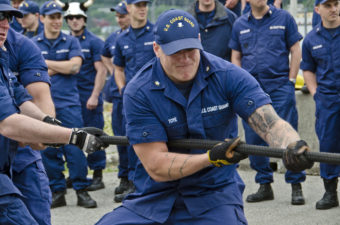
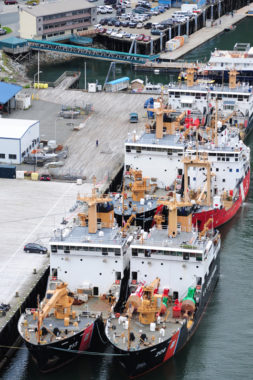
Lt. Gen. Rafael Daerbaev and Rear Adm. Thomas Ostebo have signed an agreement pledging cooperation in the Arctic, Bering Sea and North Pacific.U.S. Coast Guard Rear Adm. Thomas Ostebo and his Russian counterpart, Lt. Gen. Rafael Daerbaev, Wednesday signed an agreement calling for continued cooperation on law enforcement in the Arctic, Bering Sea and North Pacific.
Daerbaev is chief of the Northeast Border Guard of the Russian Federal Security Service. He and other Russian Coast Guardsmen have been in Juneau this week to review recent joint operations with the U.S. and develop a future plan.
Ostebo called this week’s work “a great representation of the cooperation” between the two Coast Guards.
“At the end of the day we all share the same ocean and the same maritime border that we wish to protect, preserve and ensure the safety of our mariners on,” Ostebo said.
The 17th Coast Guard and Northeast Border Guard coordinate international fisheries enforcement operations and responses to accidents at sea as well as law enforcement along the U.S. and Russian Maritime Boundary Line in the Bering Sea.
Daerbaev said Russia and the U.S. not only share the sea, but the Coast Guards are organized by the same work.
“And our work helps to expand cooperation between Russia and the USA,” Daerbaev said in Russian, with English translation.
He said the U.S. provided aircraft support for several Border Guard missions in the last six months. The two agencies also worked together on the Bangun Perkasa pirate ship, seized in international waters last September for illegal fishing.
The agencies are updating a joint operations manual and working on an agreement to combat Illegal, Unreported and Unregulated (IUU) fishing. Ostebo says the cooperative efforts between Russians and U.S. in the North Pacific, Bering Sea and the Arctic are like “a police officer with a radar gun.”
“The cooperation bet the Russians and the United States to have a presence on the maritime boundary line and to have a response presence there is well known in the fishing community, so I think that’s the real benefit,” Ostebo said. “It’s not to catch people in the act. It’s to prevent them from doing it in the first place, by them understanding that we are there.”
The two agencies meet twice a year to review their Joint Action Plan — in Alaska in the spring, and in Russia in the fall. Similar meetings have taken place since 1995.
Lieutenant Lance Leone is a U.S. Coast Guard aviator, and the sole survivor of a 2010 helicopter crash that killed three people from Air Station Sitka. He was facing charges of negligent homicide and destruction of government property.
According to Leone’s attorney, John Smith, Rear Adm. Thomas Ostebo decided not to send the charges on to court martial.
Smith says while it’s the end of the charges, it’s the beginning of a new chapter for Leone.
“Probably one of the most difficult things he’s going to have to do is to be able to do that thing that he loves to do again,” Smith said. “It’s been quite a while since he’s flown or piloted an aircraft, and I’m hoping that he is going to be able to go to retraining soon, pass that retraining, and look forward to a new assignment in the Coast Guard, flying and rescuing people in accordance with the Coast Guard mission.”
Smith said Ostebo’s decision, and the outcome of the charges against his client, serve as encouragement for the members of all military branches that the military’s system of justice works.
Smith says Leone is ecstatic about dismissal of the charges. He talked more about the case in this interview with KTOO on Tuesday afternoon.
The hearing into a Coast Guard pilot’s alleged negligence is over. The Article 32 proceeding essentially wrapped up Friday afternoon in Juneau after the last round of testimony by witnesses. Lt. Lance Leone is the only survivor of last year’s fatal Coast Guard helicopter crash off the coast of Washington State. In addition to the previous accusations of negligence and dereliction of duty, Leone is also being investigated for another dereliction count because he allegedly failed to adequately question the pilot of the flight. The aircraft, known as CG-6017, was a helicopter being transported to its new station in Sitka.
“When the natives had pulled him out, they said ‘Those stupid wires!'”
That’s how Ellen Leone describes the first words that her husband Lance heard when he was rescued by Quillayute tribemembers in a skiff in July of last year, moments after his H-60 helicopter ran into a set of the power lines and crashed. Leone said her husband didn’t know that they had struck the wires. His helicopter crashed and he didn’t know why.
Those wires to James Island were actually owned and operated by the Coast Guard to power nearby marine aids-to-navigation.
CG-6017 as the newer MH-60T model. As the pilot-in-command, Lt. Sean Krueger would sit on the right side of the cockpit and the co-pilot Lt. Lance Leone would sit on the left. Aviation Maintenence Technicians Adam Hoke and Brett Banks would sit in the mid-section of the aircraft. Photo copyright by Jeff Solberg.
Leone was the co-pilot while the pilot at the controls was Lieutenant Sean Krueger. He was killed in the crash along with Aviation Maintenance Technicians Adam Hoke and Brett Banks.
During the conclusion of Friday’s hearing, Master Chief William Johnson, commander of the Quillayute Boat Station near La Push before he retired, testified that he inquired higher up at least a year before the crash about the maintenance of the lines and poor condition of warning balls. He never got a response. Robert Van Haastert, a Federal Aviation Administration obstruction evaluation supervisor, said that he would’ve recommended better warning measures had he been called to evaluate the site. At least three other H-60 pilots that Leone served with in Sitka and Elizabeth City, North Carolina vouched to his skills and professionalism.
Attorneys in the case did not comment outside of the courtroom, but Leone’s civilian defense attorney John M. Smith said during the hearing’s closing arguments that the power lines were implicated in at least two other accidents. “The U.S. Coast Guard set a trap that was spring-loaded and that had already worked twice before,” said Smith.
Coast Guard Lieutenant Stanley Fields, Government counsel in the case, said Leone showed no reasonable duty of care as navigator and co-pilot of that flight.
Ellen Leone disputes that.
“I’m very proud of my husband and the career he has had in the Coast Guard,” said Leone.
“He’s done a great job doing his duty and, unfortunately, this was a tragic accident that occurred that nobody could’ve forseen.” Leone hopes that the U.S. Government will see their mistake after the hearing.
Pat Coyle believes Leone certainly would’ve called out the wires if he had seen them, especially if he thought his own life was in danger. Coyle also had a dim view of the evidence brought up by the Government.
“No matter what neglience, I don’t think the crime fits the punishment,” said Coyle, a commercial medical airlift pilot. While based in Sitka last year, he befriended a young Coast Guard aviator, a fellow rotorhead. At first, he didn’t know that he was the sole survivor of CG-6017.
“I just know that it’s got to jolt your confidence when something like that happens to you.”
So Coyle took up him for a spin in his Super Cub on floats.
“As a matter of fact, the next flight I let him sit in the front seat of the airplane,” said Coyle. “He did a pretty good job.”
There are two children in the Leone family, and Ellen says she’s due with another boy in April. She’s thankful for the support that they’ve received from around the country. It’s included Juneau-based Coast Guardsmen and women who took leave to attend the hearing, still dressed in winter dress or tropical blues, rank insignia and nameplates clearly visible. They declined to go on tape or have their names used, but they said they knew Leone or served with him at previous billets.
One person in particular was a civilian who had traveled all the way from Florida.
“I am here to support Lance and their family, and to let them know there are many, many people out there who support them,” said Kyla Krueger, mother of three children and wife of Lieutenant Sean Krueger, the pilot in command during that fateful flight.
“Somehow, good will come from this situation.”
Krueger also said this was a chance to hear everything first-hand, since the Coast Guard didn’t really tell her much about the crash.
“I am still just trying to process what I learned though the media prior to now, and what I’m learning as what they’re claiming to be fact and what they’re claiming to be opinion,” said Krueger.
Her husband used to wear his wedding band on a chain around his neck. She now wears it after adding her own band and engagement ring – her hand going up to touch it when she talks about Sean; how they met while he was at the Academy or about how he was picked for a pilot exchange with the Royal Navy.
There has been much speculation — but no real definitive explanation offered — that one reason that Leone was not charged with Krueger’s death is because Krueger was just as responsible. He was at the controls and some of the testimony centered on his low overflight of a Coast Guard 47-foot motor lifeboat in tribute moments before the crash. There was also an accusation by prosecutors that he was flying too low to begin with, even though cruising at 250-feet off the deck is considered standard practice in Alaska’s poor weather. Kyla Krueger says some of that was not easy to hear at first, but…
“I trust in that my husband did his job to the best of his ability everyday,” said Krueger. “In this particular case, he was still doing his job and he was doing something he loved to do until they hit that wire.”
Ellen Leone is also confident that her husband did his job well. But she suspects that the whole proceeding will have a chilling effect on other service members. She thinks that her husband is being prosecuted because he was the sole survivor in the last of a series of accidents in the previous year – some of them fatal – suffered by Coast Guard H-60’s, H-65’s, and a C-130 aircraft.
“It doesn’t bode well to other pilots in the Coast Guard to say ‘If you survive an accident, no matter what you did or didn’t do, (then) watch out!’ because they might come after you,” said Leone.
Captain Andrew Norris, the investigating officer during the hearing, said he’ll consider an additional charge of dereliction of duty against Leone. Norris was already investigating Leone for one count of dereliction for failing to navigate the helicopter to avoid hazards. Leone is also charged with destruction of government property, and negligently causing the deaths of Hoke and Banks.
The new dereliction charge is for not following proper Crew Resource Management procedures. It follows testimony Thursday from Leone’s commanding officer, Air Station Sitka Commander Doug Cameron, who suggested Leone may have been reluctant to question Krueger as the helicopter’s pilot-in-command. Cameron speculated that Leone deferred to Krueger, because of rank and experience.
It’s impossible to predict what the investigating officer’s recommendations will be and whether Rear Admiral Thomas Ostebo, the convening authority in the case, will call for a court martial, discipline Leone administratively, or just drop the charges. That could be several months away.
But the far future? Flying friend Pat Coyle doesn’t need a crystal ball or tea leaves. That’s much easier to figure out.
“His flying career is by no means over,” said Coyle. “This is a bump in the road.”
Captain Norris was expected to accept a piece of written testimony and any other further briefings on Monday before drafting his recommendations for Rear Admiral Thomas Ostebo.
The hearing into a Coast Guard pilot’s alleged negligence is over. The Article 32 proceeding wrapped up Friday afternoon in Juneau after the last round of witnesses. Lieutenant Lance Leone is the only survivor of last year’s fatal Coast Guard helicopter crash off the coast of Washington State.
Friday morning, some of the pilots that Leone flew with testified to his skills and professionalism.
A Federal Aviation Administration official testified that he would’ve likely recommended better warning measures for a set of power lines near La Push, Washington had he been called in to evaluate the site. Leone’s H-60T flew into the lines and crashed.
The pilot at the controls of the H-60T was Lieutenant Sean Krueger. He was killed in the crash along with Aviation Maintenance Technicians Adam Hoke and Brett Banks.
Government counsel or Coast Guard lawyers serving as prosecutors said that Leone showed no reasonable duty of care as navigator and co-pilot of that flight. Leone’s civilian defense council said the “U.S. Coast Guard set a trap that was spring-loaded and that had already worked twice before.” The power lines were owned and operated by the Coast Guard and they were already considered as factors in at least two other accidents.
Ellen Leone believes her husband is being prosecuted simply because the La Push crash was the last in a string of accidents suffered by the Coast Guard. In the end, she suspects it will backfire on the service.
“It doesn’t bode well for other pilots in the Coast Guard to say that ‘If you survive an accident, no matter what did or didn’t do, (then) watch out.’ Because they might come after you.”
Pat Coyle is a medical airlift pilot now based in Juneau. While in Sitka, he befriended a young Coast Guard aviator – not realizing at first that he was the sole survivor of CG 6017. Coyle says he hopes Leone returns to the cockpit soon.
“I don’t think the crime fits the punishment,” said Coyle. “No matter what negligence you point at the guy.”
Coyle was among the friends and colleagues who attended the three-day hearing.
Many Coast Guardsmen and women who knew Leone from his previous posting in North Carolina took leave to attend the hearing in uniform, but they declined to comment on tape.
Another observer traveled all the way from Florida. Kyla Krueger was the wife of Lieutenant Sean Krueger. She came to provide moral support for Leone and his family. She also wanted answers.
“The Coast Guard did not afford me the opportunity to hear any of this going into this situation with the Article 32 hearing,” said Krueger who was reluctant to rely on second-hand information or reports from the media. “The vast majority of the information I’m hearing for the first time in a factual manner.”
Captain Andrew Norris, who lead the Article 32 hearing, says he’ll consider an additional specification of dereliction of duty under the Uniform Code of Military Justice against Leone. Norris was already investigating Leone for one count of dereliction for failing to navigate the helicopter to avoid hazards. Leone is also charged with destruction of government property, and negligently causing the deaths of Hoke and Banks.
The new dereliction charge is for not following proper Crew Resource Management procedures. It follows testimony Thursday from Leone’s commanding officer, Air Station Sitka Commander Doug Cameron, who suggested Leone may have been reluctant to question Krueger as the helicopter’s pilot-in-command. Cameron speculated that Leone deferred to Krueger, because of rank and experience.
The Article 32 hearing – similar to a grand jury proceeding in civilian court – began on Wednesday. Formal motions and one last piece of written testimony will be considered on Monday. Then Norris will make a recommendation to Rear Admiral Thomas Ostebo, commander of the 17th Coast Guard District in Alaska. Ostebo will decide whether to drop the charges, pursue discipline internally, or through a court martial.
A hearing looking into the cause of a July 2010 helicopter crash moves into the third and possibly the final day on Friday.
Coast Guard Lieutenant Lance Leone is being charged with dereliction of duty, destruction of government property, and negligently causing the deaths of two of his crewmates, Aviation Maintenance Technicians Adam Hoke and Brett Banks. An Article 32 hearing — a military version of a grand jury proceeding — has revealed more details about how the H-60 crashed off of La Push, Washington.
The second day Thursday included more testimony from lead crash investigator Captain Timothy Heitsch, including questions posed by the hearing’s investigating officer. Captain Andrew Norris is essentially the single grand juror in the case. He’ll either recommend dismissal of the charges, internal discipline, or referral to a court martial.
Heitsch, also an H-60 pilot, reviewed his panel’s findings about apparent discrepancies in Leone’s radio communication to a flight service station, occasional use of a non-standard phrase or passing over a checklist in the cockpit, spending too much time troubleshooting a malfunctioning radio, allowing his crewmate and aircraft pilot Lieutenant Sean Krueger to allegedly fly through a wildlife refuge, and not questioning Krueger’s maneuvers that led to the crash.
Heitsch was also asked to draw the power lines that the helicopter hit when it crashed. They spanned 1900-feet, from a height of 36-feet on the mainland to 190-feet on James Island. The lines were used by the Coast Guard to power their own nearby marine aids-to-navigation. Heitsch drew aviation hazard marker balls at the far lower end of the wire span suggesting that they had already slid down, nearly out-of-sight of any nearby aircraft. Counsel for the Government repeatedly pointed out that — at the highest point — the power lines were still 10-feet lower than Federal Aviation Administration guidelines for marking or lighting hazards. Leone’s counsel asserted that those very same lines were the subject of a lawsuit over whether they contributed to another pilot’s death decades ago.
Testimony also touched on the sectionals, or Visual Flight Rules (VFR) navigation maps used by aviators. Heitsch, Norris, and counsels for both sides had both the Canadian and American maps of La Push opened up on the witness stand – trying to determine if markings for the power lines were accurate.
“Where is James Island on this map?” asked Norris.
“I think it’s this small dot,” was one response.
After Heitsch’s testimony, Bosuns Mate Second Class Kenneth Compton testified that on the day of the crash, an H-60 turned toward his 47-foot motor lifeboat and passed a hundred feet overhead before heading into the wires.
Then, Leone’s defense brought in his commanding officer, intended to counter Heitsch, the Government’s own primary witness. Commander Doug Cameron of Air Station Sitka described how it made sense for Leone and Krueger to do the ferry flight; Take down an H-60J model to Astoria, and return with a newer H-60T model. Krueger was very familiar with the ‘J’ and flying in Alaska, while Leone was more familiar with the ‘T’.
The publically-stated top speed for an H-60 is about 183-knots. But Heitsch stated Wednesday that Krueger and Leone exceeded the normal maximum operational airspeed of 125-knots for most of the flight. Go much higher than that without good reason for too long, and it’s hard on the aircraft.
Cameron acknowledged that the aircraft could’ve been trimmed out and the “couplers,” or a rudimentary autopilot, may have been set at 125. But it could’ve constantly varied between 119- and 133-knots simply because of aircraft performance and wind.
And on the issue of fly-bys of a Coast Guard boat, Cameron says they’re not unusual. They’re actually traditional. Like a friendly waggling of wings to a buddy or service mate. Cameron also says flying through wildlife refuges at low altitude in Alaska is not only common, it’s sometimes necessary – whether to repair an aid-to-navigation or use a low-level route to escape poor weather and dropping visibility. Cameron also referred to accident board’s findings about the lingo and radio coms as ‘nitpicking’ and suggested that a non-verbal acknowledgement of a checklist completion was possible. Cameron also said he spent two hours on a recent flight himself troubleshooting a radio.
Part of the Government’s case involving neglect is the allegation that Leone did not fulfill some of his duties as co-pilot, essentially not questioning the pilot-in-command (Krueger) for his decisions and maneuvers. But Cameron – an experienced H-60 pilot himself — suggested that a more-complicated crew dynamic may have been at play in the cockpit that day. First, Leone and Krueger apparently went to the academy together with Krueger two years ahead. Also, Leone had just arrived in Sitka from Elizabeth City, North Carolina where they did things differently – flew much higher along the shoreline for example. He was now brand-new in a challenging environment where low-level flying was sometimes necessary, while his mentor Krueger already had a strong, solid reputation as a good Alaska pilot. Cameron called it a perfect set-up for Excessive Professional Courtesy. The junior officer was still learning and may’ve yielded to the senior officer’s experience on that flight. At the same time, yanking the controls away from a fellow pilot is almost never done.
The highlight of Cameron’s testimony came, though, when he described getting a copy of the accident report and was asked whether he preferred charges against Leone. He ultimately decided against it. But Rear Admiral Thomas Ostebo, the new commander of the 17th District in Alaska, apparently didn’t like that. Ostebo told his subordinate that he was too close to Leone and had lost his objectivity. According to Cameron’s view of one encounter, it was a ‘classic discussion’ with the high-intensity Ostebo. Cameron was asked to type up his reasons for the Commandant of the Coast Guard, who was expected to soon visit Alaska. Then this past September, Leone’s orders to train and requalify for the H-60 were cancelled. He was charged in connection with the crash by another officer in District command.
Defense and prosecution also argued over the differences in airspeed indicators in both models of the aircraft. A speed of 125-knots is in a different location on a slightly-smaller airspeed indicator for the ‘T’ model. Defense contended that both Krueger and Leone were used to the ‘J’ model’s indicator and that’s why their speed exceeded 125. Government counsel essentially argued that if that were true — if their visual ‘muscle memory’ were in play — then they’d really be flying slower, not faster in the ‘T’.
The final bit of testimony Thursday came from a Coast Guard officer asked to examine navigation map data loaded into the H-60’s on-board computer. The officer theorized the digital versions loaded into the computer were the newest available, even though they were based on the original paper sectionals for La Push which did not appear to have been updated for at least 12-years. But a recent updating may not have been necessary if the landmarks and obstructions did not change.
At least a half-day of testimony is expected on Friday, possibly with more explanation of the 200-foot minimum for marking aviation hazards. Then, the investigating officer, Captain Andrew Norris, will consider the testimony and evidence before submitting his recommendations to Rear Admiral Thomas Ostebo.
Day two of a hearing gets underway on Thursday in Juneau for a Coast Guard officer facing charges related to a helicopter crash off the coast of Washington State last year.
Those who investigated the flight of Coast Guard 6017 said on Wednesday that the crash’s only survivor shirked his duties as co-pilot of the aircraft. His defense says not true. KTOO’s Matt Miller has more.
Lieutenant Lance Leone was the co-pilot of a Coast Guard H-60 helicopter that was being flown from Astoria, Oregon to its new assigned station in Sitka in July of last year. It crashed after striking power lines near La Push, Washington. Leone was the only survivor. Lieutenant Sean Krueger — the pilot – and Aviation Maintenence Technicians Adam Hoke and Brett Banks were killed.
Leone is being charged with dereliction of duty under the Uniform Code of Military Justice, specifically its alleged that he failed to navigate the helicopter to avoid hazards and he allowed a flight under 500-feet altitude in a National Wildlife Refuge. He’s being charged – through his alleged neglect – with destruction of $18.3 million worth of government property. He’s also being charged with causing the deaths of Hoke and Banks, but not Krueger.
Wednesday, a civilian helicopter pilot from Seattle, airshow organizer, and writer for helicopter magazines Jennifer Boyer said she witnessed an H-60 flying near Long Beach, Washington that same day in July of last year — believed to be Lt. Leone’s aircraft — and testified that it appeared to be flying less than 150-feet off the ground and as fast as 150-knots on the day of the crash. But under cross examination she admitted that she had sent an email to a Coast Guard officer days after the crash that indicated the chopper wasn’t flying quite that low and fast.
Captain Timothy Heitsch was part of a three-officer Coast Guard team that investigated the crash. He testified that Leone’s helicopter violated regulations for flight through two wildlife refuges. According to him, the chopper was traveling at an altitude of 200-feet and nearly 125-knots for most of the flight. That’s considered the maximum normal operational airspeed for optimum preservation of the aircraft’s mechanics.
An Article 32 hearing is much like a grand jury proceeding or preliminary hearing in civilian criminal court. But – unlike a grand jury – proceedings are open to the public and the accused’s counsel has the ability to cross-examine witnesses. It’s an early chance for the defense to refute the Government’s evidence, but it can also tip the Government to the defense’s hand if the case ever goes to a court martial.
Lt. Leone is flanked in the courtroom by his Navy and Coast Guard legal counsel, and John M. Smith, an Army veteran who has a civilian law practice in Arlington, Virginia. On the other side, two other Coast Guard officers are presenting the Government’s case. In the back of the high-ceilinged courtroom, gallery benches are partially filled with observers including Leone’s wife and brother-in-law, father, stepmother, friends from Sitka, and other Coast Guardsmen and women who knew or served with him. Kyla Krueger, widow of pilot Sean, has flown up from Florida to attend the hearing and provide moral support for Leone.
At times, he looked slightly uneasy and somber, but lightened up when embraced by family and friends or chatted with them during breaks in the hearing. On the advice of his defense attorney, he’s not talking to the media, but his family and friends are, and they all say that Lt. Leone is a good, honest man. As the only survivor of the crash, they feel that he’s being made an example of and singled out as a possible scapegoat by Coast Guard command in a show that the service is serious about safety.
After lunchtime review of the cockpit voice recorder behind closed doors, Captain Timothy Heitsch testified afterwards that an automated audible altitude alarm, heard only by the pilots, went off when the helicopter descended below 200-feet during the flight. He also said the helicopter was traveling at an altitude of 114-feet and speed of 110-knots moments before the crash. In his words, it then “struck the wires and was torn apart by dynamic forces.”
Attorney John Smith referred to the voice recorder’s transcript as he continued questioning Captain Heitsch, sometimes in the form of leading questions, to get him to admit, that yes, Lt. Leone did communicate with Lt. Krueger. He told him about navigational hazards such as a nearby eagle or fixed-wing aircraft, he gave proper notice when his eyes were down in the instruments or when various equipment malfunctions were detected. That may be meant to refute the allegation that Lt Leone was negligent in his duty as safety pilot and co-pilot of the aircraft. Lt. Leone was considered more experienced in flying a newer model of the H-60, but Lt. Krueger was the more experienced Alaskan pilot and pilot-in-command in the right seat whose hands were almost exclusively on the controls during that flight.
Smith also disputed Hietsch’s terminology that claimed that Lt Leone was “excessively heads-down” when training with newer model H-60’s slightly different instruments. And Smith pointed out that it was Lt. Krueger who announced “Couplers off” – meaning that a rudimentary equivalent of an auto-pilot was disengaged as Lt. Krueger bought the aircraft down to 115-feet 40-seconds before the crash.
Testimony has not yet touched on the visibility of the wires and how they were allegedly improperly marked as hazards to aircraft. That may come later.
With a dozen people on the witness list, proceedings now are expected to last into Friday before the hearing’s investigating officer, Coast Guard Captain Andrew Norris of the Naval War College, drafts a set of recommendations. Best analogy, perhaps, is that he’s the equivalent of a grand jury panel in civilian court. He’ll have seven days to suggest dismissal of the charges, administrative or internal discipline (known within the service as an Admiral’s or Captain’s Mast), or a court martial. Those recommendations will be forwarded to Rear Admiral Thomas Ostebo, head of the 17th Coast Guard District in Alaska. But he is not obligated to follow those recommendations.
Close
Update notification options
Subscribe to notifications
Subscribe
Get notifications about news related to the topics you care about. You can unsubscribe anytime.