Rosemarie Alexander

Owner cited for dog’s aggressive behavior

The owner of a dog killed last week for being aggressive has been cited.

A Juneau animal control investigation into Friday’s incident shows a 15-year-old boy fired warning shots to shoo away dogs that were on his family’s property. But a Rottweiler mix charged him and the frightened youth fired several rounds, killing the dog.

Animal Control officer Ben Peyerk says the boy and his siblings were confronted by the roaming dogs when they got off the school bus in the 5400 block of North Douglas Highway. The three dogs reportedly prevented the kids from getting to their house. Then the dogs left and the kids went home, only to have the pack return.

The investigation indicates the barking, aggressive dogs wouldn’t leave, so the 15-year-old retrieved a gun from his home.

Peyerk says the boy was scared for his family, and his own dog and cats that were outside at the time.

“I can’t imagine walking up your driveway as a young student and being confronted with something like that. That’s nothing I would want anybody to have to experience,” Peyerk says.

The dogs apparently had been wandering for a while. Gastineau Humane Society Director Matt Musselwhite says their behavior fits the description of aggressive animal behavior in the CBJ code.

“Title 8, which is the section of the city ordinance that covers animals, defines an aggressive animal as one that snaps at, jumps upon, of otherwise menaces, injures or frightens a person, domestic animals or livestock,” Musselwhite says.

He says Bianca Lynn Erickson has been cited for an aggressive dog, a $50 fine for the first offense.  She also was cited for allowing the dogs to roam, and failing to license the dogs.  Musselwhite says Erickson was given a warning for failing to have the dogs vaccinated against rabies.

“Keeping your pets properly restrained is the only way to ensure the safety of your pets and the general public,” he says. “You know, it really is. If you have your animal contained, a thing like this doesn’t happen.”

Investigating officer Peyerk put it this way: An animal was killed and it was 100 percent preventable.

Juneau police are also investigating the incident.

Animal Control and JPD investigate dog shooting

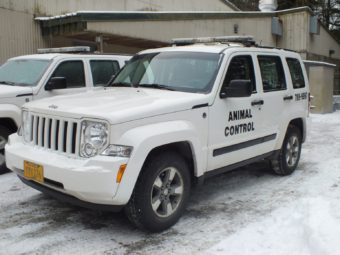
Juneau Animal Control vehicles
Juneau Animal Control is investigating the shooting death of a dog Friday at a North Douglas Highway residence. (Photo by Casey Kelly/KTOO)

A dog was shot and killed at a North Douglas Highway residence on Friday.

Juneau Animal Control and Protection received a call about 5:20 p.m. that several aggressive dogs were on a resident’s property in the 5400 block. When officers arrived, they found a dog had died of an apparent gunshot wound.

Animal Control did not release information about the incident until Monday afternoon. Officer Ben Peyerk says Juneau police also were on scene.

“JPD is investigating the use of a firearm within the city limits,” Peyerk says. “But Animal Control is still investigating and working on their report for the issue with the animal being killed and the animals being at large.”

Peyerk says the caller was concerned about the safety of people and other dogs in the area. No one was injured and there was no explanation of the caller’s definition of aggressive behavior.

None of the dogs had collars and identification tags, but Peyerk says officers were able to find their owners.

He says the dog that was shot was a mixed breed of Lab, German shepherd and rottweiler. He reminds pet owners to keep their animals confined to their own property.

Alaska student journeys home by foot and kayak

If you’re boating between Ketchikan and Gustavus in the next few weeks, keep an eye out for Zachary Brown. He’s kayaking north through the Alexander Archipelago, the final leg of a journey that started in Northern California. Brown made a pit stop in Ketchikan recently.
Zachary Brown's route home from Stanford University, walking and kayaking to Gustavus.
Zachary Brown’s route home from Stanford University, walking and kayaking to Gustavus.

He’s headed home from college. It’s a journey many graduates take, but in his case, it’s taking a little – no make that a lot – longer. Brown earned his Ph.D. in oceanography at California’s Stanford University. It’s from there that he started his journey home – on foot — to Gustavus in Southeast Alaska.

Anyone with a grasp of Alaska geography knows it would be impossible to walk all the way to Gustavus, a small community northwest of Juneau. So after about 55 days on foot, Brown ended the walking portion of his journey in Port Angeles, Wash. He got into his kayak and started paddling.

One goal of the trip is to have a big adventure and get back into the Alaska lifestyle. But the journey serves another purpose.

“A big part of it is to try to start a field school near where I grew up, near Glacier Bay. There’s this really special property out there on this remote group of islands called the Inian Islands,” he said.

The five-acre area is called the Hobbit Hole. Brown says it’s a beautiful spot that’s always been special to the residents of his hometown. It’s for sale and he’s working with a team from Stanford to buy it and turn it into an institute for students, researchers and local residents.

“Part of why I decided to do this big trip is to spread the word about that and look for our sugar daddy, as it were, to help us buy that special property,” he said.

Any luck with that?

“I’ve met a tremendous number of people and handed out a few hundred cards. No luck with the big fish yet, but there are a lot of connections percolating, so you never know,” he said.

Quite a few of those connections were made on the walking portion of the journey. He hiked along the coastal highway most of the way, rather than on trails.

“Because I figured it’s a shorter distance for one thing, but also going along the coastline you’re passing through a lot of communities, meeting more people. It’s not exactly a wilderness experience, in fact I’d say a good half of that 1,000 miles was right along the shoulders of the highway,” he said.

He admits to being tempted to take offers for rides, but stood firm on his commitment to walk.

“I had a few days of just total pouring rain and these wonderful nice people would stop and say, ‘Hey do you need a lift?’ and I’d say ‘no, I gotta walk.’ I can’t cheat this thing. I gotta walk all the 1,000 miles,” he said.

Brown started paddling about a month ago and hit Ketchikan on day 91 of the epic journey. He’s seen some amazing sights on the kayaking portion of the trip.

“When I was just about to cross into Alaska, I was sitting in a little inlet, watching eight humpback whales bubble-net feeding for over an hour. They would come up all at once and then you’d see all their eight flukes go down,” he said. “All kinds of haunting, beautiful noises coming from them.”

Brown also saw his first bear and a wolf soon after crossing the Alaska border. One of his wilder encounters, though, had nothing to do with wildlife.

“I was right in the path of one of those giant ferries in British Columbia at one point. They’re almost as big as the cruise ships” that visit Ketchikan. “They’re absolutely enormous.”

Brown was crossing close to Nanaimo on Vancouver Island and wasn’t sure at first whether the ferry was headed his way.

“And suddenly I started paddling furiously. Then there were four long horn blasts that I knew were for me. I just barely got out of the way in time.”

That’s not to say that Mother Nature also didn’t throw some challenges his way. Brown hit the Alaska border just in time for a big two-day storm. The tempest was just kicking in when he had a two-mile crossing to the Alava Bay Cabin.

“Getting across that two miles was a little hairy. It was choppy, waves were coming over the bow of the boat,” he said. “That’s the thing about being out alone. You don’t have this group decision-making process about whether the conditions look right or wrong. You have to use your own judgment. There’s nobody else to act as a safety net.”

Speaking of safety, Brown is prepared in case he gets into trouble. He has a Spot GPS that allows people to track his progress online. Through that, he sends a check-in every night to let his mom know he’s OK, and he can send an SOS if he gets into trouble. Brown also has a VHF radio and a satellite phone.

“I’m pretty well covered when it comes to communication. So I feel like even if I do have to ditch, if I somehow get separated from my boat, these things are connected to me on my PFD. Something pretty bad would have to happen for me not to be at least able to be saved,” he said.

So far, his trip has not involved any dangerous mishaps. In fact, the only time he had to bail out of his kayak was when he first started paddling from Port Angeles, Wash. in full view of well-wishers watching from shore.

“I had a group of six or eight friends who came down to see me off on my triumphant transition from the walk to the paddle,” he said.

Brown launched, turned to give a big wave and noticed his water bottle had fallen into the surf. So he went back to get it, but caught a wave and flipped. He couldn’t roll the kayak upright because it was too shallow.

“I fumbled for my spray skirt handle and I bailed out and I was just hanging my head in shame because my triumphant departure was completely ruined.”

Since then, though, Brown has managed to stay in the boat.

The trip up the Canadian coast includes a lot of wilderness, but Brown says he found some pockets of humanity along the way.

“The lighthouse on Addenbrooke Island, the caretakers there. They used a crane to hoist my kayak up onto the dock and took me in for the night. The hospitality has just been tremendous.”

Brown also stopped at an old, falling-down cannery where the caretaker let him borrow a fishing pole to go trout fishing.

Those human encounters have been few, however, and Brown has spent a lot of time on his own.

“It definitely gets lonely. No question about that. I have a lot of time to think; almost too much time to think, sometimes. But it’s incredibly rewarding and enriching at the same time. I know that before long, I’m going to be back in the real world and real life, and I have to enjoy this while I can.”

Brown estimates that his re-entry into the real world will happen around the first of September, when he expects to land back home in Gustavus.

Juneau schools mark opening day with higher enrollment

(Photo by Rosemarie Alexander/KTOO)

It’s back to school Wednesday for 4,837 Juneau children. That’s about 50 more students than the Juneau School District expected.

Already, new superintendent Mark Miller plans to add a new teacher at Dzantik’i Heeni Middle School and a half-time position at Gastineau Elementary.

“It’s always good to have a few more students than you projected because we can bring on an extra teacher if we need to, but if you guess low, you’re going to kill your budget because you don’t get enough money for the students you’re staffed for,” Miller says.

Most school district funding comes from the state of Alaska and is based on the number of students enrolled in mid-October.

Enrollment was down last school year, resulting in less funding and major budget cuts.

Economist Gregg Erickson forecasts enrollment for Juneau schools. He says the city lost a number of state and federal government jobs early last year, resulting in fewer students.

“Typically you lose a student for every four jobs or so,” he says.

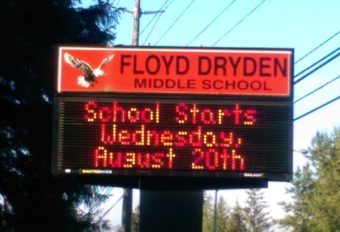
Juneau school buses are operated by First Student. School starts Wednesday, Aug. 20. (Photo by Rosemarie Alexander/KTOO)

Erickson says current employment data shows Juneau is still in a small recession. He says that could affect enrollment through 2015, when it would start slowly growing again.

“In June of last year it appears we lost about 317 jobs over the previous year. The data I have now goes six months forward and it seems to suggest that those job losses have actually accelerated a little bit and that we’ve now lost more than 400 jobs,” he says.

When students take their seats Wednesday morning, they will be counted. The October numbers go to the state education department and are used for calculating the amount districts will get for school operations.  But the budget is written in March and the district doesn’t know the amount of state funding until the legislature adjourns in mid April.

Out of Juneau schools’ 661 staff members this year, 355 are teachers. That’s 18 fewer teachers than last year, but no one was laid off. The reductions were made through attrition, according to Kristin Bartlett, district chief of staff.

Teacher Bob Williams campaigns for lieutenant gov. in Juneau

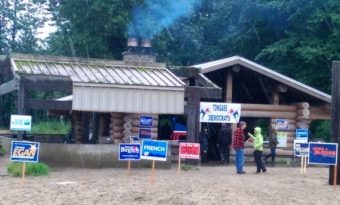
Tongass Democrats' hosted primary candidates at Sandy Beach on Sunday. (Photo by Rosemarie Alexander/KTOO)
Tongass Democrats’ hosted primary candidates at Sandy Beach on Sunday. (Photo by Rosemarie Alexander/KTOO)

Tuesday is primary election day in Alaska and candidates are still on the stump. Colony High School math teacher Bob Williams – running for lieutenant governor — had one last campaign stop in Juneau on Sunday, joining other candidates at Tongass Democrats’ annual picnic.

Williams is from Palmer. He has not run for political office before, but has some statewide recognition as the 2009 Alaska Teacher of the Year. He said he’d been content to stay in the classroom until education seemed to become a political football in the legislature and Parnell administration.

“With the push for vouchers and questioning of the value of public education, or quality education for all Alaskans, I lost faith and that’s what made me decide that I’m going to step up and do everything I can to make a positive change,” Williams said.

Williams is running in the primary against well-known Anchorage Democrat Hollis French, who’s served 12 years in the state Senate. Both hope to be gubernatorial-candidate Byron Mallott’s running mate in the general election. Mallott has no primary challenger.

Bob Williams spoke to party faithful at Tongass Democrats' picnic. The high school math teacher hopes to beat Hollis French for  Democratic nomination for lieutenant governor. (Photo by Rosemarie Alexander/KTOO)
Bob Williams spoke to party faithful at Tongass Democrats’ picnic. The high school math teacher hopes to beat Hollis French for Democratic nomination for lieutenant governor. (Photo by Rosemarie Alexander/KTOO)

In Alaska, the lieutenant governor primarily oversees the state Division of Elections. Williams said he also believes the lieutenant governor’s office is a way to increase the effectiveness of the executive branch.

It was his fourth trip to Juneau as a candidate. He says he and his wife Connie really like the capital city, but he would not commit to living here full time if elected.

“I want to tell the people of Juneau that I am from the Mat-Su Valley, but the capital should stay in Juneau, and I love being here. The lieutenant governor has an office in Juneau and Anchorage and I’d be looking at spending a lot of time in Juneau,” he said.

Primary election polls are open from 7 a.m. to 8 p.m. on Tuesday.

JPD chief says if pot is legalized, DUI enforcement could be a challenge

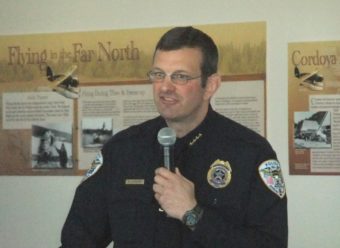
Juneau Police Chief Bryce Johnson at the Chamber of Commerce Thursday in the Alaska Room of the Juneau Airport. (Photo by Rosemarie Alexander/KTOO)

Alaskans will decide in November whether the state should tax and regulate the production, sale and use of marijuana.

If Ballot Measure 2 passes, people age 21 and older could legally buy and use pot, and even grow a certain amount. But the drug could not be used in public.

Colorado and Washington now regulate pot, and Alaska authorities, like Juneau Police Chief Bryce Johnson, are looking to those states for guidance.

Johnson told the Juneau Chamber of Commerce Thursday that enforcement of driving under the influence laws could be a challenge.

“When we talk about DWI, all of our officers are trained for alcohol detection and stand and field sobriety tests,” Johnson said. “When you go to a drug-based DUI it requires additional training and right now we only have two people who are trained to do that, so we will have to expand our capacity to be able to investigate those things.”

Both driving under the influence and the underage use of marijuana have increased in Colorado since recreational use of the drug became legal, Johnson said. Juneau could have a similar experience if the marijuana initiative passes, he said.

The “Yes on 2” campaign recently put out a press release declaring teenage marijuana use is down in Colorado since the state legalized the drug. However, the 2 percent change between 2011 and 2013 is not statistically significant, according to the Colorado Department of Health and Environment. A state of Colorado survey shows fewer youth think pot is risky.

Johnson has been Juneau police chief for a little more than a year. When he joined the force the department had a number of vacancies and still needs ten officers.

Prospective officers must pass a physical and written test as well as background investigation.

“Every time we run a test we have six to eight people that will apply. And if we have six to eight people that apply we usually get one or two of them that will pass every stage of the testing,” he said.

JPD recently hired two people, who are now at the Public Safety Training Academy in Sitka. It will be about ten months before they’ll be officers on the street.

Johnson says departments across the country are finding it difficult to recruit officers, and he expects Juneau is about two years from filling all the vacancies.


Site notifications
Update notification options
Subscribe to notifications