Listen here:
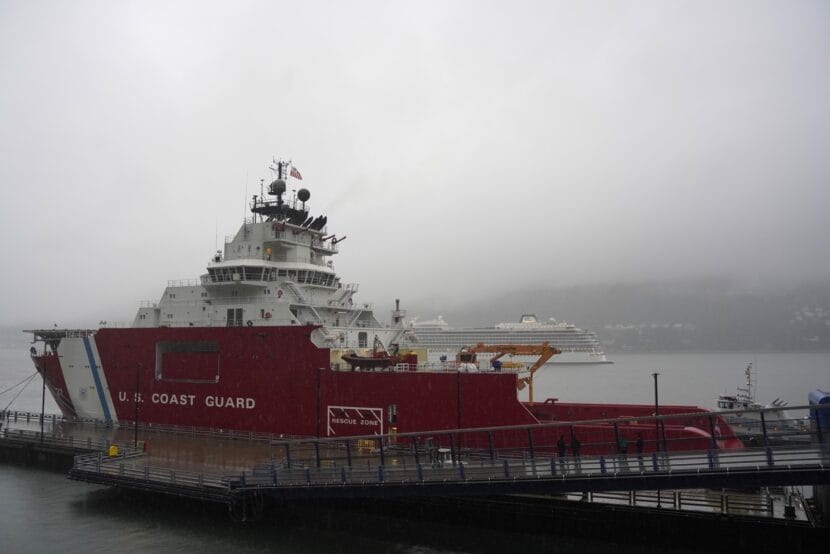
The U.S. Coast Guard officially added the first icebreaker to its fleet in over 25 years during a ceremony on Sunday in Juneau – its future home port.
The ship’s commissioning signals an expanding U.S. military presence in the Arctic Ocean. But the icebreaker is also looking to overcome its past after a tumultuous maiden voyage more than a decade ago.
Down in the engine room of the Storis on Saturday, U.S. Coast Guard Lieutenant Commander George Greendyk walked in narrow passageways between loud diesel engines that slowly thrust the ship through the placid waters of Stephens Passage.
“We’re getting to the point where we’re pretty comfortable pretty much with the majority of the ship’s operations,” Greendyk said. “Now we just need to get control of the things that pop up only every once in a while.”
The Storis joins the Healy and the Polar Star as the third polar icebreaker that the U.S. military owns.
Juneau residents may have glimpsed the large red and white ship through the fog over the weekend, but it was only here for a little while before heading north.
Captain Corey Kerns said the icebreaker’s mission over the next couple of months has two main purposes: assert U.S. sovereignty and learn how to operate the ship, which is unlike any other in their fleet.
“In this case, we need Arctic presence was the most important thing.
He said that the U.S. has failed to keep pace with other nations, including Russia and China, in building polar icebreakers capable of navigating the waters of the far north. So Congress made the Coast Guard buy this one from the American company Edison Chouest Offshore for $125 million dollars.
“So we’re willing to take some risk or forced into it, because our shipbuilding projects are so behind, you know, to be honest,” Kerns said.
The Storis had some issues in its past life.
The ship was originally called Aiviq and was built to support oil drilling in the Arctic. It famously lost control of a Shell oil rig off the coast of Kodiak during its maiden voyage in 2012.
After the oil rig ran aground, government reports concluded there were issues with how the icebreaker was designed and with how the crew handled it in dangerous waters.
One of the main issues was the location of the fuel vents. Seawater flowed into the vents and caused the diesel engines to fail. Kerns says they’ve fixed that issue.
“So those were raised a little bit higher, which means you could take more water in vicinity of them before it would down-flood,” he said. “So not that it couldn’t possibly happen again, but it’s less likely.”
In addition to raising the fuel vents, the other major changes to the ship were painting the hull red, installing military satellite communication systems and adding an armory.
Kerns said the crisis with the oil rig was also a result of how the crew made decisions at the time.
“If you’re towing 100,000-ton ship in like 40-foot seas, that’s restricting the movement of your ship. No amount of design is going to save you from a bad, bad situation,” he said.
Before getting a ride-along for press and families of the crew underway, the ship sat at Auke Bay Ferry Terminal. The voyage was delayed for around two hours.
Kearns said a propeller malfunction was to blame. But it would be a quick fix once they got downtown.
“That’s some of the growing pains of us learning,” he said.
They’re learning from a civilian crew with Edison Chouest that is contracted to train the Coast Guard.
Commander Philip Baxa, chief of the Coast Guard’s Aids to Navigation and Ice Capabilities Division, helped negotiate the purchase of Storis. He said the ship’s home port will be Juneau — once the infrastructure is built.
“It doesn’t just stop at the waterfront with a pier. It’s the warehouses and workshops for our maintainers, but it’s also the housing units for the crew members and their families,” Baxa said.
The recent Trump-signed funding bill allocated $300 million to build the port. Baxa said it will take around a decade and that building sites have not yet been decided. He expects roughly 100 crew members and maintenance workers will be stationed in town.
The ship is planning to visit Seward, Kodiak and Dutch Harbor, then will head north through the Bering Strait over the next couple of months. Port calls are subject to change.