Military

Alaska sends National Guard, other help to hurricane-hit states in the Lower 48

Approximately six feet of debris piled on the bridge from Lake Lure to Chimney Rock in North Carolina, blocking access. (Photo by Melissa Sue Gerrits/Getty Images)

The state of Alaska is sending 50 National Guardsmen to Florida to help that state recover from hurricanes Helene and Milton.

The latter hurricane is expected to make landfall early Thursday near Tampa, according to the National Weather Service.

“We are moving forward with planning and preparations with the intention of sending them via commercial air by the end of the week,” said Alan Brown, director of communications for the Alaska National Guard.

Disaster-relief staff with the Alaska Department of Military and Veterans Affairs have already traveled east to help North Carolina recover from Hurricane Helene, said Jeremy Zidek, a spokesperson for the department.

A two-person operations support team is working with the state operations center, he said, and on Thursday, a four-person team is headed east to help an individual county’s disaster recovery.

The state also sent two volunteer agency liaisons — people in charge of connecting organizations that provide help with disaster victims who need it.

One of those liaisons is in Florida, the other is in Virginia, he said.

“We have other requests coming in from the states that were affected by the hurricanes,” Zidek said. “We’re going to look at our staffing needs in Alaska … we’ll send whatever support we can.”

Alaska is a participant in the 50-state Emergency Management Assistance Compact, which allows states to share staff in case of disaster.

Zidek said the program is beneficial for everyone who participates. Alaska disaster-recovery staff get experience dealing with problems, and recipients of the aid benefit from having more hands on site.

“In Alaska, we get a tremendous amount of experience because we experience disasters on such a regular basis,” he said.

That makes Alaskans particularly helpful in the field, and they return skills to the state.

Zidek said he’s personally deployed four times to other states, learning in the process.

“Each time, I’ve brought back something that can help Alaska,” he said.

Sullivan calls for increased military presence in Arctic after close call with Russian fighter

A Russian Su-35 fighter jet crossing in front of an American F-16 during a Sept. 23, 2024 intercept in the Alaska Air Defense Identification Zone. (Screenshot from NORAD video)

After an Air Force pilot’s close encounter with a Russian fighter jet last week, U.S. Sen. Dan Sullivan is calling for the U.S. military to continue building its presence in Alaska to “meet force with force.”

In a video of the Sept. 23 encounter released by the North American Aerospace Defense Command, a Russian Tu-95 Bear bomber can be seen flying to the left of an American jet. Suddenly, a Su-35 jet passed the American F-16 fighter on its left as it rolled to the right.

The F-16 pilot reflexively banked right to avoid a collision as the Su-35 flew off into the distance.

In a press release, Sullivan said that such a maneuver is dangerous and puts lives at risk.

“The reckless and unprofessional maneuvers of Russian fighter pilots — within just a few feet of our Alaska-based fighters — in Alaska’s ADIZ on September 23 put the lives of our brave Airmen at risk and underscore the escalating aggression we’re witnessing from dictators like Vladimir Putin,” Sullivan said.

Sullivan also called for increased focus on military projects in Alaska, like the port expansion project in Nome. Once complete, the port expansion in Nome will be capable of hosting all U.S. Navy vessels except for the U.S.’s fleet of enormous 1,100-foot-long aircraft carriers.

“We need to answer force with force and continue building up America’s military presence in Alaska and the Arctic with more infrastructure, like the strategic Arctic port at Nome and reopening the Adak Naval Air Facility, and more military assets,” Sullivan said.

Sullivan’s call to reopen the Adak Naval Air Facility, which closed in 1997, comes as the U.S. military recently moved 130 troops to Shemya Island some 400 miles west of Adak Island.

U.S. Navy plans apologies to Southeast Alaska villages for century-old attacks

Angoon students prepare to paddle the unity canoe they built with master carver Wayne Price on June 19, 2023. It is the first canoe of its kind since the U.S. Navy bombardment of Angoon in 1882 that destroyed all the village’s canoes. The Navy plans to issue apologies to Kake and Angoon residents in the fall of 2024. (Photo by Claire Stremple/Alaska Beacon)

Two Tlingít villages in Southeast Alaska will receive apologies for wrongful military action from the U.S. Navy this fall.

The first of those apologies will take place in Kake this weekend, where U.S. Navy Rear Admiral Mark B. Sucato will acknowledge the harms of a bombardment in 1869. An apology in Angoon is scheduled for Oct. 26, the 142nd anniversary of the 1882 bombardment.

Navy ​​Environmental Public Affairs Specialist Julianne Leinenveber said it was determined that the military actions were wrongful because they resulted in loss of life, loss of resources, and inflicted multigenerational trauma on the affected communities.

“The pain and suffering inflicted upon the Tlingit people warrants this long overdue apology,” she wrote in an email.

Tlingit people have asked the U.S. government to apologize for decades. Leinenveber said the U.S. responded in the last few years with planning discussions at the highest levels of military leadership and the federal government about how to issue a substantive, meaningful apologies in a culturally appropriate manner. Lately, she wrote, military relationships with Alaska Native clans brought the matter to the attention of Navy leadership, who coordinated with the Office of the Secretary of Defense to formally apologize for the bombardments.

“The Navy will be issuing this apology because it is the right thing to do, regardless of how much time has passed since these tragic events transpired,” she wrote.

Joel Jackson, the president of the Organized Village of Kake, said the apologies are meaningful to the community even after a century.

“It’s a long time coming,” he said. “Hopefully, through this apology, we can start healing from the wrongs that were committed against us.”

Jackson said he is particularly concerned with the effects of intergenerational trauma, which he said he sees in his community today. The Navy apology will specifically acknowledge the U.S. government’s responsibility for that trauma.

Jackson said the military history of the event is not an accurate accounting of what happened. Many accounts refer to the bombardments as the Kake Wars.

“We never did go to war with them,” he said. “They attacked our communities.”

Military action in Kake

There are different accounts of the military events in Kake in 1869. Some refer to the events as a bombardment, while others refer to them as the Kake Wars.

What goes without much dispute is that a U.S. Navy vessel, the USS Saginaw, totally destroyed three village sites and two forts in the area of Kake in the winter. Soldiers then burned the villages and destroyed food and canoes. By all accounts, the destruction led to “many deaths.”

Descriptions of the events that precipitated the bombardment differ. An account from William S Dodge, one of two mayors of Sitka under the provisional government, printed in the Annual Report of the Department of the Interior, recounts that two Alaska Native men were killed by a sentry in Sitka when they were unaware there was an order not to leave the village there. Afterward, men from Kake killed two colonizers in retaliation, which caused the war, Dodge wrote.

A forthcoming book from Zachary R. Jones, Ph.D., is similar to this account, with the detail that a Kake clan leader asked for trade blankets and goods as compensation for the deaths in accordance with Tlingit law, but the general refused, which is why a “party of Kake Tlingits” killed two trappers on Admiralty Island in retribution. The information was released in advance of the book’s publication in a news release from the Sealaska Heritage Institute.

New relationships

Angoon School Principal Emma Demmert was invited by the U.S. Navy to take part in planning meetings early this summer for its October apology. She said she is hopeful for the future after working with Navy officials and seeing their openness and willingness to embrace Angoon’s cultural traditions.

“This is a really good step to healing for our community, and it’s really been enlightening to be a part of the team and meeting with the Navy on this whole topic,” she said.

Demmert said the apology is a shift in relations with the U.S. government and she credits the Biden administration, in part, for that change. She also pointed to the work Angoon students did to build a dugout canoe and shine light on the history of the bombardment as a reason for renewed attention to the issue.

In Kake, Joel Jackson said he was also looking to the future and to right relations with the U.S. military.

“Giving an apology is by no means the end of it. Definitely we’ll be looking for them helping us even more,” he said. Jackson pointed to Kake’s high unemployment rate.

“Helping to set up infrastructure, you know, to get in some totem poles, stuff like that. Hopefully a museum to commemorate what happened.”

Correction: One of the references to the year of the bombardment of Kake was incorrect in the original version of this article. 

NORAD detects, intercepts 2 Russian aircraft off Alaska’s coast

A U.S. F-22 jet fighter accompanies a Russian Tu-142 maritime reconnaissance/antisubmarine warfare plane through the Alaska Air Defense Identification Zone in March 2020. (From NORAD)

The North American Aerospace Defense Command tracked and intercepted two Russian military aircraft Wednesday in international airspace near Alaska.

A NORAD news release said the Russian aircraft remained in the Alaska Air Defense Identification Zone, or ADIZ, and did not enter American or Canadian sovereign airspace. The zone begin where U.S. sovereign airspace ends.

International aircraft may travel through the zones, but must identify themselves.

A NORAD spokesperson said Thursday that the two Russian planes were Tu-142s, which are used for maritime reconnaissance and anti-submarine warfare. The spokesperson declined to identify the number and type of U.S. aircraft sent to intercept and escort the Russian planes in the Alaska ADIZ.

Russian aircraft have frequently flown through the zone. They’re usually met by U.S. jet fighters out of Eielson Air Force Base or Joint Base Elmendorf-Richardson.

The NORAD news release says the Russian sorties are not seen as a threat.

Last reported sortie involved Russian, Chinese aircraft

The last time Russian aircraft passed through the zone was in late July. But the two Russian Tu-95 Bear bombers in that formation were accompanied by two Chinese H-6 Xi’an bombers. It was the first time Russian and Chinese aircraft jointly flew through the Alaska zone.

U.S. Sen. Dan Sullivan and others said the incident represented an escalation in the years-long game of cat and mouse that’s been playing out in the skies off Alaska’s coasts. In a Facebook post Thursday, Sullivan said the recent intercepts show Alaska “continues to be on the front lines of authoritarian aggression.”

Defense Secretary Lloyd Austin discussed the Russian-Chinese sortie in a briefing on July 25, later in the day the formation was intercepted.

“This is the first time we’ve seen these two countries fly together, like that” in the Arctic, Austin said. He added that the joint flight signals the growing ties between the two nations and their mutual interest in operating in the far north.

According to the U.S. Center for Strategic and International Studies, the Alaska sortie was the eighth joint bomber flight that China and Russia have conducted since 2019. The previous bomber flights were in the Sea of Japan, East China Sea and Western Pacific.

That includes some flights through the Japanese and South Korean ADIZs.

The Washington, D.C.-based think says a statement by the Russian Ministry of Defense declared the countries were conducting joint strategic air patrols in a “new area of joint operations.”

Coast Guardsman’s death prompts mental health conversations at Base Kodiak

A U.S. Coast Guard rescue helicopter lands on a runway before it parks near an Air Station Kodiak hangar. (Brian Venua/KMXT)

The death of a Kodiak-based U.S. Coast Guardsman this summer has sparked a new wave of conversations about mental health on the base.

U.S. Coast Guard Air Station Kodiak held a ceremony on July 26 to honor the life and service of a rescue swimmer who died on June 25.

The Coast Guard said the investigation into the service member’s death is ongoing, but no foul play is suspected. It did however renew a push for addressing mental health in the military.

Coast Guard officials declined to say whether the death was a suicide. But a social-media group for Coast Guardsmen described it as one, urging comrades to “find something that keeps you going.”

Cameron Snell, a public affairs specialist for the Coast Guard, said Air Station Kodiak officials have been open about encouraging members to use mental health services.

“The air station had a stand-down to inform everybody working there about what had happened, and they immediately offered grief (and) loss counseling for those service members, also for the service members in the barracks,” he said.

A stand-down means operations were paused for air station staff to meet.

Suicide rates are higher within the military, and in response, mental health programs for service members have been on the rise in recent years. Now that includes pushes from the Coast Guard’s Air Station and Base Kodiak, as well as ships that are homeported on the island too.

Snell said officials have been encouraging people to use CISM, or the Coast Guard’s Critical Incident Stress Management program.

The goal is to serve members who have faced potentially traumatic experiences, like when a peer dies or after stressful search and rescue missions. He said it’s not a perfect system, but those kinds of resources are important.

“Suicide is a troubling statistic in the military,” Snell said. “And we can never completely eliminate that statistic, but we can offer as many resources as we can to prevent that at every step of the way.”

The base also provides other resources to burn stress, like borrowing boats or other outdoor equipment from its Morale, Wellness, and Recreation Department. Snell said the Work/Life Office also provides members services like financial guidance or help finding child care.

Members of the Coast Guard have mandatory mental health screenings as part of their annual health assessments and are encouraged to report their peers if they have any concerns. Snell said commanding officers can also refer members they’re concerned about to counseling.

“(This) incident was a tragedy – one being one too many here – and we hope to be able to make the resources that we have available known,” Snell said.

Mental health emergencies on or off base should be reported by calling 911.

Providence Kodiak Island Medical Center and the Kodiak Area Native Association both offer mental health counseling in town, but waitlists can take months. Providence psychiatrists can be seen much sooner though, and emergency services are always available.

The national suicide and crisis lifeline is available by calling or texting 988. The Veterans Crisis Line is available by dialing 1 during a 988 call or by sending a text message to 838255. Online chats are also available at 988lifeline.org.

The Coast Guard also has plans to promote mental health services in September for National Suicide Prevention Month.

Alaska Public Media’s Chris Klint contributed information to this story.

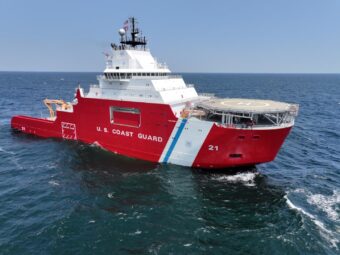
Coast Guard confirms new icebreaker will be homeported in Juneau

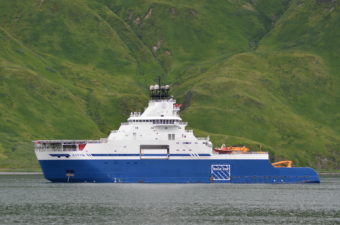
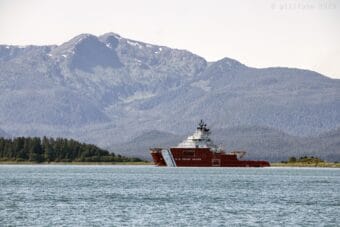
The Aiviq anchored in Unalaska in August 2016. (Sarah Hansen/KUCB)

The U.S. Coast Guard made an official announcement today that it plans to homeport an icebreaker in Juneau. 

Plans to dock an icebreaker in the capital city have been discussed for a few years, but previous funding attempts were removed from federal legislation. 

The vessel — the Aiviq — is privately-owned, and was built for oil exploration in the Arctic. The agency says the icebreaker will increase U.S. presence in the region. 

U.S. Senator Lisa Murkowski addressed the announcement at the Alaska Municipal League conference in Kodiak Wednesday.

“The ship is there, and the ship is going to be purchased, and the ship is going to be homeported in Juneau,” she said. “We’ve got a little bit of work to do on dock and shore side and housing and child care and all the like, but we’re going to be there for our Coast Guard men and women.“

In 2022, Alaska Senator Dan Sullivan said a new icebreaker could bring 190 Coast Guard personnel, and their families, to Juneau. 

In March, Congress passed a spending bill that appropriated $125 million to purchase the Aiviq. 

The Coast Guard plans to modify the vessel to meet its needs, which could take about two years. 

The agency has bigger plans to build a fleet of icebreakers called Polar Security Cutters.

KMXT’s Brian Venua contributed to this story. 

Site notifications
Update notification options
Subscribe to notifications