Military

Fort Wainwright opens the Army’s biggest child care center

Fort Wainwright Child and Youth Services Coordinator Jessica Spittle explains the age-appropriate and child-safe design of one of the new CDC’s classrooms. (Tim Ellis/KUAC)

Fort Wainwright celebrated the opening of its new Child Development Center Tuesday with a ribbon-cutting ceremony. The $3.5 million facility is the Army’s newest and largest child-care center.

Active-duty military personnel and qualifying federal employees who work at Fort Wainwright now have access to a new spacious and colorful, on-post child-care option for infants through kindergarten-age kids.

“It’s a really great facility” says Post spokesperson Eve Baker. “And it’s the only facility of that type among the Army child development centers.”

Baker says the 42,930-square-foot child-care center is the Army’s largest. And it’s designed to be used for both child care and early childhood education. That’s why 22 of the rooms for kids are referred to as classrooms.

“The center will have room for 284 children, from infants through age 5 – for preschool children and kindergartners,” she said.

Baker says the Child Development Center, or CDC, will make child care available for kids whose parents have been waiting for a space to open up.

“It will clear the waiting list for the other two facilities that we have,” she said, “and there will still be plenty of room for additional children to come in.”

The brightly lit CDC’s classrooms are furnished with age-appropriate chairs and desks and fixtures to accommodate the different age groups. It also has all the necessary grown-up amenities for staff and parents, like administrative offices, break room and a laundry.

“As well as a nursing room for staff or for parents who may want to visit their infants during the day,” Baker added.

And there’s also a 3,000-square-foot multipurpose room.

“Small groups can come in and use it, they can do sports, they can run around,” she said, “It can be an evacuation space in the event of an emergency.”

And throughout the CDC, there’s beautiful artwork that celebrates Alaska history and culture.

“Our new facility is named the Denegee Child Development Center, and that is a Tanana word for moose,” she said. “We worked closely with our Alaska Native tribal partners to come up with an appropriate name for the center.”

Baker says kids will be surrounded by artwork, much of which was created by members of the local arts community.

She says child-care providers interested in working in the new CDC can contact Fort Wainwright’s Morale, Welfare and Recreation office.

Organization awards home in Fairbanks to combat-wounded Army veteran


Andy Armstrong prepares to get the keys to his news house from representatives of the organization and business that awarded the home to him. From left, Ken Eakes, Military Warriors Support Foundation executive director; Armstrong; Adam Little, regional Bank of America/Merrill Wealth Management marketing executive; Tyann Hollis, BofA/Merrill Wealth Management vice president. (Tim Ellis/KUAC)

An Army veteran has been given a home in Fairbanks, courtesy of a program that helps wounded combat vets rebuild their lives.

Memorial Day usually is a solemn occasion for Americans to remember and thank U.S. military personnel who lost their lives in combat.

But there was no sorrow during a ceremony held last week near Fairbanks to honor a veteran who survived a brush with death.

Spec. Andy Armstrong, a military police officer, deployed to Iraq in 2009-10 and Afghanistan in 2010-11. He and three fellow soldiers were seriously injured in August 2011 when the truck they were in detonated a roadside bomb. (Andy Armstrong)

And the only tears shed at Thursday’s gathering to honor Andy Armstrong’s service came from his wife, Elise, after one of the sponsors of the event gave her the keys to the cabin.

“So please join me and welcoming the Armstrong family to their new home!” said Adam Little, a regional Bank of America/Merrill Wealth Management marketing executive.

Elise also gushed when Little said his company and the Texas-based Military Warriors Support Foundation, which organized the event, also want to ensure the home is furnished.

“This is a gift card for you to choose your furnishings for this home,” he said. “We took care of all that for your home.”

“Thank you for doing this for all the veterans that are out there, and for their families,” she said, “because, like you said, there’s a lot of sacrifices that veterans go through and that much of the country doesn’t quite understand.”

Armstrong struggled to find the words to express his appreciation.

“I can’t thank you guys enough,” he said. “What you do is absolutely phenomenal.”

Armstrong and his wife, Elise, and infant daughter, Andi, talk with visitors about their new home just before organizers of Thursday’s event handed over the keys. (Tim Ellis/KUAC)

Armstrong was medically retired in 2012 after he and three other soldiers he was with sustained serious injuries when the truck he was driving hit an explosive device buried along a road in Afghanistan. He was awarded a Purple Heart, and after rehab returned home to upstate New York, where began working as logger.

Then late last year he got a job that brought him to Alaska, driving fuel trucks up the Dalton Highway from Fairbanks to Deadhorse.

“It’s challenging,” he said. “With truck driving, it’s very monotonous — in the Lower 48. Here, that road changes, by the hour. And it’s never the same. It keeps you kinda sorta on your toes.”

Armstrong says he and his wife have long dreamed of living in Alaska. And now that he’s got a job and a home in Fairbanks, Elise and their 1-and-a-half-year-old daughter, Andi, can both join him.

“When I was in the Army, me and my wife had actually wanted to get stationed up here,” he said. “And we tried and tried, because Alaska’s kind of always been our end goal. She had never been up here, I had never been up here. We just kind of knew that we wanted to come up here and see what it’s all about.”

Elise exclaims in appreciation about the toybox that Andi found as soon as the family walked into their new home. (Tim Ellis/KUAC)

Military Warriors Support Foundation Executive Director Ken Eakes says the organization is dedicated to helping veterans injured in combat to heal and achieve their dreams.

“We’ve awarded nearly a thousand houses that are mortgage-free to our combat wounded veterans and Gold Star families over all 50 states,” he said. The house given away Thursday is the third to be awarded in Alaska.

Eakes says Bank of America donates homes to his organization, often repairs and renovates them with locally hired workers, then awards them to deserving veterans. The program also teaches budgeting and other skills to help veterans build a new life in their new home and offers other services to help wounded vets recover.

Alaska an important Special Operations training ground, as Arctic sees interest from Russia and China

Navy SEALs stationed on the East Coast jump from an MC-130J Commando II near Kodiak, Alaska, Sunday, February 25, 2024. (Salwan Georges/The Washington Post)

The United States military has become more focused on training in Alaska, as Russia and China have looked to expand into the resource-rich and increasingly ice-free Arctic.

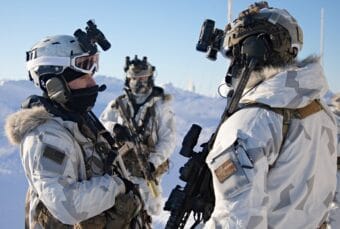
And that goes not just for conventional forces, but also for Special Operations forces like Navy SEALs and Army Green Berets. Both were training in Alaska this past winter by parachuting into frigid water off Kodiak or skiing through the woods around Fairbanks, among other exercises.

That was the subject of a story this month by the Washington Post, which was given rare access to Special Operations training in Alaska.

Washington Post reporter Alex Horton wrote the story and says the unforgiving environment is unique for such training.

Listen:

Alex Horton: In the Arctic, just surviving is the important part. You know, the extreme cold can have such an impact on you and your equipment that the first mission, really, is just to stay alive. And then the second mission is to conduct whatever you’re doing, right, whether it’s a patrol, an attack or a recovery operation. That survivability piece is, like, amped up more than any other environment on Earth.

Let’s just say, for example, you’re a Green Beret, and you’ve been shot. And you’re probably wearing big pants, coats, you know, the big thick boots. And the first thing that happens when you are wounded and a medic comes to help you is they open up your coat, they open up your pants, and all that heat just goes rushing out. And if you’re bleeding, that’s another way for your body to lose warmth. And even an IV bag that has blood in it, if they’re giving you a transfusion, the act of them giving you a transfusion is going to lower your body temperature even more. So the threat of hypothermia, the threat of water making you hypothermic, it’s an ever-present looming danger everywhere you operate in the Arctic.

Casey Grove: We’re talking about, you know, the importance of this training and what the military says about that and the whole, you know, sort of the geopolitical situation that we find ourselves, in this day and age. What did you hear from, you know, the military about that, about why it would be important for the special operations folks to be training in Alaska?

Alex Horton: You know, it’s important for Special Operations forces to be ready in any kind of environment and terrain where conflict can happen. And as climate change makes the ice recede, and there’s ships and all kinds of operations. You know, there’s energy exploration, there’s cruise ships, you know, they’re up in the Arctic, and that invites what the Pentagon calls “competition” (from) Russia and China, because there are resources to exploit, there are shipping routes to claim. You know, the sort of northern part of Russia, the way to get that energy to markets in Asia is going through the Bering Sea, around Alaska, to, you know, where Japan and Korea are. So it’s an important route for them. And it’s important route for China as well.

Why it’s important for Special Operations, specifically, too, is, you know, for the last 20 years, the command has really been focused on what they call “direct action” in Iraq and Afghanistan. That’s going on raids, doing high-profile stuff like the SEAL raid to kill Osama bin Laden. That’s what they’ve been doing, and that’s what they’ve been focused on. So now, once the Pentagon has started looking to Russia and China as more of a strategic threat and as strategic competitors, they have to find a role for Special Operations. That means they have to change. They have to focus on places like the Arctic, to operate in a climate where they didn’t have to work in, you know, 5, 10, 15 years ago.

Casey Grove: Yeah, we’ve talked kind of about like, shipping lanes opening up and exploration and that kind of thing. But every once in a while, some Russian parliamentarian, you know, says, “We should take back Alaska,” and sort of puts this idea in Alaskans’ heads that maybe somebody’s going to invade mainland Alaska. From, you know, the individual Special Operations members to the commanders, did anybody that you talked to, like, even allude to something like that?

Alex Horton: It was interesting, because, you know, the folks who were helping coordinate the trip, Northern Command, which is the the military authority that oversees, you know, North America and also NORAD, like the missile command and defense of the country, their primary mission is homeland defense. When I asked them about how they view Alaska, it’s like, you know, as you said, it has a lot of bases, has a lot of training ranges. And I asked them, like, “Do you view Alaska as, not just a place to go train, but a place to go fight? You know, maybe you will be in the same places in the future, but shooting real rounds at real enemies?” They stopped short of saying that.

And, you know, they made the point that a lot of the training includes, you know, side-by-side with NATO partners. There were Norwegians in Alaska. There were the Danish soldiers training. So a lot of it is relevant to Northern Europe, you know, all those Arctic nations, because they have similar challenges up there that you find in Alaska. There’s glaciers, there’s extreme weather, and they’re right next to Russia, and Russia has substantial Arctic infrastructure. And it’s growing, too. They’re starting to turn the lights back on in some of those Soviet, Cold War-era bases. So yeah, I think they think of this in kind of two slices. One, this kind of exercise helps you, the U.S., get strong and competent in the Arctic, in extreme cold-weather training that they can apply if something were to happen in Europe. But I think what’s left unsaid is, this could also happen in the theoretical scenario of Russia or China invading through what the military calls the “Northern Approach,” which is through Alaska.

Casey Grove: Was it difficult to get access to this, to these training exercises? Or was the Pentagon, you know, the military, like, “Please, come do a story about this?”

Alex Horton: I gotta say, it was an unusual amount of access for Special Operations Command. You know, this is something that we were invited to, and it was very limited media availability, just because of the infrastructure, you know, like seats on aircraft and cold weather equipment to go around. Like, it was just logistically difficult to have any media there. So, you know, the Special Operations Command North facilitated this trip, and, you know, all the things we saw.

And yeah, it was fairly remarkable. You know, I was just a regular Army soldier in an infantry unit, and I served on a combat deployment in Iraq. And some of the teams and the aircraft that I saw, I’d only read about, I’ve never even seen in person, like the Special Operations variant of the Chinook (helicopter) is something I saw in movies, you know, so it was kind of cool to see that stuff. The soldiers are being flown around by the 160th Special Operations Aviation Regiment, which is the unit that flew SEAL Team Six on the mission to kill Osama bin Laden. So they’re a very storied unit. And they were just, you know, the nicest, most professional folks you could meet. So, it was unusual, I would say, for reporters to meet with folks in that unit, and to be in those aircraft and to witness some of the training. It was a rare opportunity.

Feds investigate ‘large balloon’ found by fishermen near Alaska’s Aleutian chain

Military personnel at the Tom Madsen Airport in Unalaska load what appears to be a balloon onto a U.S. Coast Guard C-130 transport on March 2, 2024. (Sofia Stuart-Rasi/KUCB)

Commercial fishermen off the coast of Alaska found what the U.S. Department of Defense is calling a “large balloon with payload” and delivered it to the U.S. Coast Guard in Dutch Harbor.

Officials haven’t confirmed when the balloon was found but reporters with KUCB saw a bundle of parachute-like material being loaded onto a Coast Guard C-130 airplane on Saturday. The balloon was sent to Joint Base Elmendorf-Richardson in Anchorage for further investigation.

In a statement, U.S. Sen. Lisa Murkowski referred to the balloon as an “item of national interest.”

The incident comes about a year after a large balloon, which U.S. officials said was launched from China for intelligence-gathering purposes, passed over Alaska and Montana before being shot down by an Air Force fighter jet off South Carolina. That discovery prompted heightened concerns about air-defense tracking of unidentified balloons and several shootdowns of similar objects.

According to the Department of Defense, the latest balloon was caught in the nets of an unnamed American fishing vessel. The Coast Guard asked the fishermen to store the materiel on board until docking in Dutch Harbor.

Multiple agencies will analyze the object to learn more about its origin and purpose.

“We do not know why the balloon was in the waters off the coast of Alaska nor are we going to characterize it at this time,” wrote Department of Defense spokesperson Sue Gough in an email.

The FBI and Alaska National Guard were also involved in the recovery.

Alaska is back on the Pentagon’s radar, Sullivan says

Sen. Dan Sullivan at a 2021 event in Anchorage. (Jeff Chen/Alaska Public Media)

U.S. Sen. Dan Sullivan says Alaska is back as a recognized location of importance for the U.S. military and national security.

Sullivan noted that a decade ago the Pentagon wanted to close Alaska bases. But no longer.

“I would say the Pentagon, which literally, in my view, was the last entity in Washington, D.C. to recognize the strategic importance of the Arctic, has finally got with the program,” Sullivan said Alaska Public Media’s “Talk of Alaska” show Tuesday. “Now, a lot of it we’ve had to kind of shove them into this. But, you know, we have a very significant military buildup going on in our state.”

Alaska has more F-35 and F-22 fighter jets than any other state, Sullivan said.

It also has the Ted Stevens Center for Arctic Security Studies. Its director, retired Air Force Maj. Gen. Randy Kee, said the two-year-old center focuses on “soft power.” He said it brings U.S. military and security experts together with those from allied countries to explore regional threats and solutions.

“So they’re more competent, therefore, they’re more confident,” Kee said. “And therefore, we can more easily demonstrate the resolve it takes to tell all our competitors, keeping from becoming our adversaries, ‘Today’s not the day to mess with the United States of America, or our allies and partners that are trying to secure our national and respective allied interest across the Arctic region. Today’s not that day.’”

Another sign of renewed attention on the north came two weeks ago, when the Homeland Security Department awarded $46 million to the University of Alaska Anchorage to lead an Arctic Center of Excellence. The center is intended to bring together experts in cybersecurity, emergency management and related fields.

Cold-weather pay exists for some Alaska-based military members, but most Air Force personnel aren’t eligible

Army boots
Soldiers stand at attention during the deployment ceremony for the 164th Military Police Company, 793rd Military Police Battalion, 2d Engineer Brigade, U.S. Army Alaska, at the Alaska National Guard Armory, Thursday, Jan. 23, 2014, on Joint Base Elmendorf-Richardson, Alaska. (Photo by Justin Connaher/U.S. Air Force)

The U.S. military did not begin a new “Arctic pay” bonus for Alaska-based military members in 2023, as Sen. Lisa Murkowski intended when she added a cold-weather incentive provision to a defense bill last year. Instead, pre-existing incentives vary by location, and soldiers do better than airmen.

The Defense Department did not directly answer Alaska Public Media’s emails about why it didn’t implement universal Arctic pay, but an official responded this week with an explanation that some service members in Alaska already receive hardship pay of $150 a month for serving in remote locations. The official, who provided information on condition that her name not be used, said the hardship pay is distributed to military personnel serving above the Arctic Circle and at six other Alaska locations.

That means only a small percentage of the more than 20,000 active duty personnel assigned to Alaska get hardship pay. The military has no major Alaska installations north of the Arctic Circle. Of the six other locations — Annette Island, Clear, Cordova, Eareckson, Fort Greely, and Unalaska — Fort Greely is by far the largest, and it has only a few hundred soldiers.

As Sen. Murkowski envisioned it, Arctic pay would help combat a serious mental health crisis for service members in the state, by easing financial stress and allowing the purchase of gear to get outdoors in winter, like snow tires or warm coats.

The Army (though not the other services) has another program intended to offset the cost of cold-weather gear. Soldiers in the Fairbanks area get a one-time $2,000 payment, or $4,000 if they’re supporting a family. The Army pays half those amounts to soldiers based in the Anchorage area and other places in Alaska that are south of the 63rd parallel.

That still leaves out a lot of service members — notably airmen. The Defense Department official said a component of cost of living allowance for Alaska troops is intended to compensate for the cost of serving in a cold-weather location — but that payout has fallen by hundreds of dollars annually due to higher inflation in the Lower 48.

Murkowski’s provision authorizing “Arctic pay” remains in law, without expiration, so the Pentagon could activate it later.

Site notifications
Update notification options
Subscribe to notifications