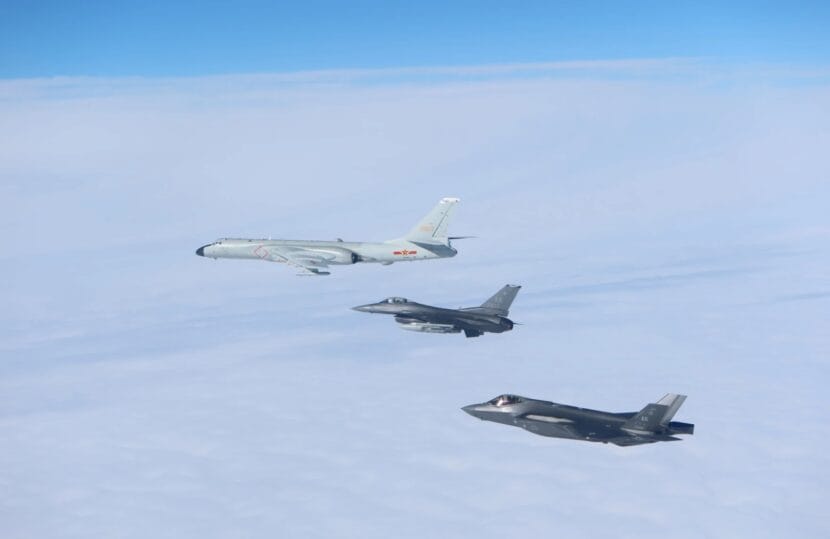
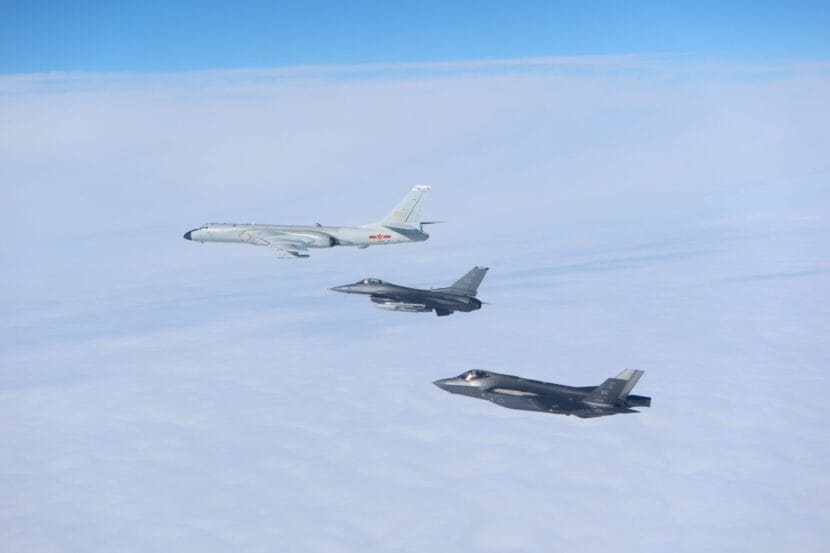
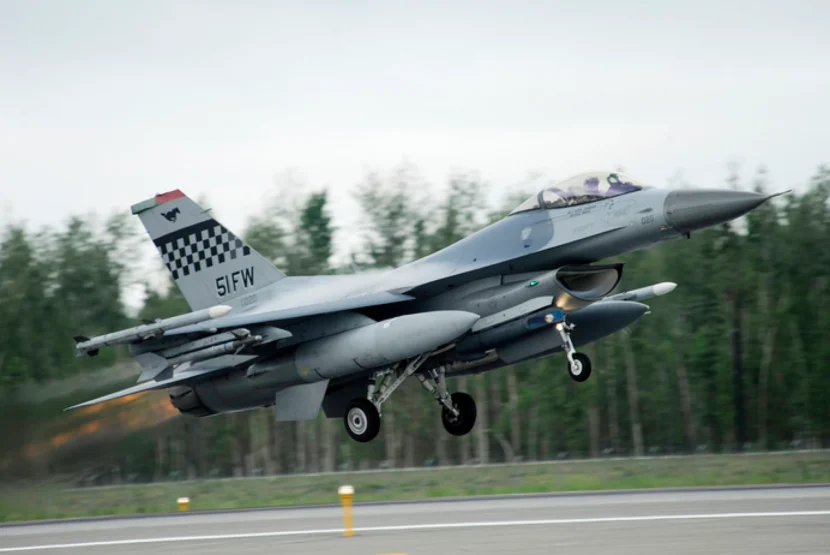
U.S. F-16 and F-35 fighter jets escort a Chinese H-6 Xian bomber through the Alaska Air Defense Identification Zone on July 24. 2024. (From U.S. Department of Defense)
U.S. military experts say a formation of four Russian and Chinese bombers that flew through international airspace off Alaska last month signals China’s growing interest in the Arctic and Russia’s intention to support its ally’s operations in the region.
The sortie of two Russian bombers and two Chinese bombers through international airspace off Alaska was unprecedented – a fact that Defense Secretary Lloyd Austin confirmed in a news briefing he held the day after the incident.
Jet fighters based in Alaska and Canada intercepted the formation on July 24 and accompanied it through the Alaska Air Defense Identification Zone, or ADIZ. Austin says the combined Russian-Chinese operation signals the growing ties between the two nations and their mutual interest in operating in the Arctic.
“This is a relationship that we have been concerned about,” he said.
Austin said that concern mainly is based on China helping Russia sustain its invasion of Ukraine. But he agreed when a reporter asked whether the two nations were testing the United States and its allies by flying the aircraft jointly through the Alaska ADIZ airspace.
“As to whether or not our adversaries are testing us at this particular time – they’re always testing us,” he said, “and that’s no surprise to any of us.”
‘This is an escalation’
U.S. Sen. Dan Sullivan said the bombers’ flight off Alaska’s coasts reflects increase efforts by China to operate in the Arctic. He said in a news release issued a few hours after the flight was interdicted that “Alaska continues to be on the front lines of the authoritarian aggression by the dictators in Russia and China who are increasingly working together.
“Make no mistake, this is an escalation – the first time that Russia and China have sent a joint bomber task force into the Alaska ADIZ,” Sullivan said in the news release.
A University of Alaska Fairbanks Arctic security expert agrees.
“This signifies a relatively substantial increase in military cooperation between both China and Russia,” said Cameron Carlson, a founder and former director of UAF’s Center for Arctic Security and Resilience. “And that’s significant.
China ‘signaling’ more joint operations
“I think it also serves as a major piece of geopolitical signaling, that they are coming together, that they are going to be conducting more joint military activities,” said Carlson, who’s now the dean of the UAF College of Business and Security Management.
U.S. and Canadian air forces have for years intercepted Russian aircraft flying through the Alaska ADIZ. More recently, U.S. Coast Guard and Navy vessels have tracked Russian and Chinese warships transiting international waters within the 200-mile U.S. exclusive economic zone around Alaska. Carlson expects more combined operations. He said former Northern Command and NORAD commander Gen. Glen VanHerck believes last week’s aircraft incursion shows the Chinese now have access to Russian airfields in the Arctic.
“Which gives them now proximity in terms of projecting power to the United States that they never had in the past,” he added.
Carlson said while last month’s incursion was a first, it likely won’t be the last.
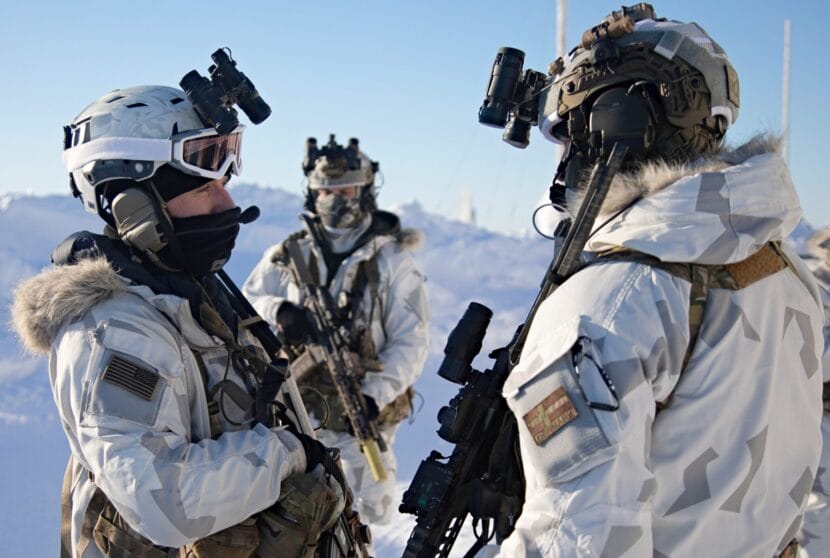
A 10th Special Forces Group (Airborne) Green Beret talks to a Danish Special Operation Forces Operator in Utqiagvik, Alaska, March 6, 2024. Green Berets and Danish Jaeger Corps trained in extreme weather conditions during Arctic Edge 24 (AE24). AE24 is an annual defense exercise for U.S. Northern Command emphasizing Joint Force operations in an extreme cold weather and high latitude environment and is designed to demonstrate the Command’s ability to conduct Globally Integrated Layered Defenses in the Arctic. (U.S. Army photo by Sgt. Shai Zachar)
The U.S. Department of Defense Arctic strategy released on Monday highlights Alaska’s importance as the far north is increasingly militarized.
The release was timely. On Wednesday air crews from the North American Aerospace Defense Command, known as NORAD, intercepted two Chinese and two Russian military planes that were flying off Alaska’s coast.
The Chinese and Russian planes were not in U.S. airspace and were not seen as a threat, but they were in an area called the Alaska Air Defense Identification Zone, NORAD said. The incident follows one in May, in which NORAD detected and tracked four Russian military aircraft flying in the Alaskan Air Defense Identification Zone.
The new Department of Defense Arctic strategy places a sharp focus on Russia, China and the increasing cooperation of those two nations in Arctic activities.
Despite the costs of its invasion of Ukraine, Russia continues to be a threat to Arctic stability, including in areas near Alaska, the strategy said.
“In addition to nuclear, conventional, and special operations threats, Russia seeks to carry out lower-level destabilizing activities in the Arctic against the United States and our Allies, including through Global Positioning System jamming and military flights that are conducted in an unprofessional manner inconsistent with international law and custom,” it said.
Those and other Russian activities could hinder U.S. capabilities to respond to crisis events, the strategy said. Additionally, “Russia’s maritime infrastructure could allow it to enforce excessive and illegal maritime claims along the Northern Sea Route (NSR) between the Bering Strait and Kara Strait,” it said.
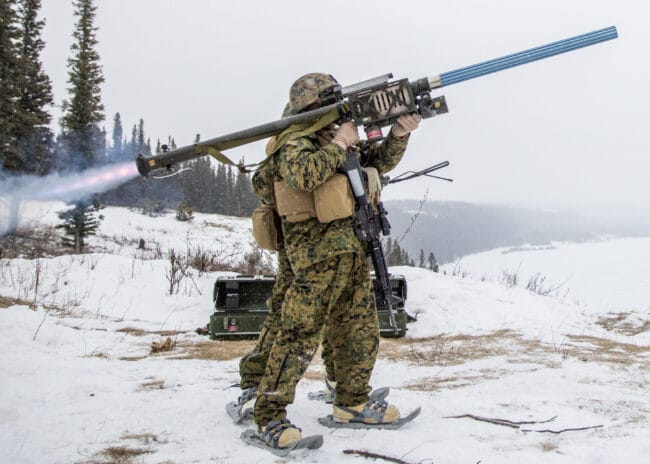
U.S. Marines with Alpha Battery, 2nd LAAD Battalion fires a stinger training launch simulator as part of exercise Arctic Edge on Fort Greely, Alaska, on Mar. 14, 2018. The Marines are part of the U.S. Army Alaska-led Joint Force Land Component Command in support of Alaskan Command’s exercise Arctic Edge 18 conducted under the authority of U.S. Northern Command. Arctic Edge 2018 is a biennial, large-scale, joint-training exercise that prepares and tests the U.S. military’s ability to operate tactically in the extreme cold-weather conditions found in Arctic environments. (U.S. Marine Corps photo by Lance Cpl. Cody J. Ohira)
China’s expanding presence in the Arctic and its emerging cooperation with Russia — something on which the latter country is becoming increasingly reliant as its isolation and costs of the Ukraine war mount — can also be seen off the Alaska coast, the strategy document said. It mentioned joint Russia-China navy exercises held in 2022 and 2023 in international waters off Alaska’s coast.
The focus on China and Russia are important elements of the department’s Arctic strategy, which updates the previous strategy issued in 2015, said Iris Ferguson, deputy assistant secretary of defense for Arctic and global resilience.
“There has been quite a bit of change just over that last five years,” Ferguson said at a panel discussion held on Tuesday by the Wilson Center in Washington, D.C. The center is a nonpartisan research and policy organization that includes in its programs a polar institute.
Alaska is important to homeland defense, which is the top national defense priority, Ferguson said at the Wilson Center’s panel discussion.
“As it turns out, the Arctic plays an incredibly important role in homeland defense,” she said. “We have an immense amount of our own defense assets that reside in the Arctic region, especially in Alaska, not only to protect our homeland but also to protect from Alaska elsewhere.”
The newly released Arctic strategy calls for the department to maintain investments in Alaska infrastructure, among other goals.
Climate change, which has changed the land and sea even over the past five years, poses other challenges to the U.S. Arctic military position, the strategy document said.
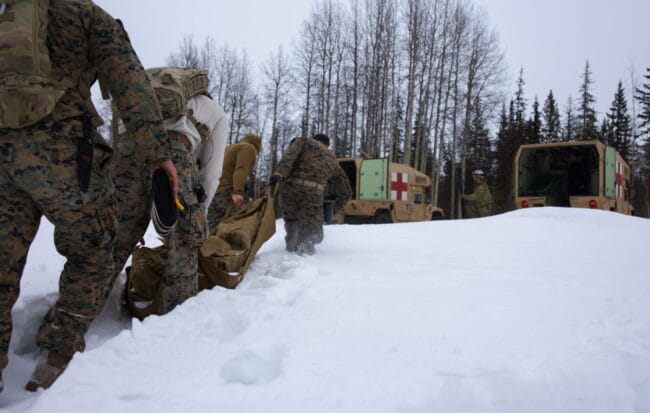
U.S. Navy sailors, hospital corpsmen with 1st Marine Division, I Marine Expeditionary Force, drag a casualty through the snow during a mass casualty drill in arctic conditions as part of exercise Arctic Edge 2024 (AE24) at Joint Base Elmendorf-Richardson, Alaska, March 5, 2024. (U.S. Marine Corps photo by Lance Cpl. Madisyn Paschal)
Ferguson, speaking at Tuesday’s event, said permafrost thaw and coastal erosion are compromising some facilities. Meanwhile, the retreat of sea ice is allowing for more ship traffic, she said. The accelerated melt of sea ice is having some other, lesser-known effects, she said. Research is underway to better understand how noises from thawing and melting ice, along with a bigger quantity of freshwater, might be affecting acoustic devices used by military forces, she said.
In contrast to the new threats that might be posed by Russia, China or those two nations working together, the U.S. Arctic position benefits from new alliances. Most significantly, Sweden and Finland have now joined NATO, strengthening the North American-Nordic collaborations.
Among those collaborations was the international military exercise Arctic Edge 2024, held in February and March in various parts of Alaska, which provided training on cold-weather operations. A parallel but related international exercise was held at the same time in Norway.
While the Arctic strategy emphasizes international collaborations, it also points to collaborations within Alaska that are with the state government, local governments, communities, tribal governments and other Indigenous groups.
The Department of Defense also partners with the U.S. Coast Guard on Arctic issues, Ferguson noted. She said the department is strongly supportive of the Coast Guard’s efforts to expand its icebreaking fleet, which currently consists of only two polar-class ships.
To that end, the White House earlier this month announced a new U.S.-Canada-Finland partnership to build more icebreakers. Called the Icebreaker Collaboration Effort, or ICE Pact, the partnership “is about more than the collective production of polar icebreakers and capabilities, including Arctic and polar-capable ships,” the July 11 White House statement said.
“It is about providing the capability for like-minded nations to uphold international rules, norms, and standards to sustain peace and stability in the Arctic and Antarctic regions for generations to come.”
North American Aerospace Defense Command fighter aircraft intercept one of the four military planes from Russia and China that entered airspace off Alaska’s coast on Wednesday. The identified and intercepted planes, two from each country, were operating in the Alaska Air Defense Identification Zone. It is international airspace, but NORAD tracks the aircraft that fly through it. (Photo provided by NORAD)
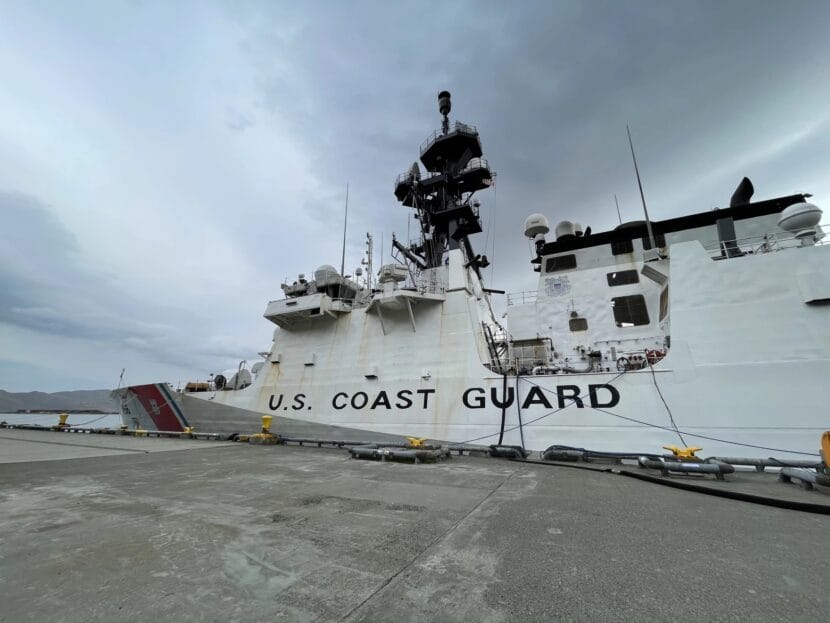
The foreign vessels spotted July 6 and 7 were following international law, and told Coast Guard personnel they were practicing “freedom of navigation operations.”
Coast Guard spokesman Lt. Cmdr. Michael Salerno said encounters with groups of Chinese vessels have been an annual occurrence in the Bering Sea since 2021, and Chinese naval ships have been spotted in the area since 2017. He said he didn’t have information about encounters with Chinese vessels prior to that.
In 2021, the Coast Guard spotted four warships in the region. About a year later, the Coast Guard cutter Kimball stumbled upon Chinese and Russian military vessels traveling together near Kiska Island. Then in 2023, U.S. Navy warships were dispatched to the Aleutians, after 11 Chinese and Russian military vessels were found operating in the region.
The latest four ships were in international waters inside the U.S. Exclusive Economic Zone, an area up to about 200 nautical miles offshore, where the U.S. has jurisdiction over natural resources.
The crew of the Kimball detected three of the latest ships 124 miles north of Amchitka Pass in the Aleutian Islands. Crew on an HC-130J airplane found another ship northeast of Atka Island.
None of the ships broke any international rules or norms. Still, the 418-foot Kimball contacted the Chinese vessels to ensure there were no disruptions to Alaska’s coastline or national interests. The Kimball continued monitoring the ships until they entered the North Pacific Ocean, south of the Aleutians.
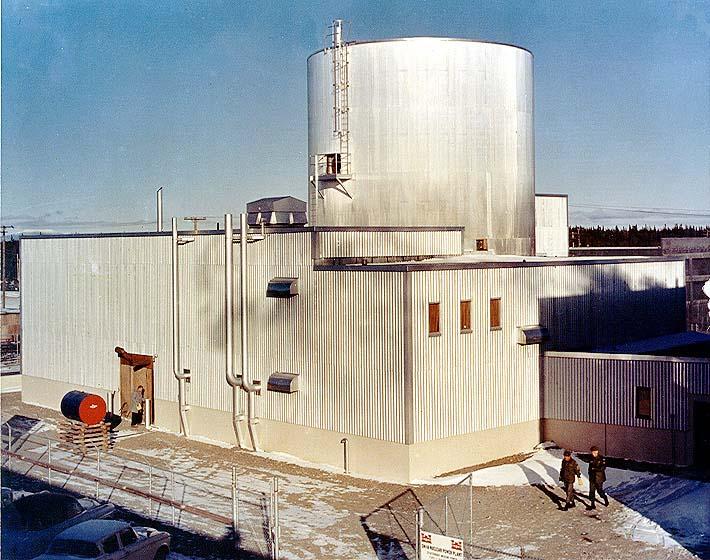
Many of the nuclear-power components of the old SM-1A are encased in concrete in the building that still stands at Fort Greely. (U.S. Army photo)
The Army Corps of Engineers has decided to begin demolition of Fort Greely’s long-mothballed nuclear power plant this summer, a year earlier than planned. That means trucks will begin hauling construction debris off-site this fall.
The SM-1A nuclear power plant was taken off-line back in 1972, and the most radioactive reactor components were removed. More than 50 years later, the building that housed the reactor is scheduled for demolition.
On Tuesday, the head of a Corps of Engineers team in charge of the dismantling and decommissioning project gave a tour of the old power plant for a group of state and federal elected officials’ staff.
Program Manager Brenda Barber provided a project update, including Corps of Engineers decision to delay enclosing the buildingin a big tent to facilitate year-round work.
“We’ve had some challenges with respect to getting that up and running,” she told staff from U.S. Sen. Lisa Murkowski’s office and from state Rep. Ashley Carrick and state Sen. Robert Myers. Rep. Mike Cronk also participated in the tour.
Barber said the original plan was to erect a large weatherproof enclosure on top of shipping containers, but that raised concerns about potential earthquake, snow and wind damage, “and whether or not that weather enclosure would stay stable on top of those conexes during some of the severe weather that occurs here.”
That led the Corps’ team to reconsider how to cover the plant with the enclosure, and the vapor containment or VC structure that towers over facility.
“That means we have to eliminate some of the height concerns, particularly with the vapor containment structure,” she said, “so that the tent can completely encompass the site, the way we intended it to do.”
Barber says the Corps’ team now proposes to partially dismantle the VC structure and remove an old quonset hut next to the plant this summer and set up the enclosure over the site next year. Demolition work would then continue through the winter. Barber says the “re-sequencing” of the work includes moving up asbestos removal to this year.
“So this means that the community on base will see some demolition activity that we originally hadn’t planned to do this year,” she said in an interview after the tour.
The work requires the Corps to monitor the demolition waste for asbestos and low-level radiation sooner than initially planned.
“That will include all of our environmental monitoring and all of our radiological monitoring on very early, in August,” she said.
The materials being removed and taken off-site are classified as low-level radioactive waste. But initially, some of the waste will be inert, she added.
“All the debris that’ll be leaving now will be just metal from the demolition, some wood debris – basically construction debris.”
Barber says the Corps needs approval from the Army Reactor Office before work under the new schedule can begin. If they get the go-ahead, demolition will start this summer with trucks hauling away debris starting in the fall.
“So it’ll be a truck carrying what we call an intermodal container,” she said. “It’s very similar in size and look to a SeaLand container that you’d typically see on a barge.”
An average of two trucks per week will transport containers to Fairbanks, where they’ll be transferred to Alaska Railroad cars for delivery to Anchorage or Whittier. From there, they’ll be barged to Seattle, then railroaded to a hazardous waste facility in Texas.
Barber says the re-sequencing of work should enable the Corps to complete the dismantling and decommissioning of the power plant by the end of 2029, the previously set goal.
She says the agency will hold public meetings on the new schedule in July or August to let the public know about the new plan for dismantling the old SM-1A.
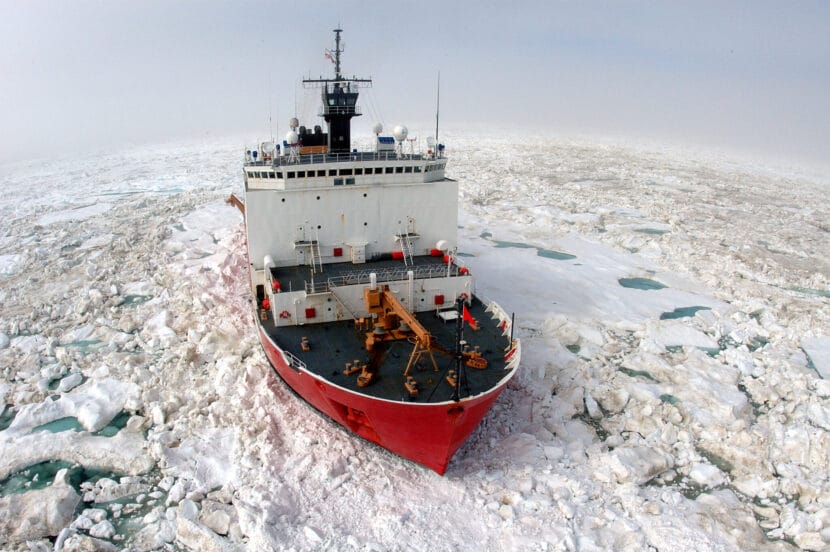
The U.S. Coast Guard Cutter Healy, a 420-foot icebreaker homeported in Seattle, breaks ice in support of scientific research in the Arctic Ocean during a 2006 cruise. The Healy is now on its way to Alaska and scheduled to complete three missions this year, including a sailing through the Northwest Passage to Greenland. (Photo by Petty Officer Second Class Prentice Danner/U.S. Coast Guard)
The U.S. Coast Guard cutter Healy, the largest U.S. icebreaker, is on its way to Alaska for the first of three Arctic scientific missions planned over the coming months.
The Healy departed on Wednesday from Seattle, its home port, the Coast Guard said. Its first mission will bring scientists to the Beaufort Sea to service underwater moorings, devices installed to collect information about oceanic conditions. Scientists on the mission will also survey the currents between the Bering Sea and the Canadian Beaufort Sea. Other work to be conducted includes monitoring of Arctic algal blooms, the Coast Guard said.
In its second mission, the Healy is scheduled to carry early career scientists on a cruise through the Northwest Passage to Greenland. That mission is intended to train scientists in Arctic research practices and is modeled after a similar mission conducted last year on the Sikuliaq, a research vessel owned by the National Science Foundation and operated by the University of Alaska Fairbanks.
The Healy’s third scheduled mission is to gather data for the Global Ocean Ship-Based Hydrographic Investigations Program, an international scientific program established in 2007. That work will collect high-resolution data across the Arctic basin, the Coast Guard said.
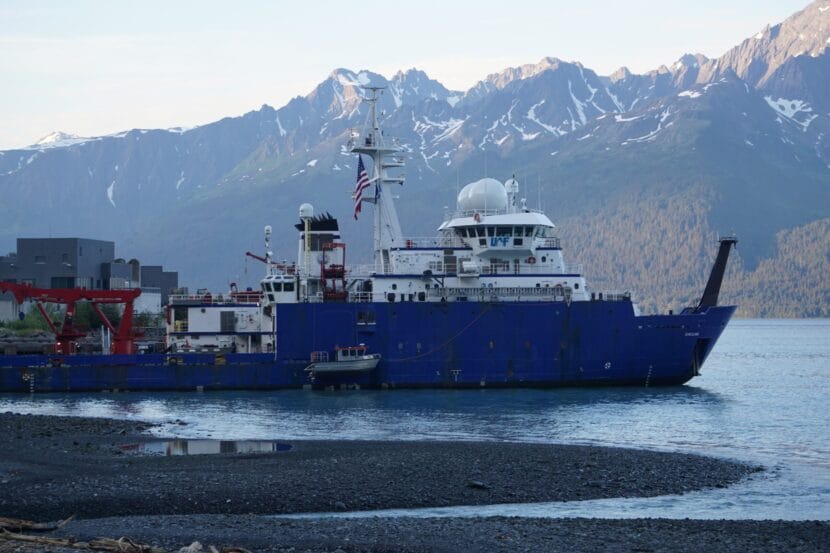
The research vessel Sikuliaq, owned by the National Science Foundation and operated by the University of Alaska Fairbanks, is docked in Seward on the evening of July 4, 2022. The Sikuliaq’s 2024 research cruises are already underway. (Photo by Yereth Rosen/Alaska Beacon)
“We are excited to support three significant missions in the northern high latitudes,” Coast Guard Capt. Michele Schallip, the Healy’s commanding officer, said in a statement. “Two of these missions are part of long-standing data collection projects, aimed at enhancing our understanding of a changing Arctic. The third mission is dedicated to inspiring future principal investigators who will continue this important work.”
At a time when scientific interest in the Arctic Ocean is intensifying, the Healy “substantially enhances” U.S. Arctic research capacity, she said. “Healy’s crew have been unwavering in their efforts during our in-port maintenance period, ensuring the cutter is ready to meet the demands of these missions,” she said.
The Healy, which is designed to break through ice up to 4.5 feet thick, is one of only two operating polar-class icebreakers owned by the Coast Guard. While the Healy generally works in the Arctic during the summer and fall supporting scientific research and other purposes, the Coast Guard’s other polar icebreaker, the Polar Star, is usually assigned to the Antarctic.
The Seward-based Sikuliaq, which completed some West Coast missions in the spring, has already been deployed in the Gulf of Alaska to continue long-term research there. The Sikuliaq has Alaska research cruises scheduled through September.
The Sikuliaq, which is named for the Inupiaq term meaning “young ice,” is designed to sail through relatively thin ice.
Other ships are also scheduled to conduct research cruises to collect information about fish stocks, whales, seabed features and sea ice, among other subjects, according to the Interagency Arctic Research Policy Committee.
A May 28 problem with an F-16 Fighting Falcon like this alerted the pilot of the jet fighter from Eielson Air Force Base’s 18th Fighter Interceptor Squadron to declare in in-flight emergency and return to base. (Eielson Air Force Base)
Eielson Air Force Base investigators are looking into the cause of an in-flight emergency that required an F-16 fighter pilot to jettison the plane’s fuel tanks shortly after taking off from the base last month. Meanwhile Eielson officials also are also preparing to remove contaminated soil from the off-base area where the tanks hit the ground.
Soon after the F-16 returned to base on May 28, Eielson officials began what’s likely to be a six-month process of determining what caused the pilot to declare an in-flight emergency. And to ensure the problem doesn’t happen again.
“The main point of conducting a safety investigation is to prevent future mishaps,” says Master Sgt. Daniel Douglas, the 354th Fighter Wing’s Flight Safety noncommissioned officer.
Douglas said in an interview last week that he can’t comment on the ongoing investigation into the mishap. But he says it’s an exhaustive process that includes interviewing those involved, examining the aircraft and double-checking initial findings with a second set of experts.
“Safety investigations are very thorough,” he said. “We don’t want to overlook anything and so we give every piece of information, every point of evidence its due diligence.”
An Eielson news release says the F-16 pilot declared an in-flight emergency just after takeoff and then jettisoned the plane’s two fuel tanks, before returning to base. Douglas says that’s done to reduce the weight of the aircraft and reduce risk of fuel further endangering the pilot and emergency personnel on the ground. No injuries were reported. The fuel tanks hit the ground in an uninhabited area about a mile and a half west of the base and east of the Tanana River.
Jettisoned fuel tanks fell on Mental Health Trust Authority land
The site is on land administered by the Alaska Mental Health Trust Authority, says Lt. Col. Christopher Higgins, who commands Eielson’s 354th Civil Engineer Squadron.
“It is densely wooded,” he said, “and so, we’ve kind of cordoned-off that entire area.”
Eielson officials asked that the exact location remain confidential, to ensure the safety at the site. Higgins says the 1.5-square-mile area includes the spots where the tanks were found and surrounding land that also may have been contaminated by JP-8 jet fuel that leaked from the two ruptured 370-gallon tanks after impact.
“We want to ensure that we’ve captured all of that fuel,” he said, “so we’ve given ourselves a little bit of a buffer to make sure that there’s enough space there.”
The base’s civil engineers will work with a contractor to clear the site and excavate all the contaminated soil, he said. It’ll then be loaded onto trucks that’ll take it to a facility that treats contaminated materials. That’ll probably be the one in Moose Creek, but that’s still not yet decided.
Higgins says the cleanup will comply with all state and federal regulations, which also mandate long-term monitoring of the site.
“I would expect that we will be required to continue to do follow-on testing for multiple years,” he said.
Eielson spokesperson Capt. Faith Hirschmann says base officials take their responsibility to protect the environment seriously.
“We’re really just committed to keeping our airmen and the community and everybody safe, while we do our mission and our training,” she said.
Douglas, the Flight Safety NCO, says it’ll probably take about six months to complete the investigation and issue a final report.
Close
Update notification options
Subscribe to notifications
Subscribe
Get notifications about news related to the topics you care about. You can unsubscribe anytime.