Mental Health

5 simple (and cheap) ways to feel better on dark winter days in Alaska

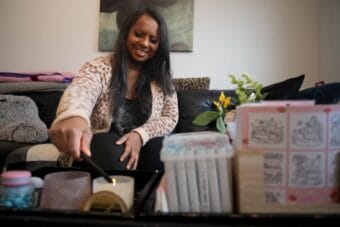
A woman in a sweater lights a candle.
Rani Malone, who works in mental health support at Alaska Behavioral Health, winds down with rituals that support sleep at her home on Oct. 31, 2025. (Matt Faubion/Alaska Public Media)

Winter in Alaska isn’t just cold. It can feel like the sun barely shows up. I wake up, and it’s dark. I go to work, still dark. By the time I drive home, it’s dark again. Every winter, those long, dark days can drag me into the winter blues — grumpy mornings, sadness and low energy.

This year, I wondered: How could I feel better during Alaska’s long, dark season without a huge effort or blowing my budget?

For this Alaska Survival Kit, I talked to two experts who shared five simple strategies.

1. Turn your bedroom into a cave

Debby Maloney, a nurse practitioner at Vitae Integrative Medical Center in Anchorage, said she sees many of the same patients each year as winter begins, seeking help for symptoms of seasonal depression. She said prevention is key because it’s easy for some people to descend into the winter blues by letting small things slide.

“We stay in bed longer,” she said. “We don’t take care of ourselves as well. We’re not exercising as much. We’re not eating the same foods and we start getting into this very slow decline, into this depressive state.”

So how do we avoid this fate?

It starts with where you sleep, Maloney said. She said you want to transform your bedroom into a cool, dark cave.

“Our bodies actually sleep better if we’re in a more cool environment,” Maloney said. “So cool, dark, cozy.”

She recommends turning your thermostat down by as much as 10 degrees at night.

Rani Malone hangs eucalyptus in her shower, using aromatherapy as part of her evening routine to combat seasonal depression symptoms. (Matt Faubion/Alaska Public Media)

2. Wake up with bright lights

To turn off the sleep hormone melatonin, you need light — and lots of it. With no morning sun in the winter, Maloney said your best bet is to use sun lamps, which mimic daytime brightness.

Maloney said she doesn’t have seasonal affective disorder, but she still uses the lamps to help with her energy and mood.

“Getting that bright light in your eyes within the first hour of waking up, [for] 20 to 30 minutes, it’s been a game changer for me,” Maloney said. “I don’t have that afternoon crash.”

If you’re on a budget, thrift stores or secondhand marketplaces usually have some of the lights for sale. Also, the hardware store sells more affordable light bulbs that simulate sunlight.

3. Don’t skip exercise

Maloney said even gentle exercise tells your body it’s time to wake up and you don’t need to be a super athlete to benefit.

“I used to tell some of my elderly patients that, if we can’t go outside and walk, maybe go to your favorite store and just walk around the perimeter,” she said. “Just get some exercise.”

4. Check in and reach out

Rani Malone, who works in mental health support at Alaska Behavioral Health, didn’t do anything special during seasonal changes as a kid growing up in Palmer. But as an adult, she’s leaned into self care in the winter to boost her mood.

One of her favorite tips is simple: Check in with neighbors and friends. It’s good for you and good for them.

“Asking people how they’re doing and trying to just connect and and plan things — social connection is going to be a huge thing that’s going to help you get through the season,” Malone said. 

Mental health advocate Rani Malone demonstrates self-care practices she recommends to Alaskans struggling with winter darkness, including creating calming evening rituals at her home on Oct. 31, 2025. (Matt Faubion/Alaska Public Media)

5. Visualize the good. Repeat.

But it’s one thing to know that we should be doing these things, and another to make yourself do them in the winter, even if you don’t feel like it. Malone said to motivate yourself, visualize the good that will come out of it.

“Thinking of, what’s your overall goal?” she said. “So just, doing the opposite of what you naturally want to do, which is stay in bed and stay warm.”

She said the more you do a healthy routine, the easier it gets. And she would know. Her elaborate night routine includes winding down with aromatherapy and a shower with eucalyptus, dim lights, journaling and sipping a nightcap magnesium drink.

But she said self care like that isn’t always enough. Malone said to get professional help if you notice these signs:

“If you’re having a hard time getting out of bed multiple mornings, and it’s now turned into weeks, and you’re missing work, or you’re missing your responsibilities of taking care of your kids or your household,” she said.

And she said it’s really important to reach out for help if you’re thinking of harming yourself or others.

This story is part of Alaska Public Media’s Alaska Survival Kit series. 

For many Alaskans seeking addiction treatment, help starts with someone who has been there

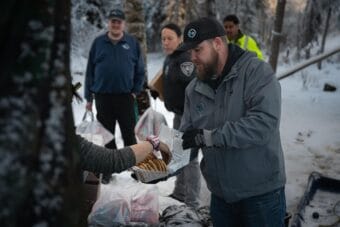
A man in a grey jacket offers a plastic box of cookies to a person out of frame.
Josh Engle, manager and peer support specialist at True North Recovery in Wasilla, gives out cookies as part of homeless outreach efforts in Anchorage on Tuesday, Nov. 25, 2025. (Matt Faubion/Alaska Public Media)

Josh Engle was bundled up on one of the first frigid days in October, walking along a forest path to do outreach in a homeless encampment in Anchorage. He approached a man in a weathered coat near several tents and a makeshift structure.

“How long you been out here on the streets?” Engle asked.

“Too long,” the man said.

“You connected with any resources?” Engle asked. The man described the tarp and blankets he’d been able to get.

Engle, a manager and peer support specialist at True North Recovery in Wasilla, hoped to guide people into recovery, if they showed interest. It’s a path Engle knows well because he’s in long-term recovery himself, so he understands how fleeting the window of opportunity can be when someone decides to seek treatment.

Engle supports people in ways that go well beyond what a more traditional therapist or psychiatrist can do. He may text with clients outside business hours, help them find work or get connected with benefits–anything that might lead to recovery. Peer support specialists like Engle — people in recovery themselves— can help people recover from both serious mental illness and substance use disorders, and can reduce healthcare costs.

“I personally really enjoy being able to connect with them on a personal level (as) someone that has walked their path and been in their shoes and ultimately have struggled the way that they’re currently struggling,” Engle said.

Josh Engle carries bags of food to an encampment for outreach in Anchorage on Tuesday Nov, 25, 2025. He hopes to talk to people who are interested in recovery. (Matt Faubion/Alaska Public Media)

True North Recovery, where Engle works, aims to hire people with lived experience in recovery not just as peer support specialists, but for every role–from receptionists to health care providers. Research shows that when patients interact with workers with lived experience, it aids recovery.

Peers can sometimes say and see things people without lived experience can’t.

Aaron Surma, executive director of the National Alliance on Mental Illness, or NAMI, in Juneau, trains peer support associates. Surma also experiences mental illness himself. He said psychiatrists and mental health professionals play an important role in supporting recovery and treatment, but there is a strong power difference.

“You’re in a small room, you’re making intense eye contact, and the dynamic is that you have the expert and the person who needs help, and the experts are taught to not really share about themselves,” Surma said. “Which makes it feel really one sided. It makes you feel like you’re being judged and evaluated.”

Surma said he was arrested multiple times during high school and was court-ordered to go to Alcoholics and Narcotics Anonymous meetings. He said hearing peers in those groups was awesome, but things felt different when talking with his formal providers.

“When I was a teenager, I was lighting stuff on fire and buying garbage bags of weed,” Surma said. “So then to go into a small room and talk to somebody who- imagine the counselor from South Park who’s saying ‘Drugs are bad, mkay?’ and it’s a million miles from what you know.”

He said it’s easier for peers to bridge those gaps in early recovery. Peer support specialists speak the language of addiction and mental illness and also understand the more traditional language of behavioral health professionals.

He said typically those professionals–like therapists and psychiatrists–dole out care in ways that are convenient for the health care system. But peer support is different.

“Recovery isn’t just supported in small doses from paid professionals, but it can also happen on our own time, in places that are comfortable to us, in settings that feel more accessible and from people who feel more approachable,” Surma said.

He said peer support relationships don’t have to be formal and the role can also be incredibly healing for the person providing the support. The hard times and challenges someone has faced suddenly have value, if those experiences help someone else.

“The sense of purpose is incredible,” Surma said. “I talk openly about having been suicidal and how to address depression, and people come out of the woodwork because they know that the door is open.”

That sense of purpose is also something peer support specialist Engle has felt deeply in his work.

“There is no way you could have convinced me 10 years ago that all of the damage and chaos that I was causing in people’s lives, my loved ones, people I just would cross paths with, that I would be able to use any of that for good,” Engle said. “I thought that was just going to be like a stain on my soul for the rest of my life.”

Instead, now his struggles are a tool to help people and do his job.

At the Anchorage encampment, Engle approached a couple’s tent. They said they were interested in a detox program but wanted to go together.

“It’s gonna be tough,” Engle said. “But what we can do is we can line it up so, like, beds on the same date. They’re just going to be different programs.”

But the couple said they had more to do before committing to detox.

“I swear, every single time we talk: ‘almost there, almost there.’ I know you are,” Engle said, his voice taking on the loving but firm tone of an older brother.

It wasn’t enough to get them into a program, but he’ll be back working to make their next steps in recovery as easy as possible when they’re ready.

Tongass Voices: Juneau’s mobile crisis responders on meeting patients where they’re at

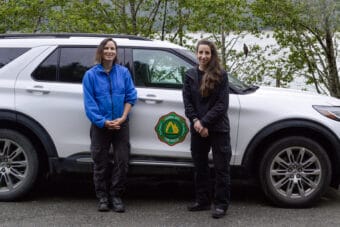
Two women stand smiling by a car marked "Capital City Fire/Rescue." Meghan DeSloover and Sarah Zaglifa respond to mental health emergencies in Juneau as part of a new mobile crisis team. July 1, 2025. (Photo by Yvonne Krumrey/KTOO)
Meghan DeSloover and Sarah Zaglifa respond to mental health emergencies in Juneau as part of a new mobile crisis team. July 1, 2025. (Photo by Yvonne Krumrey/KTOO)

This is Tongass Voices, a series from KTOO sharing weekly perspectives from the homelands of the Áak’w Kwáan and beyond.

A new mobile crisis team has been operating in Juneau since November. Each team is comprised of a clinician from Bartlett Regional Hospital and an EMT from Capital City Fire/Rescue.

Meghan DeSloover and Sarah Zaglifa reflected on their role in filling some of the gaps in behavioral health care in Juneau. The first responders broke down how their unit helps get patients care on their own terms. 

The following transcript has been lightly edited for clarity.

Sarah Zaglifa: So this is what goes in the crisis bag. We have a resource binder with everything you can imagine, treatment applications, resource lists, different assessment tools. Is in there, clean socks for someone who’s walking around in wet socks. That’s never a healthy thing, so I always keep a stash. I’m Sarah Zaglifa, and I’m a licensed clinical social worker on the mobile crisis team.

Meghan DeSloover: My name is Megan de Slover, and I am a community health specialist with Capital City Fire/Rescue and an EMT, and I work on the mobile crisis team.

I’ve been working with the fire department since 2018 just naturally, being a part of the mobile integrated health team, I have become a part of the mobile crisis team. We’ve done a number of trainings to prepare us for this, and so that’s how I’m here.

Sarah Zaglifa: So I got involved in mobile crisis way back in the 90s, believe it or not, I got my master’s degree way back then. I was living in San Francisco and part of the domestic violence task force there, and really immersed into crisis work at that point, and was married to the military. We relocated. Were stationed in Alaska, decided to settle here and wanted to commit to the community. I was working at Bartlett in the emergency department for four years. Then I worked in behavioral health and a little bit in oncology, and then when this program started getting up and running, I really wanted to get back to my crisis roots, because it’s the best job. Love it. 

Meghan DeSloover: I learned that we have a huge need in this community for assistance, and that there isn’t always money and there aren’t always avenues, and there aren’t always people to fill those roles. So I’ve just, I’ve been really thankful to be a part of this, because I feel like our role has been very helpful.

Sarah Zaglifa: I feel really inspired by Bartlett and other community partners like CCFR being very invested in the safety net of the community, and being part of the fiber of that safety net is really important. 

I think the best part about this position and where I’ve learned the most is how important it is to meet the patient – literally and figuratively – where they’re at. Your assessment is so much more rich and respectful when you’re on their turf and you are their guest versus the natural change in dynamics when you’re in an emergency department or in more clinical setting, 

I feel really proud of how our team as co-responders can just sit with someone and just be with them and whatever It is they’re in with no agenda, with no pressure.

Meghan DeSloover: We don’t fix everything for everybody. Certainly that’s not even the goal, because it would be impossible. But just people feeling like, oh, I have someone else to reach out to. 

Sarah Zaglifa: I feel like crisis is an invisible illness. Behavioral health is an invisible illness. It’s not outward. So a lot of people, I think, can easily hide some of these things and not identify it as a crisis. And we come judgment-free to just see where we can go with what we have. 

There’s plenty of times we go on a call thinking it’s about one thing, finding out the root is actually something very different, and we can work on that root. Or maybe the person’s not ready to open up to complete strangers, and so we can offer other types of support, and then maybe follow up with them. Or now, now they know us, and when they call, we’re not starting from square one. 

Utqiagvik residents gather to share joy and loss during this year’s whaling festival

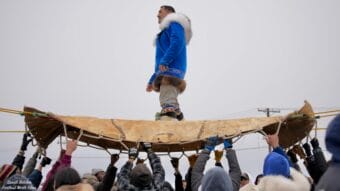
Quincy Adams prepares to jump on a sealskin blanket during Nalukataq festival in Utqiagvik in June, 2025.
Quincy Adams prepares to jump on a sealskin blanket during Nalukataq festival in Utqiagvik in June, 2025. (Photo courtesy of Sarah Betcher/Farthest North Films)

Back in June, whaler Quincy Adams soared above a seal blanket at Simmonds Field in Utqiagvik, with a bag of candy in his hands. He leaped even higher and tossed the kaleidoscope of sweets, as the children around him whooped with joy and caught treats.

Quincy and his wife Bernadette Adams are the captains of the Aaluk whaling crew. They were among those who landed a bowhead whale this spring and threw a feast for the community – especially for elders and widows who can’t hunt for themselves.

“It’s all for the community, not just for us or our crew,” Quincy Adams said. “It’s to make sure everybody gets a bite to eat, to make sure that nobody goes hungry.”

Several coastal Arctic communities – including Utqiagvik, Point Hope, Wainwright, Nuiqsut and Kaktovik – hosted festivals throughout June to celebrate a successful whaling season. The event is often called Nalukataq, or blanket toss in Iñupiaq.

The Brower family enjoys muktuk during the 2025 Nalukataq in Utqiagvik. (Photo courtesy of Sarah Betcher/Farthest North Films)

In Utqiagvik, the festival this year spanned four days and included feasts, prayers, dance and a traditional blanket toss. Each day, the whaling crews served several courses of subsistence dishes: caribou, duck and geese soup, doughnuts, boiled whale meat, muktuk, akutaq, and a delicacy – fermented whale meat and blubber, or mikigaq.

Everyone on the crew had a task, even teenagers and children who helped serve coffee and tea. Flossie Nageak celebrated her 70th birthday on one of the Nalukataq days and said that having children participate helps them learn Iñupiaq traditions.

“We work together, trying to teach them our tradition,” she said. “We need to let them get into subsistence. They’ll be next in the future.”

When the feast was over, the whalers stretched a sealskin blanket, inviting everyone to jump on it. Then, the crowd moved indoors and continued with Iñupiaq dancing and drumming throughout the night.

Several whaling crews join in a traditional Inupiaq dance during Nalukataq. (Photo courtesy of Sarah Betcher/Farthest North Films)

This year’s Nalukataq also had an emotional side for Adams. A young member of his crew died by suicide earlier this year, and the crew dedicated their whaling season to him. They also opened one of the days of Nalukataq with a prayer and a message of hope.

Adams said it is still hard for him to process the loss of the crew member who was hardworking and always eager to learn.

“He always liked to learn, always asking, ‘What’s next?'” Adams said. ” He was a young man just starting his life out.”

Adams said his sons were friends with the young man and are struggling too, so he is encouraging them to share their feelings.

Historically, suicide rates in the North Slope region have been high compared to more urban areas and Alaska as a whole, according to data from the borough. Adams said he is worried about young people who have a hard time seeking out help.

“It’s just something we wanted to get out to the other people and to the young people and the teens, tell them that there is hope, there is family that loves them,” Adams said. “If they need to talk to somebody, talk to somebody.”

Nalukataq festival in Utqiagvik in June, 2025. (Photo courtesy of Sarah Betcher/Farthest North Films)

Whaling captain Herman Ahsoak said that dedicating Nalukataqs to those who passed is not new. He said the event is about the community coming together.

“We put on the blanket and jump,” he said, “and let it all out on the blanket and just jump for joy.”

If you or someone you know is in crisis, contact the 988 Suicide & Crisis Lifeline via call, text or chat.

A retiring Juneau first responder says mobile crisis units get care to the community

Joe Mishler has managed Capital City Fire/Rescue’s CARES program for the last six years. He’s retiring this month and he says the program helps people connect with what they need, instead of repeated emergency room visits. June 5, 2025. (Photo by Yvonne Krumrey/KTOO).

Joe Mishler has been an emergency responder for more than 40 years, about half of which he spent in Juneau. He’s retiring at the end of the month to take care of an aging family member. 

Mishler has spearheaded a team of mobile response units called Community Assistance Response and Emergency Services, or CARES, that address needs that can fall through the cracks. Things like follow-up medical care, housing support or substance use treatment. He says the program evolved out of in-home care during the COVID-19 pandemic. 

The teams can meet people where they are — at home, at a shelter, or on the street. 

KTOO’s Yvonne Krumrey met him at his office at the fire station to ask about what he learned, and what mobile response units do for the community.

The following transcript has been lightly edited for clarity.

Joe Michler: Basically, I oversee all of — it’s kind of like the non-emergency portion of the fire department. 

And basically we call it MIH, the Mobile Integrated Healthcare program, developed out of that. I think part of the reason it’s accepted and been as successful as it has is because it’s basically needs driven.

We identify needs. We identify from case management, from the hospital and from the clients. We talk to our patients and we determine what it is that they need, versus saying, “Hey, we have a program and we’re going to put this out onto the community.” It’s basically grown from the community.

Yvonne Krumrey: And I think one thing that really stands out about these this program is that it’s essentially kind of, I think, filled a lot of the gaps that sometimes city services can have with a little bit more as you say that it’s both medical care, social work and emergency response kind of in the same moment. And I feel like there’s not a lot of services that can often provide exactly that for somebody. And I’m wondering, how has the response been?

Joe Mishler: The response has been tremendous. Been very well received by the community.

We have some clients that we see that there’s really no other service for them, but we’re continuously getting referrals. 

We look at why they’re using the emergency services, and then try to try to help them solve their problem and make them self sufficient, so that we’re not continuously being their resource. 

So anyhow, there’s a lot of the times the resources are already here. People just don’t know about them. 

And you know, the biggest thing is, we think that we as paramedics save lives, and really, if we would approach—that’s where burnout comes from—because so much of what we do on the ambulance Isn’t life saving, but what we really do is we help people. 

Every crisis is different. But that’s what’s neat about this program, is so often in the ambulance, we simply pick them up, you’re not dying, shuffle you to the ER, there you go, go back out and do it again. Do it again and do it again. And here we actually get to try to figure out what’s going on and stop the cycle. We actually try to help people resolve things, you know?

Yvonne Krumrey: You know, do you get to see a lot of that, like resolutions for folks? 

Joe Mishler: Yeah, yeah. It’s very rewarding work. Since we’ve started, we’ve had very, very little turnover. The people really like the job they’re doing: meeting the people and developing relationships.  And a lot of the people we’re taking care of are very seriously ill. Many of them are at the end of life. And so we’ve had many of our clients over the years, over the last few years that have passed, and that’s that’s difficult. 

Yvonne Krumrey: Are there any moments you’ve had over the last 40 or so years that really stood out to you, like why this work matters so much? That really reinforced why you do what you do? 

Joe Mishler: One of the things that kind of stands out in my mind is over the years that I found out that little things that I’ve done, they really were, in my mind, no big thing. But someone else, it was huge. And I’ve had people thank me for things, or come back or or even talk about things, but a lot of times it’s the little things and just being nice, nice to people and helping them take care of them when they’re having a really, really, really bad day, that probably does as much in helping people as all of the medical training and everything else that we do.

Many Alaska families face political differences. A therapist discusses how to address them.

Caitlin Andrews and Guinness the therapy dog in her office at Oilean Wellbeing in Ketchikan. May 1, 2025. (Jack Darrell/KRBD)

Living in America right now can feel like you and your dad are trying to fix a car, but you can’t even agree on where the engine is. And neither one of you can fathom how the other could’ve been so wrong this whole time and still drive a car. So you’re glaring at each other, white-knuckling a wrench — and the car’s still broken.

It’s not just you. The Pew Research Center says the political and ideological divide in the U.S. is wider now than it’s been in decades. And in a small town in Alaska — especially one you can’t drive away from — it can feel like there’s no escaping the conflict.

Ketchikan has seen a lot of demonstrations lately. There have been protests and rallies against and for the federal government, the mass firings, abortion, and just Donald Trump in general.

When I talked to people at the protests and rallies, though, one thing stood out. Lots of people talked about resenting people they love because of their politics. They talked about how much it sucks, and how exhausted they feel.

Believe it or not, reporters feel that tension too. So I fired off some emails to family therapists in town. “I need your expertise on navigating pressure points,” I wrote.

I told them I wasn’t comfortable with how reactive and angry I felt, and I didn’t think I was alone. I said I wanted to know if there was a way to not feel that way.

One therapist responded immediately.

“I believe there are a few of us who would appreciate talking about this topic,” she wrote. “It’s certainly at the forefront of my life currently, both with clients and personally.”

_______

Caitlin Andrews has tea and a noise machine in her waiting room. Her enormous therapy dog, Guinness, snoozed in a big armchair next to me while we talked.

Andrews’ practice is called Oilean Wellbeing – that’s Irish for “Island.” She says that in a small island town like Ketchikan, the cavernous political divide “just feels really heavy.” And she says alienation from others in the community is something her clients have been experiencing more and more.

“This is huge. I mean, the week of the elections, that was all my clients talked about. It was affecting everyone in one way or another – whether arguments with their family, not seeing eye to eye, or feeling like their household was going to be affected,” she said. “Those are all really, real things that I think therapists across the country are faced with right now.”

Andrews is a family therapist and works with people across the political spectrum. Many of her clients are teenagers and their families. She says when it comes to religion and politics, everyone needs supportive people to talk to.

“Find the people that you can have constructive, healthy discussions with,” she said. “It’s sad that it can’t be, like, the people you’ve always had in your life — but that’s just life.”

Andrews says it’s normal to feel anger towards the people closest to you, but we should ask ourselves what’s under the surface.

“Anger is not ever by itself. It’s a secondary emotion. There’s always something causing anger,” she said.

None of this is simple. Andrews says it’s important to stand up for what you believe in, but if you care about the other person, it matters how you do it.

“The important part is being able to circle back and talk about that,” she said. “If they’re emotionally mature enough and saying ‘Hey, I want to talk about what happened with our conversation.”

Still, it’s easy for both people in a political argument to take it as a personal attack.

“Especially with family, sometimes people have a hard time separating what they’re supporting versus it being about them,” Andrews said. “Sometimes, when we are upset with another person, it’s projecting something like rejection.”

And Andrews says that sometimes, protecting yourself can mean drawing a line and taking painful topics off the table.

“Go in prepared to say, ‘This is getting ugly, and I love you too much. We’re gonna have to stop talking about this topic,’” she said. “That’s a boundary.”

Some degree of pain is often built into the foundations of family relationships, but Andrews doesn’t advocate for her clients to tear it all down.

“It’s not all or nothing,” she said “I don’t think you have to cut someone off, but you have to really protect yourself.”

She says her clients often feel powerless, like no one is listening. But she told me that I’d already done step one: acknowledging I have a problem.

“That can sometimes be the hardest part,” she said. “A lot of people don’t take that responsibility. People come to me because they want to get better.”

And Andrews believes there’s one thing everyone can control: their reactions to the headlines and the people in their lives who may read them differently. And she says that’s a good place to start.

Site notifications
Update notification options
Subscribe to notifications