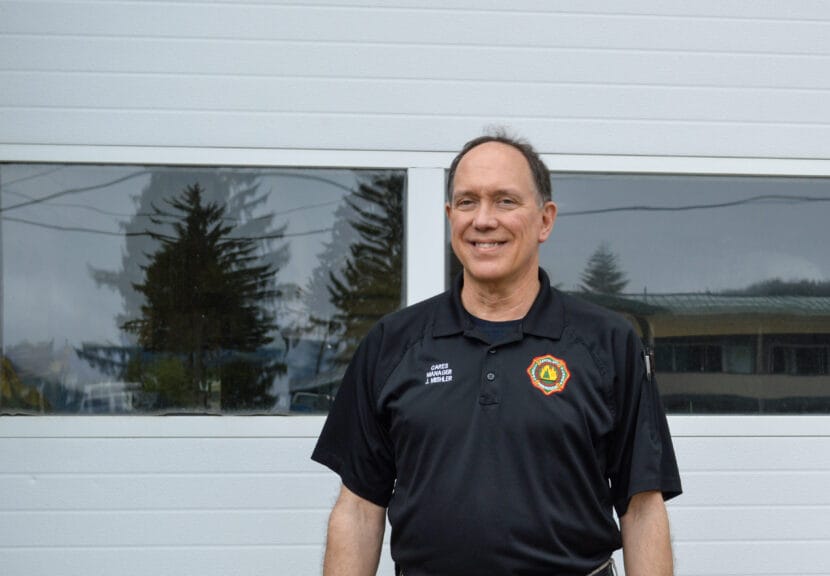
Joe Mishler has been an emergency responder for more than 40 years, about half of which he spent in Juneau. He’s retiring at the end of the month to take care of an aging family member.
Mishler has spearheaded a team of mobile response units called Community Assistance Response and Emergency Services, or CARES, that address needs that can fall through the cracks. Things like follow-up medical care, housing support or substance use treatment. He says the program evolved out of in-home care during the COVID-19 pandemic.
The teams can meet people where they are — at home, at a shelter, or on the street.
KTOO’s Yvonne Krumrey met him at his office at the fire station to ask about what he learned, and what mobile response units do for the community.
The following transcript has been lightly edited for clarity.
Joe Michler: Basically, I oversee all of — it’s kind of like the non-emergency portion of the fire department.
And basically we call it MIH, the Mobile Integrated Healthcare program, developed out of that. I think part of the reason it’s accepted and been as successful as it has is because it’s basically needs driven.
We identify needs. We identify from case management, from the hospital and from the clients. We talk to our patients and we determine what it is that they need, versus saying, “Hey, we have a program and we’re going to put this out onto the community.” It’s basically grown from the community.
Yvonne Krumrey: And I think one thing that really stands out about these this program is that it’s essentially kind of, I think, filled a lot of the gaps that sometimes city services can have with a little bit more as you say that it’s both medical care, social work and emergency response kind of in the same moment. And I feel like there’s not a lot of services that can often provide exactly that for somebody. And I’m wondering, how has the response been?
Joe Mishler: The response has been tremendous. Been very well received by the community.
We have some clients that we see that there’s really no other service for them, but we’re continuously getting referrals.
We look at why they’re using the emergency services, and then try to try to help them solve their problem and make them self sufficient, so that we’re not continuously being their resource.
So anyhow, there’s a lot of the times the resources are already here. People just don’t know about them.
And you know, the biggest thing is, we think that we as paramedics save lives, and really, if we would approach—that’s where burnout comes from—because so much of what we do on the ambulance Isn’t life saving, but what we really do is we help people.
Every crisis is different. But that’s what’s neat about this program, is so often in the ambulance, we simply pick them up, you’re not dying, shuffle you to the ER, there you go, go back out and do it again. Do it again and do it again. And here we actually get to try to figure out what’s going on and stop the cycle. We actually try to help people resolve things, you know?
Yvonne Krumrey: You know, do you get to see a lot of that, like resolutions for folks?
Joe Mishler: Yeah, yeah. It’s very rewarding work. Since we’ve started, we’ve had very, very little turnover. The people really like the job they’re doing: meeting the people and developing relationships. And a lot of the people we’re taking care of are very seriously ill. Many of them are at the end of life. And so we’ve had many of our clients over the years, over the last few years that have passed, and that’s that’s difficult.
Yvonne Krumrey: Are there any moments you’ve had over the last 40 or so years that really stood out to you, like why this work matters so much? That really reinforced why you do what you do?
Joe Mishler: One of the things that kind of stands out in my mind is over the years that I found out that little things that I’ve done, they really were, in my mind, no big thing. But someone else, it was huge. And I’ve had people thank me for things, or come back or or even talk about things, but a lot of times it’s the little things and just being nice, nice to people and helping them take care of them when they’re having a really, really, really bad day, that probably does as much in helping people as all of the medical training and everything else that we do.