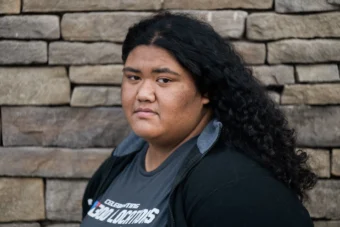
Tali Stone stands in the parking lot at the Hyatt Hotel in Anchorage on Monday, March 31, 2025. (Matt Faubion/Alaska Public Media)
Tali Stone was nine years old when her foster mother brought her to North Star, an acute psychiatric facility in Anchorage. Stone said she had been refusing to go to bed and got in a fight with her foster mom. She said her foster mom had talked about North Star before, as leverage sometimes if one of her nine foster kids wasn’t behaving.
“She always described it to me as a prison,” Stone said. “She said that they’ll lock you up. She said that it was moldy inside the building, like an actual prison.”
But this time it wasn’t an empty threat. Typically, to be admitted to a psychiatric facility someone needs to be at risk of suicide or violence, experiencing psychosis, or unable to care for themselves. Stone said during the intake, her foster mom exaggerated her behavior and lied that she was seeing ghosts.
“Even the staff said, themselves, ‘I’m not sure why you’re here,’” Stone said. “And I was like, ‘I’m not sure either.’”
Stone was at North Star for four weeks, according to her psychiatric records. And over the next two years, she was admitted to North Star a total of four times, each stay several weeks at a time.
Stone was one of the thousands of kids under the care of the Office of Children’s Services in Alaska, or OCS, who have spent time, sometimes unnecessarily, in acute psychiatric facilities. OCS is under-resourced, with a high staff turnover rate, and a serious shortage of foster families. The Department of Justice reprimanded the state in 2022 for overreliance on psychiatric hospitals and residential treatment, and the office has made improvements since then.
OCS officials did not agree to an interview for this story, but commissioner Kim Kovol from the department that oversees OCS, wrote over email that there is a lack of appropriate placements nationwide for youth with serious behavioral and emotional challenges. She wrote that they will continue to use “all existing services to the greatest extent possible,” and work towards the least restrictive care settings.
But Amanda Metivier, who runs the nonprofit Facing Foster Care, said that lack of placements means foster kids stay in psychiatric facilities for too long.
“They do an intake at a hospital, they get a diagnosis, and then they linger there,” Metivier said. “[It] used to be for months on end, but because of court cases, it’s now weeks.”
Right now kids have the right to a court hearing within 30 days of admittance, but the bill passed by the state House March 26 would reduce that timeline to seven days. That’s still much longer than many states, which require a hearing within 72 hours.
Timeliness is important because kids say these facilities are traumatic.
“What happens in these facilities?” Metivier said. “Children are physically restrained, chemically restrained, put in quiet rooms or in seclusion.”
She said even if kids in facilities don’t experience those directly, just witnessing them can be traumatic.
If the bill passes, when a child does get a court hearing, all people invested in the child’s care would have to be there: birth parents, foster families, tribes, behavioral health care providers and OCS. Every kid over ten would also have their own lawyer who could advocate for them being in the least restrictive setting appropriate.
State Representative Andrew Gray, who sponsored the bill, said there’s a lot at stake.
“The absolute human rights violation of having your freedoms completely taken away and no one coming to help you, that alone is enough that we have to fix it,” Gray said. “But, if you want to just look at it from a fiscal perspective, we’re wasting tons of money on keeping a child in the most expensive possible placement.”
He said inpatient care can cost more than a thousand dollars a night per child, a cost that is usually shared by the state and federal government.
The legislation didn’t pass last session when it included a shorter 72-hour time period before a required hearing, but Gray is optimistic it will pass this year. He said it’s important kids don’t get stuck in these places.
Metivier worked with kids in foster care to help draft the bill, and said it would add a sense of urgency to the process of assessing the care.
“We need to act quickly on either identifying a higher level of care or different therapeutic intervention, or releasing them,” she said.
Tali Stone, who entered North Star at age nine, didn’t get that kind of grace. She said she never got a hearing at all to assess whether she should be there. And she said her experience at North Star, totaling about four months, changed her from an outgoing kid to one who was reserved and numb.
“I didn’t have anyone else to tell me that you’re just a kid,” she said. “You’re just dealing with stuff that’s natural, if you’re going through this situation, telling me that I’m not a bad kid, that I’m loved, stuff like that.”
Stone said now, at age 19, about nine years after her last stay, she still feels the effects. She struggles with self esteem and self hatred.
But she recently got a job she loves, she said, with a coworker she admires.
“Every day, he’s just being himself, and I look up to him,” Stone said. “I want to know how that feels one day.”
She said she really hopes this bill passes. It now heads to the state Senate. She wants foster kids in institutions to know they’re not forgotten, and there are people out here looking out for them.
The Alaska State Capitol on March 25, 2024. (Eric Stone/Alaska Public Media)
Alaskans ages 16 and 17 would be able to consent to talk therapy under a bill introduced in the state Senate in February that would lower the age of consent from 18.
A parent or guardian would still need to consent to any medications.
Anchorage Republican Sen. Cathy Giessel, an advanced practice registered nurse, sponsored Senate Bill 90. She screens Anchorage children and teens for mental health issues and said only a third of parents typically consent when their kid requests therapy.
“I believe that students have a real understanding of their need for assistance, their need for counseling, their desire to talk to someone about the struggles they’re having,” Giessel said.
Typically, she said, major mental health challenges start around age 14, and when kids are struggling, they sometimes turn to harmful coping strategies like using nicotine, alcohol or drugs.
“By helping them early, we can head off more advanced issues later in their teen years, or even adult years,” Giessel said.
Most states allow minors to consent to mental health care. Several allow kids to consent at age 14, and two states at age 12.
Critics of the bill worry that therapists working with younger children will encourage them to identify as transgender, without parental knowledge. But peer-reviewed research has shown that kids do not identify as transgender because of so-called “social contagion.”
Meanwhile, experts say the United States is in the midst of a youth mental health crisis. Giessel said she sees that in her work, especially after the COVID-19 pandemic.
“Prior to COVID, I rarely had a student share significant anxiety, depression or even suicidal ideation,” she said. “During and after COVID, it has increased significantly more, and I think it’s a reflection, really, of what’s going on in our society. But I also think that parents are becoming less and less engaged with their kids.”
Parents and guardians are still the best people to talk to their kids about mental health struggles, and the bill is designed to include them, Giessel said. As written in the bill, therapists would be required to notify parents and guardians of the therapy after five sessions, unless the therapist and youth decide it’s unsafe or will threaten their care.
The bill is expected to head to the Senate Health and Social Services Committee within the next two weeks, where there will be an opportunity for public comment, Giessel said.
Daaljíni Mary Cruise, who helped organize the Unity for the Queer Community event, addresses those gathered on March 9, 2025. (Photo by Yvonne Krumrey/KTOO).
Members of Juneau’s LGBTQ+ community and the people who support them gathered in droves over the weekend to protest the Trump administration’s policies and language surrounding queer and trans people.
Over 200 people gathered at the Alaska State Capitol steps on Sunday to show their support for Juneau’s LGBTQ+ community with pride flags draped over shoulders and signs that said things like “Gender affirming health care is life-saving.”
Organizer Daaljíni Mary Cruise said the event was planned to show Juneau’s young people that their voices matter, that they matter.
“That’s the way we all need to be with our children,” she said. “We need to teach them it is okay to speak up against injustice.”
Cruise said living as an out queer person, teaching Lingít and raising her kids to be accepting has felt like her way to support her community. But recently that’s changed.
“That’s not enough anymore,” she said. “And it’s at this point where I feel like we have to stand up and we have to fight. We are going to have to fight hard, just like our ancestors who came before us.”
She’s talking about policies and rhetoric pushed by President Donald Trump that endanger LGBTQ+ people across the country. Within 10 days of his return to the White House, Trump banned gender-affirming health care for youth, against recommendations by the American Academy of Pediatrics.
The administration’s moves have left queer and trans people in fear.
But as the demonstrators prepared to march through downtown to Elizabeth Peratrovich Hall, Cruise said she wanted this event to be fun, too – to shine a light on the community.
“I just want to bring joy to some of the darkest days of our lives right now,” she said.
Sa.áax’w Margaret Katzeek, who works in mental health support, says coming together in times like this is necessary.
“We heal in community. This is where the healing comes from – showing up for each other,” Katzeek said.
Wendi Siebold, her partner Ray Romberg, and their child marching at a demonstration to support Juneau’s queer and trans community on March 9, 2025. (Photo by Yvonne Krumrey/KTOO)
Wendi Siebold marched with her partner and daughter. She said they especially wanted to show up for Juneau’s transgender community, which she says is being “directly targeted” by Trump’s policies.
“I feel like Juneau as a whole understands the importance for protections for everyone,” she said.
The march through downtown was followed by drag performances. At Elizabeth Peratrovich Hall, booths full of resources and pride flags awaited the demonstrators.
Kids like Silje Haven Marr waited in line to have their faces painted with glitter.
“We’re all people and like, if we’re different, like, it’s not a big thing to be different,” Haven Marr said. “And this is an event to show people that it’s normal to be you, and it’s normal to be gay and stuff.”
The Has Du Eetíx’ X’aakeidíx̱ Haa Sitee dance group performs for the Unity for the Queer Community event at Elizabeth Peratovich Hall in Juneau on March 9, 2025. (Photo by Yvonne Krumrey/KTOO).
Elizabeth Giudice, with the Southeast Alaska LGBTQ+ Alliance or SEAGLA, was standing on the other side of the line of booths. They said that anti-trans and anti-queer policy proposals aren’t new, but the political climate feels different now.
“Now that things are sort of in the forefront, people are afraid, because it seems like things are actually actionable,” Giudice said.
But they said events like this one show that Juneau’s queer community won’t go into hiding.
“When we get together, we see just how far we’ve come, just how close we can all be, and how out and how proud we can all be, and know that we don’t have to be as afraid as we have been,” they said. “And that’s progress.”
A mostly youth dance group called Has Du Eetíx’ X’aakeidíx̱ Haa Sitee took the stage to perform songs, including one that Cruise wrote for this event.
Lingít drag performer Lituya Hart Monroe joined dancers in an ermine pelt headdress, holding a pride flag.
The song is called “Ḵusax̱án Ḵusax̱ánx̱ Sitee” – love is love.
“Through love, we will succeed,” the group sang in Lingít. “We have existed forever.”
Lituya Hart Monroe dances to “Ḵusax̱án Ḵusax̱ánx̱ Sitee,” or Love is Love, written by Daaljíni Mary Cruise for the Unity for Queer Community event the on March 9, 2025. (Photo by Yvonne Krumrey/KTOO)
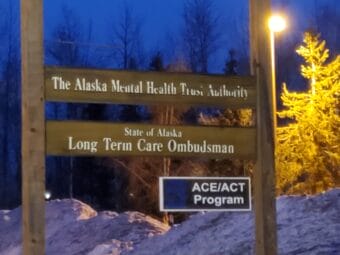
The sign outside the Alaska Mental Health Trust Authority office in Midtown Anchorage is seen on Tuesday. The state corporation has a new chief executive officer. (Photo by Yereth Rosen/Alaska Beacon)
A state-owned corporation that manages roughly $800 million in assets for the benefit of Alaskans with mental health issues has a new leader.
Dr. Mary Wilson, a pediatrician who grew up in Anchorage, was chosen by the Alaska Mental Health Trust Authority’s board to be the new chief executive officer. Wilson has worked in leadership positions with the Permanente Medical Groups in Georgia and California.
The board announced Wilson’s appointment at a special meeting on Tuesday. She officially starts her new position on Wednesday, the board said.
Wilson succeeds Steve Williams, a longtime Alaska Mental Health Trust Authority official who served as chief executive from 2022 until last July. In the intervening months, Allison Biastock, the trust’s chief communications officer, served as an interim CEO while the board conducted its hiring search.
Wilson worked for six years as executive medical director and president at the Southeast Permanente Medical Group in Atlanta. In that position, she managed the challenges of the COVID-19 pandemic and its effects on the organization’s approximately 1,000 employees, according to local news accounts.
Before that, she held senior positions at the Southern California Permanente Medical Group.
“On behalf of the board, I’m very excited that Mary is joining our organization. Her leadership experience and knowledge of our healthcare system will be invaluable as our organization continues to strategically invest in projects and initiatives that lead to improved outcomes for vulnerable Alaskans,” Brent Fisher, chair of the board of trustees, said in a statement.
Dr. Mary Wilson, a pediatrician, was hired as the new chief executive officer of the Alaska Mental Health Trust Authority. She grew up in Alaska and held leadership roles at the Permanente Medical Groups in Georgia and California. (Photo provided by Alaska Mental Health Trust Authority)
“I am honored with the opportunity to lead an organization that has such a unique and important role in supporting Trust beneficiaries and the organizations that serve and support them,” Wilson said in the statement.
Wilson is a graduate of Dimond High School in Anchorage, Colorado College and the University of Washington Medical School. She also has a master’s degree in public health from the University of California, Los Angeles. She has retired from her medical practice and returned to Alaska in 2021, Biastock said.
The Alaska Mental Health Trust Authority administers assets of a trust fund that is unique in the United States.
The fund was created in 1994, the result of a lawsuit filed by advocates for mental health patients and people with developmental disabilities. The trust’s assets, which started out $200 million and 1 million acres of land granted by the state, are managed by the authority, generating income that is used for mental health and disability programs. Beneficiaries include Alaskans affected by mental illnesses and intellectual or developmental disabilities, substance abuse disorders, dementia and traumatic brain injuries.
The trust is operated in a manner similar to a private foundation, and the authority that manages it is a state corporation.
Each year, the fund authority administers about $25 million in grants to programs that serve beneficiaries. It also engages in direct advocacy for Alaskans who need program services.
In October, the authority and the Alaska Department of Health and Alaska Department of Family and Community Services jointly released a five-year plan to guide services from 2025 to 2029.
The Comprehensive Integrated Mental Health Program Plan, issued periodically, is required by state law. The newest plan puts an emphasis on prevention and early intervention, according to state officials.
Christina Love (left) and Josie Heyano (right) speaking at an event. Courtesy of Christina Love.
Alaskans Christina Love and Josie Heyano served on the U.S. Advisory Council on Human Trafficking and helped shape the council’s 2024 report.
It outlines the forms of human trafficking, suggests policies to address the underlying causes and points out holes in the justice system that allow this type of violence to continue.
Love, who lives in Juneau, and Heyano, an Anchorage resident, spoke with KTOO’s Yvonne Krumrey to talk about what it means to be a survivor and to take the stories of other survivors — and those who didn’t survive — to the desks of federal lawmakers.
And a warning, these advocates discuss homelessness, sexual violence, drug use and suicide in this interview.
Listen:
This transcript has been lightly edited for clarity.
Josie Heyano: My name is Josie Heyano. I am a presidential appointee to the United States Advisory Council on Human Trafficking, which is an Advisory Council tasked with creating recommendations to the President’s interagency task force to combat trafficking.
Christina Love: Hi. My name is Christina love and I’m 2024’s presidential appointee to the Council on Trafficking.
People entrusted us with their stories, and we have a responsibility to receive those words, to not let them hit the floor and to lift them up. We recognize that Josie and I are in seats of privilege, you know, that there’s a lot of other people that could be here who aren’t — like, literally — and people who aren’t with us, right? The recognition of people who died, you know, like, what it means to be a survivor, is the recognition that we survive something that a lot of people don’t.
Josie Heyano: In last year’s report, and I think we put it in this year’s report also there’s a dedication space. That was a really important piece to me when I first came into the council. And to tack onto what Christina said, like, my position on the council, the reason I accepted it wasn’t because necessarily of my own lived experience, but because I was carrying so many stories, and still I’m carrying so many stories.
And that when we work in direct care, when we work in our community, it is our responsibility, or it feels like my responsibility, to do something with those stories, especially my years working with youth experiencing homelessness in Anchorage, so many of those stories were incredibly similar, and there were so many points of intervention that could have been so impactful in those stories.
And so that’s what the council position meant to me, was taking those stories from not only the clients and the people that I’ve served in my community, but my colleagues at different agencies, law enforcement, NGOs, and being able to take that experience in those stories, and level it up to the federal government level, and say, these are our experiences in Alaska.
I struggle with the word survivor. A lot of the times I actually, I really don’t like it. It doesn’t resonate for me. And it maybe that’s even like a guilt thing, I’m not sure, but it always brings to mind to me that there’s a lot of people that I’ve worked with over the years who aren’t here anymore, and there’s a lot of people who won’t be here in the future.
And so it was really important to me that the council was rooted in the recognition of that, that when we show up as survivor leaders, we’re also showing up honoring and respecting that there is a lethality to this, that there are people who aren’t here.
I found that my time on the council, there’s a lot of — maybe because it feels protective — there’s a lot of need to like, be really high level, be really federal, be really just top level, macro, everything. And that’s valuable, because that’s where we make our recommendations. But we have to root in people too, and we have to remember that humanity piece, that I’m not just going to write this recommendation because it’s my job on the council. I’m going to write this recommendation because I sat with the people who this recommendation impacts, and I care about them, and I took the time to learn about their experiences.
And I think just in general, in the anti trafficking space, there’s a need to want to just only talk about the crime of trafficking, and so I continue to find myself kind of head-butting up against that. Even, you know, I’ve done trainings here locally where submit the feedback I got on the trafficking training was, “Well, we didn’t talk about trafficking enough. ” I’m like, true, but what we did talk about was traumatic brain injuries. We did talk about our suicide rates. We did talk about the lack of shelter beds in the city. We did talk about all of the things that we really should be talking about, and if you’re listening, you can connect those pieces.
Christina Love: Working professionally, where people didn’t know I was a survivor, and then the moment they knew I was a survivor, treated me so differently, completely differently. And then late, years later, at having this experience, and someone told me, “They’re not going, they’re never going to listen to you, because you’re a survivor. They don’t see you as equal to them.”
When we talk about the people that I’ve worked with who have experienced trafficking, or even my own experience that I never was the perfect victim and have never been the perfect survivor, you know? So we have people who are experiencing great harm, who are also committing crimes, and the majority of them do end up incarcerated. One of my favorite quotes in the council’s report, and there’s so many great quotes, so many, so many great quotes, is the recognition that that so many of them end up in jail, but the people who harm them never do.
Josie Heyano: There are a lot of Native people and Native women especially, who are doing this work, and they’re doing it grassroots. They’re doing it in their communities. Having Indigenous representation on the U.S. Advisory Council is great, and it is long overdue that should have been a really long time ago, because there’s a lot of people that are doing this work and have recognized this issue in Native communities that just haven’t had a voice in the federal spaces.
Alaska is so important to me to be talked about because of my experience and because of holding the stories of so many people who their trafficking experience is rooted in drug trafficking in Alaska, it’s rooted in forced criminality. It’s rooted in substance use, and we still do not have the resources to support that.
You know, if we have a young person who is — or a person at all — who is at the airport, who is being forced to transport substances into the community, there is no legal service or advocacy route for them to access safety whatsoever. It happens consistently, constantly in the state, and has for a really long time. And I’ve had so many conversations with law enforcement, with Department of Law, with service providers where they recognize this. Yet we have no methodology to help support people. So it just continues to happen.
And at the federal level, and you know, there’s so many toolkits that exist, there’s so many trainings that exist, and I still have yet to see this issue really being tackled head on, that forced criminality piece, the forced trafficking into our rural communities, it’s really heavily impacting all of our communities. I don’t know that there’s any community that’s excluded from that. I don’t have an answer for it, other than we need to be paying attention and we need to be doing better.
Christina Love: When we talk about what Alaska needs to be able to do this in a way that would translate to lives being saved, when we’re genuinely asking people what it is that they want — and we have other reports that show exactly that when we’re saying, “What is it that you need?” People are saying that they they want to be treated as a whole human being, that they want to have access to safe housing, that they want their own money to buy food, that they want help getting their children back, or clothes that fit or they want a washing machine, or they want their car to be fixed.
A big part of the report talks about substance use and mental health coercion, that substances are an incredible way to escape or to alleviate pain, and I will say this in every interview and in every presentation and anytime somebody will listen, that trauma and substance use are a very natural reaction to violence, and violence is the unnatural thing. And that people will end their pain in any way they can. For some people, that is suicide, which why we have such high rates.
We have to make services as easy to access as alcohol and heroin. Whenever I’m working with someone who’s experienced a lot of harm, who’s trying to leave a domestic violence situation or trafficking situation, substances are not my first priority. And in taking those coping mechanisms away, that can drive them right back.
And the same for people who are perpetrating harm. When we have removed substances, we see higher rates of lethality. So we deeply need to understand substances as a way of coping with pain as well as a tactic of violence.
People who traffic people, prey on people not having their basic needs. For a lot of people, it’s because they did not have transportation that they got a ride. It is because they did not have a place to stay that they were given what they thought was a safe place to stay, or maybe they knew it wasn’t safe, but they didn’t have another option. They had no other option.
Or from my own experience, that they met a need that I had, and it was so basic — that’s something that we should all be entitled to.
If we are really working toward a solution, then we would be communities and places that when a trafficker comes in, they would have no ability to be successful, that our children would be so protected, that our children would know what healthy and safe feels like. So the moment they come into contact with someone who means to do them harm, they could feel it in their bodies, and all the red flags would go off, and they would have people that they could go to that would trust and that would listen to them, and we would have a response that would also include the meaningful rehabilitation of this person who is doing harm because they are also not well.
Josie Heyano: I want to tag on to Christina’s message too. Like anybody that hears this or listens to this, doesn’t matter what you’ve experienced, what you’ve done — that shame can feel so crippling, and it doesn’t stay that way forever. If you keep going, it doesn’t stay that way. You find your people, you find the purpose for it. It could be really transformative.
My experience was like being in a house that was on fire when no one had ever told me what fire was, and I didn’t have a plan. I didn’t know how to put it out, I didn’t know if there was someone you could call. I didn’t know if it was hot, I didn’t know what to do. And I think that that shame, combined with the naivety, like the “how did I not know this? How can I even begin to comprehend or understand it?” It’s such an isolating, lonely place to be.
And so I think some of the work that’s impactful in the council and being in community with people like Christina is having the opportunity to if anybody that listens or hears this or reads this is in a space where they feel like it’s not overcomeable or believable or understandable, that it is. And I don’t know that you get past it, but life gets bigger.
Undated photos of Raye Johnston, who died Christmas morning 2024 in Juneau. (Photos courtesy of Angel Nierstheimer)
Last week, a 30-year-old Juneau resident was killed in a police shooting. Raye Johnston grew up in Juneau, and was unhoused from a young age.
Johnston was identified as a woman in early reports of the shooting, but family and friends say they were genderfluid and used multiple pronouns.
A few days after Johnston’s death, their brother, Nathaniel Hensley-Williams, sat on the edge of a garden bed outside of the Glory Hall — an organization that provides shelter space for unhoused people in Juneau. He said he started getting condolence messages after the shooting, even before police confirmed Johnston’s identity.
“Everybody knew her,” Hensley-Williams said. “I mean, she’s been roaming the streets since she was 12, so it’s 18 years. So everybody knew her.”
His family is Lingít, from the Raven Moiety, and he pointed to the large black birds gathered across the street.
“The ravens have been upset, too,” he said.
But for him, the grief has been coming in waves.
“It hasn’t fully hit. Realization hasn’t fully set in,” he said.
Hensley-Williams said Johnston cared for the unhoused community in Juneau and would defend and support those who were having a hard time.
“She’s like me,” he said. “She never knew when to take off the cape and mask.”
Johnston’s mother, Angel Nierstheimer, agrees. She said Johnston was funny and good at making people smile.
“She was one that could uplift a lot of people, even sometimes in their darkest hour,” Nierstheimer said. “She was one for noticing that people might need a quick little chuckle.”
Hensley-Williams suggested Johnston might have known what the consequences could be when they advanced on armed police officers with a weapon on Christmas morning. Nierstheimer said Johnston had told friends they dreamed about being shot by police in the weeks leading up to the event.
According to Juneau police, officers responded to a call that Johnston was threatening people while holding a hatchet near the Mendenhall Valley Breeze In convenience store. They told Johnston to put down the weapon. When Johnston moved towards officers, police say they used a taser, but Johnston continued to advance. That’s when police say Officer Jonah Hennings-Booth opened fire and killed Johnston.
Juneau mental health advocate Christina Love met Johnston while she was doing crisis intervention work, and came to know them over the years. She saw them in moments of both hope and struggle. Love said she thought they wanted to get better.
“They were deeply interested in recovery and mental health and healing,” Love said.
Love is a specialist in advocacy for people who have experienced domestic violence, are involved with the justice system, or struggle with addiction. She also has personal experience with generational trauma among Indigenous people.
“People said, you know, this is a person that had caused a lot of harm, and there is no denying that, but I also know that it came from a place of so much need, like unmet needs, untreated medical, untreated mental health,” she said.
Johnston’s death was the second fatal police shooting in Juneau in 2024. In July, 35-year-old Steven Kissack was also shot and killed by police during an altercation downtown. Kissack had lived on the streets of Juneau for several years. After an investigation by the Alaska Bureau of Investigation, the state ruled that the use of force against Kissack was justified.
But members of the Juneau community, like Love, say these incidents raise questions about how people who live outside and struggle with mental health issues are treated in crises. She says more needs to be done to prevent mental health emergencies among Alaska Native people and the unhoused from ending this way.
“If we want changes, I think we have to ask different questions and have to demand evidence of that,” Love said. “So that means that we are asking for cultural responsiveness. We’re asking for them to be well-versed in trauma, well-versed in mental health and substance use.”
There is a script for what police do if a person threatens them with a weapon. But Love said that script considers the dangers of one moment and not the whole life of that person — or the lifetimes before.
“Because if they don’t know about the village that was burned here or why Native people — the majority of us — don’t own land, and why so many of us are struggling with substance use and mental health issues, then they’re going to think it’s an us problem, rather than it being like a systemic problem,” she said. “That bias and all of that is present when they’re holding a gun and there’s a Native woman-presenting mental health crisis in front of them.”
The Alaska Bureau of Investigation will investigate and the Office of Special Prosecutions will determine whether the shooting was legally justified. In accordance with JPD policy, the officers involved were placed on administrative leave following the shooting. On Thursday, JPD said the officers would all be back on duty by Friday.
Back at the Glory Hall garden, Hensley-Williams says he thinks Johnston is still looking out for their community.
“She’s still there, she’s still watching, she’s still there if needed, and will be until her mission is done,” he said.
A friend came outside and gave him a hug, and they watched the sunlight on the mountains together.
Update: NAMI Juneau shared grief and trauma resources available to the community.
Close
Update notification options
Subscribe to notifications
Subscribe
Get notifications about news related to the topics you care about. You can unsubscribe anytime.