
Mental Health

Juneau’s hospital closes its crisis care unit less than a year after opening it

Bartlett Regional Hospital’s Aurora Behavioral Health Center opened its doors to adolescent crisis care patients on Dec. 18, 2023. (Katie Anastas/KTOO)

A program designed to offer immediate care to adolescents in crisis at Juneau’s city-owned hospital closed last week after opening eight months ago.

In an interview, Bartlett Regional Hospital spokesperson Erin Hardin said the closure is due to a lack of funding and staff. 

“There is no dedicated subsidy funding available, and we don’t have the staff to keep the unit open,” she said. “So knowing both of those factors, the decision was made to close that particular program.”

This comes as the hospital faces a major budget crisis. Its board of directors is seeking financial help for a handful of services it says are draining money. The crisis stabilization service was one of those programs and was expected to lose $1.2 million next year. 

The hospital only started offering the service last December after the new Aurora Behavioral Health Center was completed. It was built specifically to house the program and the hospital’s psychiatric services program. 

At the time of its opening, the crisis stabilization unit was seen as a groundbreaking service to help youth in Juneau — and across Southeast Alaska — get the mental health and substance use care they need. 

According to data from the state, suicide was the leading cause of death for Alaska Native youth aged 10 to 19 and all youth aged 10 to 14 in 2020. It was the second leading cause of death that year for Alaskans aged 15 to 34.

Aaron Surma, the executive director of the National Alliance on Mental Illness Juneau, said that the demand for crisis services in Juneau is high, and the closure will be devastating for the people who need it the most. 

“People aren’t going to get what they need — and that has all kinds of negative reverberations. And I think you can draw some easy parallels to some other tragedies that have happened in our community,” he said. “So people are going to struggle more, and it’s very hard to live in crisis and be successful.”

Surma said that, in the absence of adequate crisis care services in Juneau, it’s vital that people learn how to support one another’s mental health. 

“I want and hope to help people become more comfortable supporting one another’s mental health because I think individuals can be more reliable than systems and services,” he said. 

Hardin said people in crisis can still receive care at Bartlett. But they will get it from the hospital’s emergency department rather than the crisis center. She said the hospital’s board continues to look for other more financially sustainable ways to offer crisis care in the future. 

The Aurora building will continue to remain open and house outpatient psychiatric services. Hardin said the portion of the building that housed the crisis program will likely be repurposed for other hospital programs.

‘Devastated and angry’: Protestors call for change in the wake of deadly Juneau police shooting

Left to right: Rowena Brockway, Jamiann S’eiltin Hasselquist, Eulaysia Bostrack, Savannah Brohard, Marley Webster, and Ariilana Shodda-Lee at a protest against the death of Steven Kissack in Juneau. July 21, 2024. (Photo by Yvonne Krumrey/KTOO)

Sunday afternoon, a couple dozen people gathered across from the state Capitol building in downtown Juneau. Some held signs with messages like like “Justice for Steven” and “Until we meet again.”

Genevieve McFadden’s sign read, “Rest in Peace Steven Kissack.” She said she was there because she saw videos of Steven Kissack’s shooting, and she doesn’t want to see anything like that happen in Juneau again. 

“Seeing people gunned down in the street is awful, and it makes me feel unsafe,” McFadden said. “And makes me worry about my kid, you know? I don’t want anything like that to happen to her or anybody else.”

Genevieve McFadden at a protest for Steven Kissack in Juneau. July 21, 2024. (Photo by Yvonne Krumrey/KTOO)

The protesters gathered to express their anger over the death of Steven Kissack last week. Kissack had been living on the streets downtown with his dog, Juno, for years when law enforcement shot and killed him during a confrontation on July 15. 
Bonilyn Parker came to the protest with a letter she wrote with help from some other downtown business owners. She said she plans to read it at the next Assembly meeting, on July 29.

Update: She said the letter is at Alaska Robotics if people want to sign it this week. 

She said she hopes the letter will help the city to realize the impact Kissack’s shooting has had on everyone in Juneau. 

“I think this is a really ripe moment for some change,” she said.

Nearby, Salomé Starbuck read aloud from the letter as it got passed around for people to sign. 

“As a result of this tragedy, members of our downtown community and visitors to our community are experiencing anger, fear and a loss of a loss of trust,” she read. “We must work to resolve that trust and make Juneau a place where people can live safely and without fear.”

Starbuck signed the letter.

“Every single person I’ve talked to since this has happened is devastated and angry about this happening,” she said.

There were actually two protests on Sunday: the gathering at the Capitol was advertised on a small piece of paper at a downtown memorial site for Kissack. But when demonstrators showed up, no one claimed to have planned it.

After half an hour, the group headed down to the library, where four young women had planned a second protest.

Savannah Brohard said she and her friends first made signs and took to the streets two days after the shooting. Later, they decided to plan a larger protest.  

“Our voices matter given the fact that we’re in control of the future,” Brohard said.

Her friend Eulaysia Bostrack said she wanted to take action to make it known that young people are already tired of seeing violence like this. 

“And it needs to stop, because we see this on the news every day, and it’s getting tiring, it’s painful,” Bostrack said. “This is not normal. This should not be normalized.” 

And for Ariilana Shodda-Lee, Kissack’s death hit close to home.

Protesters march through downtown Juneau in the wake of a police shooting that left an unhoused man dead. July 21, 2024. (Photo by Yvonne Krumrey/KTOO)

“I’m personally continuing to push because I’ve been homeless, and who’s to say I’m not the next to get shot if I fall to homelessness,” Shodda-Lee said. “We need to be protecting our people and not just killing them.”

So far, the name of only one of the officers involved in the shooting — an Alaska Wildlife Trooper — has been released. Juneau police say the names of JPD officers involved will be released this week. 

The Alaska Bureau of Investigations is investigating the shooting to determine if lethal force was necessary. The Alaska Office of Special Prosecutions will then independently review the findings.

NAMI Juneau offers mental health resources to witnesses of downtown shooting

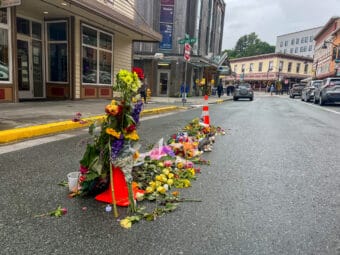
Flowers lay in the street at a memorial for Steven Kissack in downtown Juneau on July 19, 2024. (Photo by Yvonne Krumrey/KTOO)

People who witnessed Monday’s deadly police shooting in downtown Juneau are carrying a lot of emotions — anger, confusion and grief, to name a few. A local mental health care provider has compiled resources to help residents deal with the trauma.
William Sanders said he’s been struggling with his anger since Steven Kissack was shot and killed during a standoff with police officers.

“I’m trying to keep my mind occupied,” he said. “Sometimes that’s the only way I can sleep. I keep busy till I collapse.”

Sanders said he and Kissack were friends. He said Kissack was someone who helped people navigate being on the streets and always shared his food.

Sanders doesn’t have stable housing, and he said witnessing a violent death like this makes living on the streets even harder. In the chaos of the shooting, he said he and another witness feared for their own safety.

“We all checked ourselves. We didn’t know if we were hit,” he said.

Matthew Mulhern was working at Devil’s Club Brewery when police confronted Kissack. He was standing in a window that looks out on Front St. when the shooting started.

“I didn’t ever expect it to turn into what it did,” he said. “That was not a possibility in my mind, that I was going to watch someone be shot.”

He said he’s also been feeling a lot of anger. And it wasn’t until the next day that he realized how close he was to being hurt himself. He found a bullet hole in the wall where he had been standing, right before the gunfire. 

“The thing that is terrifying to me is that I cannot be safe at work, that I cannot be safe inside my building,” Mulhern said. “In what realm is that okay?” 

Mulhern was able to get an appointment with his therapist only a few hours after the shooting. And, he said, the community of people who witnessed the shooting while working downtown have been supporting each other through the fallout. 

“I am really lucky that I have a bit of a support network, and I still don’t feel like it’s enough to be perfectly honest,” he said.

Meryl Connelly-Chew is a program coordinator for the local chapter of the National Alliance on Mental Illness, or NAMI.

They said anger like Sander’s and Mulhern’s is normal when people witness traumatic events. And so are feelings of sadness, guilt and fear. 

“Really just by witnessing — even for many of us, watching the videos — or everyone in town is kind of talking about this right now. Talking about something so traumatic and violent can have an effect on us,” Connelly-Chew said. 

Connelly-Chew said NAMI has put together resources on their website for people who have witnessed a traumatic event. People can also use support hotlines like 9-8-8 or reach out to NAMI to seek therapists who specialize in trauma.

They said spaces like the vigil for Kissack earlier this week, or memorials that have been set up downtown, are important for people to be able to grieve together. 

A downtown Juneau memorial for Steven Kissack. July 19, 2024. (Photo by Yvonne Krumrey/KTOO).

“I think it’s really important to know that there is not one person in my personal or professional life in the past week that hasn’t been affected by this in some way,” they said. “I think the entire community is experiencing the effects of this.” 

Connelly-Chew said people should give each other as much compassion and kindness in the wake of Kissack’s death as they can. And that’s especially true when people interact with people who are living outside in Juneau. 

“These are folks who are grieving someone they loved very much, someone who felt like their family. They are wanting to share stories, they are wanting to take care of each other, share food, do all of the things that any of us do when we’re experiencing loss,” they said. 

And people living outside have a harder time accessing mental health care. But community support goes a long way.

“Stop in, say hello to people at the memorial site,” Connelly-Chew said. “Share a hug or a story and just show up in that grief the way that you would for someone in your neighborhood.”

Alaska Senate considers plan that would allow teens to independently seek mental health care

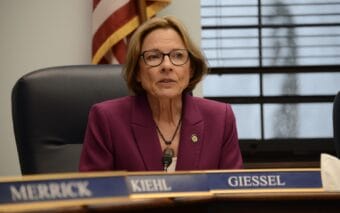
Sen. Cathy Giessel, R-Anchorage, speaks about Senate Bill 88, the Senate Majority’s new public employee pension proposal, on Wednesday, March 1, 2023. (Photo by James Brooks/Alaska Beacon)

To address a surge in mental health problems among young Alaskans, the Alaska Senate is considering whether to allow 16- and 17-year-olds to seek therapy without their parents’ permission.

On Wednesday, the Senate is scheduled to vote on Senate Bill 240, a proposal introduced by Gov. Mike Dunleavy and amended by Senate Majority Leader Cathy Giessel, R-Anchorage.

Giessel’s amendment, adopted by a 3-2 vote in the Senate Health and Social Services Committee last month, would lower to 16 years old the age at which teens can get therapy — but not medication — without permission from an adult.

Thirty-three states allow residents younger than 18 to independently obtain mental health care, and four states — California, Illinois, Maryland and Nevada — allow it as young as 12.

“In real life, I’m an advanced nurse practitioner,” Giessel told members of the committee in March. “I volunteer in schools, in school-based clinics. In that venue, I screen for behavioral and mental health issues … It is astonishing to me the things that our young people today are having to deal with.”

Nationwide, surveys have found a surge in the number of teenagers and young adults experiencing mental health problems. A 2021 national survey by the Centers for Disease Control and Prevention — the latest available — found 42% of high school students “experienced persistent feelings of sadness or hopelessness,” almost double the figure from 10 years before.

More than one in five high school students said they considered attempting suicide.

Speaking about Alaska’s leading causes of death in 2022, state health data experts wrote, “Intentional Self-Harm (Suicide) was the LCOD for teens and young adults aged 15-24 years.”

Sen. Löki Tobin, D-Anchorage, said she supports the bill.

“We have heard from many of our students about the crisis they are experiencing, and that crisis stems from a lack of support for mental health services,” she said on Monday.

Giessel said that in her work at school-based clinics, she frequently hears requests from students for mental health care, but when they learn that they need a parent’s permission, “Commonly, the child’s face falls.”

Often, they’re being cared for by a grandparent, or a single parent working multiple jobs, Giessel said, and that permission never comes.

Over the past two years, Giessel said, she’s frequently heard from behavioral health organizations.

“Every one of those organizations, every one, has agreed that we need to lower the age of consent so that a 16-year-old would be able to say that yes, I need help, and I am consenting to those services,” she said.

Trevor Storrs, president and CEO of the Alaska Children’s Trust, is one of those organizations.

“We do support it. We support the concept, whether it goes with this bill or not,” Storrs said.

“We see this amendment strengthening behavioral health. We have heard from providers and parents and most specifically, youth, that one of the barriers accessing and asking for help is first having to go through parents.”

Not everyone likes the idea of lowering the age to independently receive therapy.

After Giessel’s amendment was adopted in committee, the Matanuska-Susitna Borough School District School Board passed a resolution opposing it.

The Mat-Su Frontiersman newspaper, which covered the local debate, reported that school board members were concerned about whether the idea sets a precedent for school districts offering services without parents’ approval.

“I’m glad this is being looked at, but the family and parents need to be involved,” said Sen. Mike Shower, R-Wasilla, speaking on Monday.

Giessel’s amendment does require some parental involvement: The bill says that after a teenager starts therapy, the behavioral or mental health professional “shall contact the minor’s parents and offer to provide services to the family,” unless doing so would clearly be harmful to the teenager.

The bill also forbids medication without parental approval and doesn’t apply to hospital treatment, only outpatient care.

Those clauses didn’t assuage all critics.

Sen. Shelley Hughes, R-Palmer, asked the Senate on Monday to consider a different version of the bill, one without Giessel’s amendment, but that failed on a 13-7 vote, setting up the amended proposal for a final Senate vote on Wednesday, and a successful vote would send the bill to the House for further work.

The bill doesn’t deal with other problems, including payment for services that teens might request. SB 240 was originally written to allow school districts to bill Medicaid if they treat a Medicaid-eligible student, but the state Department of Health said it believes that billing wouldn’t be possible without parental consent.

That suggests a student operating without that consent might have to navigate health care billing on their own, but the situation regarding payment is evolving and might change, a Giessel aide said.

This story originally appeared in the Alaska Beacon and is republished here with permission.

Psychologist sues state over license application she says is unconstitutional and discriminatory

Doctor Jenny Poon outside Alaska Public Media Studios in Anchorage on Wednesday, March 20, 2024. (Matt Faubion/Alaska Public Media)

To get her license to practice psychology in Rhode Island, Jennifer Poon said she had to answer one simple question about prior medical care.

“Do you have any physical or mental health conditions that would impair your ability to practice?”

But when she moved to Alaska last year, Poon learned the state requires applicants to release all their medical, dental, and mental health records to the board. Poon said the requirement is a barrier that punishes people for seeking help.

“By asking these invasive questions, or allowing unfettered access to your entire entire medical record, that is really going to deter students from or prospective clinicians of whatever age, from seeking out their own care,” Poon said. “And we really need people who are, you know, who have been healed themselves.”

Instead of complying with the requirement, Poon hired a lawyer. She said the requirement is a personal invasion of privacy that discourages people from becoming psychologists in a state that desperately needs them. Alaska is one of a few states that screen for mental health history for a psychology license. Poon said it’s especially important for Alaska to reduce barriers to getting a license.

“There are people that I know, because I’ve talked to them, that have chosen to practice elsewhere because of our licensure policies,” Poon said.

According to the lawsuit Poon filed against the state board in March, this required release of medical information is unconstitutional because the state guarantees the right to privacy. Aneliese Palmer, Poon’s lawyer with Northern Justice Project, said without a legitimate reason, the request is unconstitutional.

“When the state mandates that they have access to your medical records, when there’s not a legitimate purpose to do so, or when that request is so broad that they can peer into all these nooks and crannies of your life, without reason to do so, that violates your right to privacy as enshrined in our state constitution,” Palmer said.

A representative of the state licensing board for psychologists said they are reviewing the complaint but cannot comment on the lawsuit. The Alaska Psychological Association also declined to comment but said in a statement that they support “civil rights and disability protections for all Alaskans, including Alaskans applying for psychologist licensure.”

According to the application, the contents of licensing files are considered public records, which means anyone can request access to them. Applicants can request confidentiality, but the application says that may or may not be granted. Palmer said that’s also a breach of the state constitution’s right to privacy.

The lawsuit also alleges that the required release of medical records doesn’t comply with Americans with Disabilities Act, the federal law that protects people with physical or mental disabilities from discrimination.

“It discourages people with disabilities from applying in the first place for having to talk about their disability, disclose all this highly sensitive information about their diagnosis, their treatment,” Palmer said. “And it unfairly burdens people with disabilities, because it requires them to disclose that information.”

Until February, the application also asked directly if a candidate has experienced, been diagnosed with, or been treated for mental illness within the last five years. Poon felt that question unfairly burdened and targeted people with disabilities and she didn’t want to answer.

Poon has a history of mental illness from when she was a child, an experience that led her to the field of psychology so she could help others with similar experiences. She said Alaskans benefit from having mental health providers who have experienced mental illness.

“We really need providers that reflect the diverse competence, composition of the communities that we serve,” Poon said. “We desperately need people who have had contact with a range of services, from mobile health teams and wellness checks, to inpatient hospitalization, to outpatient [treatment]- the entire care spectrum.”

She worked with her lawyer last year to send requests to remove the discriminatory questions and ultimately, the board did change their application in late February. Now, it only asks if someone has any mental or physical condition that would interfere with their ability to practice psychology, more like the application in Rhode Island. But Poon said the board didn’t go far enough in their revisions because it still requires the broad release of medical records.

That’s something she also said unfairly impacts people of color, Alaska Native people, and people from other historically oppressed groups. Those groups face higher rates of trauma, so are more likely to experience mental illness, and Poon said the state needs them as mental health care professionals.

Poon and her lawyer are waiting for the state to respond to the lawsuit. They hope to work together with the board to reach a resolution.

Americans on Medicare now get better access to mental health care. Here’s how

A new law brings in changes for mental health patients and providers. (Christophe Archambault/AFP via Getty Images)

Starting Jan. 1, the more than 65 million Americans who rely on Medicare will have better access to mental health coverage.

Medicare now covers therapy appointments with licensed marriage and family counselors, and licensed professional counselors. These are two types of therapists who make up around 40% of the Master’s level mental health providers in the country, according to the American Counseling Association.

Victoria Kress, a professor at Youngstown State University and a licensed professional counselor, spoke with All Things Considered host Juana Summers about how this new law could affect patients and providers.

This interview has been lightly edited for length and clarity.

Interview highlights

Juana Summers: This seems like a bit of an obvious solution to me, I have to say. There’s a big group of people out there who need access to mental health care — and by that I mean Medicare recipients — and there’s another big group of providers who are able to do so. So why did it take so long do you think for this law to pass?

Victoria Kress: There have been many iterations of licensure and legislation that have been put forward, and many different legislative techniques and strategies that have been applied to try to get us at the table and to get this passed.

I think it was really money. When I would sit with legislators, the first question they would would ask is, “What is this costed out as? How is this going to impact us fiscally?” Obviously, when you have easier access to care and more people providing services, that’s going to increase the cost.

I think with COVID, with the pandemic, it really put a spotlight on mental health needs. And many people started to realize how critically important access to care is around mental health issues. And because of that, I think legislators felt an increasing pressure to provide access to care for those on Medicare.

Summers: We should just be frank here. The need for mental health care in this country is incredibly stark. The Department of Health and Human Services estimates that 169 million Americans are living in an area with a mental health provider shortage. So how much of a dent could this change make in what seems like massive need?

Kress: It’s profound. Yes, about half of America lives in an area with a severe shortage of providers. And I can tell you, as someone who works in an urban area, even in the urban areas they’re really walking the line and struggling to find enough providers to meet the demand for our services.

So 18% of Americans receive Medicare, and they’re going to overnight have access to so many more providers. So it’s really exciting, particularly when you think about the rural areas, where one in three people receive Medicare services, and there’s such a severe shortage of providers, it’s really going to be helpful to them.


Listen to All Things Considered each day here or on your local member station for more interviews like this.


Something else that we also don’t think a lot about is addictions. Many people in America struggle with addictions. Many older adults and people with chronic disabilities struggle with addictions. About a third of all inpatient hospitalizations for opioid use disorder are paid for by Medicare. And counselors are the primary provider of all addictions counseling services. So it’s been so difficult for people to access addictions care. And now with counselors being able to provide the services that we’re trained to provide, it’s really going to open up opportunities for people to access addiction services as well.

Summers: Medicare reimbursement rates are significantly lower than what many therapists can charge out of pocket. I mean, a single session can cost hundreds of dollars for in demand providers. Are you concerned that even though they’re able to, counselors now might not want to accept Medicare because of the lower payment rates?

Kress: Yeah, absolutely. And also with the legislative change, counselors, marriage and family therapists will be being paid about 75% of what a psychologist would make. And so that’s also a deterrent there.

So it’s going to be an ongoing issue to try to get providers to sign up for Medicare reimbursement. But you know, we also have challenges in terms of continuing to encourage people to go into the mental health helping professions. And educators have a responsibility to continue to pull folks in and to train them to meet the demand that’s out there. Counseling is actually one of the most needed professions right now, there’s a severe shortage all over the country.

Summers: I want to acknowledge here before I ask this question that, of course, senior citizens are not the only Medicare recipients, though they do make up the vast majority of that population. And we know that their mental health care needs are complex and seniors have faced obstacles to receiving mental health care for years. To what degree do you think that Medicare coverage from professional counselors and family therapists could help bridge the gap for that specific population?

Kress: Counselors are uniquely trained to meet the needs of older adults. As counselors, we receive training and counseling for people across the lifespan. But we’ve not been able to work with older adults, despite our training, because of difficulties with Medicare reimbursement. So this is really exciting.

One of the things that makes counselors unique from other mental health professionals is that we have a focus on mental health. And what that means is we focus on people’s strengths, their resources and their capacities within themselves, within their families, within their communities and within society. And we focus on those and we pull those into our treatment plans and how we go about helping them make the changes that they want to make.

So I think our focus on developments, our focus on mental health, our focus on being holistic, our focus on wellness is really unique to the older adult population. I think it really resonates with them. And I think that our presence in this market is going to be really well received.

Copyright 2024 NPR. To see more, visit https://www.npr.org.
Site notifications
Update notification options
Subscribe to notifications